Revenge of the
Federalists
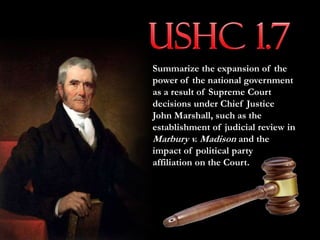
Summarize the expansion of the
power of the national government
as a result of Supreme Court
decisions under Chief Justice
John Marshall, such as the
establishment of judicial review in
Marbury v. Madison and the
impact of political party
affiliation on the Court.
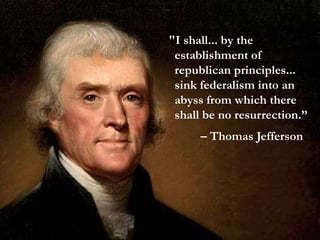
"I shall... by the
establishment of
republican principles...
sink federalism into an
abyss from which there
shall be no resurrection.”
– Thomas Jefferson
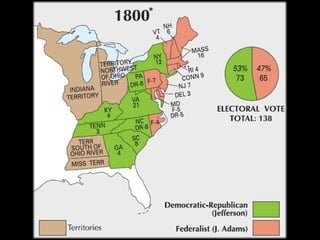
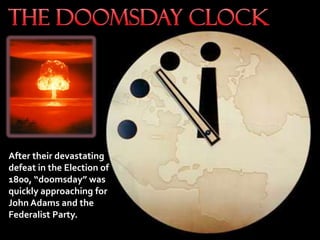
After their devastating
defeat in the Election of
1800, “doomsday” was
quickly approaching for
John Adams and the
Federalist Party.
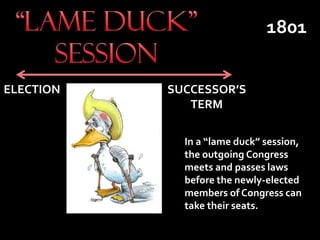
ELECTION SUCCESSOR’S
TERM
1801
In a “lame duck” session,
the outgoing Congress
meets and passes laws
before the newly-elected
members of Congress can
take their seats.
The judicial power of the United
States, shall be vested in one
Supreme Court, and in such inferior
courts as the Congress may from
time to time ordain and establish.
From Article III,
Section 1
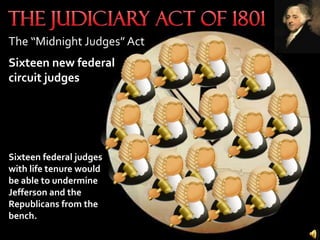
Sixteen new federal
circuit judges
The “Midnight Judges” Act
Sixteen federal judges
with life tenure would
be able to undermine
Jefferson and the
Republicans from the
bench.
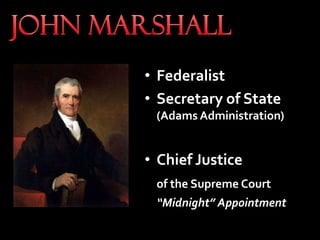
• Federalist
• Secretary of State
(Adams Administration)
• Chief Justice
of the Supreme Court
“Midnight” AppointmentJohn Marshall
Chief Justice
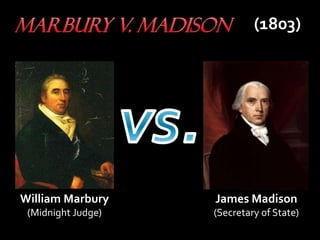
William Marbury
(Midnight Judge)
James Madison
(Secretary of State)
(1803)
William Marbury
(Midnight Judge)
James Madison
(Secretary of State)
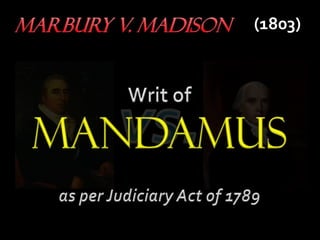
William Marbury
(Midnight Judge)
James Madison
(Secretary of State)
(1803)
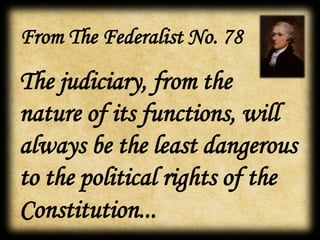
The judiciary, from the
nature of its functions, will
always be the least dangerous
to the political rights of the
Constitution...
From The Federalist No. 78
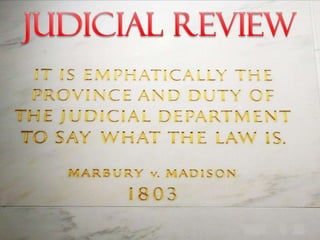
(1803)
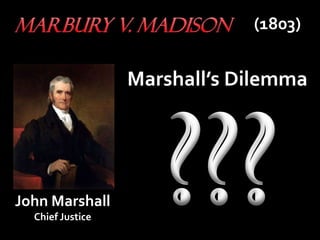
John Marshall
Chief Justice
Marshall’s Dilemma
John Marshall
Chief Justice
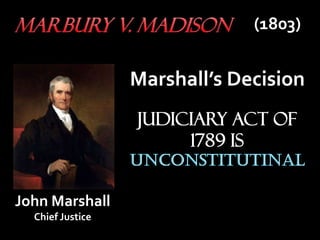
Judiciary Act of
1789 is
Marshall’s Decision
(1803)
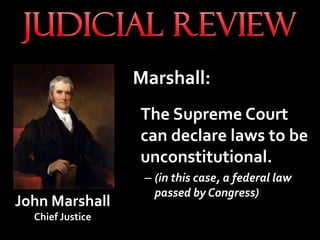
Marshall:
The Supreme Court
can declare laws to be
unconstitutional.
– (in this case, a federal law
passed by Congress)
John Marshall
Chief Justice
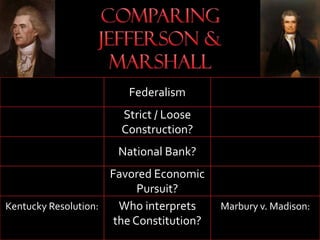
Federalism
Strict / Loose
Construction?
National Bank?
Favored Economic
Pursuit?
Kentucky Resolution: Who interprets
the Constitution?
Marbury v. Madison:
Jefferson
(Republican)
Marshall
(Federalist)
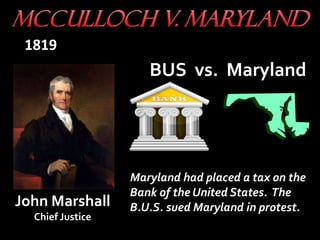
Maryland had placed a tax on the
Bank of the United States. The
B.U.S. sued Maryland in protest.
1819
BUS vs. Maryland
John Marshall
Chief Justice
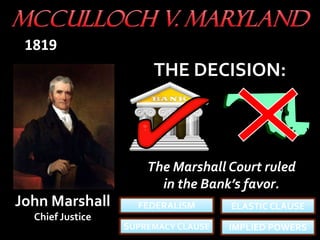
The Marshall Court ruled
in the Bank’s favor.
THE DECISION:
John Marshall
Chief Justice
SUPREMACY CLAUSE
ELASTIC CLAUSEFEDERALISM
IMPLIED POWERS
1819
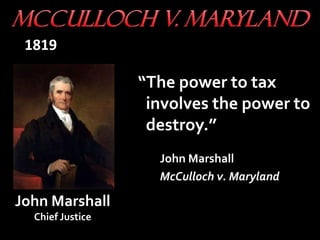
“The power to tax
involves the power to
destroy.”
John Marshall
McCulloch v. Maryland
John Marshall
Chief Justice
1819
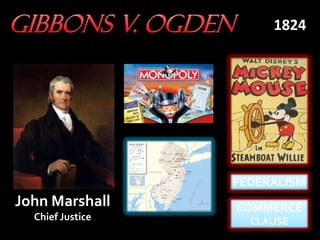
COMMERCE
CLAUSE
FEDERALISM
1824
John Marshall
Chief Justice
[The Congress shall have
Power] To regulate Commerce
with foreign Nations, and
among the several States...
From Article I,
Section 8
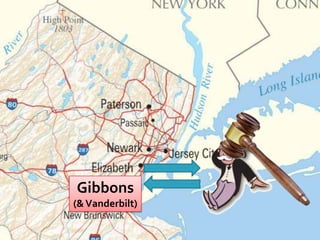
Gibbons
(&Vanderbilt)
The Marshall Court:
Using Marbury v. Madison,
McCulloch v. Maryland, and
Gibbons v. Ogden as guides,
determine whether Chief Justice
John Marshall would “Like” or
“Dislike” the following items.
NOTE: This exercise is based on the Facebook
news feed. At no point does the author assert
that the format is original. NOT INTENDED FOR
COMMERCIAL USE
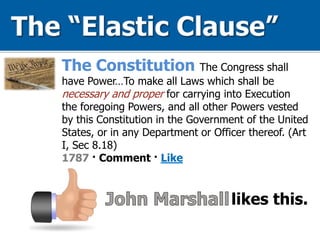
The Constitution The Congress shall
have Power…To make all Laws which shall be
necessary and proper for carrying into Execution
the foregoing Powers, and all other Powers vested
by this Constitution in the Government of the United
States, or in any Department or Officer thereof. (Art
I, Sec 8.18)
1787 · Comment · Like
likes this.
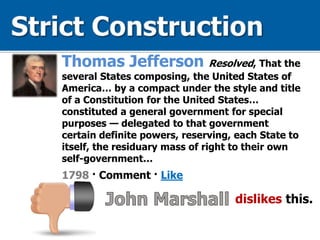
Thomas Jefferson Resolved, That the
several States composing, the United States of
America… by a compact under the style and title
of a Constitution for the United States…
constituted a general government for special
purposes — delegated to that government
certain definite powers, reserving, each State to
itself, the residuary mass of right to their own
self-government…
1798 · Comment · Like
dislikes this.
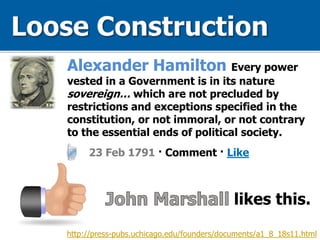
Alexander Hamilton Every power
vested in a Government is in its nature
sovereign… which are not precluded by
restrictions and exceptions specified in the
constitution, or not immoral, or not contrary
to the essential ends of political society.
23 Feb 1791 · Comment · Like
http://press-pubs.uchicago.edu/founders/documents/a1_8_18s11.html
likes this.
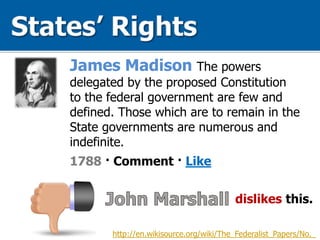
James Madison The powers
delegated by the proposed Constitution
to the federal government are few and
defined. Those which are to remain in the
State governments are numerous and
indefinite.
1788 · Comment · Like
http://en.wikisource.org/wiki/The_Federalist_Papers/No._
dislikes this.
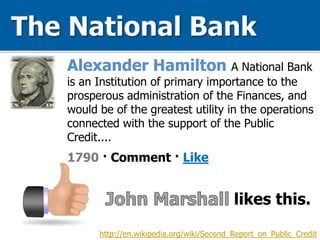
Alexander Hamilton A National Bank
is an Institution of primary importance to the
prosperous administration of the Finances, and
would be of the greatest utility in the operations
connected with the support of the Public
Credit....
1790 · Comment · Like
http://en.wikipedia.org/wiki/Second_Report_on_Public_Credit
likes this.
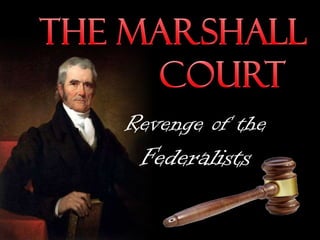
The Marshall Court

The Marshall Court

  • 1.
  • 2.
    Summarize the expansionof the power of the national government as a result of Supreme Court decisions under Chief Justice John Marshall, such as the establishment of judicial review in Marbury v. Madison and the impact of political party affiliation on the Court.
  • 4.
    "I shall... bythe establishment of republican principles... sink federalism into an abyss from which there shall be no resurrection.” – Thomas Jefferson
  • 5.
    After their devastating defeatin the Election of 1800, “doomsday” was quickly approaching for John Adams and the Federalist Party.
  • 6.
    ELECTION SUCCESSOR’S TERM 1801 In a“lame duck” session, the outgoing Congress meets and passes laws before the newly-elected members of Congress can take their seats.
  • 7.
    The judicial powerof the United States, shall be vested in one Supreme Court, and in such inferior courts as the Congress may from time to time ordain and establish. From Article III, Section 1
  • 8.
    Sixteen new federal circuitjudges The “Midnight Judges” Act Sixteen federal judges with life tenure would be able to undermine Jefferson and the Republicans from the bench.
  • 9.
    • Federalist • Secretaryof State (Adams Administration) • Chief Justice of the Supreme Court “Midnight” AppointmentJohn Marshall Chief Justice
  • 10.
    William Marbury (Midnight Judge) JamesMadison (Secretary of State) (1803) William Marbury (Midnight Judge) James Madison (Secretary of State)
  • 11.
    William Marbury (Midnight Judge) JamesMadison (Secretary of State) (1803)
  • 12.
    The judiciary, fromthe nature of its functions, will always be the least dangerous to the political rights of the Constitution... From The Federalist No. 78
  • 13.
  • 14.
    John Marshall Chief Justice JudiciaryAct of 1789 is Marshall’s Decision (1803)
  • 16.
    Marshall: The Supreme Court candeclare laws to be unconstitutional. – (in this case, a federal law passed by Congress) John Marshall Chief Justice
  • 17.
    Federalism Strict / Loose Construction? NationalBank? Favored Economic Pursuit? Kentucky Resolution: Who interprets the Constitution? Marbury v. Madison: Jefferson (Republican) Marshall (Federalist)
  • 18.
    Maryland had placeda tax on the Bank of the United States. The B.U.S. sued Maryland in protest. 1819 BUS vs. Maryland John Marshall Chief Justice
  • 19.
    The Marshall Courtruled in the Bank’s favor. THE DECISION: John Marshall Chief Justice SUPREMACY CLAUSE ELASTIC CLAUSEFEDERALISM IMPLIED POWERS 1819
  • 20.
    “The power totax involves the power to destroy.” John Marshall McCulloch v. Maryland John Marshall Chief Justice 1819
  • 21.
  • 22.
    [The Congress shallhave Power] To regulate Commerce with foreign Nations, and among the several States... From Article I, Section 8
  • 23.
  • 24.
    The Marshall Court: UsingMarbury v. Madison, McCulloch v. Maryland, and Gibbons v. Ogden as guides, determine whether Chief Justice John Marshall would “Like” or “Dislike” the following items. NOTE: This exercise is based on the Facebook news feed. At no point does the author assert that the format is original. NOT INTENDED FOR COMMERCIAL USE
  • 25.
    The Constitution TheCongress shall have Power…To make all Laws which shall be necessary and proper for carrying into Execution the foregoing Powers, and all other Powers vested by this Constitution in the Government of the United States, or in any Department or Officer thereof. (Art I, Sec 8.18) 1787 · Comment · Like likes this.
  • 26.
    Thomas Jefferson Resolved,That the several States composing, the United States of America… by a compact under the style and title of a Constitution for the United States… constituted a general government for special purposes — delegated to that government certain definite powers, reserving, each State to itself, the residuary mass of right to their own self-government… 1798 · Comment · Like dislikes this.
  • 27.
    Alexander Hamilton Everypower vested in a Government is in its nature sovereign… which are not precluded by restrictions and exceptions specified in the constitution, or not immoral, or not contrary to the essential ends of political society. 23 Feb 1791 · Comment · Like http://press-pubs.uchicago.edu/founders/documents/a1_8_18s11.html likes this.
  • 28.
    James Madison Thepowers delegated by the proposed Constitution to the federal government are few and defined. Those which are to remain in the State governments are numerous and indefinite. 1788 · Comment · Like http://en.wikisource.org/wiki/The_Federalist_Papers/No._ dislikes this.
  • 29.
    Alexander Hamilton ANational Bank is an Institution of primary importance to the prosperous administration of the Finances, and would be of the greatest utility in the operations connected with the support of the Public Credit.... 1790 · Comment · Like http://en.wikipedia.org/wiki/Second_Report_on_Public_Credit likes this.