Page 1 of 76
ILOILO SCIENCE AND TECHNOLOGY UNIVERSITY
LEON CAMPUS
Leon, Iloilo
Compiled and outlined by: Camatison,G.
Contributors: Camatison,G, Tacardon, M.F., Aligaen, Q.Jr., & Jaurigue, J.
OVERVIEW
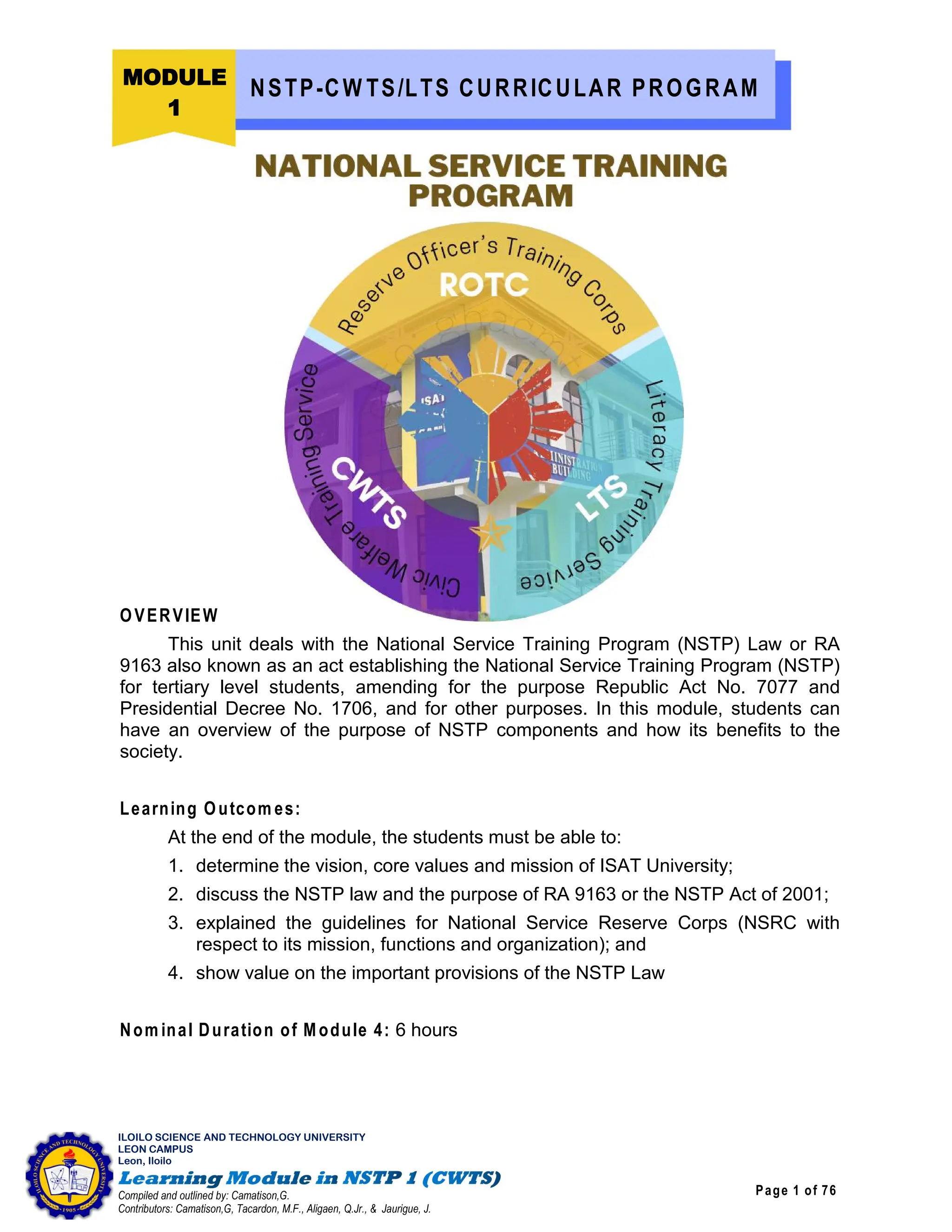
This unit deals with the National Service Training Program (NSTP) Law or RA
9163 also known as an act establishing the National Service Training Program (NSTP)
for tertiary level students, amending for the purpose Republic Act No. 7077 and
Presidential Decree No. 1706, and for other purposes. In this module, students can
have an overview of the purpose of NSTP components and how its benefits to the
society.
Learning Outcom es:
At the end of the module, the students must be able to:
1. determine the vision, core values and mission of ISAT University;
2. discuss the NSTP law and the purpose of RA 9163 or the NSTP Act of 2001;
3. explained the guidelines for National Service Reserve Corps (NSRC with
respect to its mission, functions and organization); and
4. show value on the important provisions of the NSTP Law
Nom inal Duration of Module 4: 6 hours
MODULE
1
NSTP-CW TS/LTS CURRICULAR PROGRAM
Page 2 of 76
ILOILO SCIENCE AND TECHNOLOGY UNIVERSITY
LEON CAMPUS
Leon, Iloilo
Compiled and outlined by: Camatison,G.
Contributors: Camatison,G, Tacardon, M.F., Aligaen, Q.Jr., & Jaurigue, J.
The Philippine Constitution in Article II, Section 13 of the 1987 Constitution states
that state recognizes the vital role of the youth in nation-building and shall promote and
protect their physical, moral, spiritual, and intellectual, and social well – being. It shall
inculcate in the youth patriotism and nationalism, and encourage their involvement in
public and civic affairs (De Leon, 2002).
INTRODUCTION
Legal basis of the National Service Training Program (NSTP)
This program aimed to enhance civic consciousness and defense preparedness
in the youth by developing the ethics of service and patriotism while undergoing training
in any of its three (3) program components, specifically designed to enhance the youth’s
active contribution to the general welfare.
NSTP LAW
“National Service Training Program (NSTP)” is a program aimed at enhancing
civic consciousness and defense preparedness in the youth by developing the ethics of
service and patriotism while undergoing training in any of its three (3) program
components, (Reserved Officers' Training Corps (ROTC) , Literacy Training Services
(LTS), and the Civic Welfare Training Service (CWTS)
On January 2002, Republic Act 9163 or the National Service Training Program
(NSTP) Law was signed and since the school year 2002-2003, NSTP was established
and made the Reserved Officers' Training Corps (ROTC) optional and voluntary. . All
institutions of higher education that offer baccalaureate or two-year vocational degree
require NSTP as one of the prerequisites for graduation.
Responsibility of all Citizens
While the prime duty of the government to serve and protect the people, the
Constitution also provides that it shall be the responsibility of all citizens to defend the
security and promote the general welfare of the State. In fulfillment thereof, the
government may require each citizen to render personal, military, or civil service.
Role of the Youth
The state shall promote civic consciousness and defense preparedness among
the youth and shall develop their physical, moral, spiritual, intellectual and social well-
being. It shall be inculcating the ideals of patriotism, volunteerism, and involvement in
public and civic affairs.
THREE COMPONENTS OF NSTP:
1. ROTC (Reserve Officer’s Training Corps)
- Refers to the program component, institutionalized under Section 38 and 39 of
Republic Act No. 7077, designed to provide military training to motivate, train
organize and mobilize them for national defense preparedness.
Page 3 of 76
ILOILO SCIENCE AND TECHNOLOGY UNIVERSITY
LEON CAMPUS
Leon, Iloilo
Compiled and outlined by: Camatison,G.
Contributors: Camatison,G, Tacardon, M.F., Aligaen, Q.Jr., & Jaurigue, J.
2. CW TS (Civic W elfare Training Service)
- Refers to the program component or activities contributory to the general welfare
and the betterment of life for the members of the community or the
enhancement of its facilities, especially those devoted to improving health,
education, environment, entrepreneurship, safety, recreation and moral of the
citizenry and other social welfare services.
3. LTS (Literacy Training Service)
- Refers to the program component designed to train the students to teach literacy
and numeracy skills to school children, out-of-school youth and other segments
of society in need of their services.
W hat is the duration and equivalent course unit of each of the NSTP Com ponent?
- Each of the NSTP component shall be undertaken for an academic period of two
(2) semesters for 54 to 90 training hours per semester. It shall be credited for
three (3) units per semester.
W hat fees shall be charged to students taking any of the NSTP com ponents?
- No other fees shall be collected except basic tuition fees, which should not be
more than 50% of the charges of the school per academic unit.
W ho w ill m anage the NSTP im plem entation?
- The school authorities shall exercise academic and administrative supervision on
the design, formulation, adoption and implementation of the different NSTP
components in their respective schools.
- In the case of ROTC, the school authorities and Department of National Defense
(DND), subject to the policies, regulations and programs of DND on the military
component of the training, shall exercise joint supervision over its
implementation.
- Schools who have contracted CHED accredited or TESDA-recognized Non-
Governmental Organizations (NGOs) to formulate and administer training
modules for any of the NSTP components shall jointly exercise academic and
administrative supervision with those NGOs.
- CHED Regional Offices, TESDA, Provincial/District Offices and DND-AFP
(through the Major Service Reserve Commands), shall oversee and monitor the
implementation of the NSTP under their respective jurisdiction, to determine if
the trainings are being conducted in consonance with the objectives of the
NSTP Law.
W hat is the National Service Reserve Corps (NSRC)?
- NSRC is created under Section 11 of RA 9163 or the NSTP Act of 2001,
composed of graduates of the non-ROTC components: the CWTS and LTS.
Members of this Corps maybe tapped by the State for literacy and civic welfare
activities, through the joint effort of DND, CHED, and TESDA.
Page 4 of 76
ILOILO SCIENCE AND TECHNOLOGY UNIVERSITY
LEON CAMPUS
Leon, Iloilo
Compiled and outlined by: Camatison,G.
Contributors: Camatison,G, Tacardon, M.F., Aligaen, Q.Jr., & Jaurigue, J.
Civic Welfare Training Service (CWTS) is a program or refers to activities that
contributes to the general welfare and the betterment of life for the member of the
community or the enhancement of its facilities especially those devoted to improve
health, education, environment, entrepreneurship, safety, recreation and morals of the
citizenry.
THE NSTP-CW TS DIMENSIONS OF DEVELOPMENT
S-afety and Security
E-ducation
R-ecreation
V-alues Formation and Moral Recovery
I-ndustry and Entrepreneurship
C-are for Health
E-nvironment
Safety and Security - this area involves disaster preparedness during fire,
earthquake or other calamity that needs immediate response from any trained civilians
during emergency situations. Basic lifesaving seminar, fire drill and the like are some of
these examples.
Education - this area involves enhancement of institutional support materials
and facilities for the community and school such as providing materials containing
basic literacy skills for pre-schoolers, alternative learning system for out-of-school
youths and adults, mathematics and science tutorials and extended services of skilled
students.
Recreation - this area involves sports fest, parlor games for street children and
painting that enrich youth’s capacities to relate with one another in the community
Values Formation and Moral Recovery - This involves the development of youth
to be good leaders, responsible individuals imbued with good moral values and active
agent of development of the community.
Industry and Entrepreneurship - This area includes programs and activities
that are vital to economic growth. CWTS students demonstrate technical skills in
communities like meat processing, silkscreen making and how to establish small
business.
Care for Health - This area aims to give knowledge on medical-related fields and
extend health services needed in the community. It includes medical services like
firstaid operation, vaccination, info dissemination, basic lifesaving seminars, heath /
nutrition technical assistance and training of youth to be first aid assistants.
Environm ent - This area inculcates environmental awareness and its
Page 5 of 76
ILOILO SCIENCE AND TECHNOLOGY UNIVERSITY
LEON CAMPUS
Leon, Iloilo
Compiled and outlined by: Camatison,G.
Contributors: Camatison,G, Tacardon, M.F., Aligaen, Q.Jr., & Jaurigue, J.
contribution to health and related fields. It involves management of waste,
environmental protection, dissemination and application of technologies supportive of
the community needs and livelihood activities related to environment and other related
fields supportive of the national thrust.
Answer the following questions in not less than 5 sentences and in not more than
10 sentences. Write your journal.
1. As an agricultural student how can you practice the core values of ISAT
University?
2. Analyzing today’s society what’s the importance of studying NSTP? Give
specific details to defend your answer.
Additional References:
Villasoto, H. & Villasoto N. (2018). Human Person Gearing towards Social
Development: NSTP-CWTS 1 Worktext for College Student 2nd Ed. C & E
Publishing, Inc. Quezon City, Philippines
Lee, S. (2013). National Service Training Program 3rd Ed. C & E Publishing, Inc.
Quezon City, Philippines
https://nstp.upd.edu.ph/nstp-instructional-materials/
Page 6 of 76
ILOILO SCIENCE AND TECHNOLOGY UNIVERSITY
LEON CAMPUS
Leon, Iloilo
Compiled and outlined by: Camatison,G.
Contributors: Camatison,G, Tacardon, M.F., Aligaen, Q.Jr., & Jaurigue, J.
OVERVIEW
This unit deals with the appreciation of the importance of a Filipino citizen of his
or her rights and put into habitual practices of being a Filipino. People who participate
in citizenship education gain the knowledge and abilities to comprehend, engage with,
and criticize democratic society, including politics, the media, civil society, the economy,
and the law. Its main goal is to prepare and educate people in a variety of ideas that
will aid in the growth of their lives and the community.
Learning Outcom es:
At the end of the module, the students must be able to:
1. recited, demonstrated and explained the significance of the “Talumpati sa
W atawat”, “Pagpupugay sa W atawat”, “Panunumpa sa Saligang Batas ng
Repulika ng Pilipinas”, ISAT U Hymn and Leon Hymn
2. valued the following values: MakaDiyos, Makatao, Makakalikasan and
Makabayan
Nom inal Duration of Module 4: 6 hours
MODULE
2
CITIZENSHIP TRAINING
Page 7 of 76
ILOILO SCIENCE AND TECHNOLOGY UNIVERSITY
LEON CAMPUS
Leon, Iloilo
Compiled and outlined by: Camatison,G.
Contributors: Camatison,G, Tacardon, M.F., Aligaen, Q.Jr., & Jaurigue, J.
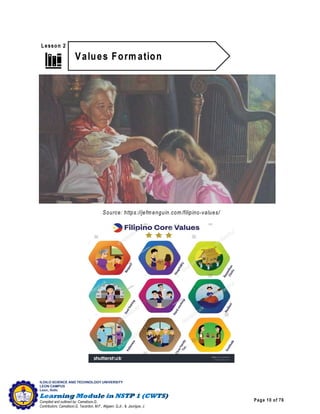
As citizens of the Republic of the Philippines, our values as Filipinos define our
identity as people. As such, we must strictly impose these values on ourselves –
regardless of age, status or religion. We must see to it that we observe these values in
all our actions, at all times and in all circumstances.
Citizenship Training
It is a program wherein it develops our characters to become more mindful of our
responsibilities, rights, and roles in the society. Embodying these values will not always
be a piece of cake but will bring great rewards for us and our country in the near future.
Good citizenship stimulates love of country making the seemingly gargantuan
task of building the nation easier. Through good citizenship, even the poor, the young,
and the old can contribute to nation building. Good citizenship likewise strengthens
unity. As Filipinos, we have our shared values which can be a strong force to unite us
as people despite our differences.
Our nation is oftentimes in crisis. And at these times, people are suffering. By
being good citizens, we will not be a part of the problem instead, we will be a part of
the solution. NSTP, as citizenship training, focuses on translating the good citizenship
values as reflected in the Preamble of the 1987 Philippine Constitution into concrete
actions in building a better Philippines.
The em phasis of the three program com ponents of CAT?
All the three program components of CAT shall give emphasis to citizenship
training, encouragement of youth to contribute in the improvement of the general
welfare and quality of life of the community, and instilling patriotism, moral, virtues,
respect for the rights of civilian and adherence to the constitution.
Citizen Advancement Training is a restructuring of the Citizen Army Training
required to all Fourth Year High School students in the Philippines in both public and
private schools as provided for in the Department of Education (DepEd) Order Bo. 35,
s. 2003 and reinforced by the DepEd Order No. 52, s. 2004.
COMPONENTS OF CAT: I. MILITARY ORIENTATION deals with the
introduction and exposure of the learner to basic knowledge, unfamiliar situations and
experiences as well as activities related to military.
COMPONENTS OF CAT: II. COMMUNITY SERVICE refers to any activity that
helps achieve the general welfare and the betterment of life of the members of the
community.
COMPONENTS OF CAT: III. PUBLIC SAFETY AND LAW ENFORCEMENT
SERVICE (PSLS) which encompasses all programs and activities which are
Page 8 of 76
ILOILO SCIENCE AND TECHNOLOGY UNIVERSITY
LEON CAMPUS
Leon, Iloilo
Compiled and outlined by: Camatison,G.
Contributors: Camatison,G, Tacardon, M.F., Aligaen, Q.Jr., & Jaurigue, J.
contributory to the maintenance of peace and order, enhancement of public safety and
encouragement in the observance of and compliance to laws.
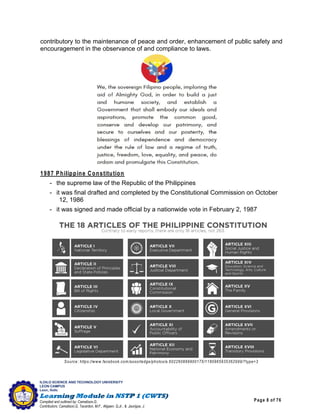
1987 Philippine Constitution
- the supreme law of the Republic of the Philippines
- it was final drafted and completed by the Constitutional Commission on October
12, 1986
- it was signed and made official by a nationwide vote in February 2, 1987
Source: https://www.facebook.com/assortedge/photos/a.602260899900175/1180965935362999/?type=3
Page 9 of 76
ILOILO SCIENCE AND TECHNOLOGY UNIVERSITY
LEON CAMPUS
Leon, Iloilo
Compiled and outlined by: Camatison,G.
Contributors: Camatison,G, Tacardon, M.F., Aligaen, Q.Jr., & Jaurigue, J.
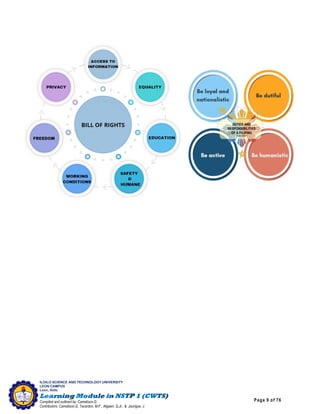
DUTIES AND
RESPONSIBILITIES
OF A FILIPINO
CITIZEN
Page 10 of 76
ILOILO SCIENCE AND TECHNOLOGY UNIVERSITY
LEON CAMPUS
Leon, Iloilo
Compiled and outlined by: Camatison,G.
Contributors: Camatison,G, Tacardon, M.F., Aligaen, Q.Jr., & Jaurigue, J.
Source: https://jefm enguin.com /filipino-values/
Page 11 of 76
ILOILO SCIENCE AND TECHNOLOGY UNIVERSITY
LEON CAMPUS
Leon, Iloilo
Compiled and outlined by: Camatison,G.
Contributors: Camatison,G, Tacardon, M.F., Aligaen, Q.Jr., & Jaurigue, J.
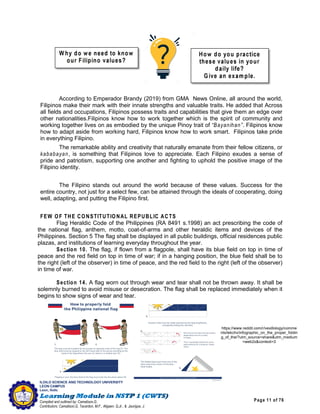
According to Emperador Brandy (2019) from GMA News Online, all around the world,
Filipinos make their mark with their innate strengths and valuable traits. He added that Across
all fields and occupations, Filipinos possess traits and capabilities that give them an edge over
other nationalities.Filipinos know how to work together which is the spirit of community and
working together lives on as embodied by the unique Pinoy trait of “Bayanihan”. Filipinos know
how to adapt aside from working hard, Filipinos know how to work smart. Filipinos take pride
in everything Filipino.
The remarkable ability and creativity that naturally emanate from their fellow citizens, or
kababayan, is something that Filipinos love to appreciate. Each Filipino exudes a sense of
pride and patriotism, supporting one another and fighting to uphold the positive image of the
Filipino identity.
The Filipino stands out around the world because of these values. Success for the
entire country, not just for a select few, can be attained through the ideals of cooperating, doing
well, adapting, and putting the Filipino first.
FEW OF THE CONSTITUTIONAL REPUBLIC ACTS
Flag Heraldic Code of the Philippines (RA 8491 s.1998) an act prescribing the code of
the national flag, anthem, motto, coat-of-arms and other heraldic items and devices of the
Philippines. Section 5 The flag shall be displayed in all public buildings, official residences public
plazas, and institutions of learning everyday throughout the year.
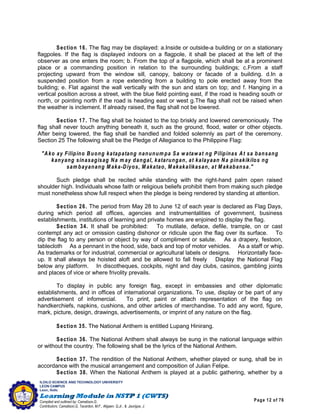
Section 10. The flag, if flown from a flagpole, shall have its blue field on top in time of
peace and the red field on top in time of war; if in a hanging position, the blue field shall be to
the right (left of the observer) in time of peace, and the red field to the right (left of the observer)
in time of war.
Section 14. A flag worn out through wear and tear shall not be thrown away. It shall be
solemnly burned to avoid misuse or desecration. The flag shall be replaced immediately when it
begins to show signs of wear and tear.
https://www.reddit.com/r/vexillology/comme
nts/lekchv/infographic_on_the_proper_foldin
g_of_the/?utm_source=share&utm_medium
=web2x&context=3
Page 12 of 76
ILOILO SCIENCE AND TECHNOLOGY UNIVERSITY
LEON CAMPUS
Leon, Iloilo
Compiled and outlined by: Camatison,G.
Contributors: Camatison,G, Tacardon, M.F., Aligaen, Q.Jr., & Jaurigue, J.
Section 16. The flag may be displayed: a.Inside or outside-a building or on a stationary
flagpoles. If the flag is displayed indoors on a flagpole, it shall be placed at the left of the
observer as one enters the room; b. From the top of a flagpole, which shall be at a prominent
place or a commanding position in relation to the surrounding buildings; c.From a staff
projecting upward from the window sill, canopy, balcony or facade of a building. d.In a
suspended position from a rope extending from a building to pole erected away from the
building; e. Flat against the wall vertically with the sun and stars on top; and f. Hanging in a
vertical position across a street, with the blue field pointing east, if the road is heading south or
north, or pointing north if the road is heading east or west g.The flag shall not be raised when
the weather is inclement. If already raised, the flag shall not be lowered.
Section 17. The flag shall be hoisted to the top briskly and lowered ceremoniously. The
flag shall never touch anything beneath it, such as the ground, flood, water or other objects.
After being lowered, the flag shall be handled and folded solemnly as part of the ceremony.
Section 25 The following shall be the Pledge of Allegiance to the Philippine Flag:
"Ako ay Filipino Buong katapatang nanunum pa Sa watawat ng Pilipinas At sa bansang
kanyang sinasagisag Na m ay dangal, katarungan, at kalayaan Na pinakikilos ng
sam bayanang M aka-Diyos, M akatao, M akakalikasan, at M akabansa."
Such pledge shall be recited while standing with the right-hand palm open raised
shoulder high. Individuals whose faith or religious beliefs prohibit them from making such pledge
must nonetheless show full respect when the pledge is being rendered by standing at attention.
Section 26. The period from May 28 to June 12 of each year is declared as Flag Days,
during which period all offices, agencies and instrumentalities of government, business
establishments, institutions of learning and private homes are enjoined to display the flag.
Section 34. It shall be prohibited: To mutilate, deface, defile, trample, on or cast
contempt any act or omission casting dishonor or ridicule upon the flag over its surface. To
dip the flag to any person or object by way of compliment or salute. As a drapery, festoon,
tablecloth As a pennant in the hood, side, back and top of motor vehicles. As a staff or whip.
As trademarks or for industrial, commercial or agricultural labels or designs. Horizontally face-
up. It shall always be hoisted aloft and be allowed to fall freely Display the National Flag
below any platform. In discotheques, cockpits, night and day clubs, casinos, gambling joints
and places of vice or where frivolity prevails.
To display in public any foreign flag, except in embassies and other diplomatic
establishments, and in offices of international organizations. To use, display or be part of any
advertisement of infomercial. To print, paint or attach representation of the flag on
handkerchiefs, napkins, cushions, and other articles of merchandise. To add any word, figure,
mark, picture, design, drawings, advertisements, or imprint of any nature on the flag.
Section 35. The National Anthem is entitled Lupang Hinirang.
Section 36. The National Anthem shall always be sung in the national language within
or without the country. The following shall be the lyrics of the National Anthem.
Section 37. The rendition of the National Anthem, whether played or sung, shall be in
accordance with the musical arrangement and composition of Julian Felipe.
Section 38. When the National Anthem is played at a public gathering, whether by a
Page 13 of 76
ILOILO SCIENCE AND TECHNOLOGY UNIVERSITY
LEON CAMPUS
Leon, Iloilo
Compiled and outlined by: Camatison,G.
Contributors: Camatison,G, Tacardon, M.F., Aligaen, Q.Jr., & Jaurigue, J.
band or by singing or both, or reproduced by any means, the attending public shall sing the
anthem. The singing must be done with fervor. As a sign of respect, all persons shall stand at
attention and face the Philippine flag, if there is one displayed, and if there is none, they shall
face the band or the conductor. At the first note, all persons shall execute a salute by placing
their right palms over their left chests. Those in military, scouting, citizen’s military training and
security guard uniforms shall give the salute prescribed by their regulations. The salute shall be
completed upon the last note of the anthem.
Section 38 The anthem shall not be played and sung for mere recreation, amusement or
entertainment purposes except on the following occasions: a. international competitions where
the Philippines is the host or has a representative; b. Local competitions; c. During “signing off”
and “signing on” of radio broadcasting and television stations; d. Before the initial and last
screening of films or before the opening of theater performances; and e. other occasions as
may be allowed by the Institute
Section 40. The national motto shall be “MAKA-DIYOS, MAKA-TAO,
MAKAKALIKASAN, AT MAKABANSA”
Section 50. Any person or judicial entity which violates any of the provisions of this Act
shall, upon conviction, be punished by a fine of not less than five thousand pesos (5,000.00) not
more than twenty thousand pesos (P20,000.00), or by imprisonment for not more than one (1)
year, or both such fine and imprisonment, at the discretion of the court: Provided, that for any
second and additional offenses, both fine and imprisonment shall always be imposed.
You can choose (2) two out of 3 to do. Don’t forget to tick your answers in the
box below. Video record your performance.
Option:
1. Perform “Lupang Hinirang” either you can sing while doing the beating with
your hands or sing it with a music accompaniment.
2. Recite 2 out of 3 of the following:
a. Preamble
b. Pledge of Allegiance to the Philippine Flag
c. “Panunumpa sa saligang Batas ng Pilipinas”
3. Sing ISAT U Hymn and your respective local Hymn
Page 14 of 76
ILOILO SCIENCE AND TECHNOLOGY UNIVERSITY
LEON CAMPUS
Leon, Iloilo
Compiled and outlined by: Camatison,G.
Contributors: Camatison,G, Tacardon, M.F., Aligaen, Q.Jr., & Jaurigue, J.
ARTICLE III
BILL OF RIGHTS
Section 1.
No person shall be deprived of life, liberty, or property without due process of law, nor
shall any person be denied the equal protection of the laws.
Section 2.
The right of the people to be secure in their persons, houses, papers, and effects
against unreasonable searches and seizures of whatever nature and for any purpose shall be
inviolable, and no search warrant or warrant of arrest shall issue except upon probable cause
to be determined personally by the judge after examination under oath or affirmation of the
complainant and the witnesses he may produce, and particularly describing the place to be
searched and the persons or things to be seized.
Section 3.
1. The privacy of communication and correspondence shall be inviolable except upon
lawful order of the court, or when public safety or order requires otherwise, as prescribed by
law.
2. Any evidence obtained in violation of this or the preceding section shall be
inadmissible for any purpose in any proceeding.
Page 15 of 76
ILOILO SCIENCE AND TECHNOLOGY UNIVERSITY
LEON CAMPUS
Leon, Iloilo
Compiled and outlined by: Camatison,G.
Contributors: Camatison,G, Tacardon, M.F., Aligaen, Q.Jr., & Jaurigue, J.
Section 4.
No law shall be passed abridging the freedom of speech, of expression, or of the press,
or the right of the people peaceably to assemble and petition the government for redress of
grievances.
Section 5.
No law shall be made respecting an establishment of religion, or prohibiting the free
exercise thereof. The free exercise and enjoyment of religious profession and worship, without
discrimination or preference, shall forever be allowed. No religious test shall be required for the
exercise of civil or political rights.
Section 6.
The liberty of abode and of changing the same within the limits prescribed by law shall
not be impaired except upon lawful order of the court. Neither shall the right to travel be
impaired except in the interest of national security, public safety, or public health, as may be
provided by law.
Section 7.
The right of the people to information on matters of public concern shall be recognized.
Access to official records, and to documents and papers pertaining to official acts, transactions,
or decisions, as well as to government research data used as basis for policy development,
shall be afforded the citizen, subject to such limitations as may be provided by law.
Section 8.
The right of the people, including those employed in the public and private sectors, to
form unions, associations, or societies for purposes not contrary to law shall not be abridged.
Section 9. Private property shall not be taken for public use without just compensation.
Section 10. No law impairing the obligation of contracts shall be passed.
Section 11. Free access to the courts and quasi-judicial bodies and adequate legal assistance
shall not be denied to any person by reason of poverty.
Section 12.
1. Any person under investigation for the commission of an offense shall have the
right to be informed of his right to remain silent and to have competent and independent
counsel preferably of his own choice. If the person cannot afford the services of counsel,
he must be provided with one. These rights cannot be waived except in writing and in the
presence of counsel.
2. No torture, force, violence, threat, intimidation, or any other means which vitiate
the free will shall be used against him. Secret detention places, solitary, incommunicado,
or other similar forms of detention are prohibited.
3. Any confession or admission obtained in violation of this or Section 17 hereof
shall be inadmissible in evidence against him.
4. The law shall provide for penal and civil sanctions for violations of this Section as
well as compensation to the rehabilitation of victims of torture or similar practices, and
their families.
Section 13.
All persons, except those charged with offenses punishable by reclusion perpetua when
evidence of guilt is strong, shall, before conviction, be bailable by sufficient sureties, or be
released on recognizance as may be provided by law. The right to bail shall not be impaired
Page 16 of 76
ILOILO SCIENCE AND TECHNOLOGY UNIVERSITY
LEON CAMPUS
Leon, Iloilo
Compiled and outlined by: Camatison,G.
Contributors: Camatison,G, Tacardon, M.F., Aligaen, Q.Jr., & Jaurigue, J.
even when the privilege of the writ of habeas corpus is suspended. Excessive bail shall not be
required.
Section 14.
1. No person shall be held to answer for a criminal offense without due process of law.
2. In all criminal prosecutions, the accused shall be presumed innocent until the contrary
is proved, and shall enjoy the right to be heard by himself and counsel, to be informed of
the nature and cause of the accusation against him, to have a speedy, impartial, and
public trial, to meet the witnesses face to face, and to have compulsory process to secure
the attendance of witnesses and the production of evidence in his behalf. However, after
arraignment, trial may proceed notwithstanding the absence of the accused: Provided,
that he has been duly notified and his failure to appear is unjustifiable.
Section 15.
The privilege of the writ of habeas corpus shall not be suspended except in cases of
invasion or rebellion, when the public safety requires it.
Section 16.
All persons shall have the right to a speedy disposition of their cases before all judicial,
quasi-judicial, or administrative bodies.
Section 17. No person shall be compelled to be a witness against himself.
Section 18.
1. No person shall be detained solely by reason of his political beliefs and aspirations.
2. No involuntary servitude in any form shall exist except as a punishment for a crime
whereof the party shall have been duly convicted.
Section 19.
1. Excessive fines shall not be imposed, nor cruel, degrading or inhuman punishment
inflicted. Neither shall death penalty be imposed, unless, for compelling reasons involving
heinous crimes, the Congress hereafter provides for it. Any death penalty already
imposed shall be reduced to reclusion perpetua.
2. The employment of physical, psychological, or degrading punishment against any
prisoner or detainee or the use of substandard or inadequate penal facilities under
subhuman conditions shall be dealt with by law.
Section 20. No person shall be imprisoned for debt or non-payment of a poll tax.
Section 21.
No person shall be twice put in jeopardy of punishment for the same offense. If an act is
punished by a law and an ordinance, conviction or acquittal under either shall constitute a bar
to another prosecution for the same act.
Section 22. No ex post facto law or bill of attainder shall be enacted.
Source :1987 Constitution
https://lawphil.net/consti/cons1987.html
BE an ACTIVE and INFORMED CITIZENS.
Page 17 of 76
ILOILO SCIENCE AND TECHNOLOGY UNIVERSITY
LEON CAMPUS
Leon, Iloilo
Compiled and outlined by: Camatison,G.
Contributors: Camatison,G, Tacardon, M.F., Aligaen, Q.Jr., & Jaurigue, J.
Reflective W riting
1. In our country, what are the scenarios you have experienced or seen that have
shown a lack of practice in our citizenship?
2. As a student, how have you been practicing as a Filipino citizen?
Activity
Please watch the video and make a video clip synopsis. https://fb.watch/8D-a8F_vFL/
(Inquirer.net)
Guided Questions:
A. What is the video all about?
B. What have you realized after watching the video?
C. Analyzing today’s society are all people enjoy their basic rights? Why/Why not?
Please explain
Additional References:
https://jefmenguin.com/filipino-values/
https://youtu.be/EWD8mSEYHRc
https://youtu.be/nS5UWhIMMg4
https://prezi.com/p/m9y4lz0mezno/nstp-citizenship-training/ https://www.slideshare.net/Rs3/citizenship-
advancement-training-25985588
(Since Copyright):
http://www.officialgazette.gov.ph/constitutions/1987-constitution/
(De Vera, Joselito C. “Strengthening Volunteerism through the Volunteer Act of 2007 (Republic Act
9418).” IVolunteer Philippines, 12 Oct. 2013, blog.ivolunteer.com.ph/2010/06/30/strengthening-
volunteerism-through-the-volunteer-actof-2007-republic-act-9418/.)
Page 18 of 76
ILOILO SCIENCE AND TECHNOLOGY UNIVERSITY
LEON CAMPUS
Leon, Iloilo
Compiled and outlined by: Camatison,G.
Contributors: Camatison,G, Tacardon, M.F., Aligaen, Q.Jr., & Jaurigue, J.
OVERVIEW
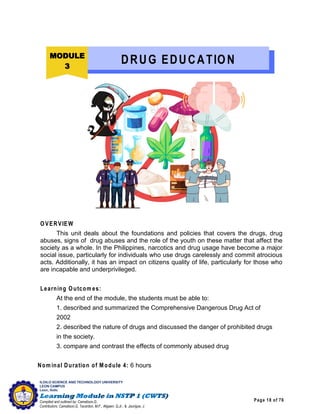
This unit deals about the foundations and policies that covers the drugs, drug
abuses, signs of drug abuses and the role of the youth on these matter that affect the
society as a whole. In the Philippines, narcotics and drug usage have become a major
social issue, particularly for individuals who use drugs carelessly and commit atrocious
acts. Additionally, it has an impact on citizens quality of life, particularly for those who
are incapable and underprivileged.
Learning Outcom es:
At the end of the module, the students must be able to:
1. described and summarized the Comprehensive Dangerous Drug Act of
2002
2. described the nature of drugs and discussed the danger of prohibited drugs
in the society.
3. compare and contrast the effects of commonly abused drug
Nom inal Duration of Module 4: 6 hours
MODULE
3
DRUG EDUCATION
Page 19 of 76
ILOILO SCIENCE AND TECHNOLOGY UNIVERSITY
LEON CAMPUS
Leon, Iloilo
Compiled and outlined by: Camatison,G.
Contributors: Camatison,G, Tacardon, M.F., Aligaen, Q.Jr., & Jaurigue, J.
Com prehensive Dangerous Drugs Act of 2002
Republic Act No. 9165 An Act Instituting The Comprehensive Dangerous Drugs
Act Of 2002, Repealing Republic Act No. 6425, Otherwise Known As The Dangerous
Drugs Act Of 1972, As Amended, Providing Funds Therefor, And For Other Purposes
UNLAW FUL ACTS AND PENALTIES
IMPORTATION OF DANGEROUS DRUGS AND/OR CONTROLLED PRECURSORS AND
ESSENTIAL CHEM ICALS. The penalty of life imprisonment to death and a fine ranging from
Five hundred thousand pesos (P500,000.00) to Ten million pesos (P10,000,000.00)
SALE, TRADING, ADM INISTRATION, DISPENSATION, DELIVERY, DISTRIBUTION AND
TRANSPORTATION OF DANGEROUS DRUGS AND/OR CONTROLLED PRECURSORS
AND ESSENTIAL CHEM ICALS. The penalty of life imprisonment to death and a fine ranging
from Five hundred thousand pesos (P500,000.00) to Ten million pesos (P10,000,000.00)
M AINTENANCE OF A DEN, DIVE OR RESORT The penalty of life im prisonm ent to death
and a fine ranging from Five hundred thousand pesos (P500,000.00) to Ten m illion pesos
(P10,000,000.00)
EM PLOYEES AND VISITORS OF A DEN, DIVE OR RESORT. The penalty of imprisonment
ranging from twelve (12) years and one (1) day to twenty (20) years and a fine ranging from
One hundred thousand pesos (P100,000.00) to Five hundred thousand pesos (P500,000.00)
M ANUFACTURE OF DANGEROUS DRUGS AND/OR CONTROLLED PRECURSORS AND
ESSENTIAL CHEM ICALS. The penalty of life imprisonment to death and a fine ranging from
Five hundred thousand pesos (P500,000.00) to Ten million pesos (P10,000,000.00)
ILLEGAL CHEM ICAL DIVERSION OF CONTROLLED PRECURSORS AND ESSENTIAL
CHEM ICALS. The penalty of imprisonment ranging from twelve (12) years and one (1) day to
twenty (20) years and a fine ranging from One hundred thousand pesos (P100,000.00) to Five
hundred thousand pesos (P500,000.00)
M ANUFACTURE OR DELIVERY OF EQUIPMENT, INSTRUM ENT, APPARATUS, AND
OTHER PARAPHERNALIA FOR DANGEROUS DRUGS AND/OR CONTROLLED
PRECURSORS AND ESSENTIAL CHEM ICALS. The penalty of imprisonment ranging from
twelve (12) years and one (1) day to twenty (20) years and a fine ranging from One hundred
thousand pesos (P100,000.00) to Five hundred thousand pesos (P500,000.00)
POSSESSION OF DANGEROUS DRUGS. The penalty of life imprisonment to death and a fine
Page 20 of 76
ILOILO SCIENCE AND TECHNOLOGY UNIVERSITY
LEON CAMPUS
Leon, Iloilo
Compiled and outlined by: Camatison,G.
Contributors: Camatison,G, Tacardon, M.F., Aligaen, Q.Jr., & Jaurigue, J.
ranging from Five hundred thousand pesos (P500,000.00) to Ten million pesos (P10,000,000.00)
(1) 10 grams or more of opium; (2) 10 grams or more of morphine; (3) 10 grams or more of
heroin; (4) 10 grams or more of cocaine or cocaine hydrochloride; (5) 50 grams or more of
methamphetamine hydrochloride or “shabu”; (6) 10 grams or more of marijuana resin or
marijuana resin oil; (7) 500 grams or more of marijuana; and (8) 10 grams or more of other
dangerous drugs such as, but not limited to, methylenedioxymethamphetamine (MDMA) or
“ecstasy”, introduced drugs and their derivatives, without having any therapeutic value or if the
quantity possessed is far beyond therapeutic requirements, as determined and promulgated by
the Board in accordance to Section 93, Article XI of this Act.
POSSESSION OF EQUIPMENT, INSTRUM ENT, APPARATUS AND OTHER
PARAPHERNALIA FOR DANGEROUS DRUGS. The penalty of imprisonment ranging from six
(6) months and one (1) day to four (4) years and a fine ranging from Ten thousand pesos
(P10,000.00) to Fifty thousand pesos (P50,000.00)
POSSESSION OF DANGEROUS DRUGS DURING PARTIES, SOCIAL GATHERINGS OR
M EETINGS. Any person found possessing any dangerous drug during a party, or at a social
gathering or meeting, or in the proximate company of at least two (2) persons, shall suffer the
maximum penalties provided for in Section 11. SEC. 11. The penalty of life imprisonment to
death and a fine ranging from Five hundred thousand pesos (P500,000.00) to Ten million pesos
(P10,000,000.00)
POSSESSION OF EQUIPMENT, INSTRUM ENT, APPARATUS AND OTHER
PARAPHERNALIA FOR DANGEROUS DRUGS DURING PARTIES, SOCIAL GATHERINGS
OR M EETINGS. The maximum penalty provided for in Section 12 of this Act shall be imposed
upon any person. SEC. 12. The penalty of imprisonment ranging from six (6) months and one (1)
day to four (4) years and a fine ranging from Ten thousand pesos (P10,000.00) to Fifty
thousand pesos (P50,000.00)
USE OF DANGEROUS DRUGS. A person apprehended or arrested, who is found to be
positive for use of any dangerous drug, after a confirmatory test, shall be imposed a penalty of a
minimum of six (6) months rehabilitation in a government center for the first offense, subject to
the provisions of Article VIII of this Act.
CULTIVATION OR CULTURE OF PLANTS CLASSIFIED AS DANGEROUS DRUGS OR ARE
SOURCES THEREOF. The penalty of life imprisonment to death and a fine ranging from Five
hundred thousand pesos (P500,000.00) to Ten million pesos (P10,000,000.00)
UNNECESSARY PRESCRIPTION OF DANGEROUS DRUGS. The penalty of imprisonment
ranging from twelve (12) years and one (1) day to twenty (20) years and a fine ranging from
One hundred thousand pesos (P100,000.00) to Five hundred thousand pesos (P500,000.00)
and the additional penalty of the revocation of his/her license to practice shall be imposed upon
the practitioner
Page 21 of 76
ILOILO SCIENCE AND TECHNOLOGY UNIVERSITY
LEON CAMPUS
Leon, Iloilo
Compiled and outlined by: Camatison,G.
Contributors: Camatison,G, Tacardon, M.F., Aligaen, Q.Jr., & Jaurigue, J.
UNLAW FUL PRESCRIPTION OF DANGEROUS DRUGS. The penalty of life imprisonment to
death and a fine ranging from Five hundred thousand pesos (P500,000.00) to Ten million pesos
(P10,000,000.00) shall be imposed upon any person, who, unless authorized by law, shall make
or issue a prescription or any other writing purporting to be a prescription for any dangerous
drug.
W HAT IS DRUGS?
Drugs are chemicals that affect a person in such a way as to bring about physiological,
emotional, or behavioral change. ‘Dangerous drugs ’ are those that have high tendency for
abuse and dependency, these substances may be organic or synthetic, and pose harm to those
who use them.
DRUG ABUSE
Drug abuse exists when a person continually uses a drug other than its intended
purpose. This continued use can lead to drug dependence, a state of physical and
psychological dependence or both on a dangerous drug.
DRUG ADDICTION
Drug addiction is a complex, and often chronic, brain disease. It is characterized by
execessive drug craving, seeking, and use. Addiction is caused by brain changes caused by
constant drug use.
DRUG DEPENDENCY
This is the state of physical and psychological dependence, or both, on a dangerous
drug, or drugs, experienced by a person following the use of that substance on a periodic or
continuous basis. A person dependent on drugs will experience withdrawal reactions (also
known as “ cold turkey ” , symptoms that occur after long-term use of a drug is reduced or
stopped abruptly) after abstaining from drugs.
M OST COMM ONLY ABUSED DRUGS IN AND THEIR ILL EFFECTS
M etham phetam ine Hydrochloride (Shabu)
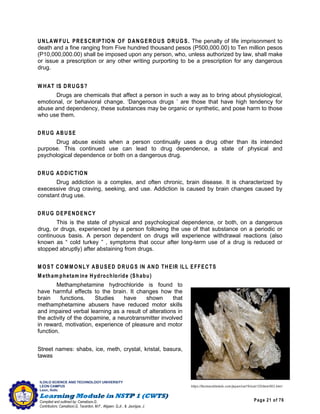
Methamphetamine hydrochloride is found to
have harmful effects to the brain. It changes how the
brain functions. Studies have shown that
methamphetamine abusers have reduced motor skills
and impaired verbal learning as a result of alterations in
the activity of the dopamine, a neurotransmitter involved
in reward, motivation, experience of pleasure and motor
function.
Street names: shabs, ice, meth, crystal, kristal, basura,
tawas
https://factsanddetails.com/japan/cat19/sub125/item663.html
Page 22 of 76
ILOILO SCIENCE AND TECHNOLOGY UNIVERSITY
LEON CAMPUS
Leon, Iloilo
Compiled and outlined by: Camatison,G.
Contributors: Camatison,G, Tacardon, M.F., Aligaen, Q.Jr., & Jaurigue, J.
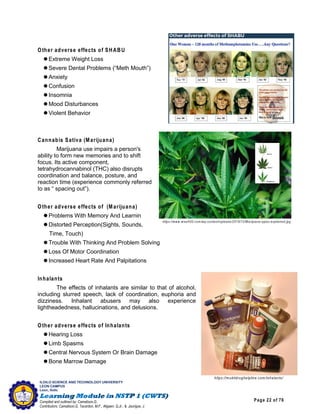
Other adverse effects of SHABU
 Extreme Weight Loss
 Severe Dental Problems (“Meth Mouth”)
 Anxiety
 Confusion
 Insomnia
 Mood Disturbances
 Violent Behavior
Cannabis Sativa (Marijuana)
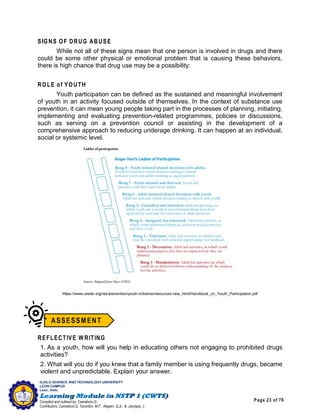
Marijuana use impairs a person's
ability to form new memories and to shift
focus. Its active component,
tetrahydrocannabinol (THC) also disrupts
coordination and balance, posture, and
reaction time (experience commonly referred
to as “ spacing out”).
Other adverse effects of (Marijuana)
 Problems With Memory And Learnin
 Distorted Perception(Sights, Sounds,
Time, Touch)
 Trouble With Thinking And Problem Solving
 Loss Of Motor Coordination
 Increased Heart Rate And Palpitations
Inhalants
The effects of inhalants are similar to that of alcohol,
including slurred speech, lack of coordination, euphoria and
dizziness. Inhalant abusers may also experience
lightheadedness, hallucinations, and delusions.
Other adverse effects of Inhalants
 Hearing Loss
 Limb Spasms
 Central Nervous System Or Brain Damage
 Bone Marrow Damage
https://www.wise420.com/wp-content/uploads/2019/12/Marijuana-types-explained.jpg
https://m uktidrughelpline.com /inhalants/
Page 23 of 76
ILOILO SCIENCE AND TECHNOLOGY UNIVERSITY
LEON CAMPUS
Leon, Iloilo
Compiled and outlined by: Camatison,G.
Contributors: Camatison,G, Tacardon, M.F., Aligaen, Q.Jr., & Jaurigue, J.
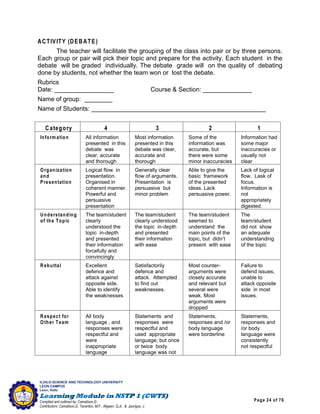
SIGNS OF DRUG ABUSE
While not all of these signs mean that one person is involved in drugs and there
could be some other physical or emotional problem that is causing these behaviors,
there is high chance that drug use may be a possibility:
ROLE of YOUTH
Youth participation can be defined as the sustained and meaningful involvement
of youth in an activity focused outside of themselves. In the context of substance use
prevention, it can mean young people taking part in the processes of planning, initiating,
implementing and evaluating prevention-related programmes, policies or discussions,
such as serving on a prevention council or assisting in the development of a
comprehensive approach to reducing underage drinking. It can happen at an individual,
social or systemic level.
https://www.unodc.org/res/prevention/youth-initiative/resources-new_html/Handbook_on_Youth_Participation.pdf
REFLECTIVE W RITING
1. As a youth, how will you help in educating others not engaging to prohibited drugs
activities?
2. What will you do if you knew that a family member is using frequently drugs, became
violent and unpredictable. Explain your answer.
Page 24 of 76
ILOILO SCIENCE AND TECHNOLOGY UNIVERSITY
LEON CAMPUS
Leon, Iloilo
Compiled and outlined by: Camatison,G.
Contributors: Camatison,G, Tacardon, M.F., Aligaen, Q.Jr., & Jaurigue, J.
ACTIVITY (DEBATE)
The teacher will facilitate the grouping of the class into pair or by three persons.
Each group or pair will pick their topic and prepare for the activity. Each student in the
debate will be graded individually. The debate grade will on the quality of debating
done by students, not whether the team won or lost the debate.
Rubrics
Date: _________________ Course & Section: ______________
Name of group: ________
Name of Students: __________________________________________________
Category 4 3 2 1
Inform ation All information
presented in this
debate was
clear, accurate
and thorough
Most information
presented in this
debate was clear,
accurate and
thorough
Some of the
information was
accurate, but
there were some
minor inaccuracies
Information had
some major
inaccuracies or
usually not
clear
Organization
and
Presentation
Logical flow in
presentation.
Organised in
coherent manner.
Powerful and
persuasive
presentation
Generally clear
flow of arguments.
Presentation is
persuasive but
minor problem
Able to give the
basic framework
of the presented
ideas. Lack
persuasive power.
Lack of logical
flow. Lask of
focus.
Information is
not
appropriately
digested.
Understanding
of the Topic
The team/student
clearly
understood the
topic in-depth
and presented
their information
forcefully and
convincingly
The team/student
clearly understood
the topic in-depth
and presented
their information
with ease
The team/student
seemed to
understand the
main points of the
topic, but didn’t
present with ease
The
team/student
did not show
an adequate
understanding
of the topic
Rebuttal Excellent
defence and
attack against
opposite side.
Able to identify
the weaknesses
Satisfactorily
defence and
attack. Attempted
to find out
weaknesses.
Most counter-
arguments were
closely accurate
and relevant but
several were
weak. Most
arguments were
dropped
Failure to
defend issues,
unable to
attack opposite
side in most
issues.
Respect for
Other Team
All body
language , and
responses were
respectful and
were
inappropriate
language
Statements and
responses were
respectful and
used appropriate
language, but once
or twice body
language was not
Statements,
responses and /or
body language
were borderline
Statements,
responses and
/or body
language were
consistently
not respectful
Page 25 of 76
ILOILO SCIENCE AND TECHNOLOGY UNIVERSITY
LEON CAMPUS
Leon, Iloilo
Compiled and outlined by: Camatison,G.
Contributors: Camatison,G, Tacardon, M.F., Aligaen, Q.Jr., & Jaurigue, J.
OVERVIEW
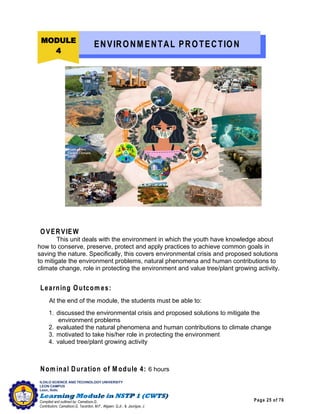
This unit deals with the environment in which the youth have knowledge about
how to conserve, preserve, protect and apply practices to achieve common goals in
saving the nature. Specifically, this covers environmental crisis and proposed solutions
to mitigate the environment problems, natural phenomena and human contributions to
climate change, role in protecting the environment and value tree/plant growing activity.
Learning Outcom es:
At the end of the module, the students must be able to:
1. discussed the environmental crisis and proposed solutions to mitigate the
environment problems
2. evaluated the natural phenomena and human contributions to climate change
3. motivated to take his/her role in protecting the environment
4. valued tree/plant growing activity
Nom inal Duration of M odule 4: 6 hours
MODULE
4
ENVIRONM ENTAL PROTECTION
Page 26 of 76
ILOILO SCIENCE AND TECHNOLOGY UNIVERSITY
LEON CAMPUS
Leon, Iloilo
Compiled and outlined by: Camatison,G.
Contributors: Camatison,G, Tacardon, M.F., Aligaen, Q.Jr., & Jaurigue, J.
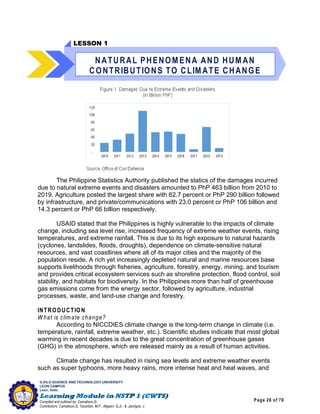
The Philippine Statistics Authority published the statics of the damages incurred
due to natural extreme events and disasters amounted to PhP 463 billion from 2010 to
2019. Agriculture posted the largest share with 62.7 percent or PhP 290 billion followed
by infrastructure, and private/communications with 23.0 percent or PhP 106 billion and
14.3 percent or PhP 66 billion respectively.
USAID stated that the Philippines is highly vulnerable to the impacts of climate
change, including sea level rise, increased frequency of extreme weather events, rising
temperatures, and extreme rainfall. This is due to its high exposure to natural hazards
(cyclones, landslides, floods, droughts), dependence on climate-sensitive natural
resources, and vast coastlines where all of its major cities and the majority of the
population reside. A rich yet increasingly depleted natural and marine resources base
supports livelihoods through fisheries, agriculture, forestry, energy, mining, and tourism
and provides critical ecosystem services such as shoreline protection, flood control, soil
stability, and habitats for biodiversity. In the Philippines more than half of greenhouse
gas emissions come from the energy sector, followed by agriculture, industrial
processes, waste, and land-use change and forestry.
INTRODUCTION
W hat is climate change?
According to NICCDIES climate change is the long-term change in climate (i.e.
temperature, rainfall, extreme weather, etc.). Scientific studies indicate that most global
warming in recent decades is due to the great concentration of greenhouse gases
(GHG) in the atmosphere, which are released mainly as a result of human activities.
Climate change has resulted in rising sea levels and extreme weather events
such as super typhoons, more heavy rains, more intense heat and heat waves, and
LESSON 1
NATURAL PHENOMENA AND HUMAN
CONTRIBUTIONS TO CLIMATE CHANGE
Page 27 of 76
ILOILO SCIENCE AND TECHNOLOGY UNIVERSITY
LEON CAMPUS
Leon, Iloilo
Compiled and outlined by: Camatison,G.
Contributors: Camatison,G, Tacardon, M.F., Aligaen, Q.Jr., & Jaurigue, J.
prolonged severe droughts, and consequently enormous losses in lives, livelihoods,
properties, and the environment. Vulnerable countries, like the Philippines, bear the
brunt of the impact of climate change.
The World Meteorological Organization (WMO) confirmed that 2015, 2016, and
2017 were the three warmest years on record 2016 still holds the global record, while
2017 has been warmest year without El Niño.
(National Integrated Climate Change Database Information and Exchange System serves as the primary enabling platform of the CCC in consolidating
and monitoring, among other things, data and information on climate change and climate action)
Being an archipelagic nation, the Philippines is susceptible and vulnerable to the
ill-effects of weather-related hazards. Extreme weather events, which include tropical
cyclones, monsoon rains and dry spells, have triggered hazards (such as floods and
landslides) that have turned into disasters.
Financial resources that were meant for development and social services have
had to be diverted in response, addressing the destruction caused by calamities that
beset different regions of the country. Changing climatic patterns and weather-related
occurrences over the past five years (2004-08) may serve as an indicator of what
climate change will mean for the country. Early recognition of this possibility and the
implementation of appropriate action and measures, through disaster risk management,
are important if loss of life and property is to be minimized, if not totally eradicated. This
is a matter of urgent concern given the geographical location and geological
characteristics of the Philippines. (Jr, Graciano & Cruz, Nathaniel & Servando,
Nathaniel & Dimalanta, Carla, (2010)
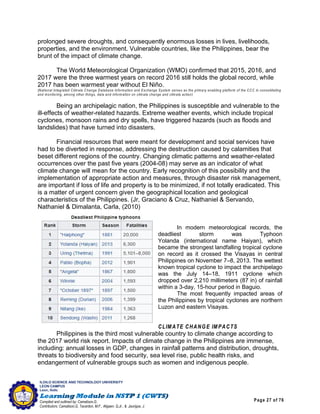
In modern meteorological records, the
deadliest storm was Typhoon
Yolanda (international name Haiyan), which
became the strongest landfalling tropical cyclone
on record as it crossed the Visayas in central
Philippines on November 7–8, 2013. The wettest
known tropical cyclone to impact the archipelago
was the July 14–18, 1911 cyclone which
dropped over 2,210 millimeters (87 in) of rainfall
within a 3-day, 15-hour period in Baguio.
The most frequently impacted areas of
the Philippines by tropical cyclones are northern
Luzon and eastern Visayas.
CLIMATE CHANGE IMPACTS
Philippines is the third most vulnerable country to climate change according to
the 2017 world risk report. Impacts of climate change in the Philippines are immense,
including: annual losses in GDP, changes in rainfall patterns and distribution, droughts,
threats to biodiversity and food security, sea level rise, public health risks, and
endangerment of vulnerable groups such as women and indigenous people.
Page 28 of 76
ILOILO SCIENCE AND TECHNOLOGY UNIVERSITY
LEON CAMPUS
Leon, Iloilo
Compiled and outlined by: Camatison,G.
Contributors: Camatison,G, Tacardon, M.F., Aligaen, Q.Jr., & Jaurigue, J.
Reflection
Sea Level Rise. According to data by the World Meteorological Organization, the
water levels around the Philippines are rising at a rate almost three times the global
average due partly to the influence of the trade winds pushing ocean currents. On
average, sea levels around the world rise 3.1 cm every ten years. Water levels in the
Philippines are projected to rise between 7.6 and 10.2 cm each decade. NASA released
data that global sea level is rising approximately 0.13 inches (3.3 millimeters) a year.
Conversation.com also discussed sea levels have risen faster over the last hundred
years than any time in the last 3,000 years. This acceleration is expected to continue. A
further 15-25cm of sea level rise is expected by 2050, with little sensitivity to
greenhouse gas emissions between now and then.
Increased Tem perature. The Philippines, like most parts of the globe, has also
exhibited increasing temperatures. Mean temperatures in all areas in the Philippines are
expected to rise by 0.9 C to 1.1 C in 2020 and by 1.8 C to 2.2 C in 2050. Likewise, all
seasonal mean temperatures will also have increases in these time slices; and these
increases during the four seasons are quite consistent in all parts of the country.
Source: Bioremediation: A Low-Cost and Clean-Green Technology for Environmental Management - Scientific
Figure on ResearchGate. Available from: https://www.researchgate.net/figure/Main-human-activities-and-their-
effect-on-the-pollution-of-terrestrial-ecosystems_fig1_341065060 [accessed 2 Oct, 2021]
Page 29 of 76
ILOILO SCIENCE AND TECHNOLOGY UNIVERSITY
LEON CAMPUS
Leon, Iloilo
Compiled and outlined by: Camatison,G.
Contributors: Camatison,G, Tacardon, M.F., Aligaen, Q.Jr., & Jaurigue, J.
1. How do you feel when you hear about global warming? Is there hope for the
future?
2. How important is nature to you? Do you try to get close to nature?
3. Have you ever donated your time or money to an environmental organization?
Which organization did you help? What is their focus?
4. What are tangible things have you been contributed in taking care of our
environment?
Page 30 of 76
ILOILO SCIENCE AND TECHNOLOGY UNIVERSITY
LEON CAMPUS
Leon, Iloilo
Compiled and outlined by: Camatison,G.
Contributors: Camatison,G, Tacardon, M.F., Aligaen, Q.Jr., & Jaurigue, J.
INTRODUCTION
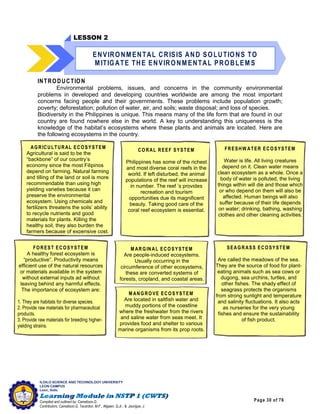
Environmental problems, issues, and concerns in the community environmental
problems in developed and developing countries worldwide are among the most important
concerns facing people and their governments. These problems include population growth;
poverty; deforestation; pollution of water, air, and soils; waste disposal; and loss of species.
Biodiversity in the Philippines is unique. This means many of the life form that are found in our
country are found nowhere else in the world. A key to understanding this uniqueness is the
knowledge of the habitat’s ecosystems where these plants and animals are located. Here are
the following ecosystems in the country.
LESSON 2
ENVIRONM ENTAL CRISIS AND SOLUTIONS TO
M ITIGATE THE ENVIRONM ENTAL PROBLEM S
M ARGINAL ECOSYSTEM
Are people-induced ecosystems.
Usually occurring in the
circumference of other ecosystems,
these are converted systems of
forests, cropland, and coastal areas.
SEAGRASS ECOSYSTEM
Are called the meadows of the sea.
They are the source of food for plant-
eating animals such as sea cows or
dugong, sea urchins, turtles, and
other fishes. The shady effect of
seagrass protects the organisms
from strong sunlight and temperature
and salinity fluctuations. It also acts
as nurseries for the very young
fishes and ensure the sustainability
of fish product.
AGRICULTURAL ECOSYSTEM
Agricultural is said to be the
“backbone” of our country’s
economy since the most Filipinos
depend on farming. Natural farming
and tilling of the land or soil is more
recommendable than using high
yielding varieties because it can
preserve the environmental
ecosystem. Using chemicals and
fertilizers threatens the soils’ ability
to recycle nutrients and good
materials for plants. Killing the
healthy soil, they also burden the
farmers because of expensive cost.
CORAL REEF SYSTEM
Philippines has some of the richest
and most diverse coral reefs in the
world. If left disturbed, the animal
populations of the reef will increase
in number. The reef ’s provides
recreation and tourism
opportunities due its magnificent
beauty. Taking good care of the
coral reef ecosystem is essential.
FRESHW ATER ECOSYSTEM
Water is life. All living creatures
depend on it. Clean water means
clean ecosystem as a whole. Once a
body of water is polluted, the living
things within will die and those which
or who depend on them will also be
affected. Human beings will also
suffer because of their life depends
on water; drinking, bathing, washing
clothes and other cleaning activities.
FOREST ECOSYSTEM
A healthy forest ecosystem is
“productive”. Productivity means
efficient use of the natural resources
or materials available in the system
without external inputs ad without
leaving behind any harmful effects.
The importance of ecosystem are:
1. They are habitats for diverse species.
2. Provide raw materials for pharmaceutical
products.
3. Provide raw materials for breeding higher-
yielding strains.
M ANGROVE ECOSYSTEM
Are located in saltfish water and
muddy portions of the coastline
where the freshwater from the rivers
and saline water from seas meet. It
provides food and shelter to various
marine organisms from its prop roots.
Page 31 of 76
ILOILO SCIENCE AND TECHNOLOGY UNIVERSITY
LEON CAMPUS
Leon, Iloilo
Compiled and outlined by: Camatison,G.
Contributors: Camatison,G, Tacardon, M.F., Aligaen, Q.Jr., & Jaurigue, J.
ENVIRONM ENTAL ISSUES IN THE PHILIPPINES
The Philippines is prone to natural disasters, particularly typhoons, floods, landslides,
volcanic eruptions, earthquakes, and tsunamis, lying as it does astride the typhoon belt, in the
active volcanic region known as the “Pacific Ring of Fire,” and in the geologically unstable
region between the Pacific and Eurasian tectonic plates. The Philippines also suffers major
human-caused environmental degradation aggravated by a high annual population growth rate,
including loss of agricultural lands, deforestation, soil erosion, air and water pollution, improper
disposal of solid and toxic wastes, loss of coral reefs, mismanagement and abuse of coastal
resources, and overfishing.
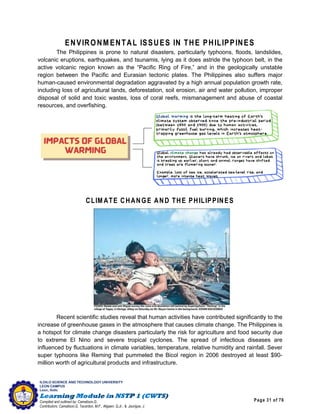
CLIM ATE CHANGE AND THE PHILIPPINES
Recent scientific studies reveal that human activities have contributed significantly to the
increase of greenhouse gases in the atmosphere that causes climate change. The Philippines is
a hotspot for climate change disasters particularly the risk for agriculture and food security due
to extreme El Nino and severe tropical cyclones. The spread of infectious diseases are
influenced by fluctuations in climate variables, temperature, relative humidity and rainfall. Sever
super typhoons like Reming that pummeled the Bicol region in 2006 destroyed at least $90-
million worth of agricultural products and infrastructure.
Page 32 of 76
ILOILO SCIENCE AND TECHNOLOGY UNIVERSITY
LEON CAMPUS
Leon, Iloilo
Compiled and outlined by: Camatison,G.
Contributors: Camatison,G, Tacardon, M.F., Aligaen, Q.Jr., & Jaurigue, J.
DECLINE OF NATURAL RESOURCES AND BIODIVERSITY
The Philippines is suffering from degradation of the natural environment. It has fifty
major rivers now polluted due to abuse and neglect. Approximately two-thirds of the country's
original mangroves have been lost. A hundred years ago, the Philippines had close to 22 million
hectares of old growth forest. At the start of 2000, we had less than 600,000 hectares of old-
growth forest left. In one century, we had cut down close to 97 percent of our original forest. A
study by the Environmental Scientists for Social Change (ESSC) reveals that we have
systematically cut this forest down and that we have not stopped its destruction and that of its
core biodiversity.
The International Rice Research Institute (IRRI) estimates that it takes over 4,000 liters
of water to produce one kilo of rice. Because of the loss of forests, we have less water since
most of our freshwater comes from watersheds found in forests. Therefore, loss of forests
means loss of food.
More than 400 plant and animal species found in the Philippines are currently threatened
with extinction, including the Philippine eagle, the tamaraw, and the dugong. In 2001, 49 of the
nation's mammal species, 86 bird species, and 320 plant species were threatened with
extinction.
Endangered species in the Philippines include the monkey-eating eagle, Philippine
tarsier, tamaraw, four species of turtle (green sea, hawksbill(https://bit.ly/3iQlm20), olive ridley
(https://bit.ly/3BKPQKx), and leatherback), Philippine’s crocodile, sinarapan (https://bit.ly/3By4Cnx), and two
species of butterflies. The Cebu warty pig, Panay flying fox, and Chapman's fruit bat have
become extinct.
ALARM ING W ASTE PROBLEM IN THE PHILIPPINES
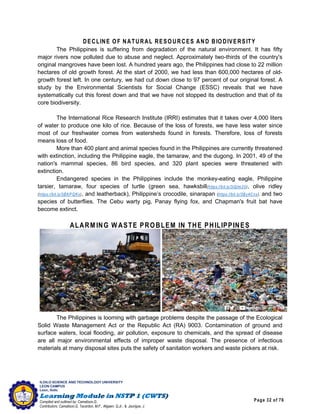
The Philippines is looming with garbage problems despite the passage of the Ecological
Solid Waste Management Act or the Republic Act (RA) 9003. Contamination of ground and
surface waters, local flooding, air pollution, exposure to chemicals, and the spread of disease
are all major environmental effects of improper waste disposal. The presence of infectious
materials at many disposal sites puts the safety of sanitation workers and waste pickers at risk.
Source: https://bit.ly/3AC1G8o Source: https://bit.ly/3iNaHW 4
Page 33 of 76
ILOILO SCIENCE AND TECHNOLOGY UNIVERSITY
LEON CAMPUS
Leon, Iloilo
Compiled and outlined by: Camatison,G.
Contributors: Camatison,G, Tacardon, M.F., Aligaen, Q.Jr., & Jaurigue, J.
Despite Republic Act 9003's existence, previous initiatives to encourage trash
segregation at source have had little success. To pursue the goal of fixing the garbage problem,
many private groups or NGOs helped implement campaigns, seminars, trainings, and other
various community activities. In every barangay or cluster of a barangay, materials recovery
facilities, also known as ecological centers, are to be established, according to RA 9003.
People’s Behavior towards Waste Behavior is a key cultural aspect that is embedded in
people’s way of life. Studying a community’s behavior and introducing new ones requires
intensive, long-term, and creative social marketing. This can be done by studying the
demographic and cultural fiber of the community through immersions and capacity building
activities.
The Resources, Environment and Economics Center for Studies, Inc.’s (REECS) 2002
study on household waste management systems and the attitudes and behavior showed that:
1. Waste management is still perceived by many as the responsibility of government.
2. Public participation in waste management, especially in segregation at source,
remains limited.
3. More extensive awareness- raising activities and training on ecological waste
management are needed, together with stricter enforcement of the Law and local ordinances
must be observed.
4. There is lack of community empowerment and political will to resolve the problem.
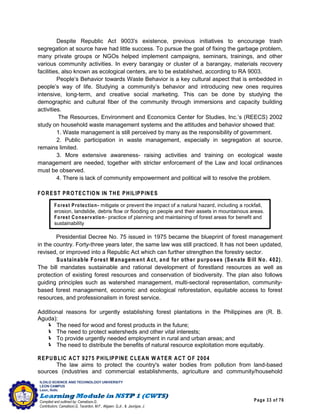
FOREST PROTECTION IN THE PHILIPPINES
Presidential Decree No. 75 issued in 1975 became the blueprint of forest management
in the country. Forty-three years later, the same law was still practiced. It has not been updated,
revised, or improved into a Republic Act which can further strengthen the forestry sector.
Sustainable Forest M anagem ent Act, and for other purposes (Senate Bill No. 402).
The bill mandates sustainable and rational development of forestland resources as well as
protection of existing forest resources and conservation of biodiversity. The plan also follows
guiding principles such as watershed management, multi-sectoral representation, community-
based forest management, economic and ecological reforestation, equitable access to forest
resources, and professionalism in forest service.
Additional reasons for urgently establishing forest plantations in the Philippines are (R. B.
Aguda):
 The need for wood and forest products in the future;
 The need to protect watersheds and other vital interests;
 To provide urgently needed employment in rural and urban areas; and
 The need to distribute the benefits of natural resource exploitation more equitably.
REPUBLIC ACT 9275 PHILIPPINE CLEAN W ATER ACT OF 2004
The law aims to protect the country's water bodies from pollution from land-based
sources (industries and commercial establishments, agriculture and community/household
Forest Protection- mitigate or prevent the impact of a natural hazard, including a rockfall,
erosion, landslide, debris flow or flooding on people and their assets in mountainous areas.
Forest Conservation- practice of planning and maintaining of forest areas for benefit and
sustainability
Page 34 of 76
ILOILO SCIENCE AND TECHNOLOGY UNIVERSITY
LEON CAMPUS
Leon, Iloilo
Compiled and outlined by: Camatison,G.
Contributors: Camatison,G, Tacardon, M.F., Aligaen, Q.Jr., & Jaurigue, J.
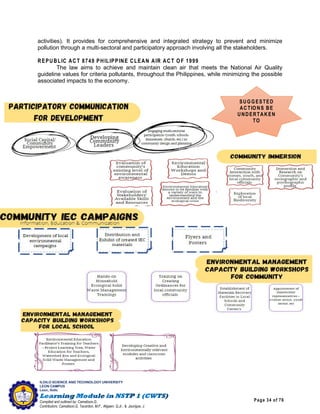
activities). It provides for comprehensive and integrated strategy to prevent and minimize
pollution through a multi-sectoral and participatory approach involving all the stakeholders.
REPUBLIC ACT 8749 PHILIPPINE CLEAN AIR ACT OF 1999
The law aims to achieve and maintain clean air that meets the National Air Quality
guideline values for criteria pollutants, throughout the Philippines, while minimizing the possible
associated impacts to the economy.
SUGGESTED
ACTIO NS BE
UNDERTAKEN
TO
Page 35 of 76
ILOILO SCIENCE AND TECHNOLOGY UNIVERSITY
LEON CAMPUS
Leon, Iloilo
Compiled and outlined by: Camatison,G.
Contributors: Camatison,G, Tacardon, M.F., Aligaen, Q.Jr., & Jaurigue, J.
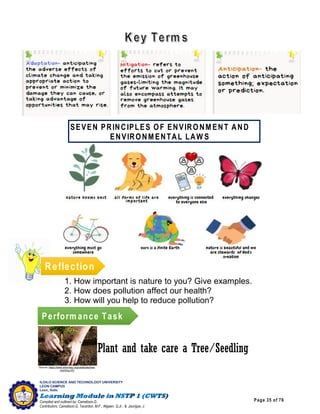
SEVEN PRINCIPLES OF ENVIRONM ENT AND
ENVIRONM ENTAL LAW S
Reflection
1. How important is nature to you? Give examples.
2. How does pollution affect our health?
3. How will you help to reduce pollution?
Source: https://www.arborday.org/celebrate/tree-
planting.cfm
Plant and take care a Tree/Seedling
Perform ance Task
Page 36 of 76
ILOILO SCIENCE AND TECHNOLOGY UNIVERSITY
LEON CAMPUS
Leon, Iloilo
Compiled and outlined by: Camatison,G.
Contributors: Camatison,G, Tacardon, M.F., Aligaen, Q.Jr., & Jaurigue, J.
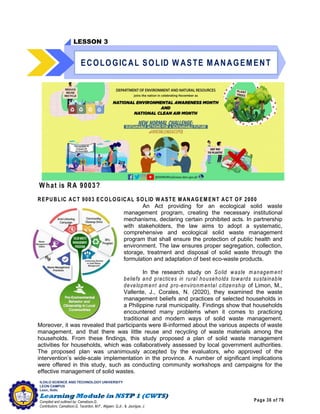
W hat is RA 9003?
REPUBLIC ACT 9003 ECOLOGICAL SOLID W ASTE M ANAG EM ENT ACT OF 2000
An Act providing for an ecological solid waste
management program, creating the necessary institutional
mechanisms, declaring certain prohibited acts. In partnership
with stakeholders, the law aims to adopt a systematic,
comprehensive and ecological solid waste management
program that shall ensure the protection of public health and
environment. The law ensures proper segregation, collection,
storage, treatment and disposal of solid waste through the
formulation and adaptation of best eco-waste products.
In the research study on Solid waste managem ent
beliefs and practices in rural households towards sustainable
developm ent and pro-environm ental citizenship of Limon, M.,
Vallente, J., Corales, N. (2020), they examined the waste
management beliefs and practices of selected households in
a Philippine rural municipality. Findings show that households
encountered many problems when it comes to practicing
traditional and modern ways of solid waste management.
Moreover, it was revealed that participants were ill-informed about the various aspects of waste
management, and that there was little reuse and recycling of waste materials among the
households. From these findings, this study proposed a plan of solid waste management
activities for households, which was collaboratively assessed by local government authorities.
The proposed plan was unanimously accepted by the evaluators, who approved of the
intervention’s wide-scale implementation in the province. A number of significant implications
were offered in this study, such as conducting community workshops and campaigns for the
effective management of solid wastes.
LESSON 3
ECOLOGICAL SOLID W ASTE MANAGEMENT
Page 37 of 76
ILOILO SCIENCE AND TECHNOLOGY UNIVERSITY
LEON CAMPUS
Leon, Iloilo
Compiled and outlined by: Camatison,G.
Contributors: Camatison,G, Tacardon, M.F., Aligaen, Q.Jr., & Jaurigue, J.
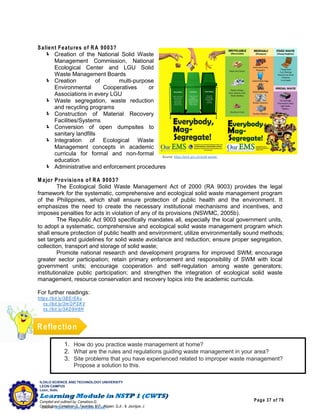
Salient Features of RA 9003?
 Creation of the National Solid Waste
Management Commission, National
Ecological Center and LGU Solid
Waste Management Boards
 Creation of multi-purpose
Environmental Cooperatives or
Associations in every LGU
 Waste segregation, waste reduction
and recycling programs
 Construction of Material Recovery
Facilities/Systems
 Conversion of open dumpsites to
sanitary landfills
 Integration of Ecological Waste
Management concepts in academic
curricula for formal and non-formal
education
 Administrative and enforcement procedures
M ajor Provisions of RA 9003?
The Ecological Solid Waste Management Act of 2000 (RA 9003) provides the legal
framework for the systematic, comprehensive and ecological solid waste management program
of the Philippines, which shall ensure protection of public health and the environment. It
emphasizes the need to create the necessary institutional mechanisms and incentives, and
imposes penalties for acts in violation of any of its provisions (NSWMC, 2005b).
The Republic Act 9003 specifically mandates all, especially the local government units,
to adopt a systematic, comprehensive and ecological solid waste management program which
shall ensure protection of public health and environment; utilize environmentally sound methods;
set targets and guidelines for solid waste avoidance and reduction; ensure proper segregation,
collection, transport and storage of solid waste;
Promote national research and development programs for improved SWM; encourage
greater sector participation; retain primary enforcement and responsibility of SWM with local
government units; encourage cooperation and self-regulation among waste generators;
institutionalize public participation; and strengthen the integration of ecological solid waste
management, resource conservation and recovery topics into the academic curricula.
For further readings:
https://bit.ly/3BErSAu
https://bit.ly/3mOPSKV
https://bit.ly/3AD8H8H
Source: https://emb.gov.ph/solid-waste/
Source: https://em b.gov.ph/solid-waste/
Reflection
1. How do you practice waste management at home?
2. What are the rules and regulations guiding waste management in your area?
3. Site problems that you have experienced related to improper waste management?
Propose a solution to this.
Page 38 of 76
ILOILO SCIENCE AND TECHNOLOGY UNIVERSITY
LEON CAMPUS
Leon, Iloilo
Compiled and outlined by: Camatison,G.
Contributors: Camatison,G, Tacardon, M.F., Aligaen, Q.Jr., & Jaurigue, J.
Republic of the Philippines
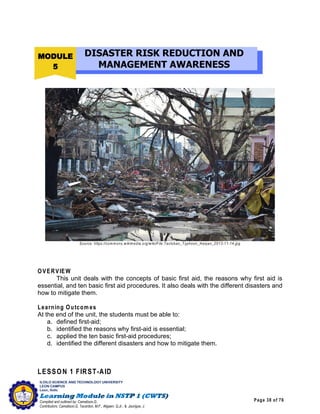
Source: https://com m ons.wikim edia.org/wiki/File:Tacloban_Typhoon_Haiyan_2013-11-14.jpg
OVERVIEW
This unit deals with the concepts of basic first aid, the reasons why first aid is
essential, and ten basic first aid procedures. It also deals with the different disasters and
how to mitigate them.
Learning Outcom es
At the end of the unit, the students must be able to:
a. defined first-aid;
b. identified the reasons why first-aid is essential;
c. applied the ten basic first-aid procedures;
d. identified the different disasters and how to mitigate them.
LESSON 1 FIRST-AID
MODULE
5
DISASTER RISK REDUCTION AND
MANAGEMENT AWARENESS
Page 39 of 76
ILOILO SCIENCE AND TECHNOLOGY UNIVERSITY
LEON CAMPUS
Leon, Iloilo
Compiled and outlined by: Camatison,G.
Contributors: Camatison,G, Tacardon, M.F., Aligaen, Q.Jr., & Jaurigue, J.
Source: The Top 5 First Aid Tips & Tricks – Ajuda ajuda.org.uk
W hat is First Aid?
First aid refers to medical attention that is usually administered immediately after the
injury occurs and at the location where it occurred. It often consists of a one-time, short-term
treatment and requires little technology or training to administer.
5 Reasons W hy Basic First Aid Know ledge is Essential
There are numerous reasons why people don’t take First Aid training programs;
 They are too busy
 They don’t know where to go
 They think that they already have enough knowledge, or
 They think that accidents happen to other people not to them or their friends, family
and colleagues.
10 Basic First Aid Procedures (Brouhard & Menna, 2021)
Basic first aid procedures can help you get someone through a medical crisis, at least
until the paramedics arrive or you can get them to a hospital. The best way to prepare for these
events is to get official first aid training, such as that offered by the American Red Cross.
First aid is the care a sick or injured person gets before they get full medical treatment.
In some cases, it may be the only care someone needs, while in others, it may keep them safe
until paramedics arrive or someone else gets them to the hospital.
First aid can include everything from bandaging a minor wound to preventing shock to
keeping someone's heart beating during a cardiac event. Ideally, it should be performed by
someone who's taken a class and is certified in first aid, but if no one is available, anyone with
some basic knowledge can pitch in.
When someone is unconscious or unresponsive, a basic tenet of first aid is ABC:
 Airw ay: If someone's not breathing, clear their airway.
 Breathing: If the airway is clear and they're still not breathing, provide rescue breathing.
 Circulation: Chest compressions to keep blood circulating should be performed along
with rescue breathing. If the person is breathing but unresponsive, check their pulse to
see if their heart has stopped and, if so, provide chest compressions.
An alternate and sim pler version of the ABCs is:
1) Aw ake? If not, try to wake them. If they don't wake up, make sure someone is calling
911 and move on to B.
2) Breathing? If not, start rescue breathing and chest compressions. If so, move on to
Page 40 of 76
ILOILO SCIENCE AND TECHNOLOGY UNIVERSITY
LEON CAMPUS
Leon, Iloilo
Compiled and outlined by: Camatison,G.
Contributors: Camatison,G, Tacardon, M.F., Aligaen, Q.Jr., & Jaurigue, J.
C.
3) Continue care: Follow instructions from 911 or continue treatment until an
ambulance arrives.
Some courses also include D and possibly E, as well:
4) D can stand for disability assessm ent, which is fairly complicated for someone
without medical training. It also sometimes stands for deadly bleeding, which needs
to be stopped, or defibrillator if someone's heart has stopped and an automated
external defibrillator (AED) device is available.
5) E stands for examination—evaluating the person for signs of injury, bleeding,
allergies, or other problems once you know they're breathing and their heart is
beating.
W hat is an AED?
An AED, or automated external defibrillator, is a portable, easy-to-use device that can
check someone's heart rhythm and, if necessary, deliver an electric shock to correct the rhythm.
Cardiopulm onary resuscitation (CPR) is the most important
medical procedure of all. If a person is in cardiac arrest (the heart is
no longer pumping blood) and CPR is not performed, that person will
die. On the other hand, performing CPR or using an AED could save
a life. AEDs are available in many public areas and
businesses. These devices are simplified for use even if you have
never been trained. CPR training will include getting familiar with
AED use, which can save valuable time if you need to use one.
First Aid for Suspected Cardiac Arrest
When you suspect someone is in cardiac arrest:
1. Get someone to call 911 or the medical alert system for your location.
2. Start chest compressions immediately. Push down hard and fast in the center of the
chest, allowing the chest to come back up naturally between compressions. Continue
until someone with more training has arrived.
3. If you're trained in CPR, use chest compressions and rescue breathing.
4. Use an AED if one is available. It's important to not delay chest compressions, though,
so have someone else find one while you do chest compressions.
Taking a formal CPR class will help you become familiar with chest compressions,
rescue breathing, and AED use, and that can make all the difference if you're around when
someone has a heart attack. To take a class, contact your local chapter of the American Red
Cross or look online for classes in your community. You can also take an online-only class if
none are available in your area.
Bleeding is usually fairly obvious, especially if it's severe. While it is important to stop
the bleeding, remember the ABCs and check first for something more serious.
Regardless of severity, almost all bleeding can be controlled, so don't think you can't help
someone who's bleeding a lot. If severe bleeding is allowed to continue, it can lead to shock and,
eventually, death.4
It's easy to overestimate the amount of blood loss you're witnessing. To get an accurate
assessment of what type of bleeding it is, look at its color and how it's leaving the body.
 Capillaries: Bleeding from capillaries, which are the smallest blood vessels, looks like a
trickle and will usually stop on its own.
 Veins: A consistent blood flow and blood that's a dark red color is most likely coming
from the veins. It can result in anywhere from mild to severe bleeding that can be rapid.
Source: American Heart Association
CPR & First Aid cpr.heart.org
Page 41 of 76
ILOILO SCIENCE AND TECHNOLOGY UNIVERSITY
LEON CAMPUS
Leon, Iloilo
Compiled and outlined by: Camatison,G.
Contributors: Camatison,G, Tacardon, M.F., Aligaen, Q.Jr., & Jaurigue, J.
 Arteries: Arteries are the largest blood vessels and are under pressure, so blood spurts
from the wound. It's also bright red, as it carries more oxygen. Blood can be lost most
rapidly from an arterial bleed and it's always considered an emergency.
Source: Gene therapy stops haemophilia patients ns-healthcare.com
First Aid for Bleeding
If you're faced with bleeding:
1. Rinse the wound with water if possible.
2. Cover the wound with a gauze or cloth (towel, blanket, clothing, whatever's available).
3. Apply direct pressure to stop the blood flow and encourage clotting.
4. If possible, elevate the bleeding body part above the heart.
5. Don't remove the cloth if it becomes soaked through, but add more layers if needed.
Removing the first layer will interfere with the clotting process and result in more blood
loss.
6. Once bleeding is stopped, apply a clean bandage.
Get medical help when the wound:
 Is deep
 Has widely separated sides
 Oozes blood after pressure has been applied
 Is from a bite (human or animal)
 Is a puncture, burn, or electrical injury
Should You Use a Tourniquet?
Using a tourniquet is somewhat controversial except in
dire emergencies in which a person's life could be at
stake. Some argue that tourniquets can do more harm
than good, possibly leading to a limb amputation due to
tissue damage.
A 2018 review of published research found that
some arterial injury and limb damage were reported,
but infrequently. However, the studies they examined
had a lot of shortcomings and inconsistencies. The
researchers called for standardized data collection of limb trauma and tourniquet use to help
determine their safety and effectiveness.
The value of using elevation or pressure points (pressing on an artery to slow blood flow) is
debated, with some experts and organizations saying to use them and others leaving these
steps out of their first aid instruction.
Choking due to a windpipe obstruction is a serious situation that can make someone lose
consciousness and even die if the obstruction isn't removed.
Source: How to make a tourniquet | Sunrise Hospital
sunrisehospital.com
Page 42 of 76
ILOILO SCIENCE AND TECHNOLOGY UNIVERSITY
LEON CAMPUS
Leon, Iloilo
Compiled and outlined by: Camatison,G.
Contributors: Camatison,G, Tacardon, M.F., Aligaen, Q.Jr., & Jaurigue, J.
Procedures are different for babies who are less than a year old.
Source: Choking first aid for kids: in pictures raisingchildren.net.au
HOW TO HELP A CHOKING INFANT
Before you start first aid on someone for choking, make sure they really need it. If they're
coughing or talking, leave them alone. That's not really choking. Signs of choking include:
 Gagging, gasping, or wheezing
 Inability to talk or make noise
 Turning blue in the face
 Grabbing at the throat
 Waving arms
 Appearing panicked
If the person is conscious and old enough to respond properly, ask if they're choking before you
start first aid. In anyone but an infant, that means performing the Heimlich maneuver.
First Aid for Choking
To perform the Heimlich maneuver:
1. Stand behind the person and lean them slightly forward
2. Put your arms around their waist
3. Clench a fist and place it between their navel and rib cage
4. Grab your fist with your other hand
5. Pull the clenched fist sharply backward and upward under their rib cage in 5 quick
thrusts. Repeat until the object is coughed up.
For someone who's obese or pregnant, perform thrusts around the chest instead of the
abdomen.
If someone is unconscious:
1. Place them on their back and kneel over them
2. Place the heel of your hand slightly above the navel
3. Place your other hand on top of it
4. Give quick upward thrusts to dislodge the obstruction
Burn
The first step to treating a burn is to stop the burning process. Chemicals need to be
cleaned off. Electricity needs to be turned off. Heat needs to be cooled down with running water.
Sunburn victims need to be covered up or go inside.
No matter what caused the burns or how bad they are, stopping the burn comes before treating
the burn.
Page 43 of 76
ILOILO SCIENCE AND TECHNOLOGY UNIVERSITY
LEON CAMPUS
Leon, Iloilo
Compiled and outlined by: Camatison,G.
Contributors: Camatison,G, Tacardon, M.F., Aligaen, Q.Jr., & Jaurigue, J.
Source: Initial Treatment For Burns In Children forbes.com
The severity of a burn is based on its depth and size:
 First-degree burn: This affects only the outer layer of skin and causes redness and
swelling. It is always considered a minor burn.
 Second-degree burn: This affects two layers of skin and causes blistering along with
redness and swelling. It is considered a major burn if it's more than 3 inches wide or on
the face, hands, feet, genitals, buttocks, or over a major joint.
 Third-degree burns: This affects deeper layers of skin and causes white or blackened
skin that may be numb. It is always considered a major burn.
First Aid for Burns
Take these first aid steps:
1. Flush the burned area with cool running water for several minutes. Do not use ice.
2. Apply a light gauze bandage.
3. Take ibuprofen or acetaminophen for pain relief if necessary.
4. Do not break any blisters that may have formed.
Do not apply ointments, butter, or oily remedies to a burn.
Blister
Whether a blister needs any treatment is debatable. If the blister is small, unbroken, and
not very painful, it's probably best to leave it alone. Cover it to prevent continued rubbing and
pressure that could cause it to swell more and possibly burst on its own.
Blisters are designed to protect the damaged skin underneath while it heals. Popping them not
only disrupts this natural healing process, but it can also let in bacteria that cause an infection.
Source: Blisters on the Hands.medicinenet.com
First Aid for Blisters
If the blister is large or painful—especially if the activity that caused it isn’t finished (such as
if you are in the middle of a hike)—follow these steps to drain and dress a blister:
1. Wash your hands and sterilize a needle with alcohol.
2. Make small punctures at the edge of the blister.
3. Gently push the fluid out.
4. Apply antibiotic ointment.
5. Bandage it.
6. If possible, take steps to protect the area from further rubbing or pressure.
If the blister broke open on its ow n:
1. Gently wash with clean water only.
Page 44 of 76
ILOILO SCIENCE AND TECHNOLOGY UNIVERSITY
LEON CAMPUS
Leon, Iloilo
Compiled and outlined by: Camatison,G.
Contributors: Camatison,G, Tacardon, M.F., Aligaen, Q.Jr., & Jaurigue, J.
2. Smooth the flap of broken skin over the newly exposed skin, unless it's dirty, torn, or pus
has gathered under it.
3. Apply petroleum jelly.
4. Bandage it.
Change the bandage any time it gets wet. Take it off when you go to bed so the area can dry.
Broken bone/fracture
Any injury to your limbs, hands, and feet needs to be treated as a broken bone (fracture)
until an X-ray can confirm whether it's broken. While fractures do need medical treatment so
they can heal properly, they don't all require an ambulance or an emergency trip to the hospital.
Source: Understanding Fractures – Prevention webmd.com
However, you should call 911 or medical hotlines in your area immediately if:
 The person is bleeding profusely, unconscious or unresponsive, not breathing, or has
numerous injuries (try to stop the bleeding or start CPR if necessary)
 You suspect a fracture or other serious injury to the spinal column, head, hip, pelvis, or
thigh—the person should not be moved except by trained medical personnel
 A broken bone protrudes from the skin (called an open or compound fracture)
 The area below an injured joint feels cold and clammy or becomes bluish
 You can't immobilize the injury well enough to transport the person
Otherwise, after using first aid, you can go to urgent care or contact your healthcare
provider's office and ask for guidance. They'll likely want to see the injured person right away so
any broken bone(s) can be properly set and treated.
First Aid for Suspected Fracture
Take these steps for a suspected fracture:
1. Don't try to straighten it.
2. For a limb, use a splint and padding to immobilize it.
3. Put a cold pack on the injury, with a barrier between it and the skin to prevent tissue
damage. If ice is all that's available, put it in a plastic bag and wrap it in a shirt or towel.
4. If it's an extremity, elevate it.
5. Give anti-inflammatory drugs like Advil (ibuprofen) or Aleve (naproxen) for pain.
Research has shown that non-steroidal anti-inflammatory drugs (NSAIDs) like Advil
and Aleve can slow bone healing, which is a process that depends on inflammation.
However, short-term NSAID use appears to have little or no effect and doesn't appear to
have a significant effect on bone healing in children.21
So it should be safe to use these
medications to help the person get through the intense, acute pain that follows a fracture.
Sprain
A sprain is an injury to ligaments, which are connective tissues that holds bones,
Page 45 of 76
ILOILO SCIENCE AND TECHNOLOGY UNIVERSITY
LEON CAMPUS
Leon, Iloilo
Compiled and outlined by: Camatison,G.
Contributors: Camatison,G, Tacardon, M.F., Aligaen, Q.Jr., & Jaurigue, J.
cartilage, and joints together. Sprains are generally caused by a violent wrenching or twisting of
a joint, which over-stretches or tears the ligament. Common places for a sprain are
the ankle and wrist.
Source: Midfoot Sprain | Upswing Health upswinghealth.com
The symptoms of a sprain are almost exactly the same as those of a broken bone
(barring a compound fracture or visible deformities). Because even a healthcare provider may
not be sure whether it's a break or sprain until after an X-ray, first aid for sprains should be
largely the same as for broken bones.
The first thing to do is make sure the injured person stops any unnecessary activity so
they don't make the injury worse. Then you can begin first aid.
First Aid for Sprains
For a suspected sprain:
1. Immobilize the limb
2. Apply a cold pack
3. Elevate the injured part if you can do so safely
4. Use NSAIDs for pain
See your healthcare provider soon for further diagnosis and treatment.
As with fractures, sprains often don't require emergency treatment. However, you should get
immediate medical care if the injured person has:
 Severe pain with movement or touch
 Ongoing inability to bear weight on the injured joint
 Increased bruising
 Numbness or pins-and-needles near the sprain
 Signs of infection
 Little or no improvement during the first week
Nosebleed
Most of us have had a bloody nose at some time in our lives. It simply means bleeding
from the inside of the nose due to trauma. The biggest cause of a nosebleed is digital trauma—
otherwise known as picking it. It can also be caused by environmental factors, medical
conditions (some minor, some serious), medications, and recreational drugs. Causes include:
 Dry or hot air
 High altitudes
 Chemical fumes that irritate the nasal passage
 Colds and allergies
 Blowing your nose hard or often
 Trauma to the nose
 Deviated septum
 Nasal polyps or tumors
 Bleeding disorders,
including hemophilia and leukemia
 High blood pressure (hypertension)
Source: Got a nosebleed? Stay calm, sit down
scmp.com
Source: Got a nosebleed? Stay calm, sit down
scmp.com
Page 46 of 76
ILOILO SCIENCE AND TECHNOLOGY UNIVERSITY
LEON CAMPUS
Leon, Iloilo
Compiled and outlined by: Camatison,G.
Contributors: Camatison,G, Tacardon, M.F., Aligaen, Q.Jr., & Jaurigue, J.
 Pregnancy
 Frequent use of nasal sprays, decongestants, and antihistamines
 NSAIDs
 Blood thinners such as Coumadin (warfarin)
 Cocaine and other inhaled drugs
First Aid for Nosebleed
The first aid for nosebleed includes:
1. Lean slightly forward, not back.
2. Pinch the nose just below the bridge, high enough that the nostrils aren't pinched closed.
3. Check after five minutes to see if bleeding has stopped. If not, continue pinching and
check after another 10 minutes.
4. You can also apply a cold pack to the bridge of the nose while pinching.
See a healthcare provider if:
 You get frequent nosebleeds
 You have anemia symptoms (weakness, faintness, fatigue, pale skin)
 You're taking blood thinners
 You have a clotting disorder
 You just started a new medication
 You also have unusual bruising
A nosebleed needs emergency medical treatment when:
 It won't stop even after more than 15 minutes of direct pressure
 You're losing a lot of blood
 You have a hard time breathing
 You've swallowed a lot of blood and vomited it up
 You've had a serious injury or a blow to the head
Bee stings
Bee stings are annoyingly painful for most people, but they
can be deadly for those who are allergic to bee venom.
First Aid for Bee-Venom Allergy
If the person who was stung has a known allergy to bee
stings, use an EpiPen to prevent anaphylaxis. An allergy to bees
can develop at any time, even in someone who's been stung
many times before, so it's important to always watch for signs
of an allergic reaction after a sting. Just about any bee sting will
cause pain, redness, and swelling. In an allergic reaction, look for:
 Swelling away from the area that was stung
 Flushing
 Hives
 Itching
 Signs of anaphylaxis, which include impaired breathing and shock (anxiety, bluish lips
and fingernails, chest pain, confusion, dizziness, profuse sweating, and skin that's pale,
cool, and clammy)
Call 911 or hotlines near your area immediately or get the person to the hospital if any of these
signs appear.
Source: Bee and Wasp Stings
health.clevelandclinic.org
Page 47 of 76
ILOILO SCIENCE AND TECHNOLOGY UNIVERSITY
LEON CAMPUS
Leon, Iloilo
Compiled and outlined by: Camatison,G.
Contributors: Camatison,G, Tacardon, M.F., Aligaen, Q.Jr., & Jaurigue, J.
First Aid for Bee Stings
Follow these steps for bee sting first aid:
1. Get the stinger out any way you can to keep it from injecting more venom. The method
doesn't matter—it's most important to do it quickly.
2. Wash the area with soap and water.
3. Use a cold pack to reduce swelling at the site, but don't apply ice directly to the skin.
4. Use an antihistamine like Benadryl (diphenhydramine) to reduce swelling and itching.
5. Use Advil or Tylenol for pain.
Frequently Asked Questions
W hat are the ABCs of first aid?
ABC in first aid traditionally stands for airway, breathing, and circulation. When someone
is unconscious or unresponsive, you should check and clear their airway and provide rescue
breathing and chest compressions. ABC can also stand for awake, breathing, and continue care.
W hat are com m on first-aid procedures?
First-aid procedures covered in a basic course include CPR, the Heimlich maneuver, and how
to assess and treat minor injuries including wounds, burns, sprains, and broken bones.30
W hat are the three Ps of first aid?
The three Ps of first aid are:
 Preserve life
 Prevent deterioration
 Promote recovery
BLS stands for Basic Life Support.
Training that includes Healthcare Provider level skills such as 2-person CPR, pulse
checks, bag valve mask use, and rescue breathing without compressions for people that have a
pulse.
W hat is the BLS sequence of steps?
The 2010 AHA Guidelines for CPR and ECC recommend a change in the BLS sequence
of steps from A-B-C (Airway, Breathing, Chest compressions) to C-A-B (Chest compressions,
Airway, Breathing) for adults, children, and infants (excluding the newly born; see Neonatal
Resuscitation section).
W hat is taught in BLS?
BLS Basics
The basic skills you'll learn in a BLS provider course include single rescuer CPR, team-based
CPR, choking relief, and AED operation for adults, children, and infants—all things you would
need to resuscitate unresponsive victims or provide immediate treatment.
Source: Basic Life Support Images, Stock Photos shutterstock.com
Page 48 of 76
ILOILO SCIENCE AND TECHNOLOGY UNIVERSITY
LEON CAMPUS
Leon, Iloilo
Compiled and outlined by: Camatison,G.
Contributors: Camatison,G, Tacardon, M.F., Aligaen, Q.Jr., & Jaurigue, J.
W hat is the difference between basic life support and first aid?
The difference between BLS and CPR is that the BLS class is an advanced CPR AED
course. If you are not a medical/healthcare professional the best course for you would be a
standard CPR AED course with or without First aid. As, the BLS would not be required of you.
First-aid Kit
A first aid kit is a collection of supplies and equipment that is used to give medical
treatment. There is a wide variation in the contents of first aid kits based on the knowledge and
experience of those putting it together, the differing first aid requirements of the area where it
may be used, and variations in legislation or regulation in a given area.
Commercially available first aid kits available via normal retail routes have traditionally
been intended for treatment of minor injuries only. Typical contents include adhesive bandages,
regular strength pain medication, gauze and low grade disinfectant.
Specialized first aid kits are available for various regions, vehicles or activities, which
may focus on specific risks or concerns related to the activity. For example, first aid kits sold
through marine supply stores for use in watercraft may contain seasickness remedies.
Airw ay, Breathing and Circulation
First aid treats the ABCs as the foundation of good treatment. For this reason, most
modern commercial first aid kits (although not necessarily those assembled at home) will
contain a suitable infection barrier for performing artificial respiration as part of cardiopulmonary
resuscitation, examples include:
 Pocket mask
 Face shield
Advanced first aid kits may also contain items such as:
 Oropharyngeal airway
 Nasopharyngeal airway
 Bag valve mask
 Manual aspirator or suction unit
 Sphygmomanometer (blood pressure cuff)
 Stethoscope
Some first aid kits, specifically those used by event first aiders and emergency services,
include bottled oxygen for resuscitation and therapy.
A pocket mask in its case Adhesive bandages Plastic tweezers Disposable gloves
Page 49 of 76
ILOILO SCIENCE AND TECHNOLOGY UNIVERSITY
LEON CAMPUS
Leon, Iloilo
Compiled and outlined by: Camatison,G.
Contributors: Camatison,G, Tacardon, M.F., Aligaen, Q.Jr., & Jaurigue, J.
Com m on Kit Item s
Thermometer Cotton balls or swabs Hand sanitizer
Adhesive dressings Emergency blanket Ice pack
Antiseptic solution Eyewash Saline
Antiseptic wipes Gauze Tissues
Bandages Gloves Tweezers
a leaflet giving first aid guidance
Personal protective equipm ent
A waterproof Pelican first aid kit.
The use of personal protective equipment or PPE will vary by the
kit, depending on its use and anticipated risk of infection. The
adjuncts to artificial respiration are covered above, but other
common infection control PPE includes:
 Gloves which are single-use and disposable to prevent
cross infection
 Goggles or other eye protection
 Surgical mask or N95 mask to reduce the possibility of
airborne infection transmission (sometimes placed on
patient instead of caregivers. For this purpose the
mask should not have an exhale valve)
 Apron
INSTRUM ENTS AND EQUIPMENT
 Trauma shears for cutting clothing and general use
 Scissors are less useful but often included (usually to cut medical equipment off or
smaller)
 Tweezers, for removing splinters amongst others.
 Lighter for sanitizing tweezers or pliers etc.
 Alcohol pads for sanitizing equipment, or unbroken skin. This is sometimes used to
debride wounds, however some training authorities advise against this as it may kill
cells which bacteria can then feed on
 Irrigation syringe - with catheter tip for cleaning wounds with sterile water, saline
solution, or a weak iodine solution. The stream of liquid flushes out particles of dirt
and debris.
 Torch (also known as a flashlight)
 Instant-acting chemical cold packs
 Alcohol rub (hand sanitizer) or antiseptic hand wipes
 Thermometer
 Space blanket (lightweight plastic foil blanket, also known as "emergency blanket")
 Penlight, cotton swab, cotton wool for applying antiseptic lotion
 safety pins, for pinning bandages.
M edication
Medication can be a controversial addition to a first aid kit, especially if it is for use on
members of the public. It is, however, common for personal or family first aid kits to contain
Page 50 of 76
ILOILO SCIENCE AND TECHNOLOGY UNIVERSITY
LEON CAMPUS
Leon, Iloilo
Compiled and outlined by: Camatison,G.
Contributors: Camatison,G, Tacardon, M.F., Aligaen, Q.Jr., & Jaurigue, J.
certain medications. Dependent on scope of practice, the main types of medicine are life saving
medications, which may be commonly found in first aid kits used by paid or assigned first aiders
for members of the public or employees, painkillers, which are often found in personal kits, but
may also be found in public provision and lastly symptomatic relief medicines, which are
generally only found in personal kits.
Pain killers
 Paracetamol (also known as acetaminophen) is one of the most common pain killing
medication, as either tablet or syrup
 Anti-inflammatory painkillers such as ibuprofen, naproxen or other NSAIDs can be used
as part of treating sprains and strains
 Codeine which is both a painkiller and anti-diarrheal
Sym ptom atic relief
 Anti diarrhea medication such as loperamide - especially important in remote or third
world locations where dehydration caused by diarrhea is a leading killer of children
 Oral rehydration salts
 Antihistamine, such as diphenhydramine
 Poison treatments
 Absorption, such as activated charcoal, Enterosgel and Atoxyl.
 Emetics to induce vomiting, such as syrup of ipecac although first aid manuals now
advise against inducing vomiting.
 Smelling salts (ammonium carbonate)
Topical m edications
Antiseptics / disinfectants. Antiseptic fluid, moist wipe or spray- For cleaning and
disinfecting a wound. Typically benzalkonium chloride, which disinfects wounds with minimal
stinging or harm to exposed tissue. Can also be used as an antibacterial hand wipe for the
person providing aid.
Povidone iodine is an antiseptic in the form of liquid, swabstick, or towelette. Can be
used in a weak dilution of clean water to prepare an irrigation solution for cleaning a wound.
Hydrogen peroxide is often included in home first aid kits, but is a poor choice for
disinfecting wounds- it kills cells and delays healing
Alcohol pads- sometimes included for disinfecting instruments or unbroken skin (for
example prior to draining a blister), or cleaning skin prior to applying an adhesive bandage.
Alcohol should not be used on an open wound, as it kills skin cells and delays healing.
M edicated antiseptic ointm ents- for preventing infection in a minor wound, after it is
cleaned. Not typically used on wounds that are bleeding heavily. Ointments typically contain one,
two, or all three of the following antibacterial ingredients (those containing all three are typically
called 'triple-antibiotic ointment') neomycin, polymyxin B sulfate or bacitracin zinc.
Burn gel - a water-based gel that acts as a cooling agent and often includes a mild
anaesthetic such as lidocaine and, sometimes, an antiseptic such as tea tree oil
Anti-itch ointm ent
 Hydrocortisone cream
 antihistamine cream containing diphenhydramine
 Calamine lotion, for skin inflammations.
 Anti-fungal cream
 Tincture of benzoin - often in the form of an individually sealed swabstick or ampule,
protects the skin and aids the adhesion of adhesive bandages, such as
moleskin, Band-Aids, or wound closure ('butterfly') strips.
Page 51 of 76
ILOILO SCIENCE AND TECHNOLOGY UNIVERSITY
LEON CAMPUS
Leon, Iloilo
Compiled and outlined by: Camatison,G.
Contributors: Camatison,G, Tacardon, M.F., Aligaen, Q.Jr., & Jaurigue, J.
W orkplace first aid kits
In the United States, the Occupational Safety and Health Administration (OSHA)
requires all job sites and workplaces to make available first aid equipment for use by injured
employees. While providing regulations for some industries such as logging in general the
regulation lack specifics on the contents of the first aid kit. This is understandable, as the
regulation covers every means of employment, and different jobs have different types of injuries
and different first-aid requirements.
In general, the type of first aid facilities required in a workplace are determined by many
factors, such as:
◦ the laws and regulation of the state or territory in which it is located;
◦ the type of industry concerned; for example, industries such as mining may have
specific industry regulations detailing specialised instructions;
◦ the type of hazards present in the workplace;
◦ the number of employees in the workplace;
◦ the number of different locations that the workplace is spread over;
◦ the proximity to local services (doctors, hospital, ambulance).
1. Do you need to learn first-aid? Yes or No. Explain your answer.
2. Have you had any first-aid experience? Yes or No. What, when, where and how?
Elaborate your answer
3. If I’m alone at an accident site, how important is it to call a responder or assist the
person? Explain your answer.
Lesson 2: Disaster
A disaster is a serious problem occurring over a short or long period of time that causes
widespread human, material, economic or environmental loss which exceeds the ability of the
affected community or society to cope using its own resources. It is a sudden calamitous event
bringing great damage, loss, or destruction (Merriam-Webster, 2021).
Disasters are serious disruptions to the functioning of a community that exceed its
capacity to cope using its own resources. Disasters can be caused by natural, man-made and
technological hazards, as well as various factors that influence the exposure and vulnerability of
a community (https://www.ifrc.org/what-disaster).
Source: ICTs 4 Disaster Management itu.int
Page 52 of 76
ILOILO SCIENCE AND TECHNOLOGY UNIVERSITY
LEON CAMPUS
Leon, Iloilo
Compiled and outlined by: Camatison,G.
Contributors: Camatison,G, Tacardon, M.F., Aligaen, Q.Jr., & Jaurigue, J.
The following table categorizes some disasters and notes first response initiatives.
Natural
Disaster
Example Profile First response
Avalanche
The sudden, drastic flow of snow down a slope,
occurring when either natural triggers, such as
loading from new snow or rain, or artificial
triggers, such as explosives or backcountry
skiers, overload the snowpack
Shut off utilities; Evacuate building if
necessary; Determine impact on the
equipment and facilities and any
disruption
Blizzard
A severe snowstorm characterized by very
strong winds and low temperatures
Power off all equipment; listen to
blizzard advisories; Evacuate area, if
unsafe; Assess damage
Earthquake
The shaking of the earth's crust, caused by
underground volcanic forces of breaking and
shifting rock beneath the earth's surface
Shut off utilities; Evacuate building if
necessary; Determine impact on the
equipment and facilities and any
disruption
Fire (wild)
Fires that originate in uninhabited areas and
which pose the risk to spread to inhabited areas
Attempt to suppress fire in early
stages; Evacuate personnel on alarm,
as necessary; Notify fire department;
Shut off utilities; Monitor weather
advisories
Flood
Flash flooding: Small creeks, gullies, dry
streambeds, ravines, culverts or even low-lying
areas flood quickly
Monitor flood advisories; Determine
flood potential to facilities; Pre-stage
emergency power generating
equipment; Assess damage
Freezing rain
Rain occurring when outside surface
temperature is below freezing
Monitor weather advisories; arrange
for snow and ice removal
Heat wave
A prolonged period of excessively hot weather
relative to the usual weather pattern of an area
and relative to normal temperatures for the
season
Listen to weather advisories; Power-off
all servers after a graceful shutdown if
there is imminent potential of power
failure; Shut down main electric circuit
usually located in the basement or the
first floor
Hurricane Heavy rains and high winds
Power off all equipment; listen to
hurricane advisories; Evacuate area, if
flooding is possible; Check gas, water
and electrical lines for damage; Do not
use telephones, in the event of severe
lightning; Assess damage
Landslide
Geological phenomenon which includes a range
of ground movement, such as rock falls, deep
failure of slopes and shallow debris flows
Shut off utilities; Evacuate building if
necessary; Determine impact on the
equipment and facilities and any
disruption
Lightning
strike
An electrical discharge caused by lightning,
typically during thunderstorms
Power off all equipment; listen to
hurricane advisories; Evacuate area, if
flooding is possible; Check gas, water
and electrical lines for damage; Do not
use telephones, in the event of severe
lightning; Assess damage
Page 53 of 76
ILOILO SCIENCE AND TECHNOLOGY UNIVERSITY
LEON CAMPUS
Leon, Iloilo
Compiled and outlined by: Camatison,G.
Contributors: Camatison,G, Tacardon, M.F., Aligaen, Q.Jr., & Jaurigue, J.
Limnic
eruption
The sudden eruption of carbon dioxide from
deep lake water
Shut off utilities; Evacuate building if
necessary; Determine impact on the
equipment and facilities and any
disruption
Tornado
Violent rotating columns of air which descend
from severe thunderstorm cloud systems
Monitor tornado advisories; Power off
equipment; Shut off utilities (power
and gas); Assess damage once storm
passes
Tsunami
A series of waves hitting shores strongly, mainly
caused by the displacement of a large volume
of a body of water, typically an ocean or a large
lake, usually caused by earthquakes, volcanic
eruptions, underwater explosions, landslides,
glacier calvings, meteorite impacts and other
disturbances above or below water
Power off all equipment; listen to
tsunami advisories; Evacuate area, if
flooding is possible; Check gas, water
and electrical lines for damage;
Assess damage
Volcanic
eruption
The release of hot magma, volcanic ash and/or
gases from a volcano
Shut off utilities; Evacuate building if
necessary; Determine impact on the
equipment and facilities and any
disruption
Human-
made
Bioterrorism
The intentional release or dissemination of
biological agents as a means of coercion
Get information immediately
from public health officials via the
news media as to the right course of
action; If you think you have been
exposed, quickly remove your clothing
and wash off your skin; put on
a HEPA to help prevent inhalation of
the agent
Civil unrest
A disturbance caused by a group of people that
may include sit-ins and other forms of
obstructions, riots, sabotage and other forms of
crime, and which is intended to be a
demonstration to the public and the
government, but can escalate into general
chaos
Contact local police or law
enforcement
Fire (urban)
Even with strict building fire codes, people still
perish needlessly in fires
Attempt to suppress fire in early
stages; Evacuate personnel on alarm,
as necessary; Notify fire department;
Shut off utilities; Monitor weather
advisories
Hazardous
material spills
The escape of solids, liquids, or gases that can
harm people, other living organisms, property or
the environment, from their intended controlled
environment such as a container.
Leave the area and call the local fire
department for help.[16] If anyone was
affected by the spill, call the your local
Emergency Medical Services line
Nuclear and
radiation
accidents
An event involving significant release of
radioactivity to the environment or a reactor
core meltdown and which leads to major
undesirable consequences to people, the
environment, or the facility
Recognize that a CBRN incident has
or may occur. Gather, assess and
disseminate all available information to
first responders. Establish an overview
of the affected area. Provide and
obtain regular updates to and from first
responders.
Power failure
Caused by summer or winter storms, lightning
or construction equipment digging in the wrong
location
Wait 5–10 minutes; power off all
servers after a graceful shutdown; do
not use telephones, in the event of
severe lightning; shut down main
electric circuit usually located in the
basement or the first floor
Page 54 of 76
ILOILO SCIENCE AND TECHNOLOGY UNIVERSITY
LEON CAMPUS
Leon, Iloilo
Compiled and outlined by: Camatison,G.
Contributors: Camatison,G, Tacardon, M.F., Aligaen, Q.Jr., & Jaurigue, J.
W hat you need to know?
Coronavirus disease (COVID-19)
Coronaviruses are a type of virus. There are many different kinds, and some cause
disease. A coronavirus identified in 2019, SARS-CoV-2, has caused a pandemic of respiratory
illness, called COVID-19.
COVID-19
 COVID-19 is the disease caused by SARS-CoV-2, the coronavirus that emerged in
December 2019.
 COVID-19 can be severe, and has caused millions of deaths around the world as well as
lasting health problems in some who have survived the illness.
 The coronavirus can be spread from person to person. It is diagnosed with a laboratory
test.
 COVID-19 vaccines have been authorized for emergency use by different countries.
 Prevention involves physical distancing, mask-wearing, hand hygiene and staying away
from others if you feel sick.
How does the coronavirus spread?
As of now, researchers know that the coronavirus is spread through droplets and virus
particles released into the air when an infected person breathes, talks, laughs, sings, coughs or
sneezes. Larger droplets may fall to the ground in a few seconds, but tiny infectious particles
can linger in the air and accumulate in indoor places, especially where many people are
gathered and there is poor ventilation. This is why mask-wearing, hand hygiene and physical
distancing are essential to preventing COVID-19.
How did the coronavirus start?
The first case of COVID-19 was reported Dec. 1, 2019, and the cause was a then-new
coronavirus later named SARS-CoV-2. SARS-CoV-2 may have originated in an animal and
changed (mutated) so it could cause illness in humans. In the past, several infectious disease
outbreaks have been traced to viruses originating in birds, pigs, bats and other animals that
mutated to become dangerous to humans. Research continues, and more study may reveal
how and why the coronavirus evolved to cause pandemic disease.
W hat is the incubation period for COVID-19?
Symptoms show up in people within two to 14 days of exposure to the virus. A person
infected with the coronavirus is contagious to others for up to two days before symptoms appear,
and they remain contagious to others for 10 to 20 days, depending upon their immune system
and the severity of their illness.
COVID-19 sym ptom s include:
Cough Muscle or body aches Diarrhea Nausea or vomiting
Fever or chills Sore throat Headache Congestion or runny
Page 55 of 76
ILOILO SCIENCE AND TECHNOLOGY UNIVERSITY
LEON CAMPUS
Leon, Iloilo
Compiled and outlined by: Camatison,G.
Contributors: Camatison,G, Tacardon, M.F., Aligaen, Q.Jr., & Jaurigue, J.
nose
Shortness of breath or difficulty
breathing
New loss of taste or
smell
New fatigue
How is COVID-19 diagnosed?
COVID-19 is diagnosed through a laboratory test. Diagnosis by examination alone is
difficult since many COVID-19 signs and symptoms can be caused by other illnesses. Some
people with the coronavirus do not have symptoms at all. Learn more about COVID-19 testing.
How is COVID-19 treated?
Treatment for COVID-19 addresses the signs and symptoms of the infection and
supports people with more severe disease. For mild cases of coronavirus disease, your doctor
may recommend measures such as fever reducers or over-the-counter medications. More
severe cases may require hospital care, where a patient may receive a combination of
treatments that could include steroids, oxygen, mechanical breathing support and other COVID-
19 treatments in development.
How do you protect yourself from this coronavirus?
Vaccines are now authorized to prevent infection with SARS-CoV-2, the coronavirus that
causes COVID-19. But until more is understood about how the vaccines affect a person’s ability
to transmit the virus, precautions such as mask-wearing, physical distancing and hand hygiene
should continue regardless of a person’s vaccination status to help prevent the spread of
COVID-19. Learn more about the COVID-19 vaccine and ways to protect yourself.
Does COVID-19 cause death?
Yes, severe COVID-19 can be fatal. For updates of coronavirus infections, deaths and
vaccinations worldwide, see the Coronavirus COVID-19 Global Cases map developed by the
Johns Hopkins Center for Systems Science and Engineering.
Coronavirus: W hat do I do if I Feel Sick?
If you are concerned that you may have COVID-19, follow these steps to help protect your
health and the health of others.
Page 56 of 76
ILOILO SCIENCE AND TECHNOLOGY UNIVERSITY
LEON CAMPUS
Leon, Iloilo
Compiled and outlined by: Camatison,G.
Contributors: Camatison,G, Tacardon, M.F., Aligaen, Q.Jr., & Jaurigue, J.
Page 57 of 76
ILOILO SCIENCE AND TECHNOLOGY UNIVERSITY
LEON CAMPUS
Leon, Iloilo
Compiled and outlined by: Camatison,G.
Contributors: Camatison,G, Tacardon, M.F., Aligaen, Q.Jr., & Jaurigue, J.
NDRRM C
The National Disaster Risk Reduction & Managem ent Council (NDRRMC),
formerly known as the National Disaster Coordinating Council (NDCC), is a working
group of various government, non-government, civil sector and private sector
organizations of the Government of the Republic of the Philippines established by
Republic Act 10121 of 2009. It is administered by the Office of Civil Defense under the
Department of National Defense. The Council is responsible for ensuring the protection
and welfare of the people during disasters or emergencies.
The NDRRMC plans and leads the guiding activities in the field of communication,
warning signals, emergency, transportation, evacuation, rescue, engineering, health
and rehabilitation, public education and auxiliary services such as fire fighting and the
police in the country. The Council utilizes the UN Cluster Approach in disaster
management.[3]
It is the country's focal for the ASEAN Agreement on Disaster
Management and Emergency Response (AADMER) and many other related
international commitments.
Philippine Disaster Reduction and Managem ent Act (RA 10121)
The Act shifted the policy environment and the way the country deals with
disasters from mere response to preparedness. RA 10121 provides a comprehensive,
all-hazard, multi-sectoral, inter-agency, and community-based approach to disaster risk
management through the formulation of the National Disaster Risk Management
Framework.
A National Disaster Risk Management Plan (NDRMP) is being formulated,
developed, and implemented as the master plan that will provide the strategies,
organisation, tasks of concerned agencies and local government units, and other
guidelines in dealing with disasters or emergencies. Through this plan, a coherent,
integrated, efficient, and responsive disaster risk management at all levels will hopefully
be achieved.
The law also promotes the development of capacities in disaster management at
the individual, organisational, and institutional levels. A very important feature of this law
is its call for the mainstreaming of disaster risk reduction in physical and land-use
planning, budget, infrastructure, education, health, environment, housing, and other
sectors.
RA 10121 also recognises local risk patterns and trends and decentralisation of
resources and responsibilities and thus encourages the participation of NGOs, private
sectors, community-based organisations, and community members in disaster
management. It inhibits the full participation of the Local Government Units (LGUs) and
communities in governance. The approach tends to be 'response-oriented' or 'reactive.'
This is evidenced by the widespread emphasis on post-disaster relief and short-term
preparedness, such as forecasting and evacuation, rather than on mitigation and post-
disaster support for economic recovery.
Page 58 of 76
ILOILO SCIENCE AND TECHNOLOGY UNIVERSITY
LEON CAMPUS
Leon, Iloilo
Compiled and outlined by: Camatison,G.
Contributors: Camatison,G, Tacardon, M.F., Aligaen, Q.Jr., & Jaurigue, J.
Moreover, the Act mandates the establishment of a Disaster Risk Reduction and
Management Office (DRRMO) in every province, city and municipality, and a Barangay
Disaster Risk Reduction and Management Committee (BDRRMC) in every barangay.
Steps of Em ergency M anagem ent
5 steps of Em ergency M anagem ent
Prevention. Actions taken to avoid an incident. Stopping an incident from
occurring. Deterrence operations and surveillance.
Mitigation. Refers to measures that prevent an emergency, reduce the chance of
an emergency happening, or reduce the damaging effects of unavoidable
emergencies. Typical mitigation measures include establishing building codes
and zoning requirements, installing shutters, and constructing barriers such as
levees.
Preparedness. Activities increase a community's ability to respond when a disaster
occurs. Typical preparedness measures include developing mutual aid
agreements and memorandums of understanding, training for both response
personnel and concerned citizens, conducting disaster exercises to reinforce
training and test capabilities, and presenting all-hazards education campaigns.
Response. Actions carried out immediately before, during, and immediately after a
hazard impact, which are aimed at saving lives, reducing economic losses, and
alleviating suffering.
Response actions may include activating the emergency operations center,
evacuating threatened populations, opening shelters and providing mass care,
emergency rescue and medical care, fire fighting, and urban search and rescue.
Recovery . Actions taken to return a community to normal or near-normal
conditions, including the restoration of basic services and the repair of physical,
social and economic damages. Typical recovery actions include debris cleanup,
financial assistance to individuals and governments, rebuilding of roads and
bridges and key facilities, and sustained mass care for displaced human and
animal populations.
Search and rescue (SAR) is the search for and provision of aid to people who are in
distress or imminent danger. The general field of search and rescue includes many
specialty sub-fields, typically determined by the type of terrain the search is conducted
over. These include mountain rescue; ground search and rescue, including the use
of search and rescue dogs; urban search and rescue in cities; combat search and
rescue on the battlefield and air-sea rescue over water.
Page 59 of 76
ILOILO SCIENCE AND TECHNOLOGY UNIVERSITY
LEON CAMPUS
Leon, Iloilo
Compiled and outlined by: Camatison,G.
Contributors: Camatison,G, Tacardon, M.F., Aligaen, Q.Jr., & Jaurigue, J.
1. What can I do to minimize the impact of a disaster?
2. How do disasters change our lives? Explain your answer.
3. Is COVID-19 vaccination safe for all of us?
Additional References:
https://www.stlouis-mo.gov/government/departments/public-safety/emergency-management/about/Steps-
of-Emergency-Management.cfm
https://www.un-spider.org/philippines-national-disaster-risk-reduction-and-management-council-ndrrmc
https://en.wikipedia.org/wiki/National_Disaster_Risk_Reduction_and_Management_Council
https://climate-laws.org/geographies/philippines/laws/philippine-disaster-reduction-and-management-act-
ra-10121
https://www.verywellhealth.com/basic-first-aid-procedures-1298578
https://en.wikipedia.org/wiki/Search_and_rescue
https://www.emergencyfirstresponse.com/5-reasons-why-basic-first-aid-knowledge-is-essential/
https://www.merriam-webster.com/dictionary/first%20aid
https://www.osha.gov/medical-first-aid/recognition
https://www.dictionary.com/browse/first-aid
https://en.wikipedia.org/wiki/First_aid
https://en.wikipedia.org/wiki/First_aid_kit#:~:text=Common%20kits%20may%20contain%3A%201%20Ad
hesive%20dressings%202,9%20Gloves%2010%20Hand%20sanitizer%20More%20items...%20
https://health.ucsd.edu/news/features/Pages/2017-06-30-what-should-be-in-a-first-aid-
kit.aspx#:~:text=Basic%20First%20Aid%20Kit%20for%20Family%20of%20Four,9%201%20instant%20co
ld%20compress%20More%20items...%20
https://en.wikipedia.org/wiki/Disaster
https://www.ifrc.org/what-disaster
https://youtu.be/5LSE7jbJYkE
https://youtu.be/kL08Q0WXO3o
https://www.hopkinsmedicine.org/health/conditions-and-diseases/coronavirus
https://www.yalemedicine.org/news/covid-19-vaccine-comparison
https://www.nationaljewish.org/patients-visitors/patient-info/important-updates/coronavirus-information-
and-resources/covid-19-vaccines/vaccine-articles/side-by-side-comparison-covid-19-vacci
Page 60 of 76
ILOILO SCIENCE AND TECHNOLOGY UNIVERSITY
LEON CAMPUS
Leon, Iloilo
Compiled and outlined by: Camatison,G.
Contributors: Camatison,G, Tacardon, M.F., Aligaen, Q.Jr., & Jaurigue, J.
OVERVIEW
This unit deals with the leadership training in which the leader inspires the
followers to perform well and develop their own leadership potentials. Specifically, this
covers leaders and leadership, characteristics, foundations and qualities of a leader,
leadership styles and application of the training acquired for the development of
leadership skills.
Learning Outcom es:
At the end of the module, the students must be able to:
1. stated and described the foundations, qualities and characteristics
2. differentiated and illustrated the kinds of leadership styles as practiced by leaders
3. evaluated the effectiveness of the seven team well-being secrets and demonstrate
the person involvement in decision-making
4. applied the training acquired for the development of leadership skills.
Nom inal Duration of M odule 1: 9 hours
MODULE 6: LEADERSHIP TRAINING
Page 61 of 76
ILOILO SCIENCE AND TECHNOLOGY UNIVERSITY
LEON CAMPUS
Leon, Iloilo
Compiled and outlined by: Camatison,G.
Contributors: Camatison,G, Tacardon, M.F., Aligaen, Q.Jr., & Jaurigue, J.
INTRODUCTION
Encyclopedia Britannica (2012) states that human beings have a typical life course that
consists of successive phases of growth, each of which is characterized by a distinct set of
physical, physiological, and behavioral features. These phases are prenatal life, infancy,
childhood, adolescence, and adulthood (including old age). Human development or
developmental psychology is a field of study that attempts to describe and explain the changes
in human cognitive, emotional, and behavioral capabilities and functioning over the entire life.
According to Swindell (2012), motivation means the drive and ambition needed to
achieve our goals. We all need that extra push at some stage of our life, whether it be at work,
in school, or home; or maybe to give up a bad habit or shed a few pounds. We need motivation
to get a job done and achieve a goal. Self-motivation can work for some people. For example,
if you are trying to lose some weight, just imagine how you look and feel when you can fit again
in your smaller-sized clothes. An old photograph of a slimmer you could help motivate you to
keep going.
Discipline in leadership leads a man pays the disciplinary costs involved. He/she needs
to submit himself/herself to a stricter discipline than is expected of others. A great number of
persons who themselves learned the act of obeying. A person who has not learned to render
prompt and willing service to others will find it difficult to win and keep control of his/her
followers. The more dynamic the leader is, the more he needs to control the irritability that
arises, must be patient listener and diplomatically brushes off time-wasting talk or gossip.
(Herrera and Coloma, 2004)
Kapur, R. (2020) on his research study about the Foundations of Leadership, leadership
has been associated with legends and myths and larger than life stories. In the leadership
myriad, there is emphasis put upon interpersonal relationships and motivational aspects, thus
providing absolute clarity to the strategic vision leading to tangible results. The men as well as
women assume leadership roles in various organizations. In the implementation of the role of
leadership in an efficient manner, there are vital roles, which are identified. These are, defining
the tasks and functions, which need to be carried out, i.e. achieving all the relevant tasks
defined, promoting mutual understanding and maintaining effective terms and relationships.
When the leaders in all settings are well-aware in terms of these factors, they will render a
significant contribution in putting into operation the function of leadership in an effectual and
meaningful way.
LEADER
Every leader is bestowed with the inherent personality that is unique with specific
qualities. This is apparent that when the individuals are assigned the positions of leaders, there
are number of factors that are to be taken into consideration. Some of these include,
educational qualifications, competencies, aptitude, personality traits, performance, conduct and
job experience. When the individuals possess these traits and are regarded as capable and
appropriate in all areas, they are assigned the leadership positions. Trust and confidence are
the two essential factors that would lead to establishing connections among the individuals and
in promoting the overall functioning of the organization in an efficacious manner. (Kapur, R.
(2020)
LESSON 1
FOUNDATIONS, QUALITIES AND CHARACTERISTICS
OF LEADERSHIP TRAINING
Page 62 of 76
ILOILO SCIENCE AND TECHNOLOGY UNIVERSITY
LEON CAMPUS
Leon, Iloilo
Compiled and outlined by: Camatison,G.
Contributors: Camatison,G, Tacardon, M.F., Aligaen, Q.Jr., & Jaurigue, J.
Show compassion for their
supporters and followers.
They posses exemplary
coaching and development
skills. They are not selfish
individuals who think only
about their own wants and
needs. They have a heart
for others.
They are captivating, charming
individuals who tend to draw
people toward them. It could be
because of the way they talk, or
carry themselves. They excel in
building relationships and eliciting
performance from their groups.
Very passionate and
intensely obsessed in
whatever they are focused
on, be it business, sport or
hobby.
Know where they want to go and they can
motivate people to believe in their vision for
their country, community, and family. Good
leaders view things as what they could be and
not simply as what they are.
Can make sound
judgments and
decisions even during
crucial situations
They are bold, willing to take
risks, and determined to chase
their dreams amid the reality of
fear and uncertainty.
Usually great orators and
persuaders, they can express their
ideas clearly and convincingly.
Determined to attain their goals in
spite of the obstacles and
problems. They believe that the
benefits of attaining their goals
outweigh the risks and hardships.
Mean what they say, they walk
the talk, practice what they
preach, and keep their promises
and they are reliable
Observe self-control and order,
where most people are easily
distracted or dejected, good
leaders manage to stay focused
and steady regardless of the
situation.
The quality of a person’s behavior as
revealed by his/her habits, thoughts,
and expressions, attitudes and interest,
actions and personal philosophies in
life. Be a piece of rock. There are
always two paths to choose from:
character and compromise. Opt the
character.
It is an extraordinary
power in a person,
group, or cause,
which takes hold of
popular imagination
and wins popular
Engages one to do
something as a continuing
obligation. It is a state of
intellectual and emotional
adherence to some
political, social, and
religious theory of action.
A two-way process of
reaching mutual
understanding, in which
participants do not only
exchange(encode-decode)
information but also create
and share meaning. The
meaning of communication
is in the response and not
in what is said or how it is
said.
Indicates a sufficiency of knowledge
and skills that enable someone to act
in a wide variety of situations. It is the
capacity of a person to understand a
situation and to respond to it
accordingly and reasonably.
The quality of the mind
that enables a person
to face difficulty and
danger without fear. It
is making things right,
not just smoothing
them over. It inspires
commitment from
followers. Life expands
in proportion to one’s
courage.
Page 63 of 76
ILOILO SCIENCE AND TECHNOLOGY UNIVERSITY
LEON CAMPUS
Leon, Iloilo
Compiled and outlined by: Camatison,G.
Contributors: Camatison,G, Tacardon, M.F., Aligaen, Q.Jr., & Jaurigue, J.
LEADERSHIP
Leadership is the art of influencing people to get the necessary support and cooperation
in community affairs and to maintain solidarity among people. It is the ability to influence others
towards desired goals. It also means “doing the right things.” (Lee, J. 2013). Leadership is an
essential part of directing. A leader is measure by how much influence he has in stimulating
people to strive towards an objective. According to Koontz and O’Donnell (1981), leadership is
“the act of including subordinates to accomplish their assignments with zeal and confidence. It is
the ability to persuade others to sell defined objectives and enthusiastically. (Davis, 1981).
Herrera and Coloma (2004) stated that leader is a good leader because he can cause
and direct people to move towards an objective. Lee, J. (2013) said that a leader is one who
helps/facilitates communities of people, takes risks, and envisions a better future for his/her
group, encourages commitment, and helps people move ahead along a path to accomplish a
goal. Leaders are needed to make decisions, to direct community activities, and to speak for the
community both in relation to its internal organizations and its outside relationship is to get result.
Leadership pertains to the qualities exemplified by a leader. It also refers to acts of
leading or the "process of social influence in which one person can enlist the aid and support of
others in the accomplishment of a common task." It is often said that some people are good
leaders while others are not. But what is really the basis for judging one's capacity to be a good
leader? From a follower's perspective, good leadership can be attributed to qualities that make
people follow a leader. It would be great to have all these qualities, but not all leaders do have
them. (Villasoto, H. & Villasoto N., 2018).
THE DIFFERENCE BETW EEN LEADERSHIP AND BEING A LEADER
Keith Webb (2021) stated that the difference is that leaders embody leadership mindsets
and actions. It is who you are as a person that makes you a leader. Doing leadership actions or
holding a leadership position does not make you a leader. Leaders are developed through
learning and practicing leadership behaviors but behaviors alone are not enough. He also
added that people need to connect those leadership practices to our mindset, attitudes, and
values by reflecting on leadership behaviors, a person can spot the inconsistencies in our
mindset that keeps us from being a leader.
Usually this requires feedback from others, because most people are blind to our own
contradictions. As an example, a senior manager highlighted the positive, forward-moving
features of new programs in her speeches. But in private, she consistently found flaws with
most new programs. She saw herself as improving the programs, but others saw her as critical
and resistant to change. As she worked with a coach, she was able to understand how her
mindset was sabotaging her development as a leader. Even though she “knew” how to be
inspirational and forward-thinking, she needed to find ways to embody being a positive change-
agent when not on stage.
Leadership skills can and should be taught. But don’t mistake leadership for being a
leader. You are a leader as leadership flows out of who you are as a person. Work on aligning
your mindset with the actions you want to live.
As to what Kapur, R. (2020) concluded on his research study that leaders are regarded
as one of the most appreciated resources in all types of organizations. An authorized leader is
like a facilitator, who facilitate transformations within the organizations on a regular basis.
Leadership is a skill and leaders need to work diligently towards development of this skill.
Page 64 of 76
ILOILO SCIENCE AND TECHNOLOGY UNIVERSITY
LEON CAMPUS
Leon, Iloilo
Compiled and outlined by: Camatison,G.
Contributors: Camatison,G, Tacardon, M.F., Aligaen, Q.Jr., & Jaurigue, J.
DEVELOPING POTENTIAL LEADERS
Developing potential leaders is a demanding work. It takes more attention and
commitment than either nurturing or equipping.
The following table shows the different in emphasis when it comes to nurturing, equipping, and
developing potential leaders (Maxwell, 1995)
FACTORS REINFORCING FOUNDATIONS OF LEADERSHIP (KAPUR, R.,2020)
The factors reinforcing foundations of leadership are the factors, which create the basis
of leadership. When leadership functions are to be initiated within organizations, the individuals
need to ensure, they are well-aware in terms of various factors, which would enable them to
prove themselves as effective, resourceful and conscientious leaders. Furthermore, through the
foundations of leadership, the individuals understand that they need to enhance their personality
traits. When there are occurrence of problems and challenges, the leaders need to possess the
necessary skills and abilities to cope with them in an effective manner. Throughout their job
positions within the organizations, the individuals need to implement the factors to reinforce
foundations of leadership. These are stated as follows:
Member of the organization
bring in new possibilities;
augmented skills initiate from
authentic conversation;
conduct analysis of pros &
cons before implementing
Challenging goals for
employees/followers; work to
their best abilities; up-gradation
of their competencies and
aptitude that can enable to work
under stress
Page 65 of 76
ILOILO SCIENCE AND TECHNOLOGY UNIVERSITY
LEON CAMPUS
Leon, Iloilo
Compiled and outlined by: Camatison,G.
Contributors: Camatison,G, Tacardon, M.F., Aligaen, Q.Jr., & Jaurigue, J.
Self-Check 6.1
Direction. Read each test item carefully and encircle the letter that corresponds to your answer.
1. Leader have a heart for their followers.
A. Vision
B. Wit
C. Charisma
D. Compassion
2. The drive and ambition needed to achieve one’s goals is to have extra push at some
stages of our life, whether it be at work, in school, or home or maybe to give up a bad
habit or shed a few pounds.
A. Motivation
B. Dedication
C. Leadership
D. Behavior
3. A leader with sufficiency of knowledge and skills that enable to act in a wide variety of
situations.
A. Wit
B. Competence
C. Discipline
D. Character
4. A leader behavior is referred to the situations, where the leaders set challenging goals
for the employees.
A. Authenticity
B. Vision
C. Achievement-Oriented
D. Communication skills
5. The leaders are vested with the power and authority to guide the members and direct
all their tasks and activities. They have the right to formulate measures, laws and
policies, which need to be followed by others.
A. Authenticity
B. Legitimacy
C. Commitment
D. Compassion
Answ er Key 6.1
1. D
2. A
3. B
4. C
5. B
Page 66 of 76
ILOILO SCIENCE AND TECHNOLOGY UNIVERSITY
LEON CAMPUS
Leon, Iloilo
Compiled and outlined by: Camatison,G.
Contributors: Camatison,G, Tacardon, M.F., Aligaen, Q.Jr., & Jaurigue, J.
Activity 1
Reflection
Direction. Make a list of a good leadership that you observe and know possessed by yourself or
your group/team leader. Be very objective in listing them down.
Leadership Traits in:
M e (Myself) Group/Team Leader
Leadership Characteristics in:
M e (Myself) Group/Team Leader
1. In developing potential leaders, attention and commitment on nurturing and equipping
are given much consideration. Explain why.
2. Election 2022 is near and how will you choose your leader? No need to mention the
name/s just explain your answer briefly.
Page 67 of 76
ILOILO SCIENCE AND TECHNOLOGY UNIVERSITY
LEON CAMPUS
Leon, Iloilo
Compiled and outlined by: Camatison,G.
Contributors: Camatison,G, Tacardon, M.F., Aligaen, Q.Jr., & Jaurigue, J.
INTRODUCTION
Leadership styles can be changed. However, most leadership training and workshops
don’t deliver lasting results because they tackle mainly the pre-frontal cortex. Competencies like
self-regulation, empathy etc. are linked to the limbic system, which learns through habits and
reinforcements. The right training model changes the links between the limbic system and
prefrontal lobes. To master new leadership skills, we must unlearn old habits and relearn new
ones, through repetition and practice, until new neural pathways are forged.
In the book Primal Leadership Unleashing the Power of Emotional Intelligence by
Goleman, D., Boyatzis, R. and Mckee,A. (2013), the leadership repertoire have 6 key leadership
styles and with associated EI (Emotional Intelligence) capabilities.
Source: https://www.m tdtraining.com /blog/what-is-a-visionary-leadership-style.htm
Commanding
Participative
Self-driven. Needed when fast
decision-making is required, the
team trusts the leader to make good
decisions and little or no team
involvement is required. It saves
time and can get quick results, but
can affect communications down
the line and miss opportunities
where collaboration would identify
other options to achieve results.
Leaders who adopt an autocratic
style tend to lead through power.
They are very goal orientated and
truly self-driven to succeed.
Involves Other. The leader involves more people in finding solutions,
allowing creativity to drive performance forward. It can create a
motivated, well-driven team and can also slow down the processes, as
people need time to consider the options to go forward. They actively
promote the involvement of other employees and listen to their
opinions. The democratic approach can encourage team co-operation,
teamwork and bring employees together by allowing team members to
have a say.
Creative thinkers. This style as
having inspiring, long-term goals
that take the department and
company forward, creating an
atmosphere where team members
can build their knowledge and
abilities, knowing they have a
mission that allows progress and
development. Visionary leaders are
self-confident who love to
brainstorm and create a new
direction. Visionary leaders are
confident in their ability to engineer
and innovate new ideas, this
approach is perfect when your
team’s productivity is falling.
Team Oriented. this style as ‘building
relationships, close communication,
showing empathy’ so an affiliative style
creates a harmonious atmosphere when
working through stressful conditions and
circumstances. People feel motivated
because there is a feeling of
camaraderie and the leader shows an
understanding of the needs of the team
through that empathetic relationship-
building. It’s needed when the team is
struggling and requires a helping hand.
The affiliative leadership style is
concerned with building stronger
relationship, enhancing employee trust,
and ensuring the overall team connection
is present.
Expect Excellence. This style epitomizes
high-performance teams and allows
motivation and competence to be self-
developed and self-driven. Pacesetting
leaders expect a high level of performance
from their team, in terms of characteristics,
they are highly driven and expect others to
follow in their footsteps. The pace-setting
leader sets exciting challenges and clear
goals for their team whilst demanding
personal responsibility for meeting those
targets.
This kind of leaders tend to lead by example.
Developing Other People. This style
helps team members to learn quickly
and effectively, putting ideas into
action with the leader facilitating the
growth and development of the team.
This leadership style focuses on
developing each team members skill-
set and attributes whilst providing
positive reinforcement. When
employees /followers believe and see
that their own manager values and
respects their individual career goals
within the workplace, they may
engage more fully in team projects
and daily tasks. These leaders tend to
lead through advice and guidance.
LESSON 2
THE KINDS OF LEADERSHIP STYLES AS PRACTICED
BY LEADERS
Page 68 of 76
ILOILO SCIENCE AND TECHNOLOGY UNIVERSITY
LEON CAMPUS
Leon, Iloilo
Compiled and outlined by: Camatison,G.
Contributors: Camatison,G, Tacardon, M.F., Aligaen, Q.Jr., & Jaurigue, J.
Source: https://readingraphics.com/book-summ ary-primal-leadership/
Page 69 of 76
ILOILO SCIENCE AND TECHNOLOGY UNIVERSITY
LEON CAMPUS
Leon, Iloilo
Compiled and outlined by: Camatison,G.
Contributors: Camatison,G, Tacardon, M.F., Aligaen, Q.Jr., & Jaurigue, J.
TRANSACTIONAL AND TRANSFORMATIONAL LEADERSHIP
International Institute for Management Development (2006-2021) presented
Transactional leadership and Transformational leadership. Transactional leadership styles use
"transactions" between a leader and his or her followers - rewards, punishments and other
exchanges - to get the job done. The leader sets clear goals, and team members know how
they'll be rewarded for their compliance. This "give and take" leadership style is more concerned
with following established routines and procedures in an efficient manner, than with making any
transformational changes to an organization. In transform ational leadership styles, the leader
inspires his or her followers with a vision and then encourages and empowers them to achieve it.
The leader also serves as a role model for the vision.
VIRTUOUS CYCLE OF LEADERSHIP CONTROL
There to be awareness of the framework through which transformational leadership must
operate, emphasizing that an active and informed membership is critical to effective leadership.
A leader has wholehearted faith and belief in the rightness of a cause. A leader who shows
his/her full support to an organization indirectly tells the members to do the same.
1. A leader should be energetic, sympathetic, friendly and understanding to ensure the
enthusiastic cooperation of followers.
2. He/she should have confidence in knowing and doing his/her job to gain the confidence
of followers.
3. He/she should be an example to followers.
Page 70 of 76
ILOILO SCIENCE AND TECHNOLOGY UNIVERSITY
LEON CAMPUS
Leon, Iloilo
Compiled and outlined by: Camatison,G.
Contributors: Camatison,G, Tacardon, M.F., Aligaen, Q.Jr., & Jaurigue, J.
The whole is greater than the sum of its parts. More tasks can be done if all things within reach are maximized and utilized.
Synergize is the habit of creative production. Best results can be produced as a group than as individuals.
Proactive means being able to take responsibility for
your life. You have the freedom to choose your
behavior and response to stimuli. Use your creativity
and have some initiative. You are the one in charge.
Know where you want to go. When making plans and
decisions, see to it that time and effort that will be
spent conform to what you want to achieve. Envision
your goal and make it happen.
Practice self-management. Know your priorities.
“The best way to understand is to listen”. The practice of empathy governs this habit. It is about putting yourself in someone
else’s shoes. By listening to a person’s explanation, only then can you evaluate probe, give advice, and interpret his/her
feelings.
Lok at life as a cooperative arena, not a competitive one. Enter agreements or make solutions that are mutually beneficial and
satisfying both parties.
What you have learned a couple years back will have become
outdated. Many things evolve and develop so fast that you need
to update through various food-for-the brain resources. A sense
of humor is vital to relieve tension and boredom as well as to
defuse hostility. Effective leaders know how to use humor to
energize his/her followers. Humor is a form of power that
provides some control over the work environment even as it
fosters camaraderie.
Ctto: Garily Cm tsn
Page 71 of 76
ILOILO SCIENCE AND TECHNOLOGY UNIVERSITY
LEON CAMPUS
Leon, Iloilo
Compiled and outlined by: Camatison,G.
Contributors: Camatison,G, Tacardon, M.F., Aligaen, Q.Jr., & Jaurigue, J.
Teamwork is the process of working collaboratively
with a group of people in order to achieve a goal. It is
often a crucial part of a business as it is often
necessary for colleagues to work well together and try
their best in any circumstances.
Teamwork means that people will try to cooperate by
using their individual skills and providing constructive
feedback, despite any personal conflict between
individuals. Teamwork brings people together for a
common purpose or goal and subordinates the needs of individual to the needs of the group.
Many management gurus define team a s a group of individuals passionately to their end goal.
When groups have common goals, teamwork is vital to success. Teachers expect teamwork
among students; employers expect employees to function effectively as a team; and most
organizations convene teams to handle problems or projects. Therefore, it is important to learn
teamwork skills even if you prefer to work independently.
What does teamwork look like in action? Basically, group members focus on the goal.
They put aside individual differences and petty grievances to get the job done. They show
passion for the project and each contributes to its success.
DECISION-M AKING
Decision-making is a process that involves selecting the
most logical choice from among two or more options. It is also a
skill and technique that underpin most aspects of management.
The art of good decision-making is complex, encompassing a
wide range of personal and interpersonal skills such as fact-
finding, logical thinking, analytical ability, sensitivity to others,
creativity, and assertiveness.
Making a decision is instrumental in the survival and
prosperity of human beings. The right choice is what sets an
average individual from the rest. Although the ability of making the
correct decision within a short span of time is highly valued trait,
we cannot simply follow a set of patterns when deciding on a course of action at all points in
time. Decisions involves a commitment to action; and the hardest step in achieving anything is
making a true commitment. The decisions are important because they have the power to trigger
the process of forming aspirations and turning goals into reality.
Kinds of Decisions Operational, Strategic, Routine, Urgent, Problematic, Consultative
Involvem ent in
Decision-m aking
Concesus or agreement, Majority, minority, silent concensus, clique,
handclasp, one-person decision, plop
Every group has to make decision at one time or another and all the members have to
make a commitment to choose the best option available.
Source: https://biz30.tim edoctor.com /virtual-team -building/
Page 72 of 76
ILOILO SCIENCE AND TECHNOLOGY UNIVERSITY
LEON CAMPUS
Leon, Iloilo
Compiled and outlined by: Camatison,G.
Contributors: Camatison,G, Tacardon, M.F., Aligaen, Q.Jr., & Jaurigue, J.
Reflection
DIFFICULTIES IN DECISION-MAKING
1. Fear of consequences brings division and disagreement.
2. Conflicting loyalties of one person and as a member of different groups frequently
leads to divided loyalties about decisions.
3. Interpersonal conflicts and personal differences evoke various feelings among
members, which interfere with sound decision-making.
4. Hidden agenda or secret motive can hinder decision-making for reasons a member
does not share with the group.
5. Blundering methods include using rigid procedure that leaves little room for
expressing differing views, substituting personal opinions for adequate information,
and disregarding proper consultation or consensus.
6. Inadequate leadership restricts the expression of opinions and discussion on issues.
7. Clash of interest occurs when different groups or individuals within an organization
have opposing interests.
1. Which symptoms of team problems have you commonly encountered?
Describe and explain the problems and your own ways of solving them.
2. If you are involved in a decision-making process, in which involvement of
decision will you belong to? Why?
Page 73 of 76
ILOILO SCIENCE AND TECHNOLOGY UNIVERSITY
LEON CAMPUS
Leon, Iloilo
Compiled and outlined by: Camatison,G.
Contributors: Camatison,G, Tacardon, M.F., Aligaen, Q.Jr., & Jaurigue, J.
Volunteerism helps hastens and strengthen community development as it
promotes active participation of individuals in different programs and projects that
respond to the needs of community. Volunteerism is an act institutionalizing strategy for
rural development strengthening volunteerism and for other purposes. It considered the
most fundamental act in the society. It is geared toward good causes that help alleviate
the suffering of others. It promotes peace, solidarity, and trust among citizens.
Section 1. Volunteer Act of 2007 (RA9418). A legislation that recognizes
volunteerism or “bayanihan”. This Act recognizes different roles in the different sectors
encourage academic institutions to continuously teach and practice volunteerism.
The three m ain objectives of the Volunteer Act of 2007
1) It aims to provide the policy framework that shall underscore the fundamental
principles necessary to harmonize the broad and diverse efforts of the voluntary
sector.
2) It aims to provide a conducive and enabling environment for the mobilization and
nurturance of volunteers and volunteer organizations, by setting mechanisms to
protect volunteers' rights and privileges and give due recognition to highlight their
roles and contributions to the society.
3) To provide an effective institutional mechanism to strengthen the role of the
Philippine National Volunteer Service Coordinating Agency PNVSCA) to perform
its mandates and to oversee the implementation of this Act.
LESSON 3
VOLUNTEERISM AND COMMUNITY
ENGAGEMENT
Page 74 of 76
ILOILO SCIENCE AND TECHNOLOGY UNIVERSITY
LEON CAMPUS
Leon, Iloilo
Compiled and outlined by: Camatison,G.
Contributors: Camatison,G, Tacardon, M.F., Aligaen, Q.Jr., & Jaurigue, J.
DEFINITION OF TERMS
(a) Volunteerism - refers to an act involving a wide range of activities, including traditional forms
of mutual aid and developmental interventions that provides an empowering environment for the
attainment of the public good and where monetary and other incentives or reward are not the
primary motivating factors.
(b) Volunteer - refers to an individual or group who for reasons arising from their socio-
developmental, business and corporate orientation, commitment or conviction, contribute time,
service and resources whether on full- time or part-time basis and is essential to social
development cause, mission or endeavor in the belief that their activity is mutually meaningful
and beneficial to public interest as well as to themselves.
(c) Volunteer service organization - refers to a local or foreign group that recruits, trams, deploys
and supports volunteer workers to programs and projects implemented by them or by other
organizations or any group that provides services and resources for the attainment of the
common good.
(d) Voluntary sector - refers to those sectors of Philippine society that organizes themselves into
volunteers to take advocacy and action primarily for local and national development as well as
international cooperation and understanding
.
Volunteerism can serve in various areas ranging from medical, environmental, and
educational support groups to child protection and human rights advocacies, poll or election
work, peacekeeping missions, and relief operations, to name a few. Some people consider
volunteerism a pastime; others see it as a vocation.
Some volunteers have high-paying jobs and stable careers; others are well known in
their fields. Volunteers could be teachers, doctors, lawyers, or celebrities. They could also be
housewives, students, or retirees. Regardless of age, economic status, sex, and educational
attainment, volunteers work together toward a common cause for which they commit their time,
know-how and expertise, and sometimes even their own money.
However, one does not want to volunteer by simply raising his / her hand of her. A
volunteer has to undergo trainings and attend seminars for specific functions or tasks that he /
she volunteers for.
Page 75 of 76
ILOILO SCIENCE AND TECHNOLOGY UNIVERSITY
LEON CAMPUS
Leon, Iloilo
Compiled and outlined by: Camatison,G.
Contributors: Camatison,G, Tacardon, M.F., Aligaen, Q.Jr., & Jaurigue, J.
It is defined by the higher educational institution (HEI) in
consultation with the local government, community-based
organizations, and non-governmental organizations as designed
to improve the quality of life of community residents, particularly
low-income individuals, or to solve particular problems related to
their needs. Community service includes the following:
1. First aid training or health care, preschool storytelling,
social welfare, social services, trauma counselling, group dynamics
2. Serving in the youth corps as defined in the NSTP Act of 2001
3. Assisting students with disabilities
4. Tutoring, supporting educational and recreational activities, and counselling,
including career counseling.
Volunteer community-service can be rendered in government offices, private companies or in
any place where services may be needed. Volunteers can also work from their homes.
Page 76 of 76
ILOILO SCIENCE AND TECHNOLOGY UNIVERSITY
LEON CAMPUS
Leon, Iloilo
Compiled and outlined by: Camatison,G.
Contributors: Camatison,G, Tacardon, M.F., Aligaen, Q.Jr., & Jaurigue, J.
Reflection
Explain how volunteering can help provide direction for your future career goals.
Perform ance Task
Use and apply your Multiple Intelligence, create an output that will showcase your
contributions or acts of volunteerism during the Covid-19 Pandemic. It can be
through music composition, dance performance, literature, spoken poetry, oration
and etc. Be creative and share your skills. Send the task to your subject teacher.

NSTP 1 Civic Welfare Training Service Module

  • 1.
    Page 1 of76 ILOILO SCIENCE AND TECHNOLOGY UNIVERSITY LEON CAMPUS Leon, Iloilo Compiled and outlined by: Camatison,G. Contributors: Camatison,G, Tacardon, M.F., Aligaen, Q.Jr., & Jaurigue, J. OVERVIEW This unit deals with the National Service Training Program (NSTP) Law or RA 9163 also known as an act establishing the National Service Training Program (NSTP) for tertiary level students, amending for the purpose Republic Act No. 7077 and Presidential Decree No. 1706, and for other purposes. In this module, students can have an overview of the purpose of NSTP components and how its benefits to the society. Learning Outcom es: At the end of the module, the students must be able to: 1. determine the vision, core values and mission of ISAT University; 2. discuss the NSTP law and the purpose of RA 9163 or the NSTP Act of 2001; 3. explained the guidelines for National Service Reserve Corps (NSRC with respect to its mission, functions and organization); and 4. show value on the important provisions of the NSTP Law Nom inal Duration of Module 4: 6 hours MODULE 1 NSTP-CW TS/LTS CURRICULAR PROGRAM
  • 2.
    Page 2 of76 ILOILO SCIENCE AND TECHNOLOGY UNIVERSITY LEON CAMPUS Leon, Iloilo Compiled and outlined by: Camatison,G. Contributors: Camatison,G, Tacardon, M.F., Aligaen, Q.Jr., & Jaurigue, J. The Philippine Constitution in Article II, Section 13 of the 1987 Constitution states that state recognizes the vital role of the youth in nation-building and shall promote and protect their physical, moral, spiritual, and intellectual, and social well – being. It shall inculcate in the youth patriotism and nationalism, and encourage their involvement in public and civic affairs (De Leon, 2002). INTRODUCTION Legal basis of the National Service Training Program (NSTP) This program aimed to enhance civic consciousness and defense preparedness in the youth by developing the ethics of service and patriotism while undergoing training in any of its three (3) program components, specifically designed to enhance the youth’s active contribution to the general welfare. NSTP LAW “National Service Training Program (NSTP)” is a program aimed at enhancing civic consciousness and defense preparedness in the youth by developing the ethics of service and patriotism while undergoing training in any of its three (3) program components, (Reserved Officers' Training Corps (ROTC) , Literacy Training Services (LTS), and the Civic Welfare Training Service (CWTS) On January 2002, Republic Act 9163 or the National Service Training Program (NSTP) Law was signed and since the school year 2002-2003, NSTP was established and made the Reserved Officers' Training Corps (ROTC) optional and voluntary. . All institutions of higher education that offer baccalaureate or two-year vocational degree require NSTP as one of the prerequisites for graduation. Responsibility of all Citizens While the prime duty of the government to serve and protect the people, the Constitution also provides that it shall be the responsibility of all citizens to defend the security and promote the general welfare of the State. In fulfillment thereof, the government may require each citizen to render personal, military, or civil service. Role of the Youth The state shall promote civic consciousness and defense preparedness among the youth and shall develop their physical, moral, spiritual, intellectual and social well- being. It shall be inculcating the ideals of patriotism, volunteerism, and involvement in public and civic affairs. THREE COMPONENTS OF NSTP: 1. ROTC (Reserve Officer’s Training Corps) - Refers to the program component, institutionalized under Section 38 and 39 of Republic Act No. 7077, designed to provide military training to motivate, train organize and mobilize them for national defense preparedness.
  • 3.
    Page 3 of76 ILOILO SCIENCE AND TECHNOLOGY UNIVERSITY LEON CAMPUS Leon, Iloilo Compiled and outlined by: Camatison,G. Contributors: Camatison,G, Tacardon, M.F., Aligaen, Q.Jr., & Jaurigue, J. 2. CW TS (Civic W elfare Training Service) - Refers to the program component or activities contributory to the general welfare and the betterment of life for the members of the community or the enhancement of its facilities, especially those devoted to improving health, education, environment, entrepreneurship, safety, recreation and moral of the citizenry and other social welfare services. 3. LTS (Literacy Training Service) - Refers to the program component designed to train the students to teach literacy and numeracy skills to school children, out-of-school youth and other segments of society in need of their services. W hat is the duration and equivalent course unit of each of the NSTP Com ponent? - Each of the NSTP component shall be undertaken for an academic period of two (2) semesters for 54 to 90 training hours per semester. It shall be credited for three (3) units per semester. W hat fees shall be charged to students taking any of the NSTP com ponents? - No other fees shall be collected except basic tuition fees, which should not be more than 50% of the charges of the school per academic unit. W ho w ill m anage the NSTP im plem entation? - The school authorities shall exercise academic and administrative supervision on the design, formulation, adoption and implementation of the different NSTP components in their respective schools. - In the case of ROTC, the school authorities and Department of National Defense (DND), subject to the policies, regulations and programs of DND on the military component of the training, shall exercise joint supervision over its implementation. - Schools who have contracted CHED accredited or TESDA-recognized Non- Governmental Organizations (NGOs) to formulate and administer training modules for any of the NSTP components shall jointly exercise academic and administrative supervision with those NGOs. - CHED Regional Offices, TESDA, Provincial/District Offices and DND-AFP (through the Major Service Reserve Commands), shall oversee and monitor the implementation of the NSTP under their respective jurisdiction, to determine if the trainings are being conducted in consonance with the objectives of the NSTP Law. W hat is the National Service Reserve Corps (NSRC)? - NSRC is created under Section 11 of RA 9163 or the NSTP Act of 2001, composed of graduates of the non-ROTC components: the CWTS and LTS. Members of this Corps maybe tapped by the State for literacy and civic welfare activities, through the joint effort of DND, CHED, and TESDA.
  • 4.
    Page 4 of76 ILOILO SCIENCE AND TECHNOLOGY UNIVERSITY LEON CAMPUS Leon, Iloilo Compiled and outlined by: Camatison,G. Contributors: Camatison,G, Tacardon, M.F., Aligaen, Q.Jr., & Jaurigue, J. Civic Welfare Training Service (CWTS) is a program or refers to activities that contributes to the general welfare and the betterment of life for the member of the community or the enhancement of its facilities especially those devoted to improve health, education, environment, entrepreneurship, safety, recreation and morals of the citizenry. THE NSTP-CW TS DIMENSIONS OF DEVELOPMENT S-afety and Security E-ducation R-ecreation V-alues Formation and Moral Recovery I-ndustry and Entrepreneurship C-are for Health E-nvironment Safety and Security - this area involves disaster preparedness during fire, earthquake or other calamity that needs immediate response from any trained civilians during emergency situations. Basic lifesaving seminar, fire drill and the like are some of these examples. Education - this area involves enhancement of institutional support materials and facilities for the community and school such as providing materials containing basic literacy skills for pre-schoolers, alternative learning system for out-of-school youths and adults, mathematics and science tutorials and extended services of skilled students. Recreation - this area involves sports fest, parlor games for street children and painting that enrich youth’s capacities to relate with one another in the community Values Formation and Moral Recovery - This involves the development of youth to be good leaders, responsible individuals imbued with good moral values and active agent of development of the community. Industry and Entrepreneurship - This area includes programs and activities that are vital to economic growth. CWTS students demonstrate technical skills in communities like meat processing, silkscreen making and how to establish small business. Care for Health - This area aims to give knowledge on medical-related fields and extend health services needed in the community. It includes medical services like firstaid operation, vaccination, info dissemination, basic lifesaving seminars, heath / nutrition technical assistance and training of youth to be first aid assistants. Environm ent - This area inculcates environmental awareness and its
  • 5.
    Page 5 of76 ILOILO SCIENCE AND TECHNOLOGY UNIVERSITY LEON CAMPUS Leon, Iloilo Compiled and outlined by: Camatison,G. Contributors: Camatison,G, Tacardon, M.F., Aligaen, Q.Jr., & Jaurigue, J. contribution to health and related fields. It involves management of waste, environmental protection, dissemination and application of technologies supportive of the community needs and livelihood activities related to environment and other related fields supportive of the national thrust. Answer the following questions in not less than 5 sentences and in not more than 10 sentences. Write your journal. 1. As an agricultural student how can you practice the core values of ISAT University? 2. Analyzing today’s society what’s the importance of studying NSTP? Give specific details to defend your answer. Additional References: Villasoto, H. & Villasoto N. (2018). Human Person Gearing towards Social Development: NSTP-CWTS 1 Worktext for College Student 2nd Ed. C & E Publishing, Inc. Quezon City, Philippines Lee, S. (2013). National Service Training Program 3rd Ed. C & E Publishing, Inc. Quezon City, Philippines https://nstp.upd.edu.ph/nstp-instructional-materials/
  • 6.
    Page 6 of76 ILOILO SCIENCE AND TECHNOLOGY UNIVERSITY LEON CAMPUS Leon, Iloilo Compiled and outlined by: Camatison,G. Contributors: Camatison,G, Tacardon, M.F., Aligaen, Q.Jr., & Jaurigue, J. OVERVIEW This unit deals with the appreciation of the importance of a Filipino citizen of his or her rights and put into habitual practices of being a Filipino. People who participate in citizenship education gain the knowledge and abilities to comprehend, engage with, and criticize democratic society, including politics, the media, civil society, the economy, and the law. Its main goal is to prepare and educate people in a variety of ideas that will aid in the growth of their lives and the community. Learning Outcom es: At the end of the module, the students must be able to: 1. recited, demonstrated and explained the significance of the “Talumpati sa W atawat”, “Pagpupugay sa W atawat”, “Panunumpa sa Saligang Batas ng Repulika ng Pilipinas”, ISAT U Hymn and Leon Hymn 2. valued the following values: MakaDiyos, Makatao, Makakalikasan and Makabayan Nom inal Duration of Module 4: 6 hours MODULE 2 CITIZENSHIP TRAINING
  • 7.
    Page 7 of76 ILOILO SCIENCE AND TECHNOLOGY UNIVERSITY LEON CAMPUS Leon, Iloilo Compiled and outlined by: Camatison,G. Contributors: Camatison,G, Tacardon, M.F., Aligaen, Q.Jr., & Jaurigue, J. As citizens of the Republic of the Philippines, our values as Filipinos define our identity as people. As such, we must strictly impose these values on ourselves – regardless of age, status or religion. We must see to it that we observe these values in all our actions, at all times and in all circumstances. Citizenship Training It is a program wherein it develops our characters to become more mindful of our responsibilities, rights, and roles in the society. Embodying these values will not always be a piece of cake but will bring great rewards for us and our country in the near future. Good citizenship stimulates love of country making the seemingly gargantuan task of building the nation easier. Through good citizenship, even the poor, the young, and the old can contribute to nation building. Good citizenship likewise strengthens unity. As Filipinos, we have our shared values which can be a strong force to unite us as people despite our differences. Our nation is oftentimes in crisis. And at these times, people are suffering. By being good citizens, we will not be a part of the problem instead, we will be a part of the solution. NSTP, as citizenship training, focuses on translating the good citizenship values as reflected in the Preamble of the 1987 Philippine Constitution into concrete actions in building a better Philippines. The em phasis of the three program com ponents of CAT? All the three program components of CAT shall give emphasis to citizenship training, encouragement of youth to contribute in the improvement of the general welfare and quality of life of the community, and instilling patriotism, moral, virtues, respect for the rights of civilian and adherence to the constitution. Citizen Advancement Training is a restructuring of the Citizen Army Training required to all Fourth Year High School students in the Philippines in both public and private schools as provided for in the Department of Education (DepEd) Order Bo. 35, s. 2003 and reinforced by the DepEd Order No. 52, s. 2004. COMPONENTS OF CAT: I. MILITARY ORIENTATION deals with the introduction and exposure of the learner to basic knowledge, unfamiliar situations and experiences as well as activities related to military. COMPONENTS OF CAT: II. COMMUNITY SERVICE refers to any activity that helps achieve the general welfare and the betterment of life of the members of the community. COMPONENTS OF CAT: III. PUBLIC SAFETY AND LAW ENFORCEMENT SERVICE (PSLS) which encompasses all programs and activities which are
  • 8.
    Page 8 of76 ILOILO SCIENCE AND TECHNOLOGY UNIVERSITY LEON CAMPUS Leon, Iloilo Compiled and outlined by: Camatison,G. Contributors: Camatison,G, Tacardon, M.F., Aligaen, Q.Jr., & Jaurigue, J. contributory to the maintenance of peace and order, enhancement of public safety and encouragement in the observance of and compliance to laws. 1987 Philippine Constitution - the supreme law of the Republic of the Philippines - it was final drafted and completed by the Constitutional Commission on October 12, 1986 - it was signed and made official by a nationwide vote in February 2, 1987 Source: https://www.facebook.com/assortedge/photos/a.602260899900175/1180965935362999/?type=3
  • 9.
    Page 9 of76 ILOILO SCIENCE AND TECHNOLOGY UNIVERSITY LEON CAMPUS Leon, Iloilo Compiled and outlined by: Camatison,G. Contributors: Camatison,G, Tacardon, M.F., Aligaen, Q.Jr., & Jaurigue, J. DUTIES AND RESPONSIBILITIES OF A FILIPINO CITIZEN
  • 10.
    Page 10 of76 ILOILO SCIENCE AND TECHNOLOGY UNIVERSITY LEON CAMPUS Leon, Iloilo Compiled and outlined by: Camatison,G. Contributors: Camatison,G, Tacardon, M.F., Aligaen, Q.Jr., & Jaurigue, J. Source: https://jefm enguin.com /filipino-values/
  • 11.
    Page 11 of76 ILOILO SCIENCE AND TECHNOLOGY UNIVERSITY LEON CAMPUS Leon, Iloilo Compiled and outlined by: Camatison,G. Contributors: Camatison,G, Tacardon, M.F., Aligaen, Q.Jr., & Jaurigue, J. According to Emperador Brandy (2019) from GMA News Online, all around the world, Filipinos make their mark with their innate strengths and valuable traits. He added that Across all fields and occupations, Filipinos possess traits and capabilities that give them an edge over other nationalities.Filipinos know how to work together which is the spirit of community and working together lives on as embodied by the unique Pinoy trait of “Bayanihan”. Filipinos know how to adapt aside from working hard, Filipinos know how to work smart. Filipinos take pride in everything Filipino. The remarkable ability and creativity that naturally emanate from their fellow citizens, or kababayan, is something that Filipinos love to appreciate. Each Filipino exudes a sense of pride and patriotism, supporting one another and fighting to uphold the positive image of the Filipino identity. The Filipino stands out around the world because of these values. Success for the entire country, not just for a select few, can be attained through the ideals of cooperating, doing well, adapting, and putting the Filipino first. FEW OF THE CONSTITUTIONAL REPUBLIC ACTS Flag Heraldic Code of the Philippines (RA 8491 s.1998) an act prescribing the code of the national flag, anthem, motto, coat-of-arms and other heraldic items and devices of the Philippines. Section 5 The flag shall be displayed in all public buildings, official residences public plazas, and institutions of learning everyday throughout the year. Section 10. The flag, if flown from a flagpole, shall have its blue field on top in time of peace and the red field on top in time of war; if in a hanging position, the blue field shall be to the right (left of the observer) in time of peace, and the red field to the right (left of the observer) in time of war. Section 14. A flag worn out through wear and tear shall not be thrown away. It shall be solemnly burned to avoid misuse or desecration. The flag shall be replaced immediately when it begins to show signs of wear and tear. https://www.reddit.com/r/vexillology/comme nts/lekchv/infographic_on_the_proper_foldin g_of_the/?utm_source=share&utm_medium =web2x&context=3
  • 12.
    Page 12 of76 ILOILO SCIENCE AND TECHNOLOGY UNIVERSITY LEON CAMPUS Leon, Iloilo Compiled and outlined by: Camatison,G. Contributors: Camatison,G, Tacardon, M.F., Aligaen, Q.Jr., & Jaurigue, J. Section 16. The flag may be displayed: a.Inside or outside-a building or on a stationary flagpoles. If the flag is displayed indoors on a flagpole, it shall be placed at the left of the observer as one enters the room; b. From the top of a flagpole, which shall be at a prominent place or a commanding position in relation to the surrounding buildings; c.From a staff projecting upward from the window sill, canopy, balcony or facade of a building. d.In a suspended position from a rope extending from a building to pole erected away from the building; e. Flat against the wall vertically with the sun and stars on top; and f. Hanging in a vertical position across a street, with the blue field pointing east, if the road is heading south or north, or pointing north if the road is heading east or west g.The flag shall not be raised when the weather is inclement. If already raised, the flag shall not be lowered. Section 17. The flag shall be hoisted to the top briskly and lowered ceremoniously. The flag shall never touch anything beneath it, such as the ground, flood, water or other objects. After being lowered, the flag shall be handled and folded solemnly as part of the ceremony. Section 25 The following shall be the Pledge of Allegiance to the Philippine Flag: "Ako ay Filipino Buong katapatang nanunum pa Sa watawat ng Pilipinas At sa bansang kanyang sinasagisag Na m ay dangal, katarungan, at kalayaan Na pinakikilos ng sam bayanang M aka-Diyos, M akatao, M akakalikasan, at M akabansa." Such pledge shall be recited while standing with the right-hand palm open raised shoulder high. Individuals whose faith or religious beliefs prohibit them from making such pledge must nonetheless show full respect when the pledge is being rendered by standing at attention. Section 26. The period from May 28 to June 12 of each year is declared as Flag Days, during which period all offices, agencies and instrumentalities of government, business establishments, institutions of learning and private homes are enjoined to display the flag. Section 34. It shall be prohibited: To mutilate, deface, defile, trample, on or cast contempt any act or omission casting dishonor or ridicule upon the flag over its surface. To dip the flag to any person or object by way of compliment or salute. As a drapery, festoon, tablecloth As a pennant in the hood, side, back and top of motor vehicles. As a staff or whip. As trademarks or for industrial, commercial or agricultural labels or designs. Horizontally face- up. It shall always be hoisted aloft and be allowed to fall freely Display the National Flag below any platform. In discotheques, cockpits, night and day clubs, casinos, gambling joints and places of vice or where frivolity prevails. To display in public any foreign flag, except in embassies and other diplomatic establishments, and in offices of international organizations. To use, display or be part of any advertisement of infomercial. To print, paint or attach representation of the flag on handkerchiefs, napkins, cushions, and other articles of merchandise. To add any word, figure, mark, picture, design, drawings, advertisements, or imprint of any nature on the flag. Section 35. The National Anthem is entitled Lupang Hinirang. Section 36. The National Anthem shall always be sung in the national language within or without the country. The following shall be the lyrics of the National Anthem. Section 37. The rendition of the National Anthem, whether played or sung, shall be in accordance with the musical arrangement and composition of Julian Felipe. Section 38. When the National Anthem is played at a public gathering, whether by a
  • 13.
    Page 13 of76 ILOILO SCIENCE AND TECHNOLOGY UNIVERSITY LEON CAMPUS Leon, Iloilo Compiled and outlined by: Camatison,G. Contributors: Camatison,G, Tacardon, M.F., Aligaen, Q.Jr., & Jaurigue, J. band or by singing or both, or reproduced by any means, the attending public shall sing the anthem. The singing must be done with fervor. As a sign of respect, all persons shall stand at attention and face the Philippine flag, if there is one displayed, and if there is none, they shall face the band or the conductor. At the first note, all persons shall execute a salute by placing their right palms over their left chests. Those in military, scouting, citizen’s military training and security guard uniforms shall give the salute prescribed by their regulations. The salute shall be completed upon the last note of the anthem. Section 38 The anthem shall not be played and sung for mere recreation, amusement or entertainment purposes except on the following occasions: a. international competitions where the Philippines is the host or has a representative; b. Local competitions; c. During “signing off” and “signing on” of radio broadcasting and television stations; d. Before the initial and last screening of films or before the opening of theater performances; and e. other occasions as may be allowed by the Institute Section 40. The national motto shall be “MAKA-DIYOS, MAKA-TAO, MAKAKALIKASAN, AT MAKABANSA” Section 50. Any person or judicial entity which violates any of the provisions of this Act shall, upon conviction, be punished by a fine of not less than five thousand pesos (5,000.00) not more than twenty thousand pesos (P20,000.00), or by imprisonment for not more than one (1) year, or both such fine and imprisonment, at the discretion of the court: Provided, that for any second and additional offenses, both fine and imprisonment shall always be imposed. You can choose (2) two out of 3 to do. Don’t forget to tick your answers in the box below. Video record your performance. Option: 1. Perform “Lupang Hinirang” either you can sing while doing the beating with your hands or sing it with a music accompaniment. 2. Recite 2 out of 3 of the following: a. Preamble b. Pledge of Allegiance to the Philippine Flag c. “Panunumpa sa saligang Batas ng Pilipinas” 3. Sing ISAT U Hymn and your respective local Hymn
  • 14.
    Page 14 of76 ILOILO SCIENCE AND TECHNOLOGY UNIVERSITY LEON CAMPUS Leon, Iloilo Compiled and outlined by: Camatison,G. Contributors: Camatison,G, Tacardon, M.F., Aligaen, Q.Jr., & Jaurigue, J. ARTICLE III BILL OF RIGHTS Section 1. No person shall be deprived of life, liberty, or property without due process of law, nor shall any person be denied the equal protection of the laws. Section 2. The right of the people to be secure in their persons, houses, papers, and effects against unreasonable searches and seizures of whatever nature and for any purpose shall be inviolable, and no search warrant or warrant of arrest shall issue except upon probable cause to be determined personally by the judge after examination under oath or affirmation of the complainant and the witnesses he may produce, and particularly describing the place to be searched and the persons or things to be seized. Section 3. 1. The privacy of communication and correspondence shall be inviolable except upon lawful order of the court, or when public safety or order requires otherwise, as prescribed by law. 2. Any evidence obtained in violation of this or the preceding section shall be inadmissible for any purpose in any proceeding.
  • 15.
    Page 15 of76 ILOILO SCIENCE AND TECHNOLOGY UNIVERSITY LEON CAMPUS Leon, Iloilo Compiled and outlined by: Camatison,G. Contributors: Camatison,G, Tacardon, M.F., Aligaen, Q.Jr., & Jaurigue, J. Section 4. No law shall be passed abridging the freedom of speech, of expression, or of the press, or the right of the people peaceably to assemble and petition the government for redress of grievances. Section 5. No law shall be made respecting an establishment of religion, or prohibiting the free exercise thereof. The free exercise and enjoyment of religious profession and worship, without discrimination or preference, shall forever be allowed. No religious test shall be required for the exercise of civil or political rights. Section 6. The liberty of abode and of changing the same within the limits prescribed by law shall not be impaired except upon lawful order of the court. Neither shall the right to travel be impaired except in the interest of national security, public safety, or public health, as may be provided by law. Section 7. The right of the people to information on matters of public concern shall be recognized. Access to official records, and to documents and papers pertaining to official acts, transactions, or decisions, as well as to government research data used as basis for policy development, shall be afforded the citizen, subject to such limitations as may be provided by law. Section 8. The right of the people, including those employed in the public and private sectors, to form unions, associations, or societies for purposes not contrary to law shall not be abridged. Section 9. Private property shall not be taken for public use without just compensation. Section 10. No law impairing the obligation of contracts shall be passed. Section 11. Free access to the courts and quasi-judicial bodies and adequate legal assistance shall not be denied to any person by reason of poverty. Section 12. 1. Any person under investigation for the commission of an offense shall have the right to be informed of his right to remain silent and to have competent and independent counsel preferably of his own choice. If the person cannot afford the services of counsel, he must be provided with one. These rights cannot be waived except in writing and in the presence of counsel. 2. No torture, force, violence, threat, intimidation, or any other means which vitiate the free will shall be used against him. Secret detention places, solitary, incommunicado, or other similar forms of detention are prohibited. 3. Any confession or admission obtained in violation of this or Section 17 hereof shall be inadmissible in evidence against him. 4. The law shall provide for penal and civil sanctions for violations of this Section as well as compensation to the rehabilitation of victims of torture or similar practices, and their families. Section 13. All persons, except those charged with offenses punishable by reclusion perpetua when evidence of guilt is strong, shall, before conviction, be bailable by sufficient sureties, or be released on recognizance as may be provided by law. The right to bail shall not be impaired
  • 16.
    Page 16 of76 ILOILO SCIENCE AND TECHNOLOGY UNIVERSITY LEON CAMPUS Leon, Iloilo Compiled and outlined by: Camatison,G. Contributors: Camatison,G, Tacardon, M.F., Aligaen, Q.Jr., & Jaurigue, J. even when the privilege of the writ of habeas corpus is suspended. Excessive bail shall not be required. Section 14. 1. No person shall be held to answer for a criminal offense without due process of law. 2. In all criminal prosecutions, the accused shall be presumed innocent until the contrary is proved, and shall enjoy the right to be heard by himself and counsel, to be informed of the nature and cause of the accusation against him, to have a speedy, impartial, and public trial, to meet the witnesses face to face, and to have compulsory process to secure the attendance of witnesses and the production of evidence in his behalf. However, after arraignment, trial may proceed notwithstanding the absence of the accused: Provided, that he has been duly notified and his failure to appear is unjustifiable. Section 15. The privilege of the writ of habeas corpus shall not be suspended except in cases of invasion or rebellion, when the public safety requires it. Section 16. All persons shall have the right to a speedy disposition of their cases before all judicial, quasi-judicial, or administrative bodies. Section 17. No person shall be compelled to be a witness against himself. Section 18. 1. No person shall be detained solely by reason of his political beliefs and aspirations. 2. No involuntary servitude in any form shall exist except as a punishment for a crime whereof the party shall have been duly convicted. Section 19. 1. Excessive fines shall not be imposed, nor cruel, degrading or inhuman punishment inflicted. Neither shall death penalty be imposed, unless, for compelling reasons involving heinous crimes, the Congress hereafter provides for it. Any death penalty already imposed shall be reduced to reclusion perpetua. 2. The employment of physical, psychological, or degrading punishment against any prisoner or detainee or the use of substandard or inadequate penal facilities under subhuman conditions shall be dealt with by law. Section 20. No person shall be imprisoned for debt or non-payment of a poll tax. Section 21. No person shall be twice put in jeopardy of punishment for the same offense. If an act is punished by a law and an ordinance, conviction or acquittal under either shall constitute a bar to another prosecution for the same act. Section 22. No ex post facto law or bill of attainder shall be enacted. Source :1987 Constitution https://lawphil.net/consti/cons1987.html BE an ACTIVE and INFORMED CITIZENS.
  • 17.
    Page 17 of76 ILOILO SCIENCE AND TECHNOLOGY UNIVERSITY LEON CAMPUS Leon, Iloilo Compiled and outlined by: Camatison,G. Contributors: Camatison,G, Tacardon, M.F., Aligaen, Q.Jr., & Jaurigue, J. Reflective W riting 1. In our country, what are the scenarios you have experienced or seen that have shown a lack of practice in our citizenship? 2. As a student, how have you been practicing as a Filipino citizen? Activity Please watch the video and make a video clip synopsis. https://fb.watch/8D-a8F_vFL/ (Inquirer.net) Guided Questions: A. What is the video all about? B. What have you realized after watching the video? C. Analyzing today’s society are all people enjoy their basic rights? Why/Why not? Please explain Additional References: https://jefmenguin.com/filipino-values/ https://youtu.be/EWD8mSEYHRc https://youtu.be/nS5UWhIMMg4 https://prezi.com/p/m9y4lz0mezno/nstp-citizenship-training/ https://www.slideshare.net/Rs3/citizenship- advancement-training-25985588 (Since Copyright): http://www.officialgazette.gov.ph/constitutions/1987-constitution/ (De Vera, Joselito C. “Strengthening Volunteerism through the Volunteer Act of 2007 (Republic Act 9418).” IVolunteer Philippines, 12 Oct. 2013, blog.ivolunteer.com.ph/2010/06/30/strengthening- volunteerism-through-the-volunteer-actof-2007-republic-act-9418/.)
  • 18.
    Page 18 of76 ILOILO SCIENCE AND TECHNOLOGY UNIVERSITY LEON CAMPUS Leon, Iloilo Compiled and outlined by: Camatison,G. Contributors: Camatison,G, Tacardon, M.F., Aligaen, Q.Jr., & Jaurigue, J. OVERVIEW This unit deals about the foundations and policies that covers the drugs, drug abuses, signs of drug abuses and the role of the youth on these matter that affect the society as a whole. In the Philippines, narcotics and drug usage have become a major social issue, particularly for individuals who use drugs carelessly and commit atrocious acts. Additionally, it has an impact on citizens quality of life, particularly for those who are incapable and underprivileged. Learning Outcom es: At the end of the module, the students must be able to: 1. described and summarized the Comprehensive Dangerous Drug Act of 2002 2. described the nature of drugs and discussed the danger of prohibited drugs in the society. 3. compare and contrast the effects of commonly abused drug Nom inal Duration of Module 4: 6 hours MODULE 3 DRUG EDUCATION
  • 19.
    Page 19 of76 ILOILO SCIENCE AND TECHNOLOGY UNIVERSITY LEON CAMPUS Leon, Iloilo Compiled and outlined by: Camatison,G. Contributors: Camatison,G, Tacardon, M.F., Aligaen, Q.Jr., & Jaurigue, J. Com prehensive Dangerous Drugs Act of 2002 Republic Act No. 9165 An Act Instituting The Comprehensive Dangerous Drugs Act Of 2002, Repealing Republic Act No. 6425, Otherwise Known As The Dangerous Drugs Act Of 1972, As Amended, Providing Funds Therefor, And For Other Purposes UNLAW FUL ACTS AND PENALTIES IMPORTATION OF DANGEROUS DRUGS AND/OR CONTROLLED PRECURSORS AND ESSENTIAL CHEM ICALS. The penalty of life imprisonment to death and a fine ranging from Five hundred thousand pesos (P500,000.00) to Ten million pesos (P10,000,000.00) SALE, TRADING, ADM INISTRATION, DISPENSATION, DELIVERY, DISTRIBUTION AND TRANSPORTATION OF DANGEROUS DRUGS AND/OR CONTROLLED PRECURSORS AND ESSENTIAL CHEM ICALS. The penalty of life imprisonment to death and a fine ranging from Five hundred thousand pesos (P500,000.00) to Ten million pesos (P10,000,000.00) M AINTENANCE OF A DEN, DIVE OR RESORT The penalty of life im prisonm ent to death and a fine ranging from Five hundred thousand pesos (P500,000.00) to Ten m illion pesos (P10,000,000.00) EM PLOYEES AND VISITORS OF A DEN, DIVE OR RESORT. The penalty of imprisonment ranging from twelve (12) years and one (1) day to twenty (20) years and a fine ranging from One hundred thousand pesos (P100,000.00) to Five hundred thousand pesos (P500,000.00) M ANUFACTURE OF DANGEROUS DRUGS AND/OR CONTROLLED PRECURSORS AND ESSENTIAL CHEM ICALS. The penalty of life imprisonment to death and a fine ranging from Five hundred thousand pesos (P500,000.00) to Ten million pesos (P10,000,000.00) ILLEGAL CHEM ICAL DIVERSION OF CONTROLLED PRECURSORS AND ESSENTIAL CHEM ICALS. The penalty of imprisonment ranging from twelve (12) years and one (1) day to twenty (20) years and a fine ranging from One hundred thousand pesos (P100,000.00) to Five hundred thousand pesos (P500,000.00) M ANUFACTURE OR DELIVERY OF EQUIPMENT, INSTRUM ENT, APPARATUS, AND OTHER PARAPHERNALIA FOR DANGEROUS DRUGS AND/OR CONTROLLED PRECURSORS AND ESSENTIAL CHEM ICALS. The penalty of imprisonment ranging from twelve (12) years and one (1) day to twenty (20) years and a fine ranging from One hundred thousand pesos (P100,000.00) to Five hundred thousand pesos (P500,000.00) POSSESSION OF DANGEROUS DRUGS. The penalty of life imprisonment to death and a fine
  • 20.
    Page 20 of76 ILOILO SCIENCE AND TECHNOLOGY UNIVERSITY LEON CAMPUS Leon, Iloilo Compiled and outlined by: Camatison,G. Contributors: Camatison,G, Tacardon, M.F., Aligaen, Q.Jr., & Jaurigue, J. ranging from Five hundred thousand pesos (P500,000.00) to Ten million pesos (P10,000,000.00) (1) 10 grams or more of opium; (2) 10 grams or more of morphine; (3) 10 grams or more of heroin; (4) 10 grams or more of cocaine or cocaine hydrochloride; (5) 50 grams or more of methamphetamine hydrochloride or “shabu”; (6) 10 grams or more of marijuana resin or marijuana resin oil; (7) 500 grams or more of marijuana; and (8) 10 grams or more of other dangerous drugs such as, but not limited to, methylenedioxymethamphetamine (MDMA) or “ecstasy”, introduced drugs and their derivatives, without having any therapeutic value or if the quantity possessed is far beyond therapeutic requirements, as determined and promulgated by the Board in accordance to Section 93, Article XI of this Act. POSSESSION OF EQUIPMENT, INSTRUM ENT, APPARATUS AND OTHER PARAPHERNALIA FOR DANGEROUS DRUGS. The penalty of imprisonment ranging from six (6) months and one (1) day to four (4) years and a fine ranging from Ten thousand pesos (P10,000.00) to Fifty thousand pesos (P50,000.00) POSSESSION OF DANGEROUS DRUGS DURING PARTIES, SOCIAL GATHERINGS OR M EETINGS. Any person found possessing any dangerous drug during a party, or at a social gathering or meeting, or in the proximate company of at least two (2) persons, shall suffer the maximum penalties provided for in Section 11. SEC. 11. The penalty of life imprisonment to death and a fine ranging from Five hundred thousand pesos (P500,000.00) to Ten million pesos (P10,000,000.00) POSSESSION OF EQUIPMENT, INSTRUM ENT, APPARATUS AND OTHER PARAPHERNALIA FOR DANGEROUS DRUGS DURING PARTIES, SOCIAL GATHERINGS OR M EETINGS. The maximum penalty provided for in Section 12 of this Act shall be imposed upon any person. SEC. 12. The penalty of imprisonment ranging from six (6) months and one (1) day to four (4) years and a fine ranging from Ten thousand pesos (P10,000.00) to Fifty thousand pesos (P50,000.00) USE OF DANGEROUS DRUGS. A person apprehended or arrested, who is found to be positive for use of any dangerous drug, after a confirmatory test, shall be imposed a penalty of a minimum of six (6) months rehabilitation in a government center for the first offense, subject to the provisions of Article VIII of this Act. CULTIVATION OR CULTURE OF PLANTS CLASSIFIED AS DANGEROUS DRUGS OR ARE SOURCES THEREOF. The penalty of life imprisonment to death and a fine ranging from Five hundred thousand pesos (P500,000.00) to Ten million pesos (P10,000,000.00) UNNECESSARY PRESCRIPTION OF DANGEROUS DRUGS. The penalty of imprisonment ranging from twelve (12) years and one (1) day to twenty (20) years and a fine ranging from One hundred thousand pesos (P100,000.00) to Five hundred thousand pesos (P500,000.00) and the additional penalty of the revocation of his/her license to practice shall be imposed upon the practitioner
  • 21.
    Page 21 of76 ILOILO SCIENCE AND TECHNOLOGY UNIVERSITY LEON CAMPUS Leon, Iloilo Compiled and outlined by: Camatison,G. Contributors: Camatison,G, Tacardon, M.F., Aligaen, Q.Jr., & Jaurigue, J. UNLAW FUL PRESCRIPTION OF DANGEROUS DRUGS. The penalty of life imprisonment to death and a fine ranging from Five hundred thousand pesos (P500,000.00) to Ten million pesos (P10,000,000.00) shall be imposed upon any person, who, unless authorized by law, shall make or issue a prescription or any other writing purporting to be a prescription for any dangerous drug. W HAT IS DRUGS? Drugs are chemicals that affect a person in such a way as to bring about physiological, emotional, or behavioral change. ‘Dangerous drugs ’ are those that have high tendency for abuse and dependency, these substances may be organic or synthetic, and pose harm to those who use them. DRUG ABUSE Drug abuse exists when a person continually uses a drug other than its intended purpose. This continued use can lead to drug dependence, a state of physical and psychological dependence or both on a dangerous drug. DRUG ADDICTION Drug addiction is a complex, and often chronic, brain disease. It is characterized by execessive drug craving, seeking, and use. Addiction is caused by brain changes caused by constant drug use. DRUG DEPENDENCY This is the state of physical and psychological dependence, or both, on a dangerous drug, or drugs, experienced by a person following the use of that substance on a periodic or continuous basis. A person dependent on drugs will experience withdrawal reactions (also known as “ cold turkey ” , symptoms that occur after long-term use of a drug is reduced or stopped abruptly) after abstaining from drugs. M OST COMM ONLY ABUSED DRUGS IN AND THEIR ILL EFFECTS M etham phetam ine Hydrochloride (Shabu) Methamphetamine hydrochloride is found to have harmful effects to the brain. It changes how the brain functions. Studies have shown that methamphetamine abusers have reduced motor skills and impaired verbal learning as a result of alterations in the activity of the dopamine, a neurotransmitter involved in reward, motivation, experience of pleasure and motor function. Street names: shabs, ice, meth, crystal, kristal, basura, tawas https://factsanddetails.com/japan/cat19/sub125/item663.html
  • 22.
    Page 22 of76 ILOILO SCIENCE AND TECHNOLOGY UNIVERSITY LEON CAMPUS Leon, Iloilo Compiled and outlined by: Camatison,G. Contributors: Camatison,G, Tacardon, M.F., Aligaen, Q.Jr., & Jaurigue, J. Other adverse effects of SHABU  Extreme Weight Loss  Severe Dental Problems (“Meth Mouth”)  Anxiety  Confusion  Insomnia  Mood Disturbances  Violent Behavior Cannabis Sativa (Marijuana) Marijuana use impairs a person's ability to form new memories and to shift focus. Its active component, tetrahydrocannabinol (THC) also disrupts coordination and balance, posture, and reaction time (experience commonly referred to as “ spacing out”). Other adverse effects of (Marijuana)  Problems With Memory And Learnin  Distorted Perception(Sights, Sounds, Time, Touch)  Trouble With Thinking And Problem Solving  Loss Of Motor Coordination  Increased Heart Rate And Palpitations Inhalants The effects of inhalants are similar to that of alcohol, including slurred speech, lack of coordination, euphoria and dizziness. Inhalant abusers may also experience lightheadedness, hallucinations, and delusions. Other adverse effects of Inhalants  Hearing Loss  Limb Spasms  Central Nervous System Or Brain Damage  Bone Marrow Damage https://www.wise420.com/wp-content/uploads/2019/12/Marijuana-types-explained.jpg https://m uktidrughelpline.com /inhalants/
  • 23.
    Page 23 of76 ILOILO SCIENCE AND TECHNOLOGY UNIVERSITY LEON CAMPUS Leon, Iloilo Compiled and outlined by: Camatison,G. Contributors: Camatison,G, Tacardon, M.F., Aligaen, Q.Jr., & Jaurigue, J. SIGNS OF DRUG ABUSE While not all of these signs mean that one person is involved in drugs and there could be some other physical or emotional problem that is causing these behaviors, there is high chance that drug use may be a possibility: ROLE of YOUTH Youth participation can be defined as the sustained and meaningful involvement of youth in an activity focused outside of themselves. In the context of substance use prevention, it can mean young people taking part in the processes of planning, initiating, implementing and evaluating prevention-related programmes, policies or discussions, such as serving on a prevention council or assisting in the development of a comprehensive approach to reducing underage drinking. It can happen at an individual, social or systemic level. https://www.unodc.org/res/prevention/youth-initiative/resources-new_html/Handbook_on_Youth_Participation.pdf REFLECTIVE W RITING 1. As a youth, how will you help in educating others not engaging to prohibited drugs activities? 2. What will you do if you knew that a family member is using frequently drugs, became violent and unpredictable. Explain your answer.
  • 24.
    Page 24 of76 ILOILO SCIENCE AND TECHNOLOGY UNIVERSITY LEON CAMPUS Leon, Iloilo Compiled and outlined by: Camatison,G. Contributors: Camatison,G, Tacardon, M.F., Aligaen, Q.Jr., & Jaurigue, J. ACTIVITY (DEBATE) The teacher will facilitate the grouping of the class into pair or by three persons. Each group or pair will pick their topic and prepare for the activity. Each student in the debate will be graded individually. The debate grade will on the quality of debating done by students, not whether the team won or lost the debate. Rubrics Date: _________________ Course & Section: ______________ Name of group: ________ Name of Students: __________________________________________________ Category 4 3 2 1 Inform ation All information presented in this debate was clear, accurate and thorough Most information presented in this debate was clear, accurate and thorough Some of the information was accurate, but there were some minor inaccuracies Information had some major inaccuracies or usually not clear Organization and Presentation Logical flow in presentation. Organised in coherent manner. Powerful and persuasive presentation Generally clear flow of arguments. Presentation is persuasive but minor problem Able to give the basic framework of the presented ideas. Lack persuasive power. Lack of logical flow. Lask of focus. Information is not appropriately digested. Understanding of the Topic The team/student clearly understood the topic in-depth and presented their information forcefully and convincingly The team/student clearly understood the topic in-depth and presented their information with ease The team/student seemed to understand the main points of the topic, but didn’t present with ease The team/student did not show an adequate understanding of the topic Rebuttal Excellent defence and attack against opposite side. Able to identify the weaknesses Satisfactorily defence and attack. Attempted to find out weaknesses. Most counter- arguments were closely accurate and relevant but several were weak. Most arguments were dropped Failure to defend issues, unable to attack opposite side in most issues. Respect for Other Team All body language , and responses were respectful and were inappropriate language Statements and responses were respectful and used appropriate language, but once or twice body language was not Statements, responses and /or body language were borderline Statements, responses and /or body language were consistently not respectful
  • 25.
    Page 25 of76 ILOILO SCIENCE AND TECHNOLOGY UNIVERSITY LEON CAMPUS Leon, Iloilo Compiled and outlined by: Camatison,G. Contributors: Camatison,G, Tacardon, M.F., Aligaen, Q.Jr., & Jaurigue, J. OVERVIEW This unit deals with the environment in which the youth have knowledge about how to conserve, preserve, protect and apply practices to achieve common goals in saving the nature. Specifically, this covers environmental crisis and proposed solutions to mitigate the environment problems, natural phenomena and human contributions to climate change, role in protecting the environment and value tree/plant growing activity. Learning Outcom es: At the end of the module, the students must be able to: 1. discussed the environmental crisis and proposed solutions to mitigate the environment problems 2. evaluated the natural phenomena and human contributions to climate change 3. motivated to take his/her role in protecting the environment 4. valued tree/plant growing activity Nom inal Duration of M odule 4: 6 hours MODULE 4 ENVIRONM ENTAL PROTECTION
  • 26.
    Page 26 of76 ILOILO SCIENCE AND TECHNOLOGY UNIVERSITY LEON CAMPUS Leon, Iloilo Compiled and outlined by: Camatison,G. Contributors: Camatison,G, Tacardon, M.F., Aligaen, Q.Jr., & Jaurigue, J. The Philippine Statistics Authority published the statics of the damages incurred due to natural extreme events and disasters amounted to PhP 463 billion from 2010 to 2019. Agriculture posted the largest share with 62.7 percent or PhP 290 billion followed by infrastructure, and private/communications with 23.0 percent or PhP 106 billion and 14.3 percent or PhP 66 billion respectively. USAID stated that the Philippines is highly vulnerable to the impacts of climate change, including sea level rise, increased frequency of extreme weather events, rising temperatures, and extreme rainfall. This is due to its high exposure to natural hazards (cyclones, landslides, floods, droughts), dependence on climate-sensitive natural resources, and vast coastlines where all of its major cities and the majority of the population reside. A rich yet increasingly depleted natural and marine resources base supports livelihoods through fisheries, agriculture, forestry, energy, mining, and tourism and provides critical ecosystem services such as shoreline protection, flood control, soil stability, and habitats for biodiversity. In the Philippines more than half of greenhouse gas emissions come from the energy sector, followed by agriculture, industrial processes, waste, and land-use change and forestry. INTRODUCTION W hat is climate change? According to NICCDIES climate change is the long-term change in climate (i.e. temperature, rainfall, extreme weather, etc.). Scientific studies indicate that most global warming in recent decades is due to the great concentration of greenhouse gases (GHG) in the atmosphere, which are released mainly as a result of human activities. Climate change has resulted in rising sea levels and extreme weather events such as super typhoons, more heavy rains, more intense heat and heat waves, and LESSON 1 NATURAL PHENOMENA AND HUMAN CONTRIBUTIONS TO CLIMATE CHANGE
  • 27.
    Page 27 of76 ILOILO SCIENCE AND TECHNOLOGY UNIVERSITY LEON CAMPUS Leon, Iloilo Compiled and outlined by: Camatison,G. Contributors: Camatison,G, Tacardon, M.F., Aligaen, Q.Jr., & Jaurigue, J. prolonged severe droughts, and consequently enormous losses in lives, livelihoods, properties, and the environment. Vulnerable countries, like the Philippines, bear the brunt of the impact of climate change. The World Meteorological Organization (WMO) confirmed that 2015, 2016, and 2017 were the three warmest years on record 2016 still holds the global record, while 2017 has been warmest year without El Niño. (National Integrated Climate Change Database Information and Exchange System serves as the primary enabling platform of the CCC in consolidating and monitoring, among other things, data and information on climate change and climate action) Being an archipelagic nation, the Philippines is susceptible and vulnerable to the ill-effects of weather-related hazards. Extreme weather events, which include tropical cyclones, monsoon rains and dry spells, have triggered hazards (such as floods and landslides) that have turned into disasters. Financial resources that were meant for development and social services have had to be diverted in response, addressing the destruction caused by calamities that beset different regions of the country. Changing climatic patterns and weather-related occurrences over the past five years (2004-08) may serve as an indicator of what climate change will mean for the country. Early recognition of this possibility and the implementation of appropriate action and measures, through disaster risk management, are important if loss of life and property is to be minimized, if not totally eradicated. This is a matter of urgent concern given the geographical location and geological characteristics of the Philippines. (Jr, Graciano & Cruz, Nathaniel & Servando, Nathaniel & Dimalanta, Carla, (2010) In modern meteorological records, the deadliest storm was Typhoon Yolanda (international name Haiyan), which became the strongest landfalling tropical cyclone on record as it crossed the Visayas in central Philippines on November 7–8, 2013. The wettest known tropical cyclone to impact the archipelago was the July 14–18, 1911 cyclone which dropped over 2,210 millimeters (87 in) of rainfall within a 3-day, 15-hour period in Baguio. The most frequently impacted areas of the Philippines by tropical cyclones are northern Luzon and eastern Visayas. CLIMATE CHANGE IMPACTS Philippines is the third most vulnerable country to climate change according to the 2017 world risk report. Impacts of climate change in the Philippines are immense, including: annual losses in GDP, changes in rainfall patterns and distribution, droughts, threats to biodiversity and food security, sea level rise, public health risks, and endangerment of vulnerable groups such as women and indigenous people.
  • 28.
    Page 28 of76 ILOILO SCIENCE AND TECHNOLOGY UNIVERSITY LEON CAMPUS Leon, Iloilo Compiled and outlined by: Camatison,G. Contributors: Camatison,G, Tacardon, M.F., Aligaen, Q.Jr., & Jaurigue, J. Reflection Sea Level Rise. According to data by the World Meteorological Organization, the water levels around the Philippines are rising at a rate almost three times the global average due partly to the influence of the trade winds pushing ocean currents. On average, sea levels around the world rise 3.1 cm every ten years. Water levels in the Philippines are projected to rise between 7.6 and 10.2 cm each decade. NASA released data that global sea level is rising approximately 0.13 inches (3.3 millimeters) a year. Conversation.com also discussed sea levels have risen faster over the last hundred years than any time in the last 3,000 years. This acceleration is expected to continue. A further 15-25cm of sea level rise is expected by 2050, with little sensitivity to greenhouse gas emissions between now and then. Increased Tem perature. The Philippines, like most parts of the globe, has also exhibited increasing temperatures. Mean temperatures in all areas in the Philippines are expected to rise by 0.9 C to 1.1 C in 2020 and by 1.8 C to 2.2 C in 2050. Likewise, all seasonal mean temperatures will also have increases in these time slices; and these increases during the four seasons are quite consistent in all parts of the country. Source: Bioremediation: A Low-Cost and Clean-Green Technology for Environmental Management - Scientific Figure on ResearchGate. Available from: https://www.researchgate.net/figure/Main-human-activities-and-their- effect-on-the-pollution-of-terrestrial-ecosystems_fig1_341065060 [accessed 2 Oct, 2021]
  • 29.
    Page 29 of76 ILOILO SCIENCE AND TECHNOLOGY UNIVERSITY LEON CAMPUS Leon, Iloilo Compiled and outlined by: Camatison,G. Contributors: Camatison,G, Tacardon, M.F., Aligaen, Q.Jr., & Jaurigue, J. 1. How do you feel when you hear about global warming? Is there hope for the future? 2. How important is nature to you? Do you try to get close to nature? 3. Have you ever donated your time or money to an environmental organization? Which organization did you help? What is their focus? 4. What are tangible things have you been contributed in taking care of our environment?
  • 30.
    Page 30 of76 ILOILO SCIENCE AND TECHNOLOGY UNIVERSITY LEON CAMPUS Leon, Iloilo Compiled and outlined by: Camatison,G. Contributors: Camatison,G, Tacardon, M.F., Aligaen, Q.Jr., & Jaurigue, J. INTRODUCTION Environmental problems, issues, and concerns in the community environmental problems in developed and developing countries worldwide are among the most important concerns facing people and their governments. These problems include population growth; poverty; deforestation; pollution of water, air, and soils; waste disposal; and loss of species. Biodiversity in the Philippines is unique. This means many of the life form that are found in our country are found nowhere else in the world. A key to understanding this uniqueness is the knowledge of the habitat’s ecosystems where these plants and animals are located. Here are the following ecosystems in the country. LESSON 2 ENVIRONM ENTAL CRISIS AND SOLUTIONS TO M ITIGATE THE ENVIRONM ENTAL PROBLEM S M ARGINAL ECOSYSTEM Are people-induced ecosystems. Usually occurring in the circumference of other ecosystems, these are converted systems of forests, cropland, and coastal areas. SEAGRASS ECOSYSTEM Are called the meadows of the sea. They are the source of food for plant- eating animals such as sea cows or dugong, sea urchins, turtles, and other fishes. The shady effect of seagrass protects the organisms from strong sunlight and temperature and salinity fluctuations. It also acts as nurseries for the very young fishes and ensure the sustainability of fish product. AGRICULTURAL ECOSYSTEM Agricultural is said to be the “backbone” of our country’s economy since the most Filipinos depend on farming. Natural farming and tilling of the land or soil is more recommendable than using high yielding varieties because it can preserve the environmental ecosystem. Using chemicals and fertilizers threatens the soils’ ability to recycle nutrients and good materials for plants. Killing the healthy soil, they also burden the farmers because of expensive cost. CORAL REEF SYSTEM Philippines has some of the richest and most diverse coral reefs in the world. If left disturbed, the animal populations of the reef will increase in number. The reef ’s provides recreation and tourism opportunities due its magnificent beauty. Taking good care of the coral reef ecosystem is essential. FRESHW ATER ECOSYSTEM Water is life. All living creatures depend on it. Clean water means clean ecosystem as a whole. Once a body of water is polluted, the living things within will die and those which or who depend on them will also be affected. Human beings will also suffer because of their life depends on water; drinking, bathing, washing clothes and other cleaning activities. FOREST ECOSYSTEM A healthy forest ecosystem is “productive”. Productivity means efficient use of the natural resources or materials available in the system without external inputs ad without leaving behind any harmful effects. The importance of ecosystem are: 1. They are habitats for diverse species. 2. Provide raw materials for pharmaceutical products. 3. Provide raw materials for breeding higher- yielding strains. M ANGROVE ECOSYSTEM Are located in saltfish water and muddy portions of the coastline where the freshwater from the rivers and saline water from seas meet. It provides food and shelter to various marine organisms from its prop roots.
  • 31.
    Page 31 of76 ILOILO SCIENCE AND TECHNOLOGY UNIVERSITY LEON CAMPUS Leon, Iloilo Compiled and outlined by: Camatison,G. Contributors: Camatison,G, Tacardon, M.F., Aligaen, Q.Jr., & Jaurigue, J. ENVIRONM ENTAL ISSUES IN THE PHILIPPINES The Philippines is prone to natural disasters, particularly typhoons, floods, landslides, volcanic eruptions, earthquakes, and tsunamis, lying as it does astride the typhoon belt, in the active volcanic region known as the “Pacific Ring of Fire,” and in the geologically unstable region between the Pacific and Eurasian tectonic plates. The Philippines also suffers major human-caused environmental degradation aggravated by a high annual population growth rate, including loss of agricultural lands, deforestation, soil erosion, air and water pollution, improper disposal of solid and toxic wastes, loss of coral reefs, mismanagement and abuse of coastal resources, and overfishing. CLIM ATE CHANGE AND THE PHILIPPINES Recent scientific studies reveal that human activities have contributed significantly to the increase of greenhouse gases in the atmosphere that causes climate change. The Philippines is a hotspot for climate change disasters particularly the risk for agriculture and food security due to extreme El Nino and severe tropical cyclones. The spread of infectious diseases are influenced by fluctuations in climate variables, temperature, relative humidity and rainfall. Sever super typhoons like Reming that pummeled the Bicol region in 2006 destroyed at least $90- million worth of agricultural products and infrastructure.
  • 32.
    Page 32 of76 ILOILO SCIENCE AND TECHNOLOGY UNIVERSITY LEON CAMPUS Leon, Iloilo Compiled and outlined by: Camatison,G. Contributors: Camatison,G, Tacardon, M.F., Aligaen, Q.Jr., & Jaurigue, J. DECLINE OF NATURAL RESOURCES AND BIODIVERSITY The Philippines is suffering from degradation of the natural environment. It has fifty major rivers now polluted due to abuse and neglect. Approximately two-thirds of the country's original mangroves have been lost. A hundred years ago, the Philippines had close to 22 million hectares of old growth forest. At the start of 2000, we had less than 600,000 hectares of old- growth forest left. In one century, we had cut down close to 97 percent of our original forest. A study by the Environmental Scientists for Social Change (ESSC) reveals that we have systematically cut this forest down and that we have not stopped its destruction and that of its core biodiversity. The International Rice Research Institute (IRRI) estimates that it takes over 4,000 liters of water to produce one kilo of rice. Because of the loss of forests, we have less water since most of our freshwater comes from watersheds found in forests. Therefore, loss of forests means loss of food. More than 400 plant and animal species found in the Philippines are currently threatened with extinction, including the Philippine eagle, the tamaraw, and the dugong. In 2001, 49 of the nation's mammal species, 86 bird species, and 320 plant species were threatened with extinction. Endangered species in the Philippines include the monkey-eating eagle, Philippine tarsier, tamaraw, four species of turtle (green sea, hawksbill(https://bit.ly/3iQlm20), olive ridley (https://bit.ly/3BKPQKx), and leatherback), Philippine’s crocodile, sinarapan (https://bit.ly/3By4Cnx), and two species of butterflies. The Cebu warty pig, Panay flying fox, and Chapman's fruit bat have become extinct. ALARM ING W ASTE PROBLEM IN THE PHILIPPINES The Philippines is looming with garbage problems despite the passage of the Ecological Solid Waste Management Act or the Republic Act (RA) 9003. Contamination of ground and surface waters, local flooding, air pollution, exposure to chemicals, and the spread of disease are all major environmental effects of improper waste disposal. The presence of infectious materials at many disposal sites puts the safety of sanitation workers and waste pickers at risk. Source: https://bit.ly/3AC1G8o Source: https://bit.ly/3iNaHW 4
  • 33.
    Page 33 of76 ILOILO SCIENCE AND TECHNOLOGY UNIVERSITY LEON CAMPUS Leon, Iloilo Compiled and outlined by: Camatison,G. Contributors: Camatison,G, Tacardon, M.F., Aligaen, Q.Jr., & Jaurigue, J. Despite Republic Act 9003's existence, previous initiatives to encourage trash segregation at source have had little success. To pursue the goal of fixing the garbage problem, many private groups or NGOs helped implement campaigns, seminars, trainings, and other various community activities. In every barangay or cluster of a barangay, materials recovery facilities, also known as ecological centers, are to be established, according to RA 9003. People’s Behavior towards Waste Behavior is a key cultural aspect that is embedded in people’s way of life. Studying a community’s behavior and introducing new ones requires intensive, long-term, and creative social marketing. This can be done by studying the demographic and cultural fiber of the community through immersions and capacity building activities. The Resources, Environment and Economics Center for Studies, Inc.’s (REECS) 2002 study on household waste management systems and the attitudes and behavior showed that: 1. Waste management is still perceived by many as the responsibility of government. 2. Public participation in waste management, especially in segregation at source, remains limited. 3. More extensive awareness- raising activities and training on ecological waste management are needed, together with stricter enforcement of the Law and local ordinances must be observed. 4. There is lack of community empowerment and political will to resolve the problem. FOREST PROTECTION IN THE PHILIPPINES Presidential Decree No. 75 issued in 1975 became the blueprint of forest management in the country. Forty-three years later, the same law was still practiced. It has not been updated, revised, or improved into a Republic Act which can further strengthen the forestry sector. Sustainable Forest M anagem ent Act, and for other purposes (Senate Bill No. 402). The bill mandates sustainable and rational development of forestland resources as well as protection of existing forest resources and conservation of biodiversity. The plan also follows guiding principles such as watershed management, multi-sectoral representation, community- based forest management, economic and ecological reforestation, equitable access to forest resources, and professionalism in forest service. Additional reasons for urgently establishing forest plantations in the Philippines are (R. B. Aguda):  The need for wood and forest products in the future;  The need to protect watersheds and other vital interests;  To provide urgently needed employment in rural and urban areas; and  The need to distribute the benefits of natural resource exploitation more equitably. REPUBLIC ACT 9275 PHILIPPINE CLEAN W ATER ACT OF 2004 The law aims to protect the country's water bodies from pollution from land-based sources (industries and commercial establishments, agriculture and community/household Forest Protection- mitigate or prevent the impact of a natural hazard, including a rockfall, erosion, landslide, debris flow or flooding on people and their assets in mountainous areas. Forest Conservation- practice of planning and maintaining of forest areas for benefit and sustainability
  • 34.
    Page 34 of76 ILOILO SCIENCE AND TECHNOLOGY UNIVERSITY LEON CAMPUS Leon, Iloilo Compiled and outlined by: Camatison,G. Contributors: Camatison,G, Tacardon, M.F., Aligaen, Q.Jr., & Jaurigue, J. activities). It provides for comprehensive and integrated strategy to prevent and minimize pollution through a multi-sectoral and participatory approach involving all the stakeholders. REPUBLIC ACT 8749 PHILIPPINE CLEAN AIR ACT OF 1999 The law aims to achieve and maintain clean air that meets the National Air Quality guideline values for criteria pollutants, throughout the Philippines, while minimizing the possible associated impacts to the economy. SUGGESTED ACTIO NS BE UNDERTAKEN TO
  • 35.
    Page 35 of76 ILOILO SCIENCE AND TECHNOLOGY UNIVERSITY LEON CAMPUS Leon, Iloilo Compiled and outlined by: Camatison,G. Contributors: Camatison,G, Tacardon, M.F., Aligaen, Q.Jr., & Jaurigue, J. SEVEN PRINCIPLES OF ENVIRONM ENT AND ENVIRONM ENTAL LAW S Reflection 1. How important is nature to you? Give examples. 2. How does pollution affect our health? 3. How will you help to reduce pollution? Source: https://www.arborday.org/celebrate/tree- planting.cfm Plant and take care a Tree/Seedling Perform ance Task
  • 36.
    Page 36 of76 ILOILO SCIENCE AND TECHNOLOGY UNIVERSITY LEON CAMPUS Leon, Iloilo Compiled and outlined by: Camatison,G. Contributors: Camatison,G, Tacardon, M.F., Aligaen, Q.Jr., & Jaurigue, J. W hat is RA 9003? REPUBLIC ACT 9003 ECOLOGICAL SOLID W ASTE M ANAG EM ENT ACT OF 2000 An Act providing for an ecological solid waste management program, creating the necessary institutional mechanisms, declaring certain prohibited acts. In partnership with stakeholders, the law aims to adopt a systematic, comprehensive and ecological solid waste management program that shall ensure the protection of public health and environment. The law ensures proper segregation, collection, storage, treatment and disposal of solid waste through the formulation and adaptation of best eco-waste products. In the research study on Solid waste managem ent beliefs and practices in rural households towards sustainable developm ent and pro-environm ental citizenship of Limon, M., Vallente, J., Corales, N. (2020), they examined the waste management beliefs and practices of selected households in a Philippine rural municipality. Findings show that households encountered many problems when it comes to practicing traditional and modern ways of solid waste management. Moreover, it was revealed that participants were ill-informed about the various aspects of waste management, and that there was little reuse and recycling of waste materials among the households. From these findings, this study proposed a plan of solid waste management activities for households, which was collaboratively assessed by local government authorities. The proposed plan was unanimously accepted by the evaluators, who approved of the intervention’s wide-scale implementation in the province. A number of significant implications were offered in this study, such as conducting community workshops and campaigns for the effective management of solid wastes. LESSON 3 ECOLOGICAL SOLID W ASTE MANAGEMENT
  • 37.
    Page 37 of76 ILOILO SCIENCE AND TECHNOLOGY UNIVERSITY LEON CAMPUS Leon, Iloilo Compiled and outlined by: Camatison,G. Contributors: Camatison,G, Tacardon, M.F., Aligaen, Q.Jr., & Jaurigue, J. Salient Features of RA 9003?  Creation of the National Solid Waste Management Commission, National Ecological Center and LGU Solid Waste Management Boards  Creation of multi-purpose Environmental Cooperatives or Associations in every LGU  Waste segregation, waste reduction and recycling programs  Construction of Material Recovery Facilities/Systems  Conversion of open dumpsites to sanitary landfills  Integration of Ecological Waste Management concepts in academic curricula for formal and non-formal education  Administrative and enforcement procedures M ajor Provisions of RA 9003? The Ecological Solid Waste Management Act of 2000 (RA 9003) provides the legal framework for the systematic, comprehensive and ecological solid waste management program of the Philippines, which shall ensure protection of public health and the environment. It emphasizes the need to create the necessary institutional mechanisms and incentives, and imposes penalties for acts in violation of any of its provisions (NSWMC, 2005b). The Republic Act 9003 specifically mandates all, especially the local government units, to adopt a systematic, comprehensive and ecological solid waste management program which shall ensure protection of public health and environment; utilize environmentally sound methods; set targets and guidelines for solid waste avoidance and reduction; ensure proper segregation, collection, transport and storage of solid waste; Promote national research and development programs for improved SWM; encourage greater sector participation; retain primary enforcement and responsibility of SWM with local government units; encourage cooperation and self-regulation among waste generators; institutionalize public participation; and strengthen the integration of ecological solid waste management, resource conservation and recovery topics into the academic curricula. For further readings: https://bit.ly/3BErSAu https://bit.ly/3mOPSKV https://bit.ly/3AD8H8H Source: https://emb.gov.ph/solid-waste/ Source: https://em b.gov.ph/solid-waste/ Reflection 1. How do you practice waste management at home? 2. What are the rules and regulations guiding waste management in your area? 3. Site problems that you have experienced related to improper waste management? Propose a solution to this.
  • 38.
    Page 38 of76 ILOILO SCIENCE AND TECHNOLOGY UNIVERSITY LEON CAMPUS Leon, Iloilo Compiled and outlined by: Camatison,G. Contributors: Camatison,G, Tacardon, M.F., Aligaen, Q.Jr., & Jaurigue, J. Republic of the Philippines Source: https://com m ons.wikim edia.org/wiki/File:Tacloban_Typhoon_Haiyan_2013-11-14.jpg OVERVIEW This unit deals with the concepts of basic first aid, the reasons why first aid is essential, and ten basic first aid procedures. It also deals with the different disasters and how to mitigate them. Learning Outcom es At the end of the unit, the students must be able to: a. defined first-aid; b. identified the reasons why first-aid is essential; c. applied the ten basic first-aid procedures; d. identified the different disasters and how to mitigate them. LESSON 1 FIRST-AID MODULE 5 DISASTER RISK REDUCTION AND MANAGEMENT AWARENESS
  • 39.
    Page 39 of76 ILOILO SCIENCE AND TECHNOLOGY UNIVERSITY LEON CAMPUS Leon, Iloilo Compiled and outlined by: Camatison,G. Contributors: Camatison,G, Tacardon, M.F., Aligaen, Q.Jr., & Jaurigue, J. Source: The Top 5 First Aid Tips & Tricks – Ajuda ajuda.org.uk W hat is First Aid? First aid refers to medical attention that is usually administered immediately after the injury occurs and at the location where it occurred. It often consists of a one-time, short-term treatment and requires little technology or training to administer. 5 Reasons W hy Basic First Aid Know ledge is Essential There are numerous reasons why people don’t take First Aid training programs;  They are too busy  They don’t know where to go  They think that they already have enough knowledge, or  They think that accidents happen to other people not to them or their friends, family and colleagues. 10 Basic First Aid Procedures (Brouhard & Menna, 2021) Basic first aid procedures can help you get someone through a medical crisis, at least until the paramedics arrive or you can get them to a hospital. The best way to prepare for these events is to get official first aid training, such as that offered by the American Red Cross. First aid is the care a sick or injured person gets before they get full medical treatment. In some cases, it may be the only care someone needs, while in others, it may keep them safe until paramedics arrive or someone else gets them to the hospital. First aid can include everything from bandaging a minor wound to preventing shock to keeping someone's heart beating during a cardiac event. Ideally, it should be performed by someone who's taken a class and is certified in first aid, but if no one is available, anyone with some basic knowledge can pitch in. When someone is unconscious or unresponsive, a basic tenet of first aid is ABC:  Airw ay: If someone's not breathing, clear their airway.  Breathing: If the airway is clear and they're still not breathing, provide rescue breathing.  Circulation: Chest compressions to keep blood circulating should be performed along with rescue breathing. If the person is breathing but unresponsive, check their pulse to see if their heart has stopped and, if so, provide chest compressions. An alternate and sim pler version of the ABCs is: 1) Aw ake? If not, try to wake them. If they don't wake up, make sure someone is calling 911 and move on to B. 2) Breathing? If not, start rescue breathing and chest compressions. If so, move on to
  • 40.
    Page 40 of76 ILOILO SCIENCE AND TECHNOLOGY UNIVERSITY LEON CAMPUS Leon, Iloilo Compiled and outlined by: Camatison,G. Contributors: Camatison,G, Tacardon, M.F., Aligaen, Q.Jr., & Jaurigue, J. C. 3) Continue care: Follow instructions from 911 or continue treatment until an ambulance arrives. Some courses also include D and possibly E, as well: 4) D can stand for disability assessm ent, which is fairly complicated for someone without medical training. It also sometimes stands for deadly bleeding, which needs to be stopped, or defibrillator if someone's heart has stopped and an automated external defibrillator (AED) device is available. 5) E stands for examination—evaluating the person for signs of injury, bleeding, allergies, or other problems once you know they're breathing and their heart is beating. W hat is an AED? An AED, or automated external defibrillator, is a portable, easy-to-use device that can check someone's heart rhythm and, if necessary, deliver an electric shock to correct the rhythm. Cardiopulm onary resuscitation (CPR) is the most important medical procedure of all. If a person is in cardiac arrest (the heart is no longer pumping blood) and CPR is not performed, that person will die. On the other hand, performing CPR or using an AED could save a life. AEDs are available in many public areas and businesses. These devices are simplified for use even if you have never been trained. CPR training will include getting familiar with AED use, which can save valuable time if you need to use one. First Aid for Suspected Cardiac Arrest When you suspect someone is in cardiac arrest: 1. Get someone to call 911 or the medical alert system for your location. 2. Start chest compressions immediately. Push down hard and fast in the center of the chest, allowing the chest to come back up naturally between compressions. Continue until someone with more training has arrived. 3. If you're trained in CPR, use chest compressions and rescue breathing. 4. Use an AED if one is available. It's important to not delay chest compressions, though, so have someone else find one while you do chest compressions. Taking a formal CPR class will help you become familiar with chest compressions, rescue breathing, and AED use, and that can make all the difference if you're around when someone has a heart attack. To take a class, contact your local chapter of the American Red Cross or look online for classes in your community. You can also take an online-only class if none are available in your area. Bleeding is usually fairly obvious, especially if it's severe. While it is important to stop the bleeding, remember the ABCs and check first for something more serious. Regardless of severity, almost all bleeding can be controlled, so don't think you can't help someone who's bleeding a lot. If severe bleeding is allowed to continue, it can lead to shock and, eventually, death.4 It's easy to overestimate the amount of blood loss you're witnessing. To get an accurate assessment of what type of bleeding it is, look at its color and how it's leaving the body.  Capillaries: Bleeding from capillaries, which are the smallest blood vessels, looks like a trickle and will usually stop on its own.  Veins: A consistent blood flow and blood that's a dark red color is most likely coming from the veins. It can result in anywhere from mild to severe bleeding that can be rapid. Source: American Heart Association CPR & First Aid cpr.heart.org
  • 41.
    Page 41 of76 ILOILO SCIENCE AND TECHNOLOGY UNIVERSITY LEON CAMPUS Leon, Iloilo Compiled and outlined by: Camatison,G. Contributors: Camatison,G, Tacardon, M.F., Aligaen, Q.Jr., & Jaurigue, J.  Arteries: Arteries are the largest blood vessels and are under pressure, so blood spurts from the wound. It's also bright red, as it carries more oxygen. Blood can be lost most rapidly from an arterial bleed and it's always considered an emergency. Source: Gene therapy stops haemophilia patients ns-healthcare.com First Aid for Bleeding If you're faced with bleeding: 1. Rinse the wound with water if possible. 2. Cover the wound with a gauze or cloth (towel, blanket, clothing, whatever's available). 3. Apply direct pressure to stop the blood flow and encourage clotting. 4. If possible, elevate the bleeding body part above the heart. 5. Don't remove the cloth if it becomes soaked through, but add more layers if needed. Removing the first layer will interfere with the clotting process and result in more blood loss. 6. Once bleeding is stopped, apply a clean bandage. Get medical help when the wound:  Is deep  Has widely separated sides  Oozes blood after pressure has been applied  Is from a bite (human or animal)  Is a puncture, burn, or electrical injury Should You Use a Tourniquet? Using a tourniquet is somewhat controversial except in dire emergencies in which a person's life could be at stake. Some argue that tourniquets can do more harm than good, possibly leading to a limb amputation due to tissue damage. A 2018 review of published research found that some arterial injury and limb damage were reported, but infrequently. However, the studies they examined had a lot of shortcomings and inconsistencies. The researchers called for standardized data collection of limb trauma and tourniquet use to help determine their safety and effectiveness. The value of using elevation or pressure points (pressing on an artery to slow blood flow) is debated, with some experts and organizations saying to use them and others leaving these steps out of their first aid instruction. Choking due to a windpipe obstruction is a serious situation that can make someone lose consciousness and even die if the obstruction isn't removed. Source: How to make a tourniquet | Sunrise Hospital sunrisehospital.com
  • 42.
    Page 42 of76 ILOILO SCIENCE AND TECHNOLOGY UNIVERSITY LEON CAMPUS Leon, Iloilo Compiled and outlined by: Camatison,G. Contributors: Camatison,G, Tacardon, M.F., Aligaen, Q.Jr., & Jaurigue, J. Procedures are different for babies who are less than a year old. Source: Choking first aid for kids: in pictures raisingchildren.net.au HOW TO HELP A CHOKING INFANT Before you start first aid on someone for choking, make sure they really need it. If they're coughing or talking, leave them alone. That's not really choking. Signs of choking include:  Gagging, gasping, or wheezing  Inability to talk or make noise  Turning blue in the face  Grabbing at the throat  Waving arms  Appearing panicked If the person is conscious and old enough to respond properly, ask if they're choking before you start first aid. In anyone but an infant, that means performing the Heimlich maneuver. First Aid for Choking To perform the Heimlich maneuver: 1. Stand behind the person and lean them slightly forward 2. Put your arms around their waist 3. Clench a fist and place it between their navel and rib cage 4. Grab your fist with your other hand 5. Pull the clenched fist sharply backward and upward under their rib cage in 5 quick thrusts. Repeat until the object is coughed up. For someone who's obese or pregnant, perform thrusts around the chest instead of the abdomen. If someone is unconscious: 1. Place them on their back and kneel over them 2. Place the heel of your hand slightly above the navel 3. Place your other hand on top of it 4. Give quick upward thrusts to dislodge the obstruction Burn The first step to treating a burn is to stop the burning process. Chemicals need to be cleaned off. Electricity needs to be turned off. Heat needs to be cooled down with running water. Sunburn victims need to be covered up or go inside. No matter what caused the burns or how bad they are, stopping the burn comes before treating the burn.
  • 43.
    Page 43 of76 ILOILO SCIENCE AND TECHNOLOGY UNIVERSITY LEON CAMPUS Leon, Iloilo Compiled and outlined by: Camatison,G. Contributors: Camatison,G, Tacardon, M.F., Aligaen, Q.Jr., & Jaurigue, J. Source: Initial Treatment For Burns In Children forbes.com The severity of a burn is based on its depth and size:  First-degree burn: This affects only the outer layer of skin and causes redness and swelling. It is always considered a minor burn.  Second-degree burn: This affects two layers of skin and causes blistering along with redness and swelling. It is considered a major burn if it's more than 3 inches wide or on the face, hands, feet, genitals, buttocks, or over a major joint.  Third-degree burns: This affects deeper layers of skin and causes white or blackened skin that may be numb. It is always considered a major burn. First Aid for Burns Take these first aid steps: 1. Flush the burned area with cool running water for several minutes. Do not use ice. 2. Apply a light gauze bandage. 3. Take ibuprofen or acetaminophen for pain relief if necessary. 4. Do not break any blisters that may have formed. Do not apply ointments, butter, or oily remedies to a burn. Blister Whether a blister needs any treatment is debatable. If the blister is small, unbroken, and not very painful, it's probably best to leave it alone. Cover it to prevent continued rubbing and pressure that could cause it to swell more and possibly burst on its own. Blisters are designed to protect the damaged skin underneath while it heals. Popping them not only disrupts this natural healing process, but it can also let in bacteria that cause an infection. Source: Blisters on the Hands.medicinenet.com First Aid for Blisters If the blister is large or painful—especially if the activity that caused it isn’t finished (such as if you are in the middle of a hike)—follow these steps to drain and dress a blister: 1. Wash your hands and sterilize a needle with alcohol. 2. Make small punctures at the edge of the blister. 3. Gently push the fluid out. 4. Apply antibiotic ointment. 5. Bandage it. 6. If possible, take steps to protect the area from further rubbing or pressure. If the blister broke open on its ow n: 1. Gently wash with clean water only.
  • 44.
    Page 44 of76 ILOILO SCIENCE AND TECHNOLOGY UNIVERSITY LEON CAMPUS Leon, Iloilo Compiled and outlined by: Camatison,G. Contributors: Camatison,G, Tacardon, M.F., Aligaen, Q.Jr., & Jaurigue, J. 2. Smooth the flap of broken skin over the newly exposed skin, unless it's dirty, torn, or pus has gathered under it. 3. Apply petroleum jelly. 4. Bandage it. Change the bandage any time it gets wet. Take it off when you go to bed so the area can dry. Broken bone/fracture Any injury to your limbs, hands, and feet needs to be treated as a broken bone (fracture) until an X-ray can confirm whether it's broken. While fractures do need medical treatment so they can heal properly, they don't all require an ambulance or an emergency trip to the hospital. Source: Understanding Fractures – Prevention webmd.com However, you should call 911 or medical hotlines in your area immediately if:  The person is bleeding profusely, unconscious or unresponsive, not breathing, or has numerous injuries (try to stop the bleeding or start CPR if necessary)  You suspect a fracture or other serious injury to the spinal column, head, hip, pelvis, or thigh—the person should not be moved except by trained medical personnel  A broken bone protrudes from the skin (called an open or compound fracture)  The area below an injured joint feels cold and clammy or becomes bluish  You can't immobilize the injury well enough to transport the person Otherwise, after using first aid, you can go to urgent care or contact your healthcare provider's office and ask for guidance. They'll likely want to see the injured person right away so any broken bone(s) can be properly set and treated. First Aid for Suspected Fracture Take these steps for a suspected fracture: 1. Don't try to straighten it. 2. For a limb, use a splint and padding to immobilize it. 3. Put a cold pack on the injury, with a barrier between it and the skin to prevent tissue damage. If ice is all that's available, put it in a plastic bag and wrap it in a shirt or towel. 4. If it's an extremity, elevate it. 5. Give anti-inflammatory drugs like Advil (ibuprofen) or Aleve (naproxen) for pain. Research has shown that non-steroidal anti-inflammatory drugs (NSAIDs) like Advil and Aleve can slow bone healing, which is a process that depends on inflammation. However, short-term NSAID use appears to have little or no effect and doesn't appear to have a significant effect on bone healing in children.21 So it should be safe to use these medications to help the person get through the intense, acute pain that follows a fracture. Sprain A sprain is an injury to ligaments, which are connective tissues that holds bones,
  • 45.
    Page 45 of76 ILOILO SCIENCE AND TECHNOLOGY UNIVERSITY LEON CAMPUS Leon, Iloilo Compiled and outlined by: Camatison,G. Contributors: Camatison,G, Tacardon, M.F., Aligaen, Q.Jr., & Jaurigue, J. cartilage, and joints together. Sprains are generally caused by a violent wrenching or twisting of a joint, which over-stretches or tears the ligament. Common places for a sprain are the ankle and wrist. Source: Midfoot Sprain | Upswing Health upswinghealth.com The symptoms of a sprain are almost exactly the same as those of a broken bone (barring a compound fracture or visible deformities). Because even a healthcare provider may not be sure whether it's a break or sprain until after an X-ray, first aid for sprains should be largely the same as for broken bones. The first thing to do is make sure the injured person stops any unnecessary activity so they don't make the injury worse. Then you can begin first aid. First Aid for Sprains For a suspected sprain: 1. Immobilize the limb 2. Apply a cold pack 3. Elevate the injured part if you can do so safely 4. Use NSAIDs for pain See your healthcare provider soon for further diagnosis and treatment. As with fractures, sprains often don't require emergency treatment. However, you should get immediate medical care if the injured person has:  Severe pain with movement or touch  Ongoing inability to bear weight on the injured joint  Increased bruising  Numbness or pins-and-needles near the sprain  Signs of infection  Little or no improvement during the first week Nosebleed Most of us have had a bloody nose at some time in our lives. It simply means bleeding from the inside of the nose due to trauma. The biggest cause of a nosebleed is digital trauma— otherwise known as picking it. It can also be caused by environmental factors, medical conditions (some minor, some serious), medications, and recreational drugs. Causes include:  Dry or hot air  High altitudes  Chemical fumes that irritate the nasal passage  Colds and allergies  Blowing your nose hard or often  Trauma to the nose  Deviated septum  Nasal polyps or tumors  Bleeding disorders, including hemophilia and leukemia  High blood pressure (hypertension) Source: Got a nosebleed? Stay calm, sit down scmp.com Source: Got a nosebleed? Stay calm, sit down scmp.com
  • 46.
    Page 46 of76 ILOILO SCIENCE AND TECHNOLOGY UNIVERSITY LEON CAMPUS Leon, Iloilo Compiled and outlined by: Camatison,G. Contributors: Camatison,G, Tacardon, M.F., Aligaen, Q.Jr., & Jaurigue, J.  Pregnancy  Frequent use of nasal sprays, decongestants, and antihistamines  NSAIDs  Blood thinners such as Coumadin (warfarin)  Cocaine and other inhaled drugs First Aid for Nosebleed The first aid for nosebleed includes: 1. Lean slightly forward, not back. 2. Pinch the nose just below the bridge, high enough that the nostrils aren't pinched closed. 3. Check after five minutes to see if bleeding has stopped. If not, continue pinching and check after another 10 minutes. 4. You can also apply a cold pack to the bridge of the nose while pinching. See a healthcare provider if:  You get frequent nosebleeds  You have anemia symptoms (weakness, faintness, fatigue, pale skin)  You're taking blood thinners  You have a clotting disorder  You just started a new medication  You also have unusual bruising A nosebleed needs emergency medical treatment when:  It won't stop even after more than 15 minutes of direct pressure  You're losing a lot of blood  You have a hard time breathing  You've swallowed a lot of blood and vomited it up  You've had a serious injury or a blow to the head Bee stings Bee stings are annoyingly painful for most people, but they can be deadly for those who are allergic to bee venom. First Aid for Bee-Venom Allergy If the person who was stung has a known allergy to bee stings, use an EpiPen to prevent anaphylaxis. An allergy to bees can develop at any time, even in someone who's been stung many times before, so it's important to always watch for signs of an allergic reaction after a sting. Just about any bee sting will cause pain, redness, and swelling. In an allergic reaction, look for:  Swelling away from the area that was stung  Flushing  Hives  Itching  Signs of anaphylaxis, which include impaired breathing and shock (anxiety, bluish lips and fingernails, chest pain, confusion, dizziness, profuse sweating, and skin that's pale, cool, and clammy) Call 911 or hotlines near your area immediately or get the person to the hospital if any of these signs appear. Source: Bee and Wasp Stings health.clevelandclinic.org
  • 47.
    Page 47 of76 ILOILO SCIENCE AND TECHNOLOGY UNIVERSITY LEON CAMPUS Leon, Iloilo Compiled and outlined by: Camatison,G. Contributors: Camatison,G, Tacardon, M.F., Aligaen, Q.Jr., & Jaurigue, J. First Aid for Bee Stings Follow these steps for bee sting first aid: 1. Get the stinger out any way you can to keep it from injecting more venom. The method doesn't matter—it's most important to do it quickly. 2. Wash the area with soap and water. 3. Use a cold pack to reduce swelling at the site, but don't apply ice directly to the skin. 4. Use an antihistamine like Benadryl (diphenhydramine) to reduce swelling and itching. 5. Use Advil or Tylenol for pain. Frequently Asked Questions W hat are the ABCs of first aid? ABC in first aid traditionally stands for airway, breathing, and circulation. When someone is unconscious or unresponsive, you should check and clear their airway and provide rescue breathing and chest compressions. ABC can also stand for awake, breathing, and continue care. W hat are com m on first-aid procedures? First-aid procedures covered in a basic course include CPR, the Heimlich maneuver, and how to assess and treat minor injuries including wounds, burns, sprains, and broken bones.30 W hat are the three Ps of first aid? The three Ps of first aid are:  Preserve life  Prevent deterioration  Promote recovery BLS stands for Basic Life Support. Training that includes Healthcare Provider level skills such as 2-person CPR, pulse checks, bag valve mask use, and rescue breathing without compressions for people that have a pulse. W hat is the BLS sequence of steps? The 2010 AHA Guidelines for CPR and ECC recommend a change in the BLS sequence of steps from A-B-C (Airway, Breathing, Chest compressions) to C-A-B (Chest compressions, Airway, Breathing) for adults, children, and infants (excluding the newly born; see Neonatal Resuscitation section). W hat is taught in BLS? BLS Basics The basic skills you'll learn in a BLS provider course include single rescuer CPR, team-based CPR, choking relief, and AED operation for adults, children, and infants—all things you would need to resuscitate unresponsive victims or provide immediate treatment. Source: Basic Life Support Images, Stock Photos shutterstock.com
  • 48.
    Page 48 of76 ILOILO SCIENCE AND TECHNOLOGY UNIVERSITY LEON CAMPUS Leon, Iloilo Compiled and outlined by: Camatison,G. Contributors: Camatison,G, Tacardon, M.F., Aligaen, Q.Jr., & Jaurigue, J. W hat is the difference between basic life support and first aid? The difference between BLS and CPR is that the BLS class is an advanced CPR AED course. If you are not a medical/healthcare professional the best course for you would be a standard CPR AED course with or without First aid. As, the BLS would not be required of you. First-aid Kit A first aid kit is a collection of supplies and equipment that is used to give medical treatment. There is a wide variation in the contents of first aid kits based on the knowledge and experience of those putting it together, the differing first aid requirements of the area where it may be used, and variations in legislation or regulation in a given area. Commercially available first aid kits available via normal retail routes have traditionally been intended for treatment of minor injuries only. Typical contents include adhesive bandages, regular strength pain medication, gauze and low grade disinfectant. Specialized first aid kits are available for various regions, vehicles or activities, which may focus on specific risks or concerns related to the activity. For example, first aid kits sold through marine supply stores for use in watercraft may contain seasickness remedies. Airw ay, Breathing and Circulation First aid treats the ABCs as the foundation of good treatment. For this reason, most modern commercial first aid kits (although not necessarily those assembled at home) will contain a suitable infection barrier for performing artificial respiration as part of cardiopulmonary resuscitation, examples include:  Pocket mask  Face shield Advanced first aid kits may also contain items such as:  Oropharyngeal airway  Nasopharyngeal airway  Bag valve mask  Manual aspirator or suction unit  Sphygmomanometer (blood pressure cuff)  Stethoscope Some first aid kits, specifically those used by event first aiders and emergency services, include bottled oxygen for resuscitation and therapy. A pocket mask in its case Adhesive bandages Plastic tweezers Disposable gloves
  • 49.
    Page 49 of76 ILOILO SCIENCE AND TECHNOLOGY UNIVERSITY LEON CAMPUS Leon, Iloilo Compiled and outlined by: Camatison,G. Contributors: Camatison,G, Tacardon, M.F., Aligaen, Q.Jr., & Jaurigue, J. Com m on Kit Item s Thermometer Cotton balls or swabs Hand sanitizer Adhesive dressings Emergency blanket Ice pack Antiseptic solution Eyewash Saline Antiseptic wipes Gauze Tissues Bandages Gloves Tweezers a leaflet giving first aid guidance Personal protective equipm ent A waterproof Pelican first aid kit. The use of personal protective equipment or PPE will vary by the kit, depending on its use and anticipated risk of infection. The adjuncts to artificial respiration are covered above, but other common infection control PPE includes:  Gloves which are single-use and disposable to prevent cross infection  Goggles or other eye protection  Surgical mask or N95 mask to reduce the possibility of airborne infection transmission (sometimes placed on patient instead of caregivers. For this purpose the mask should not have an exhale valve)  Apron INSTRUM ENTS AND EQUIPMENT  Trauma shears for cutting clothing and general use  Scissors are less useful but often included (usually to cut medical equipment off or smaller)  Tweezers, for removing splinters amongst others.  Lighter for sanitizing tweezers or pliers etc.  Alcohol pads for sanitizing equipment, or unbroken skin. This is sometimes used to debride wounds, however some training authorities advise against this as it may kill cells which bacteria can then feed on  Irrigation syringe - with catheter tip for cleaning wounds with sterile water, saline solution, or a weak iodine solution. The stream of liquid flushes out particles of dirt and debris.  Torch (also known as a flashlight)  Instant-acting chemical cold packs  Alcohol rub (hand sanitizer) or antiseptic hand wipes  Thermometer  Space blanket (lightweight plastic foil blanket, also known as "emergency blanket")  Penlight, cotton swab, cotton wool for applying antiseptic lotion  safety pins, for pinning bandages. M edication Medication can be a controversial addition to a first aid kit, especially if it is for use on members of the public. It is, however, common for personal or family first aid kits to contain
  • 50.
    Page 50 of76 ILOILO SCIENCE AND TECHNOLOGY UNIVERSITY LEON CAMPUS Leon, Iloilo Compiled and outlined by: Camatison,G. Contributors: Camatison,G, Tacardon, M.F., Aligaen, Q.Jr., & Jaurigue, J. certain medications. Dependent on scope of practice, the main types of medicine are life saving medications, which may be commonly found in first aid kits used by paid or assigned first aiders for members of the public or employees, painkillers, which are often found in personal kits, but may also be found in public provision and lastly symptomatic relief medicines, which are generally only found in personal kits. Pain killers  Paracetamol (also known as acetaminophen) is one of the most common pain killing medication, as either tablet or syrup  Anti-inflammatory painkillers such as ibuprofen, naproxen or other NSAIDs can be used as part of treating sprains and strains  Codeine which is both a painkiller and anti-diarrheal Sym ptom atic relief  Anti diarrhea medication such as loperamide - especially important in remote or third world locations where dehydration caused by diarrhea is a leading killer of children  Oral rehydration salts  Antihistamine, such as diphenhydramine  Poison treatments  Absorption, such as activated charcoal, Enterosgel and Atoxyl.  Emetics to induce vomiting, such as syrup of ipecac although first aid manuals now advise against inducing vomiting.  Smelling salts (ammonium carbonate) Topical m edications Antiseptics / disinfectants. Antiseptic fluid, moist wipe or spray- For cleaning and disinfecting a wound. Typically benzalkonium chloride, which disinfects wounds with minimal stinging or harm to exposed tissue. Can also be used as an antibacterial hand wipe for the person providing aid. Povidone iodine is an antiseptic in the form of liquid, swabstick, or towelette. Can be used in a weak dilution of clean water to prepare an irrigation solution for cleaning a wound. Hydrogen peroxide is often included in home first aid kits, but is a poor choice for disinfecting wounds- it kills cells and delays healing Alcohol pads- sometimes included for disinfecting instruments or unbroken skin (for example prior to draining a blister), or cleaning skin prior to applying an adhesive bandage. Alcohol should not be used on an open wound, as it kills skin cells and delays healing. M edicated antiseptic ointm ents- for preventing infection in a minor wound, after it is cleaned. Not typically used on wounds that are bleeding heavily. Ointments typically contain one, two, or all three of the following antibacterial ingredients (those containing all three are typically called 'triple-antibiotic ointment') neomycin, polymyxin B sulfate or bacitracin zinc. Burn gel - a water-based gel that acts as a cooling agent and often includes a mild anaesthetic such as lidocaine and, sometimes, an antiseptic such as tea tree oil Anti-itch ointm ent  Hydrocortisone cream  antihistamine cream containing diphenhydramine  Calamine lotion, for skin inflammations.  Anti-fungal cream  Tincture of benzoin - often in the form of an individually sealed swabstick or ampule, protects the skin and aids the adhesion of adhesive bandages, such as moleskin, Band-Aids, or wound closure ('butterfly') strips.
  • 51.
    Page 51 of76 ILOILO SCIENCE AND TECHNOLOGY UNIVERSITY LEON CAMPUS Leon, Iloilo Compiled and outlined by: Camatison,G. Contributors: Camatison,G, Tacardon, M.F., Aligaen, Q.Jr., & Jaurigue, J. W orkplace first aid kits In the United States, the Occupational Safety and Health Administration (OSHA) requires all job sites and workplaces to make available first aid equipment for use by injured employees. While providing regulations for some industries such as logging in general the regulation lack specifics on the contents of the first aid kit. This is understandable, as the regulation covers every means of employment, and different jobs have different types of injuries and different first-aid requirements. In general, the type of first aid facilities required in a workplace are determined by many factors, such as: ◦ the laws and regulation of the state or territory in which it is located; ◦ the type of industry concerned; for example, industries such as mining may have specific industry regulations detailing specialised instructions; ◦ the type of hazards present in the workplace; ◦ the number of employees in the workplace; ◦ the number of different locations that the workplace is spread over; ◦ the proximity to local services (doctors, hospital, ambulance). 1. Do you need to learn first-aid? Yes or No. Explain your answer. 2. Have you had any first-aid experience? Yes or No. What, when, where and how? Elaborate your answer 3. If I’m alone at an accident site, how important is it to call a responder or assist the person? Explain your answer. Lesson 2: Disaster A disaster is a serious problem occurring over a short or long period of time that causes widespread human, material, economic or environmental loss which exceeds the ability of the affected community or society to cope using its own resources. It is a sudden calamitous event bringing great damage, loss, or destruction (Merriam-Webster, 2021). Disasters are serious disruptions to the functioning of a community that exceed its capacity to cope using its own resources. Disasters can be caused by natural, man-made and technological hazards, as well as various factors that influence the exposure and vulnerability of a community (https://www.ifrc.org/what-disaster). Source: ICTs 4 Disaster Management itu.int
  • 52.
    Page 52 of76 ILOILO SCIENCE AND TECHNOLOGY UNIVERSITY LEON CAMPUS Leon, Iloilo Compiled and outlined by: Camatison,G. Contributors: Camatison,G, Tacardon, M.F., Aligaen, Q.Jr., & Jaurigue, J. The following table categorizes some disasters and notes first response initiatives. Natural Disaster Example Profile First response Avalanche The sudden, drastic flow of snow down a slope, occurring when either natural triggers, such as loading from new snow or rain, or artificial triggers, such as explosives or backcountry skiers, overload the snowpack Shut off utilities; Evacuate building if necessary; Determine impact on the equipment and facilities and any disruption Blizzard A severe snowstorm characterized by very strong winds and low temperatures Power off all equipment; listen to blizzard advisories; Evacuate area, if unsafe; Assess damage Earthquake The shaking of the earth's crust, caused by underground volcanic forces of breaking and shifting rock beneath the earth's surface Shut off utilities; Evacuate building if necessary; Determine impact on the equipment and facilities and any disruption Fire (wild) Fires that originate in uninhabited areas and which pose the risk to spread to inhabited areas Attempt to suppress fire in early stages; Evacuate personnel on alarm, as necessary; Notify fire department; Shut off utilities; Monitor weather advisories Flood Flash flooding: Small creeks, gullies, dry streambeds, ravines, culverts or even low-lying areas flood quickly Monitor flood advisories; Determine flood potential to facilities; Pre-stage emergency power generating equipment; Assess damage Freezing rain Rain occurring when outside surface temperature is below freezing Monitor weather advisories; arrange for snow and ice removal Heat wave A prolonged period of excessively hot weather relative to the usual weather pattern of an area and relative to normal temperatures for the season Listen to weather advisories; Power-off all servers after a graceful shutdown if there is imminent potential of power failure; Shut down main electric circuit usually located in the basement or the first floor Hurricane Heavy rains and high winds Power off all equipment; listen to hurricane advisories; Evacuate area, if flooding is possible; Check gas, water and electrical lines for damage; Do not use telephones, in the event of severe lightning; Assess damage Landslide Geological phenomenon which includes a range of ground movement, such as rock falls, deep failure of slopes and shallow debris flows Shut off utilities; Evacuate building if necessary; Determine impact on the equipment and facilities and any disruption Lightning strike An electrical discharge caused by lightning, typically during thunderstorms Power off all equipment; listen to hurricane advisories; Evacuate area, if flooding is possible; Check gas, water and electrical lines for damage; Do not use telephones, in the event of severe lightning; Assess damage
  • 53.
    Page 53 of76 ILOILO SCIENCE AND TECHNOLOGY UNIVERSITY LEON CAMPUS Leon, Iloilo Compiled and outlined by: Camatison,G. Contributors: Camatison,G, Tacardon, M.F., Aligaen, Q.Jr., & Jaurigue, J. Limnic eruption The sudden eruption of carbon dioxide from deep lake water Shut off utilities; Evacuate building if necessary; Determine impact on the equipment and facilities and any disruption Tornado Violent rotating columns of air which descend from severe thunderstorm cloud systems Monitor tornado advisories; Power off equipment; Shut off utilities (power and gas); Assess damage once storm passes Tsunami A series of waves hitting shores strongly, mainly caused by the displacement of a large volume of a body of water, typically an ocean or a large lake, usually caused by earthquakes, volcanic eruptions, underwater explosions, landslides, glacier calvings, meteorite impacts and other disturbances above or below water Power off all equipment; listen to tsunami advisories; Evacuate area, if flooding is possible; Check gas, water and electrical lines for damage; Assess damage Volcanic eruption The release of hot magma, volcanic ash and/or gases from a volcano Shut off utilities; Evacuate building if necessary; Determine impact on the equipment and facilities and any disruption Human- made Bioterrorism The intentional release or dissemination of biological agents as a means of coercion Get information immediately from public health officials via the news media as to the right course of action; If you think you have been exposed, quickly remove your clothing and wash off your skin; put on a HEPA to help prevent inhalation of the agent Civil unrest A disturbance caused by a group of people that may include sit-ins and other forms of obstructions, riots, sabotage and other forms of crime, and which is intended to be a demonstration to the public and the government, but can escalate into general chaos Contact local police or law enforcement Fire (urban) Even with strict building fire codes, people still perish needlessly in fires Attempt to suppress fire in early stages; Evacuate personnel on alarm, as necessary; Notify fire department; Shut off utilities; Monitor weather advisories Hazardous material spills The escape of solids, liquids, or gases that can harm people, other living organisms, property or the environment, from their intended controlled environment such as a container. Leave the area and call the local fire department for help.[16] If anyone was affected by the spill, call the your local Emergency Medical Services line Nuclear and radiation accidents An event involving significant release of radioactivity to the environment or a reactor core meltdown and which leads to major undesirable consequences to people, the environment, or the facility Recognize that a CBRN incident has or may occur. Gather, assess and disseminate all available information to first responders. Establish an overview of the affected area. Provide and obtain regular updates to and from first responders. Power failure Caused by summer or winter storms, lightning or construction equipment digging in the wrong location Wait 5–10 minutes; power off all servers after a graceful shutdown; do not use telephones, in the event of severe lightning; shut down main electric circuit usually located in the basement or the first floor
  • 54.
    Page 54 of76 ILOILO SCIENCE AND TECHNOLOGY UNIVERSITY LEON CAMPUS Leon, Iloilo Compiled and outlined by: Camatison,G. Contributors: Camatison,G, Tacardon, M.F., Aligaen, Q.Jr., & Jaurigue, J. W hat you need to know? Coronavirus disease (COVID-19) Coronaviruses are a type of virus. There are many different kinds, and some cause disease. A coronavirus identified in 2019, SARS-CoV-2, has caused a pandemic of respiratory illness, called COVID-19. COVID-19  COVID-19 is the disease caused by SARS-CoV-2, the coronavirus that emerged in December 2019.  COVID-19 can be severe, and has caused millions of deaths around the world as well as lasting health problems in some who have survived the illness.  The coronavirus can be spread from person to person. It is diagnosed with a laboratory test.  COVID-19 vaccines have been authorized for emergency use by different countries.  Prevention involves physical distancing, mask-wearing, hand hygiene and staying away from others if you feel sick. How does the coronavirus spread? As of now, researchers know that the coronavirus is spread through droplets and virus particles released into the air when an infected person breathes, talks, laughs, sings, coughs or sneezes. Larger droplets may fall to the ground in a few seconds, but tiny infectious particles can linger in the air and accumulate in indoor places, especially where many people are gathered and there is poor ventilation. This is why mask-wearing, hand hygiene and physical distancing are essential to preventing COVID-19. How did the coronavirus start? The first case of COVID-19 was reported Dec. 1, 2019, and the cause was a then-new coronavirus later named SARS-CoV-2. SARS-CoV-2 may have originated in an animal and changed (mutated) so it could cause illness in humans. In the past, several infectious disease outbreaks have been traced to viruses originating in birds, pigs, bats and other animals that mutated to become dangerous to humans. Research continues, and more study may reveal how and why the coronavirus evolved to cause pandemic disease. W hat is the incubation period for COVID-19? Symptoms show up in people within two to 14 days of exposure to the virus. A person infected with the coronavirus is contagious to others for up to two days before symptoms appear, and they remain contagious to others for 10 to 20 days, depending upon their immune system and the severity of their illness. COVID-19 sym ptom s include: Cough Muscle or body aches Diarrhea Nausea or vomiting Fever or chills Sore throat Headache Congestion or runny
  • 55.
    Page 55 of76 ILOILO SCIENCE AND TECHNOLOGY UNIVERSITY LEON CAMPUS Leon, Iloilo Compiled and outlined by: Camatison,G. Contributors: Camatison,G, Tacardon, M.F., Aligaen, Q.Jr., & Jaurigue, J. nose Shortness of breath or difficulty breathing New loss of taste or smell New fatigue How is COVID-19 diagnosed? COVID-19 is diagnosed through a laboratory test. Diagnosis by examination alone is difficult since many COVID-19 signs and symptoms can be caused by other illnesses. Some people with the coronavirus do not have symptoms at all. Learn more about COVID-19 testing. How is COVID-19 treated? Treatment for COVID-19 addresses the signs and symptoms of the infection and supports people with more severe disease. For mild cases of coronavirus disease, your doctor may recommend measures such as fever reducers or over-the-counter medications. More severe cases may require hospital care, where a patient may receive a combination of treatments that could include steroids, oxygen, mechanical breathing support and other COVID- 19 treatments in development. How do you protect yourself from this coronavirus? Vaccines are now authorized to prevent infection with SARS-CoV-2, the coronavirus that causes COVID-19. But until more is understood about how the vaccines affect a person’s ability to transmit the virus, precautions such as mask-wearing, physical distancing and hand hygiene should continue regardless of a person’s vaccination status to help prevent the spread of COVID-19. Learn more about the COVID-19 vaccine and ways to protect yourself. Does COVID-19 cause death? Yes, severe COVID-19 can be fatal. For updates of coronavirus infections, deaths and vaccinations worldwide, see the Coronavirus COVID-19 Global Cases map developed by the Johns Hopkins Center for Systems Science and Engineering. Coronavirus: W hat do I do if I Feel Sick? If you are concerned that you may have COVID-19, follow these steps to help protect your health and the health of others.
  • 56.
    Page 56 of76 ILOILO SCIENCE AND TECHNOLOGY UNIVERSITY LEON CAMPUS Leon, Iloilo Compiled and outlined by: Camatison,G. Contributors: Camatison,G, Tacardon, M.F., Aligaen, Q.Jr., & Jaurigue, J.
  • 57.
    Page 57 of76 ILOILO SCIENCE AND TECHNOLOGY UNIVERSITY LEON CAMPUS Leon, Iloilo Compiled and outlined by: Camatison,G. Contributors: Camatison,G, Tacardon, M.F., Aligaen, Q.Jr., & Jaurigue, J. NDRRM C The National Disaster Risk Reduction & Managem ent Council (NDRRMC), formerly known as the National Disaster Coordinating Council (NDCC), is a working group of various government, non-government, civil sector and private sector organizations of the Government of the Republic of the Philippines established by Republic Act 10121 of 2009. It is administered by the Office of Civil Defense under the Department of National Defense. The Council is responsible for ensuring the protection and welfare of the people during disasters or emergencies. The NDRRMC plans and leads the guiding activities in the field of communication, warning signals, emergency, transportation, evacuation, rescue, engineering, health and rehabilitation, public education and auxiliary services such as fire fighting and the police in the country. The Council utilizes the UN Cluster Approach in disaster management.[3] It is the country's focal for the ASEAN Agreement on Disaster Management and Emergency Response (AADMER) and many other related international commitments. Philippine Disaster Reduction and Managem ent Act (RA 10121) The Act shifted the policy environment and the way the country deals with disasters from mere response to preparedness. RA 10121 provides a comprehensive, all-hazard, multi-sectoral, inter-agency, and community-based approach to disaster risk management through the formulation of the National Disaster Risk Management Framework. A National Disaster Risk Management Plan (NDRMP) is being formulated, developed, and implemented as the master plan that will provide the strategies, organisation, tasks of concerned agencies and local government units, and other guidelines in dealing with disasters or emergencies. Through this plan, a coherent, integrated, efficient, and responsive disaster risk management at all levels will hopefully be achieved. The law also promotes the development of capacities in disaster management at the individual, organisational, and institutional levels. A very important feature of this law is its call for the mainstreaming of disaster risk reduction in physical and land-use planning, budget, infrastructure, education, health, environment, housing, and other sectors. RA 10121 also recognises local risk patterns and trends and decentralisation of resources and responsibilities and thus encourages the participation of NGOs, private sectors, community-based organisations, and community members in disaster management. It inhibits the full participation of the Local Government Units (LGUs) and communities in governance. The approach tends to be 'response-oriented' or 'reactive.' This is evidenced by the widespread emphasis on post-disaster relief and short-term preparedness, such as forecasting and evacuation, rather than on mitigation and post- disaster support for economic recovery.
  • 58.
    Page 58 of76 ILOILO SCIENCE AND TECHNOLOGY UNIVERSITY LEON CAMPUS Leon, Iloilo Compiled and outlined by: Camatison,G. Contributors: Camatison,G, Tacardon, M.F., Aligaen, Q.Jr., & Jaurigue, J. Moreover, the Act mandates the establishment of a Disaster Risk Reduction and Management Office (DRRMO) in every province, city and municipality, and a Barangay Disaster Risk Reduction and Management Committee (BDRRMC) in every barangay. Steps of Em ergency M anagem ent 5 steps of Em ergency M anagem ent Prevention. Actions taken to avoid an incident. Stopping an incident from occurring. Deterrence operations and surveillance. Mitigation. Refers to measures that prevent an emergency, reduce the chance of an emergency happening, or reduce the damaging effects of unavoidable emergencies. Typical mitigation measures include establishing building codes and zoning requirements, installing shutters, and constructing barriers such as levees. Preparedness. Activities increase a community's ability to respond when a disaster occurs. Typical preparedness measures include developing mutual aid agreements and memorandums of understanding, training for both response personnel and concerned citizens, conducting disaster exercises to reinforce training and test capabilities, and presenting all-hazards education campaigns. Response. Actions carried out immediately before, during, and immediately after a hazard impact, which are aimed at saving lives, reducing economic losses, and alleviating suffering. Response actions may include activating the emergency operations center, evacuating threatened populations, opening shelters and providing mass care, emergency rescue and medical care, fire fighting, and urban search and rescue. Recovery . Actions taken to return a community to normal or near-normal conditions, including the restoration of basic services and the repair of physical, social and economic damages. Typical recovery actions include debris cleanup, financial assistance to individuals and governments, rebuilding of roads and bridges and key facilities, and sustained mass care for displaced human and animal populations. Search and rescue (SAR) is the search for and provision of aid to people who are in distress or imminent danger. The general field of search and rescue includes many specialty sub-fields, typically determined by the type of terrain the search is conducted over. These include mountain rescue; ground search and rescue, including the use of search and rescue dogs; urban search and rescue in cities; combat search and rescue on the battlefield and air-sea rescue over water.
  • 59.
    Page 59 of76 ILOILO SCIENCE AND TECHNOLOGY UNIVERSITY LEON CAMPUS Leon, Iloilo Compiled and outlined by: Camatison,G. Contributors: Camatison,G, Tacardon, M.F., Aligaen, Q.Jr., & Jaurigue, J. 1. What can I do to minimize the impact of a disaster? 2. How do disasters change our lives? Explain your answer. 3. Is COVID-19 vaccination safe for all of us? Additional References: https://www.stlouis-mo.gov/government/departments/public-safety/emergency-management/about/Steps- of-Emergency-Management.cfm https://www.un-spider.org/philippines-national-disaster-risk-reduction-and-management-council-ndrrmc https://en.wikipedia.org/wiki/National_Disaster_Risk_Reduction_and_Management_Council https://climate-laws.org/geographies/philippines/laws/philippine-disaster-reduction-and-management-act- ra-10121 https://www.verywellhealth.com/basic-first-aid-procedures-1298578 https://en.wikipedia.org/wiki/Search_and_rescue https://www.emergencyfirstresponse.com/5-reasons-why-basic-first-aid-knowledge-is-essential/ https://www.merriam-webster.com/dictionary/first%20aid https://www.osha.gov/medical-first-aid/recognition https://www.dictionary.com/browse/first-aid https://en.wikipedia.org/wiki/First_aid https://en.wikipedia.org/wiki/First_aid_kit#:~:text=Common%20kits%20may%20contain%3A%201%20Ad hesive%20dressings%202,9%20Gloves%2010%20Hand%20sanitizer%20More%20items...%20 https://health.ucsd.edu/news/features/Pages/2017-06-30-what-should-be-in-a-first-aid- kit.aspx#:~:text=Basic%20First%20Aid%20Kit%20for%20Family%20of%20Four,9%201%20instant%20co ld%20compress%20More%20items...%20 https://en.wikipedia.org/wiki/Disaster https://www.ifrc.org/what-disaster https://youtu.be/5LSE7jbJYkE https://youtu.be/kL08Q0WXO3o https://www.hopkinsmedicine.org/health/conditions-and-diseases/coronavirus https://www.yalemedicine.org/news/covid-19-vaccine-comparison https://www.nationaljewish.org/patients-visitors/patient-info/important-updates/coronavirus-information- and-resources/covid-19-vaccines/vaccine-articles/side-by-side-comparison-covid-19-vacci
  • 60.
    Page 60 of76 ILOILO SCIENCE AND TECHNOLOGY UNIVERSITY LEON CAMPUS Leon, Iloilo Compiled and outlined by: Camatison,G. Contributors: Camatison,G, Tacardon, M.F., Aligaen, Q.Jr., & Jaurigue, J. OVERVIEW This unit deals with the leadership training in which the leader inspires the followers to perform well and develop their own leadership potentials. Specifically, this covers leaders and leadership, characteristics, foundations and qualities of a leader, leadership styles and application of the training acquired for the development of leadership skills. Learning Outcom es: At the end of the module, the students must be able to: 1. stated and described the foundations, qualities and characteristics 2. differentiated and illustrated the kinds of leadership styles as practiced by leaders 3. evaluated the effectiveness of the seven team well-being secrets and demonstrate the person involvement in decision-making 4. applied the training acquired for the development of leadership skills. Nom inal Duration of M odule 1: 9 hours MODULE 6: LEADERSHIP TRAINING
  • 61.
    Page 61 of76 ILOILO SCIENCE AND TECHNOLOGY UNIVERSITY LEON CAMPUS Leon, Iloilo Compiled and outlined by: Camatison,G. Contributors: Camatison,G, Tacardon, M.F., Aligaen, Q.Jr., & Jaurigue, J. INTRODUCTION Encyclopedia Britannica (2012) states that human beings have a typical life course that consists of successive phases of growth, each of which is characterized by a distinct set of physical, physiological, and behavioral features. These phases are prenatal life, infancy, childhood, adolescence, and adulthood (including old age). Human development or developmental psychology is a field of study that attempts to describe and explain the changes in human cognitive, emotional, and behavioral capabilities and functioning over the entire life. According to Swindell (2012), motivation means the drive and ambition needed to achieve our goals. We all need that extra push at some stage of our life, whether it be at work, in school, or home; or maybe to give up a bad habit or shed a few pounds. We need motivation to get a job done and achieve a goal. Self-motivation can work for some people. For example, if you are trying to lose some weight, just imagine how you look and feel when you can fit again in your smaller-sized clothes. An old photograph of a slimmer you could help motivate you to keep going. Discipline in leadership leads a man pays the disciplinary costs involved. He/she needs to submit himself/herself to a stricter discipline than is expected of others. A great number of persons who themselves learned the act of obeying. A person who has not learned to render prompt and willing service to others will find it difficult to win and keep control of his/her followers. The more dynamic the leader is, the more he needs to control the irritability that arises, must be patient listener and diplomatically brushes off time-wasting talk or gossip. (Herrera and Coloma, 2004) Kapur, R. (2020) on his research study about the Foundations of Leadership, leadership has been associated with legends and myths and larger than life stories. In the leadership myriad, there is emphasis put upon interpersonal relationships and motivational aspects, thus providing absolute clarity to the strategic vision leading to tangible results. The men as well as women assume leadership roles in various organizations. In the implementation of the role of leadership in an efficient manner, there are vital roles, which are identified. These are, defining the tasks and functions, which need to be carried out, i.e. achieving all the relevant tasks defined, promoting mutual understanding and maintaining effective terms and relationships. When the leaders in all settings are well-aware in terms of these factors, they will render a significant contribution in putting into operation the function of leadership in an effectual and meaningful way. LEADER Every leader is bestowed with the inherent personality that is unique with specific qualities. This is apparent that when the individuals are assigned the positions of leaders, there are number of factors that are to be taken into consideration. Some of these include, educational qualifications, competencies, aptitude, personality traits, performance, conduct and job experience. When the individuals possess these traits and are regarded as capable and appropriate in all areas, they are assigned the leadership positions. Trust and confidence are the two essential factors that would lead to establishing connections among the individuals and in promoting the overall functioning of the organization in an efficacious manner. (Kapur, R. (2020) LESSON 1 FOUNDATIONS, QUALITIES AND CHARACTERISTICS OF LEADERSHIP TRAINING
  • 62.
    Page 62 of76 ILOILO SCIENCE AND TECHNOLOGY UNIVERSITY LEON CAMPUS Leon, Iloilo Compiled and outlined by: Camatison,G. Contributors: Camatison,G, Tacardon, M.F., Aligaen, Q.Jr., & Jaurigue, J. Show compassion for their supporters and followers. They posses exemplary coaching and development skills. They are not selfish individuals who think only about their own wants and needs. They have a heart for others. They are captivating, charming individuals who tend to draw people toward them. It could be because of the way they talk, or carry themselves. They excel in building relationships and eliciting performance from their groups. Very passionate and intensely obsessed in whatever they are focused on, be it business, sport or hobby. Know where they want to go and they can motivate people to believe in their vision for their country, community, and family. Good leaders view things as what they could be and not simply as what they are. Can make sound judgments and decisions even during crucial situations They are bold, willing to take risks, and determined to chase their dreams amid the reality of fear and uncertainty. Usually great orators and persuaders, they can express their ideas clearly and convincingly. Determined to attain their goals in spite of the obstacles and problems. They believe that the benefits of attaining their goals outweigh the risks and hardships. Mean what they say, they walk the talk, practice what they preach, and keep their promises and they are reliable Observe self-control and order, where most people are easily distracted or dejected, good leaders manage to stay focused and steady regardless of the situation. The quality of a person’s behavior as revealed by his/her habits, thoughts, and expressions, attitudes and interest, actions and personal philosophies in life. Be a piece of rock. There are always two paths to choose from: character and compromise. Opt the character. It is an extraordinary power in a person, group, or cause, which takes hold of popular imagination and wins popular Engages one to do something as a continuing obligation. It is a state of intellectual and emotional adherence to some political, social, and religious theory of action. A two-way process of reaching mutual understanding, in which participants do not only exchange(encode-decode) information but also create and share meaning. The meaning of communication is in the response and not in what is said or how it is said. Indicates a sufficiency of knowledge and skills that enable someone to act in a wide variety of situations. It is the capacity of a person to understand a situation and to respond to it accordingly and reasonably. The quality of the mind that enables a person to face difficulty and danger without fear. It is making things right, not just smoothing them over. It inspires commitment from followers. Life expands in proportion to one’s courage.
  • 63.
    Page 63 of76 ILOILO SCIENCE AND TECHNOLOGY UNIVERSITY LEON CAMPUS Leon, Iloilo Compiled and outlined by: Camatison,G. Contributors: Camatison,G, Tacardon, M.F., Aligaen, Q.Jr., & Jaurigue, J. LEADERSHIP Leadership is the art of influencing people to get the necessary support and cooperation in community affairs and to maintain solidarity among people. It is the ability to influence others towards desired goals. It also means “doing the right things.” (Lee, J. 2013). Leadership is an essential part of directing. A leader is measure by how much influence he has in stimulating people to strive towards an objective. According to Koontz and O’Donnell (1981), leadership is “the act of including subordinates to accomplish their assignments with zeal and confidence. It is the ability to persuade others to sell defined objectives and enthusiastically. (Davis, 1981). Herrera and Coloma (2004) stated that leader is a good leader because he can cause and direct people to move towards an objective. Lee, J. (2013) said that a leader is one who helps/facilitates communities of people, takes risks, and envisions a better future for his/her group, encourages commitment, and helps people move ahead along a path to accomplish a goal. Leaders are needed to make decisions, to direct community activities, and to speak for the community both in relation to its internal organizations and its outside relationship is to get result. Leadership pertains to the qualities exemplified by a leader. It also refers to acts of leading or the "process of social influence in which one person can enlist the aid and support of others in the accomplishment of a common task." It is often said that some people are good leaders while others are not. But what is really the basis for judging one's capacity to be a good leader? From a follower's perspective, good leadership can be attributed to qualities that make people follow a leader. It would be great to have all these qualities, but not all leaders do have them. (Villasoto, H. & Villasoto N., 2018). THE DIFFERENCE BETW EEN LEADERSHIP AND BEING A LEADER Keith Webb (2021) stated that the difference is that leaders embody leadership mindsets and actions. It is who you are as a person that makes you a leader. Doing leadership actions or holding a leadership position does not make you a leader. Leaders are developed through learning and practicing leadership behaviors but behaviors alone are not enough. He also added that people need to connect those leadership practices to our mindset, attitudes, and values by reflecting on leadership behaviors, a person can spot the inconsistencies in our mindset that keeps us from being a leader. Usually this requires feedback from others, because most people are blind to our own contradictions. As an example, a senior manager highlighted the positive, forward-moving features of new programs in her speeches. But in private, she consistently found flaws with most new programs. She saw herself as improving the programs, but others saw her as critical and resistant to change. As she worked with a coach, she was able to understand how her mindset was sabotaging her development as a leader. Even though she “knew” how to be inspirational and forward-thinking, she needed to find ways to embody being a positive change- agent when not on stage. Leadership skills can and should be taught. But don’t mistake leadership for being a leader. You are a leader as leadership flows out of who you are as a person. Work on aligning your mindset with the actions you want to live. As to what Kapur, R. (2020) concluded on his research study that leaders are regarded as one of the most appreciated resources in all types of organizations. An authorized leader is like a facilitator, who facilitate transformations within the organizations on a regular basis. Leadership is a skill and leaders need to work diligently towards development of this skill.
  • 64.
    Page 64 of76 ILOILO SCIENCE AND TECHNOLOGY UNIVERSITY LEON CAMPUS Leon, Iloilo Compiled and outlined by: Camatison,G. Contributors: Camatison,G, Tacardon, M.F., Aligaen, Q.Jr., & Jaurigue, J. DEVELOPING POTENTIAL LEADERS Developing potential leaders is a demanding work. It takes more attention and commitment than either nurturing or equipping. The following table shows the different in emphasis when it comes to nurturing, equipping, and developing potential leaders (Maxwell, 1995) FACTORS REINFORCING FOUNDATIONS OF LEADERSHIP (KAPUR, R.,2020) The factors reinforcing foundations of leadership are the factors, which create the basis of leadership. When leadership functions are to be initiated within organizations, the individuals need to ensure, they are well-aware in terms of various factors, which would enable them to prove themselves as effective, resourceful and conscientious leaders. Furthermore, through the foundations of leadership, the individuals understand that they need to enhance their personality traits. When there are occurrence of problems and challenges, the leaders need to possess the necessary skills and abilities to cope with them in an effective manner. Throughout their job positions within the organizations, the individuals need to implement the factors to reinforce foundations of leadership. These are stated as follows: Member of the organization bring in new possibilities; augmented skills initiate from authentic conversation; conduct analysis of pros & cons before implementing Challenging goals for employees/followers; work to their best abilities; up-gradation of their competencies and aptitude that can enable to work under stress
  • 65.
    Page 65 of76 ILOILO SCIENCE AND TECHNOLOGY UNIVERSITY LEON CAMPUS Leon, Iloilo Compiled and outlined by: Camatison,G. Contributors: Camatison,G, Tacardon, M.F., Aligaen, Q.Jr., & Jaurigue, J. Self-Check 6.1 Direction. Read each test item carefully and encircle the letter that corresponds to your answer. 1. Leader have a heart for their followers. A. Vision B. Wit C. Charisma D. Compassion 2. The drive and ambition needed to achieve one’s goals is to have extra push at some stages of our life, whether it be at work, in school, or home or maybe to give up a bad habit or shed a few pounds. A. Motivation B. Dedication C. Leadership D. Behavior 3. A leader with sufficiency of knowledge and skills that enable to act in a wide variety of situations. A. Wit B. Competence C. Discipline D. Character 4. A leader behavior is referred to the situations, where the leaders set challenging goals for the employees. A. Authenticity B. Vision C. Achievement-Oriented D. Communication skills 5. The leaders are vested with the power and authority to guide the members and direct all their tasks and activities. They have the right to formulate measures, laws and policies, which need to be followed by others. A. Authenticity B. Legitimacy C. Commitment D. Compassion Answ er Key 6.1 1. D 2. A 3. B 4. C 5. B
  • 66.
    Page 66 of76 ILOILO SCIENCE AND TECHNOLOGY UNIVERSITY LEON CAMPUS Leon, Iloilo Compiled and outlined by: Camatison,G. Contributors: Camatison,G, Tacardon, M.F., Aligaen, Q.Jr., & Jaurigue, J. Activity 1 Reflection Direction. Make a list of a good leadership that you observe and know possessed by yourself or your group/team leader. Be very objective in listing them down. Leadership Traits in: M e (Myself) Group/Team Leader Leadership Characteristics in: M e (Myself) Group/Team Leader 1. In developing potential leaders, attention and commitment on nurturing and equipping are given much consideration. Explain why. 2. Election 2022 is near and how will you choose your leader? No need to mention the name/s just explain your answer briefly.
  • 67.
    Page 67 of76 ILOILO SCIENCE AND TECHNOLOGY UNIVERSITY LEON CAMPUS Leon, Iloilo Compiled and outlined by: Camatison,G. Contributors: Camatison,G, Tacardon, M.F., Aligaen, Q.Jr., & Jaurigue, J. INTRODUCTION Leadership styles can be changed. However, most leadership training and workshops don’t deliver lasting results because they tackle mainly the pre-frontal cortex. Competencies like self-regulation, empathy etc. are linked to the limbic system, which learns through habits and reinforcements. The right training model changes the links between the limbic system and prefrontal lobes. To master new leadership skills, we must unlearn old habits and relearn new ones, through repetition and practice, until new neural pathways are forged. In the book Primal Leadership Unleashing the Power of Emotional Intelligence by Goleman, D., Boyatzis, R. and Mckee,A. (2013), the leadership repertoire have 6 key leadership styles and with associated EI (Emotional Intelligence) capabilities. Source: https://www.m tdtraining.com /blog/what-is-a-visionary-leadership-style.htm Commanding Participative Self-driven. Needed when fast decision-making is required, the team trusts the leader to make good decisions and little or no team involvement is required. It saves time and can get quick results, but can affect communications down the line and miss opportunities where collaboration would identify other options to achieve results. Leaders who adopt an autocratic style tend to lead through power. They are very goal orientated and truly self-driven to succeed. Involves Other. The leader involves more people in finding solutions, allowing creativity to drive performance forward. It can create a motivated, well-driven team and can also slow down the processes, as people need time to consider the options to go forward. They actively promote the involvement of other employees and listen to their opinions. The democratic approach can encourage team co-operation, teamwork and bring employees together by allowing team members to have a say. Creative thinkers. This style as having inspiring, long-term goals that take the department and company forward, creating an atmosphere where team members can build their knowledge and abilities, knowing they have a mission that allows progress and development. Visionary leaders are self-confident who love to brainstorm and create a new direction. Visionary leaders are confident in their ability to engineer and innovate new ideas, this approach is perfect when your team’s productivity is falling. Team Oriented. this style as ‘building relationships, close communication, showing empathy’ so an affiliative style creates a harmonious atmosphere when working through stressful conditions and circumstances. People feel motivated because there is a feeling of camaraderie and the leader shows an understanding of the needs of the team through that empathetic relationship- building. It’s needed when the team is struggling and requires a helping hand. The affiliative leadership style is concerned with building stronger relationship, enhancing employee trust, and ensuring the overall team connection is present. Expect Excellence. This style epitomizes high-performance teams and allows motivation and competence to be self- developed and self-driven. Pacesetting leaders expect a high level of performance from their team, in terms of characteristics, they are highly driven and expect others to follow in their footsteps. The pace-setting leader sets exciting challenges and clear goals for their team whilst demanding personal responsibility for meeting those targets. This kind of leaders tend to lead by example. Developing Other People. This style helps team members to learn quickly and effectively, putting ideas into action with the leader facilitating the growth and development of the team. This leadership style focuses on developing each team members skill- set and attributes whilst providing positive reinforcement. When employees /followers believe and see that their own manager values and respects their individual career goals within the workplace, they may engage more fully in team projects and daily tasks. These leaders tend to lead through advice and guidance. LESSON 2 THE KINDS OF LEADERSHIP STYLES AS PRACTICED BY LEADERS
  • 68.
    Page 68 of76 ILOILO SCIENCE AND TECHNOLOGY UNIVERSITY LEON CAMPUS Leon, Iloilo Compiled and outlined by: Camatison,G. Contributors: Camatison,G, Tacardon, M.F., Aligaen, Q.Jr., & Jaurigue, J. Source: https://readingraphics.com/book-summ ary-primal-leadership/
  • 69.
    Page 69 of76 ILOILO SCIENCE AND TECHNOLOGY UNIVERSITY LEON CAMPUS Leon, Iloilo Compiled and outlined by: Camatison,G. Contributors: Camatison,G, Tacardon, M.F., Aligaen, Q.Jr., & Jaurigue, J. TRANSACTIONAL AND TRANSFORMATIONAL LEADERSHIP International Institute for Management Development (2006-2021) presented Transactional leadership and Transformational leadership. Transactional leadership styles use "transactions" between a leader and his or her followers - rewards, punishments and other exchanges - to get the job done. The leader sets clear goals, and team members know how they'll be rewarded for their compliance. This "give and take" leadership style is more concerned with following established routines and procedures in an efficient manner, than with making any transformational changes to an organization. In transform ational leadership styles, the leader inspires his or her followers with a vision and then encourages and empowers them to achieve it. The leader also serves as a role model for the vision. VIRTUOUS CYCLE OF LEADERSHIP CONTROL There to be awareness of the framework through which transformational leadership must operate, emphasizing that an active and informed membership is critical to effective leadership. A leader has wholehearted faith and belief in the rightness of a cause. A leader who shows his/her full support to an organization indirectly tells the members to do the same. 1. A leader should be energetic, sympathetic, friendly and understanding to ensure the enthusiastic cooperation of followers. 2. He/she should have confidence in knowing and doing his/her job to gain the confidence of followers. 3. He/she should be an example to followers.
  • 70.
    Page 70 of76 ILOILO SCIENCE AND TECHNOLOGY UNIVERSITY LEON CAMPUS Leon, Iloilo Compiled and outlined by: Camatison,G. Contributors: Camatison,G, Tacardon, M.F., Aligaen, Q.Jr., & Jaurigue, J. The whole is greater than the sum of its parts. More tasks can be done if all things within reach are maximized and utilized. Synergize is the habit of creative production. Best results can be produced as a group than as individuals. Proactive means being able to take responsibility for your life. You have the freedom to choose your behavior and response to stimuli. Use your creativity and have some initiative. You are the one in charge. Know where you want to go. When making plans and decisions, see to it that time and effort that will be spent conform to what you want to achieve. Envision your goal and make it happen. Practice self-management. Know your priorities. “The best way to understand is to listen”. The practice of empathy governs this habit. It is about putting yourself in someone else’s shoes. By listening to a person’s explanation, only then can you evaluate probe, give advice, and interpret his/her feelings. Lok at life as a cooperative arena, not a competitive one. Enter agreements or make solutions that are mutually beneficial and satisfying both parties. What you have learned a couple years back will have become outdated. Many things evolve and develop so fast that you need to update through various food-for-the brain resources. A sense of humor is vital to relieve tension and boredom as well as to defuse hostility. Effective leaders know how to use humor to energize his/her followers. Humor is a form of power that provides some control over the work environment even as it fosters camaraderie. Ctto: Garily Cm tsn
  • 71.
    Page 71 of76 ILOILO SCIENCE AND TECHNOLOGY UNIVERSITY LEON CAMPUS Leon, Iloilo Compiled and outlined by: Camatison,G. Contributors: Camatison,G, Tacardon, M.F., Aligaen, Q.Jr., & Jaurigue, J. Teamwork is the process of working collaboratively with a group of people in order to achieve a goal. It is often a crucial part of a business as it is often necessary for colleagues to work well together and try their best in any circumstances. Teamwork means that people will try to cooperate by using their individual skills and providing constructive feedback, despite any personal conflict between individuals. Teamwork brings people together for a common purpose or goal and subordinates the needs of individual to the needs of the group. Many management gurus define team a s a group of individuals passionately to their end goal. When groups have common goals, teamwork is vital to success. Teachers expect teamwork among students; employers expect employees to function effectively as a team; and most organizations convene teams to handle problems or projects. Therefore, it is important to learn teamwork skills even if you prefer to work independently. What does teamwork look like in action? Basically, group members focus on the goal. They put aside individual differences and petty grievances to get the job done. They show passion for the project and each contributes to its success. DECISION-M AKING Decision-making is a process that involves selecting the most logical choice from among two or more options. It is also a skill and technique that underpin most aspects of management. The art of good decision-making is complex, encompassing a wide range of personal and interpersonal skills such as fact- finding, logical thinking, analytical ability, sensitivity to others, creativity, and assertiveness. Making a decision is instrumental in the survival and prosperity of human beings. The right choice is what sets an average individual from the rest. Although the ability of making the correct decision within a short span of time is highly valued trait, we cannot simply follow a set of patterns when deciding on a course of action at all points in time. Decisions involves a commitment to action; and the hardest step in achieving anything is making a true commitment. The decisions are important because they have the power to trigger the process of forming aspirations and turning goals into reality. Kinds of Decisions Operational, Strategic, Routine, Urgent, Problematic, Consultative Involvem ent in Decision-m aking Concesus or agreement, Majority, minority, silent concensus, clique, handclasp, one-person decision, plop Every group has to make decision at one time or another and all the members have to make a commitment to choose the best option available. Source: https://biz30.tim edoctor.com /virtual-team -building/
  • 72.
    Page 72 of76 ILOILO SCIENCE AND TECHNOLOGY UNIVERSITY LEON CAMPUS Leon, Iloilo Compiled and outlined by: Camatison,G. Contributors: Camatison,G, Tacardon, M.F., Aligaen, Q.Jr., & Jaurigue, J. Reflection DIFFICULTIES IN DECISION-MAKING 1. Fear of consequences brings division and disagreement. 2. Conflicting loyalties of one person and as a member of different groups frequently leads to divided loyalties about decisions. 3. Interpersonal conflicts and personal differences evoke various feelings among members, which interfere with sound decision-making. 4. Hidden agenda or secret motive can hinder decision-making for reasons a member does not share with the group. 5. Blundering methods include using rigid procedure that leaves little room for expressing differing views, substituting personal opinions for adequate information, and disregarding proper consultation or consensus. 6. Inadequate leadership restricts the expression of opinions and discussion on issues. 7. Clash of interest occurs when different groups or individuals within an organization have opposing interests. 1. Which symptoms of team problems have you commonly encountered? Describe and explain the problems and your own ways of solving them. 2. If you are involved in a decision-making process, in which involvement of decision will you belong to? Why?
  • 73.
    Page 73 of76 ILOILO SCIENCE AND TECHNOLOGY UNIVERSITY LEON CAMPUS Leon, Iloilo Compiled and outlined by: Camatison,G. Contributors: Camatison,G, Tacardon, M.F., Aligaen, Q.Jr., & Jaurigue, J. Volunteerism helps hastens and strengthen community development as it promotes active participation of individuals in different programs and projects that respond to the needs of community. Volunteerism is an act institutionalizing strategy for rural development strengthening volunteerism and for other purposes. It considered the most fundamental act in the society. It is geared toward good causes that help alleviate the suffering of others. It promotes peace, solidarity, and trust among citizens. Section 1. Volunteer Act of 2007 (RA9418). A legislation that recognizes volunteerism or “bayanihan”. This Act recognizes different roles in the different sectors encourage academic institutions to continuously teach and practice volunteerism. The three m ain objectives of the Volunteer Act of 2007 1) It aims to provide the policy framework that shall underscore the fundamental principles necessary to harmonize the broad and diverse efforts of the voluntary sector. 2) It aims to provide a conducive and enabling environment for the mobilization and nurturance of volunteers and volunteer organizations, by setting mechanisms to protect volunteers' rights and privileges and give due recognition to highlight their roles and contributions to the society. 3) To provide an effective institutional mechanism to strengthen the role of the Philippine National Volunteer Service Coordinating Agency PNVSCA) to perform its mandates and to oversee the implementation of this Act. LESSON 3 VOLUNTEERISM AND COMMUNITY ENGAGEMENT
  • 74.
    Page 74 of76 ILOILO SCIENCE AND TECHNOLOGY UNIVERSITY LEON CAMPUS Leon, Iloilo Compiled and outlined by: Camatison,G. Contributors: Camatison,G, Tacardon, M.F., Aligaen, Q.Jr., & Jaurigue, J. DEFINITION OF TERMS (a) Volunteerism - refers to an act involving a wide range of activities, including traditional forms of mutual aid and developmental interventions that provides an empowering environment for the attainment of the public good and where monetary and other incentives or reward are not the primary motivating factors. (b) Volunteer - refers to an individual or group who for reasons arising from their socio- developmental, business and corporate orientation, commitment or conviction, contribute time, service and resources whether on full- time or part-time basis and is essential to social development cause, mission or endeavor in the belief that their activity is mutually meaningful and beneficial to public interest as well as to themselves. (c) Volunteer service organization - refers to a local or foreign group that recruits, trams, deploys and supports volunteer workers to programs and projects implemented by them or by other organizations or any group that provides services and resources for the attainment of the common good. (d) Voluntary sector - refers to those sectors of Philippine society that organizes themselves into volunteers to take advocacy and action primarily for local and national development as well as international cooperation and understanding . Volunteerism can serve in various areas ranging from medical, environmental, and educational support groups to child protection and human rights advocacies, poll or election work, peacekeeping missions, and relief operations, to name a few. Some people consider volunteerism a pastime; others see it as a vocation. Some volunteers have high-paying jobs and stable careers; others are well known in their fields. Volunteers could be teachers, doctors, lawyers, or celebrities. They could also be housewives, students, or retirees. Regardless of age, economic status, sex, and educational attainment, volunteers work together toward a common cause for which they commit their time, know-how and expertise, and sometimes even their own money. However, one does not want to volunteer by simply raising his / her hand of her. A volunteer has to undergo trainings and attend seminars for specific functions or tasks that he / she volunteers for.
  • 75.
    Page 75 of76 ILOILO SCIENCE AND TECHNOLOGY UNIVERSITY LEON CAMPUS Leon, Iloilo Compiled and outlined by: Camatison,G. Contributors: Camatison,G, Tacardon, M.F., Aligaen, Q.Jr., & Jaurigue, J. It is defined by the higher educational institution (HEI) in consultation with the local government, community-based organizations, and non-governmental organizations as designed to improve the quality of life of community residents, particularly low-income individuals, or to solve particular problems related to their needs. Community service includes the following: 1. First aid training or health care, preschool storytelling, social welfare, social services, trauma counselling, group dynamics 2. Serving in the youth corps as defined in the NSTP Act of 2001 3. Assisting students with disabilities 4. Tutoring, supporting educational and recreational activities, and counselling, including career counseling. Volunteer community-service can be rendered in government offices, private companies or in any place where services may be needed. Volunteers can also work from their homes.
  • 76.
    Page 76 of76 ILOILO SCIENCE AND TECHNOLOGY UNIVERSITY LEON CAMPUS Leon, Iloilo Compiled and outlined by: Camatison,G. Contributors: Camatison,G, Tacardon, M.F., Aligaen, Q.Jr., & Jaurigue, J. Reflection Explain how volunteering can help provide direction for your future career goals. Perform ance Task Use and apply your Multiple Intelligence, create an output that will showcase your contributions or acts of volunteerism during the Covid-19 Pandemic. It can be through music composition, dance performance, literature, spoken poetry, oration and etc. Be creative and share your skills. Send the task to your subject teacher.