PEOPLE’S BIODIVERSITY REGISTER
(PBR)
PEOPLE'S BIODIVERSITY REGISTER
• People's Biodiversity Register: People's Biodiversity Register is a legal document
containing comprehensive account of local bio-resources along with related traditional
knowledge & practises of the concerned area of jurisdiction under a Biodiversity
Management Committee (BMC).
•It also highlights the brief idea of landscape and demography of the concern area. As per
Rule 22(10) of the Biological Diversity Rules, 2004, the preparation of PBR of a particular
area is the primary mandate of the concerned BMC.
•A standard methodology of the PBR, developed by the National Biodiversity Authority
(NBA) is followed pan India. PBR is being prepared by the BMC in consultation with the local
people.
HISTORY
• HISTORY: The Government of India brought
into effect the first comprehensive Indian
Legislation on conservation of the nation’s
biodiversity on 5th February, 2003 in the
form of the Biological Diversity Act, 2002.
• Subsequently, in exercise of the powers
conferred by Section 62 of the said Act, the
Biological Diversity Rules, 2004 came into
force.
• The Biological Diversity Act envisages a
three tier system for implementing the same
with the National Biodiversity Authority at
the apex, each state with its individual State
Biodiversity Board and each local body with a
Biodiversity management Committee.
• The main function designated to the Biodiversity Management Committees (BMC) as per
the Rules pertains to preparation of the People’s Biodiversity Registers (PBR) in consultation
with local people.
Fig: West Bengal Biodiversity Board (India)
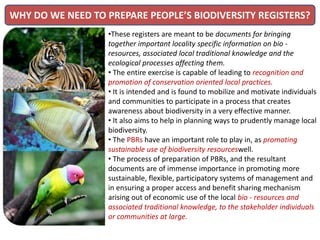
WHY DO WE NEED TO PREPARE PEOPLE’S BIODIVERSITY REGISTERS?
•These registers are meant to be documents for bringing
together important locality specific information on bio -
resources, associated local traditional knowledge and the
ecological processes affecting them.
• The entire exercise is capable of leading to recognition and
promotion of conservation oriented local practices.
• It is intended and is found to mobilize and motivate individuals
and communities to participate in a process that creates
awareness about biodiversity in a very effective manner.
• It also aims to help in planning ways to prudently manage local
biodiversity.
• The PBRs have an important role to play in, as promoting
sustainable use of biodiversity resourceswell.
• The process of preparation of PBRs, and the resultant
documents are of immense importance in promoting more
sustainable, flexible, participatory systems of management and
in ensuring a proper access and benefit sharing mechanism
arising out of economic use of the local bio - resources and
associated traditional knowledge, to the stakeholder individuals
or communities at large.
WHO CAN PREPARE PEOPLE’S BIODIVERSITY REGISTERS?
• It is the mandate of the BMC of each local body to prepare and validate the PBRs involving
local people in the whole exercise.
• Technical help during the exercise can be sought from the State Biodiversity Board or from
other available expertise.
•
• The process of documentation of the biological resources of a local body can be initiated by
any School, College, University, Institution, Club and Non Government Organization. Such
exercises can be carried out by involving students and/ with help and services from local
people of the area.
• To validate these documents of the local biological resources and associates traditional
knowledge as ‘People’s Biodiversity Registers’, it is mandatory to constitute a BMC in the said
area.
• The responsibility of maintaining and updating the prepared PBRs lies with concerned
BMCs.
HOW TO PREPARE PEOPLE’S BIODIVERSITY REGISTERS?
• The principal objective of PBR exercise is to ensure the active involvement of the local
people to whom the resources and knowledge belong, in the process. So the process is
required to follow a set pattern for fulfilling this objective.
• The first and foremost, being that the registers will be documents prepared by local people
using local knowledge. As such a bottom -up approach is required wherein giving importance
to the knowledge of local individuals and communities with regards to different aspects, viz.,
agriculture, fish & fishing, animal husbandry, traditional/ folk medicinal practices or any other
local use of the bio -resources is very vital.
• The information about local biodiversity pertaining to status, availability, usage, changes
over time, local management practices, and other relevant data along with local aspirations
has to be gathered in a very informal way and should never be a form -filling exercise.
• Interviews at individual level, focal group discussions and participatory rural appraisal can
be used as effective tools for incorporating knowledge and opinion of the local people in the
PBRs.
HOW IS THE INFORMATION COLLECTED DURING THE EXERCISE TO BE
INCORPORATED IN THE PBR?
• The information collected during the exercise has to be arranged into the following chapters
for compliance with the format of PBR prepared by the National Biodiversity Authority and
being followed by the State Biodiversity Board –
•General information regarding the area.
 Landscape – including maps, data and information regarding land and water resources,
land use pattern and changes over time in landscape.
 Lifescape – including local names, characteristics, use pattern, status, other relevant
information regarding flora, fauna, agricultural and cultivated species and domesticated
animals of the area. Scientific names of the same may be incorporated with expert input
regarding the same.
 Peoplescape – including information on castes and tribes in the area, population, caste
occupation and present trends of livelihood sustenance.
 Traditions and Rituals dependant on the local bio - resource.
 List of knowledgeable people in the area
 Aspiration of the local people regarding biodiversity and management of the same in the
area
DOES PREPARING THE PBR BRING ONE TO THE END OF THE EXERCISE?
• No, it is the beginning. A
beginning to a more sustainable,
secure and well managed
bioresource system for every local
body in the state and an informed
population aware of their rights
and duties in the context of
biodiversity of their areas.
• No PBR exercise can have its
objectives fulfilled without a
properly planned Post-PBR
exercise, designed with the help of
the PBR of the area.
Thank You

PBR peoples biodiversity registar - Ranjan Shaw

  • 1.
  • 2.
    PEOPLE'S BIODIVERSITY REGISTER •People's Biodiversity Register: People's Biodiversity Register is a legal document containing comprehensive account of local bio-resources along with related traditional knowledge & practises of the concerned area of jurisdiction under a Biodiversity Management Committee (BMC). •It also highlights the brief idea of landscape and demography of the concern area. As per Rule 22(10) of the Biological Diversity Rules, 2004, the preparation of PBR of a particular area is the primary mandate of the concerned BMC. •A standard methodology of the PBR, developed by the National Biodiversity Authority (NBA) is followed pan India. PBR is being prepared by the BMC in consultation with the local people.
  • 3.
    HISTORY • HISTORY: TheGovernment of India brought into effect the first comprehensive Indian Legislation on conservation of the nation’s biodiversity on 5th February, 2003 in the form of the Biological Diversity Act, 2002. • Subsequently, in exercise of the powers conferred by Section 62 of the said Act, the Biological Diversity Rules, 2004 came into force. • The Biological Diversity Act envisages a three tier system for implementing the same with the National Biodiversity Authority at the apex, each state with its individual State Biodiversity Board and each local body with a Biodiversity management Committee. • The main function designated to the Biodiversity Management Committees (BMC) as per the Rules pertains to preparation of the People’s Biodiversity Registers (PBR) in consultation with local people. Fig: West Bengal Biodiversity Board (India)
  • 4.
    WHY DO WENEED TO PREPARE PEOPLE’S BIODIVERSITY REGISTERS? •These registers are meant to be documents for bringing together important locality specific information on bio - resources, associated local traditional knowledge and the ecological processes affecting them. • The entire exercise is capable of leading to recognition and promotion of conservation oriented local practices. • It is intended and is found to mobilize and motivate individuals and communities to participate in a process that creates awareness about biodiversity in a very effective manner. • It also aims to help in planning ways to prudently manage local biodiversity. • The PBRs have an important role to play in, as promoting sustainable use of biodiversity resourceswell. • The process of preparation of PBRs, and the resultant documents are of immense importance in promoting more sustainable, flexible, participatory systems of management and in ensuring a proper access and benefit sharing mechanism arising out of economic use of the local bio - resources and associated traditional knowledge, to the stakeholder individuals or communities at large.
  • 5.
    WHO CAN PREPAREPEOPLE’S BIODIVERSITY REGISTERS? • It is the mandate of the BMC of each local body to prepare and validate the PBRs involving local people in the whole exercise. • Technical help during the exercise can be sought from the State Biodiversity Board or from other available expertise. • • The process of documentation of the biological resources of a local body can be initiated by any School, College, University, Institution, Club and Non Government Organization. Such exercises can be carried out by involving students and/ with help and services from local people of the area. • To validate these documents of the local biological resources and associates traditional knowledge as ‘People’s Biodiversity Registers’, it is mandatory to constitute a BMC in the said area. • The responsibility of maintaining and updating the prepared PBRs lies with concerned BMCs.
  • 6.
    HOW TO PREPAREPEOPLE’S BIODIVERSITY REGISTERS? • The principal objective of PBR exercise is to ensure the active involvement of the local people to whom the resources and knowledge belong, in the process. So the process is required to follow a set pattern for fulfilling this objective. • The first and foremost, being that the registers will be documents prepared by local people using local knowledge. As such a bottom -up approach is required wherein giving importance to the knowledge of local individuals and communities with regards to different aspects, viz., agriculture, fish & fishing, animal husbandry, traditional/ folk medicinal practices or any other local use of the bio -resources is very vital. • The information about local biodiversity pertaining to status, availability, usage, changes over time, local management practices, and other relevant data along with local aspirations has to be gathered in a very informal way and should never be a form -filling exercise. • Interviews at individual level, focal group discussions and participatory rural appraisal can be used as effective tools for incorporating knowledge and opinion of the local people in the PBRs.
  • 7.
    HOW IS THEINFORMATION COLLECTED DURING THE EXERCISE TO BE INCORPORATED IN THE PBR? • The information collected during the exercise has to be arranged into the following chapters for compliance with the format of PBR prepared by the National Biodiversity Authority and being followed by the State Biodiversity Board – •General information regarding the area.  Landscape – including maps, data and information regarding land and water resources, land use pattern and changes over time in landscape.  Lifescape – including local names, characteristics, use pattern, status, other relevant information regarding flora, fauna, agricultural and cultivated species and domesticated animals of the area. Scientific names of the same may be incorporated with expert input regarding the same.  Peoplescape – including information on castes and tribes in the area, population, caste occupation and present trends of livelihood sustenance.  Traditions and Rituals dependant on the local bio - resource.  List of knowledgeable people in the area  Aspiration of the local people regarding biodiversity and management of the same in the area
  • 8.
    DOES PREPARING THEPBR BRING ONE TO THE END OF THE EXERCISE? • No, it is the beginning. A beginning to a more sustainable, secure and well managed bioresource system for every local body in the state and an informed population aware of their rights and duties in the context of biodiversity of their areas. • No PBR exercise can have its objectives fulfilled without a properly planned Post-PBR exercise, designed with the help of the PBR of the area.
  • 9.