Introduction to
AtoM and Archivematica
Sara Allain
8 November 2016
slideshare.net/accesstomemory
Today’s Agenda
1. Introduction
2. Artefactual and Open Source Development
3. Introduction to AtoM
4. Introduction to Archivematica
5. Questions
Who is Artefactual?
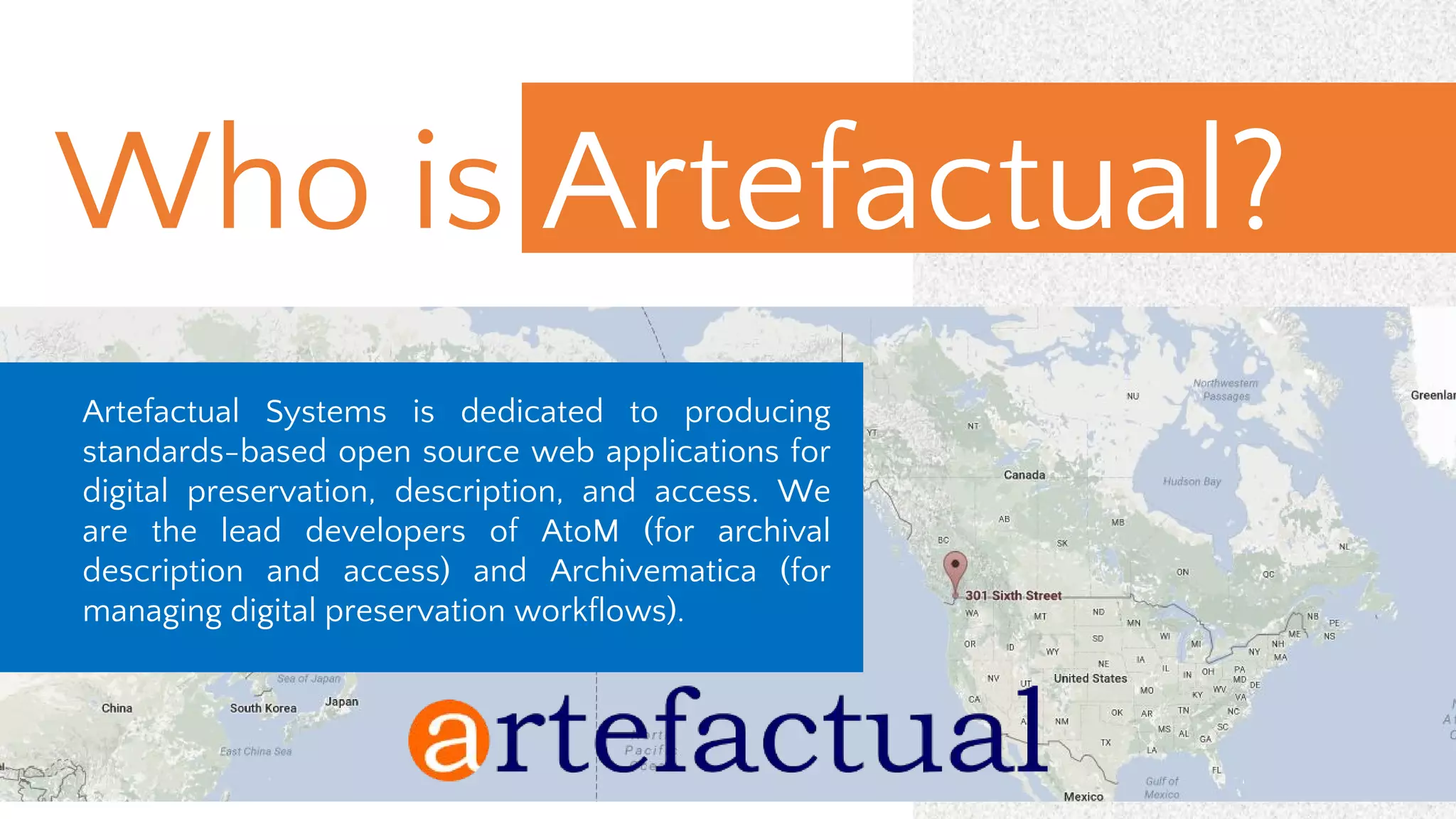
Artefactual Systems is dedicated to producing
standards-based open source web applications for
digital preservation, description, and access. We
are the lead developers of AtoM (for archival
description and access) and Archivematica (for
managing digital preservation workflows).
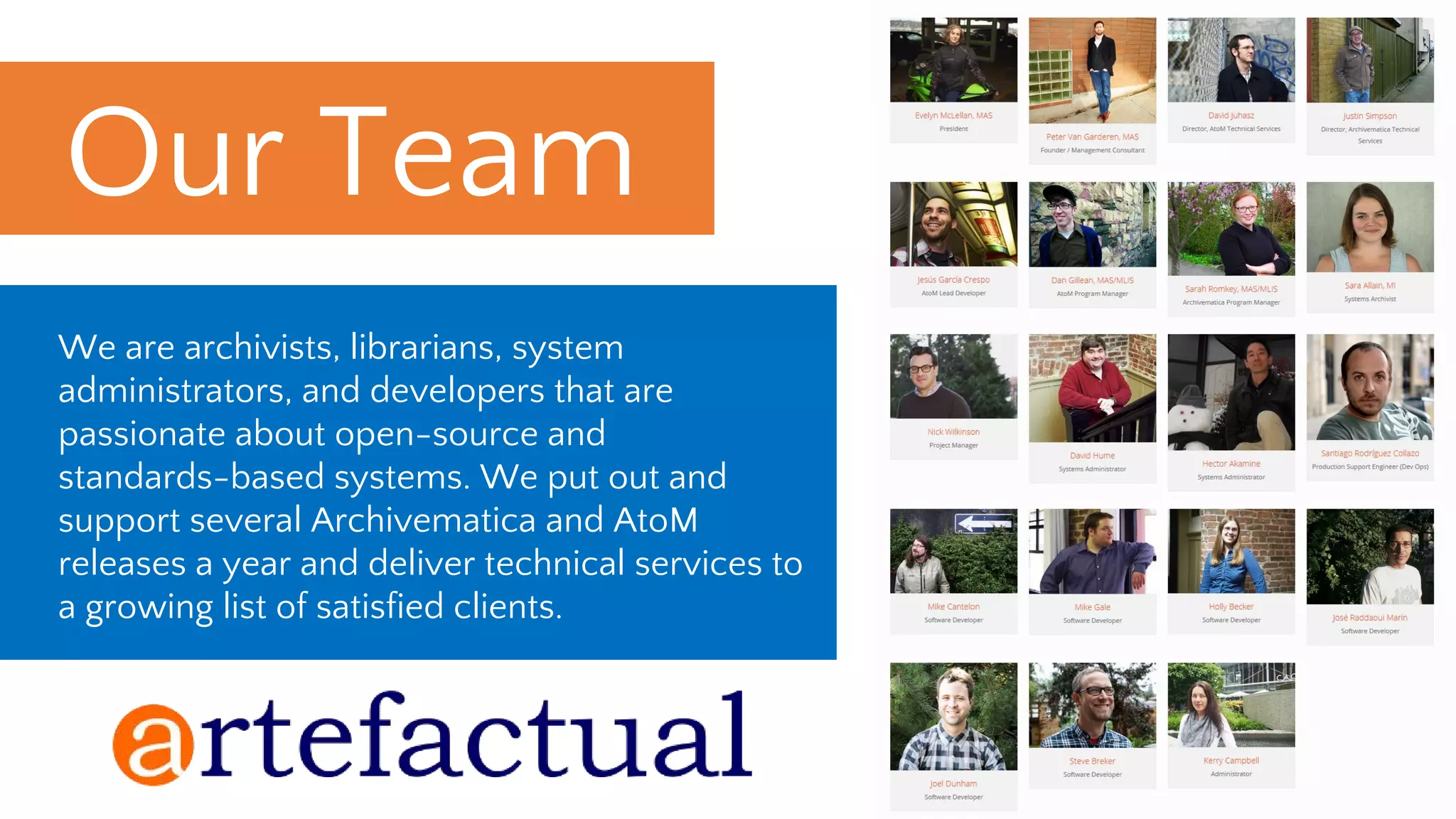
We are archivists, librarians, system
administrators, and developers that are
passionate about open-source and
standards-based systems. We put out and
support several Archivematica and AtoM
releases a year and deliver technical services to
a growing list of satisfied clients.
Our Team_
Our Team, Our Philosophy, Our Vision
Artefactual Systems
and
Open Source Development
What is Open Source?
Open Source Software (OSS) is computer
software with its source code made available
with a license in which the copyright holder
provides the rights to study, change, and
distribute the software to anyone and for any
purpose.
-- Wikipedia, Oct 13 2016
https://en.wikipedia.org/wiki/Open-source_software
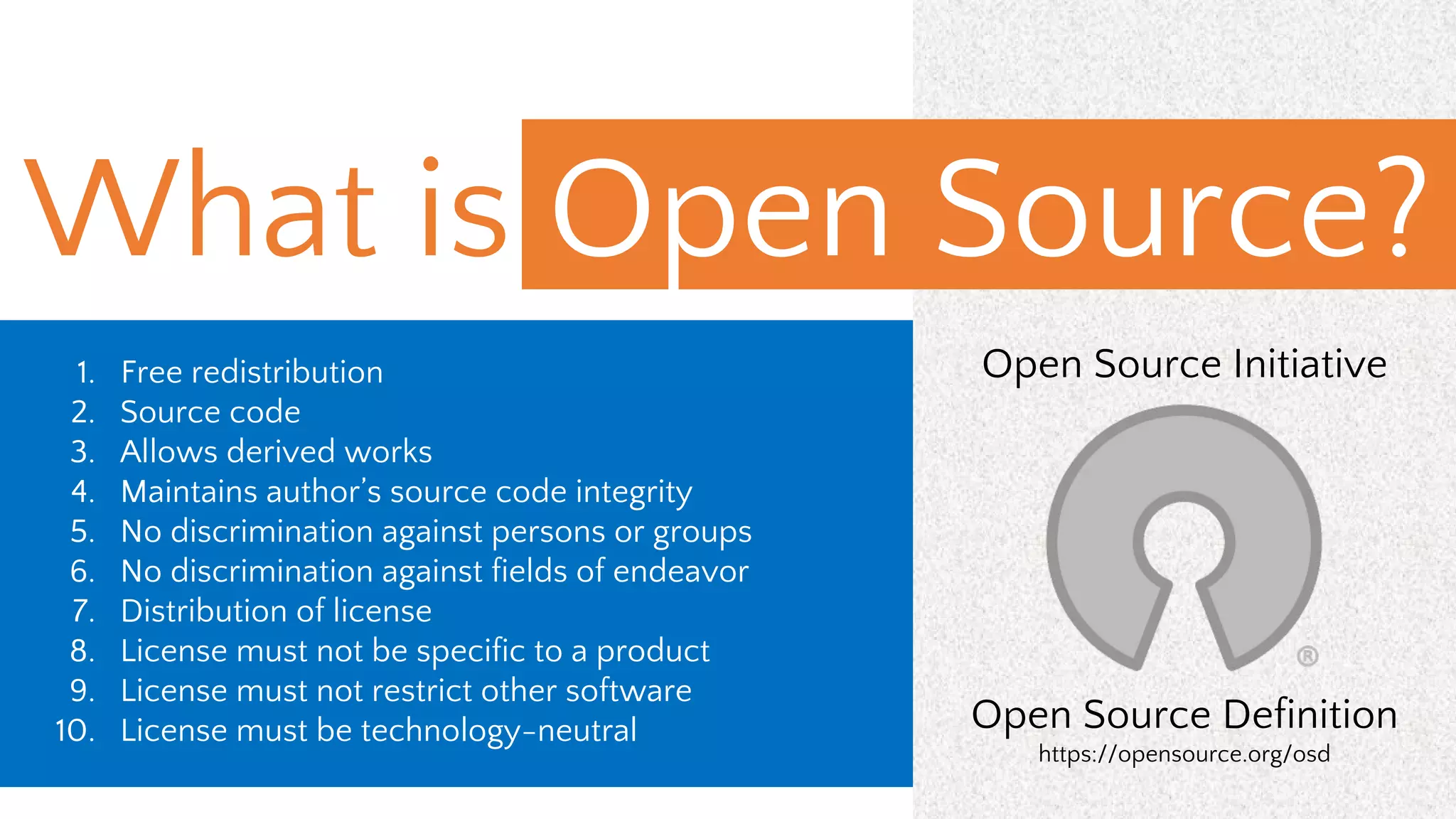
1. Free redistribution
2. Source code
3. Allows derived works
4. Maintains author’s source code integrity
5. No discrimination against persons or groups
6. No discrimination against fields of endeavor
7. Distribution of license
8. License must not be specific to a product
9. License must not restrict other software
10. License must be technology-neutral
Open Source Initiative
Open Source Definition
https://opensource.org/osd
What is Open Source?
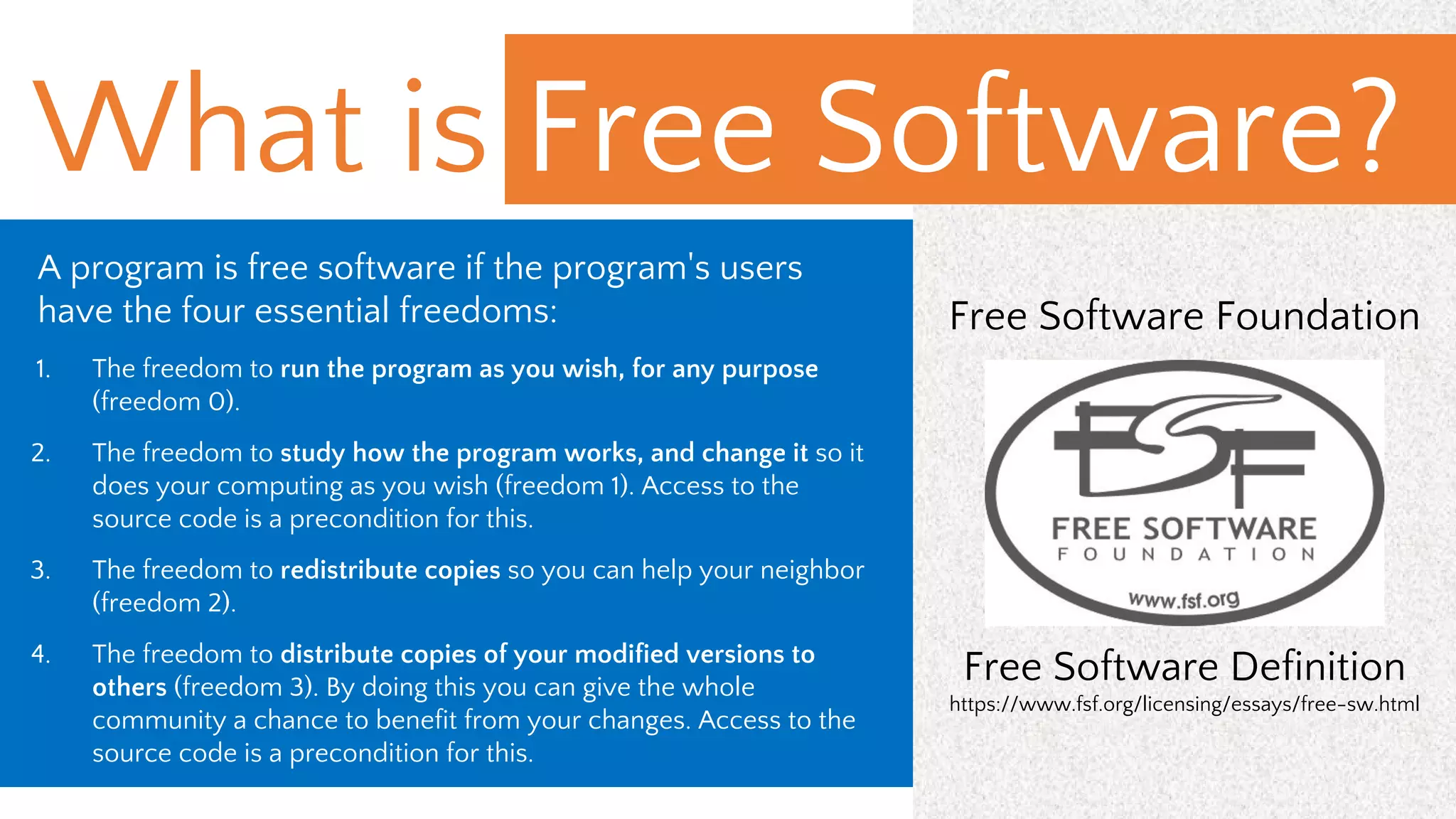
A program is free software if the program's users
have the four essential freedoms:
1. The freedom to run the program as you wish, for any purpose
(freedom 0).
2. The freedom to study how the program works, and change it so it
does your computing as you wish (freedom 1). Access to the
source code is a precondition for this.
3. The freedom to redistribute copies so you can help your neighbor
(freedom 2).
4. The freedom to distribute copies of your modified versions to
others (freedom 3). By doing this you can give the whole
community a chance to benefit from your changes. Access to the
source code is a precondition for this.
Free Software Foundation
Free Software Definition
https://www.fsf.org/licensing/essays/free-sw.html
What is Free Software?
Our Development Priorities
Free and open source
Standards-based
Generalized for broad use
Our Development Approach
• Standards-based / follows best practices
• Open source / Creative Commons
• Multilingual support whenever possible
• Generalize specific use cases
• Include all features in public release
• Iterative development via multiple
contributions over subsequent releases
Community-based
Development
Our Business Model
The “Bounty Model”
of Open Source Business
• Maintain our applications under A-GPLv3
licenses
• Provide and maintain the documentation under
CC-BY-SA licenses
• Produce additional resources (e.g. videos,
presentations, webinars) whenever possible
• Participate actively in the user forums
• Offer additional paid services
• Always include development in public project
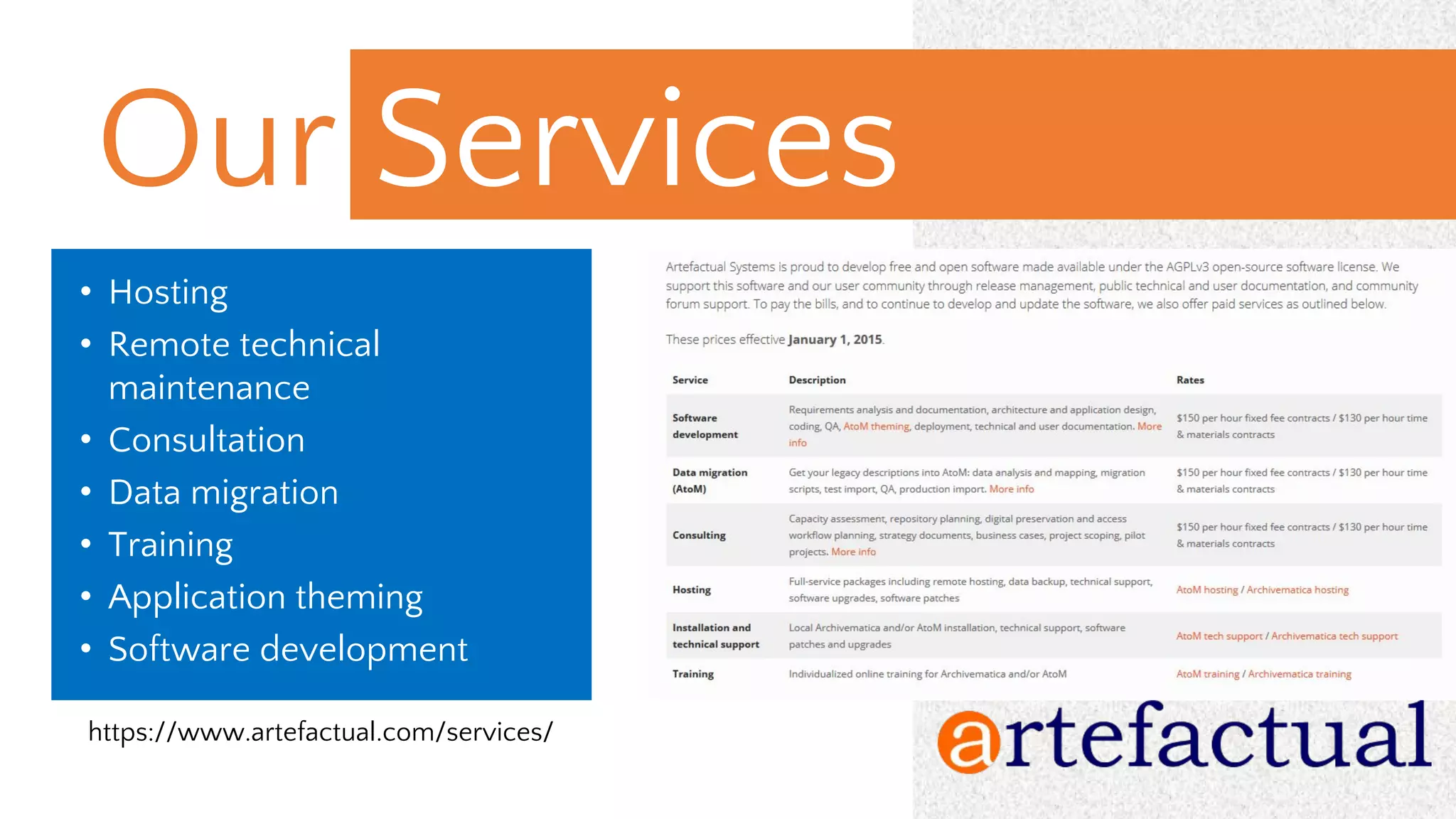
Our Services
• Hosting
• Remote technical
maintenance
• Consultation
• Data migration
• Training
• Application theming
• Software development
https://www.artefactual.com/services/
Our Applications
https://www.accesstomemory.org
Web based application for
standards-based description
and access in a multilingual,
multi-repository environment
Web based application to
support digital preservation
workflows based on the OAIS
reference model
https://www.archivematica.org
Our ApplicationsYour
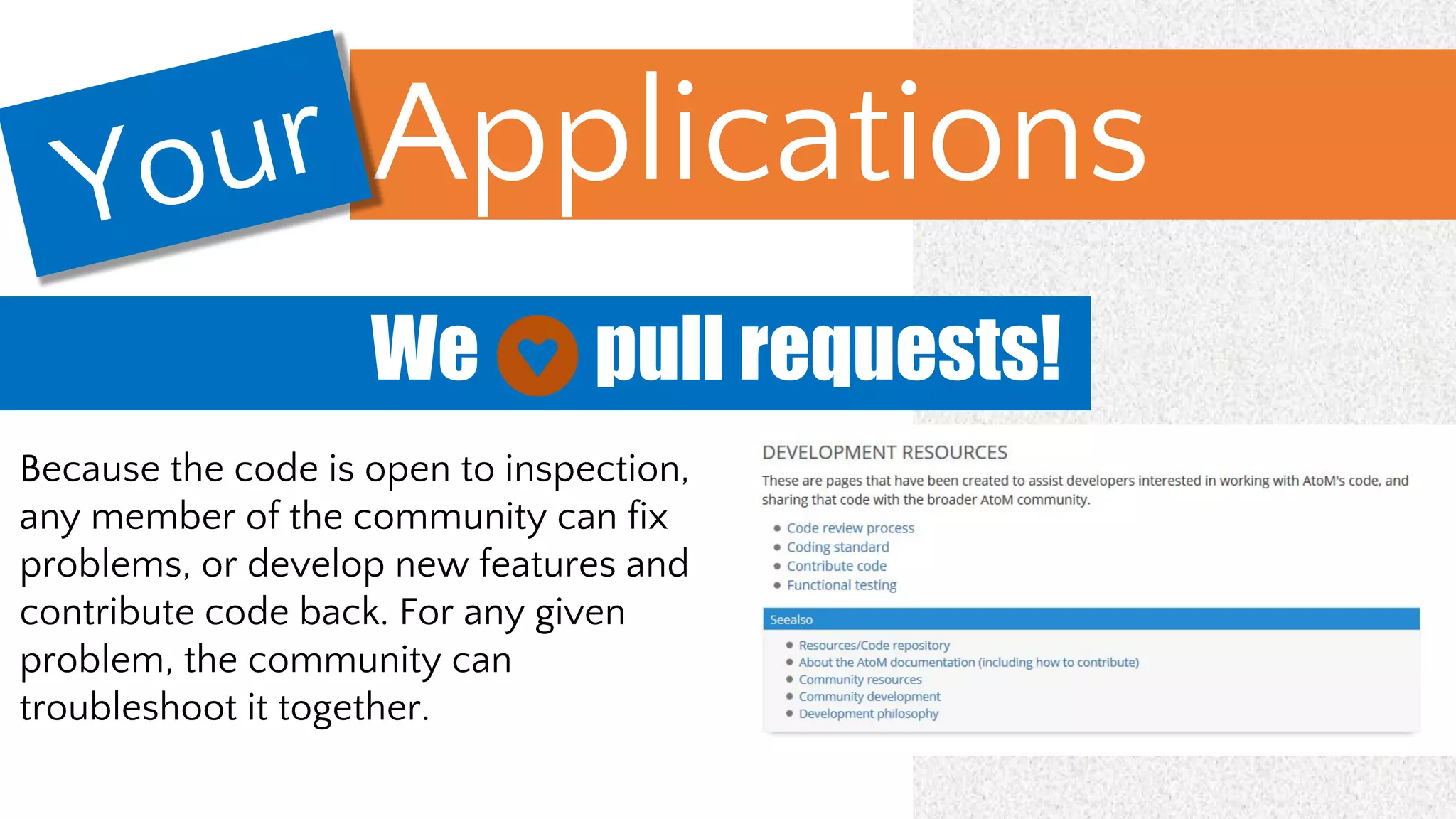
Because the code is open to inspection,
any member of the community can fix
problems, or develop new features and
contribute code back. For any given
problem, the community can
troubleshoot it together.
We pull requests!
Web based: Once installed, you only need a
modern web browser and an internet connection
to connect to the application from anywhere
Standards-based: AtoM implements existing
national and international archival content and
metadata transmission standards and best
practices, so your data is standards compliant and
interoperable
Multilingual: Supports translations of both
content and user interface elements, can be used
as a multilingual catalogue
Multi-repository: Can be used as a portal site,
content aggregator, or union catalogue to provide
access to content from multiple institutions
What is AtoM?
AtoM stands for
Access to Memory
It is a web-based, open
source application for
standards-based archival
description and access in a
multilingual, multi-repository
environment.
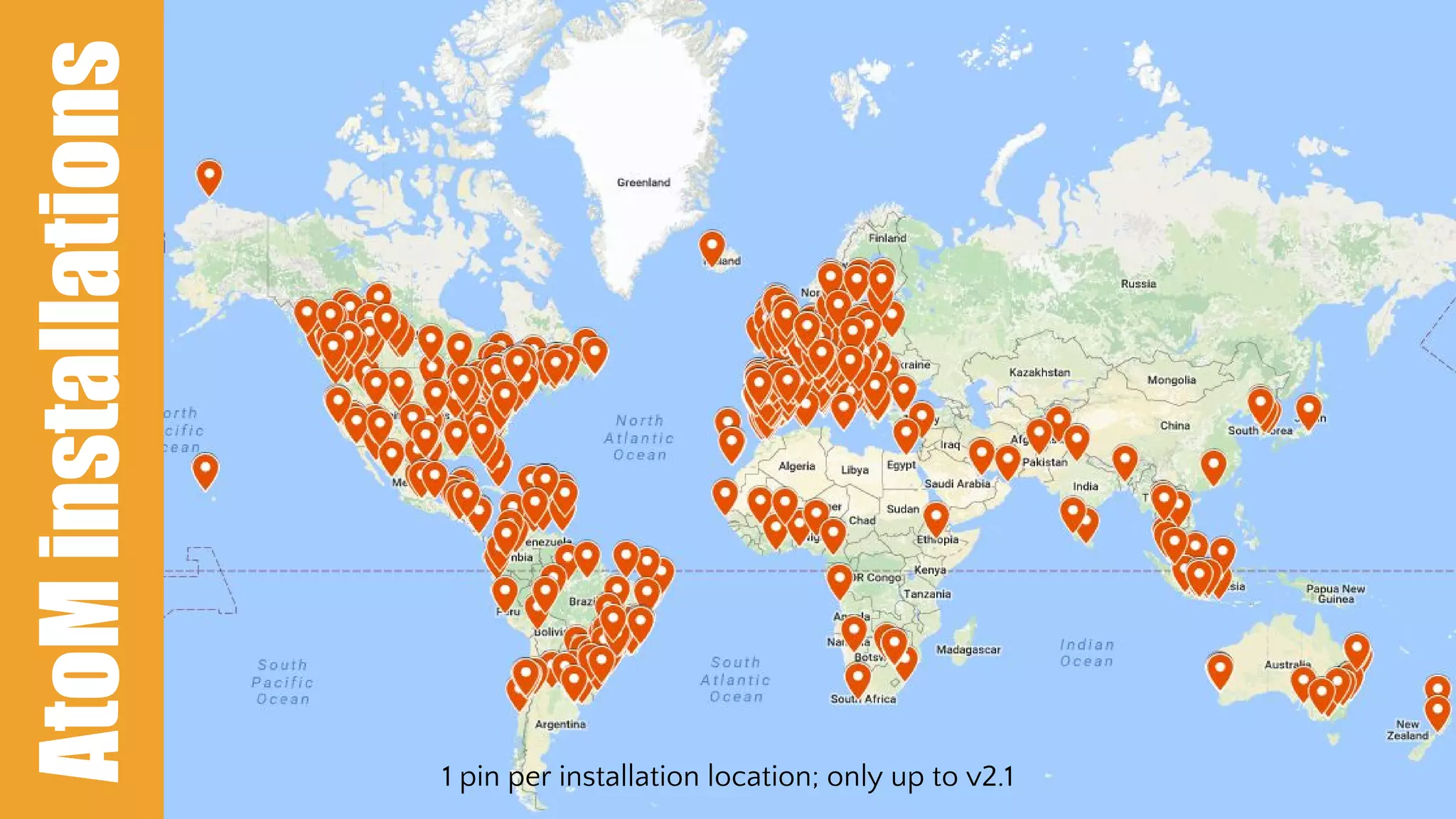
So far, this approach has worked, and the AtoM project has a vibrant international community of users.
This map shows all the different locales where AtoM has been installed, up to version 2.1 – and these
are just the places we know of.AtoMinstallations
1 pin per installation location; only up to v2.1
What is Archivematica?
Web- and standards-based open-source
application which allows your institution to
preserve long-term access to trustworthy,
authentic and reliable digital content.
-- Archivematica website, Oct 13 2016
https://www.archivematica.org/
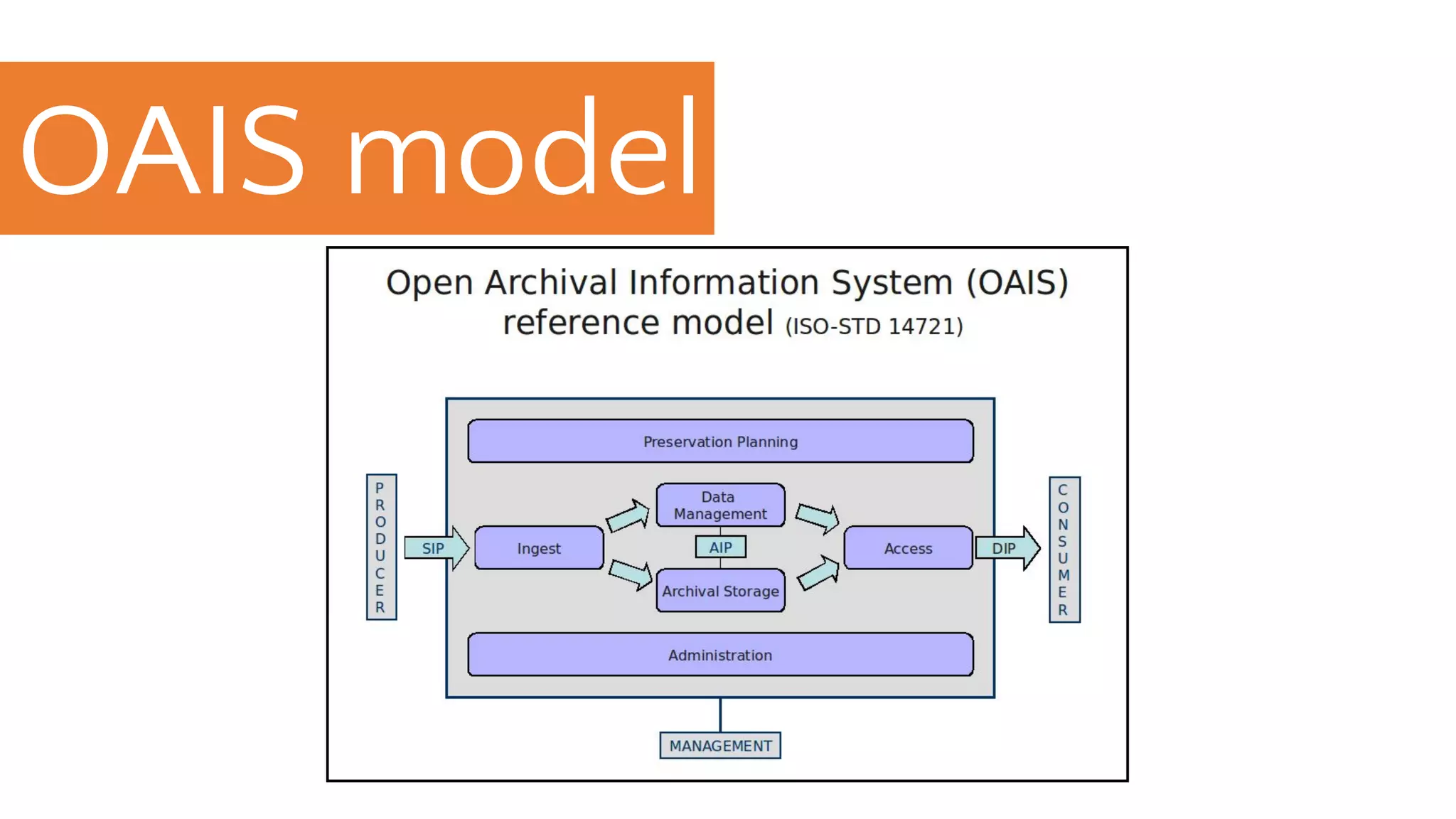
OAIS model
OAIS model
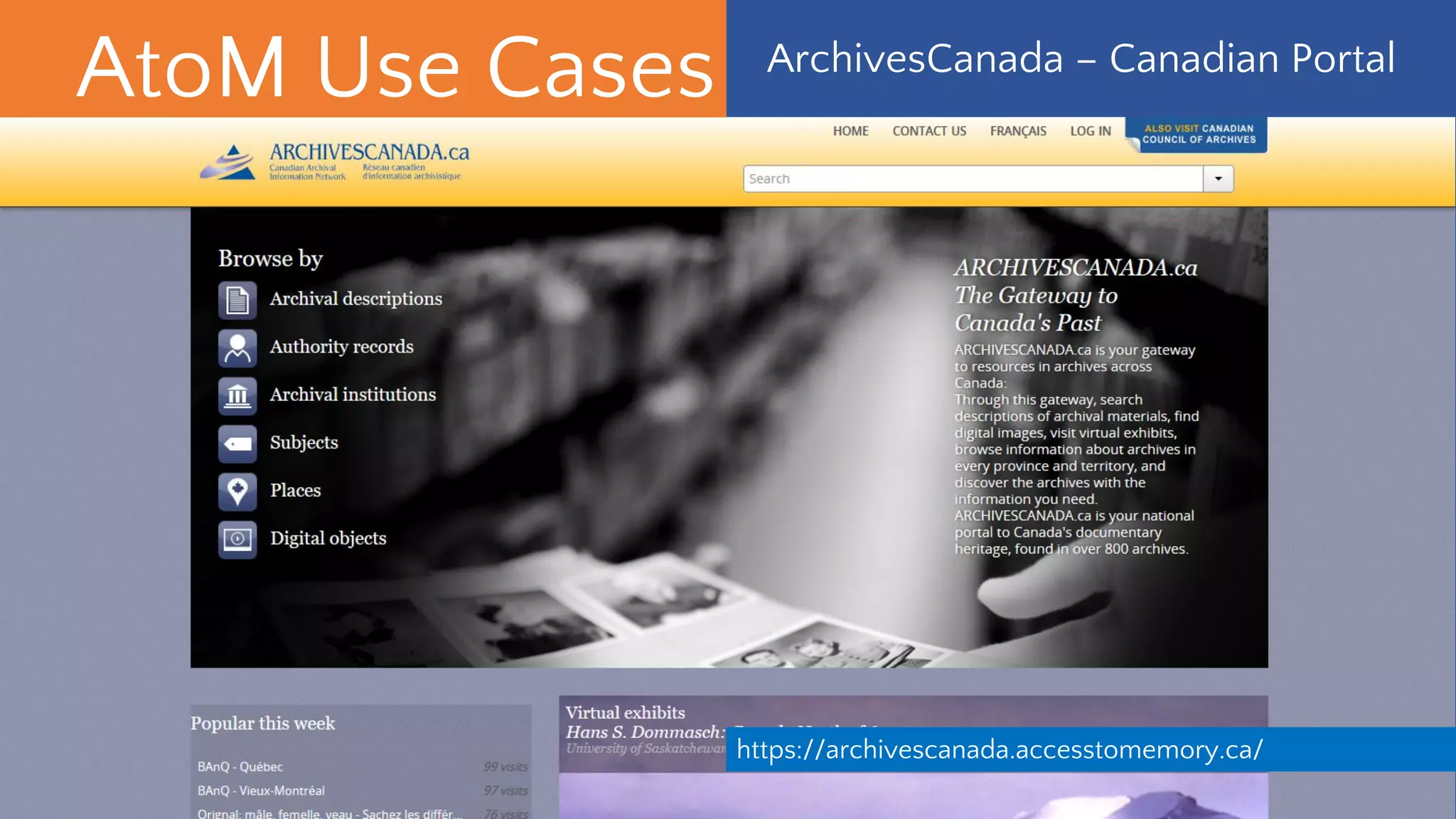
AtoM Use Cases
https://archivescanada.accesstomemory.ca/
ArchivesCanada – Canadian Portal
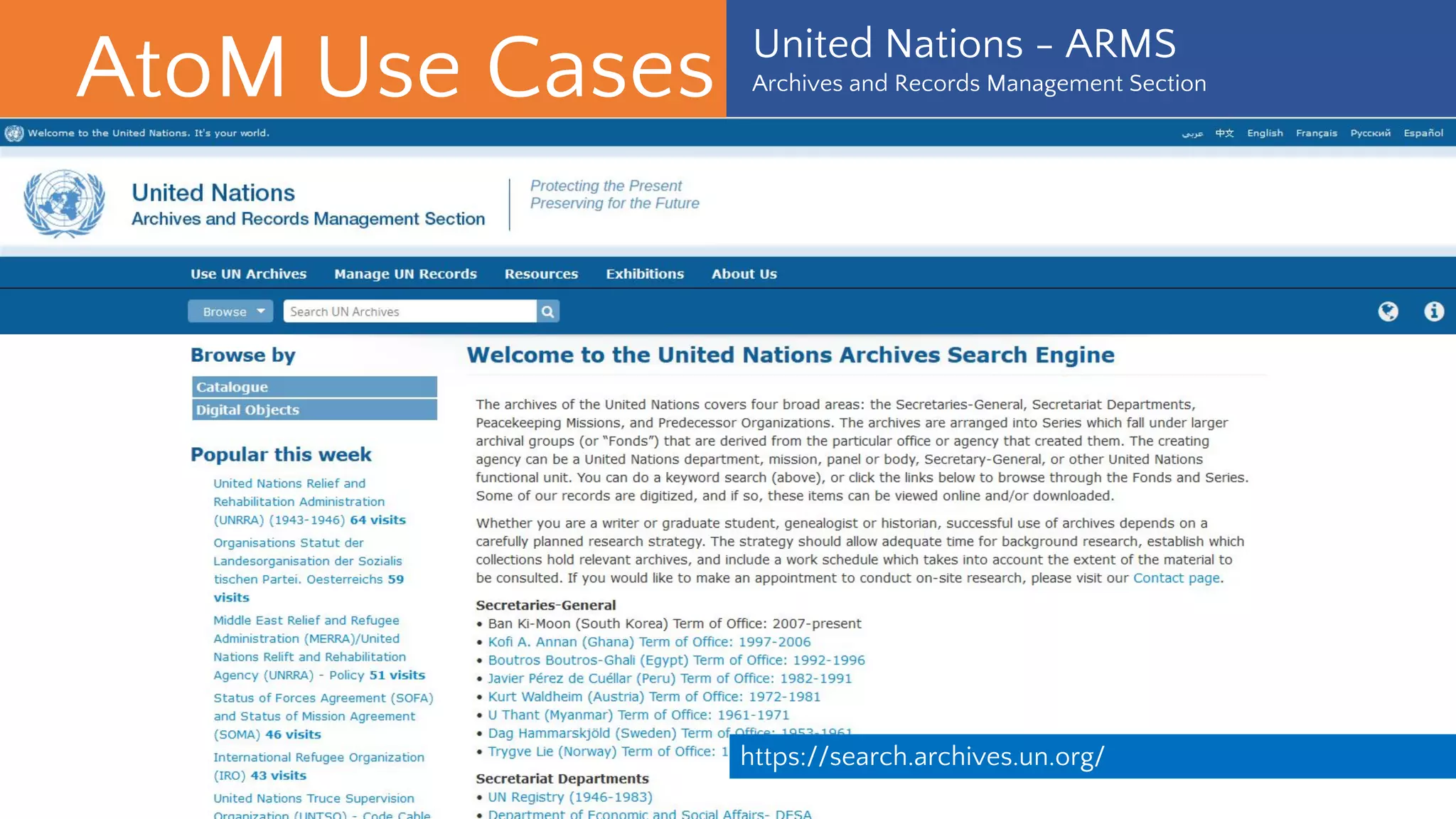
AtoM Use Cases
https://search.archives.un.org/
United Nations - ARMS
Archives and Records Management Section
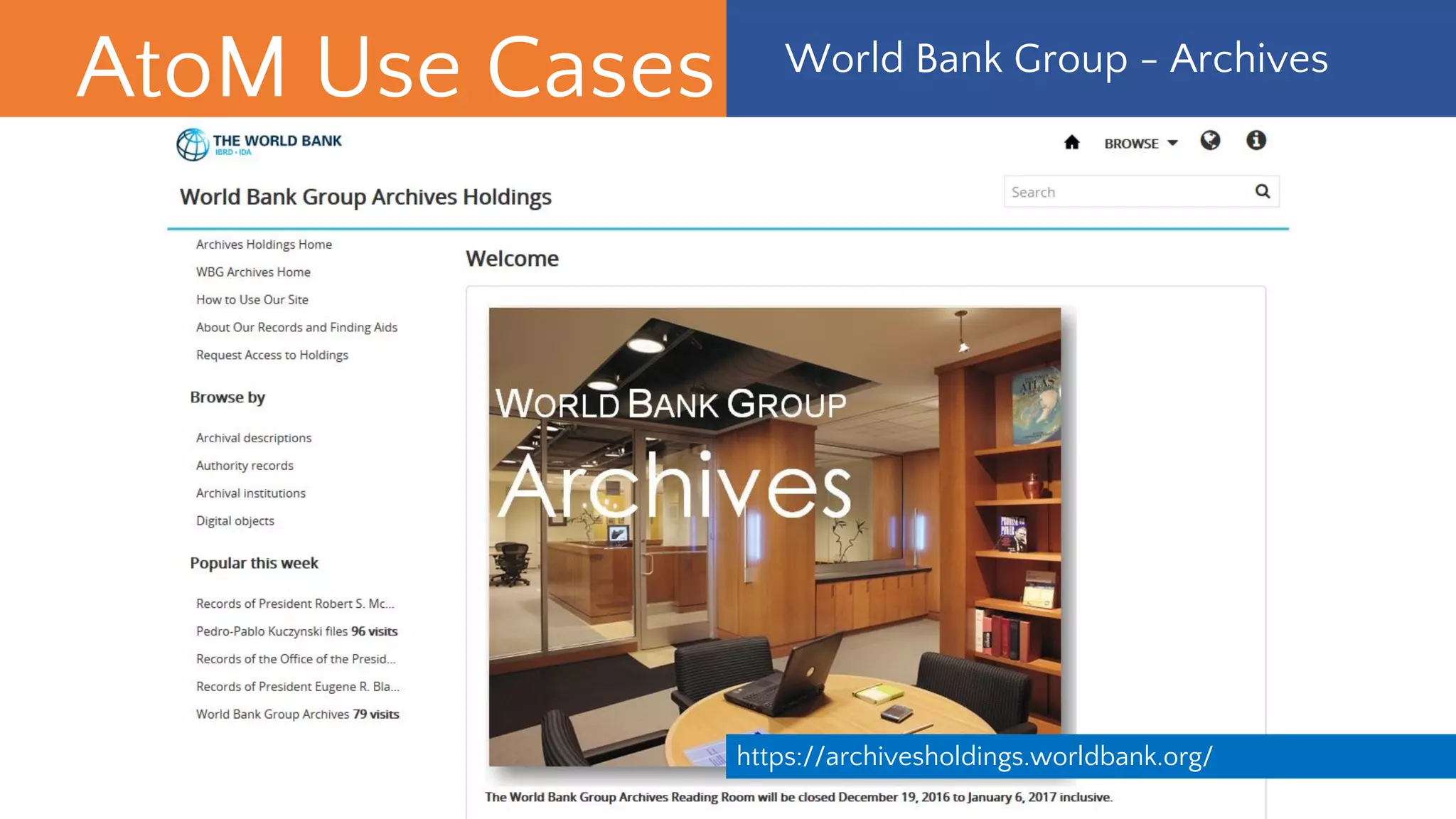
AtoM Use Cases
https://archivesholdings.worldbank.org/
World Bank Group - Archives
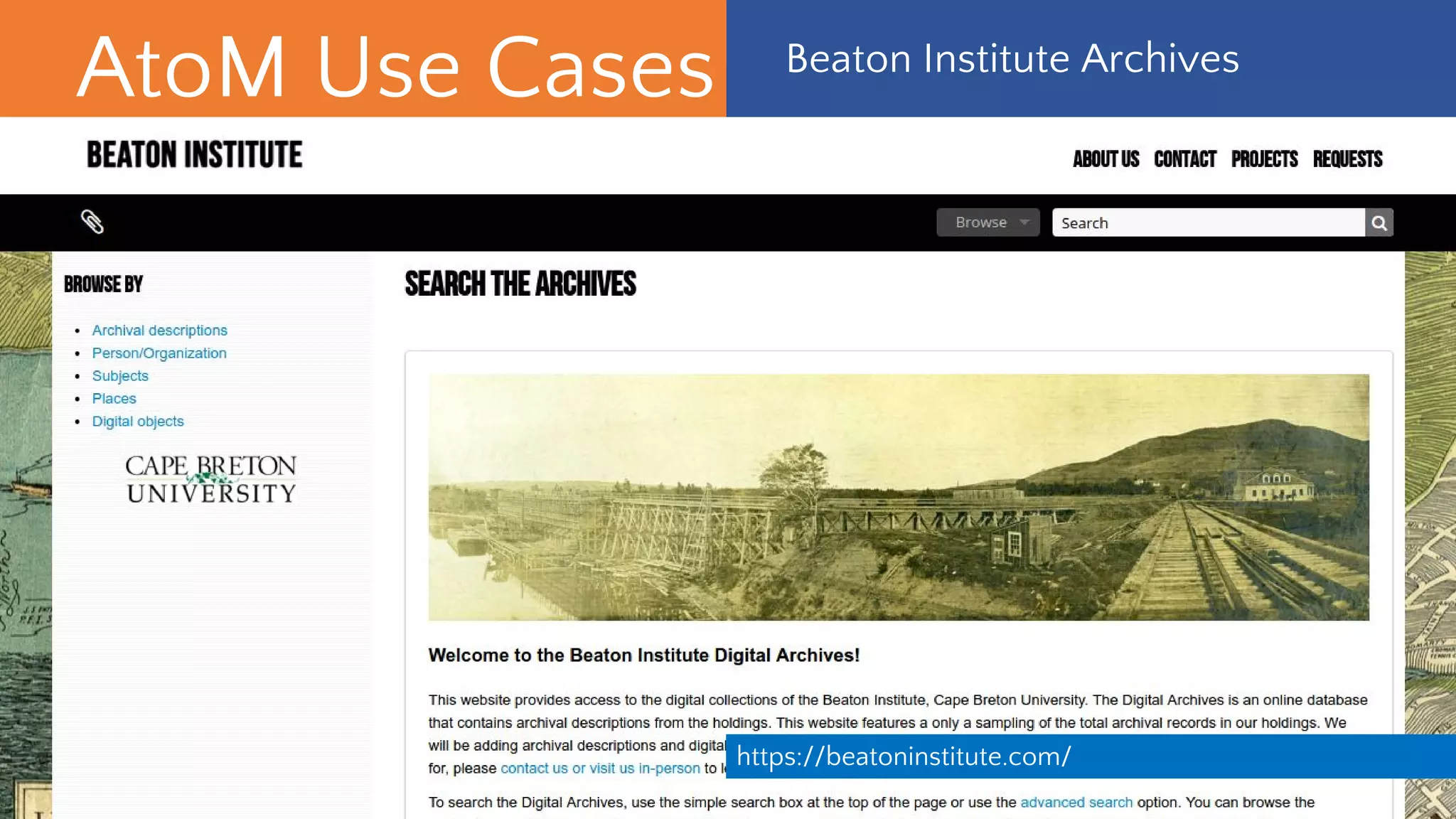
AtoM Use Cases
https://beatoninstitute.com/
Beaton Institute Archives
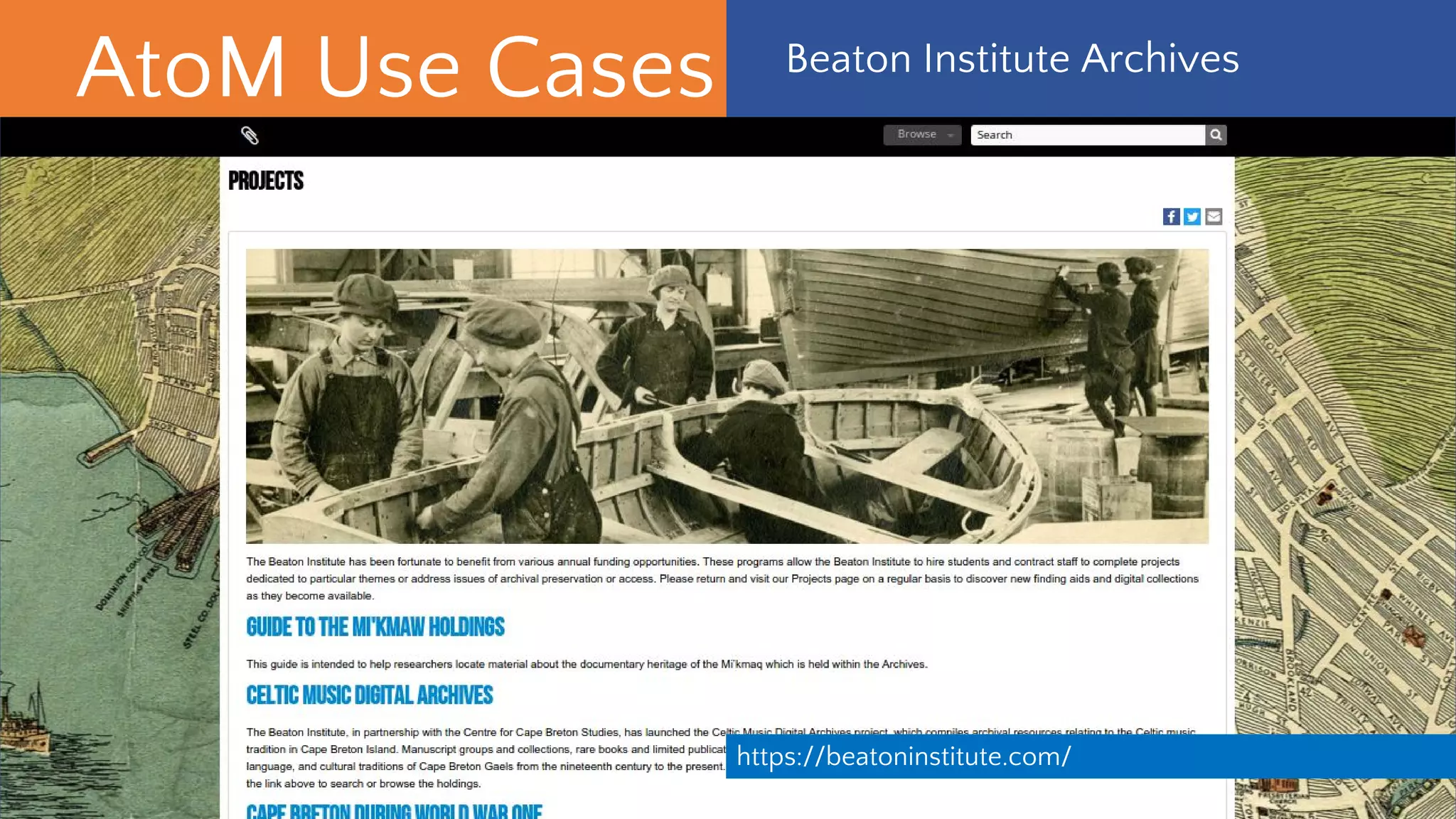
AtoM Use Cases
https://beatoninstitute.com/
Beaton Institute Archives
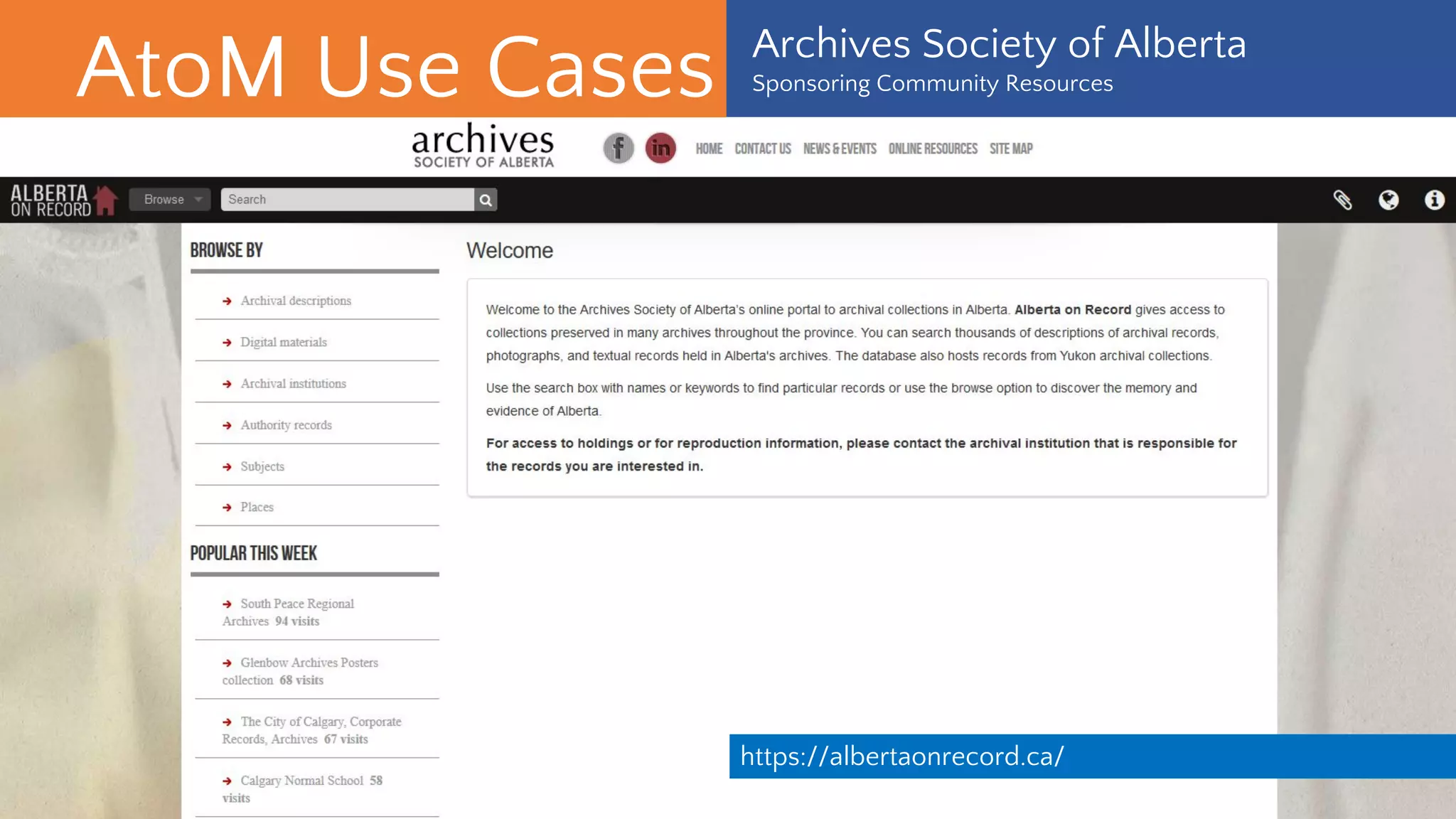
AtoM Use Cases
https://albertaonrecord.ca/
Archives Society of Alberta
Sponsoring Community Resources
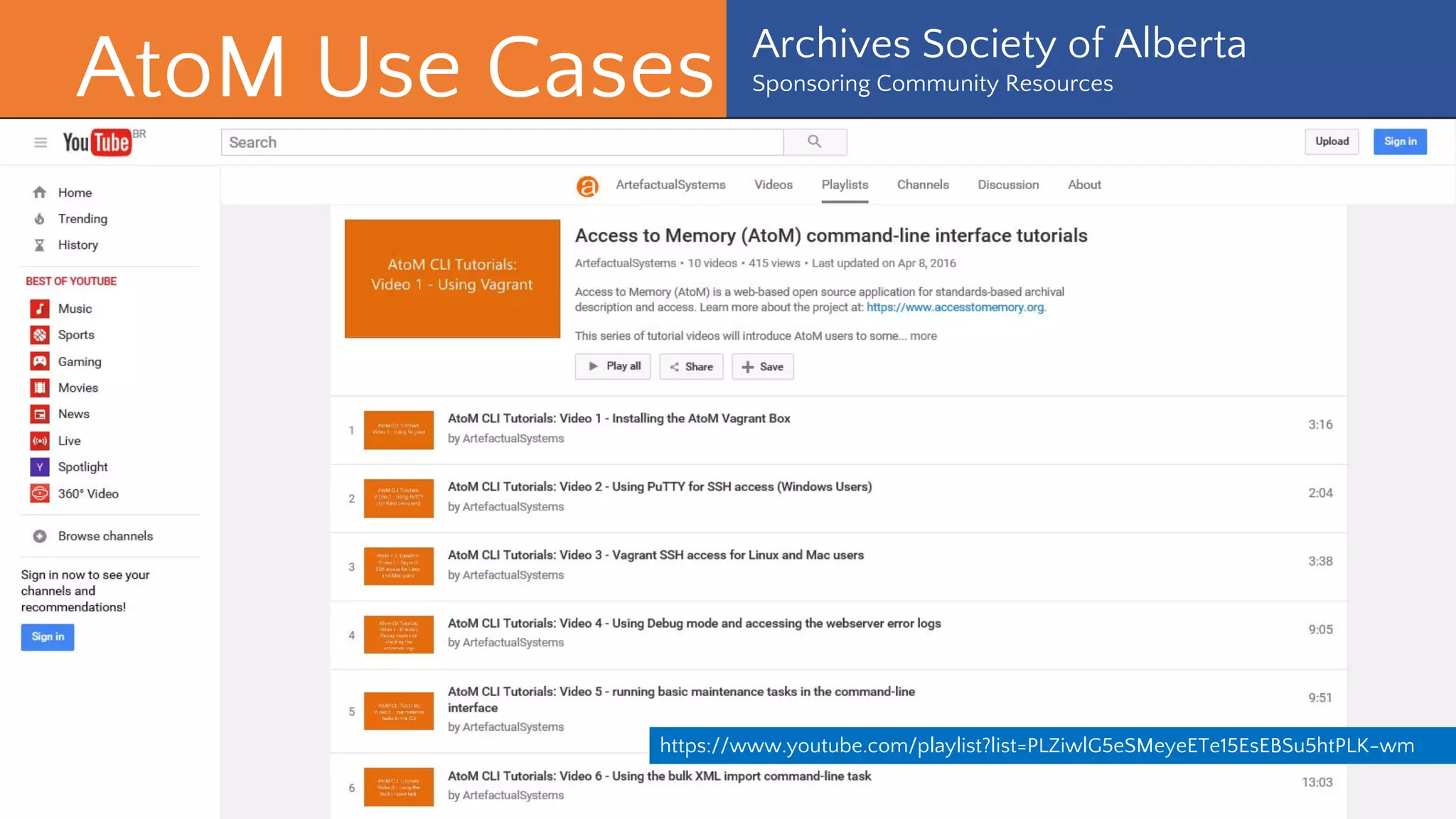
AtoM Use Cases
https://www.youtube.com/playlist?list=PLZiwlG5eSMeyeETe15EsEBSu5htPLK-wm
Archives Society of Alberta
Sponsoring Community Resources
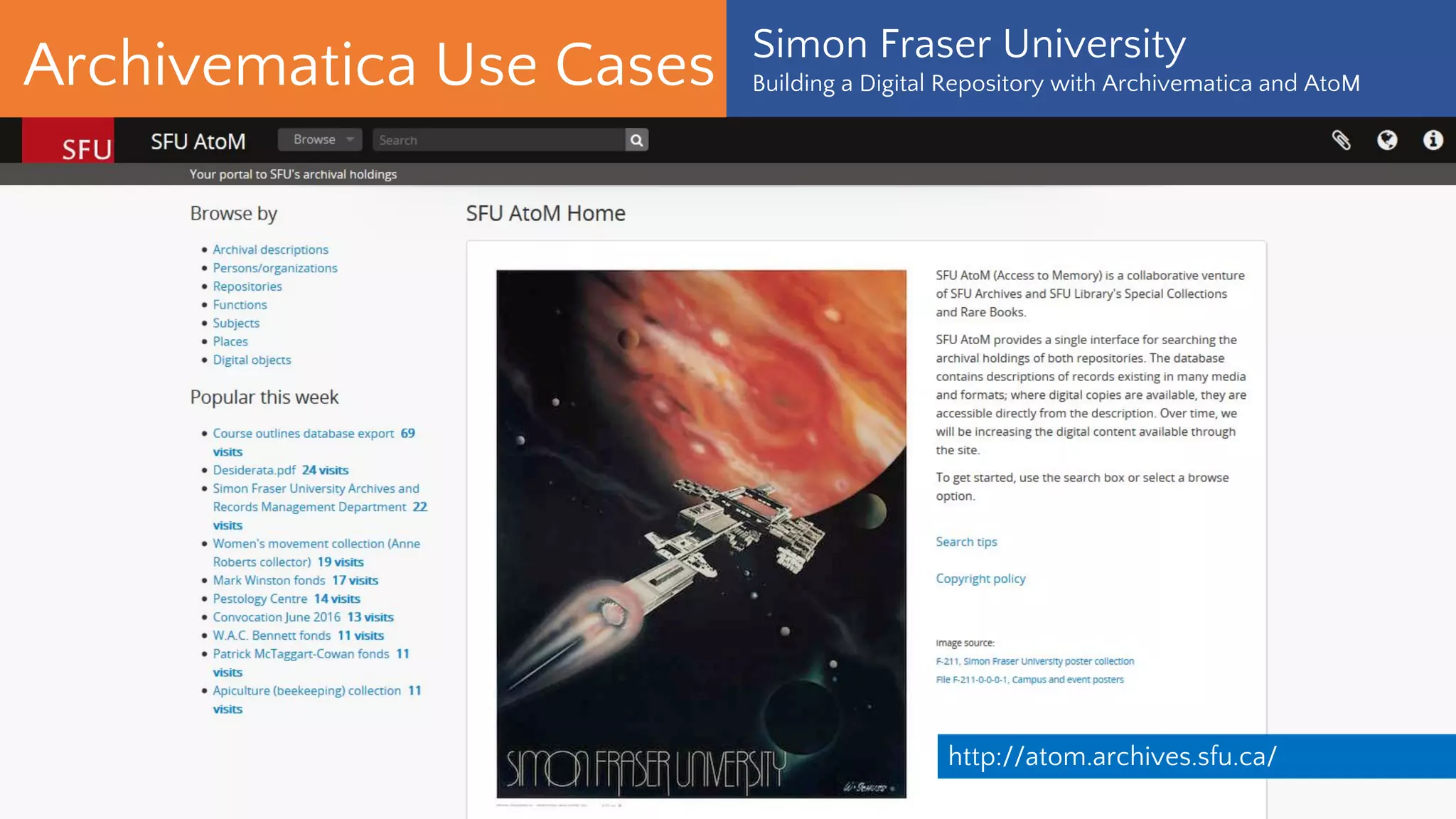
Archivematica Use Cases
http://atom.archives.sfu.ca/
Simon Fraser University
Building a Digital Repository with Archivematica and AtoM
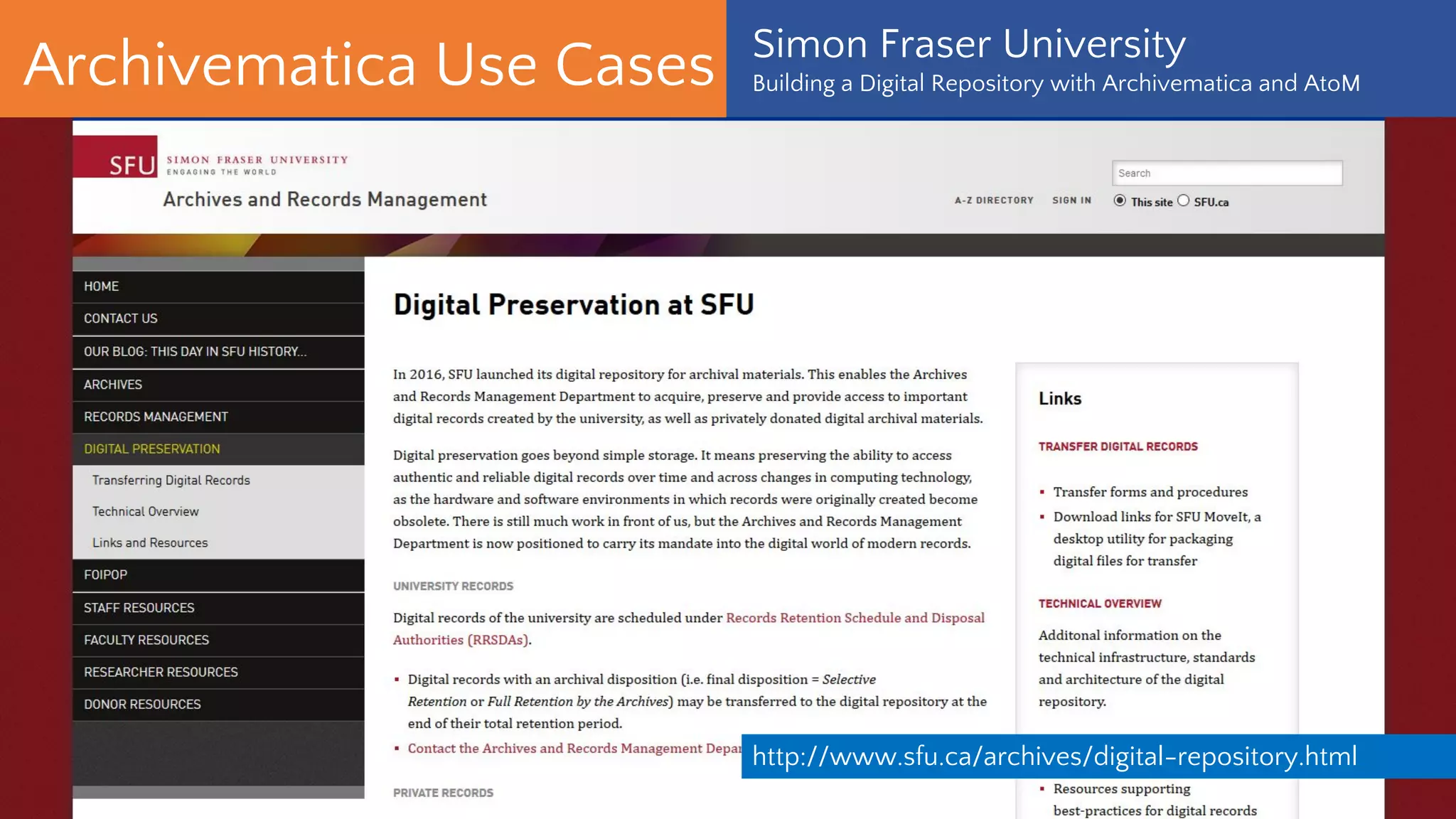
http://www.sfu.ca/archives/digital-repository.html
Simon Fraser University
Building a Digital Repository with Archivematica and AtoMArchivematica Use Cases
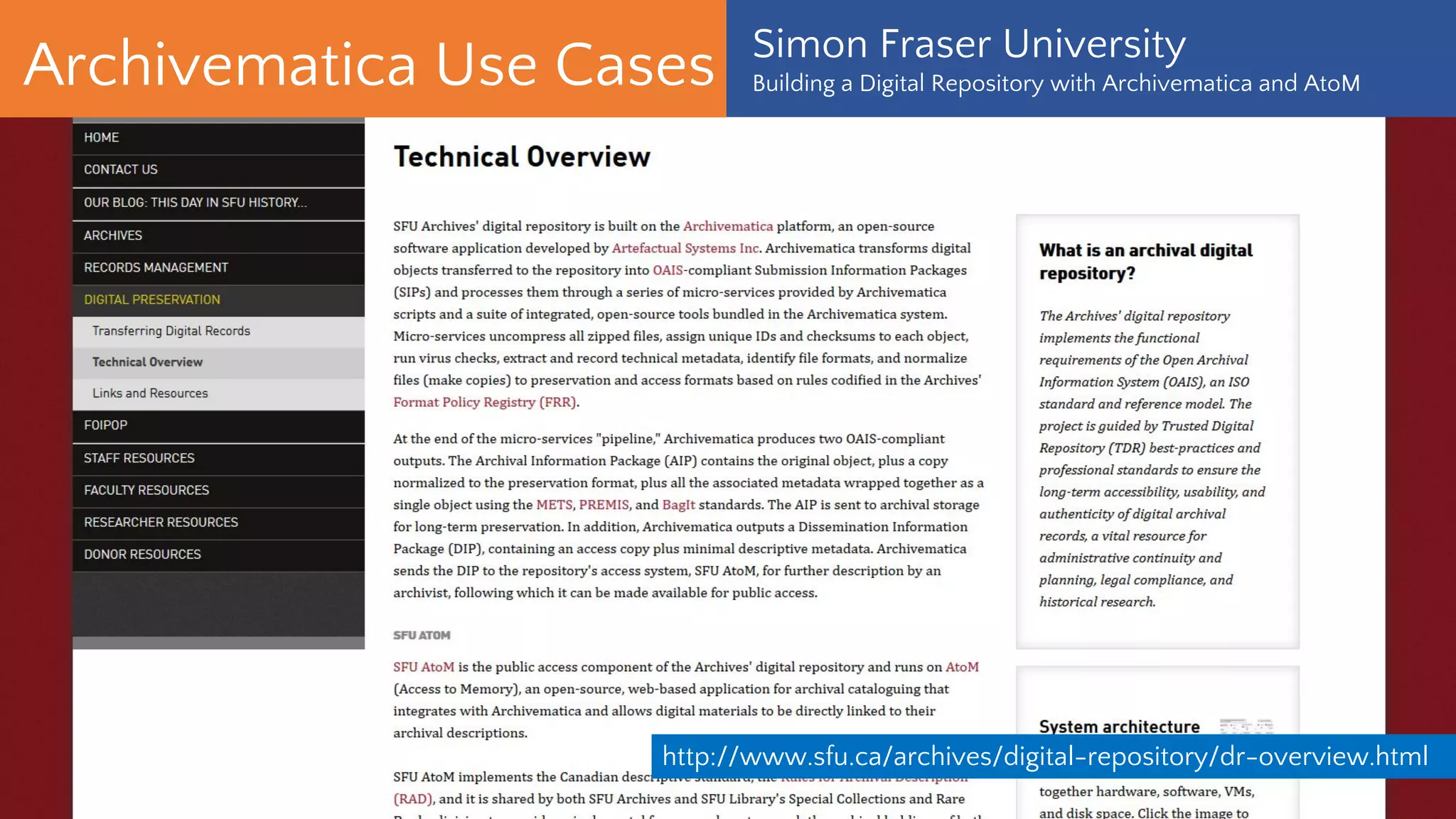
http://www.sfu.ca/archives/digital-repository/dr-overview.html
Simon Fraser University
Building a Digital Repository with Archivematica and AtoMArchivematica Use Cases
Questions?
slideshare.net/accesstomemory
info@artefactual.com

National Archives of Norway - AtoM and Archivematica intro workshop

  • 1.
    Introduction to AtoM andArchivematica Sara Allain 8 November 2016 slideshare.net/accesstomemory
  • 2.
    Today’s Agenda 1. Introduction 2.Artefactual and Open Source Development 3. Introduction to AtoM 4. Introduction to Archivematica 5. Questions
  • 3.
    Who is Artefactual? ArtefactualSystems is dedicated to producing standards-based open source web applications for digital preservation, description, and access. We are the lead developers of AtoM (for archival description and access) and Archivematica (for managing digital preservation workflows).
  • 4.
    We are archivists,librarians, system administrators, and developers that are passionate about open-source and standards-based systems. We put out and support several Archivematica and AtoM releases a year and deliver technical services to a growing list of satisfied clients. Our Team_
  • 5.
    Our Team, OurPhilosophy, Our Vision Artefactual Systems and Open Source Development
  • 6.
    What is OpenSource? Open Source Software (OSS) is computer software with its source code made available with a license in which the copyright holder provides the rights to study, change, and distribute the software to anyone and for any purpose. -- Wikipedia, Oct 13 2016 https://en.wikipedia.org/wiki/Open-source_software
  • 7.
    1. Free redistribution 2.Source code 3. Allows derived works 4. Maintains author’s source code integrity 5. No discrimination against persons or groups 6. No discrimination against fields of endeavor 7. Distribution of license 8. License must not be specific to a product 9. License must not restrict other software 10. License must be technology-neutral Open Source Initiative Open Source Definition https://opensource.org/osd What is Open Source?
  • 8.
    A program isfree software if the program's users have the four essential freedoms: 1. The freedom to run the program as you wish, for any purpose (freedom 0). 2. The freedom to study how the program works, and change it so it does your computing as you wish (freedom 1). Access to the source code is a precondition for this. 3. The freedom to redistribute copies so you can help your neighbor (freedom 2). 4. The freedom to distribute copies of your modified versions to others (freedom 3). By doing this you can give the whole community a chance to benefit from your changes. Access to the source code is a precondition for this. Free Software Foundation Free Software Definition https://www.fsf.org/licensing/essays/free-sw.html What is Free Software?
  • 9.
    Our Development Priorities Freeand open source Standards-based Generalized for broad use
  • 10.
    Our Development Approach •Standards-based / follows best practices • Open source / Creative Commons • Multilingual support whenever possible • Generalize specific use cases • Include all features in public release • Iterative development via multiple contributions over subsequent releases Community-based Development
  • 11.
    Our Business Model The“Bounty Model” of Open Source Business • Maintain our applications under A-GPLv3 licenses • Provide and maintain the documentation under CC-BY-SA licenses • Produce additional resources (e.g. videos, presentations, webinars) whenever possible • Participate actively in the user forums • Offer additional paid services • Always include development in public project
  • 12.
    Our Services • Hosting •Remote technical maintenance • Consultation • Data migration • Training • Application theming • Software development https://www.artefactual.com/services/
  • 13.
    Our Applications https://www.accesstomemory.org Web basedapplication for standards-based description and access in a multilingual, multi-repository environment Web based application to support digital preservation workflows based on the OAIS reference model https://www.archivematica.org
  • 14.
    Our ApplicationsYour Because thecode is open to inspection, any member of the community can fix problems, or develop new features and contribute code back. For any given problem, the community can troubleshoot it together. We pull requests!
  • 15.
    Web based: Onceinstalled, you only need a modern web browser and an internet connection to connect to the application from anywhere Standards-based: AtoM implements existing national and international archival content and metadata transmission standards and best practices, so your data is standards compliant and interoperable Multilingual: Supports translations of both content and user interface elements, can be used as a multilingual catalogue Multi-repository: Can be used as a portal site, content aggregator, or union catalogue to provide access to content from multiple institutions What is AtoM? AtoM stands for Access to Memory It is a web-based, open source application for standards-based archival description and access in a multilingual, multi-repository environment.
  • 16.
    So far, thisapproach has worked, and the AtoM project has a vibrant international community of users. This map shows all the different locales where AtoM has been installed, up to version 2.1 – and these are just the places we know of.AtoMinstallations 1 pin per installation location; only up to v2.1
  • 17.
    What is Archivematica? Web-and standards-based open-source application which allows your institution to preserve long-term access to trustworthy, authentic and reliable digital content. -- Archivematica website, Oct 13 2016 https://www.archivematica.org/
  • 18.
  • 19.
  • 20.
  • 21.
    AtoM Use Cases https://search.archives.un.org/ UnitedNations - ARMS Archives and Records Management Section
  • 22.
  • 23.
  • 24.
  • 25.
    AtoM Use Cases https://albertaonrecord.ca/ ArchivesSociety of Alberta Sponsoring Community Resources
  • 26.
  • 27.
    Archivematica Use Cases http://atom.archives.sfu.ca/ SimonFraser University Building a Digital Repository with Archivematica and AtoM
  • 28.
    http://www.sfu.ca/archives/digital-repository.html Simon Fraser University Buildinga Digital Repository with Archivematica and AtoMArchivematica Use Cases
  • 29.
    http://www.sfu.ca/archives/digital-repository/dr-overview.html Simon Fraser University Buildinga Digital Repository with Archivematica and AtoMArchivematica Use Cases
  • 30.