Buildingthefuturetogether:
AtoM3, Governance, and the Sustainability of Open Source Projects
http://www.spitzer.caltech.edu/uploaded_files/images/0007/9905/sig10-009a_Lrg.jpg
Buildingthefuturetogether:
OR2018 – Bozeman, Montana
Dan Gillean - Artefactual Systems
@accesstomemory
Web based: Once installed, you only need a
modern web browser and an internet
connection to connect to the application from
anywhere
Standards-based: AtoM implements existing
national and international archival content and
metadata transmission standards and best
practices, so your data is standards compliant
and interoperable
Multilingual: Supports translations of both
content and user interface elements, can be
used as a multilingual catalogue
Multi-repository: Can be used as a portal site,
content aggregator, or union catalogue to
provide access to content from multiple
institutions
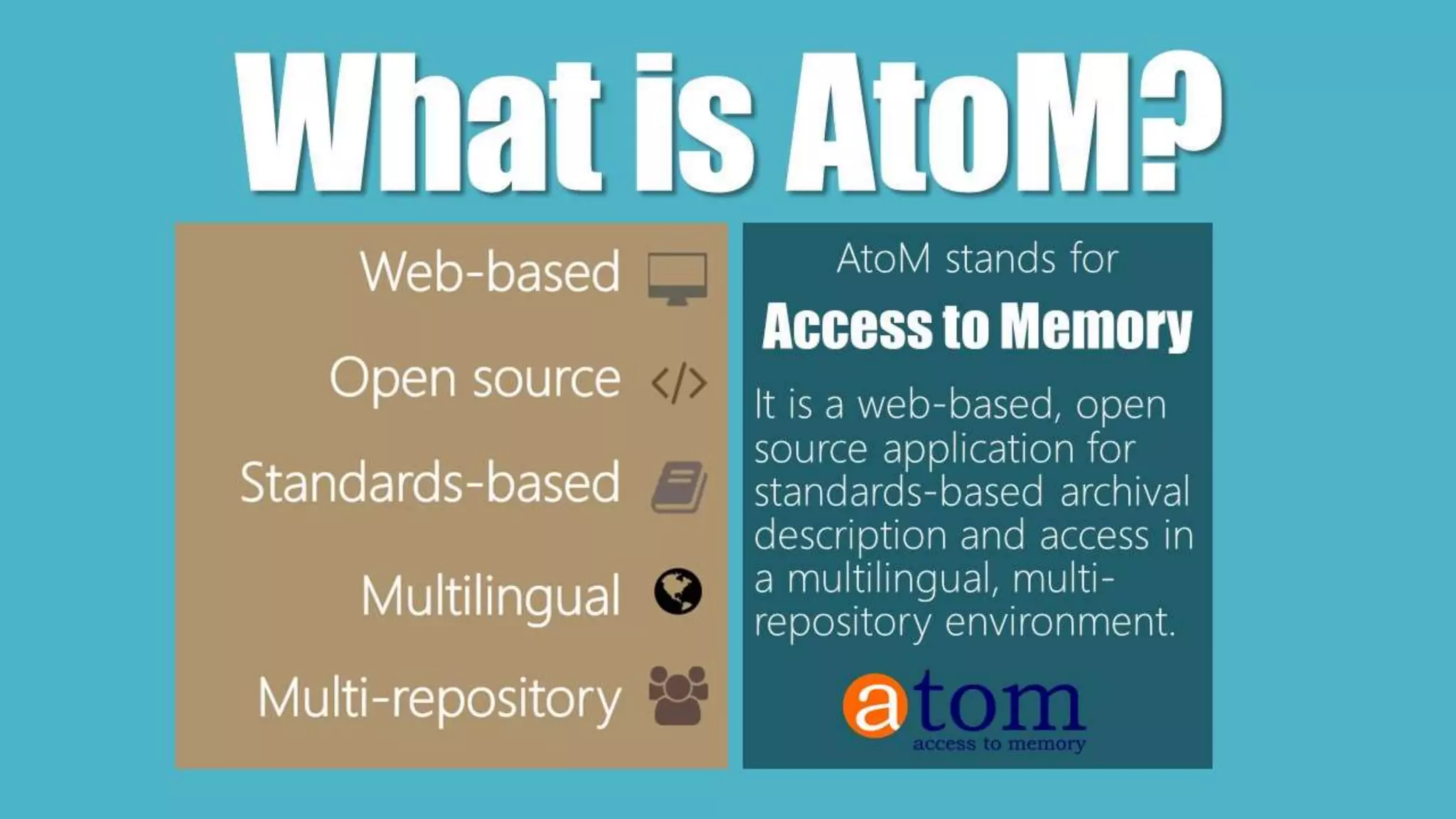
What is AtoM?AtoM stands for
Access to Memory
It is a web-based, open
source application for
standards-based archival
description and access in
a multilingual, multi-
repository environment.
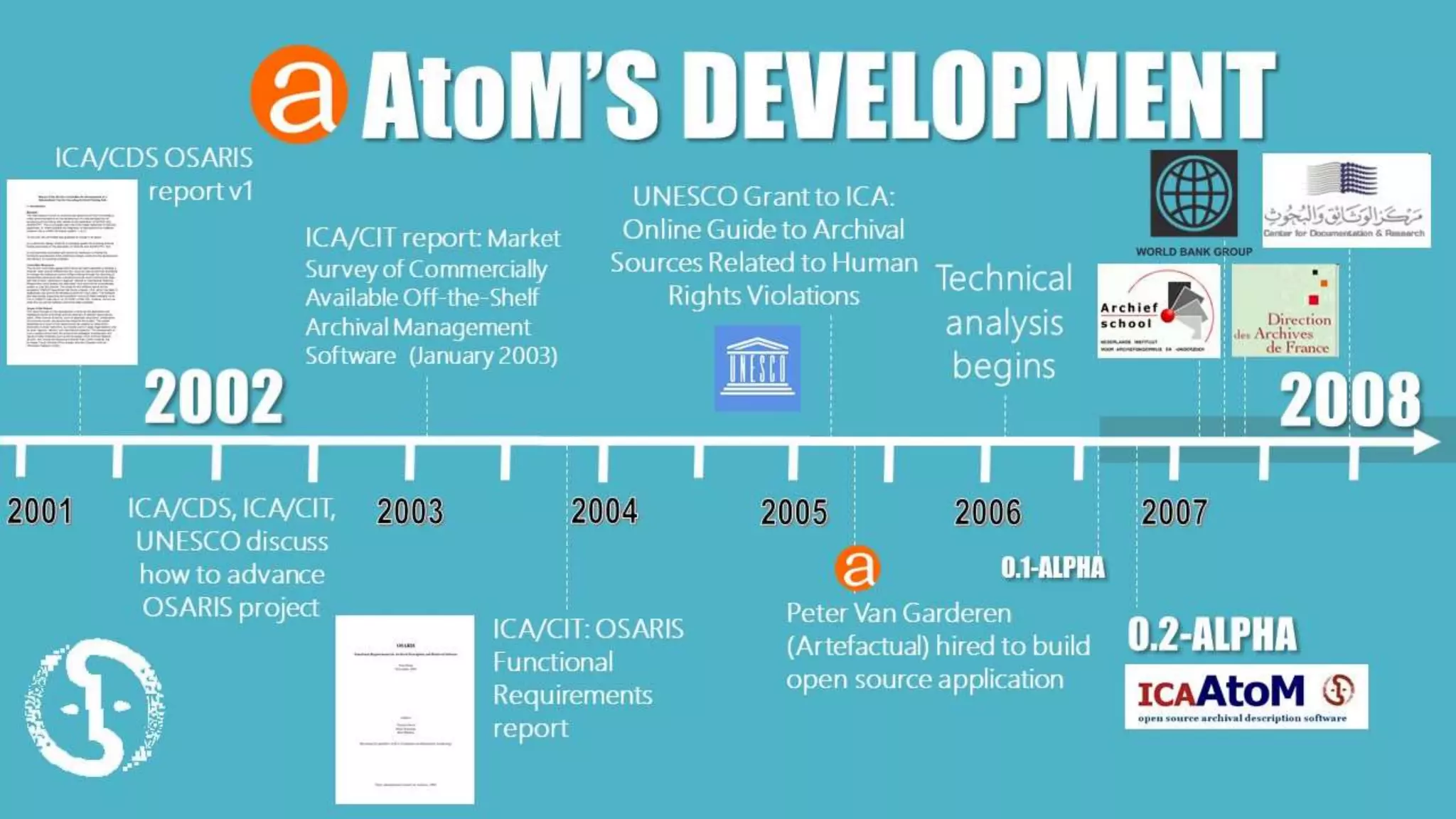
The impulse that eventually led to the creation of ICA-AtoM first came out of collaborative discussions between the ICA’s Committee on
Descriptive Standards, Committee on Information Technology, and UNESCO. In 2001, a draft report was prepared by an ad-hoc
committee from ICA-CDS to describe some of the functional requirements necessary for the online presentation of finding aids that
conformed to the ICA standards. The draft report references this theoretical system as OSARIS – the Open Source Archival Information
System – which became an ongoing topic of conversation between the groups throughout 2002. In November 2003, after performing a
survey of existing Archival Management systems, the Committee on Information Technology released an updated report on the
functional requirements for the OSARIS project, with the hopes of eventually supporting the development of such a system.
Without a clear source of funding however, the project stalled shortly after that until in 2005, UNESCO provided the ICA with a grant to
support the creation of an Online Guide to Archival Sources Related to Human Rights Violations. The ICA and UNESCO decided to use
this project as an opportunity to move the OSARIS project forward, and create an open source, web-based application for description
and access that would support the ICA standards. In late 2005, Peter Van Garderen of Artefactual Systems was hired to implement this
vision. After a thorough technical requirements analysis process, the very first alpha versions of the application were made in late 2006.
There was great interest in the prototype, and a desire to prepare a 1.0 version of the application in time for release at the 2008 ICA
conference in Kuala Lumpur, but more resources were required to carry the project forward. Fortunately, institutions such as The
Hogeschool Van Amsterdam Archiefschool, Direction des Archives de France, the World Bank Group Archives, and the United Arab
Emirates Centre for Documentation and Research all made contributions that allowed the project to continue.
2002
0.2-ALPHA
ICA/CIT report: Market
Survey of Commercially
Available Off-the-Shelf
Archival Management
Software (January 2003)
AtoM’S DEVELOPMENTICA/CDS OSARIS
report v1
ICA/CDS, ICA/CIT,
UNESCO discuss
how to advance
OSARIS project
ICA/CIT: OSARIS
Functional
Requirements
report
UNESCO Grant to ICA:
Online Guide to Archival
Sources Related to Human
Rights Violations
Peter Van Garderen
(Artefactual) hired to build
open source application
Technical
analysis
begins
0.1-ALPHA
2008
20192013
1.x
AtoM’S DEVELOPMENT
2.22.0 2.42.3
JOB SCHEDULER
2.0.1 2.1.1
2.1
2.2.11.3.1
CLIPBOARD
AtoM 2.4
• Full bulk import / export via the user
interface
• Search index improvements
• Authority records and repositories on
the Clipboard
2.4.1
Non-backwardscompatiblechanges
independencies…
• PHP Framework
• Version used in AtoM: 1.4 (deprecated in 2012)
• Current Symfony version: 4.1
• Search index
• Version used in AtoM: 5.2 (deprecated in Jan 2017)
• Current ES version: 6.2.4
AndMajorChangesCominginour
InternationalStandards…
Provideanopportunity
for AtoM’s evolution
“Veil Nebula - NGC6960” by Ken Crawford - https://en.wikipedia.org/wiki/Veil_Nebula#/media/File:Veil_Nebula_-_NGC6960.jpg
https://pixabay.com/en/audience-crowd-people-persons-828584/
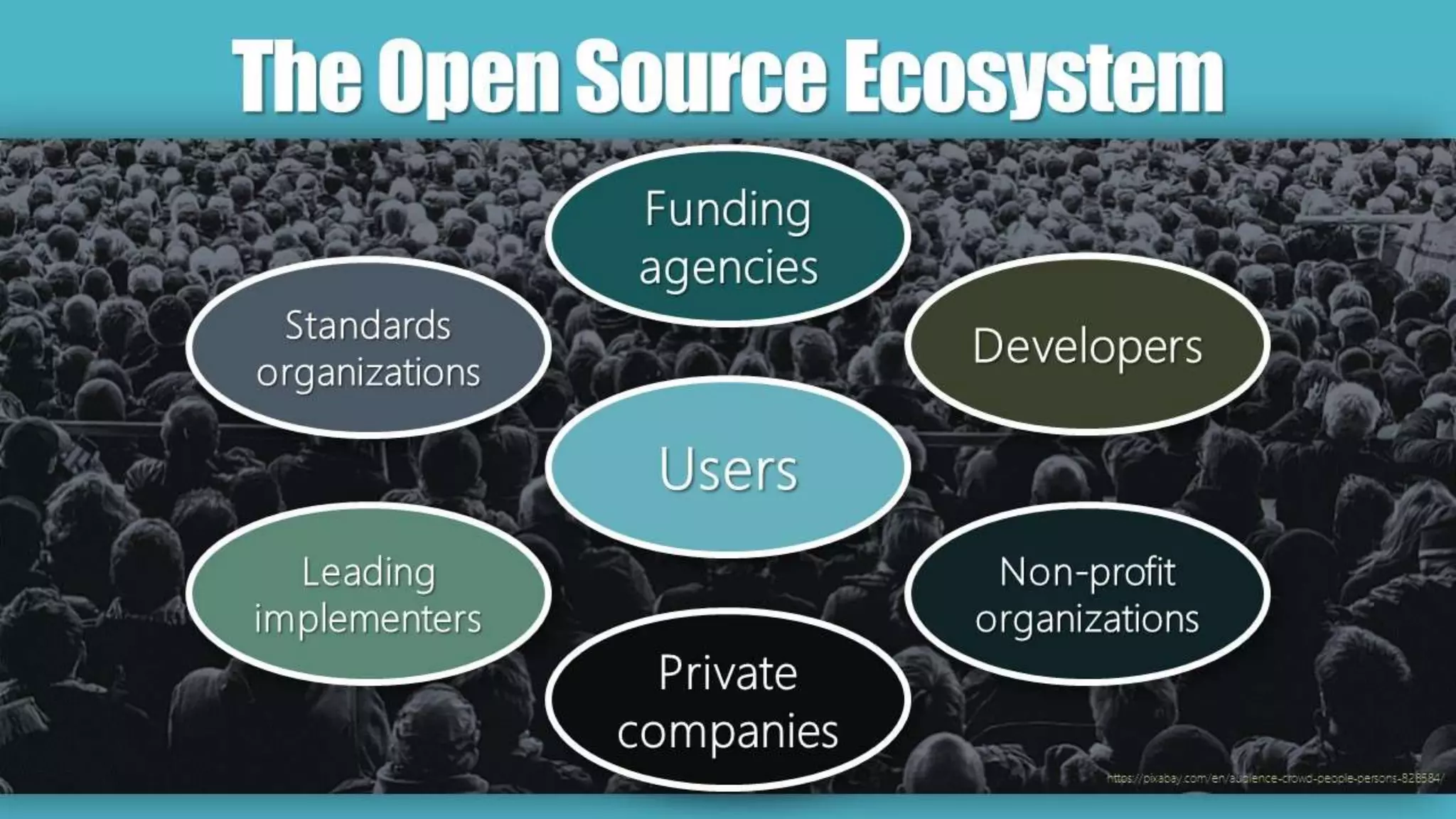
TheOpenSourceEcosystem
Leading
implementers
Private
companies
Non-profit
organizations
Funding
agencies
Developers
Users
Standards
organizations
https://pixabay.com/en/audience-crowd-people-persons-828584/
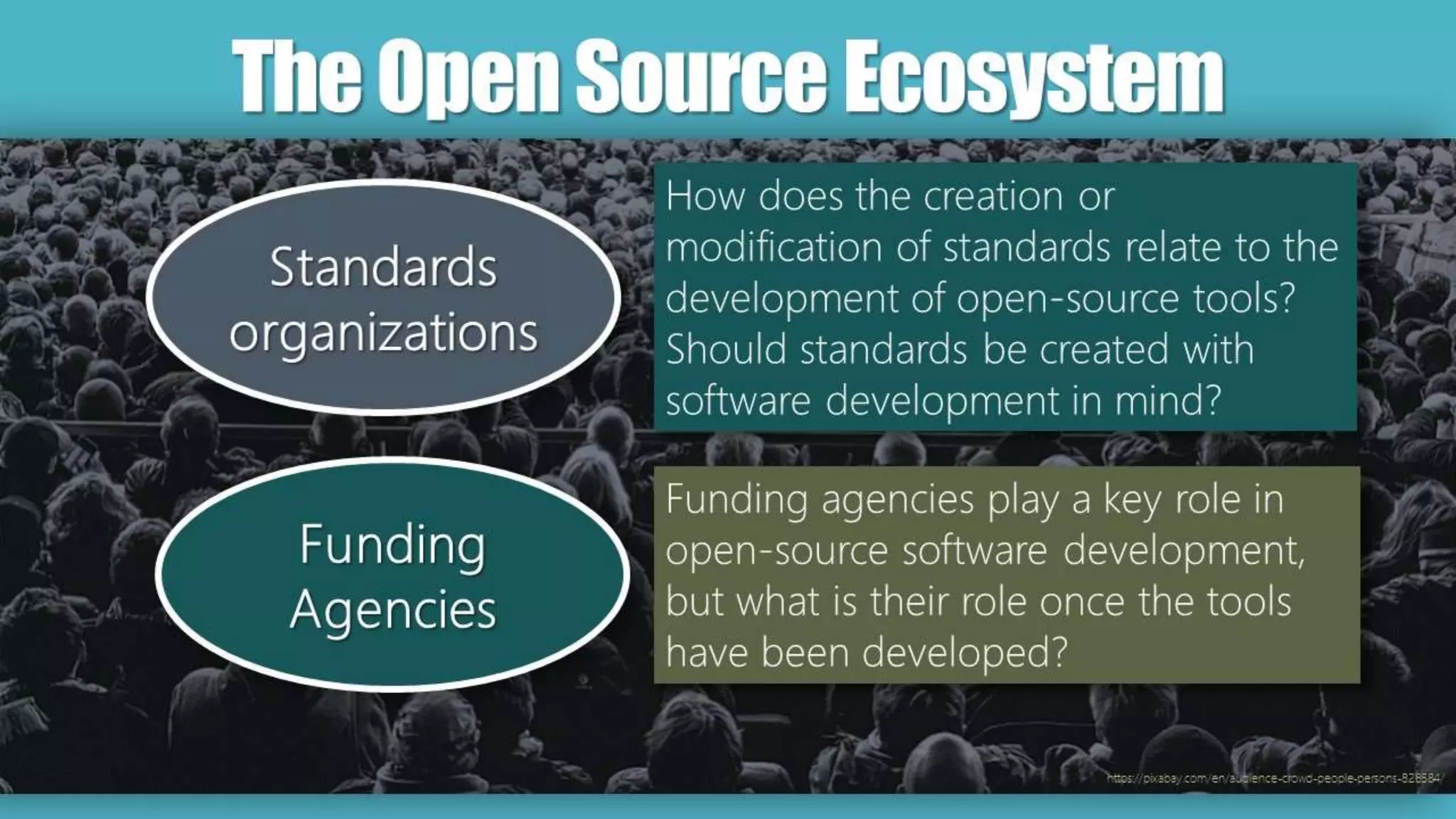
TheOpenSourceEcosystem
Standards
organizations
How does the creation or
modification of standards relate to the
development of open-source tools?
Should standards be created with
software development in mind?
Funding
Agencies
Funding agencies play a key role in
open-source software development,
but what is their role once the tools
have been developed?
https://pixabay.com/en/audience-crowd-people-persons-828584/
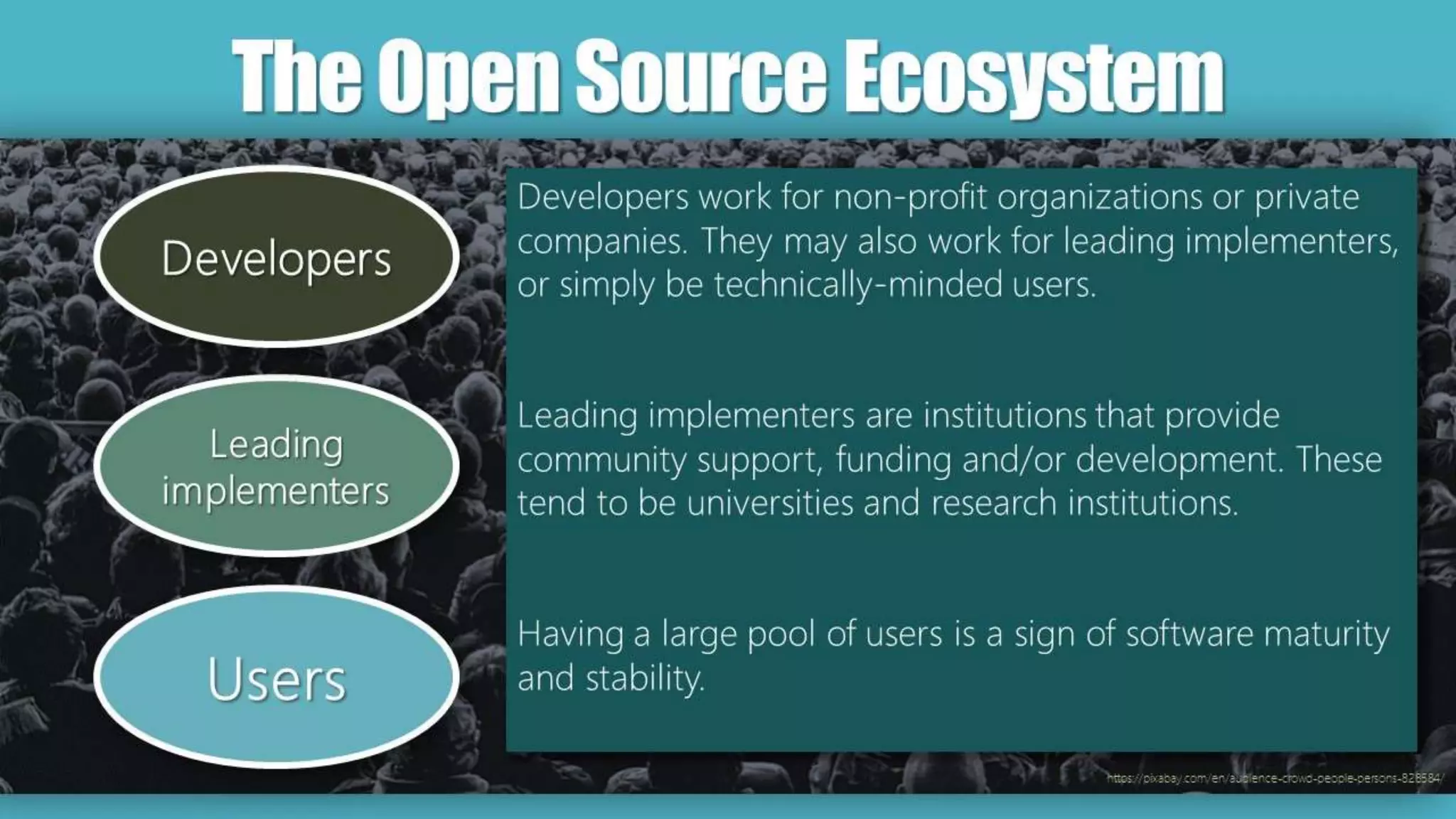
TheOpenSourceEcosystem
Leading
implementers
Developers
Users
Developers work for non-profit organizations or private
companies. They may also work for leading implementers,
or simply be technically-minded users.
Leading implementers are institutions that provide
community support, funding and/or development. These
tend to be universities and research institutions.
Having a large pool of users is a sign of software maturity
and stability.
https://pixabay.com/en/audience-crowd-people-persons-828584/
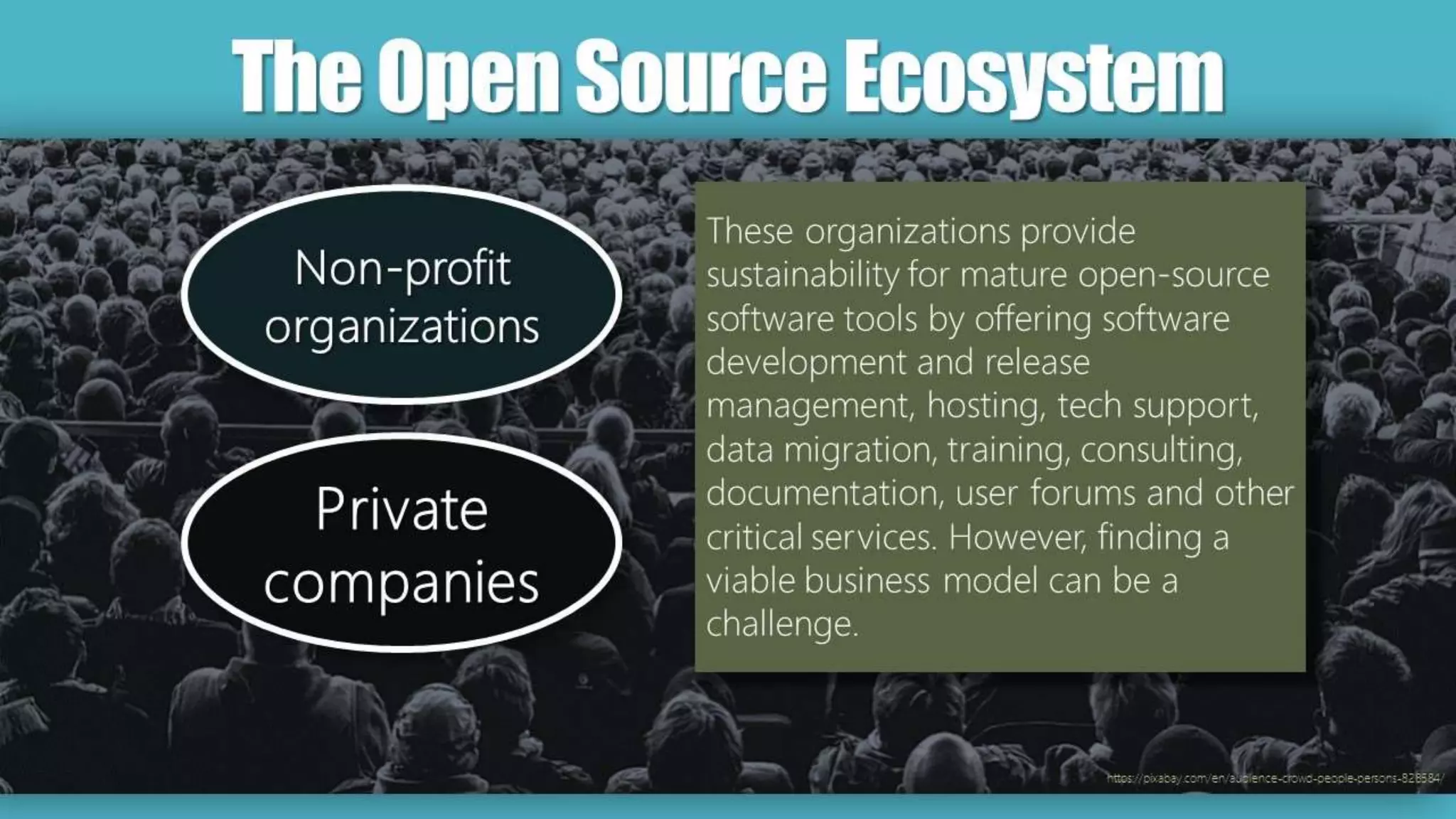
TheOpenSourceEcosystem
These organizations provide
sustainability for mature open-source
software tools by offering software
development and release
management, hosting, tech support,
data migration, training, consulting,
documentation, user forums and other
critical services. However, finding a
viable business model can be a
challenge.
Private
companies
Non-profit
organizations
Open-sourceBusinessModels
When grant funding ends or doesn’t cover all costs, there
are different ways of making open-source software viable
and self-sustaining. Here are three common models:
• Membership model
• Bounty development model
• Services model
https://commons.wikimedia.org/wiki/File:Exchange_Money_Conversion_to_Foreign_Currency.jpg
MembershipModel
The software is free and open-source but purchase of a membership allows users to gain access to
certain privileges or services. Some membership models mean that only members get access to
certain types of documentation, training materials, issue reporting systems and/or member-only
user forums. Other membership models provide privileges such as a role in governance, discounts
on training and meeting events, but don’t restrict documentation etc. Examples:
• Lyrasis (ArchivesSpace, CollectionSpace)
• BitCurator Consortium
• DuraSpace (DSpace, Archivematica, DuraCloud, Fedora)
• Islandora Foundation
• Open Preservation Foundation (JHOVE, Jpylyzer, FIDO, xcorrSound)
https://commons.wikimedia.org/wiki/File:Exchange_Money_Conversion_to_Foreign_Currency.jpg
The money raised is used to support continued development and software release management.
BountyDevelopmentModel
The software is free and open-source but development of new features and
enhancements depends on one or more institutions providing funding. The
new features and enhancements are added to subsequent public releases of
the software. Sometimes called “Professional Open Source.” Examples:
• Artefactual Systems (Archivematica, AtoM)
• Data Curation Experts (Hydra, Blacklight, Fedora)
• DiscoveryGarden (Islandora)
• Hudson Molonglo (ArchivesSpace)
https://commons.wikimedia.org/wiki/File:Exchange_Money_Conversion_to_Foreign_Currency.jpg
ServicesModel
The software is free and open-source, but there are organizations that
provide related services such as hosting, technical support, data migration,
consulting, training and customization. These organizations may or may not
be the lead developers of the tools. Examples:
• Artefactual Systems (Archivematica, AtoM)
• DuraSpace (DSpace, Archivematica, DuraCloud, Fedora)
• DiscoveryGarden (Islandora)
• Cottage Labs (Hydra, Fedora)
• AVPreserve (Archival Management System, Exactly, Fixity + other tools)
• KEEP Solutions (RODA, DSpace + other tools)
https://commons.wikimedia.org/wiki/File:Exchange_Money_Conversion_to_Foreign_Currency.jpg
OtherOpen-sourcemodels
https://commons.wikimedia.org/wiki/File:Exchange_Money_Conversion_to_Foreign_Currency.jpg
Franchising model:
The software is free and open-source, but the name and logo(s) are
proprietary and can only be used with permission. The owners of the name
and logo(s) sell the rights to organizations to provide technical support,
hosting and customization services.
Proprietary add-on / “freemium” model:
The software is free and open-source, but organizations develop proprietary
add-ons or plugins or have “enterprise” or “professional” versions that add
more functionality or scalability.
OpenSourceGovernance
https://commons.wikimedia.org/wiki/File:FAEF_Boardroom.jpg
How does the project decide:
• What’s included in the core application?
• What’s included in each release?
• What bugs and features get prioritized?
• What direction should the project take in the future?
• Who gets to commit code to the project?
• Who defines the license of the project? What license should be used?
• Who maintains the documentation? What about other resources? Forums, webinars, etc.?
• Where funding will come from?
• How community involvement and investment will be maintained and grown over time?
• How will conflicts between community members be managed? What about between
maintainers/founders?
OpenSourceGovernance
https://commons.wikimedia.org/wiki/File:FAEF_Boardroom.jpg
Benevolent Dictators
• Project leadership by one person or a small, closed core (often the original
author[s] of the project) who make all final decisions
Broader software development examples:
• Linux (Linus Torvalds)
• Python (Guido van Rossum)
Cultural heritage examples:
• EADitor and xEAC (Ethan Gruber)
• …AtoM and Archivematica? (Artefactual)
OpenSourceGovernance
https://commons.wikimedia.org/wiki/File:FAEF_Boardroom.jpg
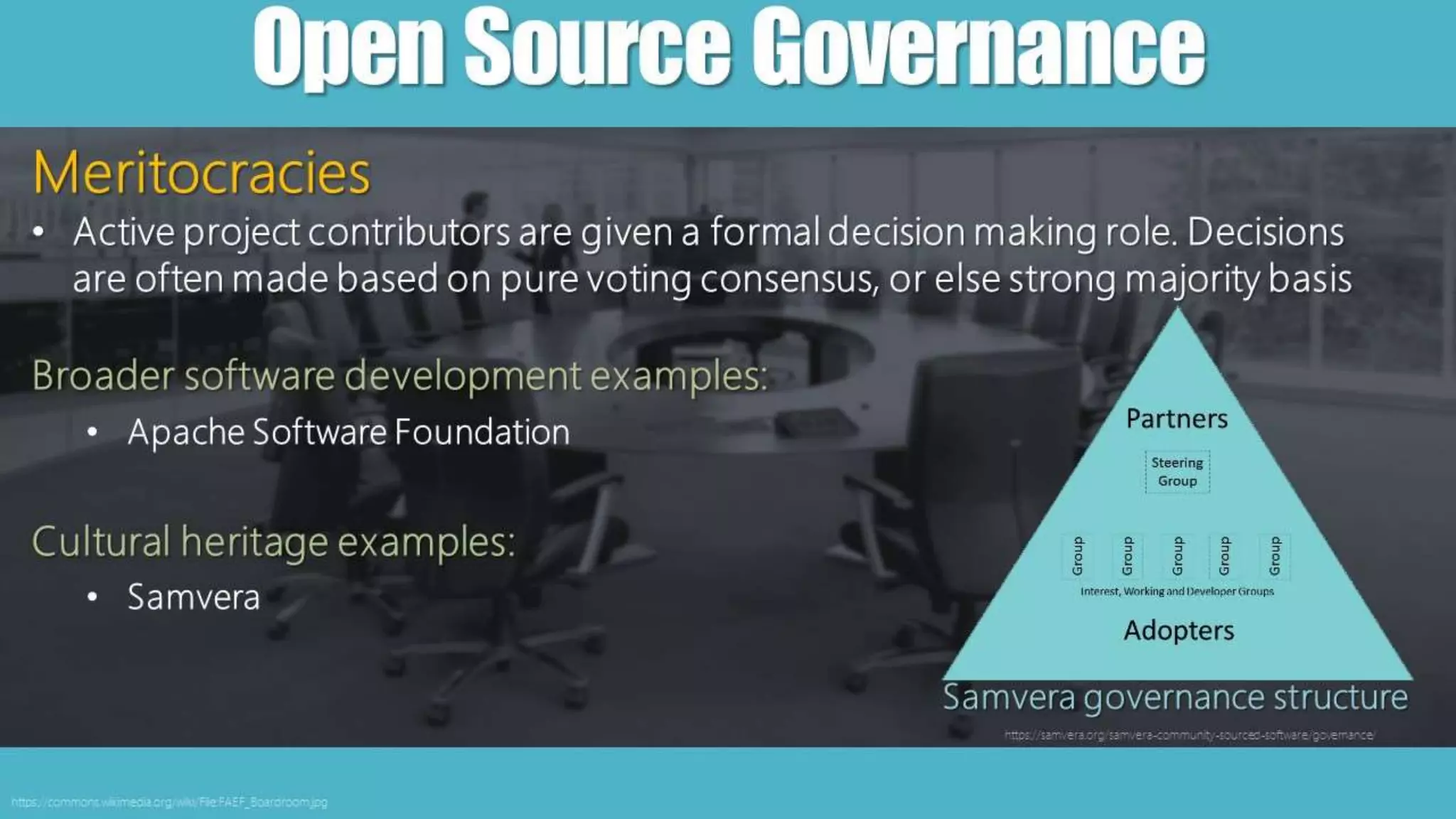
Meritocracies
• Active project contributors are given a formal decision making role. Decisions
are often made based on pure voting consensus, or else strong majority basis
Broader software development examples:
• Apache Software Foundation
Cultural heritage examples:
• Samvera
Samvera governance structure
https://samvera.org/samvera-community-sourced-software/governance/
OpenSource,Foundations,andNon-Profits
https://commons.wikimedia.org/wiki/File:FAEF_Boardroom.jpg
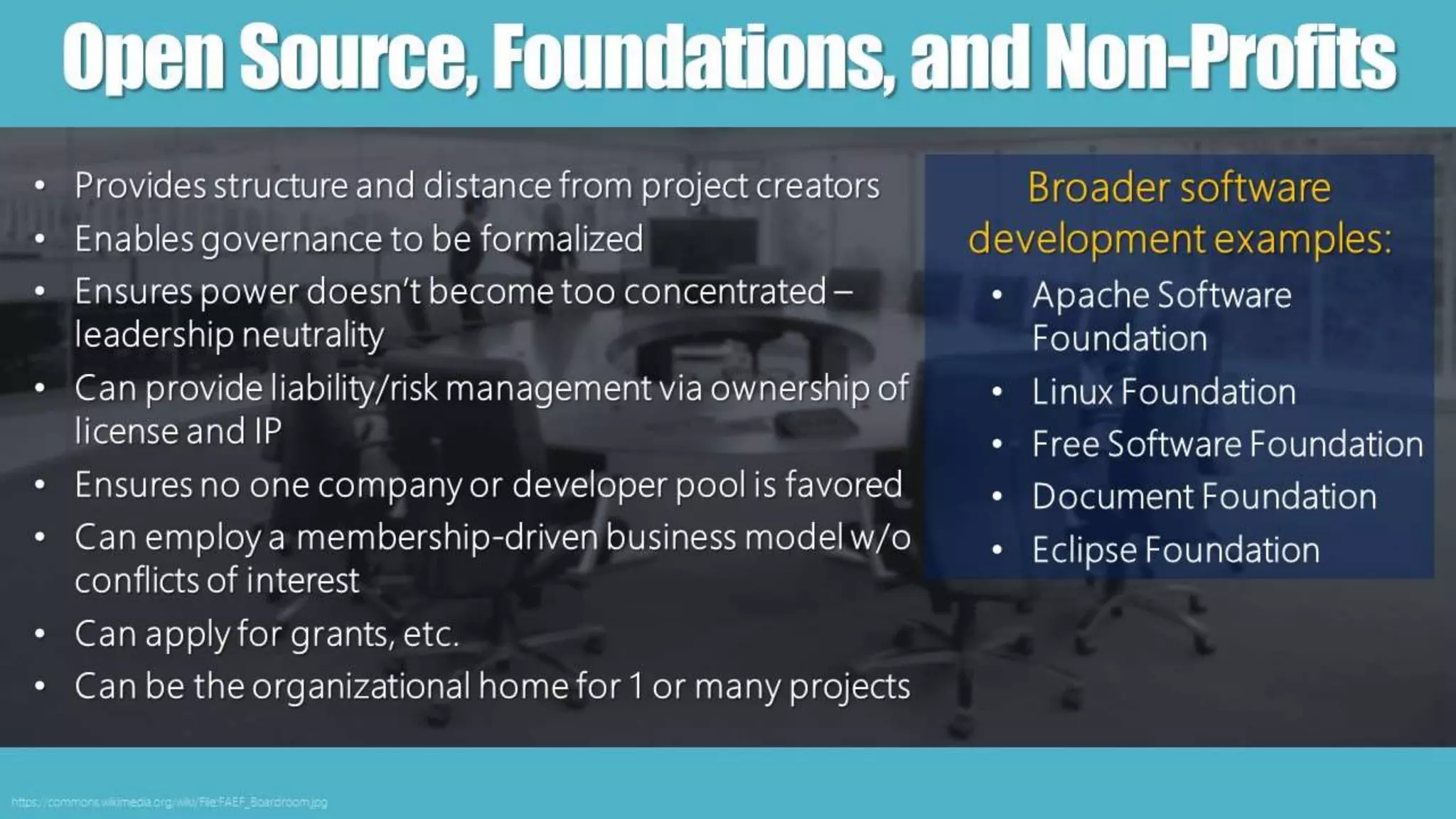
• Provides structure and distance from project creators
• Enables governance to be formalized
• Ensures power doesn’t become too concentrated –
leadership neutrality
• Can provide liability/risk management via ownership of
license and IP
• Ensures no one company or developer pool is favored
• Can employ a membership-driven business model w/o
conflicts of interest
• Can apply for grants, etc.
• Can be the organizational home for 1 or many projects
Broader software
development examples:
• Apache Software
Foundation
• Linux Foundation
• Free Software Foundation
• Document Foundation
• Eclipse Foundation
OpenSource,Foundations,andNon-Profits
https://commons.wikimedia.org/wiki/File:FAEF_Boardroom.jpg
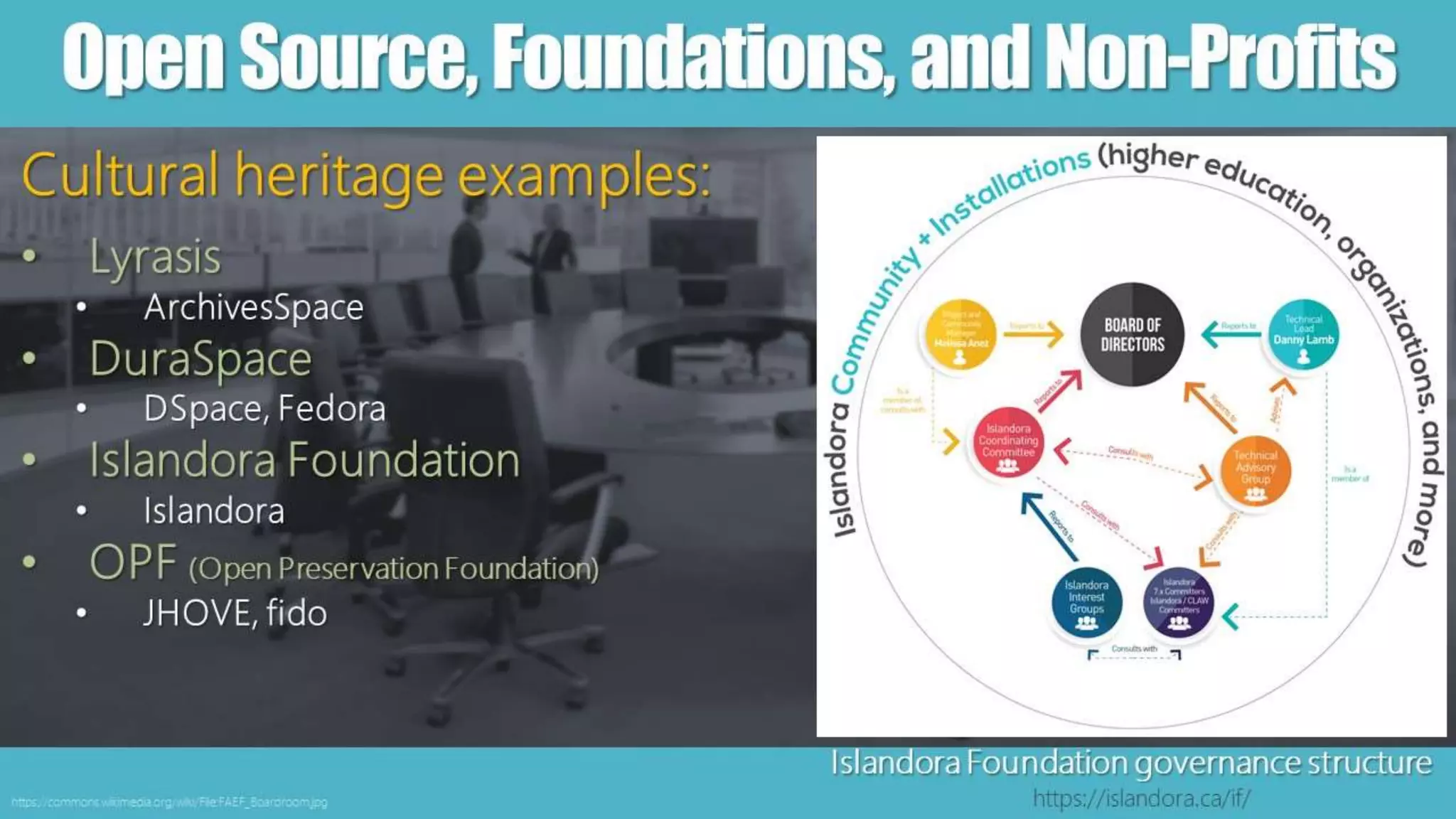
Cultural heritage examples:
• Lyrasis
• ArchivesSpace
• DuraSpace
• DSpace, Fedora
• Islandora Foundation
• Islandora
• OPF (Open Preservation Foundation)
• JHOVE, fido
Islandora Foundation governance structure
https://islandora.ca/if/
Therearemanymorevariations…
Almostasmanyasthereareprojectshttps://www.jpl.nasa.gov/spaceimages/details.php?id=pia14417
SohowwilltheAtoMproject
moveforward?
??????
https://en.wikipedia.org/wiki/Pleiades#/media/File:Pleiades_large.jpg
https://accesstomemoryfoundation.org

Building the Future Together: AtoM3, Governance, and the Sustainability of Open Source Projects

  • 1.
    Buildingthefuturetogether: AtoM3, Governance, andthe Sustainability of Open Source Projects http://www.spitzer.caltech.edu/uploaded_files/images/0007/9905/sig10-009a_Lrg.jpg Buildingthefuturetogether: OR2018 – Bozeman, Montana Dan Gillean - Artefactual Systems @accesstomemory
  • 2.
    Web based: Onceinstalled, you only need a modern web browser and an internet connection to connect to the application from anywhere Standards-based: AtoM implements existing national and international archival content and metadata transmission standards and best practices, so your data is standards compliant and interoperable Multilingual: Supports translations of both content and user interface elements, can be used as a multilingual catalogue Multi-repository: Can be used as a portal site, content aggregator, or union catalogue to provide access to content from multiple institutions What is AtoM?AtoM stands for Access to Memory It is a web-based, open source application for standards-based archival description and access in a multilingual, multi- repository environment.
  • 3.
    The impulse thateventually led to the creation of ICA-AtoM first came out of collaborative discussions between the ICA’s Committee on Descriptive Standards, Committee on Information Technology, and UNESCO. In 2001, a draft report was prepared by an ad-hoc committee from ICA-CDS to describe some of the functional requirements necessary for the online presentation of finding aids that conformed to the ICA standards. The draft report references this theoretical system as OSARIS – the Open Source Archival Information System – which became an ongoing topic of conversation between the groups throughout 2002. In November 2003, after performing a survey of existing Archival Management systems, the Committee on Information Technology released an updated report on the functional requirements for the OSARIS project, with the hopes of eventually supporting the development of such a system. Without a clear source of funding however, the project stalled shortly after that until in 2005, UNESCO provided the ICA with a grant to support the creation of an Online Guide to Archival Sources Related to Human Rights Violations. The ICA and UNESCO decided to use this project as an opportunity to move the OSARIS project forward, and create an open source, web-based application for description and access that would support the ICA standards. In late 2005, Peter Van Garderen of Artefactual Systems was hired to implement this vision. After a thorough technical requirements analysis process, the very first alpha versions of the application were made in late 2006. There was great interest in the prototype, and a desire to prepare a 1.0 version of the application in time for release at the 2008 ICA conference in Kuala Lumpur, but more resources were required to carry the project forward. Fortunately, institutions such as The Hogeschool Van Amsterdam Archiefschool, Direction des Archives de France, the World Bank Group Archives, and the United Arab Emirates Centre for Documentation and Research all made contributions that allowed the project to continue. 2002 0.2-ALPHA ICA/CIT report: Market Survey of Commercially Available Off-the-Shelf Archival Management Software (January 2003) AtoM’S DEVELOPMENTICA/CDS OSARIS report v1 ICA/CDS, ICA/CIT, UNESCO discuss how to advance OSARIS project ICA/CIT: OSARIS Functional Requirements report UNESCO Grant to ICA: Online Guide to Archival Sources Related to Human Rights Violations Peter Van Garderen (Artefactual) hired to build open source application Technical analysis begins 0.1-ALPHA 2008
  • 4.
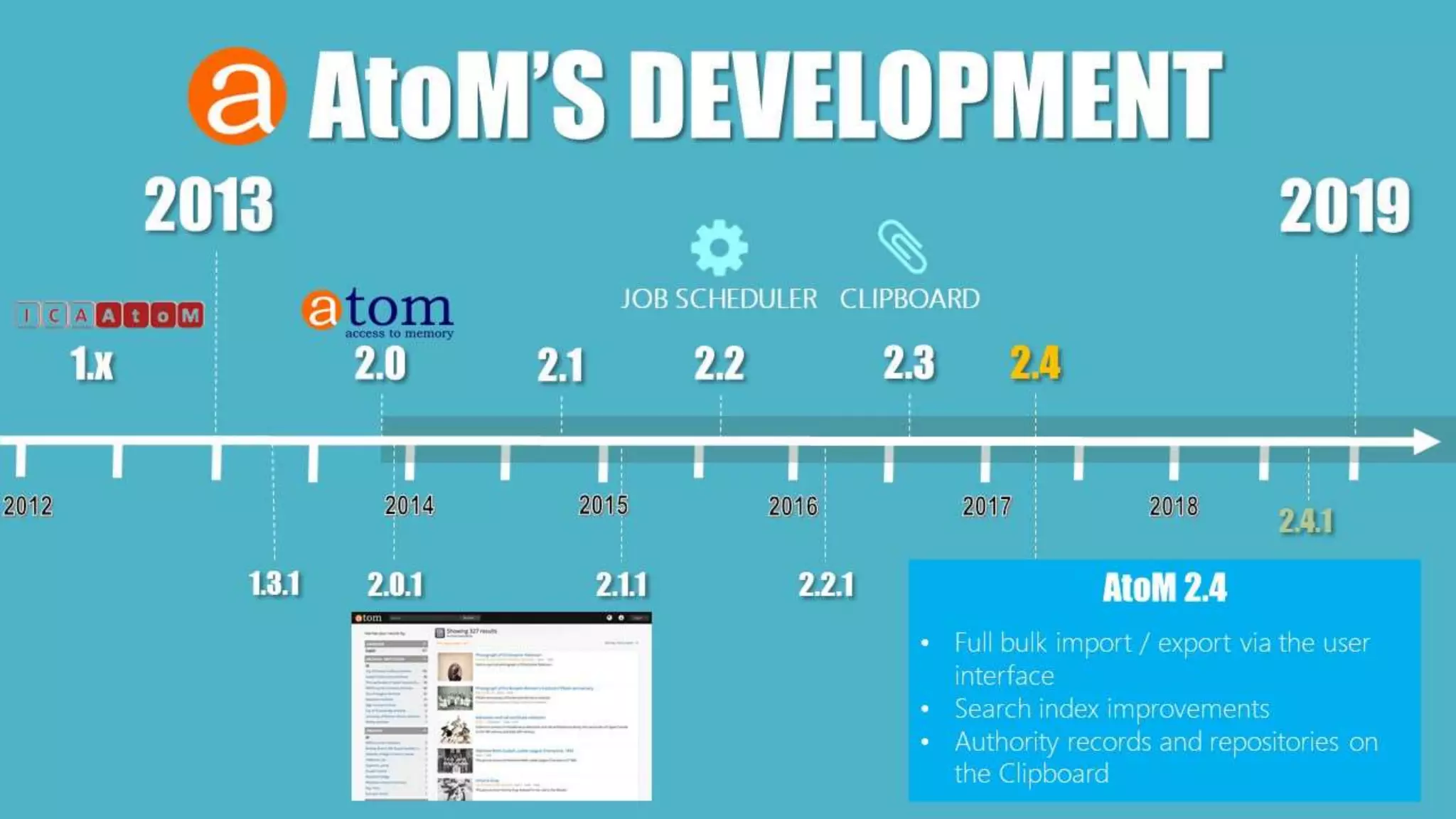
    20192013 1.x AtoM’S DEVELOPMENT 2.22.0 2.42.3 JOBSCHEDULER 2.0.1 2.1.1 2.1 2.2.11.3.1 CLIPBOARD AtoM 2.4 • Full bulk import / export via the user interface • Search index improvements • Authority records and repositories on the Clipboard 2.4.1
  • 5.
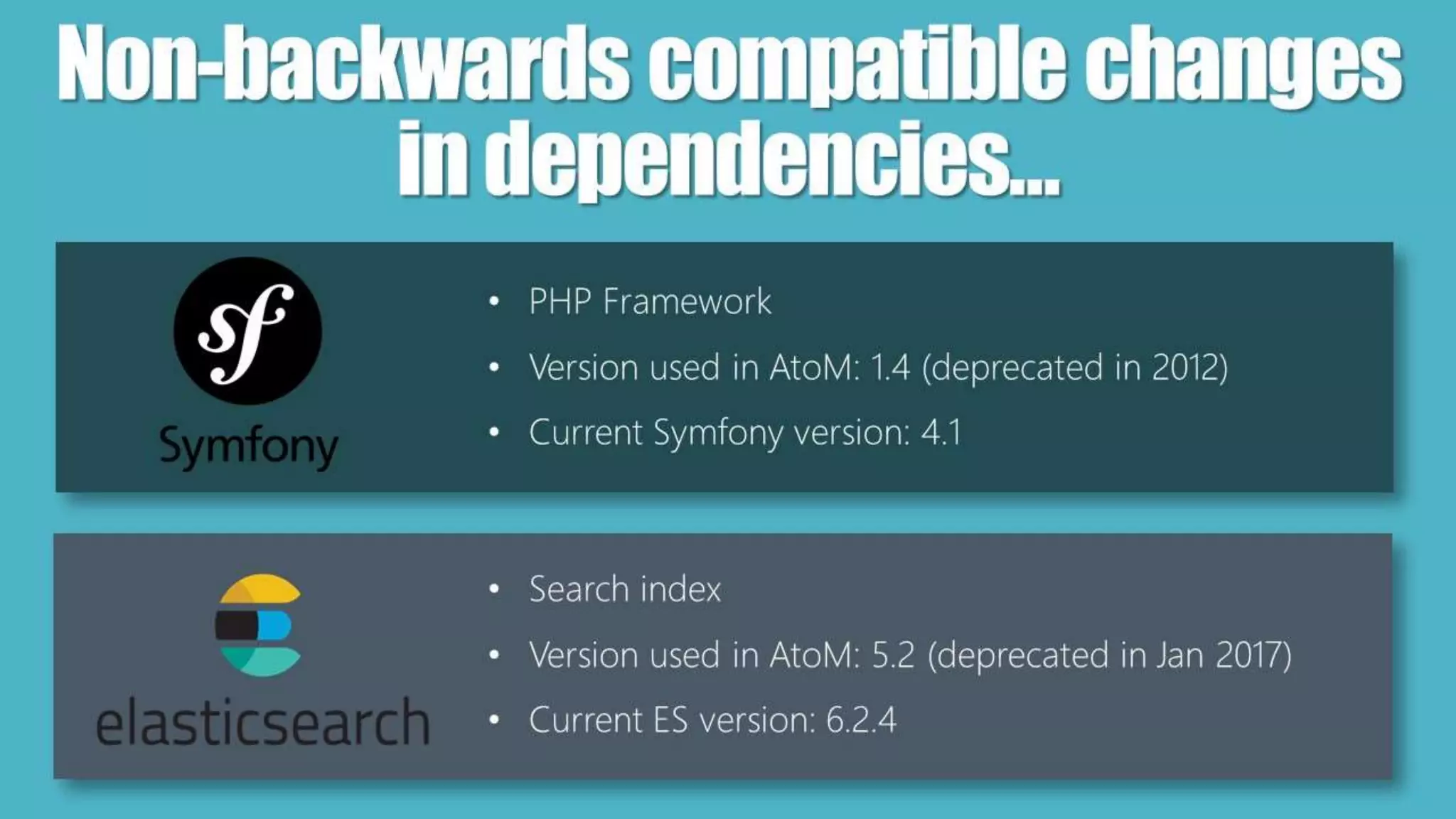
    Non-backwardscompatiblechanges independencies… • PHP Framework •Version used in AtoM: 1.4 (deprecated in 2012) • Current Symfony version: 4.1 • Search index • Version used in AtoM: 5.2 (deprecated in Jan 2017) • Current ES version: 6.2.4
  • 6.
  • 7.
    Provideanopportunity for AtoM’s evolution “VeilNebula - NGC6960” by Ken Crawford - https://en.wikipedia.org/wiki/Veil_Nebula#/media/File:Veil_Nebula_-_NGC6960.jpg
  • 8.
  • 9.
    https://pixabay.com/en/audience-crowd-people-persons-828584/ TheOpenSourceEcosystem Standards organizations How does thecreation or modification of standards relate to the development of open-source tools? Should standards be created with software development in mind? Funding Agencies Funding agencies play a key role in open-source software development, but what is their role once the tools have been developed?
  • 10.
    https://pixabay.com/en/audience-crowd-people-persons-828584/ TheOpenSourceEcosystem Leading implementers Developers Users Developers work fornon-profit organizations or private companies. They may also work for leading implementers, or simply be technically-minded users. Leading implementers are institutions that provide community support, funding and/or development. These tend to be universities and research institutions. Having a large pool of users is a sign of software maturity and stability.
  • 11.
    https://pixabay.com/en/audience-crowd-people-persons-828584/ TheOpenSourceEcosystem These organizations provide sustainabilityfor mature open-source software tools by offering software development and release management, hosting, tech support, data migration, training, consulting, documentation, user forums and other critical services. However, finding a viable business model can be a challenge. Private companies Non-profit organizations
  • 12.
    Open-sourceBusinessModels When grant fundingends or doesn’t cover all costs, there are different ways of making open-source software viable and self-sustaining. Here are three common models: • Membership model • Bounty development model • Services model https://commons.wikimedia.org/wiki/File:Exchange_Money_Conversion_to_Foreign_Currency.jpg
  • 13.
    MembershipModel The software isfree and open-source but purchase of a membership allows users to gain access to certain privileges or services. Some membership models mean that only members get access to certain types of documentation, training materials, issue reporting systems and/or member-only user forums. Other membership models provide privileges such as a role in governance, discounts on training and meeting events, but don’t restrict documentation etc. Examples: • Lyrasis (ArchivesSpace, CollectionSpace) • BitCurator Consortium • DuraSpace (DSpace, Archivematica, DuraCloud, Fedora) • Islandora Foundation • Open Preservation Foundation (JHOVE, Jpylyzer, FIDO, xcorrSound) https://commons.wikimedia.org/wiki/File:Exchange_Money_Conversion_to_Foreign_Currency.jpg The money raised is used to support continued development and software release management.
  • 14.
    BountyDevelopmentModel The software isfree and open-source but development of new features and enhancements depends on one or more institutions providing funding. The new features and enhancements are added to subsequent public releases of the software. Sometimes called “Professional Open Source.” Examples: • Artefactual Systems (Archivematica, AtoM) • Data Curation Experts (Hydra, Blacklight, Fedora) • DiscoveryGarden (Islandora) • Hudson Molonglo (ArchivesSpace) https://commons.wikimedia.org/wiki/File:Exchange_Money_Conversion_to_Foreign_Currency.jpg
  • 15.
    ServicesModel The software isfree and open-source, but there are organizations that provide related services such as hosting, technical support, data migration, consulting, training and customization. These organizations may or may not be the lead developers of the tools. Examples: • Artefactual Systems (Archivematica, AtoM) • DuraSpace (DSpace, Archivematica, DuraCloud, Fedora) • DiscoveryGarden (Islandora) • Cottage Labs (Hydra, Fedora) • AVPreserve (Archival Management System, Exactly, Fixity + other tools) • KEEP Solutions (RODA, DSpace + other tools) https://commons.wikimedia.org/wiki/File:Exchange_Money_Conversion_to_Foreign_Currency.jpg
  • 16.
    OtherOpen-sourcemodels https://commons.wikimedia.org/wiki/File:Exchange_Money_Conversion_to_Foreign_Currency.jpg Franchising model: The softwareis free and open-source, but the name and logo(s) are proprietary and can only be used with permission. The owners of the name and logo(s) sell the rights to organizations to provide technical support, hosting and customization services. Proprietary add-on / “freemium” model: The software is free and open-source, but organizations develop proprietary add-ons or plugins or have “enterprise” or “professional” versions that add more functionality or scalability.
  • 17.
    OpenSourceGovernance https://commons.wikimedia.org/wiki/File:FAEF_Boardroom.jpg How does theproject decide: • What’s included in the core application? • What’s included in each release? • What bugs and features get prioritized? • What direction should the project take in the future? • Who gets to commit code to the project? • Who defines the license of the project? What license should be used? • Who maintains the documentation? What about other resources? Forums, webinars, etc.? • Where funding will come from? • How community involvement and investment will be maintained and grown over time? • How will conflicts between community members be managed? What about between maintainers/founders?
  • 18.
    OpenSourceGovernance https://commons.wikimedia.org/wiki/File:FAEF_Boardroom.jpg Benevolent Dictators • Projectleadership by one person or a small, closed core (often the original author[s] of the project) who make all final decisions Broader software development examples: • Linux (Linus Torvalds) • Python (Guido van Rossum) Cultural heritage examples: • EADitor and xEAC (Ethan Gruber) • …AtoM and Archivematica? (Artefactual)
  • 19.
    OpenSourceGovernance https://commons.wikimedia.org/wiki/File:FAEF_Boardroom.jpg Meritocracies • Active projectcontributors are given a formal decision making role. Decisions are often made based on pure voting consensus, or else strong majority basis Broader software development examples: • Apache Software Foundation Cultural heritage examples: • Samvera Samvera governance structure https://samvera.org/samvera-community-sourced-software/governance/
  • 20.
    OpenSource,Foundations,andNon-Profits https://commons.wikimedia.org/wiki/File:FAEF_Boardroom.jpg • Provides structureand distance from project creators • Enables governance to be formalized • Ensures power doesn’t become too concentrated – leadership neutrality • Can provide liability/risk management via ownership of license and IP • Ensures no one company or developer pool is favored • Can employ a membership-driven business model w/o conflicts of interest • Can apply for grants, etc. • Can be the organizational home for 1 or many projects Broader software development examples: • Apache Software Foundation • Linux Foundation • Free Software Foundation • Document Foundation • Eclipse Foundation
  • 21.
    OpenSource,Foundations,andNon-Profits https://commons.wikimedia.org/wiki/File:FAEF_Boardroom.jpg Cultural heritage examples: •Lyrasis • ArchivesSpace • DuraSpace • DSpace, Fedora • Islandora Foundation • Islandora • OPF (Open Preservation Foundation) • JHOVE, fido Islandora Foundation governance structure https://islandora.ca/if/
  • 22.
  • 23.
  • 24.

Editor's Notes

  • #5 We’ve come a long way since then! In October of 2013, we released the 2.0 version of AtoM, which included an improved search index for better scalability and performance, a new user interface look and feel, faceted search and browse, and more. We also launched a new website, and began overhauling the project documentation. The project continues to grow and improve with every major release, and we are currently preparing for our 2.4 release in 2017.
  • #9 A successful open-source project is not something that arises in isolation. Most, if not all, of the components in this diagram have some kind of role to play in any o/s project.
  • #10 I’ve put up a question here to which I don’t really know the answer. What do you think?