SOURCE DATA
ACCESS EDUCATION
RESEARCH MIND
OPEN SOURCE:
EVOLUTION OF SOCIETY VIA
SOFTWARE DEVELOPMENT
PRACTICES
IRINA ZAKS
IRINA.ZAKS@STANFORD.EDU
r
BRIEF HISTORY OF OPEN
SOURCE
WHAT COMES TO YOUR MIND
WHEN YOU HEAR “OPEN
SOURCE”• Computer software license
• Philosophy
• Economic concept of production model
• Does “Open Source” has a definition?
• Free no cost
• Nobody owns it
• Something to do with lots of people
• You can take it and use it
• You can change it and give back
• Shared
• Distributed
• Computer networks
OPEN SOURCE DEFINITION
• The Open Source Definition (OSD) is upheld by the entire open
source community.
• It requires
– Free re-distribution of software
– Availability of source code with software
– Derived works allowed
– Integrity of author's source code be maintained
– No discrimination against persons or groups
– No discrimination against fields of endeavor
– Distribution of license
– License must not be specific to product
– License must not restrict other software
– License must be technology-neutral
Full details can be found at http://opensource.org/docs/osd
OPEN SOURCE SOFTWARE
• Open Source Software is Software
licensed with a copyright license
compliant with the Open Source Definition
(OSD)
• Software is distributed with its source code
in a human readable format
• Software is developed in an open and
collaborative way by groups of developers
THE ORIGINS OF [TERM] “OPEN
SOURCE”
• Term was introduced at the strategy session on Feb 3
1998 in Mountain View office of VA Linux
• The term was adopted by a group of activists in
reaction to Netscape's January 1998 announcement of
a source code release for Navigator.
• New license terms were needed to free developers’
community from the ideology of the term "free
software”
• Linus Torvalds gave an all-important sanction the
following day.
• Richard Stallman, pioneer of the free software
movement, initially seemed to adopt the term, but later
changed his mind.
COPYRIGHT LAW
• Copyright law (1976) protects creative works
from unauthorized reproduction, derivative
work, distribution of copies and public display
without creator’s permission under various
conditions for term from 70 to 120 years
• Creators are required to [explicitly] surrender
the rights granted to them by copyright law if
they want to permit use of their creations
• License is a mechanism to transfer copyright
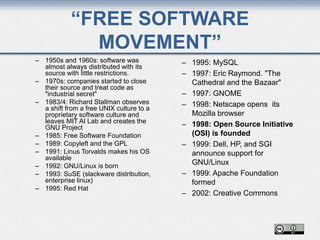
“FREE SOFTWARE
MOVEMENT”
– 1950s and 1960s: software was
almost always distributed with its
source with little restrictions.
– 1970s: companies started to close
their source and treat code as
"industrial secret"
– 1983/4: Richard Stallman observes
a shift from a free UNIX culture to a
proprietary software culture and
leaves MIT AI Lab and creates the
GNU Project
– 1985: Free Software Foundation
– 1989: Copyleft and the GPL
– 1991: Linus Torvalds makes his OS
available
– 1992: GNU/Linux is born
– 1993: SuSE (slackware distribution,
enterprise linux)
– 1995: Red Hat
– 1995: MySQL
– 1997: Eric Raymond. "The
Cathedral and the Bazaar"
– 1997: GNOME
– 1998: Netscape opens its
Mozilla browser
– 1998: Open Source Initiative
(OSI) is founded
– 1999: Dell, HP, and SGI
announce support for
GNU/Linux
– 1999: Apache Foundation
formed
– 2002: Creative Commons
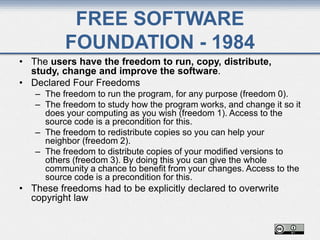
FREE SOFTWARE
FOUNDATION - 1984
• The users have the freedom to run, copy, distribute,
study, change and improve the software.
• Declared Four Freedoms
– The freedom to run the program, for any purpose (freedom 0).
– The freedom to study how the program works, and change it so it
does your computing as you wish (freedom 1). Access to the
source code is a precondition for this.
– The freedom to redistribute copies so you can help your
neighbor (freedom 2).
– The freedom to distribute copies of your modified versions to
others (freedom 3). By doing this you can give the whole
community a chance to benefit from your changes. Access to the
source code is a precondition for this.
• These freedoms had to be explicitly declared to overwrite
copyright law
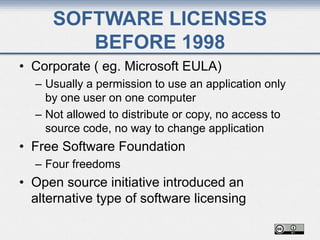
SOFTWARE LICENSES
BEFORE 1998
• Corporate ( eg. Microsoft EULA)
– Usually a permission to use an application only
by one user on one computer
– Not allowed to distribute or copy, no access to
source code, no way to change application
• Free Software Foundation
– Four freedoms
• Open source initiative introduced an
alternative type of software licensing
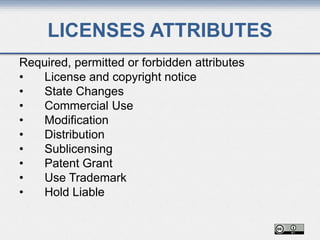
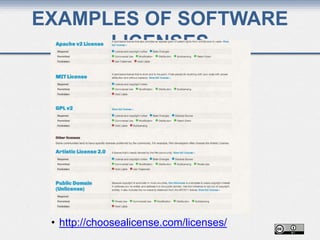
LICENSES ATTRIBUTES
Required, permitted or forbidden attributes
• License and copyright notice
• State Changes
• Commercial Use
• Modification
• Distribution
• Sublicensing
• Patent Grant
• Use Trademark
• Hold Liable
EXAMPLES OF SOFTWARE
LICENSES
• http://choosealicense.com/licenses/
EXAMPLES OF OPEN SOURCE
SOFTWARE
• Linux / Unix / BSD/ Android - OS
• Mozilla Netscape – web browser
• Apache – web server
• mySQL – database
• pHp / Ruby - languages
• Wiki / Drupal / Wordpress – web publishing
• Sakai / OpenCourseWare – learning management
system
• Simbios – bio research software
• Open Journal systems – publishing and peer
review system
HOW OPEN SOURCE
SOFTWARE AFFECTS OUR
DAILY LIFE
• Wake up to an alarm on your Android-OS
powered phone
• Check via Mozilla browser what is traffic
you will see today or what time your train
leaves
• and on and on and on it goes
OPEN SOURCE IS CHANGING
THE SOCIETY
FREE SOFTWARE IS FREE
AS IN...
• Common use of term “free” is very wide
– Free of charge – beer – disposable
– Free to use – library or city park - reusable
– Free to take and grow – puppies and software
• Open source is all of the above
– Code is free of charge
– You can simply use it
– You can modify if you want
NOT ALL FREE IS OPEN
SOURCE
• Google search/docs are free to use but
are not open source
• Open Office is free to use and open
source
What makes a project an open source?
THE SPIRIT OF OPEN
SOURCE
• Mr. D, CS student, wanted to stay connected to other
folks at his dorm and coded a new, easy to use, posting
board and put it on the server and thus on the web
• He told all his friends about this new thing and soon
everyone in his dorm was using it because it was easy
• Ms. L, an artist, liked using posting board to stay
connected, but was quite unhappy with the colors were
limited to #FFF and #00F. She created a beautiful design
and asked her friend to convert her beautiful drawing into
a template for the posting board
• Now everyone in the group (along with the rest of the
world) can enjoying useful and beautiful product.
HOW DO YOU BENEFIT BY
GIVING AWAY
– Reusable?
• Each programmer
develops one program
• They exchange programs’
code
• Each programmer has
two programs
• Two networks connected
create larger network for
both
– Disposable?
• Each programmer
brings one sandwich for
lunch
• They exchange
sandwiches
• Each programmer has
one sandwich
• Two chairs are still two
chairs
• Creative person to originate a project and
share it - core developer(s)
• Users that try the project, like it, use it, tell
what more they want(new features) and
complain when it breaks (submit bugs)
• Contributors improving the gadget for their
own needs and contributing back
• Charismatic leadership to keep the project
going
• Cheap computers and fast Internet to provide
connectivity
OPEN SOURCE
DEVELOPMENT MODEL
SOCIAL CONTEXT OF OPEN
SOURCE
• Motivation in open source community is
different from commercial world
• Common understanding principle vs.
Command principle
• In the world of cheap computers and fast
internet limited resource is skilled attention
• Abundance of resources leads to Gift culture
and makes command relationships hard to
sustain
WHERE DOES IT WORK
WELL
• Appeal of OPEN model in the fields where
results can be reused for large number of
users
– Software
– Education – MOOCs
– Science (http://folding.stanford.edu/ )
– Open Space Technology
http://www.openspaceworld.com/brief_history.
htm (used at Stanford IT unconference)
OPEN SCIENCE
• http://creativecommons.org/science
• Polymath project by Tim Gowers 2009
• GalaxyZoo http://www.galaxyzoo.org/
2007
• Folding @ home (Stanford)
http://folding.stanford.edu/
CONTENT LICENSES
• http://creativecommons.org/licenses/
• The combination of our tools and our
users is a vast vast and growing digital
commons, a pool of content that can
be copied, distributed, edited, remixed,
and built upon, all within the boundaries of
copyright law.
• Font license http://scripts.sil.org/OFL
COLLECTIVE INTELLIGENCE
• Good or bad?
• Collective decisions not always are good
MOOCS
• 2012 – Two technological factors are
driving these changes: inexpensive video
production and ubiquitous high-speed
internet.
• Vast community of users / students
• Peer grading / helping
• Teachers learning from teachers
CHALLENGES OF OPEN
SCIENCE
• Who gets credit for the work
– Who gets money
– Who gets fame
• How do you protect your work
– Is license a sufficient mechanism?
OPEN SOURCE @
STANFORD LAB
• "Innovation Goes Public", a talk by Bruce
Perenshttp://opensource.stanford.edu/2008/02/26/bruc
e-perens-talk-on-march-6
• Open source un-conference
https://opensource.stanford.edu/events/first-osl-
unconference Nov 2008
• Drupal
• UX group
• Linux group
• Stanford projects on Sourceforge
http://sourceforge.net/directory/os:mac/freshness:rece
ntly-updated/?q=stanford
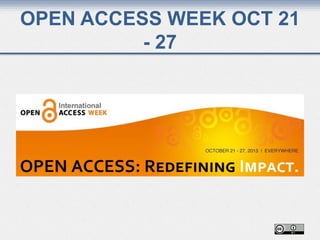
OPEN ACCESS WEEK OCT 21
- 27
SPREAD THE WORD, IMPROVE
THE WORLD!
• Promote open source to developers
– it is the natural way for developers to learn
– make better developers, make better code
• Promote open source ideas in other areas
– social activism
– privacy protection
– e-gov and open data
– piracy vs copyright discussions
– knowledge sharing
• Open source is the way to learn...
– and also the way to teach and help!
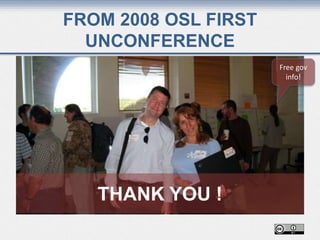
FROM 2008 OSL FIRST
UNCONFERENCE
THANK YOU !
Free gov
info!
REFERENCES
• Wikipedia
• The Cathedral and the Bazaar,
E.Raymond
• Presentation by Bruno Souza and Fabio
Kon, Open Source Initiative (OSI) -
Education Working Group
• Presentation by Alolita Sharma, OSI

Chalk Talk! Open: source, access, education, research, minds

  • 1.
  • 2.
    OPEN SOURCE: EVOLUTION OFSOCIETY VIA SOFTWARE DEVELOPMENT PRACTICES IRINA ZAKS IRINA.ZAKS@STANFORD.EDU r
  • 3.
    BRIEF HISTORY OFOPEN SOURCE
  • 4.
    WHAT COMES TOYOUR MIND WHEN YOU HEAR “OPEN SOURCE”• Computer software license • Philosophy • Economic concept of production model • Does “Open Source” has a definition? • Free no cost • Nobody owns it • Something to do with lots of people • You can take it and use it • You can change it and give back • Shared • Distributed • Computer networks
  • 5.
    OPEN SOURCE DEFINITION •The Open Source Definition (OSD) is upheld by the entire open source community. • It requires – Free re-distribution of software – Availability of source code with software – Derived works allowed – Integrity of author's source code be maintained – No discrimination against persons or groups – No discrimination against fields of endeavor – Distribution of license – License must not be specific to product – License must not restrict other software – License must be technology-neutral Full details can be found at http://opensource.org/docs/osd
  • 6.
    OPEN SOURCE SOFTWARE •Open Source Software is Software licensed with a copyright license compliant with the Open Source Definition (OSD) • Software is distributed with its source code in a human readable format • Software is developed in an open and collaborative way by groups of developers
  • 7.
    THE ORIGINS OF[TERM] “OPEN SOURCE” • Term was introduced at the strategy session on Feb 3 1998 in Mountain View office of VA Linux • The term was adopted by a group of activists in reaction to Netscape's January 1998 announcement of a source code release for Navigator. • New license terms were needed to free developers’ community from the ideology of the term "free software” • Linus Torvalds gave an all-important sanction the following day. • Richard Stallman, pioneer of the free software movement, initially seemed to adopt the term, but later changed his mind.
  • 8.
    COPYRIGHT LAW • Copyrightlaw (1976) protects creative works from unauthorized reproduction, derivative work, distribution of copies and public display without creator’s permission under various conditions for term from 70 to 120 years • Creators are required to [explicitly] surrender the rights granted to them by copyright law if they want to permit use of their creations • License is a mechanism to transfer copyright
  • 9.
    “FREE SOFTWARE MOVEMENT” – 1950sand 1960s: software was almost always distributed with its source with little restrictions. – 1970s: companies started to close their source and treat code as "industrial secret" – 1983/4: Richard Stallman observes a shift from a free UNIX culture to a proprietary software culture and leaves MIT AI Lab and creates the GNU Project – 1985: Free Software Foundation – 1989: Copyleft and the GPL – 1991: Linus Torvalds makes his OS available – 1992: GNU/Linux is born – 1993: SuSE (slackware distribution, enterprise linux) – 1995: Red Hat – 1995: MySQL – 1997: Eric Raymond. "The Cathedral and the Bazaar" – 1997: GNOME – 1998: Netscape opens its Mozilla browser – 1998: Open Source Initiative (OSI) is founded – 1999: Dell, HP, and SGI announce support for GNU/Linux – 1999: Apache Foundation formed – 2002: Creative Commons
  • 10.
    FREE SOFTWARE FOUNDATION -1984 • The users have the freedom to run, copy, distribute, study, change and improve the software. • Declared Four Freedoms – The freedom to run the program, for any purpose (freedom 0). – The freedom to study how the program works, and change it so it does your computing as you wish (freedom 1). Access to the source code is a precondition for this. – The freedom to redistribute copies so you can help your neighbor (freedom 2). – The freedom to distribute copies of your modified versions to others (freedom 3). By doing this you can give the whole community a chance to benefit from your changes. Access to the source code is a precondition for this. • These freedoms had to be explicitly declared to overwrite copyright law
  • 11.
    SOFTWARE LICENSES BEFORE 1998 •Corporate ( eg. Microsoft EULA) – Usually a permission to use an application only by one user on one computer – Not allowed to distribute or copy, no access to source code, no way to change application • Free Software Foundation – Four freedoms • Open source initiative introduced an alternative type of software licensing
  • 12.
    LICENSES ATTRIBUTES Required, permittedor forbidden attributes • License and copyright notice • State Changes • Commercial Use • Modification • Distribution • Sublicensing • Patent Grant • Use Trademark • Hold Liable
  • 13.
    EXAMPLES OF SOFTWARE LICENSES •http://choosealicense.com/licenses/
  • 14.
    EXAMPLES OF OPENSOURCE SOFTWARE • Linux / Unix / BSD/ Android - OS • Mozilla Netscape – web browser • Apache – web server • mySQL – database • pHp / Ruby - languages • Wiki / Drupal / Wordpress – web publishing • Sakai / OpenCourseWare – learning management system • Simbios – bio research software • Open Journal systems – publishing and peer review system
  • 15.
    HOW OPEN SOURCE SOFTWAREAFFECTS OUR DAILY LIFE • Wake up to an alarm on your Android-OS powered phone • Check via Mozilla browser what is traffic you will see today or what time your train leaves • and on and on and on it goes
  • 16.
    OPEN SOURCE ISCHANGING THE SOCIETY
  • 17.
    FREE SOFTWARE ISFREE AS IN... • Common use of term “free” is very wide – Free of charge – beer – disposable – Free to use – library or city park - reusable – Free to take and grow – puppies and software • Open source is all of the above – Code is free of charge – You can simply use it – You can modify if you want
  • 18.
    NOT ALL FREEIS OPEN SOURCE • Google search/docs are free to use but are not open source • Open Office is free to use and open source What makes a project an open source?
  • 19.
    THE SPIRIT OFOPEN SOURCE • Mr. D, CS student, wanted to stay connected to other folks at his dorm and coded a new, easy to use, posting board and put it on the server and thus on the web • He told all his friends about this new thing and soon everyone in his dorm was using it because it was easy • Ms. L, an artist, liked using posting board to stay connected, but was quite unhappy with the colors were limited to #FFF and #00F. She created a beautiful design and asked her friend to convert her beautiful drawing into a template for the posting board • Now everyone in the group (along with the rest of the world) can enjoying useful and beautiful product.
  • 20.
    HOW DO YOUBENEFIT BY GIVING AWAY – Reusable? • Each programmer develops one program • They exchange programs’ code • Each programmer has two programs • Two networks connected create larger network for both – Disposable? • Each programmer brings one sandwich for lunch • They exchange sandwiches • Each programmer has one sandwich • Two chairs are still two chairs
  • 21.
    • Creative personto originate a project and share it - core developer(s) • Users that try the project, like it, use it, tell what more they want(new features) and complain when it breaks (submit bugs) • Contributors improving the gadget for their own needs and contributing back • Charismatic leadership to keep the project going • Cheap computers and fast Internet to provide connectivity OPEN SOURCE DEVELOPMENT MODEL
  • 22.
    SOCIAL CONTEXT OFOPEN SOURCE • Motivation in open source community is different from commercial world • Common understanding principle vs. Command principle • In the world of cheap computers and fast internet limited resource is skilled attention • Abundance of resources leads to Gift culture and makes command relationships hard to sustain
  • 23.
    WHERE DOES ITWORK WELL • Appeal of OPEN model in the fields where results can be reused for large number of users – Software – Education – MOOCs – Science (http://folding.stanford.edu/ ) – Open Space Technology http://www.openspaceworld.com/brief_history. htm (used at Stanford IT unconference)
  • 24.
    OPEN SCIENCE • http://creativecommons.org/science •Polymath project by Tim Gowers 2009 • GalaxyZoo http://www.galaxyzoo.org/ 2007 • Folding @ home (Stanford) http://folding.stanford.edu/
  • 25.
    CONTENT LICENSES • http://creativecommons.org/licenses/ •The combination of our tools and our users is a vast vast and growing digital commons, a pool of content that can be copied, distributed, edited, remixed, and built upon, all within the boundaries of copyright law. • Font license http://scripts.sil.org/OFL
  • 26.
    COLLECTIVE INTELLIGENCE • Goodor bad? • Collective decisions not always are good
  • 27.
    MOOCS • 2012 –Two technological factors are driving these changes: inexpensive video production and ubiquitous high-speed internet. • Vast community of users / students • Peer grading / helping • Teachers learning from teachers
  • 28.
    CHALLENGES OF OPEN SCIENCE •Who gets credit for the work – Who gets money – Who gets fame • How do you protect your work – Is license a sufficient mechanism?
  • 29.
    OPEN SOURCE @ STANFORDLAB • "Innovation Goes Public", a talk by Bruce Perenshttp://opensource.stanford.edu/2008/02/26/bruc e-perens-talk-on-march-6 • Open source un-conference https://opensource.stanford.edu/events/first-osl- unconference Nov 2008 • Drupal • UX group • Linux group • Stanford projects on Sourceforge http://sourceforge.net/directory/os:mac/freshness:rece ntly-updated/?q=stanford
  • 30.
    OPEN ACCESS WEEKOCT 21 - 27
  • 31.
    SPREAD THE WORD,IMPROVE THE WORLD! • Promote open source to developers – it is the natural way for developers to learn – make better developers, make better code • Promote open source ideas in other areas – social activism – privacy protection – e-gov and open data – piracy vs copyright discussions – knowledge sharing • Open source is the way to learn... – and also the way to teach and help!
  • 32.
    FROM 2008 OSLFIRST UNCONFERENCE THANK YOU ! Free gov info!
  • 33.
    REFERENCES • Wikipedia • TheCathedral and the Bazaar, E.Raymond • Presentation by Bruno Souza and Fabio Kon, Open Source Initiative (OSI) - Education Working Group • Presentation by Alolita Sharma, OSI

Editor's Notes

  • #2 I am very happy to have an opportunity to talk about my favorite topic – Open source philosophy. Even though term open source is usually associated with computer software, the philosophy behind it is used many other .... – open education, open data, open research, etc
  • #8 The label "open source" was adopted by a group of people in the free software movement at a strategy session[12] held at Palo Alto, California, in reaction to Netscape's January 1998 announcement of a source code release for Navigator. The group of individuals at the session included Christine Peterson who suggested "open source", Todd Anderson, Larry Augustin, Jon Hall, Sam Ockman, Michael Tiemann and Eric S. Raymond. Critical moment when in the fight between corporate IE and free software spirit by Netscape pg 172 Microsoft rightly feared that that the open Web standards embodied by Netscape’s browser will lead to erosion in lucrative monopoly in PC market. Netscape rightly feared that if Microsoft achieved market dominance it will bend Web’s protocols away from open standards into proprietary channels that only Microsoft’s servers would be able to service. Existence of open web was at stake. Revenge of Hackers, page 175 Why new term, what is wrong with FREE SOFTWARE
  • #10 ● 1991: Linus Torvalds makes his OS available 1992: GNU/Linux is born ● Some of the first FLOSS-based companies are born: ○ 1989: Cygnus (to support GNU products) ● 1996: KDE: better desktop interface Open Source - a new complementary terminology for the same movement 2000: Sun opens StarOffice, creating OpenOffice.org 2001: IBM announces USD 1bi investment on Linux;Wikipedia is created 2002: Creative Commons 2003: Motorola releases first cell phone with Linux 2004: First version of Ubuntu 2005: ODF is recognized as OASIS standard, later ISO 2006: Sun opens Java Virtual Machine (OpenJDK) 2009: Oracle buys Sun OpenOffice donated to Apache, LibreOffice branched
  • #11 http://en.wikipedia.org/wiki/Four_Freedoms - The Four Freedoms were goals articulated by United States President Franklin D. Roosevelt on January 6, 1941. In an address known as theFour Freedoms speech (technically the 1941 State of the Union address), he proposed four fundamental freedoms that people "everywhere in the world" ought to enjoy: Freedom of speech Freedom of worship Freedom from want Freedom from fear
  • #15 Linux / Unix – first prove of open source development model Mozilla Netscape – applied same approach as linix to fight MS attempt to dominate browser market
  • #17  Philosophy
  • #21 When you are giving away you are joining resources
  • #22 Marten Mickos , mySQL Critical that coordinator can recognize good design ideas pg 47 In order to build a development community you need to attract people, interest them in what you are doing and that requires personality... Linux, Raymond...
  • #23 Page 52 – severe effort of many converging wills Page 57 – skilled attention
  • #28 2012 – Two technological factors are driving these changes: inexpensive video production and ubiquitous high-speed internet.
  • #32 Use open source software ○ you can't learn something you don't use! ● Once you find a problem, report it ○ this helps you learn how the project works ○ try to find on the source code why the problem exist ● Join the mailing list and answer questions ○ write documentation, a presentation, a blog ○ teaching others helps you learn more than anything