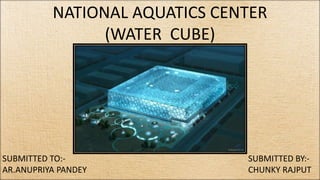
NATIONAL AQUATICS CENTER
(WATER CUBE)
SUBMITTED TO:-
AR.ANUPRIYA PANDEY
SUBMITTED BY:-
CHUNKY RAJPUT
INRODUCTION
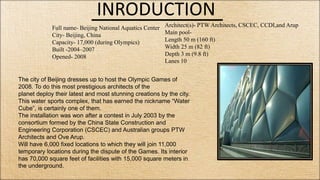
The city of Beijing dresses up to host the Olympic Games of
2008. To do this most prestigious architects of the
planet deploy their latest and most stunning creations by the city.
This water sports complex, that has earned the nickname “Water
Cube”, is certainly one of them.
The installation was won after a contest in July 2003 by the
consortium formed by the China State Construction and
Engineering Corporation (CSCEC) and Australian groups PTW
Architects and Ove Arup.
Will have 6,000 fixed locations to which they will join 11,000
temporary locations during the dispute of the Games. Its interior
has 70,000 square feet of facilities with 15,000 square meters in
the underground.
Full name- Beijing National Aquatics Center
City- Beijing, China
Capacity- 17,000 (during Olympics)
Built -2004–2007
Opened- 2008
Architect(s)- PTW Architects, CSCEC, CCDI,and Arup
Main pool-
Length 50 m (160 ft)
Width 25 m (82 ft)
Depth 3 m (9.8 ft)
Lanes 10
CONCEPT
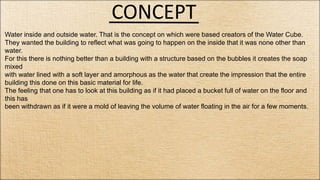
Water inside and outside water. That is the concept on which were based creators of the Water Cube.
They wanted the building to reflect what was going to happen on the inside that it was none other than
water.
For this there is nothing better than a building with a structure based on the bubbles it creates the soap
mixed
with water lined with a soft layer and amorphous as the water that create the impression that the entire
building this done on this basic material for life.
The feeling that one has to look at this building as if it had placed a bucket full of water on the floor and
this has
been withdrawn as if it were a mold of leaving the volume of water floating in the air for a few moments.
INSPIRATION
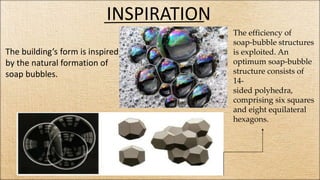
The building’s form is inspired
by the natural formation of
soap bubbles.
The efficiency of
soap-bubble structures
is exploited. An
optimum soap-bubble
structure consists of
14-
sided polyhedra,
comprising six squares
and eight equilateral
hexagons.
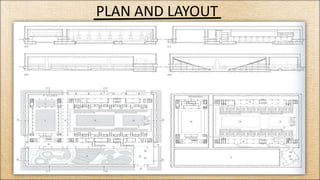
PLAN AND LAYOUT
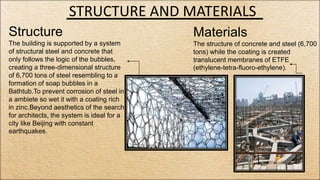
STRUCTURE AND MATERIALS
Structure
The building is supported by a system
of structural steel and concrete that
only follows the logic of the bubbles,
creating a three-dimensional structure
of 6,700 tons of steel resembling to a
formation of soap bubbles in a
Bathtub.To prevent corrosion of steel in
a ambiete so wet it with a coating rich
in zinc.Beyond aesthetics of the search
for architects, the system is ideal for a
city like Beijing with constant
earthquakes.
Materials
The structure of concrete and steel (6,700
tons) while the coating is created
translucent membranes of ETFE
(ethylene-tetra-fluoro-ethylene).

National aquatic center

  • 1.
    NATIONAL AQUATICS CENTER (WATERCUBE) SUBMITTED TO:- AR.ANUPRIYA PANDEY SUBMITTED BY:- CHUNKY RAJPUT
  • 2.
    INRODUCTION The city ofBeijing dresses up to host the Olympic Games of 2008. To do this most prestigious architects of the planet deploy their latest and most stunning creations by the city. This water sports complex, that has earned the nickname “Water Cube”, is certainly one of them. The installation was won after a contest in July 2003 by the consortium formed by the China State Construction and Engineering Corporation (CSCEC) and Australian groups PTW Architects and Ove Arup. Will have 6,000 fixed locations to which they will join 11,000 temporary locations during the dispute of the Games. Its interior has 70,000 square feet of facilities with 15,000 square meters in the underground. Full name- Beijing National Aquatics Center City- Beijing, China Capacity- 17,000 (during Olympics) Built -2004–2007 Opened- 2008 Architect(s)- PTW Architects, CSCEC, CCDI,and Arup Main pool- Length 50 m (160 ft) Width 25 m (82 ft) Depth 3 m (9.8 ft) Lanes 10
  • 3.
    CONCEPT Water inside andoutside water. That is the concept on which were based creators of the Water Cube. They wanted the building to reflect what was going to happen on the inside that it was none other than water. For this there is nothing better than a building with a structure based on the bubbles it creates the soap mixed with water lined with a soft layer and amorphous as the water that create the impression that the entire building this done on this basic material for life. The feeling that one has to look at this building as if it had placed a bucket full of water on the floor and this has been withdrawn as if it were a mold of leaving the volume of water floating in the air for a few moments.
  • 4.
    INSPIRATION The building’s formis inspired by the natural formation of soap bubbles. The efficiency of soap-bubble structures is exploited. An optimum soap-bubble structure consists of 14- sided polyhedra, comprising six squares and eight equilateral hexagons.
  • 5.
  • 6.
    STRUCTURE AND MATERIALS Structure Thebuilding is supported by a system of structural steel and concrete that only follows the logic of the bubbles, creating a three-dimensional structure of 6,700 tons of steel resembling to a formation of soap bubbles in a Bathtub.To prevent corrosion of steel in a ambiete so wet it with a coating rich in zinc.Beyond aesthetics of the search for architects, the system is ideal for a city like Beijing with constant earthquakes. Materials The structure of concrete and steel (6,700 tons) while the coating is created translucent membranes of ETFE (ethylene-tetra-fluoro-ethylene).