Celiac Disease in Athletics: An Under-recognized Condition? James E. Leone, Ph.D., LAT, ATC, CSCS,*D, CHES The George Washington University Department of Exercise Science School of Public Health and Health Services Email:  jleoneatc@yahoo.com
What is Celiac Disease?
Background Body sensitivity to  gluten Autoimmune response Cellular damage results Small intestine Nutrient Absorption
Also known as… Celiac sprue Gluten sensitive enteropathy Coeliac Disease Gluten intolerance Gee-Herter-Heubner disease Non-tropical sprue
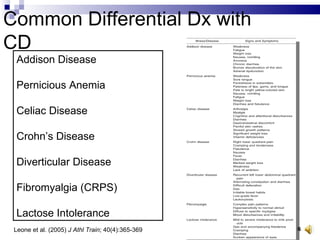
Common Differential Dx with CD Addison Disease Pernicious Anemia Celiac Disease Crohn’s Disease Diverticular Disease Fibromyalgia (CRPS) Lactose Intolerance Leone et al. (2005)  J Athl Train ; 40(4):365-369
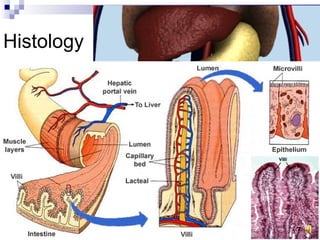
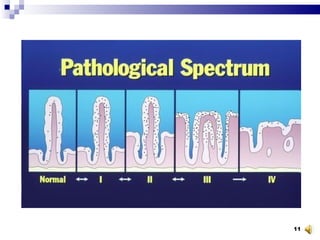
Histology
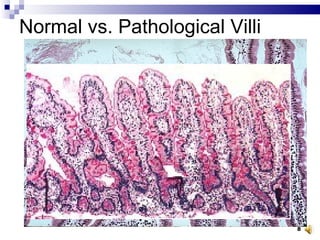
Normal vs. Pathological Villi
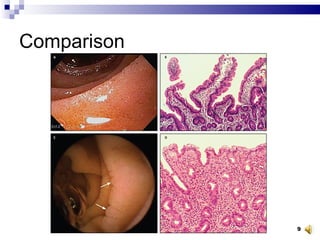
Comparison
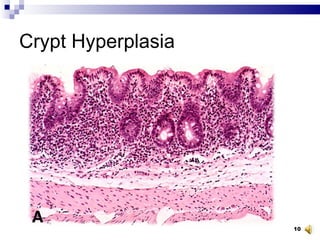
Crypt Hyperplasia
Prevalence of CD Typical stats range between 1 in every 250-300 people* More recent data suggest 1in every 100-150 people** * Worldwide: geographic regions vary **Ciacci et al (  Scand J Gastroenterol , 1995 Nov, 30:11, 1077-81); Marcu Maaki et al., 2006.
Geographic & Regional Factors CD is common in European countries: Ireland, Italy, Sweden, & Austria.  Northern Ireland, for example, one in every 300 people has CD. In Finland, prevalence may be as high as one in every 100 persons. CD also occurs in N. America where the prevalence has been estimated at one in every 3000 people. Source: http://www.medicinenet.com/celiac_disease/article.htm
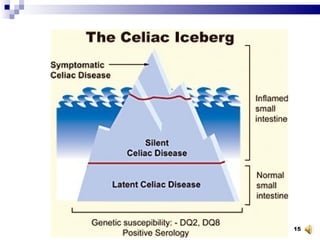
Geographic & Regional Factors Most population studies underestimate the prevalence of CD because many patients who develop CD have few or no sx’s until later in life.  Iceberg model  A recent study in the U.S. suggests that the prevalence of CD in the U.S. is similar to Europe. Source: http://www.medicinenet.com/celiac_disease/article.htm
The Impact of CD in Athletics NCAA reports approx. 380,000 athletes* If 1:3000 =  127  athletes If 1:250-300 =  1267-1520  athletes If 1:100-150 =  2533-3800  athletes Source:  NCAA CHOICES  Program: 2008
The Impact of CD in Athletics Approximately 7.2 million H.S. athletes in U.S.* If 1:3000 =  2400  athletes If 1:250-300 =  24,000-28,800  athletes If 1:100-150 =  48,000-72,000  athletes Source: National Federation of State High School Associations (NFHS). 2005--2006 High School Athletics Participation Survey. Indianapolis, IN: NHFS; 2006.
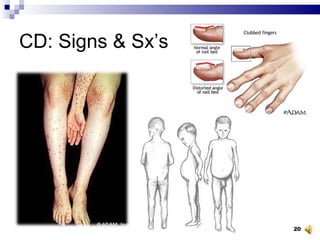
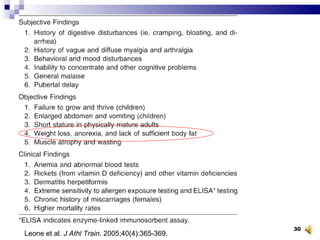
How to identify CD Symptoms of celiac disease include: gas  recurring abdominal bloating and pain  chronic diarrhea  pale, foul-smelling, or fatty stool  weight loss / weight gain  fatigue  unexplained anemia (a low count of red blood cells causing fatigue)  bone or joint pain  osteoporosis, osteopenia  behavioral changes  tingling numbness in the legs (from nerve damage)  muscle cramps  seizures  missed menstrual periods (often because of excessive weight loss)  infertility, recurrent miscarriage  delayed growth, failure to thrive in infants  pale sores inside the mouth, called aphthous ulcers  tooth discoloration or loss of enamel  itchy skin rash called dermatitis herpetiformis
CD: Signs & Sx’s
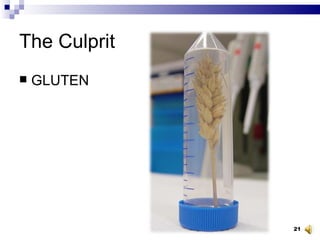
The Culprit GLUTEN
Consequences Stunted growth Failure to thrive Loss of key minerals & nutrients Vit. K, Na+, Ca  Weight Loss Seizures GI ulcers/CA (adenocarcinoma) Death…
Identification & Treatment Options Identification ELISA panel test Immunoglobulin A (IgA) anti-tissue transglutaminase (tTGA) IgA anti-endomysium antibodies (AEA)  Treatment Strict GFD Tx for skin issues Dapsome Vitamin & mineral supplementation
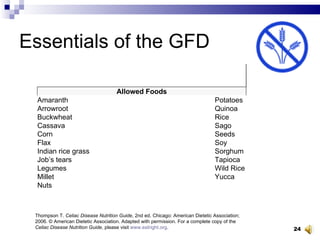
Essentials of the GFD Thompson T.  Celiac Disease Nutrition Guide , 2nd ed. Chicago: American Dietetic Association; 2006. © American Dietetic Association. Adapted with permission. For a complete copy of the  Celiac Disease Nutrition Guide , please visit  www.eatright.org . Allowed Foods Amaranth Arrowroot Buckwheat Cassava Corn Flax Indian rice grass Job’s tears Legumes Millet Nuts Potatoes Quinoa Rice Sago Seeds Soy Sorghum Tapioca Wild Rice Yucca
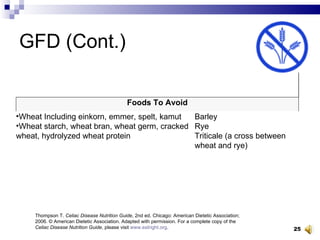
GFD (Cont.) Thompson T.  Celiac Disease Nutrition Guide , 2nd ed. Chicago: American Dietetic Association; 2006. © American Dietetic Association. Adapted with permission. For a complete copy of the  Celiac Disease Nutrition Guide , please visit  www.eatright.org . Foods To Avoid Wheat Including einkorn, emmer, spelt, kamut  Wheat starch, wheat bran, wheat germ, cracked wheat, hydrolyzed wheat protein  Barley Rye Triticale (a cross between wheat and rye)
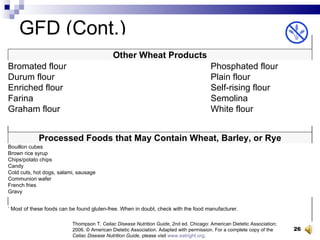
GFD (Cont.) Thompson T.  Celiac Disease Nutrition Guide , 2nd ed. Chicago: American Dietetic Association; 2006. © American Dietetic Association. Adapted with permission. For a complete copy of the  Celiac Disease Nutrition Guide , please visit  www.eatright.org . Other Wheat Products Bromated flour Durum flour Enriched flour Farina Graham flour Phosphated flour Plain flour Self-rising flour Semolina White flour Processed Foods that May Contain Wheat, Barley, or Rye Bouillon cubes Brown rice syrup Chips/potato chips Candy Cold cuts, hot dogs, salami, sausage Communion wafer French fries Gravy *  Most of these foods can be found gluten-free. When in doubt, check with the food manufacturer.
Case Studies in Athletics
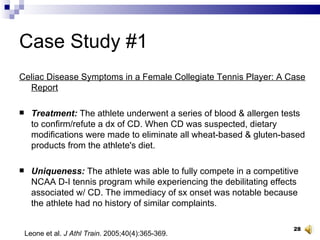
Case Study #1 Celiac Disease Symptoms in a Female Collegiate Tennis Player: A Case Report Treatment:  The athlete underwent a series of blood & allergen tests to confirm/refute a dx of CD. When CD was suspected, dietary modifications were made to eliminate all wheat-based & gluten-based products from the athlete's diet. Uniqueness:  The athlete was able to fully compete in a competitive NCAA D-I tennis program while experiencing the debilitating effects associated w/ CD. The immediacy of sx onset was notable because the athlete had no history of similar complaints. Leone et al.  J Athl Train . 2005;40(4):365-369.
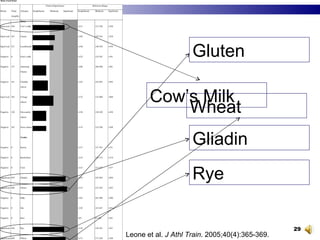
Cow’s Milk Gliadin Gluten Rye Wheat Leone et al.  J Athl Train . 2005;40(4):365-369.
Leone et al.  J Athl Train . 2005;40(4):365-369.
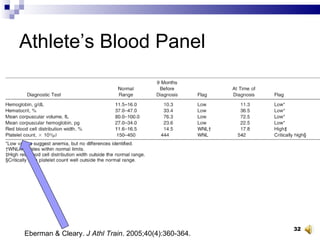
Case Study #2 Celiac Disease in an Elite Female Collegiate Volleyball Athlete: A Case Report Background:  Athlete lost 8.1 kg during the first 20 days of training, & we initially suspected an  eating disorder .  found she did not have psychological sx’s indicative of an eating disorder.  Results of routine blood tests revealed critically high platelet counts; in conjunction w/ physical findings, the athlete was referred to a gastroenterologist. Treatment:  Tx w/ a GFD, which excludes wheat, barley, and rye.  Uniqueness:  The presence of active CD may not be uncommon. However, elite athletes who face CD present a new challenge for the athletic trainer. The athletic trainer can help guide the athlete in coping w/ lifestyle changes associated w/ a GFD. Eberman & Cleary.  J Athl Train . 2005;40(4):360-364.
Athlete’s Blood Panel Eberman & Cleary.  J Athl Train . 2005;40(4):360-364.
Discussion of Case Studies One presents w/ clinically significant sx’s Other presents w/ underlying sx’s (anorexia n.) BOTH are likely CD, but high functioning Different ways in which they were managed Many doctor’s have not experienced or heard of CD, particularly in athletes
Personal Communications “ I have been searching & searching for any research on CD & athletes, & I came across your article in the JAT. I am the captain of the men’s soccer team at X University & I was just dx w/ CD. I have had 2 injury filled & frustrating yrs as I pushed myself through my muscle fatigue, weight loss, & weakness. I have high hopes to return to my former health. I am wondering how hard to train & whether there are supplements that celiac athletes should take? I am desperate for some kind of help. Any information would be appreciated!” Personal communication, 3/18/2006
“ I found your web abstract on CD. I have a 20 yr old daughter who is a basketball player at the national level. She had a 3 week episode of serious leg cramps & is now hospitalized for vertigo & cramps that go on for 2 hrs at a time. She has had so many tests, but nothing has been found. She has lost weight, but denies an ED. Please help!” Communication from Finland Personal communication, 3/18/2006
Take-Home Points: People w/ CD can’t eat foods or use items w/ gluten CD harms the small intestine.  People w/ untreated CD can’t get needed nutrients.  Without tx, people w/ CD can develop other health problems.  CD is dx by blood tests & biopsy of the small intestine.  A GFD must be followed for life.  A dietitian can help people choose the right foods.
Resources Celiac Disease Awareness Campaign National Digestive Diseases Information Clearinghouse 2 Information Way Bethesda, MD 20892–3570 Phone: 1–800–891–5389 Fax: 703–738–4929 Email:  [email_address] Internet:  www.celiac.nih.gov
American Celiac Society P.O. Box 23455 New Orleans, LA 70183–0455 Phone: 504–737–3293 Email:  [email_address] Internet:  www.americanceliacsociety.org
American Dietetic Association 120 South Riverside Plaza, Suite 2000 Chicago, IL 60606–6995 Phone: 1–800–877–1600 Email:  [email_address] Internet:  www.eatright.org
Celiac Disease Foundation 13251 Ventura Boulevard, #1 Studio City, CA 91604 Phone: 818–990–2354 Fax: 818–990–2379 Email:  [email_address] Internet:  www.celiac.org
Celiac Sprue Association/USA Inc. P.O. Box 31700 Omaha, NE 68131–0700 Phone: 1–877–CSA–4CSA (272–4272) Fax: 402–558–1347 Email:  [email_address] Internet:  www.csaceliacs.org
Gluten Intolerance Group of North America 31214 124th Avenue SE Auburn, WA 98092 Phone: 253–833–6655 Fax: 253–833–6675 Email:  [email_address] Internet:  www.gluten.net
National Foundation for Celiac Awareness P.O. Box 544 Ambler, PA 19002 Phone: 215–325–1306 Email:  [email_address] Internet: www.celiaccentral.org
Select References Ciacci et al.  Scand J Gastroenterol. 1995;30(11):1077-81) Maaki M et al.  Gut.  2001;49(4): 502–505 . http://www.medicinenet.com/celiac_disease/article.htm NCAA CHOICES  Program: 2008 National Federation of State High School Associations (NFHS). 2005--2006 High School Athletics Participation Survey. Indianapolis, IN: NHFS; 2006. Thompson T.  Celiac Disease Nutrition Guide , 2nd ed. Chicago: American Dietetic Association; 2006. © American Dietetic Association. Leone et al.  J Athl Train . 2005;40(4):365-369. Eberman & Cleary.  J Athl Train . 2005;40(4):360-364.
THANKS FOR ATTENDING!

Nata.2008.Celiac.Athletics.Leone

  • 1.
    Celiac Disease inAthletics: An Under-recognized Condition? James E. Leone, Ph.D., LAT, ATC, CSCS,*D, CHES The George Washington University Department of Exercise Science School of Public Health and Health Services Email: jleoneatc@yahoo.com
  • 2.
  • 4.
    Background Body sensitivityto gluten Autoimmune response Cellular damage results Small intestine Nutrient Absorption
  • 5.
    Also known as…Celiac sprue Gluten sensitive enteropathy Coeliac Disease Gluten intolerance Gee-Herter-Heubner disease Non-tropical sprue
  • 6.
    Common Differential Dxwith CD Addison Disease Pernicious Anemia Celiac Disease Crohn’s Disease Diverticular Disease Fibromyalgia (CRPS) Lactose Intolerance Leone et al. (2005) J Athl Train ; 40(4):365-369
  • 7.
  • 8.
  • 9.
  • 10.
  • 12.
    Prevalence of CDTypical stats range between 1 in every 250-300 people* More recent data suggest 1in every 100-150 people** * Worldwide: geographic regions vary **Ciacci et al ( Scand J Gastroenterol , 1995 Nov, 30:11, 1077-81); Marcu Maaki et al., 2006.
  • 13.
    Geographic & RegionalFactors CD is common in European countries: Ireland, Italy, Sweden, & Austria. Northern Ireland, for example, one in every 300 people has CD. In Finland, prevalence may be as high as one in every 100 persons. CD also occurs in N. America where the prevalence has been estimated at one in every 3000 people. Source: http://www.medicinenet.com/celiac_disease/article.htm
  • 14.
    Geographic & RegionalFactors Most population studies underestimate the prevalence of CD because many patients who develop CD have few or no sx’s until later in life. Iceberg model A recent study in the U.S. suggests that the prevalence of CD in the U.S. is similar to Europe. Source: http://www.medicinenet.com/celiac_disease/article.htm
  • 16.
    The Impact ofCD in Athletics NCAA reports approx. 380,000 athletes* If 1:3000 = 127 athletes If 1:250-300 = 1267-1520 athletes If 1:100-150 = 2533-3800 athletes Source: NCAA CHOICES Program: 2008
  • 17.
    The Impact ofCD in Athletics Approximately 7.2 million H.S. athletes in U.S.* If 1:3000 = 2400 athletes If 1:250-300 = 24,000-28,800 athletes If 1:100-150 = 48,000-72,000 athletes Source: National Federation of State High School Associations (NFHS). 2005--2006 High School Athletics Participation Survey. Indianapolis, IN: NHFS; 2006.
  • 18.
    How to identifyCD Symptoms of celiac disease include: gas recurring abdominal bloating and pain chronic diarrhea pale, foul-smelling, or fatty stool weight loss / weight gain fatigue unexplained anemia (a low count of red blood cells causing fatigue) bone or joint pain osteoporosis, osteopenia behavioral changes tingling numbness in the legs (from nerve damage) muscle cramps seizures missed menstrual periods (often because of excessive weight loss) infertility, recurrent miscarriage delayed growth, failure to thrive in infants pale sores inside the mouth, called aphthous ulcers tooth discoloration or loss of enamel itchy skin rash called dermatitis herpetiformis
  • 20.
  • 21.
  • 22.
    Consequences Stunted growthFailure to thrive Loss of key minerals & nutrients Vit. K, Na+, Ca Weight Loss Seizures GI ulcers/CA (adenocarcinoma) Death…
  • 23.
    Identification & TreatmentOptions Identification ELISA panel test Immunoglobulin A (IgA) anti-tissue transglutaminase (tTGA) IgA anti-endomysium antibodies (AEA) Treatment Strict GFD Tx for skin issues Dapsome Vitamin & mineral supplementation
  • 24.
    Essentials of theGFD Thompson T. Celiac Disease Nutrition Guide , 2nd ed. Chicago: American Dietetic Association; 2006. © American Dietetic Association. Adapted with permission. For a complete copy of the Celiac Disease Nutrition Guide , please visit www.eatright.org . Allowed Foods Amaranth Arrowroot Buckwheat Cassava Corn Flax Indian rice grass Job’s tears Legumes Millet Nuts Potatoes Quinoa Rice Sago Seeds Soy Sorghum Tapioca Wild Rice Yucca
  • 25.
    GFD (Cont.) ThompsonT. Celiac Disease Nutrition Guide , 2nd ed. Chicago: American Dietetic Association; 2006. © American Dietetic Association. Adapted with permission. For a complete copy of the Celiac Disease Nutrition Guide , please visit www.eatright.org . Foods To Avoid Wheat Including einkorn, emmer, spelt, kamut Wheat starch, wheat bran, wheat germ, cracked wheat, hydrolyzed wheat protein Barley Rye Triticale (a cross between wheat and rye)
  • 26.
    GFD (Cont.) ThompsonT. Celiac Disease Nutrition Guide , 2nd ed. Chicago: American Dietetic Association; 2006. © American Dietetic Association. Adapted with permission. For a complete copy of the Celiac Disease Nutrition Guide , please visit www.eatright.org . Other Wheat Products Bromated flour Durum flour Enriched flour Farina Graham flour Phosphated flour Plain flour Self-rising flour Semolina White flour Processed Foods that May Contain Wheat, Barley, or Rye Bouillon cubes Brown rice syrup Chips/potato chips Candy Cold cuts, hot dogs, salami, sausage Communion wafer French fries Gravy * Most of these foods can be found gluten-free. When in doubt, check with the food manufacturer.
  • 27.
    Case Studies inAthletics
  • 28.
    Case Study #1Celiac Disease Symptoms in a Female Collegiate Tennis Player: A Case Report Treatment: The athlete underwent a series of blood & allergen tests to confirm/refute a dx of CD. When CD was suspected, dietary modifications were made to eliminate all wheat-based & gluten-based products from the athlete's diet. Uniqueness: The athlete was able to fully compete in a competitive NCAA D-I tennis program while experiencing the debilitating effects associated w/ CD. The immediacy of sx onset was notable because the athlete had no history of similar complaints. Leone et al. J Athl Train . 2005;40(4):365-369.
  • 29.
    Cow’s Milk GliadinGluten Rye Wheat Leone et al. J Athl Train . 2005;40(4):365-369.
  • 30.
    Leone et al. J Athl Train . 2005;40(4):365-369.
  • 31.
    Case Study #2Celiac Disease in an Elite Female Collegiate Volleyball Athlete: A Case Report Background: Athlete lost 8.1 kg during the first 20 days of training, & we initially suspected an eating disorder . found she did not have psychological sx’s indicative of an eating disorder. Results of routine blood tests revealed critically high platelet counts; in conjunction w/ physical findings, the athlete was referred to a gastroenterologist. Treatment: Tx w/ a GFD, which excludes wheat, barley, and rye. Uniqueness: The presence of active CD may not be uncommon. However, elite athletes who face CD present a new challenge for the athletic trainer. The athletic trainer can help guide the athlete in coping w/ lifestyle changes associated w/ a GFD. Eberman & Cleary. J Athl Train . 2005;40(4):360-364.
  • 32.
    Athlete’s Blood PanelEberman & Cleary. J Athl Train . 2005;40(4):360-364.
  • 33.
    Discussion of CaseStudies One presents w/ clinically significant sx’s Other presents w/ underlying sx’s (anorexia n.) BOTH are likely CD, but high functioning Different ways in which they were managed Many doctor’s have not experienced or heard of CD, particularly in athletes
  • 34.
    Personal Communications “I have been searching & searching for any research on CD & athletes, & I came across your article in the JAT. I am the captain of the men’s soccer team at X University & I was just dx w/ CD. I have had 2 injury filled & frustrating yrs as I pushed myself through my muscle fatigue, weight loss, & weakness. I have high hopes to return to my former health. I am wondering how hard to train & whether there are supplements that celiac athletes should take? I am desperate for some kind of help. Any information would be appreciated!” Personal communication, 3/18/2006
  • 35.
    “ I foundyour web abstract on CD. I have a 20 yr old daughter who is a basketball player at the national level. She had a 3 week episode of serious leg cramps & is now hospitalized for vertigo & cramps that go on for 2 hrs at a time. She has had so many tests, but nothing has been found. She has lost weight, but denies an ED. Please help!” Communication from Finland Personal communication, 3/18/2006
  • 36.
    Take-Home Points: Peoplew/ CD can’t eat foods or use items w/ gluten CD harms the small intestine. People w/ untreated CD can’t get needed nutrients. Without tx, people w/ CD can develop other health problems. CD is dx by blood tests & biopsy of the small intestine. A GFD must be followed for life. A dietitian can help people choose the right foods.
  • 38.
    Resources Celiac DiseaseAwareness Campaign National Digestive Diseases Information Clearinghouse 2 Information Way Bethesda, MD 20892–3570 Phone: 1–800–891–5389 Fax: 703–738–4929 Email: [email_address] Internet: www.celiac.nih.gov
  • 39.
    American Celiac SocietyP.O. Box 23455 New Orleans, LA 70183–0455 Phone: 504–737–3293 Email: [email_address] Internet: www.americanceliacsociety.org
  • 40.
    American Dietetic Association120 South Riverside Plaza, Suite 2000 Chicago, IL 60606–6995 Phone: 1–800–877–1600 Email: [email_address] Internet: www.eatright.org
  • 41.
    Celiac Disease Foundation13251 Ventura Boulevard, #1 Studio City, CA 91604 Phone: 818–990–2354 Fax: 818–990–2379 Email: [email_address] Internet: www.celiac.org
  • 42.
    Celiac Sprue Association/USAInc. P.O. Box 31700 Omaha, NE 68131–0700 Phone: 1–877–CSA–4CSA (272–4272) Fax: 402–558–1347 Email: [email_address] Internet: www.csaceliacs.org
  • 43.
    Gluten Intolerance Groupof North America 31214 124th Avenue SE Auburn, WA 98092 Phone: 253–833–6655 Fax: 253–833–6675 Email: [email_address] Internet: www.gluten.net
  • 44.
    National Foundation forCeliac Awareness P.O. Box 544 Ambler, PA 19002 Phone: 215–325–1306 Email: [email_address] Internet: www.celiaccentral.org
  • 45.
    Select References Ciacciet al. Scand J Gastroenterol. 1995;30(11):1077-81) Maaki M et al. Gut. 2001;49(4): 502–505 . http://www.medicinenet.com/celiac_disease/article.htm NCAA CHOICES Program: 2008 National Federation of State High School Associations (NFHS). 2005--2006 High School Athletics Participation Survey. Indianapolis, IN: NHFS; 2006. Thompson T. Celiac Disease Nutrition Guide , 2nd ed. Chicago: American Dietetic Association; 2006. © American Dietetic Association. Leone et al. J Athl Train . 2005;40(4):365-369. Eberman & Cleary. J Athl Train . 2005;40(4):360-364.
  • 46.