
www.learnX.co.in
1
DRAWING : GETTING STARTED 05
1. Basic Units, Measurements & Paper Sizes 05
2. How to Hold the Pencil 09
2D COMPOSITION & LOGO DESIGN 15
Solved Examples for 2D Composition 17
Solved Examples for Logo Design 31
Previous Years Questions for Practice 33
PERSPECTIVES 38
One-Point Perspective 39
Two-Point Perspective 40
Three-Point Perspective 43
Master Tip-1 45
3D COMPOSITION 46
Lettering 58
Shade & Shadow 60
Solved Examples for 3D Composition 65
Master Tip-2 69
Previous Years Questions for Practice 70
FREE HAND SKETCHING 76
A. Sketching Human Figures 76
1. Basic Human Proportions 76
2. How to Draw Basic Human Figures 89
3. Basic Human Profiles 89
4. Forming Flesh & Skin from Skeletal Drawing 93
5. Human Body Poses 94
6. Human Clothing & Folds 100
7. Human Facial Proportions 103
8. Drawing Human Face 105
INDEX
Part A : DRAWING
www.learnX.co.in
2
B. Sketches for practice 110
1. Humans 110
2. Objects 121
3. Animals 123
4. Birds 124
5. Plants & Trees 126
6. Automobiles 128
C. Sketching from Memory / Imagination 130
Master Tip-3 137
Previous Years Questions for Practice 138
Part B : GENERAL APTITUDE 164
PROJECTIONS 165
Exercises 170
NON-VERBAL REASONING 180
Series 180
Classification 185
Mirror Images 189
Embedded Images 192
Figure Matrix 196
Paper Cutting 201
Grouping of Images 205
Shape Construction 210
Cubes and Dice 214
Analogy 220
Analytical Reasoning 224
Water Images 230
Pattern Completion 233
Paper Folding 237
Rule Detection 240
Dot Situation 246
Image Analysis 250
www.learnX.co.in
3
THEORY OF DESIGN BASICS 253
Elements of Design 254
Golden Mean Proportion 258
Principles of Design 259
Colour Theory 269
Ergonomics & Anthropometry 262
BUILDING MATERIALS & CONSTRUCTION 264
Various Building Materials & Their Properties 264
HISTORY OF ARCHITECTURE 227
Greek 227
Roman 279
Byzantine 281
Romanesque 283
Gothic 284
Egyptian 287
Hindu Temple Architecture 290
Renaissance Architecture 292
The Indus Valley Civilization 294
HISTORIC BUILDINGS IN INDIA 296
MODERN ARCHITECTURE 306
THE 7 WONDERS OF THE WORLD 309
WORLD RENOWNED ARCHITECTS & 315
THEIR WORKS
GLOSSARY OF TERMS 329
www.learnX.co.in
Studymaterial
Sample
0
www.learnX.co.in
5
Drawing : Getting Started
Basic Units, Measurements & Paper Sizes
Standard Units & Measurements :
Standard Units (SI Units)
The International System of Units (abbreviated SI) is the metric system used in
science, industry, and medicine.
You are probably familiar with a lot of these measurements. Length is about a
distance. These distances answer questions with “how far?”, “how long?”, and
“how high?”.
1 foot = 12 inches (inches are usually divided into sixteenths on a ruler)
1 yard = 3 feet = 36 inches
1 mile = 1,760 yards = 5,280 feet = 63,360 inches
Metric Units
The basis of length units for the metric system is the meter. A meter is about the
same length of one yard. You already read that the metric system is based on
units of ten so here’s a starter list, but they go on forever.
1 centimeter = 10 millimeters
1 meter = 100 centimeters = 1,000 millimeters
1 kilometer = 1,000 meters = 100,000 centimeters = 100,000,000 millimeters
= 1*108millimeters
Conversion
You’re going to have to go back and forth with units. Converting inches in to
centimeters and feet into meters is a regular thing in math and science class-
es. Here are a few conversions. Technically you only need one conversion, but
sometimes it’s easier to use one closer to the values you want.
1 inch = 2.54 centimeters = 25.4 millimeters
1 foot = 30.48 centimeters
1 yard = 0.91 meters
1 mile = 1.6 kilometers
1 millimeter = 0.04 inches
1 centimeter = .39 inches = 0.0325 feet
1 meter = 3.28 feet
1 kilometer = 0.62 miles
HiddenSome Pages are
PurchaseNATA EXAM Full Packageto ViewFull Content
HiddenSome Pages are
PurchaseNATA EXAM Full Packageto ViewFull Content
www.learnX.co.in
253
Theory of design
Basic
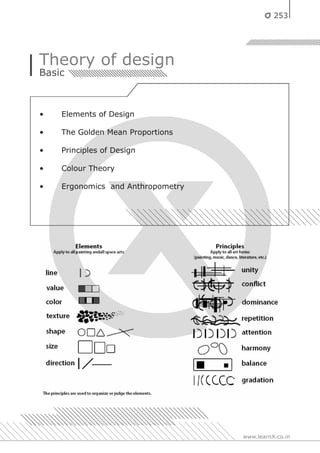
• Elements of Design
• The Golden Mean Proportions
• Principles of Design
• Colour Theory
• Ergonomics and Anthropometry
www.learnX.co.in
266
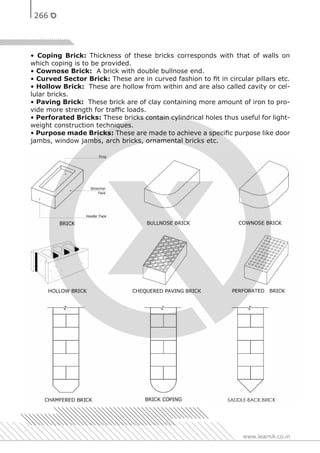
• Coping Brick: Thickness of these bricks corresponds with that of walls on
which coping is to be provided.
• Cownose Brick: A brick with double bullnose end.
• Curved Sector Brick: These are in curved fashion to fit in circular pillars etc.
• Hollow Brick: These are hollow from within and are also called cavity or cel-
lular bricks.
• Paving Brick: These brick are of clay containing more amount of iron to pro-
vide more strength for traffic loads.
• Perforated Bricks: These bricks contain cylindrical holes thus useful for light-
weight construction techniques.
• Purpose made Bricks: These are made to achieve a specific purpose like door
jambs, window jambs, arch bricks, ornamental bricks etc.
HiddenSome Pages are
PurchaseNATA EXAM Full Packageto ViewFull Content
www.learnX.co.in
300
10- JANTAR MANTAR
MONUMENT: Jantar Mantar (an astronomical ob-
servatory)
BUILT IN: 1724
LOCATION: Delhi
BUILT BY: Sawai Jai Singh II
MATERIAL: All the masonry instruments were
lined with marble so that the graduations on them
are not worn out.
The Jantar Mantar of Delhi is only one of the five
observatories built by Sawai Jai Singh II. The oth-
er four being located at Jaipur, Varanasi, Ujjain
and Mathura.
11- KONARK SUN TEMPLE
MONUMENT: - Konark Sun Temple
BUILT IN:- 13th century AD
LOCATION: - Konark (Orissa)
BUILT BY: - King Narasimhadeo
CONSTRUCTION STYLE: - Central Indian style of
Temple architecture.
“It is said to be an exact replica of the chariot of
the Sun God”
MATERIAL:- Stone (carved)
STATISTICS: - To conjure up the facade of a
wheeled chariot, the longer sides of the platform
over which the temple stands were festooned with
a relief of 12 massive, beautifully carved wheels
more than 10 feet (3 meters) in diameter.
12- RED FORT
MONUMENT: Red Fort
BUILT IN: 1638-46
LOCATION: Delhi
BUILT BY: Shahjahan
CONSTRUCTION STYLE: Mughal military archi-
tecture
MATERIAL: Red sandstone, carved marble screens
STATISTICS: The walls of this fort extend for 2
km and differ in height is 18 m on the riverside
and 33 m on the city side. The fort has two im-
portant gateways- Lahori Gate and Delhi Gate.
www.learnX.co.in
317
HiddenSome Pages are
PurchaseNATA EXAM Full Packageto ViewFull Content

Nata Study Material Samlpe

  • 3.
    www.learnX.co.in 1 DRAWING : GETTINGSTARTED 05 1. Basic Units, Measurements & Paper Sizes 05 2. How to Hold the Pencil 09 2D COMPOSITION & LOGO DESIGN 15 Solved Examples for 2D Composition 17 Solved Examples for Logo Design 31 Previous Years Questions for Practice 33 PERSPECTIVES 38 One-Point Perspective 39 Two-Point Perspective 40 Three-Point Perspective 43 Master Tip-1 45 3D COMPOSITION 46 Lettering 58 Shade & Shadow 60 Solved Examples for 3D Composition 65 Master Tip-2 69 Previous Years Questions for Practice 70 FREE HAND SKETCHING 76 A. Sketching Human Figures 76 1. Basic Human Proportions 76 2. How to Draw Basic Human Figures 89 3. Basic Human Profiles 89 4. Forming Flesh & Skin from Skeletal Drawing 93 5. Human Body Poses 94 6. Human Clothing & Folds 100 7. Human Facial Proportions 103 8. Drawing Human Face 105 INDEX Part A : DRAWING
  • 4.
    www.learnX.co.in 2 B. Sketches forpractice 110 1. Humans 110 2. Objects 121 3. Animals 123 4. Birds 124 5. Plants & Trees 126 6. Automobiles 128 C. Sketching from Memory / Imagination 130 Master Tip-3 137 Previous Years Questions for Practice 138 Part B : GENERAL APTITUDE 164 PROJECTIONS 165 Exercises 170 NON-VERBAL REASONING 180 Series 180 Classification 185 Mirror Images 189 Embedded Images 192 Figure Matrix 196 Paper Cutting 201 Grouping of Images 205 Shape Construction 210 Cubes and Dice 214 Analogy 220 Analytical Reasoning 224 Water Images 230 Pattern Completion 233 Paper Folding 237 Rule Detection 240 Dot Situation 246 Image Analysis 250
  • 5.
    www.learnX.co.in 3 THEORY OF DESIGNBASICS 253 Elements of Design 254 Golden Mean Proportion 258 Principles of Design 259 Colour Theory 269 Ergonomics & Anthropometry 262 BUILDING MATERIALS & CONSTRUCTION 264 Various Building Materials & Their Properties 264 HISTORY OF ARCHITECTURE 227 Greek 227 Roman 279 Byzantine 281 Romanesque 283 Gothic 284 Egyptian 287 Hindu Temple Architecture 290 Renaissance Architecture 292 The Indus Valley Civilization 294 HISTORIC BUILDINGS IN INDIA 296 MODERN ARCHITECTURE 306 THE 7 WONDERS OF THE WORLD 309 WORLD RENOWNED ARCHITECTS & 315 THEIR WORKS GLOSSARY OF TERMS 329
  • 6.
  • 7.
    www.learnX.co.in 5 Drawing : GettingStarted Basic Units, Measurements & Paper Sizes Standard Units & Measurements : Standard Units (SI Units) The International System of Units (abbreviated SI) is the metric system used in science, industry, and medicine. You are probably familiar with a lot of these measurements. Length is about a distance. These distances answer questions with “how far?”, “how long?”, and “how high?”. 1 foot = 12 inches (inches are usually divided into sixteenths on a ruler) 1 yard = 3 feet = 36 inches 1 mile = 1,760 yards = 5,280 feet = 63,360 inches Metric Units The basis of length units for the metric system is the meter. A meter is about the same length of one yard. You already read that the metric system is based on units of ten so here’s a starter list, but they go on forever. 1 centimeter = 10 millimeters 1 meter = 100 centimeters = 1,000 millimeters 1 kilometer = 1,000 meters = 100,000 centimeters = 100,000,000 millimeters = 1*108millimeters Conversion You’re going to have to go back and forth with units. Converting inches in to centimeters and feet into meters is a regular thing in math and science class- es. Here are a few conversions. Technically you only need one conversion, but sometimes it’s easier to use one closer to the values you want. 1 inch = 2.54 centimeters = 25.4 millimeters 1 foot = 30.48 centimeters 1 yard = 0.91 meters 1 mile = 1.6 kilometers 1 millimeter = 0.04 inches 1 centimeter = .39 inches = 0.0325 feet 1 meter = 3.28 feet 1 kilometer = 0.62 miles
  • 8.
    HiddenSome Pages are PurchaseNATAEXAM Full Packageto ViewFull Content
  • 13.
    HiddenSome Pages are PurchaseNATAEXAM Full Packageto ViewFull Content
  • 14.
    www.learnX.co.in 253 Theory of design Basic •Elements of Design • The Golden Mean Proportions • Principles of Design • Colour Theory • Ergonomics and Anthropometry
  • 15.
    www.learnX.co.in 266 • Coping Brick:Thickness of these bricks corresponds with that of walls on which coping is to be provided. • Cownose Brick: A brick with double bullnose end. • Curved Sector Brick: These are in curved fashion to fit in circular pillars etc. • Hollow Brick: These are hollow from within and are also called cavity or cel- lular bricks. • Paving Brick: These brick are of clay containing more amount of iron to pro- vide more strength for traffic loads. • Perforated Bricks: These bricks contain cylindrical holes thus useful for light- weight construction techniques. • Purpose made Bricks: These are made to achieve a specific purpose like door jambs, window jambs, arch bricks, ornamental bricks etc.
  • 17.
    HiddenSome Pages are PurchaseNATAEXAM Full Packageto ViewFull Content
  • 18.
    www.learnX.co.in 300 10- JANTAR MANTAR MONUMENT:Jantar Mantar (an astronomical ob- servatory) BUILT IN: 1724 LOCATION: Delhi BUILT BY: Sawai Jai Singh II MATERIAL: All the masonry instruments were lined with marble so that the graduations on them are not worn out. The Jantar Mantar of Delhi is only one of the five observatories built by Sawai Jai Singh II. The oth- er four being located at Jaipur, Varanasi, Ujjain and Mathura. 11- KONARK SUN TEMPLE MONUMENT: - Konark Sun Temple BUILT IN:- 13th century AD LOCATION: - Konark (Orissa) BUILT BY: - King Narasimhadeo CONSTRUCTION STYLE: - Central Indian style of Temple architecture. “It is said to be an exact replica of the chariot of the Sun God” MATERIAL:- Stone (carved) STATISTICS: - To conjure up the facade of a wheeled chariot, the longer sides of the platform over which the temple stands were festooned with a relief of 12 massive, beautifully carved wheels more than 10 feet (3 meters) in diameter. 12- RED FORT MONUMENT: Red Fort BUILT IN: 1638-46 LOCATION: Delhi BUILT BY: Shahjahan CONSTRUCTION STYLE: Mughal military archi- tecture MATERIAL: Red sandstone, carved marble screens STATISTICS: The walls of this fort extend for 2 km and differ in height is 18 m on the riverside and 33 m on the city side. The fort has two im- portant gateways- Lahori Gate and Delhi Gate.
  • 19.
  • 20.
    HiddenSome Pages are PurchaseNATAEXAM Full Packageto ViewFull Content