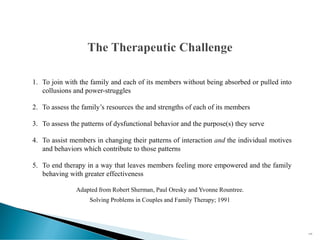
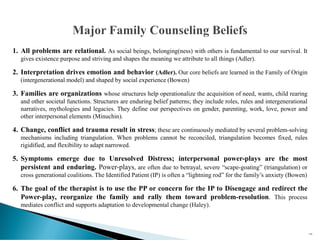
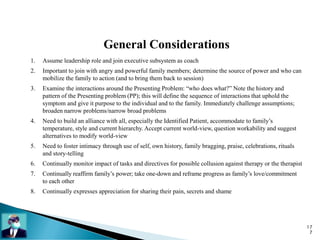
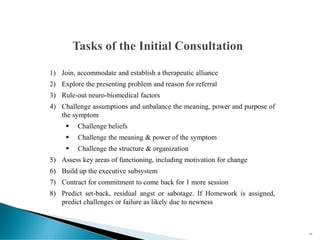
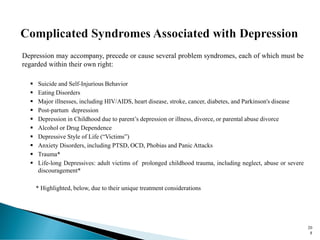
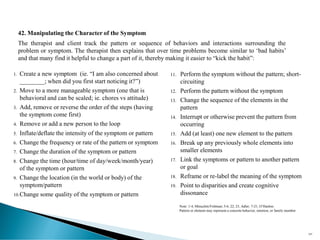
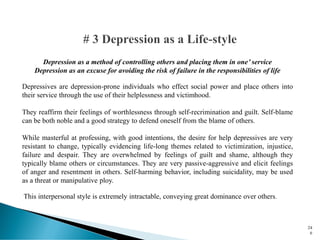
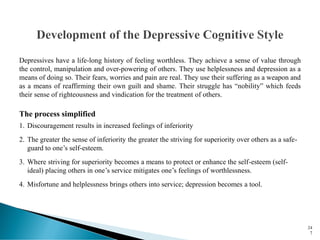
The Philosophy and Practice of Clinical Outpatient Therapy
Demetrios Peratsakis, MSEd, SDSAS, LPC, ACS
DISCLAIMER
The purpose of these materials is to help improve on one’s practice
of therapy through a deeper understanding of methods.
It is intended to augment, not replace, the instruction and practice expectations
of one’s home Community Services Board or Agency.
As such, the ideas presented herein are simply those that assist us in our work
and in our understanding of human motivation and pathology.
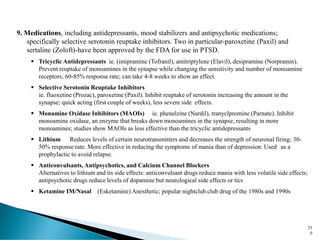
____________________ . ____________________
Disclaimer: Given the number of counseling approaches there is no shortage of opinion on how best to view the basic constructs
within our field. The ideas presented herein are simply those that assist me in my work and in my understanding of human motivation
and pathology. They are also form of homage to Robert Sherman and Richard Belson, two remarkable clinicians that have greatly
shaped our understanding of power and its role in psychological injury and the intergenerational transmission of trauma.
Background: We were working as substance abuse counselors in the 1970’s when a small group of us began training with Dr. Robert
Sherman in 1980 and continued until his retirement and relocation from New York City in 1992. Bob (Robert) was an AAMFT
Clinical Supervisor, Author, co-founder of Adlerian Family Therapy, a long-time Fellow at the North American Society of Adlerian
Psychology and Chair of the Department of Marriage and Family Therapy Programs at Queens College which he founded and where I
served on faculty in 1986 and 1987. This remarkable 12-year mentorship included small-group instruction with noted Adlerians Kurt
Adler (1980), Bernard H. Shulman (1980), Harold Mosak (1980-1981) and Larry Zuckerman (1982-1983), as well as a unique series
of live-practice seminars with several theorists, including Maurizio Andolfi (1981), Adia Shumsky (1982), Carlos Sluski (1983),
Murray Bowen (1984), James Framo (1985), Bunny Duhl (1986), Monica McGoldrick (1987), Carl Whitaker (1988), Jay Haley
(1989), Salvador Minuchin (1990 and 1991) and Peggy Papp (1992). In March 1991, we completed a two-day intensive with Patricia
and Salvador Minuchin. Over the course of his extremely distinguished career, Bob trained several thousands of counselors and left an
indelible mark on the field of psychotherapy. I am very proud and grateful to continue to regard him as a friend and mentor.
In 1990, I joined a two-year, 30-session externship with Dr. Richard Belson, Director of the (Strategic) Family Therapy Institute of
Long Island. This innovative, live-supervision practicum employed a solution-focused, team-therapy approach to treating chronic,
highly intractable problems. At the time, Richard was collaborating with Jay Haley and Cloe Madanes at the Family Therapy Institute
of Washington, D.C. (1980 to 1990), on faculty at the Adelphi School of Social Work, and serving on the editorial board of the Journal
of Strategic and Systemic Therapies (1981 to 1993). He is most noted for his work on forgiveness, revenge, and various methods of
undermining passive-aggressive acts and power-plays. To this day, I have yet to witness a more brilliant and creative tactician.
The following notes stem from their perspectives.
_______________________ . ________________________
Demetrios Peratsakis, MSEd, SDSAS, LPC, ACS, Western Tidewater Community Services Board
3
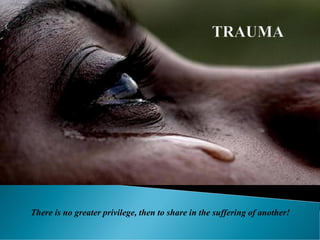
There is no greater privilege, then to share in the suffering of another!
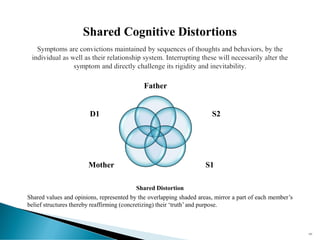
The ideas presented herein presume a psychosocial, constructivist perspective on the origin and
development of psychological symptoms. This differs greatly from the biomedical, which tends to
view symptoms as the outward expression of some underlying brain disorder or biological condition,
much like a fever denotes the existence of an infection.
The essential difference is that cognitive-behavioral and family systems theories view symptoms as
created manifestations, complex belief structures shared by the individual and their relationship
system. In this regard problems are viewed as shared cognitive distortions, myths and legends that
have acquired purpose and contain social meaning and power.
At first, this notion may appear somewhat radical. You will find, however, that this vantage point
can add inestimably to your insight on human behavior and to your ability to intervene on and
reshape social interaction.
An overview of this perspective is summarized on the following slide.
5
“Anxiety and Depression --including such varied forms of expression as dread, worry, hesitation, remorse,
grief, and despair, are affective conditions fueled by guilt and shame, two highly corrosive negative
estimations of the self. Because guilt and shame are rooted in the opinion of others, a corresponding sense of
anger or resentment occurs and worsens whenever there is a perception of injustice or critique. The ensuing
Guilt, Anger and Shame (GASh) corkscrew into repetitive cycles called rumination. This may deepen into
feelings of worthlessness, hopelessness, and rage expressed in passive-aggressive terms as depression,
inadequacy or failure.
The root of emotional pain is the hurt caused by three distinct sources of trauma: tragedy, loss and betrayal.
Unresolved, the ensuing damage, or psychological injury, is a degree of harm to one’s perceived sense of self
in relation to others, their self-esteem or sense of self-worth. This effects one’s confidence, sense of capability
and desire to trust and to be intimate. Symptoms may develop as a means to gain or re-gain control and to
stabilize and reorganize the individual and their relationship system. As such, they accumulate meaning,
purpose and power. Over time, the behaviors may concretize into established transactional patterns or habits
that we call symptoms. These become rigid and resistant to change.
As counselors, our main concern is when these conditions fulfill some important function or method of
coping. In particular, we grow troubled when symptoms serve as a means of controlling, perhaps even
punishing, others or as a method of excusing or avoiding responsibility for change.”
– Demetrios Peratsakis, MSEd, SDSAS, LPC, ACS; 2017
6
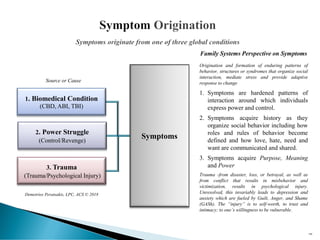
Psychological symptoms are protective belief structures that arise
from one of three broad categories of injury:
1. As a result of a biomedical condition, such as congenital, acquired or traumatic brain injury;
2. As a purposeful strategy of defense in chronic power-struggles and conflicts; and
3. As a response to the emotional pain or ‘trauma’ caused by a) loss; b) victimization by
a manmade tragedy or natural disaster; or c) from the betrayal of a sacred trust.
The following slide illustrates these categories and the manner in which
symptoms most often emerge.
7
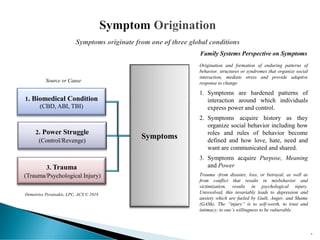
Family Systems Perspective on Symptoms
Origination and formation of enduring patterns of
behavior, structures or syndromes that organize social
interaction, mediate stress and provide adaptive
response to change
1. Symptoms are hardened patterns of
interaction around which individuals
express power and control.
2. Symptoms acquire history as they
organize social behavior including how
roles and rules of behavior become
defined and how love, hate, need and
want are communicated and shared.
3. Symptoms acquire Purpose, Meaning
and Power
Trauma -from disaster, loss, or betrayal, as well as
from conflict that results in misbehavior and
victimization, results in psychological injury.
Unresolved, this invariably leads to depression and
anxiety which are fueled by Guilt, Anger, and Shame
(GASh). The “injury” is to self-worth, to trust and
intimacy; to one’s willingness to be vulnerable.
Symptoms
1. Biomedical Condition
(CBD, ABI, TBI)
2. Power Struggle
(Control/Revenge)
3. Trauma
(Trauma/Psychological Injury)
Source or Cause
Demetrios Peratsakis, LPC, ACS © 2018
8
9
Hardships and disappointments are a natural part of life.
When gauged as deeply distressing or disturbing experiences
we refer to them as psychological injury or trauma, the primary focus of this Section.
The actual injury is damage to one’s sense of self-worth, an estimation of trust in one’s
own capabilities as well as in the safety and security of one’s relationships.
Trauma fosters guilt, anger and shame, and because of its social implications may harbor
blame and resentment toward others. Its results are cumulative.
Unresolved, it results in depression and anxiety.
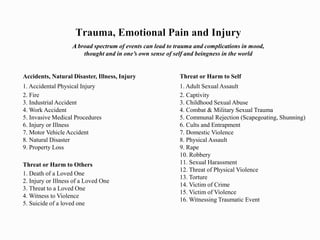
Accidents, Natural Disaster, Illness, Injury
1. Accidental Physical Injury
2. Fire
3. Industrial Accident
4. Work Accident
5. Invasive Medical Procedures
6. Injury or Illness
7. Motor Vehicle Accident
8. Natural Disaster
9. Property Loss
Threat or Harm to Others
1. Death of a Loved One
2. Injury or Illness of a Loved One
3. Threat to a Loved One
4. Witness to Violence
5. Suicide of a loved one
Threat or Harm to Self
1. Adult Sexual Assault
2. Captivity
3. Childhood Sexual Abuse
4. Combat & Military Sexual Trauma
5. Communal Rejection (Scapegoating, Shunning)
6. Cults and Entrapment
7. Domestic Violence
8. Physical Assault
9. Rape
10. Robbery
11. Sexual Harassment
12. Threat of Physical Violence
13. Torture
14. Victim of Crime
15. Victim of Violence
16. Witnessing Traumatic Event
A broad spectrum of events can lead to trauma and complications in mood,
thought and in one’s own sense of self and beingness in the world
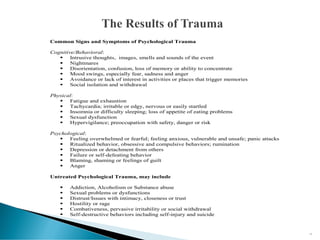
Common Signs and Symptoms of Psychological Trauma
Cognitive/Behavioral:
▪ Intrusive thoughts, images, smells and sounds of the event
▪ Nightmares
▪ Disorientation, confusion, loss of memory or ability to concentrate
▪ Mood swings, especially fear, sadness and anger
▪ Avoidance or lack of interest in activities or places that trigger memories
▪ Social isolation and withdrawal
Physical:
▪ Fatigue and exhaustion
▪ Tachycardia; irritable or edgy, nervous or easily startled
▪ Insomnia or difficulty sleeping; loss of appetite of eating problems
▪ Sexual dysfunction
▪ Hypervigilance; preoccupation with safety, danger or risk
Psychological:
▪ Feeling overwhelmed or fearful; feeling anxious, vulnerable and unsafe; panic attacks
▪ Ritualized behavior, obsessive and compulsive behaviors; rumination
▪ Depression or detachment from others
▪ Failure or self-defeating behavior
▪ Blaming, shaming or feelings of guilt
▪ Anger
Untreated Psychological Trauma, may include
▪ Addiction, Alcoholism or Substance abuse
▪ Sexual problems or dysfunctions
▪ Distrust/Issues with intimacy, closeness or trust
▪ Hostility or rage
▪ Combativeness, pervasive irritability or social withdrawal
▪ Self-destructive behaviors including self-injury and suicide
11
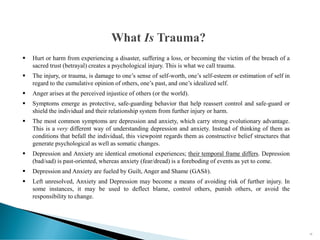
▪ Hurt or harm from experiencing a disaster, suffering a loss, or becoming the victim of the breach of a
sacred trust (betrayal) creates a psychological injury. This is what we call trauma.
▪ The injury, or trauma, is damage to one’s sense of self-worth, one’s self-esteem or estimation of self in
regard to the cumulative opinion of others, one’s past, and one’s idealized self.
▪ Anger arises at the perceived injustice of others (or the world).
▪ Symptoms emerge as protective, safe-guarding behavior that help reassert control and safe-guard or
shield the individual and their relationship system from further injury or harm.
▪ The most common symptoms are depression and anxiety, which carry strong evolutionary advantage.
This is a very different way of understanding depression and anxiety. Instead of thinking of them as
conditions that befall the individual, this viewpoint regards them as constructive belief structures that
generate psychological as well as somatic changes.
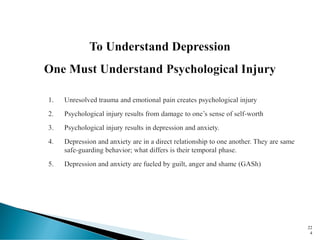
▪ Depression and Anxiety are identical emotional experiences; their temporal frame differs. Depression
(bad/sad) is past-oriented, whereas anxiety (fear/dread) is a foreboding of events as yet to come.
▪ Depression and Anxiety are fueled by Guilt, Anger and Shame (GASh).
▪ Left unresolved, Anxiety and Depression may become a means of avoiding risk of further injury. In
some instances, it may be used to deflect blame, control others, punish others, or avoid the
responsibility to change.
12
A Simpler Model for Understanding Psychological Injury
All trauma results in emotional pain.
The source of the injury, however, can greatly effect the type of psychological damage that occurs.
The death of a loved one, devastation through flood or accident, and infidelity or abuse, all differ
greatly because of the nature of the injury and its associated meaning.
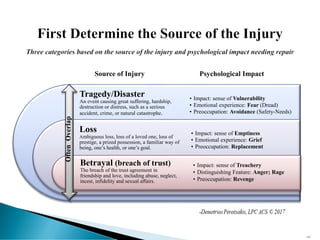
The next slide denotes three categories of psychological injury:
Loss; Tragedy/Disaster; and Betrayal.
While there may be other ways to group the causes of trauma, doing so based
on the source of the injury helps the clinician to better understand the kind of injury that has
occurred as well as the most likely path for clinical intervention.
14
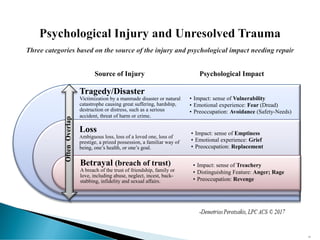
Tragedy/Disaster
Victimization by a manmade disaster or natural
catastrophe causing great suffering, hardship,
destruction or distress, such as a serious
accident, threat of harm or crime.
Loss
Ambiguous loss, loss of a loved one, loss of
prestige, a prized possession, a familiar way of
being, one’s health, or one’s goal.
Betrayal (breach of trust)
A breach of the trust of friendship, family or
love, including abuse, neglect, incest, back-
stabbing, infidelity and sexual affairs.
• Impact: sense of Vulnerability
• Emotional experience: Fear (Dread)
• Preoccupation: Avoidance (Safety-Needs)
• Impact: sense of Emptiness
• Emotional experience: Grief
• Preoccupation: Replacement
• Impact: sense of Treachery
• Distinguishing Feature: Anger; Rage
• Preoccupation: Revenge
OftenOverlap
15
Source of Injury Psychological Impact
Unresolved, psychological injuries result in symptoms.
While trauma may create new cognitive-distortions, it most often exacerbates
pre-existing ones, belief structures that the individual and their relationship system share.
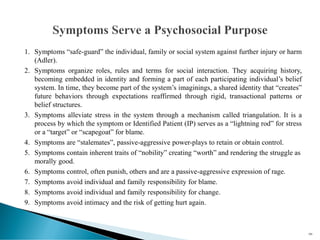
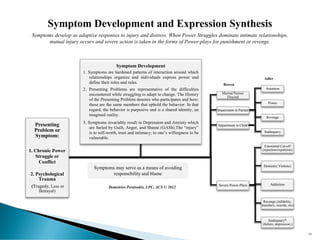
The problematic behavior or symptom that emerges is the system’s effort
to adjust, reconcile the change or protect itself from further harm.
Adler referred to this kind of emergent behavior as “safeguarding”.
The following slide references it’s formation.
16
17
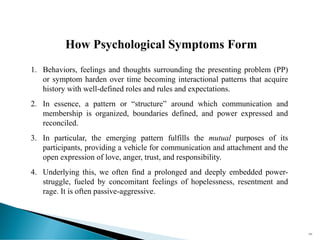
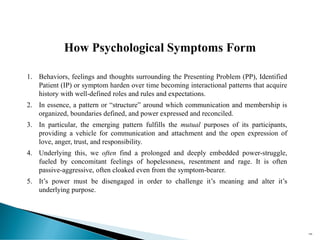
1. Behaviors, feelings and thoughts surrounding the Presenting Problem (PP), Identified Patient
(IP) or symptom harden over time becoming interactional patterns that acquire history with well-
defined roles and rules and expectations.
2. In essence, a pattern or “structure” around which communication and membership is organized,
boundaries defined, and power expressed and reconciled.
3. In particular, the emerging pattern fulfills the mutual purposes of its participants, providing a
vehicle for communication and attachment and the open expression of love, anger, trust, and
responsibility.
4. It’s power must be disengaged in order to challenge it’s meaning and alter it’s primary purpose.
Power, or the ability to influence interest and outcome, is at the core of all human interaction. As
such, it helps define and shape the meaning and experience that events contain, how they are
recollected and continuously repeated. Since symptoms are recurring, interactional transactional
patterns or “concretized” series of beliefs and behaviors, the power they contain is enormous.
5. Underlying their expression, we often find a prolonged and deeply embedded power-struggle,
fueled by concomitant feelings of hopelessness, resentment and rage. It is often passive-
aggressive, directed at others, and often cloaked, even from the symptom-bearer.
How Psychological Symptoms Form
It is very important to understand the relationship between Anger and Depression
According to Adler (1913) there are two, unconstructive methods
by which we “safeguard” or protect our self-esteem and sense of self-worth:
1) Depression; and
2) Aggression
The following slide highlights key ways that anger is used in social relations.
18
The next two slides discuss the relationship between anger and depression.
According to Adler (1913) there are two, unconstructive methods by which we “safeguard”
or protect our self-esteem and sense of self-worth: 1) Depression (sadness); and 2) Aggression (anger)
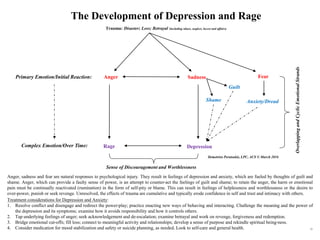
The second slide depicts an illustration for understanding the development of complex depression over
time. Since we don’t truly know how depression forms, this is simply a working model.
What we suspect is that all psychological injury results in a complex belief structure that includes hurt
and despondency over the event. Typically, guilt and shame surface as the individual evaluates their own
role in the occurrence or in their ability to remain safe or worthy of protection. If others failed to
adequately protect the individual, perpetrated the harm, or were critical in their assessment of the
individual’s performance, anger and resentment will emerge and fester.
When there is a fear or dread of reinjury, or the individual remains feeling vulnerable and unsafe, anxiety
or foreboding will develop. Depression can evolve into a chronic syndrome characterized by feelings of
worthlessness and discouragement, but also of suppressed anger and rage.
.
19
Anger (Aggression) is a natural, protective reactions to fear and injury. It is considered one of the four
primary emotions that develop within six months of birth (Anger/Disgust, Fear/Surprise, Sadness, and Joy)
1. Anger is a way to control others or to get one’s way
▪ It may be overt (bullying/violence, persuasion) or covert (passive aggressive)
▪ It can provide a faulty sense of power
▪ To retain the anger, the harm or emotional pain must continually be reactivated (rumination), often in
the form of self-pity or blame
2. Anger can temporarily empower and counter-act feelings of Sadness, Guilt and Shame
▪ It can counter-act feelings of depression and anxiety
▪ This is why we often feel sad, when we are, in fact, angry. In some families anger is so toxic that it is
more acceptable to become ill, depressed or “insane”
▪ Guilt and shame result in feelings of worthlessness and hopelessness (aka powerlessness)
▪ Individuals prone to feelings of worthlessness often develop a great sense of ‘nobility’, stemming
from beliefs associated with the desire to change, make amends or seek revenge. The ensuing struggle
justifies one’s good intentions despite the unwillingness to change or relinquish its control of others.
3. Anger may be used to establish distance or stave off intimacy and, thereby, avoid or
reduce the risk of hurt or re-injury
The Use and Mis-Use of Anger
20
The Development of Depression and Rage
Trauma: Disaster; Loss; Betrayal (including abuse, neglect, incest and affairs)
Anger
Guilt
Shame Anxiety/Dread
Sadness
DepressionRage
Primary Emotion/Initial Reaction:
Complex Emotion/Over Time:
Sense of Discouragement and Worthlessness
Fear
Demetrios Peratsakis, LPC, ACS © March 2016
Anger, sadness and fear are natural responses to psychological injury. They result in feelings of depression and anxiety, which are fueled by thoughts of guilt and
shame. Anger, which can provide a faulty sense of power, is an attempt to counter-act the feelings of guilt and shame; to retain the anger, the harm or emotional
pain must be continually reactivated (rumination) in the form of self-pity or blame. This can result in feelings of helplessness and worthlessness or the desire to
over-power, punish or seek revenge. Unresolved, the effects of trauma are cumulative and typically erode confidence in self and trust and intimacy with others.
Treatment considerations for Depression and Anxiety:
1. Resolve conflict and disengage and redirect the power-play; practice enacting new ways of behaving and interacting. Challenge the meaning and the power of
the depression and its symptoms; examine how it avoids responsibility and how it controls others.
2. Tap underlying feelings of anger; seek acknowledgement and de-escalation; examine betrayal and work on revenge, forgiveness and redemption.
3. Bridge emotional cut-offs; fill loss; connect to meaningful activity and relationships; develop a sense of purpose and rekindle spiritual being-ness.
4. Consider medication for mood stabilization and safety or suicide planning, as needed. Look to self-care and general health.
OverlappingandCyclicEmotionalStrands
21
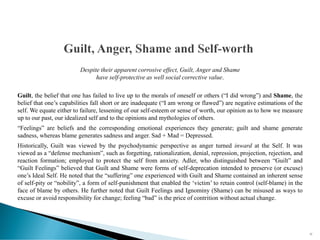
Despite their apparent corrosive effect, Guilt, Anger and Shame
have self-protective as well social corrective value.
Guilt, the belief that one has failed to live up to the morals of oneself or others (“I did wrong”) and Shame, the
belief that one’s capabilities fall short or are inadequate (“I am wrong or flawed”) are negative estimations of the
self. We equate either to failure, lessening of our self-esteem or sense of worth, our opinion as to how we measure
up to our past, our idealized self and to the opinions and mythologies of others.
“Feelings” are beliefs and the corresponding emotional experiences they generate; guilt and shame generate
sadness, whereas blame generates sadness and anger. Sad + Mad = Depressed.
Historically, Guilt was viewed by the psychodynamic perspective as anger turned inward at the Self. It was
viewed as a “defense mechanism”, such as forgetting, rationalization, denial, repression, projection, rejection, and
reaction formation; employed to protect the self from anxiety. Adler, who distinguished between “Guilt” and
“Guilt Feelings” believed that Guilt and Shame were forms of self-deprecation intended to preserve (or excuse)
one’s Ideal Self. He noted that the “suffering” one experienced with Guilt and Shame contained an inherent sense
of self-pity or “nobility”, a form of self-punishment that enabled the ‘victim’ to retain control (self-blame) in the
face of blame by others. He further noted that Guilt Feelings and Ignominy (Shame) can be misused as ways to
excuse or avoid responsibility for change; feeling “bad” is the price of contrition without actual change.
22
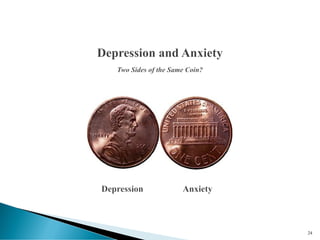
The next few slides show a very interesting relationship
between Anxiety and Depression.
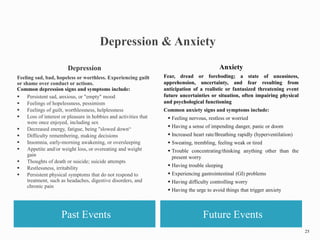
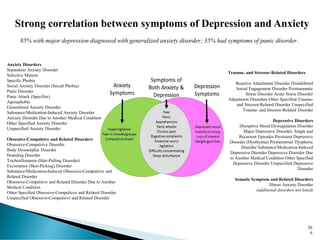
Anxiety, is fear, dread and foreboding; Depression, sadness, sorrow and despair.
It is suggested that it makes clinical sense to regard them as one and the same,
with the only difference being the temporal frame of reference.
23
24
Depression
Feeling sad, bad, hopeless or worthless. Experiencing guilt
or shame over conduct or actions.
Common depression signs and symptoms include:
▪ Persistent sad, anxious, or "empty" mood
▪ Feelings of hopelessness, pessimism
▪ Feelings of guilt, worthlessness, helplessness
▪ Loss of interest or pleasure in hobbies and activities that
were once enjoyed, including sex
▪ Decreased energy, fatigue, being "slowed down“
▪ Difficulty remembering, making decisions
▪ Insomnia, early-morning awakening, or oversleeping
▪ Appetite and/or weight loss, or overeating and weight
gain
▪ Thoughts of death or suicide; suicide attempts
▪ Restlessness, irritability
▪ Persistent physical symptoms that do not respond to
treatment, such as headaches, digestive disorders, and
chronic pain
Anxiety
Fear, dread or foreboding; a state of uneasiness,
apprehension, uncertainty, and fear resulting from
anticipation of a realistic or fantasized threatening event
future uncertainties or situation, often impairing physical
and psychological functioning
Common anxiety signs and symptoms include:
▪ Feeling nervous, restless or worried
▪ Having a sense of impending danger, panic or doom
▪ Increased heart rate/Breathing rapidly (hyperventilation)
▪ Sweating, trembling, feeling weak or tired
▪ Trouble concentrating/thinking anything other than the
present worry
▪ Having trouble sleeping
▪ Experiencing gastrointestinal (GI) problems
▪ Having difficulty controlling worry
▪ Having the urge to avoid things that trigger anxiety
Past Events Future Events
25
26
27
Anger
Sadness
Fear
Depression/Anxiety
- Demetrios Peratsakis, LPC, ACS
Guilt
Shame
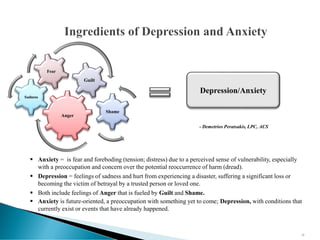
▪ Anxiety = is fear and foreboding (tension; distress) due to a perceived sense of vulnerability, especially
with a preoccupation and concern over the potential reoccurrence of harm (dread).
▪ Depression = feelings of sadness and hurt from experiencing a disaster, suffering a significant loss or
becoming the victim of betrayal by a trusted person or loved one.
▪ Both include feelings of Anger that is fueled by Guilt and Shame.
▪ Anxiety is future-oriented, a preoccupation with something yet to come; Depression, with conditions that
currently exist or events that have already happened.
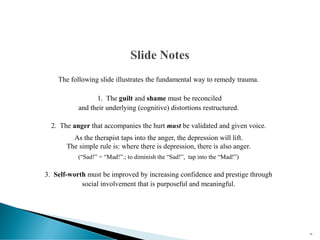
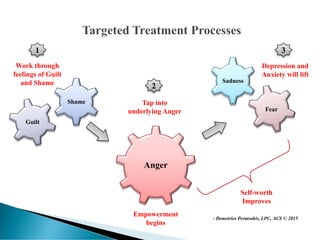
The following slide illustrates the fundamental way to remedy trauma.
1. The guilt and shame must be reconciled
and their underlying (cognitive) distortions restructured.
2. The anger that accompanies the hurt must be validated and given voice.
As the therapist taps into the anger, the depression will lift.
The simple rule is: where there is depression, there is also anger.
(“Sad!” = “Mad!”.; to diminish the “Sad!”, tap into the “Mad!”)
3. Self-worth must be improved by increasing confidence and prestige through
social involvement that is purposeful and meaningful.
28
- Demetrios Peratsakis, LPC, ACS © 2015
Sadness
Fear
Anger
Guilt
Shame
1
2
3
Depression and
Anxiety will lift
Work through
feelings of Guilt
and Shame
Tap into
underlying Anger
Empowerment
begins
Self-worth
Improves
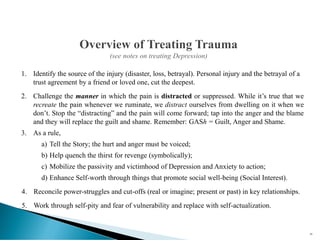
1. Identify the source of the injury (disaster, loss, betrayal). Personal injury and the betrayal of a
trust agreement by a friend or loved one, cut the deepest.
2. Challenge the manner in which the pain is distracted or suppressed. While it’s true that we
recreate the pain whenever we ruminate, we distract ourselves from dwelling on it when we
don’t. Stop the “distracting” and the pain will come forward; tap into the anger and the blame
and they will replace the guilt and shame. Remember: GASh = Guilt, Anger and Shame.
3. As a rule,
a) Tell the Story; the hurt and anger must be voiced;
b) Help quench the thirst for revenge (symbolically);
c) Mobilize the passivity and victimhood of Depression and Anxiety to action;
d) Enhance Self-worth through things that promote social well-being (Social Interest).
4. Reconcile power-struggles and cut-offs (real or imagine; present or past) in key relationships.
5. Work through self-pity and fear of vulnerability and replace with self-actualization.
30
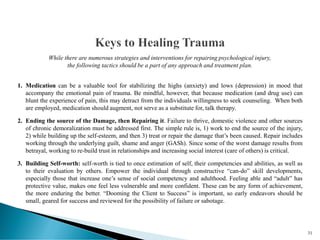
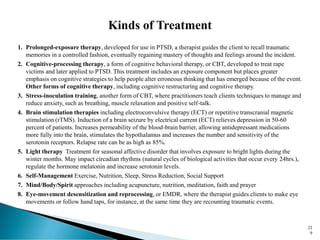
While there are numerous strategies and interventions for repairing psychological injury,
the following tactics should be a part of any approach and treatment plan.
1. Medication can be a valuable tool for stabilizing the highs (anxiety) and lows (depression) in mood that
accompany the emotional pain of trauma. Be mindful, however, that because medication (and drug use) can
blunt the experience of pain, this may detract from the individuals willingness to seek counseling. When both
are employed, medication should augment, not serve as a substitute for, talk therapy.
2. Ending the source of the Damage, then Repairing it. Failure to thrive, domestic violence and other sources
of chronic demoralization must be addressed first. The simple rule is, 1) work to end the source of the injury,
2) while building up the self-esteem, and then 3) treat or repair the damage that’s been caused. Repair includes
working through the underlying guilt, shame and anger (GASh). Since some of the worst damage results from
betrayal, working to re-build trust in relationships and increasing social interest (care of others) is critical.
3. Building Self-worth: self-worth is tied to once estimation of self, their competencies and abilities, as well as
to their evaluation by others. Empower the individual through constructive “can-do” skill developments,
especially those that increase one’s sense of social competency and adulthood. Feeling able and “adult” has
protective value, makes one feel less vulnerable and more confident. These can be any form of achievement,
the more enduring the better. “Dooming the Client to Success” is important, so early endeavors should be
small, geared for success and reviewed for the possibility of failure or sabotage.
31
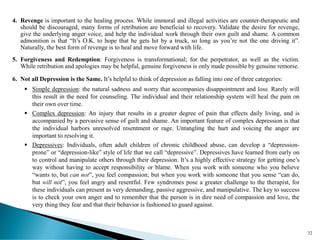
4. Revenge is important to the healing process. While immoral and illegal activities are counter-therapeutic and
should be discouraged, many forms of retribution are beneficial to recovery. Validate the desire for revenge,
give the underlying anger voice, and help the individual work through their own guilt and shame. A common
admonition is that “It’s O.K. to hope that he gets hit by a truck, so long as you’re not the one driving it”.
Naturally, the best form of revenge is to heal and move forward with life.
5. Forgiveness and Redemption: Forgiveness is transformational; for the perpetrator, as well as the victim.
While retribution and apologies may be helpful, genuine forgiveness is only made possible by genuine remorse.
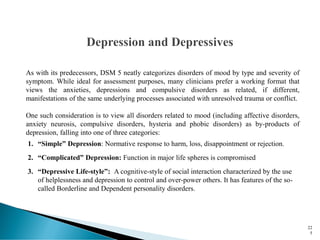
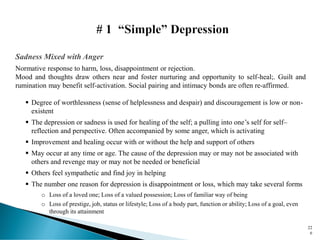
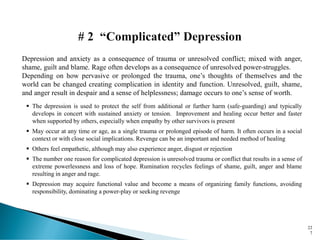
6. Not all Depression is the Same. It’s helpful to think of depression as falling into one of three categories:
▪ Simple depression: the natural sadness and worry that accompanies disappointment and loss. Rarely will
this result in the need for counseling. The individual and their relationship system will heal the pain on
their own over time.
▪ Complex depression: An injury that results in a greater degree of pain that effects daily living, and is
accompanied by a pervasive sense of guilt and shame. An important feature of complex depression is that
the individual harbors unresolved resentment or rage. Untangling the hurt and voicing the anger are
important to resolving it.
▪ Depressives: Individuals, often adult children of chronic childhood abuse, can develop a “depression-
prone” or “depression-like” style of life that we call “depressive”. Depressives have learned from early on
to control and manipulate others through their depression. It’s a highly effective strategy for getting one’s
way without having to accept responsibility or blame. When you work with someone who you believe
“wants to, but can not”, you feel compassion; but when you work with someone that you sense “can do,
but will not”, you feel angry and resentful. Few syndromes pose a greater challenge to the therapist, for
these individuals can present as very demanding, passive aggressive, and manipulative. The key to success
is to check your own anger and to remember that the person is in dire need of compassion and love, the
very thing they fear and that their behavior is fashioned to guard against.
32
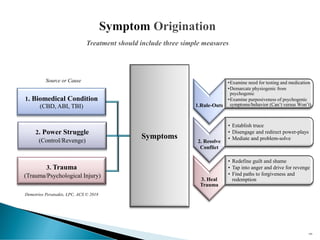
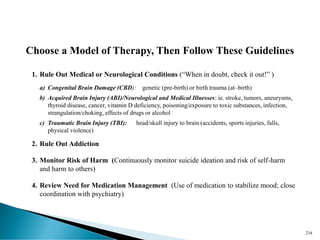
Neurobiomedical Rule-Out
Psychological symptoms may arise as a result of a biomedical condition
Psychological symptoms may arise from somatic, medical conditions or injuries.
While these might limit some capabilities or impede cognitive functioning they are not,
in and of themselves, reasons for therapy unless they pose an adjustment
problem for the individual or their families.
It is not uncommon for a physical impairment, limitation or injury to become a pretext for
the inability or lack of willingness to effectively manage change or succeed in the social tasks of life.
When in question, a determination as to whether a psychological component exists must be made.
Conversely, prior to treating a problem as originating from psychological elements, it is important to
first rule out the possibility of an underlying or concomitant medical condition.
The next two slides highlight biomedical injuries and the rule-outs that
may assist the clinician in formulating a differential diagnosis.
37
It is very important rule-out the possibility that a psychological symptom is the by-product of a medical or
cognitive impairment. This includes all disorders associated with injury or irregularities of the body and brain
due to medical, hormonal, neurological/neurochemical, structural, congenital or brain injury conditions (C-A-T).
The general rule is, “When In Doubt, Check It Out!”
1) Congenital Brain Damage (CBD): genetic (pre-birth) abnormalities or at-birth injuries;
2) Acquired Brain Injury (ABI); injuries due to Neurological and Medical Illnesses:
ie. stroke, tumors, aneurysms, thyroid disease, cancer, vitamin D deficiency, poisoning/exposure to toxic
substances, infection, choking, effects of drugs or alcohol
3) Traumatic Brain Injury (TBI): head injury; structural damage to the brain due to accidents, sports
injuries, falls, physical violence or abuse.
Symptoms which may indicate organicity or the presence of an underlying medical illness:
> a change in headache pattern; > significant weight change, gain or loss
> visual disturbances, either double vision or partial visual loss
> speech deficits, either dysarthrias (problems with the mechanical production of speech sounds) or
aphasias (difficulty with word comprehension or word usage)
> abnormal autonomic signs (blood pressure, pulse, temperature); > abnormal body movements
> disorientation and/or memory impairment; > fluctuating or impaired level of consciousness
> frequent urination, increased thirst (possible symptoms of diabetes)
38
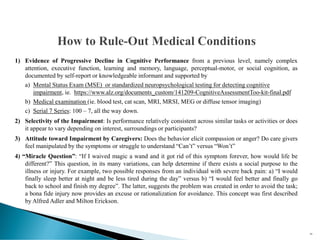
1) Evidence of Progressive Decline in Cognitive Performance from a previous level, namely complex
attention, executive function, learning and memory, language, perceptual-motor, or social cognition, as
documented by self-report or knowledgeable informant and supported by
a) Mental Status Exam (MSE) or standardized neuropsychological testing for detecting cognitive
impairment, ie. https://www.alz.org/documents_custom/141209-CognitiveAssessmentToo-kit-final.pdf
b) Medical examination (ie. blood test, cat scan, MRI, MRSI, MEG or diffuse tensor imaging)
c) Serial 7 Series: 100 – 7, all the way down.
2) Selectivity of the Impairment: Is performance relatively consistent across similar tasks or activities or does
it appear to vary depending on interest, surroundings or participants?
3) Attitude toward Impairment by Caregivers: Does the behavior elicit compassion or anger? Do care givers
feel manipulated by the symptoms or struggle to understand “Can’t” versus “Won’t”
4) “Miracle Question”: “If I waived magic a wand and it got rid of this symptom forever, how would life be
different?” This question, in its many variations, can help determine if there exists a social purpose to the
illness or injury. For example, two possible responses from an individual with severe back pain: a) “I would
finally sleep better at night and be less tired during the day” versus b) “I would feel better and finally go
back to school and finish my degree”. The latter, suggests the problem was created in order to avoid the task;
a bona fide injury now provides an excuse or rationalization for avoidance. This concept was first described
by Alfred Adler and Milton Erickson.
39
Power Struggles
Psychological symptoms may arise as a passive-aggressive display of power
in order to assert oneself or even the score in a dispute.
To better understand this concept it is important to first examine some alternative ways of
understanding symptom onset and purpose, as well as some of that conflict is reconciled in
healthy as well as unhealthy ways.
This kind of a power-struggle is often identified by a long-standing or long-simmering feud
between family members and, typically, a lone combatant such as with substance use disorders,
anorexia and depression.
The symptom becomes a means by which the individual can assert control over their own
decision-making.
At times, the symptom may also serve as a means of punishing or controlling others. In these
instances some act of betrayal such as domestic violence or infidelity is employed to break the
power-struggle(power-play) or injure the opponent in order to end the power-struggle or as a
means of revenge.
It is important, therefore, to understand the relationship of anger to power and the mis-use of
power and anger to the dimension of conflict between individuals.
43
▪ Power is the expression of will and intent; the ability to influence outcome
▪ Power is at the core of every social interaction; power is influence and control within the
relationship system
▪ Conflict is always about power; it occurs around issues of money, work, sex, children,
chores, and “in-laws”
▪ Determines style of communication and how love, caring, anger, and other emotions are
expressed and understood
▪ Determines style of decision-making and problem-solving
▪ Defines level of trust for meeting or not meeting needs
▪ Establishes rules for interdependence, independence and for distance and closeness between
members (attachment/mutual accommodation; affection/expressing and experiencing love)
▪ Defines rules around positions and roles; these are usually reciprocal, interactive patterns of
behavior found primarily in the Family of Origin. The rules are taken or assigned to
individual in the family unit and are expected to be maintained; they are relatively enduring
(permanent) and acquire “moral character” and “status” which results in one’s placement in
the family's power hierarchy, often replicated outside the family at work and with others.
44
1. Power is the natural expression of will and intent to influence outcome
2. When two or more individuals express desires and interests that conflict,
tension arises (discord)
3. These are reconciled and mediated in a variety of mutually productive and less
productive ways.
4. Anger, a natural response to disappointment and not getting one’s way is used
effectively to overpower and control; to increase one’s power through threat
and domination
45
Anger and Aggression are natural, protective reactions to fear and (the risk) injury and
considered one of the four primary emotional pairs that develop within six months of
birth (Anger/Disgust, Fear/Surprise, Sadness, and Joy)
According to Adler (1913) there are two, “unconstructive” methods
by which we safeguard our self-esteem, 1) depression and 2) aggression.
1. Anger is a way to control others or to get one’s way
▪ It may be overt (bullying/violence, persuasion) or covert (passive aggressive)
▪ It can provide a faulty sense of power
▪ To retain the anger, the harm or emotional pain must continually be reactivated
(rumination), often in the form of self-pity or blame
On the Use & Mis-Use of Anger
46
1. Anger can temporarily empower, mobilize, and counter-act feelings of
Sadness, Guilt and Shame
▪ It can counter-act feelings of depression and anxiety
▪ This is why we often feel sad, when we are, in fact, angry. In some families
anger is so toxic that it is more acceptable to become ill, depressed or
“insane”
▪ Guilt and shame result in feelings of worthlessness and hopelessness (aka
powerlessness)
▪ Individuals prone to feelings of worthlessness often develop a great sense of
‘nobility’, stemming from beliefs associated with the desire to change, make
amends or seek revenge. The ensuing struggle justifies one’s good intentions
despite the unwillingness to change or relinquish its control of others.
2. Anger may establish distance or stave off intimacy
On the Use & Mis-Use of Anger
47
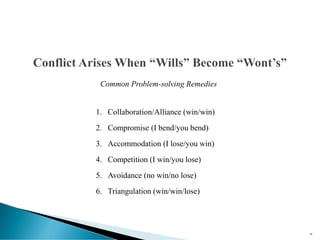
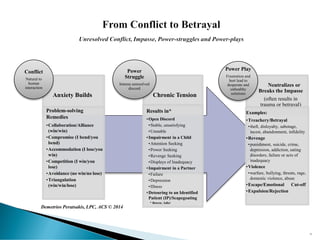
Common Problem-solving Remedies
1. Collaboration/Alliance (win/win)
2. Compromise (I bend/you bend)
3. Accommodation (I lose/you win)
4. Competition (I win/you lose)
5. Avoidance (no win/no lose)
6. Triangulation (win/win/lose)
48
Retaliation and Abuse in the Relationship System
(see section on Domestic Violence)
50
Anxiety Builds
Problem-solving
Remedies
•Collaboration/Alliance
(win/win)
•Compromise (I bend/you
bend)
•Accommodation (I lose/you
win)
•Competition (I win/you
lose)
•Avoidance (no win/no lose)
•Triangulation
(win/win/lose)
Conflict
Natural to
human
interaction
Chronic Tension
Results in*
•Open Discord
•Stable, unsatisfying
•Unstable
•Impairment in a Child
•Attention Seeking
•Power Seeking
•Revenge Seeking
•Displays of Inadequacy
•Impairment in a Partner
•Failure
•Depression
•Illness
•Detouring to an Identified
Patient (IP)/Scapegoating
* Bowen; Adler
Power
Struggle
Intense unresolved
discord
Neutralizes or
Breaks the Impasse
(often results in
trauma or betrayal)
Examples:
•Treachery/Betrayal
•theft, disloyalty, sabotage,
incest, abandonment, infidelity
•Revenge
•punishment, suicide, crime,
depression, addiction, eating
disorders, failure or acts of
inadequacy
•Violence
•warfare, bullying, threats, rage,
domestic violence, abuse
•Escape/Emotional Cut-off
•Expulsion/Rejection
Power Play
Frustration and
hurt lead to
desperate and
unhealthy
solutions
Demetrios Peratsakis, LPC, ACS © 2014
51
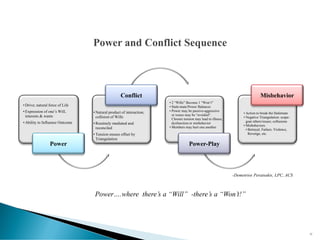
• Drive; natural force of Life
• Expression of one’s Will,
interests & wants
• Ability to Influence Outcome
Power
• Natural product of interaction;
collision of Wills
• Routinely mediated and
reconciled
• Tension ensues offset by
Triangulation
Conflict
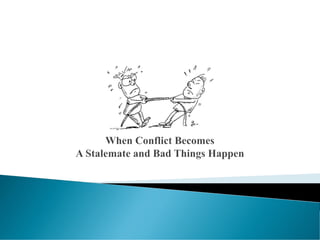
• 2 “Wills” Become 1 “Won’t”
• Stale-mate/Power Balances
• Power may be passive-aggressive
or issues may be “avoided”.
Chronic tension may lead to illness,
dysfunction or misbehavior
• Members may hurt one another
Power-Play
• Action to break the Stalemate
• Negative Triangulation: scape-
goat others/issues; collusions
• Misbehaviors
• Betrayal, Failure, Violence,
Revenge, etc.
Misbehavior
Power….where there’s a “Will” -there’s a “Won’t!”
-Demetrios Peratsakis, LPC, ACS
Power and Conflict Sequence
52
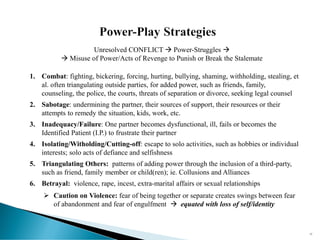
Unresolved CONFLICT → Power-Struggles →
→ Misuse of Power/Acts of Revenge to Punish or Break the Stalemate
1. Combat: fighting, bickering, forcing, hurting, bullying, shaming, withholding, stealing, et
al. often triangulating outside parties, for added power, such as friends, family,
counseling, the police, the courts, threats of separation or divorce, seeking legal counsel
2. Sabotage: undermining the partner, their sources of support, their resources or their
attempts to remedy the situation, kids, work, etc.
3. Inadequacy/Failure: One partner becomes dysfunctional, ill, fails or becomes the
Identified Patient (I.P.) to frustrate their partner
4. Isolating/Witholding/Cutting-off: escape to solo activities, such as hobbies or individual
interests; solo acts of defiance and selfishness
5. Triangulating Others: patterns of adding power through the inclusion of a third-party,
such as friend, family member or child(ren); ie. Collusions and Alliances
6. Betrayal: violence, rape, incest, extra-marital affairs or sexual relationships
➢ Caution on Violence: fear of being together or separate creates swings between fear
of abandonment and fear of engulfment → equated with loss of self/identity
53
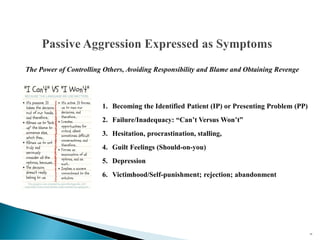
The Power of Controlling Others, Avoiding Responsibility and Blame and Obtaining Revenge
1. Becoming the Identified Patient (IP) or Presenting Problem (PP)
2. Failure/Inadequacy: “Can’t Versus Won’t”
3. Hesitation, procrastination, stalling,
4. Guilt Feelings (Should-on-you)
5. Depression
6. Victimhood/Self-punishment; rejection; abandonment
54
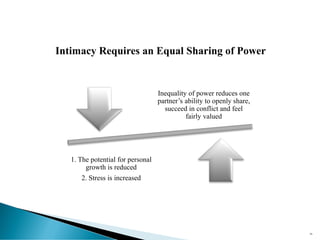
Intimacy Requires an Equal Sharing of Power
56
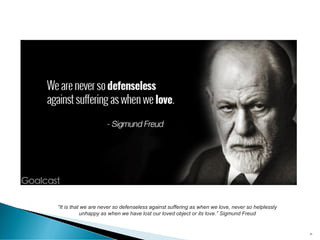
“It is that we are never so defenseless against suffering as when we love, never so helplessly
unhappy as when we have lost our loved object or its love.” Sigmund Freud
Intimacy: a Psychotherapist’s Definition
An agreement (Trust) to risk hurt and pain (Vulnerability) in order to
experience acceptance (Love) and belonging in a meaningful way (Worth).
1. Belonging in a Meaningful Way = Self-Worth = Mental Health
2. Intimacy increases belonging in a meaningful way
3. Trauma reduces our capacity for love; it makes us self-protecting, reducing
our willingness to risk pain.
4. Psychological Injury is damage to our sense of self-worth
57
Power and Intimacy
Mutuality of influence allows each partner to feel important and supported
in the relationship -affirming identity and worth. Partners can then open
themselves to being changed by the other, to accept influence.
They also feel safe enough to reveal their innermost thoughts, express
concerns, even admit weakness, uncertainty, or mistakes in a partner’s
presence. Mutual vulnerability becomes a high-water mark of bringing one’s
whole self into a relationship (Carmen Knudson-Martin; Family Process)
58
Inequality of power reduces one
partner’s ability to openly share,
succeed in conflict and feel
fairly valued
1. The potential for personal
growth is reduced
2. Stress is increased
Intimacy Requires an Equal Sharing of Power
59
Personal Injury, the Leading Cause of Psychological Injury
We punish, steal, cheat and lie to the ones we love.
We beat them, degrade them and abuse them.
We even maim, rape and kill them.
Why?!
62
63
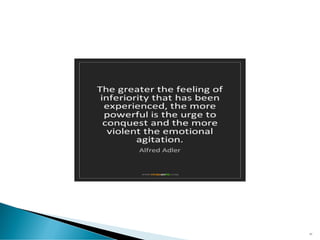
Adler posited that the central part of individual behavior
is to compensate for normal feelings of inadequacy
(Peluso & Kern, 2002; Ansbacher & Ansbacher, 1964).
▪ Individuals usually conquer feelings of inadequacy by forming
cooperative relationships, which are the underpinnings of social
interest, socialization and social belongingness, critical advantages
to evolutionary adaptation to change.
▪ Some, attempt to overcome their inferiority feelings by striving for
superiority. Overpowering and the control and taking advantage of
others provides a false sense of importance and security.
64
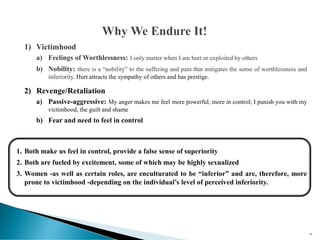
1) Revenge
a) Vengeance and Retribution: You hurt, betray or fail to protect
b) Displacement: redirection of fear, anger or aggression feelings stemming from an insoluble
conflict or injury onto another, typically less powerful substitute target (A. Freud, 1936). The
target can be a person or an object that can serve as a symbolic substitute. Someone who is
frustrated by their boss or partner may kick the dog, beat up a family member, or engage in
social or criminal mischief. Someone who feels uncomfortable with their sexual desires for a
real person may substitute a fetish.
2) Domination
a) Greed and envy
b) Fear and need to feel in control
1. Both make us feel in control, provide a false sense of superiority
2. Both are fueled by excitement, some of which may be highly sexualized
3. Men -as well as certain roles, are enculturated to be “superior” and are, therefore, more
prone to domination -depending on the individual’s level of perceived inferiority.
65
1) Victimhood
a) Feelings of Worthlessness: I only matter when I am hurt or exploited by others
b) Nobility: there is a “nobility” to the suffering and pain that mitigates the sense of worthlessness and
inferiority. Hurt attracts the sympathy of others and has prestige.
2) Revenge/Retaliation
a) Passive-aggressive: My anger makes me feel more powerful, more in control; I punish you with my
victimhood, the guilt and shame
b) Fear and need to feel in control
1. Both make us feel in control, provide a false sense of superiority
2. Both are fueled by excitement, some of which may be highly sexualized
3. Women -as well as certain roles, are enculturated to be “inferior” and are, therefore, more
prone to victimhood -depending on the individual’s level of perceived inferiority.
66
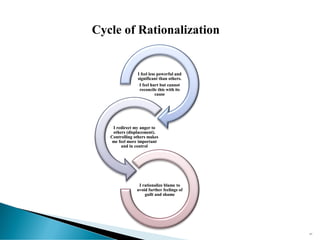
I feel less powerful and
significant than others.
I feel hurt but cannot
reconcile this with its
cause
I redirect my anger to
others (displacement).
Controlling others makes
me feel more important
and in control
I rationalize blame to
avoid further feelings of
guilt and shame
Cycle of Rationalization
67
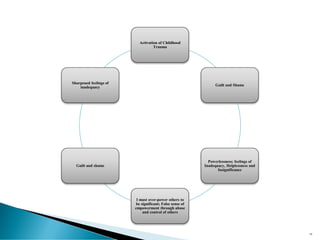
Activation of Childhood
Trauma
Guilt and Shame
Powerlessness; feelings of
Inadequacy, Helplessness and
Insignificance
I must over-power others to
be significant; False sense of
empowerment through abuse
and control of others
Guilt and shame
Sharpened feelings of
inadequacy
68
Distortions in the Belief System
Disclaimer
Given the number of counseling approaches there is no shortage of opinion on how best to view the basic constructs within our field.
The ideas presented herein are simply those that assist me in my work and in my understanding of human motivation and pathology.
They are also a form of homage to Robert Sherman and Richard Belson, two remarkable clinicians that have greatly shaped our
understanding of power and its role in psychological injury and the intergenerational transmission of trauma.
Background
We were substance abuse counselors, since the mid-1970’s, when we began our training with Dr. Robert Sherman in 1980 and
continued until his retirement and relocation from New York City in 1992. Bob (Robert) was an AAMFT Clinical Supervisor, author,
co-founder of Adlerian Family Therapy, a long-time Fellow at the North American Society of Adlerian Psychology, and Chair of the
Department of Marriage and Family Therapy Programs at Queens College which he founded and where I served on faculty in 1986
and 1987. This remarkable, 12-year mentorship included small-group instruction with noted Adlerians Kurt Adler (1980), Bernard H.
Shulman (1980), Harold Mosak (1980-1981) and Larry Zuckerman (1982-1983), as well as a unique series of live-practice seminars
with Maurizio Andolfi (1981), Adia Shumsky (1982), Carlos Sluski (1983), Murray Bowen (1984), James Framo (1985), Bunny Duhl
(1986), Monica McGoldrick (1987), Carl Whitaker (1988), Jay Haley (1989), Salvador Minuchin (1990 and 1991) and Peggy Papp
(1992). In March 1991, we undertook a two-day intensive with Patricia and Salvador Minuchin. Throughout these years, and since,
Bob has remained enormously influential, promoting counseling and psychotherapy and guiding the training of hundreds of advanced
practitioners in clinical methods and practice. I am very grateful to continue to regard him as a friend and mentor.
In 1990, a small group of us began a two-year, 30-session externship with Dr. Richard Belson, Director of the (Strategic) Family
Therapy Institute of Long Island. This innovative, live-supervision practicum employed a team-therapy approach to treating chronic,
highly intractable problems. At the time, Richard was collaborating with Jay Haley and Cloe Madanes at the Family Therapy Institute
of Washington, D.C. (1980 to 1990), on faculty at the Adelphi School of Social Work, and serving on the editorial board of the Journal
of Strategic and Systemic Therapies (1981 to 1993). He is most noted for his work on forgiveness, revenge, and various methods for
undermining passive-aggression and power-plays. To this day, I have yet to witness a more brilliant and creative tactician.
The following notes stem from their perspectives.
_______________________ . ________________________
Demetrios Peratsakis, MSEd, SDSAS, LPC, ACS, Western Tidewater Community Services Board; 2020
72
73
Irrational, mistaken and distorted beliefs are deep rooted, often intergenerational concepts or
assumptions that we hold to be true about ourselves, other people and life in general.
They are imbued with history, purpose, and power, and help shape our identity, feelings of worth,
and our estimation of self in relation to others. They shape perception, interpretation, opinion and
prediction as well as the shared narratives we call roles, rules and social functions. While some
have protective value, these “shoulds” and “should nots”, “musts” and “must nots” invariably
limit or restrict our ability to effectively adapt to change, respond to the needs of others, or
successfully navigate the development tasks of life. They tend to rigidify under stress, reducing
flexibility and exacerbating the problem. Unresolved, dissonance and anxiety grow intensifying
the need to modify -or abandon, long-standing “truisms” and convictions on life.
A major task of therapy is to unbalance and reshape these beliefs. In so doing, the client’s
precepts and interpretations are altered and new ways of thinking, feeling and interacting emerge.
This promotes new solutions, growth, and the promise of re-formulating one’s own narratives and
forging a new way of being.
The following slides highlight common mistaken beliefs, as well as ways to modify them through
direct and indirect methods of manipulation. - Demetrios Peratsakis, MSEd, SDSAS, LPC, ACS
74
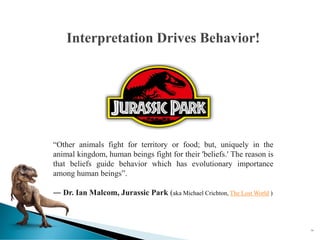
Interpretation Drives Behavior!
“Other animals fight for territory or food; but, uniquely in the
animal kingdom, human beings fight for their 'beliefs.' The reason is
that beliefs guide behavior which has evolutionary importance
among human beings”.
― Dr. Ian Malcom, Jurassic Park (aka Michael Crichton, The Lost World )
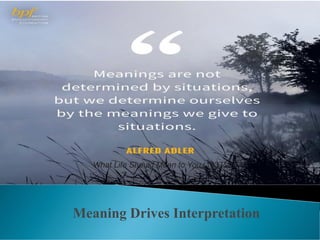
What Life Should Mean to You (1937), p. 14
Meaning Drives Interpretation
77
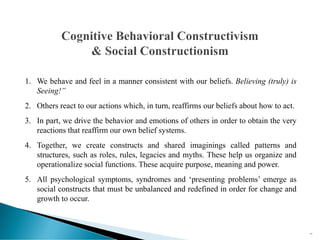
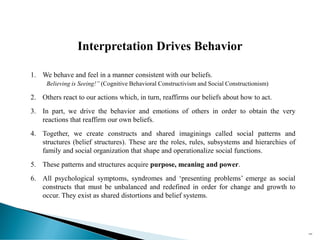
1. We behave and feel in a manner consistent with our beliefs. Believing (truly) is
Seeing!”
2. Others react to our actions which, in turn, reaffirms our beliefs about how to act.
3. In part, we drive the behavior and emotions of others in order to obtain the very
reactions that reaffirm our own belief systems.
4. Together, we create constructs and shared imaginings called patterns and
structures, such as roles, rules, legacies and myths. These help us organize and
operationalize social functions. These acquire purpose, meaning and power.
5. All psychological symptoms, syndromes and ‘presenting problems’ emerge as
social constructs that must be unbalanced and redefined in order for change and
growth to occur.
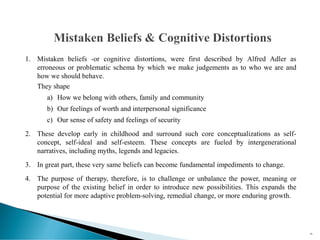
1. Mistaken beliefs -or cognitive distortions, were first described by Alfred Adler as
erroneous or problematic schema by which we make judgements as to who we are and
how we should behave.
They shape
a) How we belong with others, family and community
b) Our feelings of worth and interpersonal significance
c) Our sense of safety and feelings of security
2. These develop early in childhood and surround such core conceptualizations as self-
concept, self-ideal and self-esteem. These concepts are fueled by intergenerational
narratives, including myths, legends and legacies.
3. In great part, these very same beliefs can become fundamental impediments to change.
4. The purpose of therapy, therefore, is to challenge or unbalance the power, meaning or
purpose of the existing belief in order to introduce new possibilities. This expands the
potential for more adaptive problem-solving, remedial change, or more enduring growth.
79
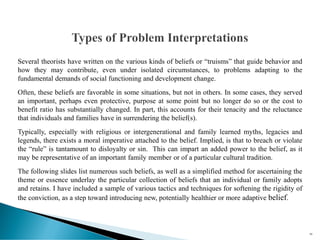
Several theorists have written on the various kinds of beliefs or “truisms” that guide behavior and
how they may contribute, even under isolated circumstances, to problems adapting to the
fundamental demands of social functioning and development change.
Often, these beliefs are favorable in some situations, but not in others. In some cases, they served
an important, perhaps even protective, purpose at some point but no longer do so or the cost to
benefit ratio has substantially changed. In part, this accounts for their tenacity and the reluctance
that individuals and families have in surrendering the belief(s).
Typically, especially with religious or intergenerational and family learned myths, legacies and
legends, there exists a moral imperative attached to the belief. Implied, is that to breach or violate
the “rule” is tantamount to disloyalty or sin. This can impart an added power to the belief, as it
may be representative of an important family member or of a particular cultural tradition.
The following slides list numerous such beliefs, as well as a simplified method for ascertaining the
theme or essence underlay the particular collection of beliefs that an individual or family adopts
and retains. I have included a sample of various tactics and techniques for softening the rigidity of
the conviction, as a step toward introducing new, potentially healthier or more adaptive belief.
80
81
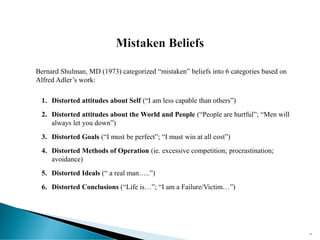
Bernard Shulman, MD (1973) categorized “mistaken” beliefs into 6 categories based on
Alfred Adler’s work:
1. Distorted attitudes about Self (“I am less capable than others”)
2. Distorted attitudes about the World and People (“People are hurtful”; “Men will
always let you down”)
3. Distorted Goals (“I must be perfect”; “I must win at all cost”)
4. Distorted Methods of Operation (ie. excessive competition; procrastination;
avoidance)
5. Distorted Ideals (“ a real man…..”)
6. Distorted Conclusions (“Life is…”; “I am a Failure/Victim…”)
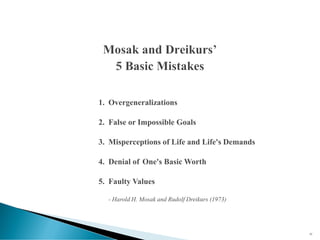
1. Overgeneralizations
2. False or Impossible Goals
3. Misperceptions of Life and Life's Demands
4. Denial of One's Basic Worth
5. Faulty Values
- Harold H. Mosak and Rudolf Dreikurs (1973)
82
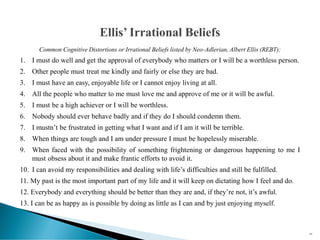
Common Cognitive Distortions or Irrational Beliefs listed by Neo-Adlerian, Albert Ellis (REBT):
1. I must do well and get the approval of everybody who matters or I will be a worthless person.
2. Other people must treat me kindly and fairly or else they are bad.
3. I must have an easy, enjoyable life or I cannot enjoy living at all.
4. All the people who matter to me must love me and approve of me or it will be awful.
5. I must be a high achiever or I will be worthless.
6. Nobody should ever behave badly and if they do I should condemn them.
7. I mustn’t be frustrated in getting what I want and if I am it will be terrible.
8. When things are tough and I am under pressure I must be hopelessly miserable.
9. When faced with the possibility of something frightening or dangerous happening to me I
must obsess about it and make frantic efforts to avoid it.
10. I can avoid my responsibilities and dealing with life’s difficulties and still be fulfilled.
11. My past is the most important part of my life and it will keep on dictating how I feel and do.
12. Everybody and everything should be better than they are and, if they’re not, it’s awful.
13. I can be as happy as is possible by doing as little as I can and by just enjoying myself.
Ellis’ Irrational Beliefs
83
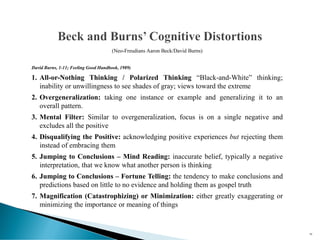
(Neo-Freudians Aaron Beck/David Burns)
David Burns, 1-11; Feeling Good Handbook, 1989)
1. All-or-Nothing Thinking / Polarized Thinking “Black-and-White” thinking;
inability or unwillingness to see shades of gray; views toward the extreme
2. Overgeneralization: taking one instance or example and generalizing it to an
overall pattern.
3. Mental Filter: Similar to overgeneralization, focus is on a single negative and
excludes all the positive
4. Disqualifying the Positive: acknowledging positive experiences but rejecting them
instead of embracing them
5. Jumping to Conclusions – Mind Reading: inaccurate belief, typically a negative
interpretation, that we know what another person is thinking
6. Jumping to Conclusions – Fortune Telling: the tendency to make conclusions and
predictions based on little to no evidence and holding them as gospel truth
7. Magnification (Catastrophizing) or Minimization: either greatly exaggerating or
minimizing the importance or meaning of things
84
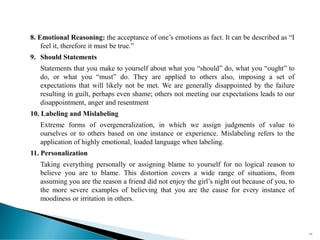
8. Emotional Reasoning: the acceptance of one’s emotions as fact. It can be described as “I
feel it, therefore it must be true.”
9. Should Statements
Statements that you make to yourself about what you “should” do, what you “ought” to
do, or what you “must” do. They are applied to others also, imposing a set of
expectations that will likely not be met. We are generally disappointed by the failure
resulting in guilt, perhaps even shame; others not meeting our expectations leads to our
disappointment, anger and resentment
10. Labeling and Mislabeling
Extreme forms of overgeneralization, in which we assign judgments of value to
ourselves or to others based on one instance or experience. Mislabeling refers to the
application of highly emotional, loaded language when labeling.
11. Personalization
Taking everything personally or assigning blame to yourself for no logical reason to
believe you are to blame. This distortion covers a wide range of situations, from
assuming you are the reason a friend did not enjoy the girl’s night out because of you, to
the more severe examples of believing that you are the cause for every instance of
moodiness or irritation in others.
85
86
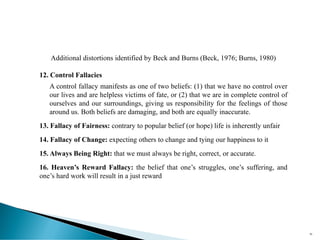
Additional distortions identified by Beck and Burns (Beck, 1976; Burns, 1980)
12. Control Fallacies
A control fallacy manifests as one of two beliefs: (1) that we have no control over
our lives and are helpless victims of fate, or (2) that we are in complete control of
ourselves and our surroundings, giving us responsibility for the feelings of those
around us. Both beliefs are damaging, and both are equally inaccurate.
13. Fallacy of Fairness: contrary to popular belief (or hope) life is inherently unfair
14. Fallacy of Change: expecting others to change and tying our happiness to it
15. Always Being Right: that we must always be right, correct, or accurate.
16. Heaven’s Reward Fallacy: the belief that one’s struggles, one’s suffering, and
one’s hard work will result in a just reward
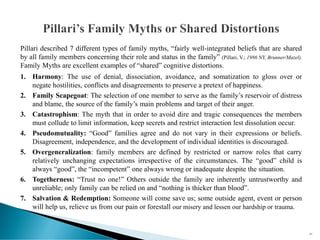
Pillari described 7 different types of family myths, “fairly well-integrated beliefs that are shared
by all family members concerning their role and status in the family” (Pillari, V.; 1986 NY, Brunner/Mazel).
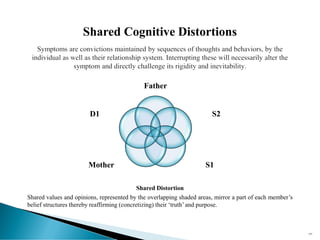
Family Myths are excellent examples of “shared” cognitive distortions.
1. Harmony: The use of denial, dissociation, avoidance, and somatization to gloss over or
negate hostilities, conflicts and disagreements to preserve a pretext of happiness.
2. Family Scapegoat: The selection of one member to serve as the family’s reservoir of distress
and blame, the source of the family’s main problems and target of their anger.
3. Catastrophism: The myth that in order to avoid dire and tragic consequences the members
must collude to limit information, keep secrets and restrict interaction lest dissolution occur.
4. Pseudomutuality: “Good” families agree and do not vary in their expressions or beliefs.
Disagreement, independence, and the development of individual identities is discouraged.
5. Overgeneralization: family members are defined by restricted or narrow roles that carry
relatively unchanging expectations irrespective of the circumstances. The “good” child is
always “good”, the “incompetent” one always wrong or inadequate despite the situation.
6. Togetherness: “Trust no one!” Others outside the family are inherently untrustworthy and
unreliable; only family can be relied on and “nothing is thicker than blood”.
7. Salvation & Redemption: Someone will come save us; some outside agent, event or person
will help us, relieve us from our pain or forestall our misery and lessen our hardship or trauma.
87
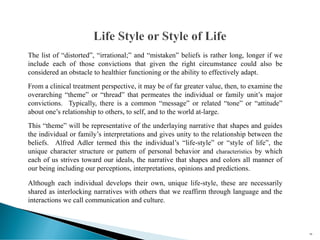
The list of “distorted”, “irrational;” and “mistaken” beliefs is rather long, longer if we
include each of those convictions that given the right circumstance could also be
considered an obstacle to healthier functioning or the ability to effectively adapt.
From a clinical treatment perspective, it may be of far greater value, then, to examine the
overarching “theme” or “thread” that permeates the individual or family unit’s major
convictions. Typically, there is a common “message” or related “tone” or “attitude”
about one’s relationship to others, to self, and to the world at-large.
This “theme” will be representative of the underlaying narrative that shapes and guides
the individual or family’s interpretations and gives unity to the relationship between the
beliefs. Alfred Adler termed this the individual’s “life-style” or “style of life”, the
unique character structure or pattern of personal behavior and characteristics by which
each of us strives toward our ideals, the narrative that shapes and colors all manner of
our being including our perceptions, interpretations, opinions and predictions.
Although each individual develops their own, unique life-style, these are necessarily
shared as interlocking narratives with others that we reaffirm through language and the
interactions we call communication and culture.
88
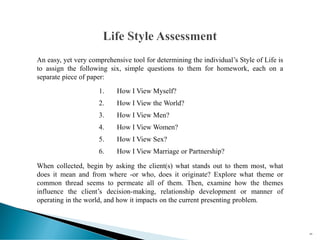
An easy, yet very comprehensive tool for determining the individual’s Style of Life is
to assign the following six, simple questions to them for homework, each on a
separate piece of paper:
1. How I View Myself?
2. How I View the World?
3. How I View Men?
4. How I View Women?
5. How I View Sex?
6. How I View Marriage or Partnership?
When collected, begin by asking the client(s) what stands out to them most, what
does it mean and from where -or who, does it originate? Explore what theme or
common thread seems to permeate all of them. Then, examine how the themes
influence the client’s decision-making, relationship development or manner of
operating in the world, and how it impacts on the current presenting problem.
89
90
▪ Challenge the beliefs, patterns or sequences of interaction surrounding the
Presenting Problem and introduce new possibilities.
▪ This will modify the rigidity of the symptom and alter its inevitability.
Unbalancing the World View
1. Look for rigidity and inflexibility in rules, expectations and outlook
2. Look for conflict (guilt and shame) created between ideal and actual performance
3. Look for extremes such as “Must” and “Should”, “Never” and “Always”
✓ Trace it in the family lineage (genogram); ie “Whose rule is that?”
✓ Examine Pluses and Minuses to broaden narrow perspectives
✓ Examine how it is used to reaffirm convictions that preserve one’s sense of self,
self-esteem or loyalty to family
✓ Examine what “breaking” the rule means and how that justifies retaining the
conviction
✓ Examine the purpose of the conviction or the benefit its conflict, shame or guilt
provides. Often, while negative, suffering can entail a sense of “nobility”
91
92
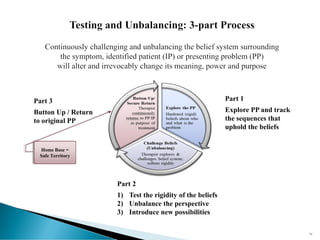
Part 3
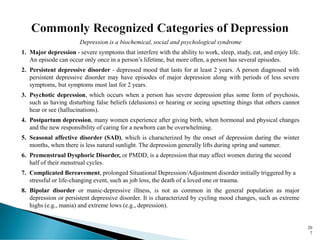
Button Up / Return
to original PP
Part 1
Explore PP and track
the sequences that
uphold the beliefs
Part 2
1) Test the rigidity of the beliefs
2) Unbalance the perspective
3) Introduce new possibilities
Home Base =
Safe Territory
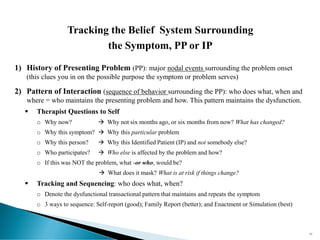
Tracking the Belief System Surrounding
the Symptom, PP or IP
1) History of Presenting Problem (PP): major nodal events surrounding the problem onset
(this clues you in on the possible purpose the symptom or problem serves)
2) Pattern of Interaction (sequence of behavior surrounding the PP): who does what, when and
where = who maintains the presenting problem and how. This pattern maintains the dysfunction.
▪ Therapist Questions to Self
o Why now? → Why not six months ago, or six months from now? What has changed?
o Why this symptom? → Why this particular problem
o Why this person? → Why this Identified Patient (IP) and not somebody else?
o Who participates? → Who else is affected by the problem and how?
o If this was NOT the problem, what -or who, would be?
→ What does it mask? What is at risk if things change?
▪ Tracking and Sequencing: who does what, when?
o Denote the dysfunctional transactional pattern that maintains and repeats the symptom
o 3 ways to sequence: Self-report (good); Family Report (better); and Enactment or Simulation (best)
93
Challenge the family or individual’s way of being, a) the purpose of their
beliefs, b) the ideas they attach to their problems or symptom(s) and c) the
manner in which they interact and are organized
“The beliefs, myths, ideas, attitudes, rules, and object projections that
underlie the problem behaviors and perceptions of the problem within the
system give purpose to the behavior.
Within this internal framework of logic, the behavior both makes sense
and is useful. The beliefs include goals to be attained that are anticipated,
consciously or unconsciously, to yield either satisfaction and growth
through connection, cooperation, and assertion, or greater safety through
aggression, manipulation, or avoidance.
The behavior constitutes the line of movement toward those goals.”
- Robert Sherman (1991)
95
97
“Psychotherapy (psychological therapy or talking therapy) is the use of psychological
methods, particularly when based on regular personal interaction, to help a person change
behavior and overcome problems in desired ways.” - Wikipedia
Changing beliefs especially those crafted by fear or built on safe-guarding behavior can be
difficult even when the outcome or goal is desired. Powerful motivators, such as influence and
prestige or loyalty to friends and family further complicate change, a process described by
many but well summarized by the 5 stages of the transtheoretical model (TTM), originally
proposed by Prochaska and Velicer (1997):
1. Precontemplation (Not yet acknowledging a problem behavior needs to be changed) ƒ
2. Contemplation (Acknowledging a problem yet not ready or sure of wanting to change) ƒ
3. Preparation/Determination (Getting ready to change) ƒ
4. Action/Willpower (Changing behavior); and ƒ
5. Maintenance (Maintaining the behavior change) or Relapse (Returning to older behaviors
and abandoning the new changes)
98
Naturally, ideas regarding the Presenting Problem and the Identified Patient (IP) can be
particularly tenacious. They are very engrained, closed loops of communication and interaction
that solidify as habit and continually repeat, gaining history, meaning, and power. Tracking the
sequences of activity that surround its recurrence provides clarity as to who participates and
how. This transactional loop serves as a nexus for each of its participants; this maintains the
problem and provides a vehicle for shared communication and purpose.
Several direct and indirect methods for “unbalancing” and manipulating beliefs are listed in the
following slides, although these represent but a portion of those recognized in the literature.
“Unbalancing” is exactly as the term implies, it is a technique by which the counselor introduces
doubt, alternative explanations and new possibilities in order to shift the client’s belief or have
them behave in a different way. They have been grouped, here, according to three distinct target
areas although most are interchangeable depending on the line of inquiry or action:

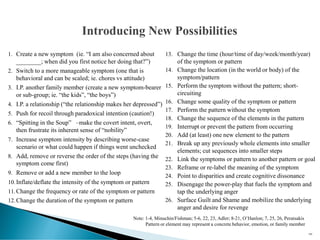
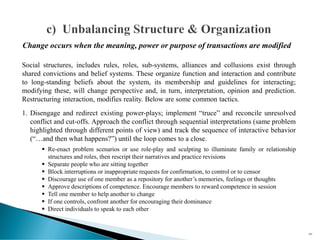
1. Unbalancing the meaning, purpose or power of the belief, itself;
2. Unbalancing the beliefs surrounding the presenting problem or symptom or disrupting the
sequence of behaviors and interactions that maintain it; and
3. Unbalancing interactional structures and shared beliefs such as roles, rules, and ways of
being organized that preserve the status quo and restrict a more adaptive response.
Change occurs when the meaning, power or purpose of a belief is modified
1. The most common method for countering negative, self-limiting and counter-productive thoughts is to
use Critical Reasoning or a process known as Cognitive Restructuring (Doyle, 1998; Hope, 2010) to
“unbalance” and redefine the belief structure. There are four generally recognized steps:
a) Identify problematic images or mental activity that occur as a response to some trigger, like an
action or event. These "automatic thoughts" (ATs) convey negative assumptions and predictions
about the self, others, the world and ways to belong and function socially;
b) Isolate the distorted, irrational, or mistaken assumption that underlies the automatic thought;
c) Use a Socratic dialogue (through interviewing, role-play or imagery) to introduce doubt, pose new
possibilities, and undermine or attack its underlying logic (“unbalancing”). Examples include,
▪ Examine the Pros and Cons; assess the negative consequences and scale or assess its cost
▪ Weaken a strongly held belief by pitting it against an equally strong opposite belief
▪ Point to disparities and logical inconsistencies, especially between beliefs or values
▪ Inflate, exaggerate or dramatize the belief to make it extreme, trivial or silly
▪ Create or reframe a narrative or story that puts the situation in a more favorable context (reframing)
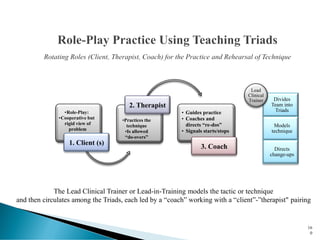
▪ Examine the family rule or “voice” behind the assumption and attend to the loyalty issues
▪ Use of the “Miracle Question”, Time Travel or Time-outs to imagine and explore freedom from AT
d) Develop, reframe or re-narrate a rational rebuttal to the automatic thought
99
2. Thought Stopping: short-circuiting negative ideation; Self-Talk: positive self-affirmation
3. “Spitting in the Soup”: undermine the narrative by interpreting the motive or making its covert
intent, overt, then frustrate its inherent sense of “nobility” or personal gain
4. What if this wasn’t so? Explore a scenario in which the idea was no longer true or applicable.
Explore “worse-case” scenarios; “What’s the worst thing that would happen if…?”
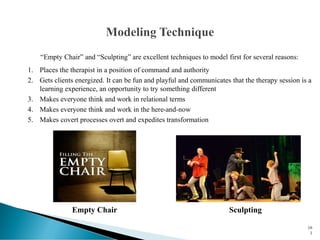
5. Empty Chair: externalize the belief as an opponent or “demon”, then encourage rebellion
against it
6. Use imagery, visualization, role-play, sculpting, drawing or other projective techniques to gain
perspective, elongate the narrative or directly manipulate some part of it
7. Use free association, analysis of dreams, early recollections, or fantasy exercises to undermine
the power of the belief or myth or to foster imagery-based exposure
8. Mindfulness meditation, relaxed breathing, yoga or progressive relaxation to reduce
fragmentation and anxiety, still panic, integrate body and mind and improve focus
9. Activity Scheduling to intentionally experience activities typically avoided
10. Graded Exposure or desensitization to feared or toxic experience, increasing comfort
11. Successive Approximation or breaking large steps into smaller ones
12. Journaling or thought record of moods and/or thoughts, especially noting the time, the extent
of the mood or thought, and what led to it
13. Skills Training (ie. assertiveness, communication, social skills) designed to remedy skills
deficits through modeling, coaching and direct instruction, and role-play training
14. Flagging the Minefield ((Sklare, 2005) or anticipating and preparing for relapse and pitfalls
100
It is important to continually test the rigidity of the beliefs surrounding the Presenting
Problem and the Identified Patient. Introducing new possibilities, reframing and
resequencing existing interactional patterns or re-organizing roles, rules and organizational
structures or patterns increases flexibility and expands the client’s perspective and ability
to interpret -and then respond, in a different way.
1) History of Presenting Problem (PP): major nodal events surrounding the problem
onset, including trauma, betrayals, losses, anniversary dates and major transitional
events such as retirement, divorce, graduations or beginning school, leaving home, et
al. The difficulties adapting to change, hardships or periods of heightened stress often
foster the creation of problematic or symptomatic behavior patterns. The symptom
onset often clues you in on the possible purpose the symptom or problem serves.
2) Pattern of Interaction This refers to the sequence of behavior surrounding the
Presenting Problem or problem occurrence (who does what, when and where). This
repetitive, interactional loop maintains the presenting problem and highlights who
participates in maintaining it. Manipulating its components, introduces new
possibilities and fosters a revised perspective on the problem, its etiology and purpose.
b) Unbalancing the Symptom
101
Change occurs when the meaning, power or purpose of the P.P. is modified
102
1. Behaviors, feelings and thoughts surrounding the presenting problem (PP)
or symptom harden over time becoming interactional patterns that acquire
history with well-defined roles and rules and expectations.
2. In essence, a pattern or “structure” around which communication and
membership is organized, boundaries defined, and power expressed and
reconciled.
3. In particular, the emerging pattern fulfills the mutual purposes of its
participants, providing a vehicle for communication and attachment and the
open expression of love, anger, trust, and responsibility.
4. Underlying this, we often find a prolonged and deeply embedded power-
struggle, fueled by concomitant feelings of hopelessness, resentment and
rage. It is often passive-aggressive.
How Psychological Symptoms Form
103
Shared Distortion
Shared values and opinions, represented by the overlapping shaded areas, mirror a part of each member’s
belief structures thereby reaffirming (concretizing) their ‘truth’and purpose.
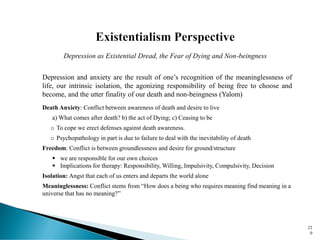
Shared Cognitive Distortions
Father
S2
S1Mother
D1
1. Create a new symptom (ie. “I am also concerned about
________; when did you first notice her doing that?”)
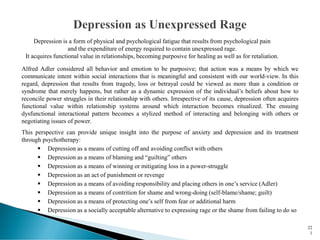
2. Switch to a more manageable symptom (one that is
behavioral and can be scaled; ie. chores vs attitude)
3. I.P. another family member (create a new symptom-bearer
or sub-group; ie. “the kids”, “the boys”)
4. I.P. a relationship (“the relationship makes her depressed”)
5. Push for recoil through paradoxical intention (caution!)
6. “Spitting in the Soup” –make the covert intent, overt,
then frustrate its inherent sense of “nobility”
7. Increase symptom intensity by describing worse-case
scenario or what could happen if things went unchecked
8. Add, remove or reverse the order of the steps (having the
symptom come first)
9. Remove or add a new member to the loop
10.Inflate/deflate the intensity of the symptom or pattern
11.Change the frequency or rate of the symptom or pattern
12.Change the duration of the symptom or pattern
13. Change the time (hour/time of day/week/month/year)
of the symptom or pattern
14. Change the location (in the world or body) of the
symptom/pattern
15. Perform the symptom without the pattern; short-
circuiting
16. Change some quality of the symptom or pattern
17. Perform the pattern without the symptom
18. Change the sequence of the elements in the pattern
19. Interrupt or prevent the pattern from occurring
20. Add (at least) one new element to the pattern
21. Break up any previously whole elements into smaller
elements; cut sequences into smaller steps
22. Link the symptoms or pattern to another pattern or goal
23. Reframe or re-label the meaning of the symptom
24. Point to disparities and create cognitive dissonance
25. Disengage the power-play that fuels the symptom and
tap the underlying anger
26. Surface Guilt and Shame and mobilize the underlying
anger and desire for revenge
Note: 1-4, Minuchin/Fishman; 5-6, 22, 23, Adler; 8-21, O’Hanlon; 7, 25, 26, Peratsakis
Pattern or element may represent a concrete behavior, emotion, or family member
Introducing New Possibilities
104
Social structures, includes rules, roles, sub-systems, alliances and collusions exist through
shared convictions and belief systems. These organize function and interaction and contribute
to long-standing beliefs about the system, its membership and guidelines for interacting;
modifying these, will change perspective and, in turn, interpretation, opinion and prediction.
Restructuring interaction, modifies reality. Below are some common tactics.
1. Disengage and redirect existing power-plays; implement “truce” and reconcile unresolved
conflict and cut-offs. Approach the conflict through sequential interpretations (same problem
highlighted through different points of view) and track the sequence of interactive behavior
(“…and then what happens?”) until the loop comes to a close.
▪ Re-enact problem scenarios or use role-play and sculpting to illuminate family or relationship
structures and roles, then rescript their narratives and practice revisions
▪ Separate people who are sitting together
▪ Block interruptions or inappropriate requests for confirmation, to control or to censor
▪ Discourage use of one member as a repository for another’s memories, feelings or thoughts
▪ Approve descriptions of competence. Encourage members to reward competence in session
▪ Tell one member to help another to change
▪ If one controls, confront another for encouraging their dominance
▪ Direct individuals to speak to each other
105
Change occurs when the meaning, power or purpose of transactions are modified
2. Use of ‘empty chair’ to represent absent members, hidden rules, secrets or taboos;
manipulate and use space, to connect and disconnect, to show closeness or distance; use
props and furniture (concrete reminders) to illustrate relational components
3. Unbalance alliances, coalitions and collusions; fashion new ones, or temporarily join a
subsystem, to adjust the balance of power and improve communication patterns
4. Establish, strengthen, or weaken boundaries; empower the executive sub-system
5. I-Messages; increase differentiation of self, personal space and independence of
members
6. Block inappropriate roles or role behavior; model appropriate behavior. Prescribe role
reversals; revise roles, strengthen existing natural roles, or assign new ones
7. Temporarily shift power and authority structure: Queen for a Day; King of the Castle
8. Provide more structure in a chaotic organization; reduce rigidity in an inflexible structure
9. Take a “one-down” position to force the client or family into the “one-up”
10. Create celebrations, honorifics or exorcisms to modify, up or down, the power
surrounding a member; introduce new customs, rituals, practices or ordeals
11. Hold an exorcism or funerary rite for the old belief, family myth or legend; create a ritual
or assignment to be practiced that mirrors the new belief. Create a new point in time
(“then” versus” from here forward”) or establish a “truce” for moving forward
106
12. Use of a Genogram, Socio-map or Family Floor Plan to examine truisms and taboos
13. Establish a Family Council so that grievances and supports can be materialized
14. Spread out a symptomatic role among all family members to expose the family secret or
remove or rotate the symptomatic member from the scapegoat position
15. Introduce other clients or families to session and foster interfamilial organization
16. Time-travel or regrow the client or family from scratch and have them “act as if” they are
the person or persons they wish to be
17. Use Behavior Rehearsal; “Acting As If”; Guided Imagery; and Fantasy techniques to work
on self-empowerment and explore fears and dreads to success and failure
18. Work through issues of Guilt, Anger and Shame (GASh); focus on desires and acts of
revenge and move toward acts of forgiveness and redemption
19. Connect with each member and affirm their value; create Caring Days,
20. Identify and validate strengths; encourage recognition by the family of each other through
celebrations, boasting, awards and acts of praise. Promote “New Talk”
21. Refer clients to additional educational materials and resources, experts and trainers
22. Assign tasks and functions based on abilities. “What is she good at?”
23. Help members with assertiveness and improve mediation and negotiation skills. Curtail
acts of aggression, back-biting, complaining, rivalry, subterfuge and revenge
107
24. Identify choices and make joint decisions. “Doom” clients to success by setting small,
common workable goals and anticipating obstacles, sabotage and possible failure
25. Identify and emphasize positive changes and movement; examine what worked
26. Reframe negative meanings and negatively charged events
27. Recall incidents that worked successfully in the past or solutions from TV, Movies or
others
28. Increase self-esteem, personal worth and mutual respect and valuation; connect in a
meaningful way. Improve self-image through boasting and self-esteem worksheets
29. Challenge underlying “nobility” of self-defeating behaviors (“Spitting in Client’s Soup”)
30. Use paradox (with caution) to prescribe existing roles, rules, and patterns of interaction
31. Add or detract family members from session
32. Bring other families into session and pair subsystems, foster interfamily competitions or
use members in similar roles as co-therapists
33. Place the symptom on vacation or write a prescription to schedule it at given times
34. Have the clients experience each other in a different, fun, way or varied venue
35. Explore what each member is willing to do to alleviate the current problem, change the
rule, alter the belief, or help create, through a change in their own behavior, a new
interactional paradigm
108
36. Use of the Therapeutic Alliance to foster change. Few components of the therapy
process are as potentially transformational as the relationship that, clients have with the
therapist. By continuously demonstrating acceptance and positive regard, active
listening, and support and encouragement, the therapist provides a safe milieu for the
experimentation and trial of new ways of thinking and behaving. Moreover, a seasoned
therapist may use their own way of being, their own style of interacting with the client
to both frustrate and promote behavior change. Even by simply responding in a manner
that is different then what is expected -or routinely experienced with others, the
therapist has created the opportunity for change. Finding a balance between support
and confrontation, at times even provocation, is an important attribute of the
experienced therapist. So, too, is the ability to disengage and redirect the power-
struggles that arise between the therapist and client and that are common to the
therapeutic relationship. In this regard, the greatest agent of change is often the
clinician, themselves.
109
The single most important element to the change process.
11
3
Ordering work through encouragement and exploration
Prescribing or assigning tasks provide practice in new ways of thinking and behaving.
It includes simple tasks or assignments as well as complex sequences of
behavioral interactions designed to foster change, such as
1. Enactment/Re-enactments: repeating a pattern/with modifications
2. Ordeals: patterns designed to be burdensome, and
3. Rituals or Ceremonies: patterns meant to be transformational
In this regard, therapy is nothing more than a long series of creating
deliberate opportunities for change!
11
5
3 Simple Steps
STEP # 1: Give Task
1) Assume Authority & Expertise
▪ All Clients are a “Forced Referral”: therapy must assure safety while pushing for
experimentation and change
▪ Normalize Experience: “…we see this all the time”; “Most kids…”
▪ Never Ask Permission rule
2) Direct with Simple Commands
▪ Keep Directives Behavioral; ie “Talk to her”; “Get up and go sit next to him”;
“Get them to behave”
▪ Use Simple Intros to more complex tasks: “Let’s try something…”; “Most/Some
people find this helpful…”; “Let’s do an experiment”; “I’m going to have you
do something that may be very difficult/uncomfortable… ” “What if, we do
this…”.
▪ Homework is Failure Prone: script it; make behavior independent of others;
predict difficulty or failure
11
6
STEP # 2: Stay on Task!
▪ Do NOT Rescue! -Always redirect back to task
GOLDEN RULE: “ALWAYS Interrupt When Work is NOT Being Done;
NEVER Interrupt When Work IS Being Done!”
▪ Push-back is to be Expected, but NOT Accepted
Work through power-struggles and challenges to the therapeutic alliance:
1) Fear
a) Anxiety or Angst: comfort the fear and encourage them back to task (“This is very
hard”; “Let’s slow down and try again”)
b) Morbid Dread: push; if task cannot be completed, focus on the fear: “What is the
worse that would happen?”; “What’s happening now?” “If you could do it…”
2) Power-play: Natural and routine to the Therapeutic Alliance; Dis-arm, dis-engage
and redirect the power-play. Address resentment and anger
11
7
STEP # 3: Button-Up!
1) Stop: “Let’s stop” or “Hold up, that’s enough hard work for now…”
-add hand gestures as signals
2) Explore:
▪ “Was that worse than you thought it would be?”
▪ “That was tough work, what should we do different next time?”
▪ If the task was not completed
o “That was very hard; what was going on for you while you were trying it?”
o “That was very hard; tell me, what do you think would have happened if
you could have done it?” “What’s the worse thing that might have
happened?”
11
8
STEP # 3: Button-Up!
3) Do a Temperature Check
Examine therapeutic alliance for possible back-lash, anger, resentment or fear:
“I pushed you pretty hard, how upset with me are you?”
1. Predict residual anger; “If it turns out that you are angry would you agree to
come back just 1 more time?”
2. Predict “relapse” or back-sliding due to difficulty of change
4) Optional: Assign homework
▪ Must be “safe” and do-able in behavioral terms
▪ Must anticipate failure or sabotage; exaggerate it’s difficulty and predict what could go
wrong
▪ Client must be free to abandon task, unless it a “test” of client’s motivation for change
11
9
1. Conflict with the therapist is a common component of therapy
2. It is often expressed as an overt or covert power play
3. Unraveling it is important as it mirrors conflict with others
4. Disengaging and redirecting the power plays is central to problem-solving,
as well as to a healthier and more trusting therapeutic alliance.
12
0
The following four slides show various ways that individuals, couples and families
endeavor to exert their control over the therapy and the therapeutic alliance.
When clients are legitimately attempting to comply with the terms of treatment and do not,
it is important to keep in mind that legitimate factors may be impeding their cooperation.
This can range from childcare and transportation issues, to second-guessing the competency of
the therapist, to ambivalence about the goal or reason for seeking treatment or
fear or anxiety about certain tasks or portions of therapy.
At other times, it is simply an issue of power and control.
The simple rule is that with the former, you experience compassion
and concern, with the latter you feel resentful and annoyed.
Any refusal to be cooperative must be contended with prior to moving forward.
Indeed, the therapist’s agreement to move forward, to continue past this challenge,
is the single greatest expression of their own power and should not be squandered.
12
1
1. Not talking
2. Not following advice or
suggestions
3. Non-disclosure [Selective
disclosure] or not answering
questions
4. Taking notes or recording sessions
5. Coming late or leaving sessions
early
6. Non-payment/Non-compliance
with Required releases and
Paperwork
7. Stalking, Threatening, or
Intimidating
8. Provocative or threatening clothing
9. Change seating or other office
arrangements
10. Provocative or threatening language
11. Use of language
12. Belligerence and Rage
13. Dominating the conversation
14. Inappropriate touching, hugging, etc
15. Inappropriate gifts
16. Inappropriate or offering incentives
17. Acting seductively, coy or unduly
vulnerable
12
2
1-17: “Client Expressions of Power in the Therapeutic Alliance” -by Ofer Zur, P.D.
1. Sets appointment, cancels/no-shows; sets appointment, cancels/no-shows
▪ Declare them not ready! Inform them that they are not ready and advise them to try later. If they
persist, ascribe an overt message to any next cancellation: “I am not convinced its a good time, but
I’m willing to set another appointment so long as we agree that if, for whatever reason, you are
unable to keep it we will simply understand that as your way of saying “this is NOT a good time”.
▪ Pronounce them cured! Tongue-in-cheek: congratulate them on what they are doing and advise
them to continue to do more of it. Inform them that if things worsen then to contact you or the
agency.
2. Key member/partner sets appointment, other key member refuses to attend
It is common for one member to be more motivated to attend treatment. Reasons include:
▪ beliefs about the value of treatment or cultural morays about seeking help;
▪ desire to refuse or punish the partner or family spokesperson;
▪ fear of being attacked at session;
▪ viewing the therapist as the another’s/partner’s choice or advocate;
▪ concern that things could worsen;
▪ the invitation to attend was poorly given; and
▪ appropriate concerns and barriers such as child-care, loss of work, etc.
12
3
2. Key member/partner sets appointment, other key member refuses to attend (continued)
Hidden Agenda At times, the initiator has a hidden agenda and desires to attend treatment on their own.
Typically, it is about leaving the partner and wishing to utilize the treatment process as a way to collude with
the therapist or sway the treatment outcome.
To Begin or Not? The therapist must decide whether to begin without key individuals and whether doing so
will encourage the absence; in particular, this is a dilemma in couple therapy:
▪ an “empty chair” could be brought in as a proxy for the absent member
▪ the agenda could be highly restricted to work that does NOT include the missing member
▪ absence should be given an overt meaning, a statement, possibly of intent: “her absence means she’s
unsure about this”
▪ treatment should begin with strategies for inviting the partner or key member to attend. If/when the
missing member or partner attends the therapist should explore concerns about bias and establish a new
starting point.
3. One sets appointment, then sabotages another’s participation
▪ garner support from the therapist in advance
▪ prepare to escape the relationship
▪ dump some major information about the relationship that has been held secret from the partner or family
4. Both attend, one sees a problem, one does not
▪ The temptation for the therapist may be to take sides, especially with the “yes, there is a problem”
viewpoint
This is a Trap! Both must be fully invested either in agreeing to a common issue or that the issue pushed
by one partner has sufficient concern or angst to the partner that investing in its resolution is of value.
▪ Let them struggle (Do NOT take sides!)
▪ Have partner worsen their problem until their partner agrees to work
12
4
5. Both attend, both agree that one partner is the problem or “Identified Patient” (IP)
This is an acceptable starting point. The couple sees and agrees that one is the cause of all their ills or it may
be a bona fide individual crisis, such as the partner having recently suffered a great loss. The therapist begins
with the Presenting Problem and begins to point to relational elements, thereby broadening the issue to the
dyad. If a crisis, the partner’s support is invaluable to the process of healing; if a chronic concern, then the
therapist can begin to explore the burden and frustrations (anger/resentment) the partner holds for the
Identified patient (IP). This is an acceptable starting point, whether Crisis or Chronic
▪ Crisis: get partner’s support
▪ Chronic; get partner’s support, then point to relational burdens and resentments
6. Both attend, agenda moves to Individual Counseling (I/C) or child focus (F/C)
▪ It’s possible the therapist moved too fast.
▪ Has the Therapist moved too fast?
▪ Has a bona fide crisis occurred?
7. Both attend, one begins to No-show (leaving therapist with partner/spouse)
▪ Hidden Agenda?
▪ Has the Therapist alienated the partner?
▪ Has the attendee sabotaged the partner’s attendance?
8. Both attend, one drops a “bomb” (ie. sexual affair, drug abuse, major illness)
a) Consider it a Marital Crisis→ can the couple continue?
b) Consider a “structured separation”
12
5
9. Both attend, one discloses their desire to separate or divorce
a) Consider it a Marital Crisis → can the couple continue?
b) Consider a “structured separation”
c) Th. can help work toward separation and divorce
d) Th. should be prepared to continue with abandoned partner
10. Both attend, one or both unclear on separate or remain together
a) Not uncommon (couple should be told so)
b) Explore how to decide: work toward one extreme or the other
11. Both attend, one or both continually triangulate the therapist
a) Point out and examine purpose
b) Sit further from couple, take turns, add co-therapist (examine issue in clinical supervision)
12. Shot-gunning/Carpet-bombing: Both attend, bombard the therapist with multiple
problems or crises; agenda/goal continually changes `or vacillates
a) Keeps the therapy off-balance (means of controlling)
b) Explore couple’s difficulty prioritizing/committing to one item or goal
12
6
Taking a “One-down” Position and Reaffirming the Working Alliance
1. Understanding the nature of power and its integral relation to our
social interactions is the key to mediating power-plays and remedying
conflict.
2. Power, is influence and control within the relationship system. It is the
ability to influence outcome, the manifest expression of our will.
3. In this regard, it is never random but purposive and consistent with our
self-concept and worldview.
4. It colors our beliefs, opinions, interests and desires and can best be
understood through our behavior and the intended goal of our action.
12
8
Examine the Intent of the Power Struggle
▪ Does the client need to control others in order to feel more worthwhile or superior?
▪ Is the client angry or upset with the therapist?
▪ Is the client second-guessing the utility or effectiveness of treatment?
▪ Has the therapist behaved in a manner that is suspect or that has damaged the trust?
▪ Does the therapist misuse their power and belittle, shame, or induce guilt in the
client, especially by moralizing, lecturing or assuming a haughty or “parental”
attitude?
▪ Is the client frightened, contending with mistrust from prior emotional trauma and
psychological injury?
▪ Is the client worried or freighted about the potential consequences of change?
12
9
Disengaging and Redirecting
▪ Stop the process and ask directly about the issue. “I think I may have stepped
on your toes a bit, are we going to be okay?……..”
▪ Take a 1-down: “I’m not sure where we are; how should we proceed?”; “I’m a
bit lost, where should we go from here?”
▪ Point to the ambivalence: “I’m getting some mixed messages; should we move
forward or not; is this worth trying to change?”
▪ Seek permission to power-play: “My role is to push you in ways that will be
uncomfortable. That may be more than you bargained for but otherwise we
may waste a lot of time and not get as much done”.
“Would you rather I annoy you or waste your time?”
13
0
“ …if the therapist doesn’t change, then the patient doesn’t, either”
-Carl Jung
13
2
Therapy allows for the continuous possibility of a genuine,
human-to-human encounter.
As the counselor develops greater “therapeutic relational competence”
(Watchel, 2008), their power as an agent for change matures and grows.
In this manner, both therapist and client grow through authentic
encounter with each other (Connell et al.,1999; Napiers & Whitaker, 1978)
General Rules of Therapy
▪ Psychotherapy is the art of encouraging practice in new ways of being.
▪ The difference between counseling and psychotherapy is the degree to which you are
willing to accept personal responsibility for change.
▪ When you begin to view each of your actions as either therapeutic -or counter-
therapeutic, your work becomes nothing short of remarkable.
▪ Clients come to therapy not because they desire change, but because they failed to
accommodate to change.
▪ Trauma, is the psychological injury to one’s feelings of self-worth, an estimation of
personal value inextricably tied to others. It results in depression and anxiety, which are
fueled by Guilt, Anger and Shame (GASh).
▪ Symptoms can serve as an effective means of avoiding responsibility for change.
▪ Never interrupt when work is being done; always interrupt when work is not being done.
▪ Assigning homework can pose untenable risk; if the problem could be safely handled
outside of session, there’d be no need to be discussing inside of session!
▪ Nothing impedes therapy more than the therapist’s own fears.
13
3
▪ Contracting, is the most sophisticated portion of the therapy process. It requires
continuous refinement of the goal of therapy and a continual re-evaluation of one’s
investment for change.
▪ You can only control what you agree to do or not do. That is the source of power.
▪ Therapists fail by agreeing to conditions that reduce their effectiveness to help:
o Never accept secrets
o Never parent children -unless you are planning to adopt them
o Never ask permission -unless you are willing to accept a “No”
o Never exclude members necessary for change
o Never work harder than your client
o Never proceed until conditions are acceptable
▪ Despite what is said, believe what one does (and does not do). Help match words
with behavior and both with intent.
▪ Make the covert, overt, especially when behavior is passive-aggressive.
▪ Misery conceals its true goal of “nobility”.
▪ Depression can be a highly effective form of coercion; suicide, an even greater one.
13
4
▪ A problem is the result of a power-play, real or symbolic, between the individual and
others, the individual and society, the individual and themselves. The role of
psychotherapy is to disengage and redirect the power-play (Robert Sherman)
▪ All problems are relational, as is their cure.
▪ The single greatest agent of change, is the “therapeutic alliance”.
▪ Sit within arm’s reach of the client.
▪ How therapy ends is more important than how it begins.
▪ If you are not actively discouraging, you are passively encouraging.
▪ Every client is a forced referral.
▪ Symptoms are highly effective strategies for avoiding change. To change the symptom,
challenge its power; to challenge its power, change its reality.
▪ Ghosts need to be exorcised. The dead, can be especially demanding.
▪ Change the symptom to change the structure; change the structure to change the
symptom. Change both, and you change the system.
▪ Betrayal, demands revenge. Punishment and restitution are the salve that reconcile the
path toward forgiveness and redemption.
13
5
▪ Psychotherapy is an isomorphic process; the clinician, client and supervisor are each
transformed as therapy triggers the pain of their respective lives.
▪ The client’s behavior is intended to suppress their pain; challenge the distracting
behaviors and the pain will emerge for healing.
▪ True intimacy provides a mirror onto one’s self; this is the reason that those who feel
unworthy, fear it.
▪ The response to our behavior by others is intentional; it allows others to reaffirm our own
beliefs about ourselves and how we are to behave. These “shared imaginings” are the root
of our social identity and the reason we retain such preferred ways of interacting.
▪ The best clinicians are willing to immerse themselves in the pain, rage, or insanity of
another.
▪ When all else fails
a. prescribe the symptom
b. invite a consultant or co-therapist to session
c. add or subtract a member to session
d. convert the client to a therapist
e. pronounce the client cured
13
6
Recommended Format for Continuous Skill Development
In Counseling and Psychotherapy
Each Group Runs 2 Hours
Group Case Supervision for Continuous Skill Development
“The Team Case Supervision Model is a small-group learning experience for continuous skill
development in counseling and psychotherapy. It’s structure promotes critical reasoning and
provides a superior method for case conceptualization and practice.
The traditional model of group supervision often spot-lights the presenter and leaves them
feeling overwhelmed by the suggestions of others. The Team Case Supervision Model shifts the
group’s focus by challenging each of the group member on how they might handle some aspect
of the case, introduce a particular topic, or approach a specific technique. By meeting as a group,
the participants learn from one another’s case work and improve their clinical practice through
role-play and re-enactment. The facilitator models technique, demonstrates alternative
approaches, and coaches the members on how to refine their verbal and behavioral interventions.
The group process targets three interconnected parts of the counseling process: 1) case
conceptualization; 2) treatment planning and strategy; and 3) interventive tactics and techniques.
The genogram is required for all case presentations. It provides the group with a common point
of reference, places the client(s) in a relational context, highlights patterns and trends, and
benchmarks important dates and nodal events.
As confidence in shared consultation grows, more complex forms of clinical practice become
more practicable, including peer consultation, co-therapy, team-therapy, and live-supervision”.
- Demetrios Peratsakis, MSEd, SDSAS, LPC, ACS
14
1
1. Genogram
The use of the genogram as a common diagnostic tool and point of reference
(Assessment and Case Conceptualization Skills)
2. Socratic Dialogue/Small Group Questioning; 8-12 Clinicians
The use of a structured group or team experience to explore and recommend
treatment strategies (Treatment Planning). Ideally, group members meet in a
circle facing a white board or easel pad.
3. Role-Play
The use of role play and re-enactment to practice and refine clinical skills
(Coaching and Modeling Intervention and Technique)
14
2
Genograms are a required for case presentation, assessment and case conceptualization
1. Genograms provide a common assessment tool for case studies and supervision
2. Members learn from each other’s casework, including assessment, treatment planning, methods of
intervention and special topic areas, such as depression, paraphilia or work with couples.
3. Genograms place the client(s) in a relational context and promotes thinking in systemic terms
4. Genograms take the focus off the Presenter and makes the supervision process collaborative
5. Genograms point to client foundation beliefs about roles, rules, gender, familial trends and characteristics
14
3
1. Team Supervision is a “structured” group experience that brainstorms treatment options. Members are
restricted from advising one another; instead, each member is challenged as to how they would handle the
case or some particular aspect of it and why. Common challenges include: “You’ve taken over this case and
they’ve arrived for their next appointment. Tell us what you will do and why? And then what? And then?” “If
you had 3 sessions left, describe what you would do, session by session.” “If you could get anyone to attend
who would you want in session and why?” “Describe the perfect “cure” that you would prescribe!”
2. Members brainstorm and problem-solve case solutions. This generates new perspectives for the Presenter,
promotes critical thinking by each member, and encourages group learning and peer cohesion.
3. Case collaboration promotes co-therapy, team-therapy, in-session consultation, and peer supervision.
4. Sharing common ups and downs builds confidence, staff moral and interdepartmental teamwork
“I Cannot Teach Anybody Anything I Can Only Make Them Think” - Socrates
14
4
Members refine their clinical practice through Role-play and Re-enactment
1. Demonstration (Modeling) of technique by more experienced counselors provides “learning by observing”
2. Coaching by facilitator provides fine-tuning of verbal and behavioral interventions
3. Role-play provides members opportunities to try out and rehearse new techniques
4. As confidence grows, the group may elect to participate in Co-therapy, Team therapy and Live Supervision
5. As confidence grows, Team members take turns facilitating the group and later establish their own Teams
14
5
1. Draw Genogram: The presenter is asked to draw the case genogram and indicate the following
▪ The presenting problem and a history of its onset
▪ Who lives at home/is involved in the presenting problem
▪ Who has attended session and number of sessions to date
▪ The presenter’s overall treatment strategy
2. Collect Info: The supervisor allows 5-10 minutes for questions about the case
3. Socratic Questioning: (see attached slides)
4. Button-Up: The supervisor wraps up and closes the discussion
▪ Points to how best to work with issues common to this kind of issue, case or client;
▪ Cautions about possible “blind spots”
▪ Points to areas for clinical improvement and professional development
14
6
As a “structured” group experience, the facilitator’s role is to create a classroom-like experience
that challenges each clinician’s knowledge and skill level. A main objective of the experience is
to practice and refine technique through role-play and re-enactment of session dealings
The facilitator actively
1. Gatekeeps against “Advice-Giving”
Prevents members from “advising” the presenter or others: No direct advice permitted or advice-giving
under the guise of asking leading questions, asking for clarification or wondering and musing out loud
2. Provokes Critical Reasoning through “Socratic Questioning”
Stimulates critical thinking by questioning and challenging group members as to how they would handle
some particular aspect of the counseling session or intervention, then using comments from the current
speaker to challenge another, and so on.
3. Trains Skill Refinement through Role-play and Re-enactment
1) Structures role-plays between members so they have an opportunity to practice and refine their
skills to enact an intervention or tactic
2) Demonstrates technique by directly modeling its introduction, use and variations
3) Coaches member in “therapist” role by fine-tuning their verbal and behavioral interventions
14
7
14
8
Socratic Method of Drilling Down
- follow this simple line of questioning -
“Tell us what you would do?”
“And then what would you do?”
“And then what?”
“And then?”
“And how would you go about doing that?”
“And then what would you do?”
“And then what?”
“And then……….?”
Sample Socratic Questions
Supervisor challenges group members, “round-robin”, on how they would handle the case
Why is treatment being sought at this particular time? Why this particular problem? What has changed? What if
the Presenting problem was NOT the problem but masked an underlying issue?
1) “Imagine you’ve just inherited this case. There is an appointment scheduled for this afternoon. How
would you approach this next session? Be very specific, then tell us why?”
2) “What if you had only 5 sessions left. Explain what you would do, session by session, and why?” “What if
only 3 sessions remained?” “Surprise, this is your last possible session; what do you do?”
3) “You are stepping into this case for only 1 session as a “specialist” or “consultant”; what would you state is
the reason for your visit and what might you try that you ordinarily would not?”
4) “A critical member refuses or is refused participation; how would you get them in?”
5) “What about this case increases the risk of failure or mitigates the potential for gain?”
6) “Name some of the pitfalls or mine-fields you see in this kind of a case? What the most worrisome issues
and how do you plan for them?”
7) “Imagine you trained in _______ therapy; how might you approach this case differently?”
8) “Who can identify a specific intervention they would wish to try with this case? Using group members,
role-play how you might introduce and try that particular technique or tactic.”
14
9
15
1
1. The Genogram helps you think in relational terms
2. Points to intergenerational foundation beliefs about roles, rules, gender, and familial
trends and characteristics
3. Removes blame and shame
4. Makes the client a co-therapist and the session collaborative and educational
15
2
Presenting Problem & Nodal Events
Note:
1. Nodal events surrounding the onset of the
Presenting Problem denotes purpose of problem;
2. The sequence of behaviors surrounding the
presenting problem (who does what when?)
denotes who participates in maintaining it
Major Issues and Trends
Note:
1. Intergenerational trends denote potential
“vulnerabilities” in adaptation to change;
2. Intergenerational trends as well as major issues
denote preferred ways of handling stress,
communicating power and intimacy, parenting and
sibling relations, health concerns and so on
153
15
4
Intergenerational Beliefs, Issues and Trends
Family Constellation: Display family membership and nodal events for at least three generations
▪ the client’s name, age, gender , occupation, spouse/partner, children, parents and siblings
▪ the wider family such as grandparents, uncles, aunties, and their pairings and children (include names, birth dates,
ages, gender, occupation , highest level of education, dates of marriage, divorce, death, etc.)
▪ how persons are related and the relationship between family members (adoptions, marriages, sources of
stress/support, alliances/collusions, etc.)
▪ clinical and health issues such as child/partner abuse, drug and alcohol dependency, anxiety, depression, heart
conditions, cancers, diabetes, etc..
▪ ethnic and cultural history of the family
▪ socioeconomic status of the family
▪ major nodal events and recent trigger issues, such as pregnancies, illnesses, relocations, or separations
Family Atmosphere: Track and Interpret family beliefs and relationship patterns, conflicts, etc..
▪ post the client’s symptoms/concerns and trace similar patterns across member relationships
▪ look at roles and rules that may have bearing on the presenting problem (s); post myths, legends and value
statements
▪ look at life-cycle, nodal events and triggers for timing surrounding the presenting problem(s)
▪ demarcate, by dotted inclusion lines, members who participates/in the presenting problem
▪ client(s) and therapist (s) share observations and interpretations from the genogram
Susanne is a 38-year-old female residing with her husband, Scott, and three children, Samuel, 14-year-old son,
Samantha, 7-year-old daughter, and Stephanie, 2-year-old daughter. Susanne and Scott have been married for 16
years, since August of 2002. They reported presumably leading a “normal” life. Susanne is a nurse at a local
hospital and Scott works as a teller at a local bank. Susanne and Scott reside in a small town close to both of
their parents. The family regularly gets together for weekly dinners so the children have time to visit with the
maternal grandparents who pay for the two eldest children to attend a local private school while the two year old
is in regular day care or with the grandparents, rotating care throughout the week.
Susanne was the first to admit that, with busy schedules, she and Scott have not had enough time together and
when they did find time for date nights, Scott often had to work late or “time got away from him.” 8 months
ago, Scott and Susanne were able to spend time together one evening when Scott told Susanne that he has been
having an affair, which has resulted in ongoing tension. He has two other affairs, 1 prior to their marriage, 1 in
first 5 years. He continues to reside in the home helping with the children who have begun to exhibit problems.
Mom admits she is not eating or sleeping and feels sullen and listless putting her job at risk; Scott reports that
she has begun drinking again. Her parents have stepped in and want her to leave Scott. Scott and Susanne report
that their 14 year old son has started acting out in school and skipping classes and that for the past two months
the 2 year old has begun wetting her bed. They report that they came to counseling to work on the issue with
their son and the infidelity does not need to be discussed
15
6
Presenting Problem Hx
PP: 14 yo problems at school; defiant at home with father
▪ 2 yo bed wetting
▪ Intact, marriage 16 years; 3 kids (14, 7, 2)
▪ Onset began after x-marital affair (8 months ago)
▪ Both parents work; maternal grandparents very enmeshed
Major Issues/Trends
▪ Couple Issues/Infidelity
▪ Depression
▪ Addiction/Alcohol
▪ Other(s)?
Structural Mapping
From F M
S D-1 D-2
To
Susanne-
IP 38 -y/o
Scott- 39
Samuel- 14
Stephanie
- 2
Samantha-
7
Alcohol
Domestic Violence
Infidelity
Alcohol
Alcohol
Depression
Depressed
Antidepressants
3 Affairs
“Sober” 12 years
Retired Army
Failing School
Dad says “he’s gay”
Enuresis
Very Enmeshed
Distant/Defiant
M 16 years Session 1:
▪ Mom and Oldest Son
▪ PP: “His grades and
relationship with dad”
Session2:
▪ All attend; dad dominates
▪ PP: Oldest Son’s grades;
mom’s drinking; her parents
Session 3: All scheduled to
come back
15
7
Encouraging practice early in the training series fosters the importance of
Modeling (demonstration) and Role-play as tools for teaching and learning therapy.
Modeling and Role-play provide
1. Behavior Rehearsal: opportunity to smooth out performance and make it more natural
2. Do-Overs: allows the opportunity to re-try the approach with different language or
style, from a different vantage point, or with a different “client” member
3. Variation: allows for alternative or substitute methods or creative add-ons
15
9
•Role-Play:
•Cooperative but
rigid view of
problem
1. Client (s)
•Practices the
technique
•Is allowed
“do-overs”
2. Therapist
• Guides practice
• Coaches and
directs “re-dos”
• Signals starts/stops
3. Coach
The Lead Clinical Trainer or Lead-in-Training models the tactic or technique
and then circulates among the Triads, each led by a “coach” working with a “client”-”therapist" pairing
Divides
Team into
Triads
Models
technique
Directs
change-ups
Lead
Clinical
Trainer
16
0
Empty Chair
“Empty Chair” and “Sculpting” are excellent techniques to model first for several reasons:
1. Places the therapist in a position of command and authority
2. Gets clients energized. It can be fun and playful and communicates that the therapy session is a
learning experience, an opportunity to try something different
3. Makes everyone think and work in relational terms
4. Makes everyone think and work in the here-and-now
5. Makes covert processes overt and expedites transformation
Sculpting
16
1
What it is
▪ Putting family members in physical positions that represent how “sculptor” sees each person’s role in the
family.
How it works
▪ Each family member given opportunity to sculpt family as they see it.
▪ Gives nonverbal, symbolic depiction of family process from each person’s perspective.
o Nonverbal confrontation that bypasses cognitive defenses.
o Able to literally see how he or she is contributing to problematic family process.
▪ Best to let each person sculpt before allowing discussion of sculptures.
▪ Encourage family members to respect the subjective experience and deepen understanding of one another.
Benefits
▪ Makes the covert, overt. Provides insight into each other’s perspective and experience of relationship
▪ Creates a set time-line of “Now” and “Future”; “How do we get from where we are to there?”
▪ Shows disparities in perspective and roles; “How do we get these “pictures” to match-up better?
▪ Makes session fun and provides a continuous frame of reference for session
16
2
Type of 3-dimensional projective technique or psychodrama used in group and family counseling to portray
the relationship system between members, focusing on boundaries, intimacy, power and alignments. The
traditional Sculpting technique (“snap-shots”) relies on depictions that represent the perspective of each
member on their or the group’s process. One may vary this basic technique in several ways:
▪ Snap Shots: Show me how it is. Show me how you would wish it to be. How do we get there?
▪ Drama Mama: sculpt the conflict; without speaking, show me how you would resolve it
▪ Symptom Sculpture : sculpt your symptom
▪ Therapist’s Sculpture: as a supervision and treatment planning tool, the therapist sculpts their
client(s) and how they wish to mobilize them (courtesy of Natalia Tague, LPC)
▪ Psychodynamics: sculpture of any part of the family process
1. The therapist (or clients) sculpts the underlying processes that sustains the stalemate or power-
struggle (ie. Individuation) and “freezes” the snap-shot
2. The therapist then whispers specific instructions to each member that will exaggerate, breach or
spoil the stalemate; members are told to act with all their fervor when commanded to “Go!”
3. Therapist directs the group to “Go!”
16
3
Chairs may be used to illustrate relational issues and dynamics or to heighten and lower
confrontation among members. As such, they make the covert, overt and allow rehearsal in
new forms of alignment and communication.
The Empty Chair Technique
A projective technique popularized by the Gestalt therapy group, “empty chair” is an effective
medium through which one may remedy unfinished business, including such noxious issues
as anger, guilt and shame.
▪ Unfinished Business
The relevance of unfinished business to self-worth cannot be overstated. It is a source of
continuous grief and duress, a constant reminder that one has failed to achieve or remedy
some important task or piece of business. One cannot feel entirely whole or at peace and
will judge themselves wanting until closure has occurred. Lack of closure thwarts progress
in moving forward.
16
4
▪ Detail Makes It Real
The greater the detail and specificity attached to the imagery or recollection (protagonist, symptom, role,
rule, disturbing event, etc) the more likely it is that underlying feelings will surface; the visage will
become more concrete and the reaction to it more genuine. The power and immediacy of the technique
can by increased by moving the task from mere reference (“If your dad was here, what would you say to
him?”) to an explicit, detailed image of the individual including their clothing, body language, facial
expressions and vocal intonations. For example, “Your father is sitting here in this chair wearing his
tattered green t-shirt and coveralls with the torn patch on his right knee; he’s got that familiar scowl and
cold-eyed stare of disgust on his face and a two-day stubble of beard, wringing his hands and beginning
to slowly, deliberately nod his head back and forth in disapproval when he says….”.
▪ Concrete Reminder
The “chair” serves as a “concrete reminder” and therefore should be pulled out and put away as often as
is helpful for the process. Its symbolic intensity can be altered by its proximity; the closer the chair is
moved to the client the more intense the experience tends to be. Similarly, a frontal positioning of the
chair is the most intense, representing a more confrontational situation. The emotional intensity can be
reduced by turning the chair sideways or entirely around so that the client is facing its back. Once
“contaminated” the chair should never be used in session with the same client for any other purpose as it
is now imbued with symbolic content and power.
16
5
Variations on the Empty Chair
1. Placeholder: empty seat representing an important member, living or dead, not in session
2. Open Forum/Hot Seat: place empty chair in the middle of the room and ask “Who wants to work?” Extra
chair can be brought forward for client to call forward another member
3. Decision Making: place two chairs facing each other, representing either side of debate/dilemma. Have the
client takes turns sitting in each until they’ve decided how they wish to proceed
4. Controlled Confrontation/Abating Volatile Material: Set two chairs back-to-back (not touching).
Angry/volatile clients are encouraged to begin a dialogue. Later, reposition chairs
5. Co-therapist: Use an empty chair to represent the client.
a) Open: invite the client to be your co-therapist and advise you as to how to help the “client” to change.
b)Directive: “Chris, tell me what “Chrissy” needs to do to become the new-Chris, “Christina”?
6. Symptom Vacation: chair as a repository for the client’s symptom, their depression or illness, providing a
temporary “vacation” from their problem that they retrieve before they leave session.
7. Greek Chorus: empty chair off to the side as a contrarian “Greek Chorus” meta-message of refusal to change.
8. Sculpting: Use empty chairs to illustrate proximity, collusions and alliances
16
6
9. Exorcism: Advanced technique requiring a relaxation directive.
Working through unfinished business: refer to the person, rule, behavior, illness, or symptom as
a “ghost” that will continue to “haunt” the client until exorcised. Have the client confront them as
the source of their misery or pain.
Make an estranged or cut-off member “visible”
Ghosts are family legacies, myths, and legends as well as dead and estranged members whose
persona have presence and meaning to the individual or group. They may be “good” ghosts or
“bad” ghosts, and may be as guiltsimple as a family or personal rule or value or a more
complex, over-riding philosophy or vantage point on how to behave, interact and even think.
“Good” ghosts can provide support and nurturance; “bad” ghosts can be inexorable in their
demands and ruthless in their punishments.
▪ “Ghosts” often ‘haunt’ due to, shame, retribution or vengeance. Anger and rage can be elixirs.
▪ Make covert issues and rules, overt: (ie. “Temper” = adversary that one can battle)
▪ Work through what makes the ghost more/less restless…what issue needs to be put to rest?
▪ Write a letter, epitaph or will to the Ghost, emphasize disparities and similarities; develop a
new legend or myth; make a “voodoo-doll”; create a ritual for taming the ghost
▪ Reconnect to estranged partners and members
▪ Hold a séance or conduct an exorcism
▪ Prescribe the phantom
16
7
9. Exorcism (continued): Advanced technique requiring a relaxation directive.
➢ Make a volatile emotion such as Rage or Shame “controllable”
This is an excellent technique for acquiring greater mastery of something
heretofore experienced as not under one’s control, such as emotional (ie.
rage, sadness) or physical pain
▪ Picture the “feeling” that you’re having
▪ What color is it? What is its shape? It’s size? What texture does it have?
What’s its temperature?
▪ Can you change its shape….it’s color….it’s temperature…..it’s texture….
Now, make it larger/smaller; hotter/cooler; more rough/smoother; less
red/more red; taller/shorter. For homework, sit and relax and practice
changing the one thing we have agreed to (always move to less toxic)
16
8
16
9
1. Counselor-supervisees are students; as such, they should be prepared with all necessary documentation and client materials, have
completed their assignments and forged a bond with their immediate instructor.
2. They should keep an up to date list of Active Clients and a history of session and supervisory meeting dates.
3. Each New Case presented should include, at minimum, the following information:
a. Referral source, date and initial reason. If client initiated, their stated purpose for seeking treatment.
b. Genogram, socio-gram or summary of relational issues or snap-shot of the client system, including individual backgrounds, such as
medical conditions; medications; presentation/hygiene; occupation/education level; and living arrangements; as well as more dynamic
artifacts, such as life-cycle issues; deaths, births and anniversary dates; family roles, rules, myths and legacies; trauma events and cut-
offs and sources of support and distress
c. The Presenting Problem, including the contract for therapy goal(s), participants and expected duration
d. An analysis of who needs to participate and why; what’s the hypothesis on reason from seeking treatment.
e. Number of sessions to date, frequency of treatment and format
4. Active Case presentations should include the information above as well as a summary of treatment to date:
a. Overview of treatment goal (s), number of sessions and progress or change to date
b. Relationship with counselor
c. Details on how the Presenting Problem, Symptom(s) or Pain has changed
d. Plans for Termination date and work
5. Counselors are also expected to
a. Follow directives, study assignments, as appropriate to their level demonstrate a working knowledge of counseling theory, core
theoretical constructs, basic counseling techniques and the major elements inherent in specialty issues
b. Join with the client(s), use one’s self in therapy, bond with the client(s)assume risk
c. To be receptive to feedback on clinical work, progress and personal growth, including receptivity to supervision
d. To participate in professional training, conference development, peer supervision, and community-wide presentations
1. More economical use of time, costs and expertise.
2. Skill improvement through vicarious learning, as supervisees observe peers conceptualizing and
intervening with clients.
3. Group supervision enables supervisees to be exposed to a broader range of clients and syndromes than
any one person’s caseload
4. The normalization of supervisees’experiences
5. Supervisee feedback of greater quantity, quality and diversity; other supervisees can offer perspectives
that are broader and more diverse than a single supervisor
6. Quality increases as novice supervisees are likely to employ language that is more readily understood by
other novices
7. The group format enriches the ways a supervisor is able to observe a supervisee
8. The opportunity for supervisees to learn supervision skills and the manner in which supervisors approach
providing guidance
17
0
There are times when problems arise in the supervisory process which could be an indication of
▪ Conflict or boredom with the supervisor;
▪ Ambivalence about the field or frustration with one’s own personal abilities;
▪ Problems at work or of a personal nature;
▪ Conflicting directives from peers and others; or
▪ Unidentified resonance or “blind spots” resulting from Parallel Process and Isomorphism
Concerns that may indicate the Counselor is experiencing difficulties:
▪ Recent change in supervisee behavior, especially withdrawal, aloofness, or avoidance.
▪ Decreased participation in meetings, quality of interaction becoming poor or guarded.
▪ Change in overall style of interaction, such as combativeness or sullenness.
▪ Over-compliance with supervisor suggestions.
▪ Supervisee appearing preoccupied, seeming distant or annoyed, seeming stressed or nervous.
▪ Supervisee confusion or passive-aggressive responses to directives and recommendations.
The supervisor should raise their concerns and be open to the need to modify their own style of
teaching as well as the need to re-evaluate the growth of the counselor and target their training
more appropriately.
17
1
1. Isomorphism/Parallel process resonance : unresolved personal conflict or trauma activated by the
treatment (counselor-client) or supervisory relationship (supervisee-supervisor) that goes
unrecognized or unaddressed, resulting in “blind spots”, transference/counter-transference and the
replication of intergenerational patterns, rules, and roles.
2. Skewed power dynamics of the relationship (especially for beginning practitioners)
a) Supervisee continually feeling over-powered; high reactivity to limit-setting and rule and role enforcement
by the supervisor
b) Misuse of power by the supervisor; fostering feelings of inadequacy, inferiority or shame (abuse)
3. Putting the supervisor on a pedestal: idealization of the supervisor or continual need for
acceptance or approval
4. Supervisor having a continual need to be seen as knowledgeable and competent
5. Personal dislike or disdain for the client, supervisee or supervisor
6. Sexual or romantic attraction by to the client, supervisee or supervisor
7. Cultural bias (over-identification or under-sensitivity) between the counselor and client or
counselor and supervisee due to age, gender, religion, politics, sexual orientation or beliefs
8. Shame: feeling ashamed or guilty that one is unable to treat or guide successfully
9. Using one’s own personal philosophy or our world-view as the default perspective in treatment
17
2
10. Disagreeing with supervisory directives or receiving conflicting feedback from other
supervisors, peers or reading materials. While this may broaden insight it may also create
confusion or timidity in session
▪ Paralysis often occurs because of the fear of doing, the desire to please, or anxiety about being wrong
▪ Supervisees are responsible for following the directive of their assigned primary supervisor
▪ Peer observation may have as much (or more) validity and should not be discounted
▪ There is rarely only one way of interceding; alternatives provide flexibility & spontaneity in session
▪ Counselors, as well as supervisors, should pay attention to the suggestions they like the least
▪ Counselors must accommodate feedback to their own language, tempo, and way of working
▪ Counselors should avoid selecting a method simply because it “feels safer” or is more “comfortable”
▪ If there are several ways of moving and one is truly “stuck” as to how to proceed, ask the client
▪ Learning to “trust one’s gut instincts” is the beginning of independence in counseling
▪ While Counseling is only as good as the counselor, Supervision is only as good as the supervisor
▪ Counselors should be coached on responsible spontaneity:
o if one is clear on the plan for the session, one is free take whatever step fits best at the moment and
fully experience the ways be willing to abandon the plan, in order to go where the client needs to
be.
17
3
1. To join with the family and each of its members without being absorbed or pulled into
collusions and power-struggles
2. To assess the family’s resources the and strengths of each of its members
3. To assess the patterns of dysfunctional behavior and the purpose(s) they serve
4. To assist members in changing their patterns of interaction and the individual motives
and behaviors which contribute to those patterns
5. To end therapy in a way that leaves members feeling more empowered and the family
behaving with greater effectiveness
Adapted from Robert Sherman, Paul Oresky and Yvonne Rountree.
Solving Problems in Couples and Family Therapy; 1991
175
1. All problems are relational. As social beings, belonging(ness) with others is fundamental to our survival. It
gives existence purpose and striving and shapes the meaning we attribute to all things (Adler).
2. Interpretation drives emotion and behavior (Adler). Our core beliefs are learned in the Family of Origin
(intergenerational model) and shaped by social experience (Bowen)
3. Families are organizations whose structures help operationalize the acquisition of need, wants, child rearing
and other societal functions. Structures are enduring belief patterns; they include roles, rules and intergenerational
narratives, mythologies and legacies. They define our perspectives on gender, parenting, work, love, power and
other interpersonal elements (Minuchin).
4. Change, conflict and trauma result in stress; these are continuously mediated by several problem-solving
mechanisms including triangulation. When problems cannot be reconciled, triangulation becomes fixed, rules
rigidified, and flexibility to adapt narrowed.
5. Symptoms emerge due to Unresolved Distress; interpersonal power-plays are the most
persistent and enduring. Power-plays, are often due to betrayal, severe “scape-goating” (triangulation) or
cross generational coalitions. The Identified Patient (IP) is often a “lightning rod” for the family’s anxiety (Bowen)
6. The goal of the therapist is to use the PP or concern for the IP to Disengage and redirect the
Power-play, reorganize the family and rally them toward problem-resolution. This process
mediates conflict and supports adaptation to developmental change (Haley).
176
17
7
General Considerations
1. Assume leadership role and join executive subsystem as coach
2. Important to join with angry and powerful family members; determine the source of power and who can
mobilize the family to action (and to bring them back to session)
3. Examine the interactions around the Presenting Problem: “who does what?” Note the history and
pattern of the Presenting problem (PP); this will define the sequence of interactions that uphold the
symptom and give it purpose to the individual and to the family. Immediately challenge assumptions;
broaden narrow problems/narrow broad problems
4. Need to build an alliance with all, especially the Identified Patient, accommodate to family’s
temperature, style and current hierarchy. Accept current world-view, question workability and suggest
alternatives to modify world-view
5. Need to foster intimacy through use of self, own history, family bragging, praise, celebrations, rituals
and story-telling
6. Continually monitor impact of tasks and directives for possible collusion against therapy or the therapist
7. Continually reaffirm family’s power; take one-down and reframe progress as family’s love/commitment
to each other
8. Continually expresses appreciation for sharing their pain, secrets and shame
1) Join, accommodate and establish a therapeutic alliance
2) Explore the presenting problem and reason for referral
3) Rule-out neuro-biomedical factors
4) Challenge assumptions and unbalance the meaning, power and purpose of
the symptom
▪ Challenge beliefs
▪ Challenge the meaning & power of the symptom
▪ Challenge the structure & organization
5) Assess key areas of functioning, including motivation for change
6) Build up the executive subsystem
7) Contract for commitment to come back for 1 more session
8) Predict set-back, residual angst or sabotage. If Homework is assigned,
predict challenges or failure as likely due to newness
178
STEP 1: Global Assessment
STEP 2: Rule Out Medical or Neurological Conditions
STEP 3: Challenge the Meaning and Purpose of the Symptom
1) Track the Beliefs Surrounding the Presenting Problem (PP), Identified Patient (IP) or
Symptom(s)
2) Test the Rigidity of the Belief System
3) Unbalance the Beliefs and Introduce New Possibilities
4) Return to PP with expanded perspective
STEP 4: Contract for Talk Therapy -augmented with medication, if necessary *
As a (very) General Rule:
▪ SMI Mood Disorder; SA OP; MH OP; SED = Talk Therapy augmented by Medication
▪ TCM SMI; DD; Acute Care = Medication augmented by Talk Therapy
* Medication may greatly curtail interest in attending psychotherapy
Goals of Talk Therapy
1)Problem-solve and Resolve Conflict;
2)Heal Unresolved Trauma; and
3)Treat the Underlying Purpose that the Psychological Symptom Serves
17
9
Triangulation
From Problem Solving to Problem Configurations
dyad
third person or subject of mutual, concern or interest
anxiety
closeness may increase as
anxiety is reduced
183
dyad
third person or subject of mutual, concern or interest
Anxiety decreases in dyad
➢ Third party helps mediate conflict or remedy problem in the two-person relationship (dyad). For example:
▪ siblings cease their disagreement over chores to actively chide their younger brother
▪ co-workers are unclear on best approach to an issue and seek guidance from their supervisor
1. Greater anxiety = more closeness or distance
184
dyad
third person or subject of mutual,
concern or interest
Alliance
increases trust
and intimacy
➢ Two members (or all three) are drawn closer in alliance or
support. For example:
▪ Separated or divorced husband and wife come together as parents
for their child in need
▪ Sisters share greater intimacy after one has been the victim of a
crime (the triangulated my be a person or an issue, such as “work”,
the “neighbors” or in this example, the “crime”)
closeness may increase as
anxiety is reduced
185
Triangles: Problem Solvers and Creators
Triangle Theory
1. CONFLICT
a. Continuous Condition of Human Interaction
b. Chronic Conflict Results in Tension Expressed as “Physiological Symptoms, Emotional Dysfunction,
Social Illness or Social Misbehavior” - M. Bowen
“The (Bowen) theory states that the triangle, a three-person emotional configuration, is the molecule or the basic
building block of any emotional system, whether it is in the family or any other group. The triangle is the smallest
stable relationship system. A two-person system may be stable as long as it is calm, but when anxiety increases, it
immediately involves the most vulnerable other person to become a triangle. When tension in the triangle is too
great for the threesome, it involves others to become a series of interlocking triangles.” M. Bowen. “Family
Therapy in Clinical Practice.” Aronson New York. 1976. P373
c. Resulting Conditions are Characterized by “1) marital (or partner) discord; 2) dysfunction in a partner;
3) impairment in one or more of the children; or 4) severe emotional “cut-off”, including isolation,
abandonment, betrayal, or expulsion
2. TRIANGULATION
a. Triangles: smallest stable emotional unit
b. Pattern of interaction that reduces anxiety and emotional reactivity
c. Triangulation may also result in problem avoidance, scapegoating, or lead to “ganging up”
d. Triangulation may lead to a preferred pattern of interaction that avoids responsibility for change (Adler)
186
Over time
▪ Triangulation begins as a normative response due to stress or anxiety
caused by developmental transition, change or conflict
▪ The pattern habituates, then rigidifies as a preferred transactional
pattern for avoiding stress in the dyad
▪ The IP begins to actively participate in maintaining the role due to
primary and secondary gains
▪ The “problem”, which then serves the purpose of refocusing attention
onto the IP and away from tension within the dyad, becomes an
organizational node around which behaviors repeat, thereby governing
some part of the family system’s communication and function
▪ Over time, this interactional sequence acquires identity, history and
functional value (Power), much like any role, and we call it a
“symptom” and the symptom-bearer, “dysfunctional”
▪ A key component in symptom development is that the evolving
pattern of interaction avoids more painful conflict
▪ This places the IP at risk of remaining the “lightning rod” and
accelerating behaviors in order to maintain the same net effect
▪ When this occurs, it negates the need to achieve a more effective
solution to some other important change (adaptive response) and
growth is thwarted. The ensuing condition is called “dysfunction”.
- d. peratsakis
187
Minuchin and Bowen
Detouring and Cross-generational Coalitions are two types of triangulation described by
Salvador Minuchin (1974) that lead to problematic behavior patterns.
“When parents are unable to resolve problems between them, they may direct their focus of concern away from
themselves and onto the child, perhaps reinforcing maladaptive behavior in the child. The child may then become
identified as the problematic member of the family. Detouring occurs when parents, rather than directing anger or
criticism toward each other, focus the negativity on the child and the parent-child conflict thus serves to distract from
the tension in the marital subsystem. This type of triangulation also is sometimes referred to as scapegoating as the
child's well-being is sacrificed in order that the marital conflict might be avoided (Minuchin 1974).
Cross-generational coalitions develop when one or both parents trying to enlist the support of the child against the
other parent. Cross-generational coalitions also exist when one of the parents responds to the child's needs with
excessive concern and devotion (enmeshment) while the other parent withdraws and becomes less responsive. In the
latter situation, the attention to the child is supportive rather than critical or conflictual. Minuchin believed cross-
generational coalitions to be particularly associated with psychosomatic illness (Minuchin, Rosman, and Baker 1978)
and recent research also shows associations with marital distress (e.g., Kerig 1995; Lindahl, Clements, and Markman
1997)”. -Courtesy of http://family.jrank.org/pages/1707/Triangulation-Systemic-Structural-Family-Theories.html">Triangulation
These processes are the mechanics by which the family “projects” their anxieties unto a member (Bowen, 1966, 1972)
188
Bowen: relationship fusion, which leads to triangling or triangulation, fuels symptom formation which manifests itself in one of
three categories. 1) couple conflict; 2) impairment or illness in a partner or spouse; or 3) projection of a problem onto one or
more children (family projection process).
* “The family projection process describes the primary way parents transmit their emotional problems to a child. The projection process can impair
the functioning of one or more children and increase their vulnerability to clinical symptoms. Children inherit many types of problems (as well as
strengths) through the relationships with their parents, but the problems they inherit that most affect their lives are relationship sensitivities such as
heightened needs for attention and approval, difficulty dealing with expectations, the tendency to blame oneself or others, feeling responsible for the
happiness of others or that others are responsible for one’s own happiness, and acting impulsively to relieve the anxiety of the moment rather than
tolerating anxiety and acting thoughtfully. If the projection process is fairly intense, the child develops stronger relationship sensitivities than his
parents. The sensitivities increase a person’s vulnerability to symptoms by fostering behaviors that escalate chronic anxiety in a relationship system.
The projection process follows three steps:
(1) the parent focuses on a child out of fear that something is wrong with the child;
(2) the parent interprets the child’s behavior as confirming the fear; and
(3) the parent treats the child as if something is really wrong with the child.
These steps of scanning, diagnosing, and treating begin early in the child’s life and continue. The parents’ fears and perceptions so shape the child’s
development and behavior that he grows to embody their fears and perceptions. One reason the projection process is a self-fulfilling prophecy is that
parents try to “fix” the problem they have diagnosed in the child; for example, parents perceive their child to have low self-esteem, they repeatedly
try to affirm the child, and the child’s self-esteem grows dependent on their affirmation.
Parents often feel they have not given enough love, attention, or support to a child manifesting problems, but they have invested more time, energy,
and worry in this child than in his siblings. The siblings less involved in the family projection process have a more mature and reality-based
relationship with their parents that fosters the siblings developing into less needy, less reactive, and more goal-directed people. Both parents
participate equally in the family projection process, but in different ways. The mother is usually the primary caretaker and more prone than the father
to excessive emotional involvement with one or more of the children. The father typically occupies the outside position in the parental triangle,
except during periods of heightened tension in the mother-child relationship. Both parents are unsure of themselves in relationship to the child, but
commonly one parent acts sure of himself or herself and the other parent goes along. The intensity of the projection process is unrelated to the
amount of time parents spend with a child”. - courtesy The Bowen Center
189
Conflict in the dyad goes
unresolved as attention is drawn
away from important issues
Adult
Adult
# 2. Collusion and Cross-generational Coalitions
# 1. Detouring or “Scapegoating”
(problem avoidance)
▪ Collusion: Two members ally against a third, such as when a friend serves as a confidant
with one of the partners during couple discord or siblings ally against another. The third
member feels pressured or manipulated or gets isolated, feels ignored, excluded, or rejected
as a result of being brought into the conflict
▪ Cross-generational Coalition: The third party is a child pulled into an inappropriate role
(cross-generational coalition) such as mediator in the conflict between two parents. This
could include parent-child-parent and parent-child-grandparent triangles.
# 1
# 2 child
190
T
“Unresolved conflict in the
dyad draws attention away from
important issues”
# 1. Detouring or “Scapegoating”
(problem avoidance)
# 1
Adult
Adult
T
# 2. Collusion and Cross-Generational Coalitions
# 2
▪ Collusion: Two members ally against a third, such as when a
friend serves as a confidant with one of the partners during
couple discord or siblings ally against another. The third
member feels pressured or manipulated or becomes isolated,
feels ignored, excluded, or rejected as a result of being
brought into the conflict
191
Symptom Development
Why Problems are Problems!
195
1. We behave and feel in a manner consistent with our beliefs.
Believing is Seeing!” (Cognitive Behavioral Constructivism and Social Constructionism)
2. Others react to our actions which, in turn, reaffirms our beliefs about how to act.
3. In part, we drive the behavior and emotions of others in order to obtain the very
reactions that reaffirm our own beliefs.
4. Together, we create constructs and shared imaginings called social patterns and
structures (belief structures). These are the roles, rules, subsystems and hierarchies of
family and social organization that shape and operationalize social functions.
5. These patterns and structures acquire purpose, meaning and power.
6. All psychological symptoms, syndromes and ‘presenting problems’ emerge as social
constructs that must be unbalanced and redefined in order for change and growth to
occur. They exist as shared distortions and belief systems.
Interpretation Drives Behavior
196
1. Behaviors, feelings and thoughts surrounding the Presenting Problem (PP), Identified
Patient (IP) or symptom harden over time becoming interactional patterns that acquire
history with well-defined roles and rules and expectations.
2. In essence, a pattern or “structure” around which communication and membership is
organized, boundaries defined, and power expressed and reconciled.
3. In particular, the emerging pattern fulfills the mutual purposes of its participants,
providing a vehicle for communication and attachment and the open expression of
love, anger, trust, and responsibility.
4. Underlying this, we often find a prolonged and deeply embedded power-struggle,
fueled by concomitant feelings of hopelessness, resentment and rage. It is often
passive-aggressive, often cloaked even from the symptom-bearer.
5. It’s power must be disengaged in order to challenge it’s meaning and alter it’s
underlying purpose.
How Psychological Symptoms Form
197
Shared Distortion
Shared values and opinions, represented by the overlapping shaded areas, mirror a part of each member’s
belief structures thereby reaffirming (concretizing) their ‘truth’and purpose.
Shared Cognitive Distortions
Father
S2
S1Mother
D1
Family Systems Perspective on Symptoms
Origination and formation of enduring patterns of
behavior, structures or syndromes that organize social
interaction, mediate stress and provide adaptive
response to change
1. Symptoms are hardened patterns of
interaction around which individuals
express power and control.
2. Symptoms acquire history as they
organize social behavior including how
roles and rules of behavior become
defined and how love, hate, need and
want are communicated and shared.
3. Symptoms acquire Purpose, Meaning
and Power
Trauma -from disaster, loss, or betrayal, as well as
from conflict that results in misbehavior and
victimization, results in psychological injury.
Unresolved, this invariably leads to depression and
anxiety which are fueled by Guilt, Anger, and Shame
(GASh). The “injury” is to self-worth, to trust and
intimacy; to one’s willingness to be vulnerable.
Symptoms
1. Biomedical Condition
(CBD, ABI, TBI)
2. Power Struggle
(Control/Revenge)
3. Trauma
(Trauma/Psychological Injury)
Source or Cause
Demetrios Peratsakis, LPC, ACS © 2018
198
Symptoms
1. Biomedical Condition
(CBD, ABI, TBI)
2. Power Struggle
(Control/Revenge)
3. Trauma
(Trauma/Psychological Injury)
Source or Cause
Demetrios Peratsakis, LPC, ACS © 2018
199
1.Rule-Outs
•Examine need for testing and medication
•Demarcate physiogenic from
psychogenic
•Examine purposiveness of psychogenic
symptoms/behavior (Can’t versus Won’t)
2. Resolve
Conflict
• Establish truce
• Disengage and redirect power-plays
• Mediate and problem-solve
3. Heal
Trauma
• Redefine guilt and shame
• Tap into anger and drive for revenge
• Find paths to forgiveness and
redemption
1. Symptoms “safe-guard” the individual, family or social system against further injury or harm
(Adler).
2. Symptoms organize roles, rules and terms for social interaction. They acquiring history,
becoming embedded in identity and forming a part of each participating individual’s belief
system. In time, they become part of the system’s imaginings, a shared identity that “creates”
future behaviors through expectations reaffirmed through rigid, transactional patterns or
belief structures.
3. Symptoms alleviate stress in the system through a mechanism called triangulation. It is a
process by which the symptom or Identified Patient (IP) serves as a “lightning rod” for stress
or a “target” or “scapegoat” for blame.
4. Symptoms are “stalemates”, passive-aggressive power-plays to retain or obtain control.
5. Symptoms contain inherent traits of “nobility” creating “worth” and rendering the struggle as
morally good.
6. Symptoms control, often punish, others and are a passive-aggressive expression of rage.
7. Symptoms avoid individual and family responsibility for blame.
8. Symptoms avoid individual and family responsibility for change.
9. Symptoms avoid intimacy and the risk of getting hurt again.
200
Presenting
Problem or
Symptom:
1. Chronic Power
Struggle or
Conflict
2. Psychological
Trauma
(Tragedy, Loss or
Betrayal)
Marital/Partner
Discord
Impairment in Partner
Attention
Power
Revenge
Inadequacy
Impairment in Child
Severe Power-Plays
Emotional Cut-off
(rejection/expulsion)
Domestic Violence
Addiction
Revenge (infidelity,
treachery, suicide, etc)
Inadequacy*
(failure, depression,)
Symptom Development
1. Symptoms are hardened patterns of interaction around which
relationships organize and individuals express power and
define their roles and rules.
2. Presenting Problems are representative of the difficulties
encountered while struggling to adapt to change. The History
of the Presenting Problem denotes who participates and how;
these are the same members that uphold the behavior. In that
regard, the behavior is purposive and is a shared identity, an
imagined reality.
3. Symptoms invariably result in Depression and Anxiety which
are fueled by Guilt, Anger, and Shame (GASh).The “injury”
is to self-worth, trust and intimacy; to one’s willingness to be
vulnerable.
Symptom Development and Expression Synthesis
Symptoms develop as adaptive responses to injury and distress. When Power Struggles dominate intimate relationships,
mutual injury occurs and severe action is taken in the forms of Power-plays for punishment or revenge.
Bowen
Adler
Symptoms may serve as a means of avoiding
responsibility and blame
Demetrios Peratsakis, LPC, ACS © 2012
201
Eris, the Goddess of Strife and Discord and mother to painful Ponos ("Hardship"), Lethe, ("Forgetfulness") and Limos ("Starvation") and the
tearful Algea ("Pains"), Hysminai ("Battles"), Makhai ("Wars"), Phonoi ("Murders"), and Androktasiai ("Manslaughters"), Neikean ("Quarrels"),
Pseudo-Logoi ("Lying Stories"), Amphillogiani ("Disputes"), Dysnomia ("Anarchy") and Ate ("Ruin") . -Hesiod's Theogony (circa 650-750 BC)
20
5
Given the scope and breadth of Depression it should be considered a spectrum disorder,
ranging from a normative response to disappointment and hurt
to pervasive melancholia that negatively effects thinking and functioning,
driving neuro-biomedical changes as well as being driven by them.
Therapy must include treatment of its symptoms and the psychological
injury and functional value associated with it.
The Center for Disease Control (CDC) and the National Institute of Mental Health (NIMH)
estimate that in any given year almost 25% of the adult public suffers from a serious,
debilitating mental health condition, 26% of whom suffer from chronic depression.
Annual World Health Organization estimates:
350 million suffer from depression, 800,000 of who commit suicide.
US: 15 million depressed, 30,000 suicides, at an annual cost of $210 Billion (MDD)
▪ Depressed Mood (Irritability and anger in adolescents)
▪ Anger
▪ Markedly diminished interest or pleasure
▪ Significant change in appetite and/or weight
▪ Insomnia or hypersomnia
▪ Psychomotor agitation or retardation
▪ Fatigue or loss of energy; diminished concentration
▪ Becoming withdrawn or isolated
▪ Feelings of worthlessness or excessive guilt
▪ Recurrent thoughts of death or suicide
20
6
Depression is a biochemical, social and psychological syndrome
1. Major depression - severe symptoms that interfere with the ability to work, sleep, study, eat, and enjoy life.
An episode can occur only once in a person’s lifetime, but more often, a person has several episodes.
2. Persistent depressive disorder - depressed mood that lasts for at least 2 years. A person diagnosed with
persistent depressive disorder may have episodes of major depression along with periods of less severe
symptoms, but symptoms must last for 2 years.
3. Psychotic depression, which occurs when a person has severe depression plus some form of psychosis,
such as having disturbing false beliefs (delusions) or hearing or seeing upsetting things that others cannot
hear or see (hallucinations).
4. Postpartum depression, many women experience after giving birth, when hormonal and physical changes
and the new responsibility of caring for a newborn can be overwhelming.
5. Seasonal affective disorder (SAD), which is characterized by the onset of depression during the winter
months, when there is less natural sunlight. The depression generally lifts during spring and summer.
6. Premenstrual Dysphoric Disorder, or PMDD, is a depression that may affect women during the second
half of their menstrual cycles.
7. Complicated Bereavement, prolonged Situational Depression/Adjustment disorder initially triggered by a
stressful or life-changing event, such as job loss, the death of a loved one or trauma.
8. Bipolar disorder or manic-depressive illness, is not as common in the general population as major
depression or persistent depressive disorder. It is characterized by cycling mood changes, such as extreme
highs (e.g., mania) and extreme lows (e.g., depression).
20
7
Depression may accompany, precede or cause several problem syndromes, each of which must be
regarded within their own right:
▪ Suicide and Self-Injurious Behavior
▪ Eating Disorders
▪ Major illnesses, including HIV/AIDS, heart disease, stroke, cancer, diabetes, and Parkinson's disease
▪ Post-partum depression
▪ Depression in Childhood due to parent’s depression or illness, divorce, or parental abuse divorce
▪ Alcohol or Drug Dependence
▪ Depressive Style of Life (“Victims”)
▪ Anxiety Disorders, including PTSD, OCD, Phobias and Panic Attacks
▪ Trauma*
▪ Life-long Depressives: adult victims of prolonged childhood trauma, including neglect, abuse or severe
discouragement*
* Highlighted, below, due to their unique treatment considerations
20
8
Anxiety Disorders
Separation Anxiety Disorder
Selective Mutism
Specific Phobia
Social Anxiety Disorder (Social Phobia)
Panic Disorder
Panic Attack (Specifier)
Agoraphobia
Generalized Anxiety Disorder
Substance/Medication-Induced Anxiety Disorder
Anxiety Disorder Due to Another Medical Condition
Other Specified Anxiety Disorder
Unspecified Anxiety Disorder
Obsessive-Compulsive and Related Disorders
Obsessive-Compulsive Disorder
Body Dysmorphic Disorder
Hoarding Disorder
Trichotillomania (Hair-Pulling Disorder)
Excoriation (Skin-Picking) Disorder
Substance/Medication-Induced Obsessive-Compulsive and
Related Disorder
Obsessive-Compulsive and Related Disorder Due to Another
Medical Condition
Other Specified Obsessive-Compulsive and Related Disorder
Unspecified Obsessive-Compulsive and Related Disorder
Trauma- and Stressor-Related Disorders
Reactive Attachment Disorder Disinhibited
Social Engagement Disorder Posttraumatic
Stress Disorder Acute Stress Disorder
Adjustment Disorders Other Specified Trauma-
and Stressor-Related Disorder Unspecified
Trauma- and Stressor-Related Disorder
Depressive Disorders
Disruptive Mood Dysregulation Disorder
Major Depressive Disorder, Single and
Recurrent Episodes Persistent Depressive
Disorder (Dysthymia) Premenstrual Dysphoric
Disorder Substance/Medication-Induced
Depressive Disorder Depressive Disorder Due
to Another Medical Condition Other Specified
Depressive Disorder Unspecified Depressive
Disorder
Somatic Symptom and Related Disorders
Illness Anxiety Disorder
(additional disorders not listed)
Strong correlation between symptoms of Depression and Anxiety
85% with major depression diagnosed with generalized anxiety disorder; 35% had symptoms of panic disorder.
20
9
1. Kessler et al. Arch Gen Psychiatry, 1995 2. DSM-IV 3. Rasmussen. Psychopharmacol Bull, 1988 4. Van Ameringen et al. J
Affect Disord, 1991 5. Brawman-Mintzer, Lydiard RB. J Clin Psychiatry, 1996 6. Stein et al, Am J Psychiatry, 2000
Major
Depression
Posttraumatic
Stress Disorder
Social Phobia
(Social Anxiety Disorder)
OCD
Panic Disorder
GAD
8%-39% of
Patients with GAD5
67% of Patients
with OCD3
34-70% of Patients with
Social Phobia4,6
48% of Patients with PTSD1
50% to 65% of Patients
with Panic Disorder2
Lifetime Comorbidity
21
0
• At some point in their lives, about one in four Americans will experience depression. In market economies (ie. US) depression is the leading form of mental illness (g)
• Risk factors: past abuse (physical, sexual, emotional), certain medications, conflict with family or friends, death or loss, chronic/ major illness, family history of depression (a)
• Depressed individuals have two times greater overall mortality risk than the general population due to direct (e.g., suicide) and indirect (medical illness) causes (g)
• Almost 20 million people in the United States suffer from depression in a given year (a)
• Positive events, such as graduating, getting married, or a new job can lead to depression (b)
• Nearly 30% of people with substance abuse problems also suffer from depression (e)
• Depression may occur in 1 in 33 children and 1 in 8 teenagers (USA); he or she has a greater than 50% chance of experiencing another episode in the next five years (b)
• Total cost of depression in US estimated at $44 billion: $12 billion in direct treatment, $8 billion in premature death and $24 billion in absenteeism and reduced productivity at
work. This excludes out-of-pocket family expenses, costs of minor and untreated depression, excessive hospitalization, general medical services, and diagnostic tests (g)
• Women are twice as likely to suffer from depression than men. Women may be at a higher risk due in part to estrogen, which may alter neurotransmitter activity (b)
• Increased risk of depression in mid-life men due to the decrease of testosterone (b)
• Men experience depression differently from women; women feel hopeless, men feel irritable. Women prefer a listening ear, men may became withdrawn, violent or abusive (b)
• Depressed women are especially at risk for developing osteoporosis (c)
• As many as 15% of those who suffer from some form of depression take their lives each year (g)
• According to the National Institute of Health (NIH), more than 6% of children suffer from depression and 4.9% of them have major depression (g)
• Self-mutilation (cutting or burning) is one way in which individuals show they are depressed (b
• Because the brains of older people are more vulnerable to chemical abnormalities, they are more likely than young people to suffer depression (b)
• Sufferers of depression are more likely to have a heart attack and people who have had heart attacks or heart surgery are more at risk for depression (g)
• Approximately 80% sufferers of depression are not receiving treatment (a)
• Recent research suggests that depression can shorten the lives of people with cancer by years (g)
• Mental Health America reports that over 5.5 million adults in the United States suffer from bipolar disorder in a given year. This illness tends to run in families (b)
• Postpartum depression affects about 10% of new mothers, according to the National Women’s Health Information (a)
• Fifty-eight percent of caregivers for an elderly relative experience symptoms of depression (b)
• Perimenopause (menopause transition) and the resulting reduced and fluctuating hormone levels can trigger depression (c)
• Long-term use of marijuana leads to changes in dopamine production and has been implicated in the onset of depressive symptoms (b)
• People with depression are five times more likely to have a breathing-related sleep disorder than non-depressed people (f)
• On a worldwide basis, depression ranks fourth as a cause of disability and early death according to the Global Burden of Disease Study (g) The World Health Organization
estimates that depression will be the second highest medical cause of disability by the year 2030, second only to HIV/AIDS (g).
• Age of depression onset is becoming increasingly younger (b). Today the average age for the onset of depression varies between 24-35 years of age, with a mean age of 27 (g)
• Depression often presents itself in four ways: mood changes, cognitive (memory and thought process) changes, physical changes, and behavioral changes.e
• Long-term use of some prescription medications may cause depressive symptoms, such as corticosteroids (Deltasone, Orasone), the anti-inflammatory Interferon (Avonex,
Rebetron), bronchodilators (Slo-phyllin, Theo-Dur), stimulants (e.g., diet pills), sleeping and anti-anxiety pills (Valium, Librium), acne medications (Accutane), some blood
pressure and heart medications, oral contraceptives, and anticancer drugs (tamoxifen) (b)
• Some diseases interconnected with depression, such as thyroid problems, heart disease, stroke, cancer, Alzheimer’s, Parkinson’s, obstructive sleep apnea and chronic pain (g)
• Depression is common among those with eating disorders such as anorexia nervosa, bulimia nervosa, and binge eating disorder (a)
References
a Berne, Emma Carlson. 2007. Depression. Farmington Hills, MI: The Gale Group
b Brees, Karen K, PhD. 2008. Everything Guide to Depression. Avon, MA: F+W Publications, Inc.
c “Depression Hard on the Bones.” Reuters Health. September 17, 2009. September 27, 2009
d “Eating Seafood While Pregnant May Boost Mood.” Reuters Health. July 30, 2009 Sept 26, 2009
e Edwards, Virginia, M.D. 2002. Depression and Bipolar Disorders: Everything You Need to Know. Buffalo, NY: Firefly Books Inc.
f Hendrick, Bill. “Adults Playing Video Games: Health Risks?” WebMD.com. August 20, 2009
g Lam, Raymond W. and Hiram Wok. 2008. Depression. New York, NY: Oxford University Press.
h Preidt, Robert. “Foreclosures Plunge People into Depression.” University of Pennsylvania School of Medicine, News Release August 18, 2009
i “Suicide Risk with Antidepressants Falls with Age.” HealthDay. August 12, 2009
21
1
. Prevailing thoughts and models that add to our understanding of Depression
Six (6) different Viewpoints:
1. Depression is a medical disease caused by neurochemical or hormonal imbalances
(Neurobiology Model)
2. Depression is the result of unfortunate experiences (Psychosocial Model)
3. Depression is caused by certain styles of thinking (Cognitive-Behavioral Model)
4. Depression as evolutionary advantage (Evolutionary Psychology)
5. Depression as existential dread (Existentialism)
6. Depression as power/unexpressed rage: purposive emotion and behavior
(Adler/Peratsakis)
21
3
Depression is a medical disease caused by neurochemical, structural or hormonal imbalances
1. Chemical Imbalance/Faulty Brain Wiring
Electro-chemical disruption to monoamine neurotransmitters (serotonin, dopamine, norepinephrine,
neuropeptides) or neural communication receptors of the limbic system, a part of the brain associated with
the regulation of sleep, appetite, memory and emotional processes; low levels, particularly of
norepinephrine and serotonin, appear to result in depression, whereas excess or imbalanced levels,
particularly of dopamine, appear associated with mania. Neuro-imagery shows lower activity levels in the
frontal lobes during depression, the part of the brain associated with higher cognitive processes, and high
levels of activity in the amygdala, the part of the brain associated with fear, a possible correlation. Research
suggests that with each subsequent period of mood disturbance 1) the period of time between each episode
decreases, 2) the episodes occur more readily, and that 3) the experience is more debilitating.
2. Brain Atrophy
CT and MRI scans have found atrophy or deterioration in the cerebral cortex and cerebellum in severe cases
of unipolar depression and bipolar depression. Patients with left frontal stroke often manifest depressive
symptomatology, whereas, patients with right frontal stroke often manifest manic symptomatology. Loss of
brain volume (atrophy) in the frontal lobe, prefrontal cortex, and hippocampus, areas associated with
emotions and important in the consolidation of information from short-term memory to long-term memory,
has been implicated in the development of depression through suppression of the BDNF (brain-derived
neurotrophic factor) protein essential to neurogenesis and cell survival. BDNF modification of synaptic
transmission, especially in the hippocampus and neo-cortex, may contribute to conditions such as epilepsy,
chronic pain sensitization, and all mood related neuropsychiatric disorders.
21
4
Depression is a medical disease caused by neurochemical, structural or hormonal imbalances
3. Hormonal Imbalances
Chronic activation (endocrinal default) in the hypothalamic-pituitary-adrenal (HPA) axis, the region that
manages the body’s response to stress, has been associated with depression. When stressed, the hypothalamus
produces corticotropin-releasing factor (CRF) and other substances that stimulate the pituitary gland to release
stress hormones that send a flight-or-fight response. PET scans have also shown decreased metabolic activity in
the frontal area of the cortex of people with severe depression.
4. Genetics
Genetics are believed to predispose individuals toward or away (vulnerabilities/resiliencies) the development of
depression or other mood disorders. Twin studies suggest 46 percent matching for identical twins, compared
with 20 percent of fraternal twins.
5. Brain Inflammation
Activation or inflammation of Microglia, endogenous immune cells of the brain, by pathogens such as
peripheral immune cells or toxins, leeched through the blood vessel walls, has been implicated in depression.
Major stimulators of inflammation in our diet are gluten and sugar; depression is found in as many as 52 percent
of gluten-sensitive individuals.
21
5
Depression is the Result of Unfortunate Experiences
▪ Genetic and biomedical factors predispose individuals to vulnerabilities that may trigger
anxiety and depression when major changes and life events result in psychosocial distress.
▪ Trauma, loss and other extremely disruptive events overwhelm an individual and override
their resiliency.
▪ Anxiety, phobia and compulsions are different manifestations of depression, caused by harm
▪ Loss of loved one, treasured possession, body part, status or prestige, goal, or familiar way of being
▪ Natural catastrophe, war or disaster
▪ Betrayal
▪ Incest
▪ Rejection, isolation, ostracism or shunning
▪ Domestic violence; physical and emotional abuse and neglect
▪ Rape or sexual violence
▪ Bullying
▪ Chronic childhood discouragement
▪ Sadness complicated by event(s) that further reduce resiliency or increase vulnerability resulting in
downward spiral characterized by excessive rumination and self-deprecation (Blame/Shame)
216
Depression is caused by certain styles of thinking
▪ Events do not trigger depression; how we respond to the things that happen to us in life does
▪ Depression relies on how we explain things to ourselves; how we interpret reality
▪ Depressive thinking-styles form a pattern of thinking (a cycle of depression); the patterns create a downward
spiral that fuels the depression
Behavioral Theories
Depression results from negative life events that represent a reduction in positive reinforcement;
sympathetic responses to depressive behavior then serve as positive reinforcement for the depression itself.
Learned Helplessness Theory
Uncontrollable negative event(s) lead to stress and belief that one is helpless to control important outcomes.
In turn, hopelessness leads to loss of motivation, to reduced actions that might control the environment, and
to an inability to learn how to control situations that are controllable.
Cognitive Distortion Theory (A. Beck)
Depression results from errors in thinking leading to a gloomy view of one’s self, the world, and the future:
All or nothing thinking (seeing things in black or white); Overgeneralization (seeing a single negative event
as part of a large pattern of negative events); Disqualifying the positive (rejecting positive experiences by
discounting them), Jumping to conclusions (concluding that something negative will happen or is happening
with no evidence), Emotional reasoning (assuming that negative emotions necessarily reflect reality),
“Should” statements (putting constant demands on oneself), and Labeling (overgeneralizing by attaching a
negative, global label to a person or situation)
21
7
The negative styles of thinking are termed “cognitive distortions” or “irrational beliefs”
Beck (1967) identifies a number of illogical thinking processes (i.e. distortions of thought processes):
▪ Arbitrary interference: Drawing conclusions on the basis of sufficient or irrelevant evidence.
▪ Selective abstraction: Focusing on a single aspect of a situation and ignoring others.
▪ Magnification: exaggerating the importance of undesirable events
▪ Minimization: underplaying the significance of an event.
▪ Overgeneralization: drawing broad negative conclusions on the basis of a single insignificant event.
▪ Personalization: Attributing the negative feelings of others to yourself
According to Ellis, these are other common irrational assumptions:
▪ The idea that one should be thoroughly competent at everything.
▪ The idea that is it catastrophic when things are not the way you want them to be.
▪ The idea that people have no control over their happiness.
▪ The idea that you need someone stronger than yourself to be dependent on.
▪ The idea that your past history greatly influences your present life.
▪ The idea that there is a perfect solution to human problems, and it’s a disaster if you don’t find it.
21
8
Analytical (or adaptive) rumination hypothesis (ARH) by Andrews PW, and Thomson JA Jr.
Depression as a suite of body responses designed to promote rumination, reportedly a form of intensive
problem-solving. Specifically, “… that depression is a stress response mechanism (a) that is triggered by
analytically difficult problems that influence important fitness-related goals; (b) that coordinates changes in
body systems to promote sustained analysis of the triggering problem, otherwise known as depressive
rumination; (c) that helps people generate and evaluate potential solutions to the triggering problem; and (d) that
makes trade-offs with other goals to promote analysis of the triggering problem, including reduced accuracy on
laboratory tasks. Collectively, we refer to this suite of claims as the analytical rumination hypothesis.”
Psychological Review, 2009
1. Depression as a form of healing and self-compassion
▪ Body language and emotional tone are universal communications
▪ One withdraws in self-protection to reconsider and recharge, potentially to improve
▪ Others form a protective ring of support, reaffirming pairing, familial and social bonds
▪ Anxiety acts as a fear response furthering self-protection and healing
2. Rumination: an intense, analytic thinking process examining problems and concerns
▪ Persistent analysis and contemplation provides solution-oriented action
▪ Rumination can continue uninterrupted with minimal neuronal damage due to 5HT1A receptor activity
Depression as an adaptive response to hurt and stress.
21
9
Depression as Existential Dread, the Fear of Dying and Non-beingness
Depression and anxiety are the result of one’s recognition of the meaninglessness of
life, our intrinsic isolation, the agonizing responsibility of being free to choose and
become, and the utter finality of our death and non-beingness (Yalom)
Death Anxiety: Conflict between awareness of death and desire to live
a) What comes after death? b) the act of Dying; c) Ceasing to be
o To cope we erect defenses against death awareness.
o Psychopathology in part is due to failure to deal with the inevitability of death
Freedom: Conflict is between groundlessness and desire for ground/structure
▪ we are responsible for our own choices
▪ Implications for therapy: Responsibility, Willing, Impulsivity, Compulsivity, Decision
Isolation: Angst that each of us enters and departs the world alone
Meaninglessness: Conflict stems from “How does a being who requires meaning find meaning in a
universe that has no meaning?”
22
0
Alfred Adler considered all behavior and emotion to be purposive; that action was a means by which we
communicate intent within social interactions that is meaningful and consistent with our world-view. In this
regard, depression that results from tragedy, loss or betrayal could be viewed as more than a condition or
syndrome that merely happens, but rather as a dynamic expression of the individual’s beliefs about how to
reconcile power struggles in their relationship with others. Irrespective of its cause, depression often acquires
functional value within relationship systems around which interaction becomes ritualized. The ensuing
dysfunctional interactional pattern becomes a stylized method of interacting and belonging with others or
negotiating issues of power.
This perspective can provide unique insight into the purpose of anxiety and depression and its treatment
through psychotherapy:
▪ Depression as a means of cutting off and avoiding conflict with others
▪ Depression as a means of blaming and “guilting” others
▪ Depression as a means of winning or mitigating loss in a power-struggle
▪ Depression as an act of punishment or revenge
▪ Depression as a means of avoiding responsibility and placing others in one’s service (Adler)
▪ Depression as a means of contrition for shame and wrong-doing (self-blame/shame; guilt)
▪ Depression as a means of protecting one’s self from fear or additional harm
▪ Depression as a socially acceptable alternative to expressing rage or the shame from failing to do so
Depression is a form of physical and psychological fatigue that results from psychological pain
and the expenditure of energy required to contain unexpressed rage.
It acquires functional value in relationships, becoming purposive for healing as well as for retaliation.
22
1
22
4
As with its predecessors, DSM 5 neatly categorizes disorders of mood by type and severity of
symptom. While ideal for assessment purposes, many clinicians prefer a working format that
views the anxieties, depressions and compulsive disorders as related, if different,
manifestations of the same underlying processes associated with unresolved trauma or conflict.
One such consideration is to view all disorders related to mood (including affective disorders,
anxiety neurosis, compulsive disorders, hysteria and phobic disorders) as by-products of
depression, falling into one of three categories:
1. “Simple” Depression: Normative response to harm, loss, disappointment or rejection.
2. “Complicated” Depression: Function in major life spheres is compromised
3. “Depressive Life-style”: A cognitive-style of social interaction characterized by the use
of helplessness and depression to control and over-power others. It has features of the so-
called Borderline and Dependent personality disorders.
22
5
Sadness Mixed with Anger
Normative response to harm, loss, disappointment or rejection.
Mood and thoughts draw others near and foster nurturing and opportunity to self-heal;. Guilt and
rumination may benefit self-activation. Social pairing and intimacy bonds are often re-affirmed.
▪ Degree of worthlessness (sense of helplessness and despair) and discouragement is low or non-
existent
▪ The depression or sadness is used for healing of the self; a pulling into one’s self for self–
reflection and perspective. Often accompanied by some anger, which is activating
▪ Improvement and healing occur with or without the help and support of others
▪ May occur at any time or age. The cause of the depression may or may not be associated with
others and revenge may or may not be needed or beneficial
▪ Others feel sympathetic and find joy in helping
▪ The number one reason for depression is disappointment or loss, which may take several forms
o Loss of a loved one; Loss of a valued possession; Loss of familiar way of being
o Loss of prestige, job, status or lifestyle; Loss of a body part, function or ability; Loss of a goal, even
through its attainment
22
6
Depression and anxiety as a consequence of trauma or unresolved conflict; mixed with anger,
shame, guilt and blame. Rage often develops as a consequence of unresolved power-struggles.
Depending on how pervasive or prolonged the trauma, one’s thoughts of themselves and the
world can be changed creating complication in identity and function. Unresolved, guilt, shame,
and anger result in despair and a sense of helplessness; damage occurs to one’s sense of worth.
▪ The depression is used to protect the self from additional or further harm (safe-guarding) and typically
develops in concert with sustained anxiety or tension. Improvement and healing occur better and faster
when supported by others, especially when empathy by other survivors is present
▪ May occur at any time or age, as a single trauma or prolonged episode of harm. It often occurs in a social
context or with close social implications. Revenge can be an important and needed method of healing
▪ Others feel empathetic, although may also experience anger, disgust or rejection
▪ The number one reason for complicated depression is unresolved trauma or conflict that results in a sense of
extreme powerlessness and loss of hope. Rumination recycles feelings of shame, guilt, anger and blame
resulting in anger and rage.
▪ Depression may acquire functional value and become a means of organizing family functions, avoiding
responsibility, dominating a power-play or seeking revenge
22
7
Common Techniques for Treatment of
“Simple” and “Complicated” Depression
22
8
Kinds of Treatment
1. Prolonged-exposure therapy, developed for use in PTSD, a therapist guides the client to recall traumatic
memories in a controlled fashion, eventually regaining mastery of thoughts and feelings around the incident.
2. Cognitive-processing therapy, a form of cognitive behavioral therapy, or CBT, developed to treat rape
victims and later applied to PTSD. This treatment includes an exposure component but places greater
emphasis on cognitive strategies to help people alter erroneous thinking that has emerged because of the event.
Other forms of cognitive therapy, including cognitive restructuring and cognitive therapy.
3. Stress-inoculation training, another form of CBT, where practitioners teach clients techniques to manage and
reduce anxiety, such as breathing, muscle relaxation and positive self-talk.
4. Brain stimulation therapies including electroconvulsive therapy (ECT) or repetitive transcranial magnetic
stimulation (rTMS). Induction of a brain seizure by electrical current (ECT) relieves depression in 50-60
percent of patients. Increases permeability of the blood-brain barrier, allowing antidepressant medications
more fully into the brain, stimulates the hypothalamus and increases the number and sensitivity of the
serotonin receptors. Relapse rate can be as high as 85%.
5. Light therapy Treatment for seasonal affective disorder that involves exposure to bright lights during the
winter months. May impact circadian rhythms (natural cycles of biological activities that occur every 24hrs.),
regulate the hormone melatonin and increase serotonin levels.
6. Self-Management Exercise, Nutrition, Sleep, Stress Reduction, Social Support
7. Mind/Body/Spirit approaches including acupuncture, nutrition, meditation, faith and prayer
8. Eye-movement desensitization and reprocessing, or EMDR, where the therapist guides clients to make eye
movements or follow hand taps, for instance, at the same time they are recounting traumatic events.
22
9
9. Medications, including antidepressants, mood stabilizers and antipsychotic medications;
specifically selective serotonin reuptake inhibitors. Two in particular-paroxetine (Paxil) and
sertaline (Zoloft)-have been approved by the FDA for use in PTSD.
▪ Tricyclic Antidepressants ie. (imipramine (Tofranil), amitriptylene (Elavil), desipramine (Norpramin).
Prevent reuptake of monoamines in the synapse while changing the sensitivity and number of monoamine
receptors; 60-85% response rate; can take 4-8 weeks to show an effect.
▪ Selective Serotonin Reuptake Inhibitors
ie. fluoxetine (Prozac), paroxetine (Paxil). Inhibit reuptake of serotonin increasing the amount in the
synapse; quick acting (first couple of weeks), less severe side effects.
▪ Monamine Oxidase Inhibitors (MAOIs) ie. phenelzine (Nardil), tranyclpromine (Parnate). Inhibit
monoamine oxidase, an enzyme that breaks down monoamines in the synapse, resulting in more
monoamines; studies show MAOIs as less effective than the tricyclic antidepressants
▪ Lithium Reduces levels of certain neurotransmitters and decreases the strength of neuronal firing; 30-
50% response rate. More effective in reducing the symptoms of mania than of depression. Used as a
prophylactic to avoid relapse.
▪ Anticonvulsants, Antipsychotics, and Calcium Channel Blockers
Alternatives to lithium and its side effects: anticonvulsant drugs reduce mania with less volatile side effects;
antipsychotic drugs reduce levels of dopamine but neurological side effects or tics
▪ Ketamine IM/Nasal (Esketamine) Anesthetic; popular nightclub club drug of the 1980s and 1990s
23
0
Treatment of choice: psychotherapy, augmented with medication
for the management of more disturbing symptoms.
Double-blind, controlled trials for outpatient treatment with mild-to-moderate depression have reported
remission rates of 46% for medication alone, 46% for psychotherapy and 24% for control conditions
(Casacalenda et al., 2002), leaving up to 50% of patients with some degree of persistent symptoms.
General Purpose of Therapy
1. Understand the behaviors, emotions, and ideas that contribute to one’s depression
2. Understand and identify the life problems or events—like a major illness, death, a
loss of a job or a divorce—that contribute or result in depression and discover
which aspects of those one may be able to solve or improve
3. Express underlying feelings of shame, blame, guilt and anger
4. Regain a sense of control and pleasure in life
5. Learn coping techniques and problem-solving skills
23
1
The National Institute of Mental Health (2011)
highlighted CBT and IPT as
primary psychotherapeutic treatments for depression*
*(Higher clinical benefits have been suggested by interpersonal psychotherapy (IPT), cognitive behavior therapy (CBT), and
two types of behavior therapy (BT) (Hollon & Ponniah, 2010, p. 917). Hollon and Ponniah (2010) summarized that these
treatments showed evidence of being as effective as medication and also appeared to “enhance the effectiveness of medications
when added in combination” (p. 926).
There are many other models.
23
2
Tragedy/Disaster
An event causing great suffering, hardship,
destruction or distress, such as a serious
accident, crime, or natural catastrophe.
Loss
Ambiguous loss, loss of a loved one, loss of
prestige, a prized possession, a familiar way of
being, one’s health, or one’s goal.
Betrayal (breach of trust)
The breach of the trust agreement in
friendship and love, including abuse, neglect,
incest, infidelity and sexual affairs.
• Impact: sense of Vulnerability
• Emotional experience: Fear (Dread)
• Preoccupation: Avoidance (Safety-Needs)
• Impact: sense of Emptiness
• Emotional experience: Grief
• Preoccupation: Replacement
• Impact: sense of Treachery
• Distinguishing Feature: Anger; Rage
• Preoccupation: Revenge
OftenOverlap
233
Source of Injury Psychological Impact
Choose a Model of Therapy, Then Follow These Guidelines
1. Rule Out Medical or Neurological Conditions (“When in doubt, check it out!” )
a) Congenital Brain Damage (CBD): genetic (pre-birth) or birth trauma (at–birth)
b) Acquired Brain Injury (ABI)/Neurological and Medical Illnesses: ie. stroke, tumors, aneurysms,
thyroid disease, cancer, vitamin D deficiency, poisoning/exposure to toxic substances, infection,
strangulation/choking, effects of drugs or alcohol
c) Traumatic Brain Injury (TBI): head/skull injury to brain (accidents, sports injuries, falls,
physical violence)
2. Rule Out Addiction
3. Monitor Risk of Harm (Continuously monitor suicide ideation and risk of self-harm
and harm to others)
4. Review Need for Medication Management (Use of medication to stabilize mood; close
coordination with psychiatry)
234
5. Coordination and Reporting (Treatment often includes coordination and reporting,
especially for youngsters, with key stakeholders, including medical, family, courts,
CPMTs/FAPTs, employers, law enforcement, schools and hospitals)
6. Review Companion Issues (Review for addiction, domestic violence, eating disorders,
and phobias, as well as the need to work with ancillary problems such as criminal justice
involvement and work-place or school-related failure)
7. Monitor for AMA (Need to monitor premature (AMA) exiting from therapy once
depressions begins to lift)
8. Monitor Self for Burn-out (Continually monitor self for burn-out and possible
resentment of client’s demands)
9. Tap into Anger (Many depressions are tied to feelings of anger and resentment in
addition to helplessness and worthlessness); Resolve open conflict and disengage and
redirect existing power-plays. Bridge emotional cut-offs; fill loss; connect to meaningful
activity and relationships; develop a sense of purpose and rekindle spiritual being-ness.
10. Make a Genogram Think in relational/systemic terms. “Who makes you angry?”
“How are others affected by your sadness, your hurt?”
23
5
10. Challenge the meaning and the power of the depression and its symptoms; examine
how it avoids responsibility and how it controls others. In particular, challenge
Mistaken Beliefs that serve to justify failure to accept responsibility for change, seek
revenge or work toward increased intimacy and belongingness with meaningful activity
a) Distorted attitudes about Self (“I am less capable than others”)
b) Distorted attitudes about the World and People (“People are hurtful”; “men will always let you down”)
c) Distorted Goals (“I must be perfect”; “I must win at all cost”)
d) Distorted Methods of Operation (ie. excessive competition; procrastination; avoidance)
e) Distorted Ideals (“ a real man…..”)
f) Distorted Conclusions (“Life is…”; “I am a Failure/Victim…”)
11. Address underlying feelings of Guilt, Anger and Shame (GASh)
a) Tragedy: address fears and apprehensions; secure safety and attend to proper health measures (exercise, rest,
nutrition, etc). Obtain support and protection from others
b) Loss: “Fill the hole” that loss has left through letters, foundation, new relationships and meaningful activity;
reconnect to others; address long-standing cut-offs;
c) Betrayal: use of revenge techniques; negotiate amends and routes to redemption, an enormously powerful remedy for
wrongful acts and thoughts
d) General:
a) Give voice to anger
b) Challenge the nobility of the suffering (“spit in the soup”)
c) Disengage and redirect the power-play
12. Enhance Feelings of Self-worth (next 5 slides)
23
6
23
7
Sample Techniques for Enriching Worth
Worth is the estimation of our own value. While intricately tied to the opinion of others, it is also a valuation we make when
comparing ourselves to others, to our own past conduct or accomplishments and to some ideal or idealized imagining. Mostly, we
can never match up to the ideal which results in some degree of a) guilt feelings (I am not moral enough), b) shame (I am not good
enough) and c) striving (If I can do better…). When we believe the estimation of our moral compass or competency by others is
unjust or unfair (real or imagined) we harbor resentment at the perceived injustice. This is why Guilt and Shame is most often
accompanied with Anger; and, while the anger may appear to be targeted toward oneself, it is, in truth, resentment at the injustice
place upon one by others or another. There is truth to the old therapist saying that “a dead mother can be the most demanding…”).
There are many self-esteem, self-protection and self-regard techniques and exercises including worksheets and journals, many of
which are available free on-line or purchased as workbooks. Below are some simple, as well as more sophisticated techniques or
schools of technique that should become a routine part of the therapist’s tool-box
1. Work through Guilt, Anger and Shame. This is a very sophisticated area of work.
2. Increase Differentiation of Self (delineation of one’s Self-boundaries). These reduces overall reactivity: a) demarcate
feeling from thought; b) one’s own feelings and thoughts from another’s; c) the origin of one’s beliefs; d) the relationship
between thought and belief (interpretation).
3. Increase one’s sense of belonging. When anxious, depressed or under duress one isolates and restricts their sphere of
contact (isolating will also result in depression and anxiety). Reconnect to others, meaningful goals and activities.
4. Behavior Rehearsal (real and imagined practice) reduces anxiety and stimulates competencies
5. Reframing: every situation, including a problem, has some positive aspect, either in process or in outcome. Turn meaning and
personal context from a felt minus (-) into a felt plus (+). To be effective, it must be true. To be more impactful, it must be more
than the mere “oh, look at the upside”, it must cut to the root of the despair: ie. “…while it’s true that you stayed for fear of
leaving, that may have been the price you had to pay to ensure that you were making the right decision for your kids. That’s a
remarkable sacrifice that only a loving mother could do”.
23
8
6. Explore fears and dreads: “What’s the worst that could happen? What would you do? And then what?”. “If we did
battle with this _____, what would we need to do in order to win?”
7. Top Ten List/ "Boasting": Tell me what you are good at? To others: “What is he/she good at?” Example prompts:
o I like myself because…
o I’m an expert at…; I feel good about…; My friends would tell you I have a great…;
o My favorite place is…
o People say I am a good…People compliment me about…I’m loved by…
o I’ve been told I have pretty…
o I consider myself a good…
o What I enjoy most is…
o The person I admire the most is…
o I have a natural talent for…
o Goals for my future are…
o I know I will reach my goals because I am…
o I feel good when I…
o I’ve been successful at…
o I laugh when I think about…
o The traits I admire myself for are…
o I feel peaceful when…
8. Self-Esteem Journal: many, many online worksheets and journals; ie. http://www.self-esteem-experts.com/self-esteem-
worksheets.html or http://spiritwire.com/selfesteemtips.html
9. Mild Hypnotic Suggestion: “When did you first realize that you could....?
10.Simple Paradox: exaggerate the symptom or complaint in order to obtain recoil
11.Reduce “Buts” and “Shoulds”: Move to acceptance of behavior truth; change “But” to “And”
12.“Doom” Client to Success: direct task in a manner that more energy must be expended to fail than to succeed. Action
must be in defined, behavioral terms within the client’s control: restrict frequency, duration, location, participants, et al; then
predict the difficulty of the task and that many often fail at it the first few times.
13.Examine Success: what worked? How do we do more of what worked and then apply that to other things? Log all that is
going well enough to Not want to change
23
9
14. Gift to Self: have client reward self for some success
15. Increase social competency: art, dance, wine, film, literature
16. Increase sense of physical safety and health: vitamins, yoga, karate, balancing a check-book
17. Pet therapy: new puppy, kitten or fish; volunteer at kennel
18. Ordeals: Attach burdensome rituals to negative thought and behaviors. This is a very sophisticated area of work
19. Act “As If”/Chrissie and Christina Chairs: more sophisticated than “behavior rehearsal”, “acting as if” involves
taking on a whole personna, becoming the person who is competent to do the thing desired, a “New Identity” (ie. “that was
the old way, the old you (“Chrissy”); tell me how Christina, the new you, will do it?”) An excellent way of using this is
to create a new personna based on the client’s name; ie. “so, Chrissie, if you were capable of finally doing this and being
more like that very capable woman you describe, let’s call her “Christina” (I think there was a noblewoman or Queen by
that name), could you tell me how “Christina” would do it?” Now a “super-ego” version of Chrissie has been created and
one can say things like “that’s the old way(“Chrissie”), tell me how “Christina” would do it?”
20. “Spitting in the Client’s Soup”: Make the covert intent, overt: exposing the hidden agenda or motive (covert intent)
can neutralize its utility and power. This is especially helpful when it undermines the nobility often associated with “good
intentions”, that which disguises true intent.
To do so, point to the real motive of the client's behavior; for example:
“It seems like you are trying to make me feel angry, so that I can push you away and then you can tell yourself that nobody
wants you?”
“You seem to be punishing her with your depression (incompetence); that’s a clever way to get even. You must be really
pissed at her!”
Turning to wife in session: “I wonder if he brought you so that I can take care of you while he leaves and escapes the
marriage!”
21. Therapist takes a One-down position: this “forces” the client in the “one-up position”
24
0
22.Paradoxical Interventions: This rather sophisticated body of work involves prescribing the very symptoms, rules,
roles or behaviors that are reportedly problematic. Highly effective, it relies on the client’s inherent rebelliousness or
defiance. Of course, the public hearing that you asked someone to “cut themselves with a bigger knife if they are
serious about suicide” may not play well in the news.
23.Guided Imagery: the use of imagination to heal trauma and to create incremental recuperation. Guided Imagery
involves a relaxation exercise coupled with a suggestion or task. The greater the relaxation, the more profound the
experience possible. Example; after some relaxation work
a. “imagine that you are holding a baby, and the baby is you……”
b. “you have become very, very small, entered your body and gone up to look through your eyes. What do you
see?”
c. “you anger (guilt, shame) is a black, spiky ball that is very cold (client’s description)….let’s focus on its
coldness and make it just a bit warmer, a little bit warmer now, and a bit warmer, still…”
d. “picture yourself having done “it”/something well it; now watch yourself in the process, like a movie, running
it backwards and forwards and seeing how you did it in a new way, a way that now works”
e. “pretend you are sleeping and when you awoke a miracle had occurred and everything was going well in
your life…”
f. “time travel to a time in the past/future, when everything was/is as it should be……”
g. “fantasize the “evil” part of you…”; “fantasize the “good” part of you…”
h. “picture that you have met someone that likes you; they confide what they admire about you…
24.Empty Chair: for rehearsal and expression of anger and unfinished business. The more detailed the description the
more “real” the protagonist becomes. The chair has now become a “concrete reminder” of the person and can be put
away and pulled out as often as desired, but should never be used for anything else as it is now representative of the
person or symptom or entity depicted.
Example: exorcizing the Ghost; place the “ghost” (person, rule, behavior, illness, symptom) in the chair and
confront them as the source of the trauma, loss or betrayal
Example: Co-therapy/exorcizing One’s Past; make the client the therapist and have them treat their past self
24
1
25. Mindfullness: meditation is a powerful technique for a) relaxing the body, b) stilling the mind and c) exercising one’s
connectivity to their senses
26. Matching Intent: we are often aware that what we say and what we do are not in sync and that our behavior is a truer
indication of our intent. Owning one’s intent, despite how that may feel to self or seem or others, is an important step toward
empowerment. One then is free to choose to change.
27. Born Again/In-Utero Re-growth: recreate one’s birth and life history
28. Improve Problem-solving Skills: CBT and many models of therapy have good worksheets for improving decision-
making and problem-solving capabilities which help make an individual feel less inept. An important part of this is learning to
“Broaden Narrow Problems and Narrow Broad Problems”.
29. “Fessing Up and Owning”: our own misbehavior and harm to others, no matter how “justified”, results in diminished
self-worth. These must be remedied or reconciled in order for redemption to occur:
a. emotional cut-offs;
b. cross-generational coalitions, collusions and other subversive alliances;
c. discord with a parent, partner, child or loved one;
d. exiting power-struggles;
e. Betrayals
30. “Acts of Contrition” are necessary to make amends and seek forgiveness. Examples include
▪ get on knees and beg for forgiveness
▪ go to church/temple/place of worship and seek confession
▪ talk about one’s own shame; describe one’s own weakness
▪ write a letter, poem or newspaper ad of apology
▪ contact relatives, children, peers or co-workers and “confess to the sin”
▪ allow the victim to give them a “token” punch in the arm, step on the toe or spit at the shoes
▪ arrange and participate in a voluntary (controlled) public “shaming” or reading of transgressions
▪ destroy or damage a favored possession; give away a cherished belonging
▪ hold a “confessional”
▪ sacrifice a favored activity or need (“Lent”)
▪ enter “indentured servitude” for a period of time
31. Push Button Technique: 3 memories and 2 buttons
32. Confusion Technique/Oration before the Oracle
33. Coin Toss (Wishing Well): “What were you hoping for..?”
34. Red, White and Blue Poker Chips: sobriety from symptoms
35. Early Recollections/Dreams
36. Genogram: Family Messages/”How I View…”
37. Concrete Reminders: Lucky Coins, Power Stones, Hash Tags and Band-Aids
38. Pretending to have the Symptom (use of a timer)
39. Cliff Hangers: “ I see a lot of significance in something you said today. Let’s discuss it next time”
40. “The Question” - “How would your life be different if you no longer had this problem?”
(“Suppose I gave you a pill….”; “Imagine I have a magic wand…”; “If you looked into a crystal ball…”)
41. Reflecting As If (RAI; Richard Watts) The therapist uses reflective questions such as:
▪ If you were acting as if you were the person you would like to be, how would you be acting differently?
▪ If a good friend would see you several months from now and you were more like the person you desire to be or
your situation had significantly improved, what would this person see you doing differently?
24
2
1. Create a new symptom (ie. “I am also concerned about
________; when did you first start noticing it?”)
2. Move to a more manageable symptom (one that is
behavioral and can be scaled; ie. chores vs attitude)
3. Add, remove or reverse the order of the steps (having
the symptom come first)
4. Remove or add a new person to the loop
5. Inflate/deflate the intensity of the symptom or pattern
6. Change the frequency or rate of the pattern or symptom
7. Change the duration of the symptom or pattern
8. Change the time (hour/time of day/week/month/year)
of the symptom or pattern
9. Change the location (in the world or body) of the
symptom/pattern
10.Change some quality of the symptom or pattern
11. Perform the symptom without the pattern; short-
circuiting
12. Perform the pattern without the symptom
13. Change the sequence of the elements in the
pattern
14. Interrupt or otherwise prevent the pattern from
occurring
15. Add (at least) one new element to the pattern
16. Break up any previously whole elements into
smaller elements
17. Link the symptoms or pattern to another pattern
or goal
18. Reframe or re-label the meaning of the symptom
19. Point to disparities and create cognitive
dissonance
Note: 1-4, Minuchin/Fishman; 5-6, 22, 23, Adler; 7-21, O’Hanlon.
Pattern or element may represent a concrete behavior, emotion, or family member
243
42. Manipulating the Character of the Symptom
The therapist and client track the pattern or sequence of behaviors and interactions surrounding the
problem or symptom. The therapist then explains that over time problems become similar to ‘bad habits’
and that many find it helpful to change a part of it, thereby making it easier to “kick the habit”:
244
24
5
“Helpers”
and
Therapists
“Drowning”
in Misery
Depression as a method of controlling others and placing them in one’ service
Depression as an excuse for avoiding the risk of failure in the responsibilities of life
Depressives are depression-prone individuals who effect social power and place others into
their service through the use of their helplessness and victimhood.
They reaffirm their feelings of worthlessness through self-recrimination and guilt. Self-blame
can be both noble and a good strategy to defend oneself from the blame of others.
While masterful at professing, with good intentions, the desire for help depressives are very
resistant to change, typically evidencing life-long themes related to victimization, injustice,
failure and despair. They are overwhelmed by feelings of guilt and shame, although they
typically blame others or circumstances. They are very passive-aggressive and elicit feelings
of anger and resentment in others. Self-harming behavior, including suicidality, may be used
as a threat or manipulative ploy.
This interpersonal style is extremely intractable, conveying great dominance over others.
24
6
Depressives have a life-long history of feeling worthless. They achieve a sense of value through
the control, manipulation and over-powering of others. They use helplessness and depression as a
means of doing so. Their fears, worries and pain are real. They use their suffering as a weapon and
as a means of reaffirming their own guilt and shame. Their struggle has “nobility” which feeds
their sense of righteousness and vindication for the treatment of others.
The process simplified
1. Discouragement results in increased feelings of inferiority
2. The greater the sense of inferiority the greater the striving for superiority over others as a safe-
guard to one’s self-esteem.
3. Where striving for superiority becomes a means to protect or enhance the self-esteem (self-
ideal) placing others in one’s service mitigates one’s feelings of worthlessness.
4. Misfortune and helplessness brings others into service; depression becomes a tool.
24
7
24
8
Certain individuals use their misfortunes to control and manipulate others
Problems such as depression, failure and inadequacy are recited along with a history of trauma. This is very prevalent in adult victims of
childhood abuse or neglect. The individual has come to believe, from early on, that they are worthless in the eyes of others and helpless to
control the means to protect themselves and effect a change in their needs. Such early and significant trauma can create a shame-based
sense of self that pervades their social interactions and perpetuates the mythology that “I am a victim” or that “I have been damaged”. In
turn they learn that by communicating this as well as by adapting its corresponding tone that can avoid responsibility and solicit empathy
and protection from others. In its more extreme form the individual has adopted a style of life personified by victimization and learned to
place others into their service. The well-intended efforts by others to comfort and help are turned against them.
Adler wrote extensively on the power of depression and learned helplessness:
Individuals who view themselves as “victims” are depression-prone individuals who effect social power and place others into their service
through the use of their helplessness. They reaffirm their feelings of worthlessness through self-recrimination and guilt. Self-blame can be
both noble and a good strategy to defend oneself from the blame of others. Despite professing good intentions, depressives are nonetheless
very resistant to change, typically evidencing life-long themes related to a sense of hopelessness and despair, failure, and feelings of guilt
and shame. They are passive-aggressive and elicit feelings of anger and resentment in others. This interpersonal style is extremely
oppositional and intractable, conveying great dominance over others. Self-harming behavior, including suicidality, may be used as a threat
or manipulative ploy:
▪ Worthlessness (sense of helplessness and despair) and discouragement is pervasive and an integral part of the identity of self in
relation to others
▪ Depression is used to control others and place them in one’s service. There is a nobility to the struggle of reaching for superiority
from feelings of worthlessness; they will recoil from attempts to lift them up from the depression and improve the individual’s
self-esteem and image of self.
▪ Improvement requires considerable re-socialization. Personal discouragement is high and ingrained to the point that efforts to
improve threaten the self-identity Their despair, good intention (guilt) and continual failure reaffirm their sense of worthlessness.
▪ Depression occurs as means of coping during an early history of prolonged or severe discouragement or repeated trauma.
Depressives develop their life-style from childhood, typically in a neglectful, abusive or over-controlling home environment.
Adult victims of early, pervasive childhood abuse often develop depressive life-styles. Others feel placed upon and resentful
- Reference Slide -
Adler’s Premise
1. Childhood of Neglect or Abuse Trauma
Prolonged and profound trauma in childhood often leads to the development of a
personality style and method of social interaction characterized by feelings of
worthlessness and guilt and the belief that one is inferior to others and a “victim”
of life’s hardships. When this occurs, the behavior becomes intransigent and
profoundly shapes one’s view of the self, of others, and of the world at-large. As
the inability to control what occurs to them is a driving theme, the individuals
develops and comes to rely on passivity and the lack of acceptance of
responsibility and power as a means of coping.
The ensuing depression, is an immensely powerful and demanding means of
placing others in one’s service and, thereby, controlling their actions and moving
to a position of superior influence.
24
9
Adler’s Premise
2. Childhood of Extreme Pampering
Ironically, a seemingly opposite childhood profile, one in which the child is exceedingly spoiled and successful at
controlling others through temper-tantrums encouraged by over-permissive and pampering parents, can likewise
lead to a style of interaction characterized by poor self-esteem and great feelings of inadequacy and ineptitude.
First postulated by Adler, the “spoiled” or “overly pampered” child has a) never truly learned to accept
responsibility for failure and inadequacy and b) learned that their significance is tied to the controlling and over-
powering of others. They develop the mistaken belief that their worth is greater than others, that responsibility for
one’s actions can be deferred and that their value is tied to a position or status among others that has not been truly
earned. The ensuing sense of entitlement or perfectionism places one in a false sense of importance above others
that creates a barrier to intimacy and the vulnerability of genuine love. The individual position develops a
personality style and method of social interaction characterized by feelings of inferiority to others when not
controlling or upstaging others. The individual comes to rely on temper tantrums, silent or deafening, as a means of
controlling others and reaffirming their mistaken belief that they are superior. Depression results from fear of
inadequacy as measured against the aggrandized and idealized persona.
Adler referred to either of these two dispositions as the roots of the “Depressive Life-style”: the mistaken belief
that one is inferior to others and the mistaken belief that one is superior to others, results in the tendency to see
oneself as equal to others and thereby less able to be trusting and intimate. Depression is the ensuing result, that is
continually offset by controlling others as reaffirmation of one’s sense of false worth.
25
0
Collective Thoughts on Working with Depressives
The “Depressive Style of Life” poses the most difficult style of interaction to change.
1. Failure in therapy provides an ideal justification for reaffirming the helplessness and
deplorability of one’s conditions;
2. While depression can acquire “functional value” and thereby be employed by anyone
in the control of others and social circumstances, the depressive life style is
characterized by the need to be superior to others, through
1. Aggression/domination;
2. Great passivity (passive-aggression); or
3. Both
In effect, it avoids the responsibility of being on equal terms with others which -while avoiding
the risk of hurt and betrayal through trust gone awry, negates the opportunity to experience true
intimacy and the rewards of being in common purpose with others.
Although intimacy exists within relationships with disproportionate balances of powers, only
those on equal footing hold the promise of personal growth through a mature and mutual
acceptance.
251
1. Depressives may present as demanding while seeming to do little to get themselves
out of the very holes they seem to dig themselves in to -all the while complaining that
you aren't working hard enough to assist them.
2. Victim-like depressives are highly attracted to therapy due in part to their genuine
desire for change and in part to the desire to prove the ineffectiveness of others in
helping them change. This reaffirms the futility of trying and relieves them from blame.
3. Failure in therapy or the ineptitude of the therapist may be used to justify one’s
“helplessness” while defeating the therapist -at their own game, has its own sweet
rewards (superiority). Hopelessness is the “noble struggle of good intention, unsullied
by risk” (Peratsakis)
3. Depressives are manipulative and highly oppositional to any attempt to lift them
from their depression. For this reason the therapist must master and continually employ
paradoxical intention and a one-down position.
4. Depressives are personified by a sense of worthlessness, helplessness and despair.
It is pervasive and an integral part of the identity of self. Improvement requires
considerable re-socialization. Personal discouragement is high and ingrained to the
point that efforts to improve threaten the identity. Depressives recoil from attempts to
uplift the depression and improve the individual’s self-esteem and image of self.
25
2
11. “Depressives” avoid responsibility for life while ensuring that their own needs are
continually met. Others feel manipulated and angry, then guilty for not being
sufficiently supportive.
12. To work effectively with a depressive, the therapist must acquire a mastery as well
as a comfort-level with paradoxical intention and the one-down position, each being
highly effective methods of retaining power while disarming another’s. For the
Depressive, “equality” is to be avoided at all cost:
a) Efforts to lift the person from their depression are met with heightened
symptoms and veiled threats. Paradoxical intention is more successful;
pushing the client “down” further when they are trying to occupy the “low”
position, results in a recoil, a push to assert oneself upward. Often anger
accompanies the reaction, which must be reconciled.
b) The one-down position technique is an effective strategy when challenged
to take or assume control: like a see-saw, while occupying the one-down
position the client has no recourse but to occupy the “top”.
c) Guilt and shame are used as alibis for avoiding responsibility and change.
They are extremely useful for engendering care from others while avoiding
the potential failures inherent in true intimacy. Abandoning the aggression or
passive-aggressiveness will be challenging, but with enduring encouragement
the therapist can help the client endeavor to risk and find meaning by
contributing in a healthy and productive way. It takes persistence and love.
25
3
25
4
Depressives Can Be “Therapist Slayers”
25
5
25
6
Rejection IS the Goal
25
7
The depressive thrives on rejection, finds nobility in suffering, controls others through their
helplessness, and utilizes failure and inadequacy to justify their feelings of worthlessness.
Effective treatment relies exclusively on the use of the therapeutic alliance to “force” the
depressive into experiencing a different kind of relationship, one of acceptance, trust and love.
Often, this may take several years.
1. All about Superiority: therapist is prepared to take a 1-down position; client fears equality =
risk of intimacy
2. All about Power and Control: therapist must continuously address power-plays in the
therapeutic alliance
3. All about Trauma: incorporate work for treating complicated depression (GASh)
4. All about the Fear of Intimacy
a) Use therapeutic alliance to engender trust, hope, humor and love (acceptance)
b) Reframe power-plays as fear of intimacy and hurt
c) Enlarge sphere of meaningful activity (meaningful activity with meaningful others)
d) Enlarge sphere of caring with others (social acceptance; social interest and belongingness)
25
8
25
9
The cure for feelings of worthlessness is love
For additional information or materials please contact me directly at
dperatsakis@wtcsb.org or dperatsakis@gmail.com
References
1. Adler, A., The Individual Psychology of Alfred Adler, H. L. Ansbacher and R. R. Ansbacher
(Eds.) (Harper Torchbooks, NY 1956
2. Adler, A., The Practice and Theory of Individual Psychology, translated by P. Radin
(Routledge & Kegan Paul, London 1925; revised edition 1929, & reprints
3. Cognitive Restructuring: Gladding, Samuel. Counseling: A Comprehensive Review. 6th.
Columbus: Pearson Education Inc., 2009.
4. Conte, Christian. Advanced Techniques for Counseling and Psychotherapy, Springer
Publishng Company, New York
5. Dinkmeyer, D., Pew, W. and Dinkmeyer, D. Jr. 1979. Adlerian Counseling and
Psychotherapy, Monterey, CA: Brooks/Cole.
6. Dreikurs, R., Gould, S. and Corsini, R. 1974. Family Council, Chicago: Henry Regnery.
7. Erford, Bradley T., 2015, 2010. Forty Techniques Every Therapist Should Know, 2nd edition,
Merrill Counseling Series, Pearson
8. Hope D.A.; Burns J.A.; Hyes S.A.; Herbert J.D.; Warner M.D. (2010). "Automatic thoughts
and cognitive restructuring in cognitive behavioral group therapy for social anxiety
disorder". Cognitive Therapy Research. 34: 1–12.
9. Sherman, R., Oresky, P., Rountree, Y. 1991. Solving Problems in Couples and Family Therapy,
Brunner/Mazel. New York
10.Sherman, R., Fredman, N., 1986. Handbook of Structured Techniques in Marriage & Family
Therapy, Brunner/Mazel, NY
11.Sherman, R., Dinkmeyer, D.,1987. Adlerian Family Therapy, Brunner/Mazel, New York
261

Advanced Methods in Clinical Practice feb 2020

  • 1.
    The Philosophy andPractice of Clinical Outpatient Therapy Demetrios Peratsakis, MSEd, SDSAS, LPC, ACS
  • 2.
    DISCLAIMER The purpose ofthese materials is to help improve on one’s practice of therapy through a deeper understanding of methods. It is intended to augment, not replace, the instruction and practice expectations of one’s home Community Services Board or Agency. As such, the ideas presented herein are simply those that assist us in our work and in our understanding of human motivation and pathology. ____________________ . ____________________
  • 3.
    Disclaimer: Given thenumber of counseling approaches there is no shortage of opinion on how best to view the basic constructs within our field. The ideas presented herein are simply those that assist me in my work and in my understanding of human motivation and pathology. They are also form of homage to Robert Sherman and Richard Belson, two remarkable clinicians that have greatly shaped our understanding of power and its role in psychological injury and the intergenerational transmission of trauma. Background: We were working as substance abuse counselors in the 1970’s when a small group of us began training with Dr. Robert Sherman in 1980 and continued until his retirement and relocation from New York City in 1992. Bob (Robert) was an AAMFT Clinical Supervisor, Author, co-founder of Adlerian Family Therapy, a long-time Fellow at the North American Society of Adlerian Psychology and Chair of the Department of Marriage and Family Therapy Programs at Queens College which he founded and where I served on faculty in 1986 and 1987. This remarkable 12-year mentorship included small-group instruction with noted Adlerians Kurt Adler (1980), Bernard H. Shulman (1980), Harold Mosak (1980-1981) and Larry Zuckerman (1982-1983), as well as a unique series of live-practice seminars with several theorists, including Maurizio Andolfi (1981), Adia Shumsky (1982), Carlos Sluski (1983), Murray Bowen (1984), James Framo (1985), Bunny Duhl (1986), Monica McGoldrick (1987), Carl Whitaker (1988), Jay Haley (1989), Salvador Minuchin (1990 and 1991) and Peggy Papp (1992). In March 1991, we completed a two-day intensive with Patricia and Salvador Minuchin. Over the course of his extremely distinguished career, Bob trained several thousands of counselors and left an indelible mark on the field of psychotherapy. I am very proud and grateful to continue to regard him as a friend and mentor. In 1990, I joined a two-year, 30-session externship with Dr. Richard Belson, Director of the (Strategic) Family Therapy Institute of Long Island. This innovative, live-supervision practicum employed a solution-focused, team-therapy approach to treating chronic, highly intractable problems. At the time, Richard was collaborating with Jay Haley and Cloe Madanes at the Family Therapy Institute of Washington, D.C. (1980 to 1990), on faculty at the Adelphi School of Social Work, and serving on the editorial board of the Journal of Strategic and Systemic Therapies (1981 to 1993). He is most noted for his work on forgiveness, revenge, and various methods of undermining passive-aggressive acts and power-plays. To this day, I have yet to witness a more brilliant and creative tactician. The following notes stem from their perspectives. _______________________ . ________________________ Demetrios Peratsakis, MSEd, SDSAS, LPC, ACS, Western Tidewater Community Services Board 3
  • 4.
    There is nogreater privilege, then to share in the suffering of another!
  • 5.
    The ideas presentedherein presume a psychosocial, constructivist perspective on the origin and development of psychological symptoms. This differs greatly from the biomedical, which tends to view symptoms as the outward expression of some underlying brain disorder or biological condition, much like a fever denotes the existence of an infection. The essential difference is that cognitive-behavioral and family systems theories view symptoms as created manifestations, complex belief structures shared by the individual and their relationship system. In this regard problems are viewed as shared cognitive distortions, myths and legends that have acquired purpose and contain social meaning and power. At first, this notion may appear somewhat radical. You will find, however, that this vantage point can add inestimably to your insight on human behavior and to your ability to intervene on and reshape social interaction. An overview of this perspective is summarized on the following slide. 5
  • 6.
    “Anxiety and Depression--including such varied forms of expression as dread, worry, hesitation, remorse, grief, and despair, are affective conditions fueled by guilt and shame, two highly corrosive negative estimations of the self. Because guilt and shame are rooted in the opinion of others, a corresponding sense of anger or resentment occurs and worsens whenever there is a perception of injustice or critique. The ensuing Guilt, Anger and Shame (GASh) corkscrew into repetitive cycles called rumination. This may deepen into feelings of worthlessness, hopelessness, and rage expressed in passive-aggressive terms as depression, inadequacy or failure. The root of emotional pain is the hurt caused by three distinct sources of trauma: tragedy, loss and betrayal. Unresolved, the ensuing damage, or psychological injury, is a degree of harm to one’s perceived sense of self in relation to others, their self-esteem or sense of self-worth. This effects one’s confidence, sense of capability and desire to trust and to be intimate. Symptoms may develop as a means to gain or re-gain control and to stabilize and reorganize the individual and their relationship system. As such, they accumulate meaning, purpose and power. Over time, the behaviors may concretize into established transactional patterns or habits that we call symptoms. These become rigid and resistant to change. As counselors, our main concern is when these conditions fulfill some important function or method of coping. In particular, we grow troubled when symptoms serve as a means of controlling, perhaps even punishing, others or as a method of excusing or avoiding responsibility for change.” – Demetrios Peratsakis, MSEd, SDSAS, LPC, ACS; 2017 6
  • 7.
    Psychological symptoms areprotective belief structures that arise from one of three broad categories of injury: 1. As a result of a biomedical condition, such as congenital, acquired or traumatic brain injury; 2. As a purposeful strategy of defense in chronic power-struggles and conflicts; and 3. As a response to the emotional pain or ‘trauma’ caused by a) loss; b) victimization by a manmade tragedy or natural disaster; or c) from the betrayal of a sacred trust. The following slide illustrates these categories and the manner in which symptoms most often emerge. 7
  • 8.
    Family Systems Perspectiveon Symptoms Origination and formation of enduring patterns of behavior, structures or syndromes that organize social interaction, mediate stress and provide adaptive response to change 1. Symptoms are hardened patterns of interaction around which individuals express power and control. 2. Symptoms acquire history as they organize social behavior including how roles and rules of behavior become defined and how love, hate, need and want are communicated and shared. 3. Symptoms acquire Purpose, Meaning and Power Trauma -from disaster, loss, or betrayal, as well as from conflict that results in misbehavior and victimization, results in psychological injury. Unresolved, this invariably leads to depression and anxiety which are fueled by Guilt, Anger, and Shame (GASh). The “injury” is to self-worth, to trust and intimacy; to one’s willingness to be vulnerable. Symptoms 1. Biomedical Condition (CBD, ABI, TBI) 2. Power Struggle (Control/Revenge) 3. Trauma (Trauma/Psychological Injury) Source or Cause Demetrios Peratsakis, LPC, ACS © 2018 8
  • 9.
    9 Hardships and disappointmentsare a natural part of life. When gauged as deeply distressing or disturbing experiences we refer to them as psychological injury or trauma, the primary focus of this Section. The actual injury is damage to one’s sense of self-worth, an estimation of trust in one’s own capabilities as well as in the safety and security of one’s relationships. Trauma fosters guilt, anger and shame, and because of its social implications may harbor blame and resentment toward others. Its results are cumulative. Unresolved, it results in depression and anxiety.
  • 10.
    Accidents, Natural Disaster,Illness, Injury 1. Accidental Physical Injury 2. Fire 3. Industrial Accident 4. Work Accident 5. Invasive Medical Procedures 6. Injury or Illness 7. Motor Vehicle Accident 8. Natural Disaster 9. Property Loss Threat or Harm to Others 1. Death of a Loved One 2. Injury or Illness of a Loved One 3. Threat to a Loved One 4. Witness to Violence 5. Suicide of a loved one Threat or Harm to Self 1. Adult Sexual Assault 2. Captivity 3. Childhood Sexual Abuse 4. Combat & Military Sexual Trauma 5. Communal Rejection (Scapegoating, Shunning) 6. Cults and Entrapment 7. Domestic Violence 8. Physical Assault 9. Rape 10. Robbery 11. Sexual Harassment 12. Threat of Physical Violence 13. Torture 14. Victim of Crime 15. Victim of Violence 16. Witnessing Traumatic Event A broad spectrum of events can lead to trauma and complications in mood, thought and in one’s own sense of self and beingness in the world
  • 11.
    Common Signs andSymptoms of Psychological Trauma Cognitive/Behavioral: ▪ Intrusive thoughts, images, smells and sounds of the event ▪ Nightmares ▪ Disorientation, confusion, loss of memory or ability to concentrate ▪ Mood swings, especially fear, sadness and anger ▪ Avoidance or lack of interest in activities or places that trigger memories ▪ Social isolation and withdrawal Physical: ▪ Fatigue and exhaustion ▪ Tachycardia; irritable or edgy, nervous or easily startled ▪ Insomnia or difficulty sleeping; loss of appetite of eating problems ▪ Sexual dysfunction ▪ Hypervigilance; preoccupation with safety, danger or risk Psychological: ▪ Feeling overwhelmed or fearful; feeling anxious, vulnerable and unsafe; panic attacks ▪ Ritualized behavior, obsessive and compulsive behaviors; rumination ▪ Depression or detachment from others ▪ Failure or self-defeating behavior ▪ Blaming, shaming or feelings of guilt ▪ Anger Untreated Psychological Trauma, may include ▪ Addiction, Alcoholism or Substance abuse ▪ Sexual problems or dysfunctions ▪ Distrust/Issues with intimacy, closeness or trust ▪ Hostility or rage ▪ Combativeness, pervasive irritability or social withdrawal ▪ Self-destructive behaviors including self-injury and suicide 11
  • 12.
    ▪ Hurt orharm from experiencing a disaster, suffering a loss, or becoming the victim of the breach of a sacred trust (betrayal) creates a psychological injury. This is what we call trauma. ▪ The injury, or trauma, is damage to one’s sense of self-worth, one’s self-esteem or estimation of self in regard to the cumulative opinion of others, one’s past, and one’s idealized self. ▪ Anger arises at the perceived injustice of others (or the world). ▪ Symptoms emerge as protective, safe-guarding behavior that help reassert control and safe-guard or shield the individual and their relationship system from further injury or harm. ▪ The most common symptoms are depression and anxiety, which carry strong evolutionary advantage. This is a very different way of understanding depression and anxiety. Instead of thinking of them as conditions that befall the individual, this viewpoint regards them as constructive belief structures that generate psychological as well as somatic changes. ▪ Depression and Anxiety are identical emotional experiences; their temporal frame differs. Depression (bad/sad) is past-oriented, whereas anxiety (fear/dread) is a foreboding of events as yet to come. ▪ Depression and Anxiety are fueled by Guilt, Anger and Shame (GASh). ▪ Left unresolved, Anxiety and Depression may become a means of avoiding risk of further injury. In some instances, it may be used to deflect blame, control others, punish others, or avoid the responsibility to change. 12
  • 13.
    A Simpler Modelfor Understanding Psychological Injury
  • 14.
    All trauma resultsin emotional pain. The source of the injury, however, can greatly effect the type of psychological damage that occurs. The death of a loved one, devastation through flood or accident, and infidelity or abuse, all differ greatly because of the nature of the injury and its associated meaning. The next slide denotes three categories of psychological injury: Loss; Tragedy/Disaster; and Betrayal. While there may be other ways to group the causes of trauma, doing so based on the source of the injury helps the clinician to better understand the kind of injury that has occurred as well as the most likely path for clinical intervention. 14
  • 15.
    Tragedy/Disaster Victimization by amanmade disaster or natural catastrophe causing great suffering, hardship, destruction or distress, such as a serious accident, threat of harm or crime. Loss Ambiguous loss, loss of a loved one, loss of prestige, a prized possession, a familiar way of being, one’s health, or one’s goal. Betrayal (breach of trust) A breach of the trust of friendship, family or love, including abuse, neglect, incest, back- stabbing, infidelity and sexual affairs. • Impact: sense of Vulnerability • Emotional experience: Fear (Dread) • Preoccupation: Avoidance (Safety-Needs) • Impact: sense of Emptiness • Emotional experience: Grief • Preoccupation: Replacement • Impact: sense of Treachery • Distinguishing Feature: Anger; Rage • Preoccupation: Revenge OftenOverlap 15 Source of Injury Psychological Impact
  • 16.
    Unresolved, psychological injuriesresult in symptoms. While trauma may create new cognitive-distortions, it most often exacerbates pre-existing ones, belief structures that the individual and their relationship system share. The problematic behavior or symptom that emerges is the system’s effort to adjust, reconcile the change or protect itself from further harm. Adler referred to this kind of emergent behavior as “safeguarding”. The following slide references it’s formation. 16
  • 17.
    17 1. Behaviors, feelingsand thoughts surrounding the Presenting Problem (PP), Identified Patient (IP) or symptom harden over time becoming interactional patterns that acquire history with well- defined roles and rules and expectations. 2. In essence, a pattern or “structure” around which communication and membership is organized, boundaries defined, and power expressed and reconciled. 3. In particular, the emerging pattern fulfills the mutual purposes of its participants, providing a vehicle for communication and attachment and the open expression of love, anger, trust, and responsibility. 4. It’s power must be disengaged in order to challenge it’s meaning and alter it’s primary purpose. Power, or the ability to influence interest and outcome, is at the core of all human interaction. As such, it helps define and shape the meaning and experience that events contain, how they are recollected and continuously repeated. Since symptoms are recurring, interactional transactional patterns or “concretized” series of beliefs and behaviors, the power they contain is enormous. 5. Underlying their expression, we often find a prolonged and deeply embedded power-struggle, fueled by concomitant feelings of hopelessness, resentment and rage. It is often passive- aggressive, directed at others, and often cloaked, even from the symptom-bearer. How Psychological Symptoms Form
  • 18.
    It is veryimportant to understand the relationship between Anger and Depression According to Adler (1913) there are two, unconstructive methods by which we “safeguard” or protect our self-esteem and sense of self-worth: 1) Depression; and 2) Aggression The following slide highlights key ways that anger is used in social relations. 18
  • 19.
    The next twoslides discuss the relationship between anger and depression. According to Adler (1913) there are two, unconstructive methods by which we “safeguard” or protect our self-esteem and sense of self-worth: 1) Depression (sadness); and 2) Aggression (anger) The second slide depicts an illustration for understanding the development of complex depression over time. Since we don’t truly know how depression forms, this is simply a working model. What we suspect is that all psychological injury results in a complex belief structure that includes hurt and despondency over the event. Typically, guilt and shame surface as the individual evaluates their own role in the occurrence or in their ability to remain safe or worthy of protection. If others failed to adequately protect the individual, perpetrated the harm, or were critical in their assessment of the individual’s performance, anger and resentment will emerge and fester. When there is a fear or dread of reinjury, or the individual remains feeling vulnerable and unsafe, anxiety or foreboding will develop. Depression can evolve into a chronic syndrome characterized by feelings of worthlessness and discouragement, but also of suppressed anger and rage. . 19
  • 20.
    Anger (Aggression) isa natural, protective reactions to fear and injury. It is considered one of the four primary emotions that develop within six months of birth (Anger/Disgust, Fear/Surprise, Sadness, and Joy) 1. Anger is a way to control others or to get one’s way ▪ It may be overt (bullying/violence, persuasion) or covert (passive aggressive) ▪ It can provide a faulty sense of power ▪ To retain the anger, the harm or emotional pain must continually be reactivated (rumination), often in the form of self-pity or blame 2. Anger can temporarily empower and counter-act feelings of Sadness, Guilt and Shame ▪ It can counter-act feelings of depression and anxiety ▪ This is why we often feel sad, when we are, in fact, angry. In some families anger is so toxic that it is more acceptable to become ill, depressed or “insane” ▪ Guilt and shame result in feelings of worthlessness and hopelessness (aka powerlessness) ▪ Individuals prone to feelings of worthlessness often develop a great sense of ‘nobility’, stemming from beliefs associated with the desire to change, make amends or seek revenge. The ensuing struggle justifies one’s good intentions despite the unwillingness to change or relinquish its control of others. 3. Anger may be used to establish distance or stave off intimacy and, thereby, avoid or reduce the risk of hurt or re-injury The Use and Mis-Use of Anger 20
  • 21.
    The Development ofDepression and Rage Trauma: Disaster; Loss; Betrayal (including abuse, neglect, incest and affairs) Anger Guilt Shame Anxiety/Dread Sadness DepressionRage Primary Emotion/Initial Reaction: Complex Emotion/Over Time: Sense of Discouragement and Worthlessness Fear Demetrios Peratsakis, LPC, ACS © March 2016 Anger, sadness and fear are natural responses to psychological injury. They result in feelings of depression and anxiety, which are fueled by thoughts of guilt and shame. Anger, which can provide a faulty sense of power, is an attempt to counter-act the feelings of guilt and shame; to retain the anger, the harm or emotional pain must be continually reactivated (rumination) in the form of self-pity or blame. This can result in feelings of helplessness and worthlessness or the desire to over-power, punish or seek revenge. Unresolved, the effects of trauma are cumulative and typically erode confidence in self and trust and intimacy with others. Treatment considerations for Depression and Anxiety: 1. Resolve conflict and disengage and redirect the power-play; practice enacting new ways of behaving and interacting. Challenge the meaning and the power of the depression and its symptoms; examine how it avoids responsibility and how it controls others. 2. Tap underlying feelings of anger; seek acknowledgement and de-escalation; examine betrayal and work on revenge, forgiveness and redemption. 3. Bridge emotional cut-offs; fill loss; connect to meaningful activity and relationships; develop a sense of purpose and rekindle spiritual being-ness. 4. Consider medication for mood stabilization and safety or suicide planning, as needed. Look to self-care and general health. OverlappingandCyclicEmotionalStrands 21
  • 22.
    Despite their apparentcorrosive effect, Guilt, Anger and Shame have self-protective as well social corrective value. Guilt, the belief that one has failed to live up to the morals of oneself or others (“I did wrong”) and Shame, the belief that one’s capabilities fall short or are inadequate (“I am wrong or flawed”) are negative estimations of the self. We equate either to failure, lessening of our self-esteem or sense of worth, our opinion as to how we measure up to our past, our idealized self and to the opinions and mythologies of others. “Feelings” are beliefs and the corresponding emotional experiences they generate; guilt and shame generate sadness, whereas blame generates sadness and anger. Sad + Mad = Depressed. Historically, Guilt was viewed by the psychodynamic perspective as anger turned inward at the Self. It was viewed as a “defense mechanism”, such as forgetting, rationalization, denial, repression, projection, rejection, and reaction formation; employed to protect the self from anxiety. Adler, who distinguished between “Guilt” and “Guilt Feelings” believed that Guilt and Shame were forms of self-deprecation intended to preserve (or excuse) one’s Ideal Self. He noted that the “suffering” one experienced with Guilt and Shame contained an inherent sense of self-pity or “nobility”, a form of self-punishment that enabled the ‘victim’ to retain control (self-blame) in the face of blame by others. He further noted that Guilt Feelings and Ignominy (Shame) can be misused as ways to excuse or avoid responsibility for change; feeling “bad” is the price of contrition without actual change. 22
  • 23.
    The next fewslides show a very interesting relationship between Anxiety and Depression. Anxiety, is fear, dread and foreboding; Depression, sadness, sorrow and despair. It is suggested that it makes clinical sense to regard them as one and the same, with the only difference being the temporal frame of reference. 23
  • 24.
  • 25.
    Depression Feeling sad, bad,hopeless or worthless. Experiencing guilt or shame over conduct or actions. Common depression signs and symptoms include: ▪ Persistent sad, anxious, or "empty" mood ▪ Feelings of hopelessness, pessimism ▪ Feelings of guilt, worthlessness, helplessness ▪ Loss of interest or pleasure in hobbies and activities that were once enjoyed, including sex ▪ Decreased energy, fatigue, being "slowed down“ ▪ Difficulty remembering, making decisions ▪ Insomnia, early-morning awakening, or oversleeping ▪ Appetite and/or weight loss, or overeating and weight gain ▪ Thoughts of death or suicide; suicide attempts ▪ Restlessness, irritability ▪ Persistent physical symptoms that do not respond to treatment, such as headaches, digestive disorders, and chronic pain Anxiety Fear, dread or foreboding; a state of uneasiness, apprehension, uncertainty, and fear resulting from anticipation of a realistic or fantasized threatening event future uncertainties or situation, often impairing physical and psychological functioning Common anxiety signs and symptoms include: ▪ Feeling nervous, restless or worried ▪ Having a sense of impending danger, panic or doom ▪ Increased heart rate/Breathing rapidly (hyperventilation) ▪ Sweating, trembling, feeling weak or tired ▪ Trouble concentrating/thinking anything other than the present worry ▪ Having trouble sleeping ▪ Experiencing gastrointestinal (GI) problems ▪ Having difficulty controlling worry ▪ Having the urge to avoid things that trigger anxiety Past Events Future Events 25
  • 26.
  • 27.
    27 Anger Sadness Fear Depression/Anxiety - Demetrios Peratsakis,LPC, ACS Guilt Shame ▪ Anxiety = is fear and foreboding (tension; distress) due to a perceived sense of vulnerability, especially with a preoccupation and concern over the potential reoccurrence of harm (dread). ▪ Depression = feelings of sadness and hurt from experiencing a disaster, suffering a significant loss or becoming the victim of betrayal by a trusted person or loved one. ▪ Both include feelings of Anger that is fueled by Guilt and Shame. ▪ Anxiety is future-oriented, a preoccupation with something yet to come; Depression, with conditions that currently exist or events that have already happened.
  • 28.
    The following slideillustrates the fundamental way to remedy trauma. 1. The guilt and shame must be reconciled and their underlying (cognitive) distortions restructured. 2. The anger that accompanies the hurt must be validated and given voice. As the therapist taps into the anger, the depression will lift. The simple rule is: where there is depression, there is also anger. (“Sad!” = “Mad!”.; to diminish the “Sad!”, tap into the “Mad!”) 3. Self-worth must be improved by increasing confidence and prestige through social involvement that is purposeful and meaningful. 28
  • 29.
    - Demetrios Peratsakis,LPC, ACS © 2015 Sadness Fear Anger Guilt Shame 1 2 3 Depression and Anxiety will lift Work through feelings of Guilt and Shame Tap into underlying Anger Empowerment begins Self-worth Improves
  • 30.
    1. Identify thesource of the injury (disaster, loss, betrayal). Personal injury and the betrayal of a trust agreement by a friend or loved one, cut the deepest. 2. Challenge the manner in which the pain is distracted or suppressed. While it’s true that we recreate the pain whenever we ruminate, we distract ourselves from dwelling on it when we don’t. Stop the “distracting” and the pain will come forward; tap into the anger and the blame and they will replace the guilt and shame. Remember: GASh = Guilt, Anger and Shame. 3. As a rule, a) Tell the Story; the hurt and anger must be voiced; b) Help quench the thirst for revenge (symbolically); c) Mobilize the passivity and victimhood of Depression and Anxiety to action; d) Enhance Self-worth through things that promote social well-being (Social Interest). 4. Reconcile power-struggles and cut-offs (real or imagine; present or past) in key relationships. 5. Work through self-pity and fear of vulnerability and replace with self-actualization. 30
  • 31.
    While there arenumerous strategies and interventions for repairing psychological injury, the following tactics should be a part of any approach and treatment plan. 1. Medication can be a valuable tool for stabilizing the highs (anxiety) and lows (depression) in mood that accompany the emotional pain of trauma. Be mindful, however, that because medication (and drug use) can blunt the experience of pain, this may detract from the individuals willingness to seek counseling. When both are employed, medication should augment, not serve as a substitute for, talk therapy. 2. Ending the source of the Damage, then Repairing it. Failure to thrive, domestic violence and other sources of chronic demoralization must be addressed first. The simple rule is, 1) work to end the source of the injury, 2) while building up the self-esteem, and then 3) treat or repair the damage that’s been caused. Repair includes working through the underlying guilt, shame and anger (GASh). Since some of the worst damage results from betrayal, working to re-build trust in relationships and increasing social interest (care of others) is critical. 3. Building Self-worth: self-worth is tied to once estimation of self, their competencies and abilities, as well as to their evaluation by others. Empower the individual through constructive “can-do” skill developments, especially those that increase one’s sense of social competency and adulthood. Feeling able and “adult” has protective value, makes one feel less vulnerable and more confident. These can be any form of achievement, the more enduring the better. “Dooming the Client to Success” is important, so early endeavors should be small, geared for success and reviewed for the possibility of failure or sabotage. 31
  • 32.
    4. Revenge isimportant to the healing process. While immoral and illegal activities are counter-therapeutic and should be discouraged, many forms of retribution are beneficial to recovery. Validate the desire for revenge, give the underlying anger voice, and help the individual work through their own guilt and shame. A common admonition is that “It’s O.K. to hope that he gets hit by a truck, so long as you’re not the one driving it”. Naturally, the best form of revenge is to heal and move forward with life. 5. Forgiveness and Redemption: Forgiveness is transformational; for the perpetrator, as well as the victim. While retribution and apologies may be helpful, genuine forgiveness is only made possible by genuine remorse. 6. Not all Depression is the Same. It’s helpful to think of depression as falling into one of three categories: ▪ Simple depression: the natural sadness and worry that accompanies disappointment and loss. Rarely will this result in the need for counseling. The individual and their relationship system will heal the pain on their own over time. ▪ Complex depression: An injury that results in a greater degree of pain that effects daily living, and is accompanied by a pervasive sense of guilt and shame. An important feature of complex depression is that the individual harbors unresolved resentment or rage. Untangling the hurt and voicing the anger are important to resolving it. ▪ Depressives: Individuals, often adult children of chronic childhood abuse, can develop a “depression- prone” or “depression-like” style of life that we call “depressive”. Depressives have learned from early on to control and manipulate others through their depression. It’s a highly effective strategy for getting one’s way without having to accept responsibility or blame. When you work with someone who you believe “wants to, but can not”, you feel compassion; but when you work with someone that you sense “can do, but will not”, you feel angry and resentful. Few syndromes pose a greater challenge to the therapist, for these individuals can present as very demanding, passive aggressive, and manipulative. The key to success is to check your own anger and to remember that the person is in dire need of compassion and love, the very thing they fear and that their behavior is fashioned to guard against. 32
  • 35.
  • 36.
    Psychological symptoms mayarise as a result of a biomedical condition
  • 37.
    Psychological symptoms mayarise from somatic, medical conditions or injuries. While these might limit some capabilities or impede cognitive functioning they are not, in and of themselves, reasons for therapy unless they pose an adjustment problem for the individual or their families. It is not uncommon for a physical impairment, limitation or injury to become a pretext for the inability or lack of willingness to effectively manage change or succeed in the social tasks of life. When in question, a determination as to whether a psychological component exists must be made. Conversely, prior to treating a problem as originating from psychological elements, it is important to first rule out the possibility of an underlying or concomitant medical condition. The next two slides highlight biomedical injuries and the rule-outs that may assist the clinician in formulating a differential diagnosis. 37
  • 38.
    It is veryimportant rule-out the possibility that a psychological symptom is the by-product of a medical or cognitive impairment. This includes all disorders associated with injury or irregularities of the body and brain due to medical, hormonal, neurological/neurochemical, structural, congenital or brain injury conditions (C-A-T). The general rule is, “When In Doubt, Check It Out!” 1) Congenital Brain Damage (CBD): genetic (pre-birth) abnormalities or at-birth injuries; 2) Acquired Brain Injury (ABI); injuries due to Neurological and Medical Illnesses: ie. stroke, tumors, aneurysms, thyroid disease, cancer, vitamin D deficiency, poisoning/exposure to toxic substances, infection, choking, effects of drugs or alcohol 3) Traumatic Brain Injury (TBI): head injury; structural damage to the brain due to accidents, sports injuries, falls, physical violence or abuse. Symptoms which may indicate organicity or the presence of an underlying medical illness: > a change in headache pattern; > significant weight change, gain or loss > visual disturbances, either double vision or partial visual loss > speech deficits, either dysarthrias (problems with the mechanical production of speech sounds) or aphasias (difficulty with word comprehension or word usage) > abnormal autonomic signs (blood pressure, pulse, temperature); > abnormal body movements > disorientation and/or memory impairment; > fluctuating or impaired level of consciousness > frequent urination, increased thirst (possible symptoms of diabetes) 38
  • 39.
    1) Evidence ofProgressive Decline in Cognitive Performance from a previous level, namely complex attention, executive function, learning and memory, language, perceptual-motor, or social cognition, as documented by self-report or knowledgeable informant and supported by a) Mental Status Exam (MSE) or standardized neuropsychological testing for detecting cognitive impairment, ie. https://www.alz.org/documents_custom/141209-CognitiveAssessmentToo-kit-final.pdf b) Medical examination (ie. blood test, cat scan, MRI, MRSI, MEG or diffuse tensor imaging) c) Serial 7 Series: 100 – 7, all the way down. 2) Selectivity of the Impairment: Is performance relatively consistent across similar tasks or activities or does it appear to vary depending on interest, surroundings or participants? 3) Attitude toward Impairment by Caregivers: Does the behavior elicit compassion or anger? Do care givers feel manipulated by the symptoms or struggle to understand “Can’t” versus “Won’t” 4) “Miracle Question”: “If I waived magic a wand and it got rid of this symptom forever, how would life be different?” This question, in its many variations, can help determine if there exists a social purpose to the illness or injury. For example, two possible responses from an individual with severe back pain: a) “I would finally sleep better at night and be less tired during the day” versus b) “I would feel better and finally go back to school and finish my degree”. The latter, suggests the problem was created in order to avoid the task; a bona fide injury now provides an excuse or rationalization for avoidance. This concept was first described by Alfred Adler and Milton Erickson. 39
  • 41.
  • 43.
    Psychological symptoms mayarise as a passive-aggressive display of power in order to assert oneself or even the score in a dispute. To better understand this concept it is important to first examine some alternative ways of understanding symptom onset and purpose, as well as some of that conflict is reconciled in healthy as well as unhealthy ways. This kind of a power-struggle is often identified by a long-standing or long-simmering feud between family members and, typically, a lone combatant such as with substance use disorders, anorexia and depression. The symptom becomes a means by which the individual can assert control over their own decision-making. At times, the symptom may also serve as a means of punishing or controlling others. In these instances some act of betrayal such as domestic violence or infidelity is employed to break the power-struggle(power-play) or injure the opponent in order to end the power-struggle or as a means of revenge. It is important, therefore, to understand the relationship of anger to power and the mis-use of power and anger to the dimension of conflict between individuals. 43
  • 44.
    ▪ Power isthe expression of will and intent; the ability to influence outcome ▪ Power is at the core of every social interaction; power is influence and control within the relationship system ▪ Conflict is always about power; it occurs around issues of money, work, sex, children, chores, and “in-laws” ▪ Determines style of communication and how love, caring, anger, and other emotions are expressed and understood ▪ Determines style of decision-making and problem-solving ▪ Defines level of trust for meeting or not meeting needs ▪ Establishes rules for interdependence, independence and for distance and closeness between members (attachment/mutual accommodation; affection/expressing and experiencing love) ▪ Defines rules around positions and roles; these are usually reciprocal, interactive patterns of behavior found primarily in the Family of Origin. The rules are taken or assigned to individual in the family unit and are expected to be maintained; they are relatively enduring (permanent) and acquire “moral character” and “status” which results in one’s placement in the family's power hierarchy, often replicated outside the family at work and with others. 44
  • 45.
    1. Power isthe natural expression of will and intent to influence outcome 2. When two or more individuals express desires and interests that conflict, tension arises (discord) 3. These are reconciled and mediated in a variety of mutually productive and less productive ways. 4. Anger, a natural response to disappointment and not getting one’s way is used effectively to overpower and control; to increase one’s power through threat and domination 45
  • 46.
    Anger and Aggressionare natural, protective reactions to fear and (the risk) injury and considered one of the four primary emotional pairs that develop within six months of birth (Anger/Disgust, Fear/Surprise, Sadness, and Joy) According to Adler (1913) there are two, “unconstructive” methods by which we safeguard our self-esteem, 1) depression and 2) aggression. 1. Anger is a way to control others or to get one’s way ▪ It may be overt (bullying/violence, persuasion) or covert (passive aggressive) ▪ It can provide a faulty sense of power ▪ To retain the anger, the harm or emotional pain must continually be reactivated (rumination), often in the form of self-pity or blame On the Use & Mis-Use of Anger 46
  • 47.
    1. Anger cantemporarily empower, mobilize, and counter-act feelings of Sadness, Guilt and Shame ▪ It can counter-act feelings of depression and anxiety ▪ This is why we often feel sad, when we are, in fact, angry. In some families anger is so toxic that it is more acceptable to become ill, depressed or “insane” ▪ Guilt and shame result in feelings of worthlessness and hopelessness (aka powerlessness) ▪ Individuals prone to feelings of worthlessness often develop a great sense of ‘nobility’, stemming from beliefs associated with the desire to change, make amends or seek revenge. The ensuing struggle justifies one’s good intentions despite the unwillingness to change or relinquish its control of others. 2. Anger may establish distance or stave off intimacy On the Use & Mis-Use of Anger 47
  • 48.
    Common Problem-solving Remedies 1.Collaboration/Alliance (win/win) 2. Compromise (I bend/you bend) 3. Accommodation (I lose/you win) 4. Competition (I win/you lose) 5. Avoidance (no win/no lose) 6. Triangulation (win/win/lose) 48
  • 49.
    Retaliation and Abusein the Relationship System (see section on Domestic Violence)
  • 50.
  • 51.
    Anxiety Builds Problem-solving Remedies •Collaboration/Alliance (win/win) •Compromise (Ibend/you bend) •Accommodation (I lose/you win) •Competition (I win/you lose) •Avoidance (no win/no lose) •Triangulation (win/win/lose) Conflict Natural to human interaction Chronic Tension Results in* •Open Discord •Stable, unsatisfying •Unstable •Impairment in a Child •Attention Seeking •Power Seeking •Revenge Seeking •Displays of Inadequacy •Impairment in a Partner •Failure •Depression •Illness •Detouring to an Identified Patient (IP)/Scapegoating * Bowen; Adler Power Struggle Intense unresolved discord Neutralizes or Breaks the Impasse (often results in trauma or betrayal) Examples: •Treachery/Betrayal •theft, disloyalty, sabotage, incest, abandonment, infidelity •Revenge •punishment, suicide, crime, depression, addiction, eating disorders, failure or acts of inadequacy •Violence •warfare, bullying, threats, rage, domestic violence, abuse •Escape/Emotional Cut-off •Expulsion/Rejection Power Play Frustration and hurt lead to desperate and unhealthy solutions Demetrios Peratsakis, LPC, ACS © 2014 51
  • 52.
    • Drive; naturalforce of Life • Expression of one’s Will, interests & wants • Ability to Influence Outcome Power • Natural product of interaction; collision of Wills • Routinely mediated and reconciled • Tension ensues offset by Triangulation Conflict • 2 “Wills” Become 1 “Won’t” • Stale-mate/Power Balances • Power may be passive-aggressive or issues may be “avoided”. Chronic tension may lead to illness, dysfunction or misbehavior • Members may hurt one another Power-Play • Action to break the Stalemate • Negative Triangulation: scape- goat others/issues; collusions • Misbehaviors • Betrayal, Failure, Violence, Revenge, etc. Misbehavior Power….where there’s a “Will” -there’s a “Won’t!” -Demetrios Peratsakis, LPC, ACS Power and Conflict Sequence 52
  • 53.
    Unresolved CONFLICT →Power-Struggles → → Misuse of Power/Acts of Revenge to Punish or Break the Stalemate 1. Combat: fighting, bickering, forcing, hurting, bullying, shaming, withholding, stealing, et al. often triangulating outside parties, for added power, such as friends, family, counseling, the police, the courts, threats of separation or divorce, seeking legal counsel 2. Sabotage: undermining the partner, their sources of support, their resources or their attempts to remedy the situation, kids, work, etc. 3. Inadequacy/Failure: One partner becomes dysfunctional, ill, fails or becomes the Identified Patient (I.P.) to frustrate their partner 4. Isolating/Witholding/Cutting-off: escape to solo activities, such as hobbies or individual interests; solo acts of defiance and selfishness 5. Triangulating Others: patterns of adding power through the inclusion of a third-party, such as friend, family member or child(ren); ie. Collusions and Alliances 6. Betrayal: violence, rape, incest, extra-marital affairs or sexual relationships ➢ Caution on Violence: fear of being together or separate creates swings between fear of abandonment and fear of engulfment → equated with loss of self/identity 53
  • 54.
    The Power ofControlling Others, Avoiding Responsibility and Blame and Obtaining Revenge 1. Becoming the Identified Patient (IP) or Presenting Problem (PP) 2. Failure/Inadequacy: “Can’t Versus Won’t” 3. Hesitation, procrastination, stalling, 4. Guilt Feelings (Should-on-you) 5. Depression 6. Victimhood/Self-punishment; rejection; abandonment 54
  • 55.
    Intimacy Requires anEqual Sharing of Power
  • 56.
    56 “It is thatwe are never so defenseless against suffering as when we love, never so helplessly unhappy as when we have lost our loved object or its love.” Sigmund Freud
  • 57.
    Intimacy: a Psychotherapist’sDefinition An agreement (Trust) to risk hurt and pain (Vulnerability) in order to experience acceptance (Love) and belonging in a meaningful way (Worth). 1. Belonging in a Meaningful Way = Self-Worth = Mental Health 2. Intimacy increases belonging in a meaningful way 3. Trauma reduces our capacity for love; it makes us self-protecting, reducing our willingness to risk pain. 4. Psychological Injury is damage to our sense of self-worth 57
  • 58.
    Power and Intimacy Mutualityof influence allows each partner to feel important and supported in the relationship -affirming identity and worth. Partners can then open themselves to being changed by the other, to accept influence. They also feel safe enough to reveal their innermost thoughts, express concerns, even admit weakness, uncertainty, or mistakes in a partner’s presence. Mutual vulnerability becomes a high-water mark of bringing one’s whole self into a relationship (Carmen Knudson-Martin; Family Process) 58
  • 59.
    Inequality of powerreduces one partner’s ability to openly share, succeed in conflict and feel fairly valued 1. The potential for personal growth is reduced 2. Stress is increased Intimacy Requires an Equal Sharing of Power 59
  • 60.
    Personal Injury, theLeading Cause of Psychological Injury
  • 62.
    We punish, steal,cheat and lie to the ones we love. We beat them, degrade them and abuse them. We even maim, rape and kill them. Why?! 62
  • 63.
  • 64.
    Adler posited thatthe central part of individual behavior is to compensate for normal feelings of inadequacy (Peluso & Kern, 2002; Ansbacher & Ansbacher, 1964). ▪ Individuals usually conquer feelings of inadequacy by forming cooperative relationships, which are the underpinnings of social interest, socialization and social belongingness, critical advantages to evolutionary adaptation to change. ▪ Some, attempt to overcome their inferiority feelings by striving for superiority. Overpowering and the control and taking advantage of others provides a false sense of importance and security. 64
  • 65.
    1) Revenge a) Vengeanceand Retribution: You hurt, betray or fail to protect b) Displacement: redirection of fear, anger or aggression feelings stemming from an insoluble conflict or injury onto another, typically less powerful substitute target (A. Freud, 1936). The target can be a person or an object that can serve as a symbolic substitute. Someone who is frustrated by their boss or partner may kick the dog, beat up a family member, or engage in social or criminal mischief. Someone who feels uncomfortable with their sexual desires for a real person may substitute a fetish. 2) Domination a) Greed and envy b) Fear and need to feel in control 1. Both make us feel in control, provide a false sense of superiority 2. Both are fueled by excitement, some of which may be highly sexualized 3. Men -as well as certain roles, are enculturated to be “superior” and are, therefore, more prone to domination -depending on the individual’s level of perceived inferiority. 65
  • 66.
    1) Victimhood a) Feelingsof Worthlessness: I only matter when I am hurt or exploited by others b) Nobility: there is a “nobility” to the suffering and pain that mitigates the sense of worthlessness and inferiority. Hurt attracts the sympathy of others and has prestige. 2) Revenge/Retaliation a) Passive-aggressive: My anger makes me feel more powerful, more in control; I punish you with my victimhood, the guilt and shame b) Fear and need to feel in control 1. Both make us feel in control, provide a false sense of superiority 2. Both are fueled by excitement, some of which may be highly sexualized 3. Women -as well as certain roles, are enculturated to be “inferior” and are, therefore, more prone to victimhood -depending on the individual’s level of perceived inferiority. 66
  • 67.
    I feel lesspowerful and significant than others. I feel hurt but cannot reconcile this with its cause I redirect my anger to others (displacement). Controlling others makes me feel more important and in control I rationalize blame to avoid further feelings of guilt and shame Cycle of Rationalization 67
  • 68.
    Activation of Childhood Trauma Guiltand Shame Powerlessness; feelings of Inadequacy, Helplessness and Insignificance I must over-power others to be significant; False sense of empowerment through abuse and control of others Guilt and shame Sharpened feelings of inadequacy 68
  • 70.
    Distortions in theBelief System
  • 72.
    Disclaimer Given the numberof counseling approaches there is no shortage of opinion on how best to view the basic constructs within our field. The ideas presented herein are simply those that assist me in my work and in my understanding of human motivation and pathology. They are also a form of homage to Robert Sherman and Richard Belson, two remarkable clinicians that have greatly shaped our understanding of power and its role in psychological injury and the intergenerational transmission of trauma. Background We were substance abuse counselors, since the mid-1970’s, when we began our training with Dr. Robert Sherman in 1980 and continued until his retirement and relocation from New York City in 1992. Bob (Robert) was an AAMFT Clinical Supervisor, author, co-founder of Adlerian Family Therapy, a long-time Fellow at the North American Society of Adlerian Psychology, and Chair of the Department of Marriage and Family Therapy Programs at Queens College which he founded and where I served on faculty in 1986 and 1987. This remarkable, 12-year mentorship included small-group instruction with noted Adlerians Kurt Adler (1980), Bernard H. Shulman (1980), Harold Mosak (1980-1981) and Larry Zuckerman (1982-1983), as well as a unique series of live-practice seminars with Maurizio Andolfi (1981), Adia Shumsky (1982), Carlos Sluski (1983), Murray Bowen (1984), James Framo (1985), Bunny Duhl (1986), Monica McGoldrick (1987), Carl Whitaker (1988), Jay Haley (1989), Salvador Minuchin (1990 and 1991) and Peggy Papp (1992). In March 1991, we undertook a two-day intensive with Patricia and Salvador Minuchin. Throughout these years, and since, Bob has remained enormously influential, promoting counseling and psychotherapy and guiding the training of hundreds of advanced practitioners in clinical methods and practice. I am very grateful to continue to regard him as a friend and mentor. In 1990, a small group of us began a two-year, 30-session externship with Dr. Richard Belson, Director of the (Strategic) Family Therapy Institute of Long Island. This innovative, live-supervision practicum employed a team-therapy approach to treating chronic, highly intractable problems. At the time, Richard was collaborating with Jay Haley and Cloe Madanes at the Family Therapy Institute of Washington, D.C. (1980 to 1990), on faculty at the Adelphi School of Social Work, and serving on the editorial board of the Journal of Strategic and Systemic Therapies (1981 to 1993). He is most noted for his work on forgiveness, revenge, and various methods for undermining passive-aggression and power-plays. To this day, I have yet to witness a more brilliant and creative tactician. The following notes stem from their perspectives. _______________________ . ________________________ Demetrios Peratsakis, MSEd, SDSAS, LPC, ACS, Western Tidewater Community Services Board; 2020 72
  • 73.
    73 Irrational, mistaken anddistorted beliefs are deep rooted, often intergenerational concepts or assumptions that we hold to be true about ourselves, other people and life in general. They are imbued with history, purpose, and power, and help shape our identity, feelings of worth, and our estimation of self in relation to others. They shape perception, interpretation, opinion and prediction as well as the shared narratives we call roles, rules and social functions. While some have protective value, these “shoulds” and “should nots”, “musts” and “must nots” invariably limit or restrict our ability to effectively adapt to change, respond to the needs of others, or successfully navigate the development tasks of life. They tend to rigidify under stress, reducing flexibility and exacerbating the problem. Unresolved, dissonance and anxiety grow intensifying the need to modify -or abandon, long-standing “truisms” and convictions on life. A major task of therapy is to unbalance and reshape these beliefs. In so doing, the client’s precepts and interpretations are altered and new ways of thinking, feeling and interacting emerge. This promotes new solutions, growth, and the promise of re-formulating one’s own narratives and forging a new way of being. The following slides highlight common mistaken beliefs, as well as ways to modify them through direct and indirect methods of manipulation. - Demetrios Peratsakis, MSEd, SDSAS, LPC, ACS
  • 74.
    74 Interpretation Drives Behavior! “Otheranimals fight for territory or food; but, uniquely in the animal kingdom, human beings fight for their 'beliefs.' The reason is that beliefs guide behavior which has evolutionary importance among human beings”. ― Dr. Ian Malcom, Jurassic Park (aka Michael Crichton, The Lost World )
  • 76.
    What Life ShouldMean to You (1937), p. 14 Meaning Drives Interpretation
  • 77.
    77 1. We behaveand feel in a manner consistent with our beliefs. Believing (truly) is Seeing!” 2. Others react to our actions which, in turn, reaffirms our beliefs about how to act. 3. In part, we drive the behavior and emotions of others in order to obtain the very reactions that reaffirm our own belief systems. 4. Together, we create constructs and shared imaginings called patterns and structures, such as roles, rules, legacies and myths. These help us organize and operationalize social functions. These acquire purpose, meaning and power. 5. All psychological symptoms, syndromes and ‘presenting problems’ emerge as social constructs that must be unbalanced and redefined in order for change and growth to occur.
  • 79.
    1. Mistaken beliefs-or cognitive distortions, were first described by Alfred Adler as erroneous or problematic schema by which we make judgements as to who we are and how we should behave. They shape a) How we belong with others, family and community b) Our feelings of worth and interpersonal significance c) Our sense of safety and feelings of security 2. These develop early in childhood and surround such core conceptualizations as self- concept, self-ideal and self-esteem. These concepts are fueled by intergenerational narratives, including myths, legends and legacies. 3. In great part, these very same beliefs can become fundamental impediments to change. 4. The purpose of therapy, therefore, is to challenge or unbalance the power, meaning or purpose of the existing belief in order to introduce new possibilities. This expands the potential for more adaptive problem-solving, remedial change, or more enduring growth. 79
  • 80.
    Several theorists havewritten on the various kinds of beliefs or “truisms” that guide behavior and how they may contribute, even under isolated circumstances, to problems adapting to the fundamental demands of social functioning and development change. Often, these beliefs are favorable in some situations, but not in others. In some cases, they served an important, perhaps even protective, purpose at some point but no longer do so or the cost to benefit ratio has substantially changed. In part, this accounts for their tenacity and the reluctance that individuals and families have in surrendering the belief(s). Typically, especially with religious or intergenerational and family learned myths, legacies and legends, there exists a moral imperative attached to the belief. Implied, is that to breach or violate the “rule” is tantamount to disloyalty or sin. This can impart an added power to the belief, as it may be representative of an important family member or of a particular cultural tradition. The following slides list numerous such beliefs, as well as a simplified method for ascertaining the theme or essence underlay the particular collection of beliefs that an individual or family adopts and retains. I have included a sample of various tactics and techniques for softening the rigidity of the conviction, as a step toward introducing new, potentially healthier or more adaptive belief. 80
  • 81.
    81 Bernard Shulman, MD(1973) categorized “mistaken” beliefs into 6 categories based on Alfred Adler’s work: 1. Distorted attitudes about Self (“I am less capable than others”) 2. Distorted attitudes about the World and People (“People are hurtful”; “Men will always let you down”) 3. Distorted Goals (“I must be perfect”; “I must win at all cost”) 4. Distorted Methods of Operation (ie. excessive competition; procrastination; avoidance) 5. Distorted Ideals (“ a real man…..”) 6. Distorted Conclusions (“Life is…”; “I am a Failure/Victim…”)
  • 82.
    1. Overgeneralizations 2. Falseor Impossible Goals 3. Misperceptions of Life and Life's Demands 4. Denial of One's Basic Worth 5. Faulty Values - Harold H. Mosak and Rudolf Dreikurs (1973) 82
  • 83.
    Common Cognitive Distortionsor Irrational Beliefs listed by Neo-Adlerian, Albert Ellis (REBT): 1. I must do well and get the approval of everybody who matters or I will be a worthless person. 2. Other people must treat me kindly and fairly or else they are bad. 3. I must have an easy, enjoyable life or I cannot enjoy living at all. 4. All the people who matter to me must love me and approve of me or it will be awful. 5. I must be a high achiever or I will be worthless. 6. Nobody should ever behave badly and if they do I should condemn them. 7. I mustn’t be frustrated in getting what I want and if I am it will be terrible. 8. When things are tough and I am under pressure I must be hopelessly miserable. 9. When faced with the possibility of something frightening or dangerous happening to me I must obsess about it and make frantic efforts to avoid it. 10. I can avoid my responsibilities and dealing with life’s difficulties and still be fulfilled. 11. My past is the most important part of my life and it will keep on dictating how I feel and do. 12. Everybody and everything should be better than they are and, if they’re not, it’s awful. 13. I can be as happy as is possible by doing as little as I can and by just enjoying myself. Ellis’ Irrational Beliefs 83
  • 84.
    (Neo-Freudians Aaron Beck/DavidBurns) David Burns, 1-11; Feeling Good Handbook, 1989) 1. All-or-Nothing Thinking / Polarized Thinking “Black-and-White” thinking; inability or unwillingness to see shades of gray; views toward the extreme 2. Overgeneralization: taking one instance or example and generalizing it to an overall pattern. 3. Mental Filter: Similar to overgeneralization, focus is on a single negative and excludes all the positive 4. Disqualifying the Positive: acknowledging positive experiences but rejecting them instead of embracing them 5. Jumping to Conclusions – Mind Reading: inaccurate belief, typically a negative interpretation, that we know what another person is thinking 6. Jumping to Conclusions – Fortune Telling: the tendency to make conclusions and predictions based on little to no evidence and holding them as gospel truth 7. Magnification (Catastrophizing) or Minimization: either greatly exaggerating or minimizing the importance or meaning of things 84
  • 85.
    8. Emotional Reasoning:the acceptance of one’s emotions as fact. It can be described as “I feel it, therefore it must be true.” 9. Should Statements Statements that you make to yourself about what you “should” do, what you “ought” to do, or what you “must” do. They are applied to others also, imposing a set of expectations that will likely not be met. We are generally disappointed by the failure resulting in guilt, perhaps even shame; others not meeting our expectations leads to our disappointment, anger and resentment 10. Labeling and Mislabeling Extreme forms of overgeneralization, in which we assign judgments of value to ourselves or to others based on one instance or experience. Mislabeling refers to the application of highly emotional, loaded language when labeling. 11. Personalization Taking everything personally or assigning blame to yourself for no logical reason to believe you are to blame. This distortion covers a wide range of situations, from assuming you are the reason a friend did not enjoy the girl’s night out because of you, to the more severe examples of believing that you are the cause for every instance of moodiness or irritation in others. 85
  • 86.
    86 Additional distortions identifiedby Beck and Burns (Beck, 1976; Burns, 1980) 12. Control Fallacies A control fallacy manifests as one of two beliefs: (1) that we have no control over our lives and are helpless victims of fate, or (2) that we are in complete control of ourselves and our surroundings, giving us responsibility for the feelings of those around us. Both beliefs are damaging, and both are equally inaccurate. 13. Fallacy of Fairness: contrary to popular belief (or hope) life is inherently unfair 14. Fallacy of Change: expecting others to change and tying our happiness to it 15. Always Being Right: that we must always be right, correct, or accurate. 16. Heaven’s Reward Fallacy: the belief that one’s struggles, one’s suffering, and one’s hard work will result in a just reward
  • 87.
    Pillari described 7different types of family myths, “fairly well-integrated beliefs that are shared by all family members concerning their role and status in the family” (Pillari, V.; 1986 NY, Brunner/Mazel). Family Myths are excellent examples of “shared” cognitive distortions. 1. Harmony: The use of denial, dissociation, avoidance, and somatization to gloss over or negate hostilities, conflicts and disagreements to preserve a pretext of happiness. 2. Family Scapegoat: The selection of one member to serve as the family’s reservoir of distress and blame, the source of the family’s main problems and target of their anger. 3. Catastrophism: The myth that in order to avoid dire and tragic consequences the members must collude to limit information, keep secrets and restrict interaction lest dissolution occur. 4. Pseudomutuality: “Good” families agree and do not vary in their expressions or beliefs. Disagreement, independence, and the development of individual identities is discouraged. 5. Overgeneralization: family members are defined by restricted or narrow roles that carry relatively unchanging expectations irrespective of the circumstances. The “good” child is always “good”, the “incompetent” one always wrong or inadequate despite the situation. 6. Togetherness: “Trust no one!” Others outside the family are inherently untrustworthy and unreliable; only family can be relied on and “nothing is thicker than blood”. 7. Salvation & Redemption: Someone will come save us; some outside agent, event or person will help us, relieve us from our pain or forestall our misery and lessen our hardship or trauma. 87
  • 88.
    The list of“distorted”, “irrational;” and “mistaken” beliefs is rather long, longer if we include each of those convictions that given the right circumstance could also be considered an obstacle to healthier functioning or the ability to effectively adapt. From a clinical treatment perspective, it may be of far greater value, then, to examine the overarching “theme” or “thread” that permeates the individual or family unit’s major convictions. Typically, there is a common “message” or related “tone” or “attitude” about one’s relationship to others, to self, and to the world at-large. This “theme” will be representative of the underlaying narrative that shapes and guides the individual or family’s interpretations and gives unity to the relationship between the beliefs. Alfred Adler termed this the individual’s “life-style” or “style of life”, the unique character structure or pattern of personal behavior and characteristics by which each of us strives toward our ideals, the narrative that shapes and colors all manner of our being including our perceptions, interpretations, opinions and predictions. Although each individual develops their own, unique life-style, these are necessarily shared as interlocking narratives with others that we reaffirm through language and the interactions we call communication and culture. 88
  • 89.
    An easy, yetvery comprehensive tool for determining the individual’s Style of Life is to assign the following six, simple questions to them for homework, each on a separate piece of paper: 1. How I View Myself? 2. How I View the World? 3. How I View Men? 4. How I View Women? 5. How I View Sex? 6. How I View Marriage or Partnership? When collected, begin by asking the client(s) what stands out to them most, what does it mean and from where -or who, does it originate? Explore what theme or common thread seems to permeate all of them. Then, examine how the themes influence the client’s decision-making, relationship development or manner of operating in the world, and how it impacts on the current presenting problem. 89
  • 90.
    90 ▪ Challenge thebeliefs, patterns or sequences of interaction surrounding the Presenting Problem and introduce new possibilities. ▪ This will modify the rigidity of the symptom and alter its inevitability. Unbalancing the World View
  • 91.
    1. Look forrigidity and inflexibility in rules, expectations and outlook 2. Look for conflict (guilt and shame) created between ideal and actual performance 3. Look for extremes such as “Must” and “Should”, “Never” and “Always” ✓ Trace it in the family lineage (genogram); ie “Whose rule is that?” ✓ Examine Pluses and Minuses to broaden narrow perspectives ✓ Examine how it is used to reaffirm convictions that preserve one’s sense of self, self-esteem or loyalty to family ✓ Examine what “breaking” the rule means and how that justifies retaining the conviction ✓ Examine the purpose of the conviction or the benefit its conflict, shame or guilt provides. Often, while negative, suffering can entail a sense of “nobility” 91
  • 92.
    92 Part 3 Button Up/ Return to original PP Part 1 Explore PP and track the sequences that uphold the beliefs Part 2 1) Test the rigidity of the beliefs 2) Unbalance the perspective 3) Introduce new possibilities Home Base = Safe Territory
  • 93.
    Tracking the BeliefSystem Surrounding the Symptom, PP or IP 1) History of Presenting Problem (PP): major nodal events surrounding the problem onset (this clues you in on the possible purpose the symptom or problem serves) 2) Pattern of Interaction (sequence of behavior surrounding the PP): who does what, when and where = who maintains the presenting problem and how. This pattern maintains the dysfunction. ▪ Therapist Questions to Self o Why now? → Why not six months ago, or six months from now? What has changed? o Why this symptom? → Why this particular problem o Why this person? → Why this Identified Patient (IP) and not somebody else? o Who participates? → Who else is affected by the problem and how? o If this was NOT the problem, what -or who, would be? → What does it mask? What is at risk if things change? ▪ Tracking and Sequencing: who does what, when? o Denote the dysfunctional transactional pattern that maintains and repeats the symptom o 3 ways to sequence: Self-report (good); Family Report (better); and Enactment or Simulation (best) 93
  • 94.
    Challenge the familyor individual’s way of being, a) the purpose of their beliefs, b) the ideas they attach to their problems or symptom(s) and c) the manner in which they interact and are organized
  • 95.
    “The beliefs, myths,ideas, attitudes, rules, and object projections that underlie the problem behaviors and perceptions of the problem within the system give purpose to the behavior. Within this internal framework of logic, the behavior both makes sense and is useful. The beliefs include goals to be attained that are anticipated, consciously or unconsciously, to yield either satisfaction and growth through connection, cooperation, and assertion, or greater safety through aggression, manipulation, or avoidance. The behavior constitutes the line of movement toward those goals.” - Robert Sherman (1991) 95
  • 97.
    97 “Psychotherapy (psychological therapyor talking therapy) is the use of psychological methods, particularly when based on regular personal interaction, to help a person change behavior and overcome problems in desired ways.” - Wikipedia Changing beliefs especially those crafted by fear or built on safe-guarding behavior can be difficult even when the outcome or goal is desired. Powerful motivators, such as influence and prestige or loyalty to friends and family further complicate change, a process described by many but well summarized by the 5 stages of the transtheoretical model (TTM), originally proposed by Prochaska and Velicer (1997): 1. Precontemplation (Not yet acknowledging a problem behavior needs to be changed) ƒ 2. Contemplation (Acknowledging a problem yet not ready or sure of wanting to change) ƒ 3. Preparation/Determination (Getting ready to change) ƒ 4. Action/Willpower (Changing behavior); and ƒ 5. Maintenance (Maintaining the behavior change) or Relapse (Returning to older behaviors and abandoning the new changes)
  • 98.
    98 Naturally, ideas regardingthe Presenting Problem and the Identified Patient (IP) can be particularly tenacious. They are very engrained, closed loops of communication and interaction that solidify as habit and continually repeat, gaining history, meaning, and power. Tracking the sequences of activity that surround its recurrence provides clarity as to who participates and how. This transactional loop serves as a nexus for each of its participants; this maintains the problem and provides a vehicle for shared communication and purpose. Several direct and indirect methods for “unbalancing” and manipulating beliefs are listed in the following slides, although these represent but a portion of those recognized in the literature. “Unbalancing” is exactly as the term implies, it is a technique by which the counselor introduces doubt, alternative explanations and new possibilities in order to shift the client’s belief or have them behave in a different way. They have been grouped, here, according to three distinct target areas although most are interchangeable depending on the line of inquiry or action: 1. Unbalancing the meaning, purpose or power of the belief, itself; 2. Unbalancing the beliefs surrounding the presenting problem or symptom or disrupting the sequence of behaviors and interactions that maintain it; and 3. Unbalancing interactional structures and shared beliefs such as roles, rules, and ways of being organized that preserve the status quo and restrict a more adaptive response.
  • 99.
    Change occurs whenthe meaning, power or purpose of a belief is modified 1. The most common method for countering negative, self-limiting and counter-productive thoughts is to use Critical Reasoning or a process known as Cognitive Restructuring (Doyle, 1998; Hope, 2010) to “unbalance” and redefine the belief structure. There are four generally recognized steps: a) Identify problematic images or mental activity that occur as a response to some trigger, like an action or event. These "automatic thoughts" (ATs) convey negative assumptions and predictions about the self, others, the world and ways to belong and function socially; b) Isolate the distorted, irrational, or mistaken assumption that underlies the automatic thought; c) Use a Socratic dialogue (through interviewing, role-play or imagery) to introduce doubt, pose new possibilities, and undermine or attack its underlying logic (“unbalancing”). Examples include, ▪ Examine the Pros and Cons; assess the negative consequences and scale or assess its cost ▪ Weaken a strongly held belief by pitting it against an equally strong opposite belief ▪ Point to disparities and logical inconsistencies, especially between beliefs or values ▪ Inflate, exaggerate or dramatize the belief to make it extreme, trivial or silly ▪ Create or reframe a narrative or story that puts the situation in a more favorable context (reframing) ▪ Examine the family rule or “voice” behind the assumption and attend to the loyalty issues ▪ Use of the “Miracle Question”, Time Travel or Time-outs to imagine and explore freedom from AT d) Develop, reframe or re-narrate a rational rebuttal to the automatic thought 99
  • 100.
    2. Thought Stopping:short-circuiting negative ideation; Self-Talk: positive self-affirmation 3. “Spitting in the Soup”: undermine the narrative by interpreting the motive or making its covert intent, overt, then frustrate its inherent sense of “nobility” or personal gain 4. What if this wasn’t so? Explore a scenario in which the idea was no longer true or applicable. Explore “worse-case” scenarios; “What’s the worst thing that would happen if…?” 5. Empty Chair: externalize the belief as an opponent or “demon”, then encourage rebellion against it 6. Use imagery, visualization, role-play, sculpting, drawing or other projective techniques to gain perspective, elongate the narrative or directly manipulate some part of it 7. Use free association, analysis of dreams, early recollections, or fantasy exercises to undermine the power of the belief or myth or to foster imagery-based exposure 8. Mindfulness meditation, relaxed breathing, yoga or progressive relaxation to reduce fragmentation and anxiety, still panic, integrate body and mind and improve focus 9. Activity Scheduling to intentionally experience activities typically avoided 10. Graded Exposure or desensitization to feared or toxic experience, increasing comfort 11. Successive Approximation or breaking large steps into smaller ones 12. Journaling or thought record of moods and/or thoughts, especially noting the time, the extent of the mood or thought, and what led to it 13. Skills Training (ie. assertiveness, communication, social skills) designed to remedy skills deficits through modeling, coaching and direct instruction, and role-play training 14. Flagging the Minefield ((Sklare, 2005) or anticipating and preparing for relapse and pitfalls 100
  • 101.
    It is importantto continually test the rigidity of the beliefs surrounding the Presenting Problem and the Identified Patient. Introducing new possibilities, reframing and resequencing existing interactional patterns or re-organizing roles, rules and organizational structures or patterns increases flexibility and expands the client’s perspective and ability to interpret -and then respond, in a different way. 1) History of Presenting Problem (PP): major nodal events surrounding the problem onset, including trauma, betrayals, losses, anniversary dates and major transitional events such as retirement, divorce, graduations or beginning school, leaving home, et al. The difficulties adapting to change, hardships or periods of heightened stress often foster the creation of problematic or symptomatic behavior patterns. The symptom onset often clues you in on the possible purpose the symptom or problem serves. 2) Pattern of Interaction This refers to the sequence of behavior surrounding the Presenting Problem or problem occurrence (who does what, when and where). This repetitive, interactional loop maintains the presenting problem and highlights who participates in maintaining it. Manipulating its components, introduces new possibilities and fosters a revised perspective on the problem, its etiology and purpose. b) Unbalancing the Symptom 101 Change occurs when the meaning, power or purpose of the P.P. is modified
  • 102.
    102 1. Behaviors, feelingsand thoughts surrounding the presenting problem (PP) or symptom harden over time becoming interactional patterns that acquire history with well-defined roles and rules and expectations. 2. In essence, a pattern or “structure” around which communication and membership is organized, boundaries defined, and power expressed and reconciled. 3. In particular, the emerging pattern fulfills the mutual purposes of its participants, providing a vehicle for communication and attachment and the open expression of love, anger, trust, and responsibility. 4. Underlying this, we often find a prolonged and deeply embedded power- struggle, fueled by concomitant feelings of hopelessness, resentment and rage. It is often passive-aggressive. How Psychological Symptoms Form
  • 103.
    103 Shared Distortion Shared valuesand opinions, represented by the overlapping shaded areas, mirror a part of each member’s belief structures thereby reaffirming (concretizing) their ‘truth’and purpose. Shared Cognitive Distortions Father S2 S1Mother D1
  • 104.
    1. Create anew symptom (ie. “I am also concerned about ________; when did you first notice her doing that?”) 2. Switch to a more manageable symptom (one that is behavioral and can be scaled; ie. chores vs attitude) 3. I.P. another family member (create a new symptom-bearer or sub-group; ie. “the kids”, “the boys”) 4. I.P. a relationship (“the relationship makes her depressed”) 5. Push for recoil through paradoxical intention (caution!) 6. “Spitting in the Soup” –make the covert intent, overt, then frustrate its inherent sense of “nobility” 7. Increase symptom intensity by describing worse-case scenario or what could happen if things went unchecked 8. Add, remove or reverse the order of the steps (having the symptom come first) 9. Remove or add a new member to the loop 10.Inflate/deflate the intensity of the symptom or pattern 11.Change the frequency or rate of the symptom or pattern 12.Change the duration of the symptom or pattern 13. Change the time (hour/time of day/week/month/year) of the symptom or pattern 14. Change the location (in the world or body) of the symptom/pattern 15. Perform the symptom without the pattern; short- circuiting 16. Change some quality of the symptom or pattern 17. Perform the pattern without the symptom 18. Change the sequence of the elements in the pattern 19. Interrupt or prevent the pattern from occurring 20. Add (at least) one new element to the pattern 21. Break up any previously whole elements into smaller elements; cut sequences into smaller steps 22. Link the symptoms or pattern to another pattern or goal 23. Reframe or re-label the meaning of the symptom 24. Point to disparities and create cognitive dissonance 25. Disengage the power-play that fuels the symptom and tap the underlying anger 26. Surface Guilt and Shame and mobilize the underlying anger and desire for revenge Note: 1-4, Minuchin/Fishman; 5-6, 22, 23, Adler; 8-21, O’Hanlon; 7, 25, 26, Peratsakis Pattern or element may represent a concrete behavior, emotion, or family member Introducing New Possibilities 104
  • 105.
    Social structures, includesrules, roles, sub-systems, alliances and collusions exist through shared convictions and belief systems. These organize function and interaction and contribute to long-standing beliefs about the system, its membership and guidelines for interacting; modifying these, will change perspective and, in turn, interpretation, opinion and prediction. Restructuring interaction, modifies reality. Below are some common tactics. 1. Disengage and redirect existing power-plays; implement “truce” and reconcile unresolved conflict and cut-offs. Approach the conflict through sequential interpretations (same problem highlighted through different points of view) and track the sequence of interactive behavior (“…and then what happens?”) until the loop comes to a close. ▪ Re-enact problem scenarios or use role-play and sculpting to illuminate family or relationship structures and roles, then rescript their narratives and practice revisions ▪ Separate people who are sitting together ▪ Block interruptions or inappropriate requests for confirmation, to control or to censor ▪ Discourage use of one member as a repository for another’s memories, feelings or thoughts ▪ Approve descriptions of competence. Encourage members to reward competence in session ▪ Tell one member to help another to change ▪ If one controls, confront another for encouraging their dominance ▪ Direct individuals to speak to each other 105 Change occurs when the meaning, power or purpose of transactions are modified
  • 106.
    2. Use of‘empty chair’ to represent absent members, hidden rules, secrets or taboos; manipulate and use space, to connect and disconnect, to show closeness or distance; use props and furniture (concrete reminders) to illustrate relational components 3. Unbalance alliances, coalitions and collusions; fashion new ones, or temporarily join a subsystem, to adjust the balance of power and improve communication patterns 4. Establish, strengthen, or weaken boundaries; empower the executive sub-system 5. I-Messages; increase differentiation of self, personal space and independence of members 6. Block inappropriate roles or role behavior; model appropriate behavior. Prescribe role reversals; revise roles, strengthen existing natural roles, or assign new ones 7. Temporarily shift power and authority structure: Queen for a Day; King of the Castle 8. Provide more structure in a chaotic organization; reduce rigidity in an inflexible structure 9. Take a “one-down” position to force the client or family into the “one-up” 10. Create celebrations, honorifics or exorcisms to modify, up or down, the power surrounding a member; introduce new customs, rituals, practices or ordeals 11. Hold an exorcism or funerary rite for the old belief, family myth or legend; create a ritual or assignment to be practiced that mirrors the new belief. Create a new point in time (“then” versus” from here forward”) or establish a “truce” for moving forward 106
  • 107.
    12. Use ofa Genogram, Socio-map or Family Floor Plan to examine truisms and taboos 13. Establish a Family Council so that grievances and supports can be materialized 14. Spread out a symptomatic role among all family members to expose the family secret or remove or rotate the symptomatic member from the scapegoat position 15. Introduce other clients or families to session and foster interfamilial organization 16. Time-travel or regrow the client or family from scratch and have them “act as if” they are the person or persons they wish to be 17. Use Behavior Rehearsal; “Acting As If”; Guided Imagery; and Fantasy techniques to work on self-empowerment and explore fears and dreads to success and failure 18. Work through issues of Guilt, Anger and Shame (GASh); focus on desires and acts of revenge and move toward acts of forgiveness and redemption 19. Connect with each member and affirm their value; create Caring Days, 20. Identify and validate strengths; encourage recognition by the family of each other through celebrations, boasting, awards and acts of praise. Promote “New Talk” 21. Refer clients to additional educational materials and resources, experts and trainers 22. Assign tasks and functions based on abilities. “What is she good at?” 23. Help members with assertiveness and improve mediation and negotiation skills. Curtail acts of aggression, back-biting, complaining, rivalry, subterfuge and revenge 107
  • 108.
    24. Identify choicesand make joint decisions. “Doom” clients to success by setting small, common workable goals and anticipating obstacles, sabotage and possible failure 25. Identify and emphasize positive changes and movement; examine what worked 26. Reframe negative meanings and negatively charged events 27. Recall incidents that worked successfully in the past or solutions from TV, Movies or others 28. Increase self-esteem, personal worth and mutual respect and valuation; connect in a meaningful way. Improve self-image through boasting and self-esteem worksheets 29. Challenge underlying “nobility” of self-defeating behaviors (“Spitting in Client’s Soup”) 30. Use paradox (with caution) to prescribe existing roles, rules, and patterns of interaction 31. Add or detract family members from session 32. Bring other families into session and pair subsystems, foster interfamily competitions or use members in similar roles as co-therapists 33. Place the symptom on vacation or write a prescription to schedule it at given times 34. Have the clients experience each other in a different, fun, way or varied venue 35. Explore what each member is willing to do to alleviate the current problem, change the rule, alter the belief, or help create, through a change in their own behavior, a new interactional paradigm 108
  • 109.
    36. Use ofthe Therapeutic Alliance to foster change. Few components of the therapy process are as potentially transformational as the relationship that, clients have with the therapist. By continuously demonstrating acceptance and positive regard, active listening, and support and encouragement, the therapist provides a safe milieu for the experimentation and trial of new ways of thinking and behaving. Moreover, a seasoned therapist may use their own way of being, their own style of interacting with the client to both frustrate and promote behavior change. Even by simply responding in a manner that is different then what is expected -or routinely experienced with others, the therapist has created the opportunity for change. Finding a balance between support and confrontation, at times even provocation, is an important attribute of the experienced therapist. So, too, is the ability to disengage and redirect the power- struggles that arise between the therapist and client and that are common to the therapeutic relationship. In this regard, the greatest agent of change is often the clinician, themselves. 109
  • 112.
    The single mostimportant element to the change process.
  • 113.
  • 114.
    Ordering work throughencouragement and exploration
  • 115.
    Prescribing or assigningtasks provide practice in new ways of thinking and behaving. It includes simple tasks or assignments as well as complex sequences of behavioral interactions designed to foster change, such as 1. Enactment/Re-enactments: repeating a pattern/with modifications 2. Ordeals: patterns designed to be burdensome, and 3. Rituals or Ceremonies: patterns meant to be transformational In this regard, therapy is nothing more than a long series of creating deliberate opportunities for change! 11 5
  • 116.
    3 Simple Steps STEP# 1: Give Task 1) Assume Authority & Expertise ▪ All Clients are a “Forced Referral”: therapy must assure safety while pushing for experimentation and change ▪ Normalize Experience: “…we see this all the time”; “Most kids…” ▪ Never Ask Permission rule 2) Direct with Simple Commands ▪ Keep Directives Behavioral; ie “Talk to her”; “Get up and go sit next to him”; “Get them to behave” ▪ Use Simple Intros to more complex tasks: “Let’s try something…”; “Most/Some people find this helpful…”; “Let’s do an experiment”; “I’m going to have you do something that may be very difficult/uncomfortable… ” “What if, we do this…”. ▪ Homework is Failure Prone: script it; make behavior independent of others; predict difficulty or failure 11 6
  • 117.
    STEP # 2:Stay on Task! ▪ Do NOT Rescue! -Always redirect back to task GOLDEN RULE: “ALWAYS Interrupt When Work is NOT Being Done; NEVER Interrupt When Work IS Being Done!” ▪ Push-back is to be Expected, but NOT Accepted Work through power-struggles and challenges to the therapeutic alliance: 1) Fear a) Anxiety or Angst: comfort the fear and encourage them back to task (“This is very hard”; “Let’s slow down and try again”) b) Morbid Dread: push; if task cannot be completed, focus on the fear: “What is the worse that would happen?”; “What’s happening now?” “If you could do it…” 2) Power-play: Natural and routine to the Therapeutic Alliance; Dis-arm, dis-engage and redirect the power-play. Address resentment and anger 11 7
  • 118.
    STEP # 3:Button-Up! 1) Stop: “Let’s stop” or “Hold up, that’s enough hard work for now…” -add hand gestures as signals 2) Explore: ▪ “Was that worse than you thought it would be?” ▪ “That was tough work, what should we do different next time?” ▪ If the task was not completed o “That was very hard; what was going on for you while you were trying it?” o “That was very hard; tell me, what do you think would have happened if you could have done it?” “What’s the worse thing that might have happened?” 11 8
  • 119.
    STEP # 3:Button-Up! 3) Do a Temperature Check Examine therapeutic alliance for possible back-lash, anger, resentment or fear: “I pushed you pretty hard, how upset with me are you?” 1. Predict residual anger; “If it turns out that you are angry would you agree to come back just 1 more time?” 2. Predict “relapse” or back-sliding due to difficulty of change 4) Optional: Assign homework ▪ Must be “safe” and do-able in behavioral terms ▪ Must anticipate failure or sabotage; exaggerate it’s difficulty and predict what could go wrong ▪ Client must be free to abandon task, unless it a “test” of client’s motivation for change 11 9
  • 120.
    1. Conflict withthe therapist is a common component of therapy 2. It is often expressed as an overt or covert power play 3. Unraveling it is important as it mirrors conflict with others 4. Disengaging and redirecting the power plays is central to problem-solving, as well as to a healthier and more trusting therapeutic alliance. 12 0
  • 121.
    The following fourslides show various ways that individuals, couples and families endeavor to exert their control over the therapy and the therapeutic alliance. When clients are legitimately attempting to comply with the terms of treatment and do not, it is important to keep in mind that legitimate factors may be impeding their cooperation. This can range from childcare and transportation issues, to second-guessing the competency of the therapist, to ambivalence about the goal or reason for seeking treatment or fear or anxiety about certain tasks or portions of therapy. At other times, it is simply an issue of power and control. The simple rule is that with the former, you experience compassion and concern, with the latter you feel resentful and annoyed. Any refusal to be cooperative must be contended with prior to moving forward. Indeed, the therapist’s agreement to move forward, to continue past this challenge, is the single greatest expression of their own power and should not be squandered. 12 1
  • 122.
    1. Not talking 2.Not following advice or suggestions 3. Non-disclosure [Selective disclosure] or not answering questions 4. Taking notes or recording sessions 5. Coming late or leaving sessions early 6. Non-payment/Non-compliance with Required releases and Paperwork 7. Stalking, Threatening, or Intimidating 8. Provocative or threatening clothing 9. Change seating or other office arrangements 10. Provocative or threatening language 11. Use of language 12. Belligerence and Rage 13. Dominating the conversation 14. Inappropriate touching, hugging, etc 15. Inappropriate gifts 16. Inappropriate or offering incentives 17. Acting seductively, coy or unduly vulnerable 12 2 1-17: “Client Expressions of Power in the Therapeutic Alliance” -by Ofer Zur, P.D.
  • 123.
    1. Sets appointment,cancels/no-shows; sets appointment, cancels/no-shows ▪ Declare them not ready! Inform them that they are not ready and advise them to try later. If they persist, ascribe an overt message to any next cancellation: “I am not convinced its a good time, but I’m willing to set another appointment so long as we agree that if, for whatever reason, you are unable to keep it we will simply understand that as your way of saying “this is NOT a good time”. ▪ Pronounce them cured! Tongue-in-cheek: congratulate them on what they are doing and advise them to continue to do more of it. Inform them that if things worsen then to contact you or the agency. 2. Key member/partner sets appointment, other key member refuses to attend It is common for one member to be more motivated to attend treatment. Reasons include: ▪ beliefs about the value of treatment or cultural morays about seeking help; ▪ desire to refuse or punish the partner or family spokesperson; ▪ fear of being attacked at session; ▪ viewing the therapist as the another’s/partner’s choice or advocate; ▪ concern that things could worsen; ▪ the invitation to attend was poorly given; and ▪ appropriate concerns and barriers such as child-care, loss of work, etc. 12 3
  • 124.
    2. Key member/partnersets appointment, other key member refuses to attend (continued) Hidden Agenda At times, the initiator has a hidden agenda and desires to attend treatment on their own. Typically, it is about leaving the partner and wishing to utilize the treatment process as a way to collude with the therapist or sway the treatment outcome. To Begin or Not? The therapist must decide whether to begin without key individuals and whether doing so will encourage the absence; in particular, this is a dilemma in couple therapy: ▪ an “empty chair” could be brought in as a proxy for the absent member ▪ the agenda could be highly restricted to work that does NOT include the missing member ▪ absence should be given an overt meaning, a statement, possibly of intent: “her absence means she’s unsure about this” ▪ treatment should begin with strategies for inviting the partner or key member to attend. If/when the missing member or partner attends the therapist should explore concerns about bias and establish a new starting point. 3. One sets appointment, then sabotages another’s participation ▪ garner support from the therapist in advance ▪ prepare to escape the relationship ▪ dump some major information about the relationship that has been held secret from the partner or family 4. Both attend, one sees a problem, one does not ▪ The temptation for the therapist may be to take sides, especially with the “yes, there is a problem” viewpoint This is a Trap! Both must be fully invested either in agreeing to a common issue or that the issue pushed by one partner has sufficient concern or angst to the partner that investing in its resolution is of value. ▪ Let them struggle (Do NOT take sides!) ▪ Have partner worsen their problem until their partner agrees to work 12 4
  • 125.
    5. Both attend,both agree that one partner is the problem or “Identified Patient” (IP) This is an acceptable starting point. The couple sees and agrees that one is the cause of all their ills or it may be a bona fide individual crisis, such as the partner having recently suffered a great loss. The therapist begins with the Presenting Problem and begins to point to relational elements, thereby broadening the issue to the dyad. If a crisis, the partner’s support is invaluable to the process of healing; if a chronic concern, then the therapist can begin to explore the burden and frustrations (anger/resentment) the partner holds for the Identified patient (IP). This is an acceptable starting point, whether Crisis or Chronic ▪ Crisis: get partner’s support ▪ Chronic; get partner’s support, then point to relational burdens and resentments 6. Both attend, agenda moves to Individual Counseling (I/C) or child focus (F/C) ▪ It’s possible the therapist moved too fast. ▪ Has the Therapist moved too fast? ▪ Has a bona fide crisis occurred? 7. Both attend, one begins to No-show (leaving therapist with partner/spouse) ▪ Hidden Agenda? ▪ Has the Therapist alienated the partner? ▪ Has the attendee sabotaged the partner’s attendance? 8. Both attend, one drops a “bomb” (ie. sexual affair, drug abuse, major illness) a) Consider it a Marital Crisis→ can the couple continue? b) Consider a “structured separation” 12 5
  • 126.
    9. Both attend,one discloses their desire to separate or divorce a) Consider it a Marital Crisis → can the couple continue? b) Consider a “structured separation” c) Th. can help work toward separation and divorce d) Th. should be prepared to continue with abandoned partner 10. Both attend, one or both unclear on separate or remain together a) Not uncommon (couple should be told so) b) Explore how to decide: work toward one extreme or the other 11. Both attend, one or both continually triangulate the therapist a) Point out and examine purpose b) Sit further from couple, take turns, add co-therapist (examine issue in clinical supervision) 12. Shot-gunning/Carpet-bombing: Both attend, bombard the therapist with multiple problems or crises; agenda/goal continually changes `or vacillates a) Keeps the therapy off-balance (means of controlling) b) Explore couple’s difficulty prioritizing/committing to one item or goal 12 6
  • 127.
    Taking a “One-down”Position and Reaffirming the Working Alliance
  • 128.
    1. Understanding thenature of power and its integral relation to our social interactions is the key to mediating power-plays and remedying conflict. 2. Power, is influence and control within the relationship system. It is the ability to influence outcome, the manifest expression of our will. 3. In this regard, it is never random but purposive and consistent with our self-concept and worldview. 4. It colors our beliefs, opinions, interests and desires and can best be understood through our behavior and the intended goal of our action. 12 8
  • 129.
    Examine the Intentof the Power Struggle ▪ Does the client need to control others in order to feel more worthwhile or superior? ▪ Is the client angry or upset with the therapist? ▪ Is the client second-guessing the utility or effectiveness of treatment? ▪ Has the therapist behaved in a manner that is suspect or that has damaged the trust? ▪ Does the therapist misuse their power and belittle, shame, or induce guilt in the client, especially by moralizing, lecturing or assuming a haughty or “parental” attitude? ▪ Is the client frightened, contending with mistrust from prior emotional trauma and psychological injury? ▪ Is the client worried or freighted about the potential consequences of change? 12 9
  • 130.
    Disengaging and Redirecting ▪Stop the process and ask directly about the issue. “I think I may have stepped on your toes a bit, are we going to be okay?……..” ▪ Take a 1-down: “I’m not sure where we are; how should we proceed?”; “I’m a bit lost, where should we go from here?” ▪ Point to the ambivalence: “I’m getting some mixed messages; should we move forward or not; is this worth trying to change?” ▪ Seek permission to power-play: “My role is to push you in ways that will be uncomfortable. That may be more than you bargained for but otherwise we may waste a lot of time and not get as much done”. “Would you rather I annoy you or waste your time?” 13 0
  • 131.
    “ …if thetherapist doesn’t change, then the patient doesn’t, either” -Carl Jung
  • 132.
    13 2 Therapy allows forthe continuous possibility of a genuine, human-to-human encounter. As the counselor develops greater “therapeutic relational competence” (Watchel, 2008), their power as an agent for change matures and grows. In this manner, both therapist and client grow through authentic encounter with each other (Connell et al.,1999; Napiers & Whitaker, 1978)
  • 133.
    General Rules ofTherapy ▪ Psychotherapy is the art of encouraging practice in new ways of being. ▪ The difference between counseling and psychotherapy is the degree to which you are willing to accept personal responsibility for change. ▪ When you begin to view each of your actions as either therapeutic -or counter- therapeutic, your work becomes nothing short of remarkable. ▪ Clients come to therapy not because they desire change, but because they failed to accommodate to change. ▪ Trauma, is the psychological injury to one’s feelings of self-worth, an estimation of personal value inextricably tied to others. It results in depression and anxiety, which are fueled by Guilt, Anger and Shame (GASh). ▪ Symptoms can serve as an effective means of avoiding responsibility for change. ▪ Never interrupt when work is being done; always interrupt when work is not being done. ▪ Assigning homework can pose untenable risk; if the problem could be safely handled outside of session, there’d be no need to be discussing inside of session! ▪ Nothing impedes therapy more than the therapist’s own fears. 13 3
  • 134.
    ▪ Contracting, isthe most sophisticated portion of the therapy process. It requires continuous refinement of the goal of therapy and a continual re-evaluation of one’s investment for change. ▪ You can only control what you agree to do or not do. That is the source of power. ▪ Therapists fail by agreeing to conditions that reduce their effectiveness to help: o Never accept secrets o Never parent children -unless you are planning to adopt them o Never ask permission -unless you are willing to accept a “No” o Never exclude members necessary for change o Never work harder than your client o Never proceed until conditions are acceptable ▪ Despite what is said, believe what one does (and does not do). Help match words with behavior and both with intent. ▪ Make the covert, overt, especially when behavior is passive-aggressive. ▪ Misery conceals its true goal of “nobility”. ▪ Depression can be a highly effective form of coercion; suicide, an even greater one. 13 4
  • 135.
    ▪ A problemis the result of a power-play, real or symbolic, between the individual and others, the individual and society, the individual and themselves. The role of psychotherapy is to disengage and redirect the power-play (Robert Sherman) ▪ All problems are relational, as is their cure. ▪ The single greatest agent of change, is the “therapeutic alliance”. ▪ Sit within arm’s reach of the client. ▪ How therapy ends is more important than how it begins. ▪ If you are not actively discouraging, you are passively encouraging. ▪ Every client is a forced referral. ▪ Symptoms are highly effective strategies for avoiding change. To change the symptom, challenge its power; to challenge its power, change its reality. ▪ Ghosts need to be exorcised. The dead, can be especially demanding. ▪ Change the symptom to change the structure; change the structure to change the symptom. Change both, and you change the system. ▪ Betrayal, demands revenge. Punishment and restitution are the salve that reconcile the path toward forgiveness and redemption. 13 5
  • 136.
    ▪ Psychotherapy isan isomorphic process; the clinician, client and supervisor are each transformed as therapy triggers the pain of their respective lives. ▪ The client’s behavior is intended to suppress their pain; challenge the distracting behaviors and the pain will emerge for healing. ▪ True intimacy provides a mirror onto one’s self; this is the reason that those who feel unworthy, fear it. ▪ The response to our behavior by others is intentional; it allows others to reaffirm our own beliefs about ourselves and how we are to behave. These “shared imaginings” are the root of our social identity and the reason we retain such preferred ways of interacting. ▪ The best clinicians are willing to immerse themselves in the pain, rage, or insanity of another. ▪ When all else fails a. prescribe the symptom b. invite a consultant or co-therapist to session c. add or subtract a member to session d. convert the client to a therapist e. pronounce the client cured 13 6
  • 139.
    Recommended Format forContinuous Skill Development In Counseling and Psychotherapy Each Group Runs 2 Hours
  • 140.
    Group Case Supervisionfor Continuous Skill Development
  • 141.
    “The Team CaseSupervision Model is a small-group learning experience for continuous skill development in counseling and psychotherapy. It’s structure promotes critical reasoning and provides a superior method for case conceptualization and practice. The traditional model of group supervision often spot-lights the presenter and leaves them feeling overwhelmed by the suggestions of others. The Team Case Supervision Model shifts the group’s focus by challenging each of the group member on how they might handle some aspect of the case, introduce a particular topic, or approach a specific technique. By meeting as a group, the participants learn from one another’s case work and improve their clinical practice through role-play and re-enactment. The facilitator models technique, demonstrates alternative approaches, and coaches the members on how to refine their verbal and behavioral interventions. The group process targets three interconnected parts of the counseling process: 1) case conceptualization; 2) treatment planning and strategy; and 3) interventive tactics and techniques. The genogram is required for all case presentations. It provides the group with a common point of reference, places the client(s) in a relational context, highlights patterns and trends, and benchmarks important dates and nodal events. As confidence in shared consultation grows, more complex forms of clinical practice become more practicable, including peer consultation, co-therapy, team-therapy, and live-supervision”. - Demetrios Peratsakis, MSEd, SDSAS, LPC, ACS 14 1
  • 142.
    1. Genogram The useof the genogram as a common diagnostic tool and point of reference (Assessment and Case Conceptualization Skills) 2. Socratic Dialogue/Small Group Questioning; 8-12 Clinicians The use of a structured group or team experience to explore and recommend treatment strategies (Treatment Planning). Ideally, group members meet in a circle facing a white board or easel pad. 3. Role-Play The use of role play and re-enactment to practice and refine clinical skills (Coaching and Modeling Intervention and Technique) 14 2
  • 143.
    Genograms are arequired for case presentation, assessment and case conceptualization 1. Genograms provide a common assessment tool for case studies and supervision 2. Members learn from each other’s casework, including assessment, treatment planning, methods of intervention and special topic areas, such as depression, paraphilia or work with couples. 3. Genograms place the client(s) in a relational context and promotes thinking in systemic terms 4. Genograms take the focus off the Presenter and makes the supervision process collaborative 5. Genograms point to client foundation beliefs about roles, rules, gender, familial trends and characteristics 14 3
  • 144.
    1. Team Supervisionis a “structured” group experience that brainstorms treatment options. Members are restricted from advising one another; instead, each member is challenged as to how they would handle the case or some particular aspect of it and why. Common challenges include: “You’ve taken over this case and they’ve arrived for their next appointment. Tell us what you will do and why? And then what? And then?” “If you had 3 sessions left, describe what you would do, session by session.” “If you could get anyone to attend who would you want in session and why?” “Describe the perfect “cure” that you would prescribe!” 2. Members brainstorm and problem-solve case solutions. This generates new perspectives for the Presenter, promotes critical thinking by each member, and encourages group learning and peer cohesion. 3. Case collaboration promotes co-therapy, team-therapy, in-session consultation, and peer supervision. 4. Sharing common ups and downs builds confidence, staff moral and interdepartmental teamwork “I Cannot Teach Anybody Anything I Can Only Make Them Think” - Socrates 14 4
  • 145.
    Members refine theirclinical practice through Role-play and Re-enactment 1. Demonstration (Modeling) of technique by more experienced counselors provides “learning by observing” 2. Coaching by facilitator provides fine-tuning of verbal and behavioral interventions 3. Role-play provides members opportunities to try out and rehearse new techniques 4. As confidence grows, the group may elect to participate in Co-therapy, Team therapy and Live Supervision 5. As confidence grows, Team members take turns facilitating the group and later establish their own Teams 14 5
  • 146.
    1. Draw Genogram:The presenter is asked to draw the case genogram and indicate the following ▪ The presenting problem and a history of its onset ▪ Who lives at home/is involved in the presenting problem ▪ Who has attended session and number of sessions to date ▪ The presenter’s overall treatment strategy 2. Collect Info: The supervisor allows 5-10 minutes for questions about the case 3. Socratic Questioning: (see attached slides) 4. Button-Up: The supervisor wraps up and closes the discussion ▪ Points to how best to work with issues common to this kind of issue, case or client; ▪ Cautions about possible “blind spots” ▪ Points to areas for clinical improvement and professional development 14 6
  • 147.
    As a “structured”group experience, the facilitator’s role is to create a classroom-like experience that challenges each clinician’s knowledge and skill level. A main objective of the experience is to practice and refine technique through role-play and re-enactment of session dealings The facilitator actively 1. Gatekeeps against “Advice-Giving” Prevents members from “advising” the presenter or others: No direct advice permitted or advice-giving under the guise of asking leading questions, asking for clarification or wondering and musing out loud 2. Provokes Critical Reasoning through “Socratic Questioning” Stimulates critical thinking by questioning and challenging group members as to how they would handle some particular aspect of the counseling session or intervention, then using comments from the current speaker to challenge another, and so on. 3. Trains Skill Refinement through Role-play and Re-enactment 1) Structures role-plays between members so they have an opportunity to practice and refine their skills to enact an intervention or tactic 2) Demonstrates technique by directly modeling its introduction, use and variations 3) Coaches member in “therapist” role by fine-tuning their verbal and behavioral interventions 14 7
  • 148.
    14 8 Socratic Method ofDrilling Down - follow this simple line of questioning - “Tell us what you would do?” “And then what would you do?” “And then what?” “And then?” “And how would you go about doing that?” “And then what would you do?” “And then what?” “And then……….?”
  • 149.
    Sample Socratic Questions Supervisorchallenges group members, “round-robin”, on how they would handle the case Why is treatment being sought at this particular time? Why this particular problem? What has changed? What if the Presenting problem was NOT the problem but masked an underlying issue? 1) “Imagine you’ve just inherited this case. There is an appointment scheduled for this afternoon. How would you approach this next session? Be very specific, then tell us why?” 2) “What if you had only 5 sessions left. Explain what you would do, session by session, and why?” “What if only 3 sessions remained?” “Surprise, this is your last possible session; what do you do?” 3) “You are stepping into this case for only 1 session as a “specialist” or “consultant”; what would you state is the reason for your visit and what might you try that you ordinarily would not?” 4) “A critical member refuses or is refused participation; how would you get them in?” 5) “What about this case increases the risk of failure or mitigates the potential for gain?” 6) “Name some of the pitfalls or mine-fields you see in this kind of a case? What the most worrisome issues and how do you plan for them?” 7) “Imagine you trained in _______ therapy; how might you approach this case differently?” 8) “Who can identify a specific intervention they would wish to try with this case? Using group members, role-play how you might introduce and try that particular technique or tactic.” 14 9
  • 151.
    15 1 1. The Genogramhelps you think in relational terms 2. Points to intergenerational foundation beliefs about roles, rules, gender, and familial trends and characteristics 3. Removes blame and shame 4. Makes the client a co-therapist and the session collaborative and educational
  • 152.
  • 153.
    Presenting Problem &Nodal Events Note: 1. Nodal events surrounding the onset of the Presenting Problem denotes purpose of problem; 2. The sequence of behaviors surrounding the presenting problem (who does what when?) denotes who participates in maintaining it Major Issues and Trends Note: 1. Intergenerational trends denote potential “vulnerabilities” in adaptation to change; 2. Intergenerational trends as well as major issues denote preferred ways of handling stress, communicating power and intimacy, parenting and sibling relations, health concerns and so on 153
  • 154.
    15 4 Intergenerational Beliefs, Issuesand Trends Family Constellation: Display family membership and nodal events for at least three generations ▪ the client’s name, age, gender , occupation, spouse/partner, children, parents and siblings ▪ the wider family such as grandparents, uncles, aunties, and their pairings and children (include names, birth dates, ages, gender, occupation , highest level of education, dates of marriage, divorce, death, etc.) ▪ how persons are related and the relationship between family members (adoptions, marriages, sources of stress/support, alliances/collusions, etc.) ▪ clinical and health issues such as child/partner abuse, drug and alcohol dependency, anxiety, depression, heart conditions, cancers, diabetes, etc.. ▪ ethnic and cultural history of the family ▪ socioeconomic status of the family ▪ major nodal events and recent trigger issues, such as pregnancies, illnesses, relocations, or separations Family Atmosphere: Track and Interpret family beliefs and relationship patterns, conflicts, etc.. ▪ post the client’s symptoms/concerns and trace similar patterns across member relationships ▪ look at roles and rules that may have bearing on the presenting problem (s); post myths, legends and value statements ▪ look at life-cycle, nodal events and triggers for timing surrounding the presenting problem(s) ▪ demarcate, by dotted inclusion lines, members who participates/in the presenting problem ▪ client(s) and therapist (s) share observations and interpretations from the genogram
  • 156.
    Susanne is a38-year-old female residing with her husband, Scott, and three children, Samuel, 14-year-old son, Samantha, 7-year-old daughter, and Stephanie, 2-year-old daughter. Susanne and Scott have been married for 16 years, since August of 2002. They reported presumably leading a “normal” life. Susanne is a nurse at a local hospital and Scott works as a teller at a local bank. Susanne and Scott reside in a small town close to both of their parents. The family regularly gets together for weekly dinners so the children have time to visit with the maternal grandparents who pay for the two eldest children to attend a local private school while the two year old is in regular day care or with the grandparents, rotating care throughout the week. Susanne was the first to admit that, with busy schedules, she and Scott have not had enough time together and when they did find time for date nights, Scott often had to work late or “time got away from him.” 8 months ago, Scott and Susanne were able to spend time together one evening when Scott told Susanne that he has been having an affair, which has resulted in ongoing tension. He has two other affairs, 1 prior to their marriage, 1 in first 5 years. He continues to reside in the home helping with the children who have begun to exhibit problems. Mom admits she is not eating or sleeping and feels sullen and listless putting her job at risk; Scott reports that she has begun drinking again. Her parents have stepped in and want her to leave Scott. Scott and Susanne report that their 14 year old son has started acting out in school and skipping classes and that for the past two months the 2 year old has begun wetting her bed. They report that they came to counseling to work on the issue with their son and the infidelity does not need to be discussed 15 6
  • 157.
    Presenting Problem Hx PP:14 yo problems at school; defiant at home with father ▪ 2 yo bed wetting ▪ Intact, marriage 16 years; 3 kids (14, 7, 2) ▪ Onset began after x-marital affair (8 months ago) ▪ Both parents work; maternal grandparents very enmeshed Major Issues/Trends ▪ Couple Issues/Infidelity ▪ Depression ▪ Addiction/Alcohol ▪ Other(s)? Structural Mapping From F M S D-1 D-2 To Susanne- IP 38 -y/o Scott- 39 Samuel- 14 Stephanie - 2 Samantha- 7 Alcohol Domestic Violence Infidelity Alcohol Alcohol Depression Depressed Antidepressants 3 Affairs “Sober” 12 years Retired Army Failing School Dad says “he’s gay” Enuresis Very Enmeshed Distant/Defiant M 16 years Session 1: ▪ Mom and Oldest Son ▪ PP: “His grades and relationship with dad” Session2: ▪ All attend; dad dominates ▪ PP: Oldest Son’s grades; mom’s drinking; her parents Session 3: All scheduled to come back 15 7
  • 159.
    Encouraging practice earlyin the training series fosters the importance of Modeling (demonstration) and Role-play as tools for teaching and learning therapy. Modeling and Role-play provide 1. Behavior Rehearsal: opportunity to smooth out performance and make it more natural 2. Do-Overs: allows the opportunity to re-try the approach with different language or style, from a different vantage point, or with a different “client” member 3. Variation: allows for alternative or substitute methods or creative add-ons 15 9
  • 160.
    •Role-Play: •Cooperative but rigid viewof problem 1. Client (s) •Practices the technique •Is allowed “do-overs” 2. Therapist • Guides practice • Coaches and directs “re-dos” • Signals starts/stops 3. Coach The Lead Clinical Trainer or Lead-in-Training models the tactic or technique and then circulates among the Triads, each led by a “coach” working with a “client”-”therapist" pairing Divides Team into Triads Models technique Directs change-ups Lead Clinical Trainer 16 0
  • 161.
    Empty Chair “Empty Chair”and “Sculpting” are excellent techniques to model first for several reasons: 1. Places the therapist in a position of command and authority 2. Gets clients energized. It can be fun and playful and communicates that the therapy session is a learning experience, an opportunity to try something different 3. Makes everyone think and work in relational terms 4. Makes everyone think and work in the here-and-now 5. Makes covert processes overt and expedites transformation Sculpting 16 1
  • 162.
    What it is ▪Putting family members in physical positions that represent how “sculptor” sees each person’s role in the family. How it works ▪ Each family member given opportunity to sculpt family as they see it. ▪ Gives nonverbal, symbolic depiction of family process from each person’s perspective. o Nonverbal confrontation that bypasses cognitive defenses. o Able to literally see how he or she is contributing to problematic family process. ▪ Best to let each person sculpt before allowing discussion of sculptures. ▪ Encourage family members to respect the subjective experience and deepen understanding of one another. Benefits ▪ Makes the covert, overt. Provides insight into each other’s perspective and experience of relationship ▪ Creates a set time-line of “Now” and “Future”; “How do we get from where we are to there?” ▪ Shows disparities in perspective and roles; “How do we get these “pictures” to match-up better? ▪ Makes session fun and provides a continuous frame of reference for session 16 2
  • 163.
    Type of 3-dimensionalprojective technique or psychodrama used in group and family counseling to portray the relationship system between members, focusing on boundaries, intimacy, power and alignments. The traditional Sculpting technique (“snap-shots”) relies on depictions that represent the perspective of each member on their or the group’s process. One may vary this basic technique in several ways: ▪ Snap Shots: Show me how it is. Show me how you would wish it to be. How do we get there? ▪ Drama Mama: sculpt the conflict; without speaking, show me how you would resolve it ▪ Symptom Sculpture : sculpt your symptom ▪ Therapist’s Sculpture: as a supervision and treatment planning tool, the therapist sculpts their client(s) and how they wish to mobilize them (courtesy of Natalia Tague, LPC) ▪ Psychodynamics: sculpture of any part of the family process 1. The therapist (or clients) sculpts the underlying processes that sustains the stalemate or power- struggle (ie. Individuation) and “freezes” the snap-shot 2. The therapist then whispers specific instructions to each member that will exaggerate, breach or spoil the stalemate; members are told to act with all their fervor when commanded to “Go!” 3. Therapist directs the group to “Go!” 16 3
  • 164.
    Chairs may beused to illustrate relational issues and dynamics or to heighten and lower confrontation among members. As such, they make the covert, overt and allow rehearsal in new forms of alignment and communication. The Empty Chair Technique A projective technique popularized by the Gestalt therapy group, “empty chair” is an effective medium through which one may remedy unfinished business, including such noxious issues as anger, guilt and shame. ▪ Unfinished Business The relevance of unfinished business to self-worth cannot be overstated. It is a source of continuous grief and duress, a constant reminder that one has failed to achieve or remedy some important task or piece of business. One cannot feel entirely whole or at peace and will judge themselves wanting until closure has occurred. Lack of closure thwarts progress in moving forward. 16 4
  • 165.
    ▪ Detail MakesIt Real The greater the detail and specificity attached to the imagery or recollection (protagonist, symptom, role, rule, disturbing event, etc) the more likely it is that underlying feelings will surface; the visage will become more concrete and the reaction to it more genuine. The power and immediacy of the technique can by increased by moving the task from mere reference (“If your dad was here, what would you say to him?”) to an explicit, detailed image of the individual including their clothing, body language, facial expressions and vocal intonations. For example, “Your father is sitting here in this chair wearing his tattered green t-shirt and coveralls with the torn patch on his right knee; he’s got that familiar scowl and cold-eyed stare of disgust on his face and a two-day stubble of beard, wringing his hands and beginning to slowly, deliberately nod his head back and forth in disapproval when he says….”. ▪ Concrete Reminder The “chair” serves as a “concrete reminder” and therefore should be pulled out and put away as often as is helpful for the process. Its symbolic intensity can be altered by its proximity; the closer the chair is moved to the client the more intense the experience tends to be. Similarly, a frontal positioning of the chair is the most intense, representing a more confrontational situation. The emotional intensity can be reduced by turning the chair sideways or entirely around so that the client is facing its back. Once “contaminated” the chair should never be used in session with the same client for any other purpose as it is now imbued with symbolic content and power. 16 5
  • 166.
    Variations on theEmpty Chair 1. Placeholder: empty seat representing an important member, living or dead, not in session 2. Open Forum/Hot Seat: place empty chair in the middle of the room and ask “Who wants to work?” Extra chair can be brought forward for client to call forward another member 3. Decision Making: place two chairs facing each other, representing either side of debate/dilemma. Have the client takes turns sitting in each until they’ve decided how they wish to proceed 4. Controlled Confrontation/Abating Volatile Material: Set two chairs back-to-back (not touching). Angry/volatile clients are encouraged to begin a dialogue. Later, reposition chairs 5. Co-therapist: Use an empty chair to represent the client. a) Open: invite the client to be your co-therapist and advise you as to how to help the “client” to change. b)Directive: “Chris, tell me what “Chrissy” needs to do to become the new-Chris, “Christina”? 6. Symptom Vacation: chair as a repository for the client’s symptom, their depression or illness, providing a temporary “vacation” from their problem that they retrieve before they leave session. 7. Greek Chorus: empty chair off to the side as a contrarian “Greek Chorus” meta-message of refusal to change. 8. Sculpting: Use empty chairs to illustrate proximity, collusions and alliances 16 6
  • 167.
    9. Exorcism: Advancedtechnique requiring a relaxation directive. Working through unfinished business: refer to the person, rule, behavior, illness, or symptom as a “ghost” that will continue to “haunt” the client until exorcised. Have the client confront them as the source of their misery or pain. Make an estranged or cut-off member “visible” Ghosts are family legacies, myths, and legends as well as dead and estranged members whose persona have presence and meaning to the individual or group. They may be “good” ghosts or “bad” ghosts, and may be as guiltsimple as a family or personal rule or value or a more complex, over-riding philosophy or vantage point on how to behave, interact and even think. “Good” ghosts can provide support and nurturance; “bad” ghosts can be inexorable in their demands and ruthless in their punishments. ▪ “Ghosts” often ‘haunt’ due to, shame, retribution or vengeance. Anger and rage can be elixirs. ▪ Make covert issues and rules, overt: (ie. “Temper” = adversary that one can battle) ▪ Work through what makes the ghost more/less restless…what issue needs to be put to rest? ▪ Write a letter, epitaph or will to the Ghost, emphasize disparities and similarities; develop a new legend or myth; make a “voodoo-doll”; create a ritual for taming the ghost ▪ Reconnect to estranged partners and members ▪ Hold a séance or conduct an exorcism ▪ Prescribe the phantom 16 7
  • 168.
    9. Exorcism (continued):Advanced technique requiring a relaxation directive. ➢ Make a volatile emotion such as Rage or Shame “controllable” This is an excellent technique for acquiring greater mastery of something heretofore experienced as not under one’s control, such as emotional (ie. rage, sadness) or physical pain ▪ Picture the “feeling” that you’re having ▪ What color is it? What is its shape? It’s size? What texture does it have? What’s its temperature? ▪ Can you change its shape….it’s color….it’s temperature…..it’s texture…. Now, make it larger/smaller; hotter/cooler; more rough/smoother; less red/more red; taller/shorter. For homework, sit and relax and practice changing the one thing we have agreed to (always move to less toxic) 16 8
  • 169.
    16 9 1. Counselor-supervisees arestudents; as such, they should be prepared with all necessary documentation and client materials, have completed their assignments and forged a bond with their immediate instructor. 2. They should keep an up to date list of Active Clients and a history of session and supervisory meeting dates. 3. Each New Case presented should include, at minimum, the following information: a. Referral source, date and initial reason. If client initiated, their stated purpose for seeking treatment. b. Genogram, socio-gram or summary of relational issues or snap-shot of the client system, including individual backgrounds, such as medical conditions; medications; presentation/hygiene; occupation/education level; and living arrangements; as well as more dynamic artifacts, such as life-cycle issues; deaths, births and anniversary dates; family roles, rules, myths and legacies; trauma events and cut- offs and sources of support and distress c. The Presenting Problem, including the contract for therapy goal(s), participants and expected duration d. An analysis of who needs to participate and why; what’s the hypothesis on reason from seeking treatment. e. Number of sessions to date, frequency of treatment and format 4. Active Case presentations should include the information above as well as a summary of treatment to date: a. Overview of treatment goal (s), number of sessions and progress or change to date b. Relationship with counselor c. Details on how the Presenting Problem, Symptom(s) or Pain has changed d. Plans for Termination date and work 5. Counselors are also expected to a. Follow directives, study assignments, as appropriate to their level demonstrate a working knowledge of counseling theory, core theoretical constructs, basic counseling techniques and the major elements inherent in specialty issues b. Join with the client(s), use one’s self in therapy, bond with the client(s)assume risk c. To be receptive to feedback on clinical work, progress and personal growth, including receptivity to supervision d. To participate in professional training, conference development, peer supervision, and community-wide presentations
  • 170.
    1. More economicaluse of time, costs and expertise. 2. Skill improvement through vicarious learning, as supervisees observe peers conceptualizing and intervening with clients. 3. Group supervision enables supervisees to be exposed to a broader range of clients and syndromes than any one person’s caseload 4. The normalization of supervisees’experiences 5. Supervisee feedback of greater quantity, quality and diversity; other supervisees can offer perspectives that are broader and more diverse than a single supervisor 6. Quality increases as novice supervisees are likely to employ language that is more readily understood by other novices 7. The group format enriches the ways a supervisor is able to observe a supervisee 8. The opportunity for supervisees to learn supervision skills and the manner in which supervisors approach providing guidance 17 0
  • 171.
    There are timeswhen problems arise in the supervisory process which could be an indication of ▪ Conflict or boredom with the supervisor; ▪ Ambivalence about the field or frustration with one’s own personal abilities; ▪ Problems at work or of a personal nature; ▪ Conflicting directives from peers and others; or ▪ Unidentified resonance or “blind spots” resulting from Parallel Process and Isomorphism Concerns that may indicate the Counselor is experiencing difficulties: ▪ Recent change in supervisee behavior, especially withdrawal, aloofness, or avoidance. ▪ Decreased participation in meetings, quality of interaction becoming poor or guarded. ▪ Change in overall style of interaction, such as combativeness or sullenness. ▪ Over-compliance with supervisor suggestions. ▪ Supervisee appearing preoccupied, seeming distant or annoyed, seeming stressed or nervous. ▪ Supervisee confusion or passive-aggressive responses to directives and recommendations. The supervisor should raise their concerns and be open to the need to modify their own style of teaching as well as the need to re-evaluate the growth of the counselor and target their training more appropriately. 17 1
  • 172.
    1. Isomorphism/Parallel processresonance : unresolved personal conflict or trauma activated by the treatment (counselor-client) or supervisory relationship (supervisee-supervisor) that goes unrecognized or unaddressed, resulting in “blind spots”, transference/counter-transference and the replication of intergenerational patterns, rules, and roles. 2. Skewed power dynamics of the relationship (especially for beginning practitioners) a) Supervisee continually feeling over-powered; high reactivity to limit-setting and rule and role enforcement by the supervisor b) Misuse of power by the supervisor; fostering feelings of inadequacy, inferiority or shame (abuse) 3. Putting the supervisor on a pedestal: idealization of the supervisor or continual need for acceptance or approval 4. Supervisor having a continual need to be seen as knowledgeable and competent 5. Personal dislike or disdain for the client, supervisee or supervisor 6. Sexual or romantic attraction by to the client, supervisee or supervisor 7. Cultural bias (over-identification or under-sensitivity) between the counselor and client or counselor and supervisee due to age, gender, religion, politics, sexual orientation or beliefs 8. Shame: feeling ashamed or guilty that one is unable to treat or guide successfully 9. Using one’s own personal philosophy or our world-view as the default perspective in treatment 17 2
  • 173.
    10. Disagreeing withsupervisory directives or receiving conflicting feedback from other supervisors, peers or reading materials. While this may broaden insight it may also create confusion or timidity in session ▪ Paralysis often occurs because of the fear of doing, the desire to please, or anxiety about being wrong ▪ Supervisees are responsible for following the directive of their assigned primary supervisor ▪ Peer observation may have as much (or more) validity and should not be discounted ▪ There is rarely only one way of interceding; alternatives provide flexibility & spontaneity in session ▪ Counselors, as well as supervisors, should pay attention to the suggestions they like the least ▪ Counselors must accommodate feedback to their own language, tempo, and way of working ▪ Counselors should avoid selecting a method simply because it “feels safer” or is more “comfortable” ▪ If there are several ways of moving and one is truly “stuck” as to how to proceed, ask the client ▪ Learning to “trust one’s gut instincts” is the beginning of independence in counseling ▪ While Counseling is only as good as the counselor, Supervision is only as good as the supervisor ▪ Counselors should be coached on responsible spontaneity: o if one is clear on the plan for the session, one is free take whatever step fits best at the moment and fully experience the ways be willing to abandon the plan, in order to go where the client needs to be. 17 3
  • 175.
    1. To joinwith the family and each of its members without being absorbed or pulled into collusions and power-struggles 2. To assess the family’s resources the and strengths of each of its members 3. To assess the patterns of dysfunctional behavior and the purpose(s) they serve 4. To assist members in changing their patterns of interaction and the individual motives and behaviors which contribute to those patterns 5. To end therapy in a way that leaves members feeling more empowered and the family behaving with greater effectiveness Adapted from Robert Sherman, Paul Oresky and Yvonne Rountree. Solving Problems in Couples and Family Therapy; 1991 175
  • 176.
    1. All problemsare relational. As social beings, belonging(ness) with others is fundamental to our survival. It gives existence purpose and striving and shapes the meaning we attribute to all things (Adler). 2. Interpretation drives emotion and behavior (Adler). Our core beliefs are learned in the Family of Origin (intergenerational model) and shaped by social experience (Bowen) 3. Families are organizations whose structures help operationalize the acquisition of need, wants, child rearing and other societal functions. Structures are enduring belief patterns; they include roles, rules and intergenerational narratives, mythologies and legacies. They define our perspectives on gender, parenting, work, love, power and other interpersonal elements (Minuchin). 4. Change, conflict and trauma result in stress; these are continuously mediated by several problem-solving mechanisms including triangulation. When problems cannot be reconciled, triangulation becomes fixed, rules rigidified, and flexibility to adapt narrowed. 5. Symptoms emerge due to Unresolved Distress; interpersonal power-plays are the most persistent and enduring. Power-plays, are often due to betrayal, severe “scape-goating” (triangulation) or cross generational coalitions. The Identified Patient (IP) is often a “lightning rod” for the family’s anxiety (Bowen) 6. The goal of the therapist is to use the PP or concern for the IP to Disengage and redirect the Power-play, reorganize the family and rally them toward problem-resolution. This process mediates conflict and supports adaptation to developmental change (Haley). 176
  • 177.
    17 7 General Considerations 1. Assumeleadership role and join executive subsystem as coach 2. Important to join with angry and powerful family members; determine the source of power and who can mobilize the family to action (and to bring them back to session) 3. Examine the interactions around the Presenting Problem: “who does what?” Note the history and pattern of the Presenting problem (PP); this will define the sequence of interactions that uphold the symptom and give it purpose to the individual and to the family. Immediately challenge assumptions; broaden narrow problems/narrow broad problems 4. Need to build an alliance with all, especially the Identified Patient, accommodate to family’s temperature, style and current hierarchy. Accept current world-view, question workability and suggest alternatives to modify world-view 5. Need to foster intimacy through use of self, own history, family bragging, praise, celebrations, rituals and story-telling 6. Continually monitor impact of tasks and directives for possible collusion against therapy or the therapist 7. Continually reaffirm family’s power; take one-down and reframe progress as family’s love/commitment to each other 8. Continually expresses appreciation for sharing their pain, secrets and shame
  • 178.
    1) Join, accommodateand establish a therapeutic alliance 2) Explore the presenting problem and reason for referral 3) Rule-out neuro-biomedical factors 4) Challenge assumptions and unbalance the meaning, power and purpose of the symptom ▪ Challenge beliefs ▪ Challenge the meaning & power of the symptom ▪ Challenge the structure & organization 5) Assess key areas of functioning, including motivation for change 6) Build up the executive subsystem 7) Contract for commitment to come back for 1 more session 8) Predict set-back, residual angst or sabotage. If Homework is assigned, predict challenges or failure as likely due to newness 178
  • 179.
    STEP 1: GlobalAssessment STEP 2: Rule Out Medical or Neurological Conditions STEP 3: Challenge the Meaning and Purpose of the Symptom 1) Track the Beliefs Surrounding the Presenting Problem (PP), Identified Patient (IP) or Symptom(s) 2) Test the Rigidity of the Belief System 3) Unbalance the Beliefs and Introduce New Possibilities 4) Return to PP with expanded perspective STEP 4: Contract for Talk Therapy -augmented with medication, if necessary * As a (very) General Rule: ▪ SMI Mood Disorder; SA OP; MH OP; SED = Talk Therapy augmented by Medication ▪ TCM SMI; DD; Acute Care = Medication augmented by Talk Therapy * Medication may greatly curtail interest in attending psychotherapy Goals of Talk Therapy 1)Problem-solve and Resolve Conflict; 2)Heal Unresolved Trauma; and 3)Treat the Underlying Purpose that the Psychological Symptom Serves 17 9
  • 181.
  • 182.
    From Problem Solvingto Problem Configurations
  • 183.
    dyad third person orsubject of mutual, concern or interest anxiety closeness may increase as anxiety is reduced 183
  • 184.
    dyad third person orsubject of mutual, concern or interest Anxiety decreases in dyad ➢ Third party helps mediate conflict or remedy problem in the two-person relationship (dyad). For example: ▪ siblings cease their disagreement over chores to actively chide their younger brother ▪ co-workers are unclear on best approach to an issue and seek guidance from their supervisor 1. Greater anxiety = more closeness or distance 184
  • 185.
    dyad third person orsubject of mutual, concern or interest Alliance increases trust and intimacy ➢ Two members (or all three) are drawn closer in alliance or support. For example: ▪ Separated or divorced husband and wife come together as parents for their child in need ▪ Sisters share greater intimacy after one has been the victim of a crime (the triangulated my be a person or an issue, such as “work”, the “neighbors” or in this example, the “crime”) closeness may increase as anxiety is reduced 185
  • 186.
    Triangles: Problem Solversand Creators Triangle Theory 1. CONFLICT a. Continuous Condition of Human Interaction b. Chronic Conflict Results in Tension Expressed as “Physiological Symptoms, Emotional Dysfunction, Social Illness or Social Misbehavior” - M. Bowen “The (Bowen) theory states that the triangle, a three-person emotional configuration, is the molecule or the basic building block of any emotional system, whether it is in the family or any other group. The triangle is the smallest stable relationship system. A two-person system may be stable as long as it is calm, but when anxiety increases, it immediately involves the most vulnerable other person to become a triangle. When tension in the triangle is too great for the threesome, it involves others to become a series of interlocking triangles.” M. Bowen. “Family Therapy in Clinical Practice.” Aronson New York. 1976. P373 c. Resulting Conditions are Characterized by “1) marital (or partner) discord; 2) dysfunction in a partner; 3) impairment in one or more of the children; or 4) severe emotional “cut-off”, including isolation, abandonment, betrayal, or expulsion 2. TRIANGULATION a. Triangles: smallest stable emotional unit b. Pattern of interaction that reduces anxiety and emotional reactivity c. Triangulation may also result in problem avoidance, scapegoating, or lead to “ganging up” d. Triangulation may lead to a preferred pattern of interaction that avoids responsibility for change (Adler) 186
  • 187.
    Over time ▪ Triangulationbegins as a normative response due to stress or anxiety caused by developmental transition, change or conflict ▪ The pattern habituates, then rigidifies as a preferred transactional pattern for avoiding stress in the dyad ▪ The IP begins to actively participate in maintaining the role due to primary and secondary gains ▪ The “problem”, which then serves the purpose of refocusing attention onto the IP and away from tension within the dyad, becomes an organizational node around which behaviors repeat, thereby governing some part of the family system’s communication and function ▪ Over time, this interactional sequence acquires identity, history and functional value (Power), much like any role, and we call it a “symptom” and the symptom-bearer, “dysfunctional” ▪ A key component in symptom development is that the evolving pattern of interaction avoids more painful conflict ▪ This places the IP at risk of remaining the “lightning rod” and accelerating behaviors in order to maintain the same net effect ▪ When this occurs, it negates the need to achieve a more effective solution to some other important change (adaptive response) and growth is thwarted. The ensuing condition is called “dysfunction”. - d. peratsakis 187
  • 188.
    Minuchin and Bowen Detouringand Cross-generational Coalitions are two types of triangulation described by Salvador Minuchin (1974) that lead to problematic behavior patterns. “When parents are unable to resolve problems between them, they may direct their focus of concern away from themselves and onto the child, perhaps reinforcing maladaptive behavior in the child. The child may then become identified as the problematic member of the family. Detouring occurs when parents, rather than directing anger or criticism toward each other, focus the negativity on the child and the parent-child conflict thus serves to distract from the tension in the marital subsystem. This type of triangulation also is sometimes referred to as scapegoating as the child's well-being is sacrificed in order that the marital conflict might be avoided (Minuchin 1974). Cross-generational coalitions develop when one or both parents trying to enlist the support of the child against the other parent. Cross-generational coalitions also exist when one of the parents responds to the child's needs with excessive concern and devotion (enmeshment) while the other parent withdraws and becomes less responsive. In the latter situation, the attention to the child is supportive rather than critical or conflictual. Minuchin believed cross- generational coalitions to be particularly associated with psychosomatic illness (Minuchin, Rosman, and Baker 1978) and recent research also shows associations with marital distress (e.g., Kerig 1995; Lindahl, Clements, and Markman 1997)”. -Courtesy of http://family.jrank.org/pages/1707/Triangulation-Systemic-Structural-Family-Theories.html">Triangulation These processes are the mechanics by which the family “projects” their anxieties unto a member (Bowen, 1966, 1972) 188
  • 189.
    Bowen: relationship fusion,which leads to triangling or triangulation, fuels symptom formation which manifests itself in one of three categories. 1) couple conflict; 2) impairment or illness in a partner or spouse; or 3) projection of a problem onto one or more children (family projection process). * “The family projection process describes the primary way parents transmit their emotional problems to a child. The projection process can impair the functioning of one or more children and increase their vulnerability to clinical symptoms. Children inherit many types of problems (as well as strengths) through the relationships with their parents, but the problems they inherit that most affect their lives are relationship sensitivities such as heightened needs for attention and approval, difficulty dealing with expectations, the tendency to blame oneself or others, feeling responsible for the happiness of others or that others are responsible for one’s own happiness, and acting impulsively to relieve the anxiety of the moment rather than tolerating anxiety and acting thoughtfully. If the projection process is fairly intense, the child develops stronger relationship sensitivities than his parents. The sensitivities increase a person’s vulnerability to symptoms by fostering behaviors that escalate chronic anxiety in a relationship system. The projection process follows three steps: (1) the parent focuses on a child out of fear that something is wrong with the child; (2) the parent interprets the child’s behavior as confirming the fear; and (3) the parent treats the child as if something is really wrong with the child. These steps of scanning, diagnosing, and treating begin early in the child’s life and continue. The parents’ fears and perceptions so shape the child’s development and behavior that he grows to embody their fears and perceptions. One reason the projection process is a self-fulfilling prophecy is that parents try to “fix” the problem they have diagnosed in the child; for example, parents perceive their child to have low self-esteem, they repeatedly try to affirm the child, and the child’s self-esteem grows dependent on their affirmation. Parents often feel they have not given enough love, attention, or support to a child manifesting problems, but they have invested more time, energy, and worry in this child than in his siblings. The siblings less involved in the family projection process have a more mature and reality-based relationship with their parents that fosters the siblings developing into less needy, less reactive, and more goal-directed people. Both parents participate equally in the family projection process, but in different ways. The mother is usually the primary caretaker and more prone than the father to excessive emotional involvement with one or more of the children. The father typically occupies the outside position in the parental triangle, except during periods of heightened tension in the mother-child relationship. Both parents are unsure of themselves in relationship to the child, but commonly one parent acts sure of himself or herself and the other parent goes along. The intensity of the projection process is unrelated to the amount of time parents spend with a child”. - courtesy The Bowen Center 189
  • 190.
    Conflict in thedyad goes unresolved as attention is drawn away from important issues Adult Adult # 2. Collusion and Cross-generational Coalitions # 1. Detouring or “Scapegoating” (problem avoidance) ▪ Collusion: Two members ally against a third, such as when a friend serves as a confidant with one of the partners during couple discord or siblings ally against another. The third member feels pressured or manipulated or gets isolated, feels ignored, excluded, or rejected as a result of being brought into the conflict ▪ Cross-generational Coalition: The third party is a child pulled into an inappropriate role (cross-generational coalition) such as mediator in the conflict between two parents. This could include parent-child-parent and parent-child-grandparent triangles. # 1 # 2 child 190
  • 191.
    T “Unresolved conflict inthe dyad draws attention away from important issues” # 1. Detouring or “Scapegoating” (problem avoidance) # 1 Adult Adult T # 2. Collusion and Cross-Generational Coalitions # 2 ▪ Collusion: Two members ally against a third, such as when a friend serves as a confidant with one of the partners during couple discord or siblings ally against another. The third member feels pressured or manipulated or becomes isolated, feels ignored, excluded, or rejected as a result of being brought into the conflict 191
  • 193.
  • 194.
  • 195.
    195 1. We behaveand feel in a manner consistent with our beliefs. Believing is Seeing!” (Cognitive Behavioral Constructivism and Social Constructionism) 2. Others react to our actions which, in turn, reaffirms our beliefs about how to act. 3. In part, we drive the behavior and emotions of others in order to obtain the very reactions that reaffirm our own beliefs. 4. Together, we create constructs and shared imaginings called social patterns and structures (belief structures). These are the roles, rules, subsystems and hierarchies of family and social organization that shape and operationalize social functions. 5. These patterns and structures acquire purpose, meaning and power. 6. All psychological symptoms, syndromes and ‘presenting problems’ emerge as social constructs that must be unbalanced and redefined in order for change and growth to occur. They exist as shared distortions and belief systems. Interpretation Drives Behavior
  • 196.
    196 1. Behaviors, feelingsand thoughts surrounding the Presenting Problem (PP), Identified Patient (IP) or symptom harden over time becoming interactional patterns that acquire history with well-defined roles and rules and expectations. 2. In essence, a pattern or “structure” around which communication and membership is organized, boundaries defined, and power expressed and reconciled. 3. In particular, the emerging pattern fulfills the mutual purposes of its participants, providing a vehicle for communication and attachment and the open expression of love, anger, trust, and responsibility. 4. Underlying this, we often find a prolonged and deeply embedded power-struggle, fueled by concomitant feelings of hopelessness, resentment and rage. It is often passive-aggressive, often cloaked even from the symptom-bearer. 5. It’s power must be disengaged in order to challenge it’s meaning and alter it’s underlying purpose. How Psychological Symptoms Form
  • 197.
    197 Shared Distortion Shared valuesand opinions, represented by the overlapping shaded areas, mirror a part of each member’s belief structures thereby reaffirming (concretizing) their ‘truth’and purpose. Shared Cognitive Distortions Father S2 S1Mother D1
  • 198.
    Family Systems Perspectiveon Symptoms Origination and formation of enduring patterns of behavior, structures or syndromes that organize social interaction, mediate stress and provide adaptive response to change 1. Symptoms are hardened patterns of interaction around which individuals express power and control. 2. Symptoms acquire history as they organize social behavior including how roles and rules of behavior become defined and how love, hate, need and want are communicated and shared. 3. Symptoms acquire Purpose, Meaning and Power Trauma -from disaster, loss, or betrayal, as well as from conflict that results in misbehavior and victimization, results in psychological injury. Unresolved, this invariably leads to depression and anxiety which are fueled by Guilt, Anger, and Shame (GASh). The “injury” is to self-worth, to trust and intimacy; to one’s willingness to be vulnerable. Symptoms 1. Biomedical Condition (CBD, ABI, TBI) 2. Power Struggle (Control/Revenge) 3. Trauma (Trauma/Psychological Injury) Source or Cause Demetrios Peratsakis, LPC, ACS © 2018 198
  • 199.
    Symptoms 1. Biomedical Condition (CBD,ABI, TBI) 2. Power Struggle (Control/Revenge) 3. Trauma (Trauma/Psychological Injury) Source or Cause Demetrios Peratsakis, LPC, ACS © 2018 199 1.Rule-Outs •Examine need for testing and medication •Demarcate physiogenic from psychogenic •Examine purposiveness of psychogenic symptoms/behavior (Can’t versus Won’t) 2. Resolve Conflict • Establish truce • Disengage and redirect power-plays • Mediate and problem-solve 3. Heal Trauma • Redefine guilt and shame • Tap into anger and drive for revenge • Find paths to forgiveness and redemption
  • 200.
    1. Symptoms “safe-guard”the individual, family or social system against further injury or harm (Adler). 2. Symptoms organize roles, rules and terms for social interaction. They acquiring history, becoming embedded in identity and forming a part of each participating individual’s belief system. In time, they become part of the system’s imaginings, a shared identity that “creates” future behaviors through expectations reaffirmed through rigid, transactional patterns or belief structures. 3. Symptoms alleviate stress in the system through a mechanism called triangulation. It is a process by which the symptom or Identified Patient (IP) serves as a “lightning rod” for stress or a “target” or “scapegoat” for blame. 4. Symptoms are “stalemates”, passive-aggressive power-plays to retain or obtain control. 5. Symptoms contain inherent traits of “nobility” creating “worth” and rendering the struggle as morally good. 6. Symptoms control, often punish, others and are a passive-aggressive expression of rage. 7. Symptoms avoid individual and family responsibility for blame. 8. Symptoms avoid individual and family responsibility for change. 9. Symptoms avoid intimacy and the risk of getting hurt again. 200
  • 201.
    Presenting Problem or Symptom: 1. ChronicPower Struggle or Conflict 2. Psychological Trauma (Tragedy, Loss or Betrayal) Marital/Partner Discord Impairment in Partner Attention Power Revenge Inadequacy Impairment in Child Severe Power-Plays Emotional Cut-off (rejection/expulsion) Domestic Violence Addiction Revenge (infidelity, treachery, suicide, etc) Inadequacy* (failure, depression,) Symptom Development 1. Symptoms are hardened patterns of interaction around which relationships organize and individuals express power and define their roles and rules. 2. Presenting Problems are representative of the difficulties encountered while struggling to adapt to change. The History of the Presenting Problem denotes who participates and how; these are the same members that uphold the behavior. In that regard, the behavior is purposive and is a shared identity, an imagined reality. 3. Symptoms invariably result in Depression and Anxiety which are fueled by Guilt, Anger, and Shame (GASh).The “injury” is to self-worth, trust and intimacy; to one’s willingness to be vulnerable. Symptom Development and Expression Synthesis Symptoms develop as adaptive responses to injury and distress. When Power Struggles dominate intimate relationships, mutual injury occurs and severe action is taken in the forms of Power-plays for punishment or revenge. Bowen Adler Symptoms may serve as a means of avoiding responsibility and blame Demetrios Peratsakis, LPC, ACS © 2012 201
  • 205.
    Eris, the Goddessof Strife and Discord and mother to painful Ponos ("Hardship"), Lethe, ("Forgetfulness") and Limos ("Starvation") and the tearful Algea ("Pains"), Hysminai ("Battles"), Makhai ("Wars"), Phonoi ("Murders"), and Androktasiai ("Manslaughters"), Neikean ("Quarrels"), Pseudo-Logoi ("Lying Stories"), Amphillogiani ("Disputes"), Dysnomia ("Anarchy") and Ate ("Ruin") . -Hesiod's Theogony (circa 650-750 BC) 20 5 Given the scope and breadth of Depression it should be considered a spectrum disorder, ranging from a normative response to disappointment and hurt to pervasive melancholia that negatively effects thinking and functioning, driving neuro-biomedical changes as well as being driven by them. Therapy must include treatment of its symptoms and the psychological injury and functional value associated with it.
  • 206.
    The Center forDisease Control (CDC) and the National Institute of Mental Health (NIMH) estimate that in any given year almost 25% of the adult public suffers from a serious, debilitating mental health condition, 26% of whom suffer from chronic depression. Annual World Health Organization estimates: 350 million suffer from depression, 800,000 of who commit suicide. US: 15 million depressed, 30,000 suicides, at an annual cost of $210 Billion (MDD) ▪ Depressed Mood (Irritability and anger in adolescents) ▪ Anger ▪ Markedly diminished interest or pleasure ▪ Significant change in appetite and/or weight ▪ Insomnia or hypersomnia ▪ Psychomotor agitation or retardation ▪ Fatigue or loss of energy; diminished concentration ▪ Becoming withdrawn or isolated ▪ Feelings of worthlessness or excessive guilt ▪ Recurrent thoughts of death or suicide 20 6
  • 207.
    Depression is abiochemical, social and psychological syndrome 1. Major depression - severe symptoms that interfere with the ability to work, sleep, study, eat, and enjoy life. An episode can occur only once in a person’s lifetime, but more often, a person has several episodes. 2. Persistent depressive disorder - depressed mood that lasts for at least 2 years. A person diagnosed with persistent depressive disorder may have episodes of major depression along with periods of less severe symptoms, but symptoms must last for 2 years. 3. Psychotic depression, which occurs when a person has severe depression plus some form of psychosis, such as having disturbing false beliefs (delusions) or hearing or seeing upsetting things that others cannot hear or see (hallucinations). 4. Postpartum depression, many women experience after giving birth, when hormonal and physical changes and the new responsibility of caring for a newborn can be overwhelming. 5. Seasonal affective disorder (SAD), which is characterized by the onset of depression during the winter months, when there is less natural sunlight. The depression generally lifts during spring and summer. 6. Premenstrual Dysphoric Disorder, or PMDD, is a depression that may affect women during the second half of their menstrual cycles. 7. Complicated Bereavement, prolonged Situational Depression/Adjustment disorder initially triggered by a stressful or life-changing event, such as job loss, the death of a loved one or trauma. 8. Bipolar disorder or manic-depressive illness, is not as common in the general population as major depression or persistent depressive disorder. It is characterized by cycling mood changes, such as extreme highs (e.g., mania) and extreme lows (e.g., depression). 20 7
  • 208.
    Depression may accompany,precede or cause several problem syndromes, each of which must be regarded within their own right: ▪ Suicide and Self-Injurious Behavior ▪ Eating Disorders ▪ Major illnesses, including HIV/AIDS, heart disease, stroke, cancer, diabetes, and Parkinson's disease ▪ Post-partum depression ▪ Depression in Childhood due to parent’s depression or illness, divorce, or parental abuse divorce ▪ Alcohol or Drug Dependence ▪ Depressive Style of Life (“Victims”) ▪ Anxiety Disorders, including PTSD, OCD, Phobias and Panic Attacks ▪ Trauma* ▪ Life-long Depressives: adult victims of prolonged childhood trauma, including neglect, abuse or severe discouragement* * Highlighted, below, due to their unique treatment considerations 20 8
  • 209.
    Anxiety Disorders Separation AnxietyDisorder Selective Mutism Specific Phobia Social Anxiety Disorder (Social Phobia) Panic Disorder Panic Attack (Specifier) Agoraphobia Generalized Anxiety Disorder Substance/Medication-Induced Anxiety Disorder Anxiety Disorder Due to Another Medical Condition Other Specified Anxiety Disorder Unspecified Anxiety Disorder Obsessive-Compulsive and Related Disorders Obsessive-Compulsive Disorder Body Dysmorphic Disorder Hoarding Disorder Trichotillomania (Hair-Pulling Disorder) Excoriation (Skin-Picking) Disorder Substance/Medication-Induced Obsessive-Compulsive and Related Disorder Obsessive-Compulsive and Related Disorder Due to Another Medical Condition Other Specified Obsessive-Compulsive and Related Disorder Unspecified Obsessive-Compulsive and Related Disorder Trauma- and Stressor-Related Disorders Reactive Attachment Disorder Disinhibited Social Engagement Disorder Posttraumatic Stress Disorder Acute Stress Disorder Adjustment Disorders Other Specified Trauma- and Stressor-Related Disorder Unspecified Trauma- and Stressor-Related Disorder Depressive Disorders Disruptive Mood Dysregulation Disorder Major Depressive Disorder, Single and Recurrent Episodes Persistent Depressive Disorder (Dysthymia) Premenstrual Dysphoric Disorder Substance/Medication-Induced Depressive Disorder Depressive Disorder Due to Another Medical Condition Other Specified Depressive Disorder Unspecified Depressive Disorder Somatic Symptom and Related Disorders Illness Anxiety Disorder (additional disorders not listed) Strong correlation between symptoms of Depression and Anxiety 85% with major depression diagnosed with generalized anxiety disorder; 35% had symptoms of panic disorder. 20 9
  • 210.
    1. Kessler etal. Arch Gen Psychiatry, 1995 2. DSM-IV 3. Rasmussen. Psychopharmacol Bull, 1988 4. Van Ameringen et al. J Affect Disord, 1991 5. Brawman-Mintzer, Lydiard RB. J Clin Psychiatry, 1996 6. Stein et al, Am J Psychiatry, 2000 Major Depression Posttraumatic Stress Disorder Social Phobia (Social Anxiety Disorder) OCD Panic Disorder GAD 8%-39% of Patients with GAD5 67% of Patients with OCD3 34-70% of Patients with Social Phobia4,6 48% of Patients with PTSD1 50% to 65% of Patients with Panic Disorder2 Lifetime Comorbidity 21 0
  • 211.
    • At somepoint in their lives, about one in four Americans will experience depression. In market economies (ie. US) depression is the leading form of mental illness (g) • Risk factors: past abuse (physical, sexual, emotional), certain medications, conflict with family or friends, death or loss, chronic/ major illness, family history of depression (a) • Depressed individuals have two times greater overall mortality risk than the general population due to direct (e.g., suicide) and indirect (medical illness) causes (g) • Almost 20 million people in the United States suffer from depression in a given year (a) • Positive events, such as graduating, getting married, or a new job can lead to depression (b) • Nearly 30% of people with substance abuse problems also suffer from depression (e) • Depression may occur in 1 in 33 children and 1 in 8 teenagers (USA); he or she has a greater than 50% chance of experiencing another episode in the next five years (b) • Total cost of depression in US estimated at $44 billion: $12 billion in direct treatment, $8 billion in premature death and $24 billion in absenteeism and reduced productivity at work. This excludes out-of-pocket family expenses, costs of minor and untreated depression, excessive hospitalization, general medical services, and diagnostic tests (g) • Women are twice as likely to suffer from depression than men. Women may be at a higher risk due in part to estrogen, which may alter neurotransmitter activity (b) • Increased risk of depression in mid-life men due to the decrease of testosterone (b) • Men experience depression differently from women; women feel hopeless, men feel irritable. Women prefer a listening ear, men may became withdrawn, violent or abusive (b) • Depressed women are especially at risk for developing osteoporosis (c) • As many as 15% of those who suffer from some form of depression take their lives each year (g) • According to the National Institute of Health (NIH), more than 6% of children suffer from depression and 4.9% of them have major depression (g) • Self-mutilation (cutting or burning) is one way in which individuals show they are depressed (b • Because the brains of older people are more vulnerable to chemical abnormalities, they are more likely than young people to suffer depression (b) • Sufferers of depression are more likely to have a heart attack and people who have had heart attacks or heart surgery are more at risk for depression (g) • Approximately 80% sufferers of depression are not receiving treatment (a) • Recent research suggests that depression can shorten the lives of people with cancer by years (g) • Mental Health America reports that over 5.5 million adults in the United States suffer from bipolar disorder in a given year. This illness tends to run in families (b) • Postpartum depression affects about 10% of new mothers, according to the National Women’s Health Information (a) • Fifty-eight percent of caregivers for an elderly relative experience symptoms of depression (b) • Perimenopause (menopause transition) and the resulting reduced and fluctuating hormone levels can trigger depression (c) • Long-term use of marijuana leads to changes in dopamine production and has been implicated in the onset of depressive symptoms (b) • People with depression are five times more likely to have a breathing-related sleep disorder than non-depressed people (f) • On a worldwide basis, depression ranks fourth as a cause of disability and early death according to the Global Burden of Disease Study (g) The World Health Organization estimates that depression will be the second highest medical cause of disability by the year 2030, second only to HIV/AIDS (g). • Age of depression onset is becoming increasingly younger (b). Today the average age for the onset of depression varies between 24-35 years of age, with a mean age of 27 (g) • Depression often presents itself in four ways: mood changes, cognitive (memory and thought process) changes, physical changes, and behavioral changes.e • Long-term use of some prescription medications may cause depressive symptoms, such as corticosteroids (Deltasone, Orasone), the anti-inflammatory Interferon (Avonex, Rebetron), bronchodilators (Slo-phyllin, Theo-Dur), stimulants (e.g., diet pills), sleeping and anti-anxiety pills (Valium, Librium), acne medications (Accutane), some blood pressure and heart medications, oral contraceptives, and anticancer drugs (tamoxifen) (b) • Some diseases interconnected with depression, such as thyroid problems, heart disease, stroke, cancer, Alzheimer’s, Parkinson’s, obstructive sleep apnea and chronic pain (g) • Depression is common among those with eating disorders such as anorexia nervosa, bulimia nervosa, and binge eating disorder (a) References a Berne, Emma Carlson. 2007. Depression. Farmington Hills, MI: The Gale Group b Brees, Karen K, PhD. 2008. Everything Guide to Depression. Avon, MA: F+W Publications, Inc. c “Depression Hard on the Bones.” Reuters Health. September 17, 2009. September 27, 2009 d “Eating Seafood While Pregnant May Boost Mood.” Reuters Health. July 30, 2009 Sept 26, 2009 e Edwards, Virginia, M.D. 2002. Depression and Bipolar Disorders: Everything You Need to Know. Buffalo, NY: Firefly Books Inc. f Hendrick, Bill. “Adults Playing Video Games: Health Risks?” WebMD.com. August 20, 2009 g Lam, Raymond W. and Hiram Wok. 2008. Depression. New York, NY: Oxford University Press. h Preidt, Robert. “Foreclosures Plunge People into Depression.” University of Pennsylvania School of Medicine, News Release August 18, 2009 i “Suicide Risk with Antidepressants Falls with Age.” HealthDay. August 12, 2009 21 1
  • 213.
    . Prevailing thoughtsand models that add to our understanding of Depression Six (6) different Viewpoints: 1. Depression is a medical disease caused by neurochemical or hormonal imbalances (Neurobiology Model) 2. Depression is the result of unfortunate experiences (Psychosocial Model) 3. Depression is caused by certain styles of thinking (Cognitive-Behavioral Model) 4. Depression as evolutionary advantage (Evolutionary Psychology) 5. Depression as existential dread (Existentialism) 6. Depression as power/unexpressed rage: purposive emotion and behavior (Adler/Peratsakis) 21 3
  • 214.
    Depression is amedical disease caused by neurochemical, structural or hormonal imbalances 1. Chemical Imbalance/Faulty Brain Wiring Electro-chemical disruption to monoamine neurotransmitters (serotonin, dopamine, norepinephrine, neuropeptides) or neural communication receptors of the limbic system, a part of the brain associated with the regulation of sleep, appetite, memory and emotional processes; low levels, particularly of norepinephrine and serotonin, appear to result in depression, whereas excess or imbalanced levels, particularly of dopamine, appear associated with mania. Neuro-imagery shows lower activity levels in the frontal lobes during depression, the part of the brain associated with higher cognitive processes, and high levels of activity in the amygdala, the part of the brain associated with fear, a possible correlation. Research suggests that with each subsequent period of mood disturbance 1) the period of time between each episode decreases, 2) the episodes occur more readily, and that 3) the experience is more debilitating. 2. Brain Atrophy CT and MRI scans have found atrophy or deterioration in the cerebral cortex and cerebellum in severe cases of unipolar depression and bipolar depression. Patients with left frontal stroke often manifest depressive symptomatology, whereas, patients with right frontal stroke often manifest manic symptomatology. Loss of brain volume (atrophy) in the frontal lobe, prefrontal cortex, and hippocampus, areas associated with emotions and important in the consolidation of information from short-term memory to long-term memory, has been implicated in the development of depression through suppression of the BDNF (brain-derived neurotrophic factor) protein essential to neurogenesis and cell survival. BDNF modification of synaptic transmission, especially in the hippocampus and neo-cortex, may contribute to conditions such as epilepsy, chronic pain sensitization, and all mood related neuropsychiatric disorders. 21 4
  • 215.
    Depression is amedical disease caused by neurochemical, structural or hormonal imbalances 3. Hormonal Imbalances Chronic activation (endocrinal default) in the hypothalamic-pituitary-adrenal (HPA) axis, the region that manages the body’s response to stress, has been associated with depression. When stressed, the hypothalamus produces corticotropin-releasing factor (CRF) and other substances that stimulate the pituitary gland to release stress hormones that send a flight-or-fight response. PET scans have also shown decreased metabolic activity in the frontal area of the cortex of people with severe depression. 4. Genetics Genetics are believed to predispose individuals toward or away (vulnerabilities/resiliencies) the development of depression or other mood disorders. Twin studies suggest 46 percent matching for identical twins, compared with 20 percent of fraternal twins. 5. Brain Inflammation Activation or inflammation of Microglia, endogenous immune cells of the brain, by pathogens such as peripheral immune cells or toxins, leeched through the blood vessel walls, has been implicated in depression. Major stimulators of inflammation in our diet are gluten and sugar; depression is found in as many as 52 percent of gluten-sensitive individuals. 21 5
  • 216.
    Depression is theResult of Unfortunate Experiences ▪ Genetic and biomedical factors predispose individuals to vulnerabilities that may trigger anxiety and depression when major changes and life events result in psychosocial distress. ▪ Trauma, loss and other extremely disruptive events overwhelm an individual and override their resiliency. ▪ Anxiety, phobia and compulsions are different manifestations of depression, caused by harm ▪ Loss of loved one, treasured possession, body part, status or prestige, goal, or familiar way of being ▪ Natural catastrophe, war or disaster ▪ Betrayal ▪ Incest ▪ Rejection, isolation, ostracism or shunning ▪ Domestic violence; physical and emotional abuse and neglect ▪ Rape or sexual violence ▪ Bullying ▪ Chronic childhood discouragement ▪ Sadness complicated by event(s) that further reduce resiliency or increase vulnerability resulting in downward spiral characterized by excessive rumination and self-deprecation (Blame/Shame) 216
  • 217.
    Depression is causedby certain styles of thinking ▪ Events do not trigger depression; how we respond to the things that happen to us in life does ▪ Depression relies on how we explain things to ourselves; how we interpret reality ▪ Depressive thinking-styles form a pattern of thinking (a cycle of depression); the patterns create a downward spiral that fuels the depression Behavioral Theories Depression results from negative life events that represent a reduction in positive reinforcement; sympathetic responses to depressive behavior then serve as positive reinforcement for the depression itself. Learned Helplessness Theory Uncontrollable negative event(s) lead to stress and belief that one is helpless to control important outcomes. In turn, hopelessness leads to loss of motivation, to reduced actions that might control the environment, and to an inability to learn how to control situations that are controllable. Cognitive Distortion Theory (A. Beck) Depression results from errors in thinking leading to a gloomy view of one’s self, the world, and the future: All or nothing thinking (seeing things in black or white); Overgeneralization (seeing a single negative event as part of a large pattern of negative events); Disqualifying the positive (rejecting positive experiences by discounting them), Jumping to conclusions (concluding that something negative will happen or is happening with no evidence), Emotional reasoning (assuming that negative emotions necessarily reflect reality), “Should” statements (putting constant demands on oneself), and Labeling (overgeneralizing by attaching a negative, global label to a person or situation) 21 7
  • 218.
    The negative stylesof thinking are termed “cognitive distortions” or “irrational beliefs” Beck (1967) identifies a number of illogical thinking processes (i.e. distortions of thought processes): ▪ Arbitrary interference: Drawing conclusions on the basis of sufficient or irrelevant evidence. ▪ Selective abstraction: Focusing on a single aspect of a situation and ignoring others. ▪ Magnification: exaggerating the importance of undesirable events ▪ Minimization: underplaying the significance of an event. ▪ Overgeneralization: drawing broad negative conclusions on the basis of a single insignificant event. ▪ Personalization: Attributing the negative feelings of others to yourself According to Ellis, these are other common irrational assumptions: ▪ The idea that one should be thoroughly competent at everything. ▪ The idea that is it catastrophic when things are not the way you want them to be. ▪ The idea that people have no control over their happiness. ▪ The idea that you need someone stronger than yourself to be dependent on. ▪ The idea that your past history greatly influences your present life. ▪ The idea that there is a perfect solution to human problems, and it’s a disaster if you don’t find it. 21 8
  • 219.
    Analytical (or adaptive)rumination hypothesis (ARH) by Andrews PW, and Thomson JA Jr. Depression as a suite of body responses designed to promote rumination, reportedly a form of intensive problem-solving. Specifically, “… that depression is a stress response mechanism (a) that is triggered by analytically difficult problems that influence important fitness-related goals; (b) that coordinates changes in body systems to promote sustained analysis of the triggering problem, otherwise known as depressive rumination; (c) that helps people generate and evaluate potential solutions to the triggering problem; and (d) that makes trade-offs with other goals to promote analysis of the triggering problem, including reduced accuracy on laboratory tasks. Collectively, we refer to this suite of claims as the analytical rumination hypothesis.” Psychological Review, 2009 1. Depression as a form of healing and self-compassion ▪ Body language and emotional tone are universal communications ▪ One withdraws in self-protection to reconsider and recharge, potentially to improve ▪ Others form a protective ring of support, reaffirming pairing, familial and social bonds ▪ Anxiety acts as a fear response furthering self-protection and healing 2. Rumination: an intense, analytic thinking process examining problems and concerns ▪ Persistent analysis and contemplation provides solution-oriented action ▪ Rumination can continue uninterrupted with minimal neuronal damage due to 5HT1A receptor activity Depression as an adaptive response to hurt and stress. 21 9
  • 220.
    Depression as ExistentialDread, the Fear of Dying and Non-beingness Depression and anxiety are the result of one’s recognition of the meaninglessness of life, our intrinsic isolation, the agonizing responsibility of being free to choose and become, and the utter finality of our death and non-beingness (Yalom) Death Anxiety: Conflict between awareness of death and desire to live a) What comes after death? b) the act of Dying; c) Ceasing to be o To cope we erect defenses against death awareness. o Psychopathology in part is due to failure to deal with the inevitability of death Freedom: Conflict is between groundlessness and desire for ground/structure ▪ we are responsible for our own choices ▪ Implications for therapy: Responsibility, Willing, Impulsivity, Compulsivity, Decision Isolation: Angst that each of us enters and departs the world alone Meaninglessness: Conflict stems from “How does a being who requires meaning find meaning in a universe that has no meaning?” 22 0
  • 221.
    Alfred Adler consideredall behavior and emotion to be purposive; that action was a means by which we communicate intent within social interactions that is meaningful and consistent with our world-view. In this regard, depression that results from tragedy, loss or betrayal could be viewed as more than a condition or syndrome that merely happens, but rather as a dynamic expression of the individual’s beliefs about how to reconcile power struggles in their relationship with others. Irrespective of its cause, depression often acquires functional value within relationship systems around which interaction becomes ritualized. The ensuing dysfunctional interactional pattern becomes a stylized method of interacting and belonging with others or negotiating issues of power. This perspective can provide unique insight into the purpose of anxiety and depression and its treatment through psychotherapy: ▪ Depression as a means of cutting off and avoiding conflict with others ▪ Depression as a means of blaming and “guilting” others ▪ Depression as a means of winning or mitigating loss in a power-struggle ▪ Depression as an act of punishment or revenge ▪ Depression as a means of avoiding responsibility and placing others in one’s service (Adler) ▪ Depression as a means of contrition for shame and wrong-doing (self-blame/shame; guilt) ▪ Depression as a means of protecting one’s self from fear or additional harm ▪ Depression as a socially acceptable alternative to expressing rage or the shame from failing to do so Depression is a form of physical and psychological fatigue that results from psychological pain and the expenditure of energy required to contain unexpressed rage. It acquires functional value in relationships, becoming purposive for healing as well as for retaliation. 22 1
  • 224.
  • 225.
    As with itspredecessors, DSM 5 neatly categorizes disorders of mood by type and severity of symptom. While ideal for assessment purposes, many clinicians prefer a working format that views the anxieties, depressions and compulsive disorders as related, if different, manifestations of the same underlying processes associated with unresolved trauma or conflict. One such consideration is to view all disorders related to mood (including affective disorders, anxiety neurosis, compulsive disorders, hysteria and phobic disorders) as by-products of depression, falling into one of three categories: 1. “Simple” Depression: Normative response to harm, loss, disappointment or rejection. 2. “Complicated” Depression: Function in major life spheres is compromised 3. “Depressive Life-style”: A cognitive-style of social interaction characterized by the use of helplessness and depression to control and over-power others. It has features of the so- called Borderline and Dependent personality disorders. 22 5
  • 226.
    Sadness Mixed withAnger Normative response to harm, loss, disappointment or rejection. Mood and thoughts draw others near and foster nurturing and opportunity to self-heal;. Guilt and rumination may benefit self-activation. Social pairing and intimacy bonds are often re-affirmed. ▪ Degree of worthlessness (sense of helplessness and despair) and discouragement is low or non- existent ▪ The depression or sadness is used for healing of the self; a pulling into one’s self for self– reflection and perspective. Often accompanied by some anger, which is activating ▪ Improvement and healing occur with or without the help and support of others ▪ May occur at any time or age. The cause of the depression may or may not be associated with others and revenge may or may not be needed or beneficial ▪ Others feel sympathetic and find joy in helping ▪ The number one reason for depression is disappointment or loss, which may take several forms o Loss of a loved one; Loss of a valued possession; Loss of familiar way of being o Loss of prestige, job, status or lifestyle; Loss of a body part, function or ability; Loss of a goal, even through its attainment 22 6
  • 227.
    Depression and anxietyas a consequence of trauma or unresolved conflict; mixed with anger, shame, guilt and blame. Rage often develops as a consequence of unresolved power-struggles. Depending on how pervasive or prolonged the trauma, one’s thoughts of themselves and the world can be changed creating complication in identity and function. Unresolved, guilt, shame, and anger result in despair and a sense of helplessness; damage occurs to one’s sense of worth. ▪ The depression is used to protect the self from additional or further harm (safe-guarding) and typically develops in concert with sustained anxiety or tension. Improvement and healing occur better and faster when supported by others, especially when empathy by other survivors is present ▪ May occur at any time or age, as a single trauma or prolonged episode of harm. It often occurs in a social context or with close social implications. Revenge can be an important and needed method of healing ▪ Others feel empathetic, although may also experience anger, disgust or rejection ▪ The number one reason for complicated depression is unresolved trauma or conflict that results in a sense of extreme powerlessness and loss of hope. Rumination recycles feelings of shame, guilt, anger and blame resulting in anger and rage. ▪ Depression may acquire functional value and become a means of organizing family functions, avoiding responsibility, dominating a power-play or seeking revenge 22 7
  • 228.
    Common Techniques forTreatment of “Simple” and “Complicated” Depression 22 8
  • 229.
    Kinds of Treatment 1.Prolonged-exposure therapy, developed for use in PTSD, a therapist guides the client to recall traumatic memories in a controlled fashion, eventually regaining mastery of thoughts and feelings around the incident. 2. Cognitive-processing therapy, a form of cognitive behavioral therapy, or CBT, developed to treat rape victims and later applied to PTSD. This treatment includes an exposure component but places greater emphasis on cognitive strategies to help people alter erroneous thinking that has emerged because of the event. Other forms of cognitive therapy, including cognitive restructuring and cognitive therapy. 3. Stress-inoculation training, another form of CBT, where practitioners teach clients techniques to manage and reduce anxiety, such as breathing, muscle relaxation and positive self-talk. 4. Brain stimulation therapies including electroconvulsive therapy (ECT) or repetitive transcranial magnetic stimulation (rTMS). Induction of a brain seizure by electrical current (ECT) relieves depression in 50-60 percent of patients. Increases permeability of the blood-brain barrier, allowing antidepressant medications more fully into the brain, stimulates the hypothalamus and increases the number and sensitivity of the serotonin receptors. Relapse rate can be as high as 85%. 5. Light therapy Treatment for seasonal affective disorder that involves exposure to bright lights during the winter months. May impact circadian rhythms (natural cycles of biological activities that occur every 24hrs.), regulate the hormone melatonin and increase serotonin levels. 6. Self-Management Exercise, Nutrition, Sleep, Stress Reduction, Social Support 7. Mind/Body/Spirit approaches including acupuncture, nutrition, meditation, faith and prayer 8. Eye-movement desensitization and reprocessing, or EMDR, where the therapist guides clients to make eye movements or follow hand taps, for instance, at the same time they are recounting traumatic events. 22 9
  • 230.
    9. Medications, includingantidepressants, mood stabilizers and antipsychotic medications; specifically selective serotonin reuptake inhibitors. Two in particular-paroxetine (Paxil) and sertaline (Zoloft)-have been approved by the FDA for use in PTSD. ▪ Tricyclic Antidepressants ie. (imipramine (Tofranil), amitriptylene (Elavil), desipramine (Norpramin). Prevent reuptake of monoamines in the synapse while changing the sensitivity and number of monoamine receptors; 60-85% response rate; can take 4-8 weeks to show an effect. ▪ Selective Serotonin Reuptake Inhibitors ie. fluoxetine (Prozac), paroxetine (Paxil). Inhibit reuptake of serotonin increasing the amount in the synapse; quick acting (first couple of weeks), less severe side effects. ▪ Monamine Oxidase Inhibitors (MAOIs) ie. phenelzine (Nardil), tranyclpromine (Parnate). Inhibit monoamine oxidase, an enzyme that breaks down monoamines in the synapse, resulting in more monoamines; studies show MAOIs as less effective than the tricyclic antidepressants ▪ Lithium Reduces levels of certain neurotransmitters and decreases the strength of neuronal firing; 30- 50% response rate. More effective in reducing the symptoms of mania than of depression. Used as a prophylactic to avoid relapse. ▪ Anticonvulsants, Antipsychotics, and Calcium Channel Blockers Alternatives to lithium and its side effects: anticonvulsant drugs reduce mania with less volatile side effects; antipsychotic drugs reduce levels of dopamine but neurological side effects or tics ▪ Ketamine IM/Nasal (Esketamine) Anesthetic; popular nightclub club drug of the 1980s and 1990s 23 0
  • 231.
    Treatment of choice:psychotherapy, augmented with medication for the management of more disturbing symptoms. Double-blind, controlled trials for outpatient treatment with mild-to-moderate depression have reported remission rates of 46% for medication alone, 46% for psychotherapy and 24% for control conditions (Casacalenda et al., 2002), leaving up to 50% of patients with some degree of persistent symptoms. General Purpose of Therapy 1. Understand the behaviors, emotions, and ideas that contribute to one’s depression 2. Understand and identify the life problems or events—like a major illness, death, a loss of a job or a divorce—that contribute or result in depression and discover which aspects of those one may be able to solve or improve 3. Express underlying feelings of shame, blame, guilt and anger 4. Regain a sense of control and pleasure in life 5. Learn coping techniques and problem-solving skills 23 1
  • 232.
    The National Instituteof Mental Health (2011) highlighted CBT and IPT as primary psychotherapeutic treatments for depression* *(Higher clinical benefits have been suggested by interpersonal psychotherapy (IPT), cognitive behavior therapy (CBT), and two types of behavior therapy (BT) (Hollon & Ponniah, 2010, p. 917). Hollon and Ponniah (2010) summarized that these treatments showed evidence of being as effective as medication and also appeared to “enhance the effectiveness of medications when added in combination” (p. 926). There are many other models. 23 2
  • 233.
    Tragedy/Disaster An event causinggreat suffering, hardship, destruction or distress, such as a serious accident, crime, or natural catastrophe. Loss Ambiguous loss, loss of a loved one, loss of prestige, a prized possession, a familiar way of being, one’s health, or one’s goal. Betrayal (breach of trust) The breach of the trust agreement in friendship and love, including abuse, neglect, incest, infidelity and sexual affairs. • Impact: sense of Vulnerability • Emotional experience: Fear (Dread) • Preoccupation: Avoidance (Safety-Needs) • Impact: sense of Emptiness • Emotional experience: Grief • Preoccupation: Replacement • Impact: sense of Treachery • Distinguishing Feature: Anger; Rage • Preoccupation: Revenge OftenOverlap 233 Source of Injury Psychological Impact
  • 234.
    Choose a Modelof Therapy, Then Follow These Guidelines 1. Rule Out Medical or Neurological Conditions (“When in doubt, check it out!” ) a) Congenital Brain Damage (CBD): genetic (pre-birth) or birth trauma (at–birth) b) Acquired Brain Injury (ABI)/Neurological and Medical Illnesses: ie. stroke, tumors, aneurysms, thyroid disease, cancer, vitamin D deficiency, poisoning/exposure to toxic substances, infection, strangulation/choking, effects of drugs or alcohol c) Traumatic Brain Injury (TBI): head/skull injury to brain (accidents, sports injuries, falls, physical violence) 2. Rule Out Addiction 3. Monitor Risk of Harm (Continuously monitor suicide ideation and risk of self-harm and harm to others) 4. Review Need for Medication Management (Use of medication to stabilize mood; close coordination with psychiatry) 234
  • 235.
    5. Coordination andReporting (Treatment often includes coordination and reporting, especially for youngsters, with key stakeholders, including medical, family, courts, CPMTs/FAPTs, employers, law enforcement, schools and hospitals) 6. Review Companion Issues (Review for addiction, domestic violence, eating disorders, and phobias, as well as the need to work with ancillary problems such as criminal justice involvement and work-place or school-related failure) 7. Monitor for AMA (Need to monitor premature (AMA) exiting from therapy once depressions begins to lift) 8. Monitor Self for Burn-out (Continually monitor self for burn-out and possible resentment of client’s demands) 9. Tap into Anger (Many depressions are tied to feelings of anger and resentment in addition to helplessness and worthlessness); Resolve open conflict and disengage and redirect existing power-plays. Bridge emotional cut-offs; fill loss; connect to meaningful activity and relationships; develop a sense of purpose and rekindle spiritual being-ness. 10. Make a Genogram Think in relational/systemic terms. “Who makes you angry?” “How are others affected by your sadness, your hurt?” 23 5
  • 236.
    10. Challenge themeaning and the power of the depression and its symptoms; examine how it avoids responsibility and how it controls others. In particular, challenge Mistaken Beliefs that serve to justify failure to accept responsibility for change, seek revenge or work toward increased intimacy and belongingness with meaningful activity a) Distorted attitudes about Self (“I am less capable than others”) b) Distorted attitudes about the World and People (“People are hurtful”; “men will always let you down”) c) Distorted Goals (“I must be perfect”; “I must win at all cost”) d) Distorted Methods of Operation (ie. excessive competition; procrastination; avoidance) e) Distorted Ideals (“ a real man…..”) f) Distorted Conclusions (“Life is…”; “I am a Failure/Victim…”) 11. Address underlying feelings of Guilt, Anger and Shame (GASh) a) Tragedy: address fears and apprehensions; secure safety and attend to proper health measures (exercise, rest, nutrition, etc). Obtain support and protection from others b) Loss: “Fill the hole” that loss has left through letters, foundation, new relationships and meaningful activity; reconnect to others; address long-standing cut-offs; c) Betrayal: use of revenge techniques; negotiate amends and routes to redemption, an enormously powerful remedy for wrongful acts and thoughts d) General: a) Give voice to anger b) Challenge the nobility of the suffering (“spit in the soup”) c) Disengage and redirect the power-play 12. Enhance Feelings of Self-worth (next 5 slides) 23 6
  • 237.
    23 7 Sample Techniques forEnriching Worth Worth is the estimation of our own value. While intricately tied to the opinion of others, it is also a valuation we make when comparing ourselves to others, to our own past conduct or accomplishments and to some ideal or idealized imagining. Mostly, we can never match up to the ideal which results in some degree of a) guilt feelings (I am not moral enough), b) shame (I am not good enough) and c) striving (If I can do better…). When we believe the estimation of our moral compass or competency by others is unjust or unfair (real or imagined) we harbor resentment at the perceived injustice. This is why Guilt and Shame is most often accompanied with Anger; and, while the anger may appear to be targeted toward oneself, it is, in truth, resentment at the injustice place upon one by others or another. There is truth to the old therapist saying that “a dead mother can be the most demanding…”). There are many self-esteem, self-protection and self-regard techniques and exercises including worksheets and journals, many of which are available free on-line or purchased as workbooks. Below are some simple, as well as more sophisticated techniques or schools of technique that should become a routine part of the therapist’s tool-box 1. Work through Guilt, Anger and Shame. This is a very sophisticated area of work. 2. Increase Differentiation of Self (delineation of one’s Self-boundaries). These reduces overall reactivity: a) demarcate feeling from thought; b) one’s own feelings and thoughts from another’s; c) the origin of one’s beliefs; d) the relationship between thought and belief (interpretation). 3. Increase one’s sense of belonging. When anxious, depressed or under duress one isolates and restricts their sphere of contact (isolating will also result in depression and anxiety). Reconnect to others, meaningful goals and activities. 4. Behavior Rehearsal (real and imagined practice) reduces anxiety and stimulates competencies 5. Reframing: every situation, including a problem, has some positive aspect, either in process or in outcome. Turn meaning and personal context from a felt minus (-) into a felt plus (+). To be effective, it must be true. To be more impactful, it must be more than the mere “oh, look at the upside”, it must cut to the root of the despair: ie. “…while it’s true that you stayed for fear of leaving, that may have been the price you had to pay to ensure that you were making the right decision for your kids. That’s a remarkable sacrifice that only a loving mother could do”.
  • 238.
    23 8 6. Explore fearsand dreads: “What’s the worst that could happen? What would you do? And then what?”. “If we did battle with this _____, what would we need to do in order to win?” 7. Top Ten List/ "Boasting": Tell me what you are good at? To others: “What is he/she good at?” Example prompts: o I like myself because… o I’m an expert at…; I feel good about…; My friends would tell you I have a great…; o My favorite place is… o People say I am a good…People compliment me about…I’m loved by… o I’ve been told I have pretty… o I consider myself a good… o What I enjoy most is… o The person I admire the most is… o I have a natural talent for… o Goals for my future are… o I know I will reach my goals because I am… o I feel good when I… o I’ve been successful at… o I laugh when I think about… o The traits I admire myself for are… o I feel peaceful when… 8. Self-Esteem Journal: many, many online worksheets and journals; ie. http://www.self-esteem-experts.com/self-esteem- worksheets.html or http://spiritwire.com/selfesteemtips.html 9. Mild Hypnotic Suggestion: “When did you first realize that you could....? 10.Simple Paradox: exaggerate the symptom or complaint in order to obtain recoil 11.Reduce “Buts” and “Shoulds”: Move to acceptance of behavior truth; change “But” to “And” 12.“Doom” Client to Success: direct task in a manner that more energy must be expended to fail than to succeed. Action must be in defined, behavioral terms within the client’s control: restrict frequency, duration, location, participants, et al; then predict the difficulty of the task and that many often fail at it the first few times. 13.Examine Success: what worked? How do we do more of what worked and then apply that to other things? Log all that is going well enough to Not want to change
  • 239.
    23 9 14. Gift toSelf: have client reward self for some success 15. Increase social competency: art, dance, wine, film, literature 16. Increase sense of physical safety and health: vitamins, yoga, karate, balancing a check-book 17. Pet therapy: new puppy, kitten or fish; volunteer at kennel 18. Ordeals: Attach burdensome rituals to negative thought and behaviors. This is a very sophisticated area of work 19. Act “As If”/Chrissie and Christina Chairs: more sophisticated than “behavior rehearsal”, “acting as if” involves taking on a whole personna, becoming the person who is competent to do the thing desired, a “New Identity” (ie. “that was the old way, the old you (“Chrissy”); tell me how Christina, the new you, will do it?”) An excellent way of using this is to create a new personna based on the client’s name; ie. “so, Chrissie, if you were capable of finally doing this and being more like that very capable woman you describe, let’s call her “Christina” (I think there was a noblewoman or Queen by that name), could you tell me how “Christina” would do it?” Now a “super-ego” version of Chrissie has been created and one can say things like “that’s the old way(“Chrissie”), tell me how “Christina” would do it?” 20. “Spitting in the Client’s Soup”: Make the covert intent, overt: exposing the hidden agenda or motive (covert intent) can neutralize its utility and power. This is especially helpful when it undermines the nobility often associated with “good intentions”, that which disguises true intent. To do so, point to the real motive of the client's behavior; for example: “It seems like you are trying to make me feel angry, so that I can push you away and then you can tell yourself that nobody wants you?” “You seem to be punishing her with your depression (incompetence); that’s a clever way to get even. You must be really pissed at her!” Turning to wife in session: “I wonder if he brought you so that I can take care of you while he leaves and escapes the marriage!” 21. Therapist takes a One-down position: this “forces” the client in the “one-up position”
  • 240.
    24 0 22.Paradoxical Interventions: Thisrather sophisticated body of work involves prescribing the very symptoms, rules, roles or behaviors that are reportedly problematic. Highly effective, it relies on the client’s inherent rebelliousness or defiance. Of course, the public hearing that you asked someone to “cut themselves with a bigger knife if they are serious about suicide” may not play well in the news. 23.Guided Imagery: the use of imagination to heal trauma and to create incremental recuperation. Guided Imagery involves a relaxation exercise coupled with a suggestion or task. The greater the relaxation, the more profound the experience possible. Example; after some relaxation work a. “imagine that you are holding a baby, and the baby is you……” b. “you have become very, very small, entered your body and gone up to look through your eyes. What do you see?” c. “you anger (guilt, shame) is a black, spiky ball that is very cold (client’s description)….let’s focus on its coldness and make it just a bit warmer, a little bit warmer now, and a bit warmer, still…” d. “picture yourself having done “it”/something well it; now watch yourself in the process, like a movie, running it backwards and forwards and seeing how you did it in a new way, a way that now works” e. “pretend you are sleeping and when you awoke a miracle had occurred and everything was going well in your life…” f. “time travel to a time in the past/future, when everything was/is as it should be……” g. “fantasize the “evil” part of you…”; “fantasize the “good” part of you…” h. “picture that you have met someone that likes you; they confide what they admire about you… 24.Empty Chair: for rehearsal and expression of anger and unfinished business. The more detailed the description the more “real” the protagonist becomes. The chair has now become a “concrete reminder” of the person and can be put away and pulled out as often as desired, but should never be used for anything else as it is now representative of the person or symptom or entity depicted. Example: exorcizing the Ghost; place the “ghost” (person, rule, behavior, illness, symptom) in the chair and confront them as the source of the trauma, loss or betrayal Example: Co-therapy/exorcizing One’s Past; make the client the therapist and have them treat their past self
  • 241.
    24 1 25. Mindfullness: meditationis a powerful technique for a) relaxing the body, b) stilling the mind and c) exercising one’s connectivity to their senses 26. Matching Intent: we are often aware that what we say and what we do are not in sync and that our behavior is a truer indication of our intent. Owning one’s intent, despite how that may feel to self or seem or others, is an important step toward empowerment. One then is free to choose to change. 27. Born Again/In-Utero Re-growth: recreate one’s birth and life history 28. Improve Problem-solving Skills: CBT and many models of therapy have good worksheets for improving decision- making and problem-solving capabilities which help make an individual feel less inept. An important part of this is learning to “Broaden Narrow Problems and Narrow Broad Problems”. 29. “Fessing Up and Owning”: our own misbehavior and harm to others, no matter how “justified”, results in diminished self-worth. These must be remedied or reconciled in order for redemption to occur: a. emotional cut-offs; b. cross-generational coalitions, collusions and other subversive alliances; c. discord with a parent, partner, child or loved one; d. exiting power-struggles; e. Betrayals 30. “Acts of Contrition” are necessary to make amends and seek forgiveness. Examples include ▪ get on knees and beg for forgiveness ▪ go to church/temple/place of worship and seek confession ▪ talk about one’s own shame; describe one’s own weakness ▪ write a letter, poem or newspaper ad of apology ▪ contact relatives, children, peers or co-workers and “confess to the sin” ▪ allow the victim to give them a “token” punch in the arm, step on the toe or spit at the shoes ▪ arrange and participate in a voluntary (controlled) public “shaming” or reading of transgressions ▪ destroy or damage a favored possession; give away a cherished belonging ▪ hold a “confessional” ▪ sacrifice a favored activity or need (“Lent”) ▪ enter “indentured servitude” for a period of time
  • 242.
    31. Push ButtonTechnique: 3 memories and 2 buttons 32. Confusion Technique/Oration before the Oracle 33. Coin Toss (Wishing Well): “What were you hoping for..?” 34. Red, White and Blue Poker Chips: sobriety from symptoms 35. Early Recollections/Dreams 36. Genogram: Family Messages/”How I View…” 37. Concrete Reminders: Lucky Coins, Power Stones, Hash Tags and Band-Aids 38. Pretending to have the Symptom (use of a timer) 39. Cliff Hangers: “ I see a lot of significance in something you said today. Let’s discuss it next time” 40. “The Question” - “How would your life be different if you no longer had this problem?” (“Suppose I gave you a pill….”; “Imagine I have a magic wand…”; “If you looked into a crystal ball…”) 41. Reflecting As If (RAI; Richard Watts) The therapist uses reflective questions such as: ▪ If you were acting as if you were the person you would like to be, how would you be acting differently? ▪ If a good friend would see you several months from now and you were more like the person you desire to be or your situation had significantly improved, what would this person see you doing differently? 24 2
  • 243.
    1. Create anew symptom (ie. “I am also concerned about ________; when did you first start noticing it?”) 2. Move to a more manageable symptom (one that is behavioral and can be scaled; ie. chores vs attitude) 3. Add, remove or reverse the order of the steps (having the symptom come first) 4. Remove or add a new person to the loop 5. Inflate/deflate the intensity of the symptom or pattern 6. Change the frequency or rate of the pattern or symptom 7. Change the duration of the symptom or pattern 8. Change the time (hour/time of day/week/month/year) of the symptom or pattern 9. Change the location (in the world or body) of the symptom/pattern 10.Change some quality of the symptom or pattern 11. Perform the symptom without the pattern; short- circuiting 12. Perform the pattern without the symptom 13. Change the sequence of the elements in the pattern 14. Interrupt or otherwise prevent the pattern from occurring 15. Add (at least) one new element to the pattern 16. Break up any previously whole elements into smaller elements 17. Link the symptoms or pattern to another pattern or goal 18. Reframe or re-label the meaning of the symptom 19. Point to disparities and create cognitive dissonance Note: 1-4, Minuchin/Fishman; 5-6, 22, 23, Adler; 7-21, O’Hanlon. Pattern or element may represent a concrete behavior, emotion, or family member 243 42. Manipulating the Character of the Symptom The therapist and client track the pattern or sequence of behaviors and interactions surrounding the problem or symptom. The therapist then explains that over time problems become similar to ‘bad habits’ and that many find it helpful to change a part of it, thereby making it easier to “kick the habit”:
  • 244.
  • 245.
  • 246.
    Depression as amethod of controlling others and placing them in one’ service Depression as an excuse for avoiding the risk of failure in the responsibilities of life Depressives are depression-prone individuals who effect social power and place others into their service through the use of their helplessness and victimhood. They reaffirm their feelings of worthlessness through self-recrimination and guilt. Self-blame can be both noble and a good strategy to defend oneself from the blame of others. While masterful at professing, with good intentions, the desire for help depressives are very resistant to change, typically evidencing life-long themes related to victimization, injustice, failure and despair. They are overwhelmed by feelings of guilt and shame, although they typically blame others or circumstances. They are very passive-aggressive and elicit feelings of anger and resentment in others. Self-harming behavior, including suicidality, may be used as a threat or manipulative ploy. This interpersonal style is extremely intractable, conveying great dominance over others. 24 6
  • 247.
    Depressives have alife-long history of feeling worthless. They achieve a sense of value through the control, manipulation and over-powering of others. They use helplessness and depression as a means of doing so. Their fears, worries and pain are real. They use their suffering as a weapon and as a means of reaffirming their own guilt and shame. Their struggle has “nobility” which feeds their sense of righteousness and vindication for the treatment of others. The process simplified 1. Discouragement results in increased feelings of inferiority 2. The greater the sense of inferiority the greater the striving for superiority over others as a safe- guard to one’s self-esteem. 3. Where striving for superiority becomes a means to protect or enhance the self-esteem (self- ideal) placing others in one’s service mitigates one’s feelings of worthlessness. 4. Misfortune and helplessness brings others into service; depression becomes a tool. 24 7
  • 248.
    24 8 Certain individuals usetheir misfortunes to control and manipulate others Problems such as depression, failure and inadequacy are recited along with a history of trauma. This is very prevalent in adult victims of childhood abuse or neglect. The individual has come to believe, from early on, that they are worthless in the eyes of others and helpless to control the means to protect themselves and effect a change in their needs. Such early and significant trauma can create a shame-based sense of self that pervades their social interactions and perpetuates the mythology that “I am a victim” or that “I have been damaged”. In turn they learn that by communicating this as well as by adapting its corresponding tone that can avoid responsibility and solicit empathy and protection from others. In its more extreme form the individual has adopted a style of life personified by victimization and learned to place others into their service. The well-intended efforts by others to comfort and help are turned against them. Adler wrote extensively on the power of depression and learned helplessness: Individuals who view themselves as “victims” are depression-prone individuals who effect social power and place others into their service through the use of their helplessness. They reaffirm their feelings of worthlessness through self-recrimination and guilt. Self-blame can be both noble and a good strategy to defend oneself from the blame of others. Despite professing good intentions, depressives are nonetheless very resistant to change, typically evidencing life-long themes related to a sense of hopelessness and despair, failure, and feelings of guilt and shame. They are passive-aggressive and elicit feelings of anger and resentment in others. This interpersonal style is extremely oppositional and intractable, conveying great dominance over others. Self-harming behavior, including suicidality, may be used as a threat or manipulative ploy: ▪ Worthlessness (sense of helplessness and despair) and discouragement is pervasive and an integral part of the identity of self in relation to others ▪ Depression is used to control others and place them in one’s service. There is a nobility to the struggle of reaching for superiority from feelings of worthlessness; they will recoil from attempts to lift them up from the depression and improve the individual’s self-esteem and image of self. ▪ Improvement requires considerable re-socialization. Personal discouragement is high and ingrained to the point that efforts to improve threaten the self-identity Their despair, good intention (guilt) and continual failure reaffirm their sense of worthlessness. ▪ Depression occurs as means of coping during an early history of prolonged or severe discouragement or repeated trauma. Depressives develop their life-style from childhood, typically in a neglectful, abusive or over-controlling home environment. Adult victims of early, pervasive childhood abuse often develop depressive life-styles. Others feel placed upon and resentful - Reference Slide -
  • 249.
    Adler’s Premise 1. Childhoodof Neglect or Abuse Trauma Prolonged and profound trauma in childhood often leads to the development of a personality style and method of social interaction characterized by feelings of worthlessness and guilt and the belief that one is inferior to others and a “victim” of life’s hardships. When this occurs, the behavior becomes intransigent and profoundly shapes one’s view of the self, of others, and of the world at-large. As the inability to control what occurs to them is a driving theme, the individuals develops and comes to rely on passivity and the lack of acceptance of responsibility and power as a means of coping. The ensuing depression, is an immensely powerful and demanding means of placing others in one’s service and, thereby, controlling their actions and moving to a position of superior influence. 24 9
  • 250.
    Adler’s Premise 2. Childhoodof Extreme Pampering Ironically, a seemingly opposite childhood profile, one in which the child is exceedingly spoiled and successful at controlling others through temper-tantrums encouraged by over-permissive and pampering parents, can likewise lead to a style of interaction characterized by poor self-esteem and great feelings of inadequacy and ineptitude. First postulated by Adler, the “spoiled” or “overly pampered” child has a) never truly learned to accept responsibility for failure and inadequacy and b) learned that their significance is tied to the controlling and over- powering of others. They develop the mistaken belief that their worth is greater than others, that responsibility for one’s actions can be deferred and that their value is tied to a position or status among others that has not been truly earned. The ensuing sense of entitlement or perfectionism places one in a false sense of importance above others that creates a barrier to intimacy and the vulnerability of genuine love. The individual position develops a personality style and method of social interaction characterized by feelings of inferiority to others when not controlling or upstaging others. The individual comes to rely on temper tantrums, silent or deafening, as a means of controlling others and reaffirming their mistaken belief that they are superior. Depression results from fear of inadequacy as measured against the aggrandized and idealized persona. Adler referred to either of these two dispositions as the roots of the “Depressive Life-style”: the mistaken belief that one is inferior to others and the mistaken belief that one is superior to others, results in the tendency to see oneself as equal to others and thereby less able to be trusting and intimate. Depression is the ensuing result, that is continually offset by controlling others as reaffirmation of one’s sense of false worth. 25 0
  • 251.
    Collective Thoughts onWorking with Depressives The “Depressive Style of Life” poses the most difficult style of interaction to change. 1. Failure in therapy provides an ideal justification for reaffirming the helplessness and deplorability of one’s conditions; 2. While depression can acquire “functional value” and thereby be employed by anyone in the control of others and social circumstances, the depressive life style is characterized by the need to be superior to others, through 1. Aggression/domination; 2. Great passivity (passive-aggression); or 3. Both In effect, it avoids the responsibility of being on equal terms with others which -while avoiding the risk of hurt and betrayal through trust gone awry, negates the opportunity to experience true intimacy and the rewards of being in common purpose with others. Although intimacy exists within relationships with disproportionate balances of powers, only those on equal footing hold the promise of personal growth through a mature and mutual acceptance. 251
  • 252.
    1. Depressives maypresent as demanding while seeming to do little to get themselves out of the very holes they seem to dig themselves in to -all the while complaining that you aren't working hard enough to assist them. 2. Victim-like depressives are highly attracted to therapy due in part to their genuine desire for change and in part to the desire to prove the ineffectiveness of others in helping them change. This reaffirms the futility of trying and relieves them from blame. 3. Failure in therapy or the ineptitude of the therapist may be used to justify one’s “helplessness” while defeating the therapist -at their own game, has its own sweet rewards (superiority). Hopelessness is the “noble struggle of good intention, unsullied by risk” (Peratsakis) 3. Depressives are manipulative and highly oppositional to any attempt to lift them from their depression. For this reason the therapist must master and continually employ paradoxical intention and a one-down position. 4. Depressives are personified by a sense of worthlessness, helplessness and despair. It is pervasive and an integral part of the identity of self. Improvement requires considerable re-socialization. Personal discouragement is high and ingrained to the point that efforts to improve threaten the identity. Depressives recoil from attempts to uplift the depression and improve the individual’s self-esteem and image of self. 25 2
  • 253.
    11. “Depressives” avoidresponsibility for life while ensuring that their own needs are continually met. Others feel manipulated and angry, then guilty for not being sufficiently supportive. 12. To work effectively with a depressive, the therapist must acquire a mastery as well as a comfort-level with paradoxical intention and the one-down position, each being highly effective methods of retaining power while disarming another’s. For the Depressive, “equality” is to be avoided at all cost: a) Efforts to lift the person from their depression are met with heightened symptoms and veiled threats. Paradoxical intention is more successful; pushing the client “down” further when they are trying to occupy the “low” position, results in a recoil, a push to assert oneself upward. Often anger accompanies the reaction, which must be reconciled. b) The one-down position technique is an effective strategy when challenged to take or assume control: like a see-saw, while occupying the one-down position the client has no recourse but to occupy the “top”. c) Guilt and shame are used as alibis for avoiding responsibility and change. They are extremely useful for engendering care from others while avoiding the potential failures inherent in true intimacy. Abandoning the aggression or passive-aggressiveness will be challenging, but with enduring encouragement the therapist can help the client endeavor to risk and find meaning by contributing in a healthy and productive way. It takes persistence and love. 25 3
  • 254.
    25 4 Depressives Can Be“Therapist Slayers”
  • 255.
  • 256.
  • 257.
  • 258.
    The depressive thriveson rejection, finds nobility in suffering, controls others through their helplessness, and utilizes failure and inadequacy to justify their feelings of worthlessness. Effective treatment relies exclusively on the use of the therapeutic alliance to “force” the depressive into experiencing a different kind of relationship, one of acceptance, trust and love. Often, this may take several years. 1. All about Superiority: therapist is prepared to take a 1-down position; client fears equality = risk of intimacy 2. All about Power and Control: therapist must continuously address power-plays in the therapeutic alliance 3. All about Trauma: incorporate work for treating complicated depression (GASh) 4. All about the Fear of Intimacy a) Use therapeutic alliance to engender trust, hope, humor and love (acceptance) b) Reframe power-plays as fear of intimacy and hurt c) Enlarge sphere of meaningful activity (meaningful activity with meaningful others) d) Enlarge sphere of caring with others (social acceptance; social interest and belongingness) 25 8
  • 259.
    25 9 The cure forfeelings of worthlessness is love
  • 260.
    For additional informationor materials please contact me directly at dperatsakis@wtcsb.org or dperatsakis@gmail.com
  • 261.
    References 1. Adler, A.,The Individual Psychology of Alfred Adler, H. L. Ansbacher and R. R. Ansbacher (Eds.) (Harper Torchbooks, NY 1956 2. Adler, A., The Practice and Theory of Individual Psychology, translated by P. Radin (Routledge & Kegan Paul, London 1925; revised edition 1929, & reprints 3. Cognitive Restructuring: Gladding, Samuel. Counseling: A Comprehensive Review. 6th. Columbus: Pearson Education Inc., 2009. 4. Conte, Christian. Advanced Techniques for Counseling and Psychotherapy, Springer Publishng Company, New York 5. Dinkmeyer, D., Pew, W. and Dinkmeyer, D. Jr. 1979. Adlerian Counseling and Psychotherapy, Monterey, CA: Brooks/Cole. 6. Dreikurs, R., Gould, S. and Corsini, R. 1974. Family Council, Chicago: Henry Regnery. 7. Erford, Bradley T., 2015, 2010. Forty Techniques Every Therapist Should Know, 2nd edition, Merrill Counseling Series, Pearson 8. Hope D.A.; Burns J.A.; Hyes S.A.; Herbert J.D.; Warner M.D. (2010). "Automatic thoughts and cognitive restructuring in cognitive behavioral group therapy for social anxiety disorder". Cognitive Therapy Research. 34: 1–12. 9. Sherman, R., Oresky, P., Rountree, Y. 1991. Solving Problems in Couples and Family Therapy, Brunner/Mazel. New York 10.Sherman, R., Fredman, N., 1986. Handbook of Structured Techniques in Marriage & Family Therapy, Brunner/Mazel, NY 11.Sherman, R., Dinkmeyer, D.,1987. Adlerian Family Therapy, Brunner/Mazel, New York 261