Genre Research: Fantasy Films
Fantasy Definition


-Fantasy is a genre of fiction that uses magic and other
supernatural occurrences as a main element of the plot,
theme, or setting.
-The genre the setting takes place in imaginary worlds
where magic is common.
-Considered to be distinct from science fiction film and
horror films (although do overlap which then become
sub-genres)
What are the fundamental aspects
           of Fantasy?

    Fantasy films are films with themes involving:
                           -magic
                   -supernatural events
                - make-believe creatures
                  -exotic fantasy worlds


 Fantasy films often have an element of magic, myth,
        wonder, escapism, and the unexpected.
Genre History
Fantasy films were rare until the 1980s, when high-tech
    filmmaking techniques had increased the audience
   interest also increased which then caused the genre
                        to succeed.

 With its roots in myth and legend, fantasy is the most
                   basic of all the genres.
Genre History- 1900’s
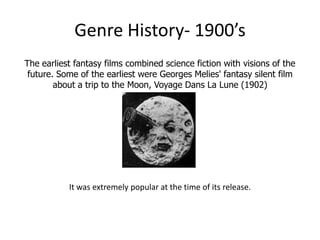
The earliest fantasy films combined science fiction with visions of the
 future. Some of the earliest were Georges Melies' fantasy silent film
        about a trip to the Moon, Voyage Dans La Lune (1902)


           It was extremely popular at the time of its release.
Genre History- 1930’s
The greatest children's fantasy/musical of all time was The Wizard of
                              Oz (1939)

                           The Wizard of Oz is a 1939 American
musical fantasy             film produced by Metro-Goldwyn-Mayer.
Genre History- 1940’s
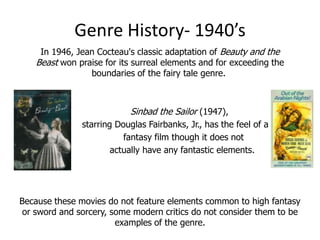
     In 1946, Jean Cocteau's classic adaptation of Beauty and the
    Beast won praise for its surreal elements and for exceeding the
                 boundaries of the fairy tale genre.


                           Sinbad the Sailor (1947),
               starring Douglas Fairbanks, Jr., has the feel of a
                          fantasy film though it does not
                       actually have any fantastic elements.


Because these movies do not feature elements common to high fantasy
 or sword and sorcery, some modern critics do not consider them to be
                        examples of the genre.
Genre History- 1950’s
There were a number of low budget fantasies produced in the 1950s,
            typically based on Greek or Arabian legend.

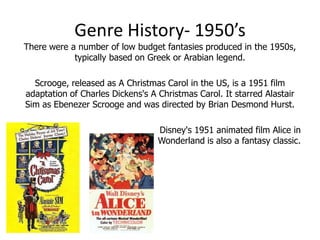
  Scrooge, released as A Christmas Carol in the US, is a 1951 film
adaptation of Charles Dickens's A Christmas Carol. It starred Alastair
Sim as Ebenezer Scrooge and was directed by Brian Desmond Hurst.

                                  Disney's 1951 animated film Alice in
                                  Wonderland is also a fantasy classic.
Genre History- 1960’s
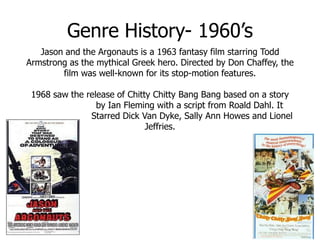
   Jason and the Argonauts is a 1963 fantasy film starring Todd
Armstrong as the mythical Greek hero. Directed by Don Chaffey, the
        film was well-known for its stop-motion features.

 1968 saw the release of Chitty Chitty Bang Bang based on a story
                 by Ian Fleming with a script from Roald Dahl. It
               Starred Dick Van Dyke, Sally Ann Howes and Lionel
                              Jeffries.
Genre History – 1970’s
  A few low budget pictures were made in this era such as:
                -1975's The Land That Time Forgot.
-1971's Bedknobs and Broomsticks and Willy Wonka & the Chocolate
   Factory (again being from Roald Dahl in both script and novel.)
Genre History-1980’s
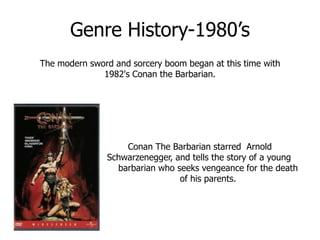
The modern sword and sorcery boom began at this time with
              1982's Conan the Barbarian.


                   Conan The Barbarian starred Arnold
               Schwarzenegger, and tells the story of a young
                 barbarian who seeks vengeance for the death
                                of his parents.
Sub-Genre Research
Epic or High Fantasy
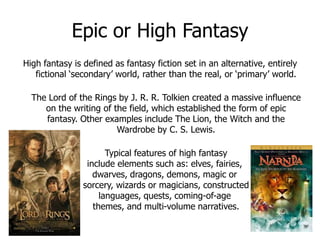
High fantasy is defined as fantasy fiction set in an alternative, entirely
   fictional ‘secondary’ world, rather than the real, or ‘primary’ world.

  The Lord of the Rings by J. R. R. Tolkien created a massive influence
     on the writing of the field, which established the form of epic
     fantasy. Other examples include The Lion, the Witch and the
                        Wardrobe by C. S. Lewis.

                       Typical features of high fantasy
                 include elements such as: elves, fairies,
                   dwarves, dragons, demons, magic or
                sorcery, wizards or magicians, constructed
                     languages, quests, coming-of-age
                   themes, and multi-volume narratives.
Low Fantasy
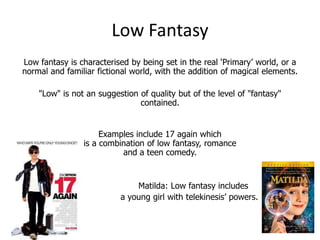
Low fantasy is characterised by being set in the real ‘Primary’ world, or a
normal and familiar fictional world, with the addition of magical elements.

    "Low" is not an suggestion of quality but of the level of "fantasy"
                               contained.


                     Examples include 17 again which
                is a combination of low fantasy, romance
                          and a teen comedy.


                              Matilda: Low fantasy includes
                          a young girl with telekinesis’ powers.
Distinguishing between subgenres
The distinction between whether the setting is the primary or secondary
world, and therefore whether it is low or high fantasy, can be unclear:

The secondary world may take three forms.
-Primary does not exist
-Entered through a portal from the primary
-World-within-a-world

HOWEVER:
The Lord of the Rings is set in Earth's past but the setting,
Middle-earth, is different from the reality to be
classed as a secondary world and therefore high fantasy.

Harry Potter series is set in the real world; however, the primary setting,
which is the school, (Hogwarts) in Scotland, but is
separated from the real world and becomes a "world-within-a-
world.’ Hogwarts is therefore as much of an alternative world as C. S.
Lewis' Narnia, which means that both series are in the high fantasy
subgenre.
Contemporary fantasy
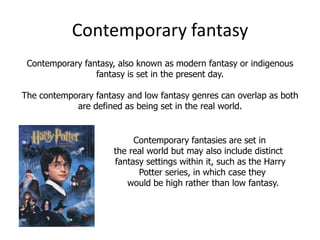
 Contemporary fantasy, also known as modern fantasy or indigenous
                 fantasy is set in the present day.

The contemporary fantasy and low fantasy genres can overlap as both
            are defined as being set in the real world.


                           Contemporary fantasies are set in
                      the real world but may also include distinct
                      fantasy settings within it, such as the Harry
                            Potter series, in which case they
                         would be high rather than low fantasy.
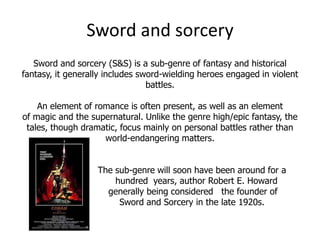
Sword and sorcery
   Sword and sorcery (S&S) is a sub-genre of fantasy and historical
fantasy, it generally includes sword-wielding heroes engaged in violent
                                 battles.

    An element of romance is often present, as well as an element
of magic and the supernatural. Unlike the genre high/epic fantasy, the
 tales, though dramatic, focus mainly on personal battles rather than
                    world-endangering matters.


                   The sub-genre will soon have been around for a
                       hundred years, author Robert E. Howard
                     generally being considered the founder of
                        Sword and Sorcery in the late 1920s.
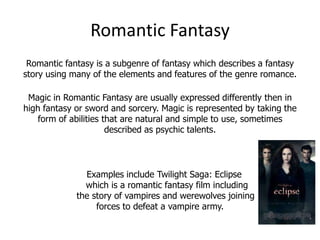
Romantic Fantasy
 Romantic fantasy is a subgenre of fantasy which describes a fantasy
story using many of the elements and features of the genre romance.

 Magic in Romantic Fantasy are usually expressed differently then in
high fantasy or sword and sorcery. Magic is represented by taking the
    form of abilities that are natural and simple to use, sometimes
                       described as psychic talents.


               Examples include Twilight Saga: Eclipse
               which is a romantic fantasy film including
             the story of vampires and werewolves joining
                  forces to defeat a vampire army.
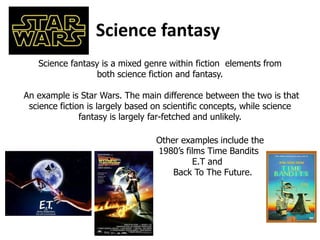
Science fantasy
   Science fantasy is a mixed genre within fiction elements from
                  both science fiction and fantasy.

An example is Star Wars. The main difference between the two is that
 science fiction is largely based on scientific concepts, while science
               fantasy is largely far-fetched and unlikely.

                                  Other examples include the
                                  1980’s films Time Bandits
                                           E.T and
                                      Back To The Future.
Fantasy


If the author is doing their job you can experience a world
       as close to ours or as different from ours as their
    imagination allows, but at the same time allowing us to
    believe that elves, magic, epic adventure, and fairy folk
   exist. Fantasy plays with our imaginations and lets them
         run wild in a way that few other genres allow.

               (source for definition fandomania.com)
Conclusion
KEY ELEMENTS:
 -Magic
 -Supernatural
 -Fantasy or parallel worlds as a setting
 -Make-believe creatures
 -Villain or hero

fantasy research

  • 1.
  • 2.
    Fantasy Definition -Fantasy isa genre of fiction that uses magic and other supernatural occurrences as a main element of the plot, theme, or setting. -The genre the setting takes place in imaginary worlds where magic is common. -Considered to be distinct from science fiction film and horror films (although do overlap which then become sub-genres)
  • 3.
    What are thefundamental aspects of Fantasy? Fantasy films are films with themes involving: -magic -supernatural events - make-believe creatures -exotic fantasy worlds Fantasy films often have an element of magic, myth, wonder, escapism, and the unexpected.
  • 4.
    Genre History Fantasy filmswere rare until the 1980s, when high-tech filmmaking techniques had increased the audience interest also increased which then caused the genre to succeed. With its roots in myth and legend, fantasy is the most basic of all the genres.
  • 5.
    Genre History- 1900’s Theearliest fantasy films combined science fiction with visions of the future. Some of the earliest were Georges Melies' fantasy silent film about a trip to the Moon, Voyage Dans La Lune (1902) It was extremely popular at the time of its release.
  • 6.
    Genre History- 1930’s Thegreatest children's fantasy/musical of all time was The Wizard of Oz (1939) The Wizard of Oz is a 1939 American musical fantasy film produced by Metro-Goldwyn-Mayer.
  • 7.
    Genre History- 1940’s In 1946, Jean Cocteau's classic adaptation of Beauty and the Beast won praise for its surreal elements and for exceeding the boundaries of the fairy tale genre. Sinbad the Sailor (1947), starring Douglas Fairbanks, Jr., has the feel of a fantasy film though it does not actually have any fantastic elements. Because these movies do not feature elements common to high fantasy or sword and sorcery, some modern critics do not consider them to be examples of the genre.
  • 8.
    Genre History- 1950’s Therewere a number of low budget fantasies produced in the 1950s, typically based on Greek or Arabian legend. Scrooge, released as A Christmas Carol in the US, is a 1951 film adaptation of Charles Dickens's A Christmas Carol. It starred Alastair Sim as Ebenezer Scrooge and was directed by Brian Desmond Hurst. Disney's 1951 animated film Alice in Wonderland is also a fantasy classic.
  • 9.
    Genre History- 1960’s Jason and the Argonauts is a 1963 fantasy film starring Todd Armstrong as the mythical Greek hero. Directed by Don Chaffey, the film was well-known for its stop-motion features. 1968 saw the release of Chitty Chitty Bang Bang based on a story by Ian Fleming with a script from Roald Dahl. It Starred Dick Van Dyke, Sally Ann Howes and Lionel Jeffries.
  • 10.
    Genre History –1970’s A few low budget pictures were made in this era such as: -1975's The Land That Time Forgot. -1971's Bedknobs and Broomsticks and Willy Wonka & the Chocolate Factory (again being from Roald Dahl in both script and novel.)
  • 11.
    Genre History-1980’s The modernsword and sorcery boom began at this time with 1982's Conan the Barbarian. Conan The Barbarian starred Arnold Schwarzenegger, and tells the story of a young barbarian who seeks vengeance for the death of his parents.
  • 12.
  • 13.
    Epic or HighFantasy High fantasy is defined as fantasy fiction set in an alternative, entirely fictional ‘secondary’ world, rather than the real, or ‘primary’ world. The Lord of the Rings by J. R. R. Tolkien created a massive influence on the writing of the field, which established the form of epic fantasy. Other examples include The Lion, the Witch and the Wardrobe by C. S. Lewis. Typical features of high fantasy include elements such as: elves, fairies, dwarves, dragons, demons, magic or sorcery, wizards or magicians, constructed languages, quests, coming-of-age themes, and multi-volume narratives.
  • 14.
    Low Fantasy Low fantasyis characterised by being set in the real ‘Primary’ world, or a normal and familiar fictional world, with the addition of magical elements. "Low" is not an suggestion of quality but of the level of "fantasy" contained. Examples include 17 again which is a combination of low fantasy, romance and a teen comedy. Matilda: Low fantasy includes a young girl with telekinesis’ powers.
  • 15.
    Distinguishing between subgenres Thedistinction between whether the setting is the primary or secondary world, and therefore whether it is low or high fantasy, can be unclear: The secondary world may take three forms. -Primary does not exist -Entered through a portal from the primary -World-within-a-world HOWEVER: The Lord of the Rings is set in Earth's past but the setting, Middle-earth, is different from the reality to be classed as a secondary world and therefore high fantasy. Harry Potter series is set in the real world; however, the primary setting, which is the school, (Hogwarts) in Scotland, but is separated from the real world and becomes a "world-within-a- world.’ Hogwarts is therefore as much of an alternative world as C. S. Lewis' Narnia, which means that both series are in the high fantasy subgenre.
  • 16.
    Contemporary fantasy Contemporaryfantasy, also known as modern fantasy or indigenous fantasy is set in the present day. The contemporary fantasy and low fantasy genres can overlap as both are defined as being set in the real world. Contemporary fantasies are set in the real world but may also include distinct fantasy settings within it, such as the Harry Potter series, in which case they would be high rather than low fantasy.
  • 17.
    Sword and sorcery Sword and sorcery (S&S) is a sub-genre of fantasy and historical fantasy, it generally includes sword-wielding heroes engaged in violent battles. An element of romance is often present, as well as an element of magic and the supernatural. Unlike the genre high/epic fantasy, the tales, though dramatic, focus mainly on personal battles rather than world-endangering matters. The sub-genre will soon have been around for a hundred years, author Robert E. Howard generally being considered the founder of Sword and Sorcery in the late 1920s.
  • 18.
    Romantic Fantasy Romanticfantasy is a subgenre of fantasy which describes a fantasy story using many of the elements and features of the genre romance. Magic in Romantic Fantasy are usually expressed differently then in high fantasy or sword and sorcery. Magic is represented by taking the form of abilities that are natural and simple to use, sometimes described as psychic talents. Examples include Twilight Saga: Eclipse which is a romantic fantasy film including the story of vampires and werewolves joining forces to defeat a vampire army.
  • 19.
    Science fantasy Science fantasy is a mixed genre within fiction elements from both science fiction and fantasy. An example is Star Wars. The main difference between the two is that science fiction is largely based on scientific concepts, while science fantasy is largely far-fetched and unlikely. Other examples include the 1980’s films Time Bandits E.T and Back To The Future.
  • 20.
    Fantasy If the authoris doing their job you can experience a world as close to ours or as different from ours as their imagination allows, but at the same time allowing us to believe that elves, magic, epic adventure, and fairy folk exist. Fantasy plays with our imaginations and lets them run wild in a way that few other genres allow. (source for definition fandomania.com)
  • 21.
    Conclusion KEY ELEMENTS: -Magic -Supernatural -Fantasy or parallel worlds as a setting -Make-believe creatures -Villain or hero