Narration
telling a single story or several related stories

“There are only two or three
human stories and they go on
repeating themselves as fiercely
as if they had never happened
before.”
--Willa Cather
Prewriting strategies
• What event evokes strong emotion and will
have a powerful effect on your readers?
• Think about a personal experience, an
incident in someone else’s life
• You may want to focus on a public event
• If you write about someone or something
else, will you be able to interview them or
research the situation?
Focus on the conflict
• What is the source of tension? Internal or
external conflict? Personal or social?
• Will the conflict create enough interest to
hook your readers?
• What point does the conflict convey?
• What tone is appropriate?
Strategies for Writing a Narrative
1- Identify the point of the narrative conflict.
--Probably won’t have a thesis but must have focus
2- Develop only those details that advance the
narrative point
-- Keep your audience in mind
-- Show, don’t tell
-- Use your dramatic license- faction
3- Organize the narrative sequence
--flashback
--flashforward
for emphasis only
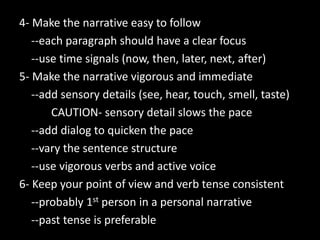
4- Make the narrative easy to follow
--each paragraph should have a clear focus
--use time signals (now, then, later, next, after)
5- Make the narrative vigorous and immediate
--add sensory details (see, hear, touch, smell, taste)
CAUTION- sensory detail slows the pace
--add dialog to quicken the pace
--vary the sentence structure
--use vigorous verbs and active voice
6- Keep your point of view and verb tense consistent
--probably 1st person in a personal narrative
--past tense is preferable

Narration power point

  • 1.
    Narration telling a singlestory or several related stories “There are only two or three human stories and they go on repeating themselves as fiercely as if they had never happened before.” --Willa Cather
  • 2.
    Prewriting strategies • Whatevent evokes strong emotion and will have a powerful effect on your readers? • Think about a personal experience, an incident in someone else’s life • You may want to focus on a public event • If you write about someone or something else, will you be able to interview them or research the situation?
  • 3.
    Focus on theconflict • What is the source of tension? Internal or external conflict? Personal or social? • Will the conflict create enough interest to hook your readers? • What point does the conflict convey? • What tone is appropriate?
  • 4.
    Strategies for Writinga Narrative 1- Identify the point of the narrative conflict. --Probably won’t have a thesis but must have focus 2- Develop only those details that advance the narrative point -- Keep your audience in mind -- Show, don’t tell -- Use your dramatic license- faction 3- Organize the narrative sequence --flashback --flashforward for emphasis only
  • 5.
    4- Make thenarrative easy to follow --each paragraph should have a clear focus --use time signals (now, then, later, next, after) 5- Make the narrative vigorous and immediate --add sensory details (see, hear, touch, smell, taste) CAUTION- sensory detail slows the pace --add dialog to quicken the pace --vary the sentence structure --use vigorous verbs and active voice 6- Keep your point of view and verb tense consistent --probably 1st person in a personal narrative --past tense is preferable