WRITING A
NARRATIVE
WRITING A NARRATIVE
Some tips on writing a narrative:
• Read and keyword the question carefully.
• Some good stories start with a framing device such
as a frightening flashback or someone telling the
story to listeners.
• Keep the storyline simple but try to vary the pace
of the narrative; if it is too slow, it will become
boring; too fast, and it will become confusing.
• Decide on the tense you are going to use.
• Decide on the narrative voice.
WRITING A NARRATIVE
• Keep the number of characters to a minimum to
avoid confusion
• Not all characters need dialogue
• Use figurative language
• Proofread and edit your composition
• In a narrative, the imagination is brought in to play
rather than the events being real
• There is suspense throughout to make the reader
want to read
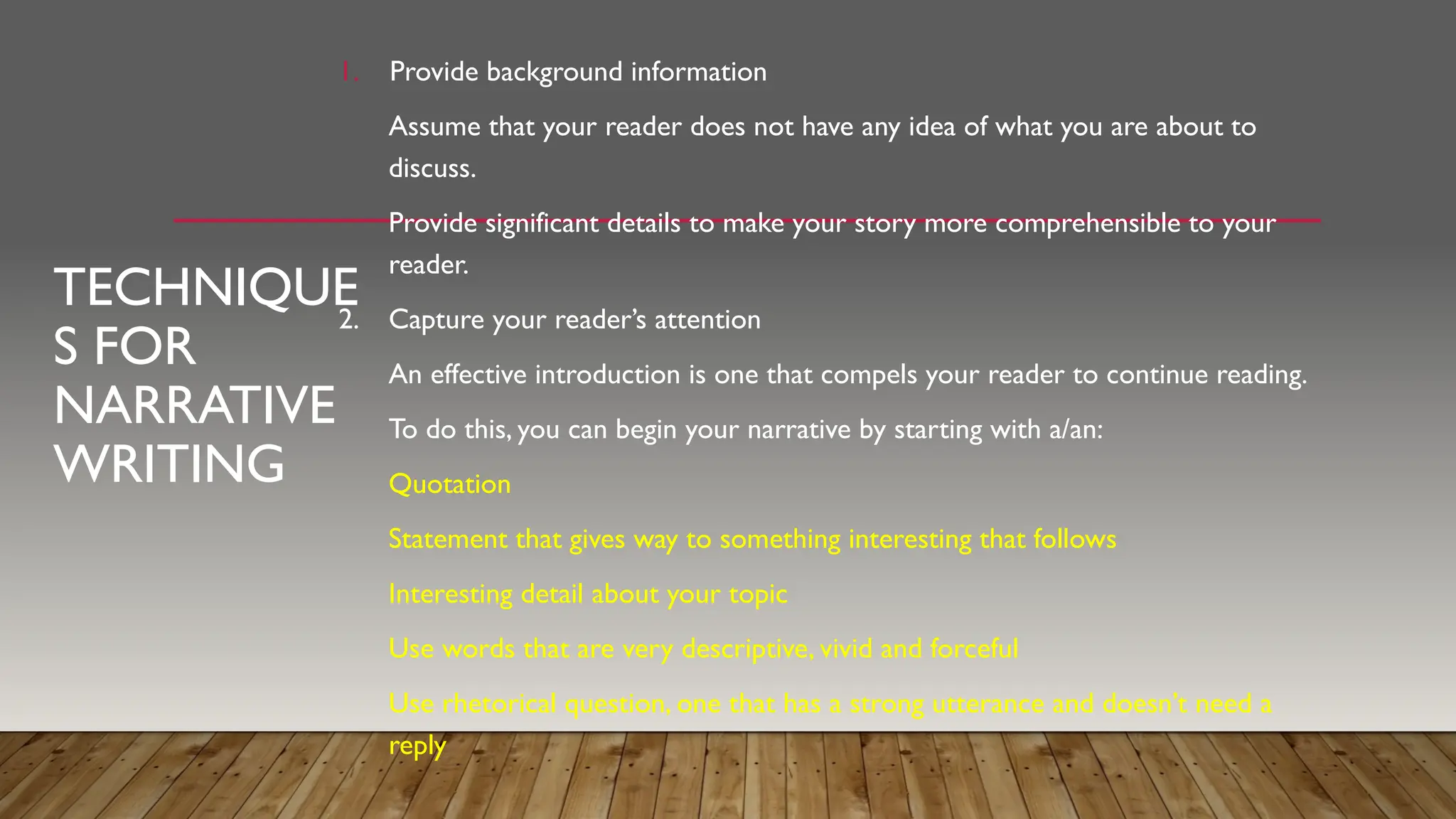
TECHNIQUE
S FOR
NARRATIVE
WRITING
1. Provide background information
Assume that your reader does not have any idea of what you are about to
discuss.
Provide significant details to make your story more comprehensible to your
reader.
2. Capture your reader’s attention
An effective introduction is one that compels your reader to continue reading.
To do this, you can begin your narrative by starting with a/an:
Quotation
Statement that gives way to something interesting that follows
Interesting detail about your topic
Use words that are very descriptive, vivid and forceful
Use rhetorical question, one that has a strong utterance and doesn’t need a
reply
TECHNIQ
UES FOR
NARRATIV
E
WRITING
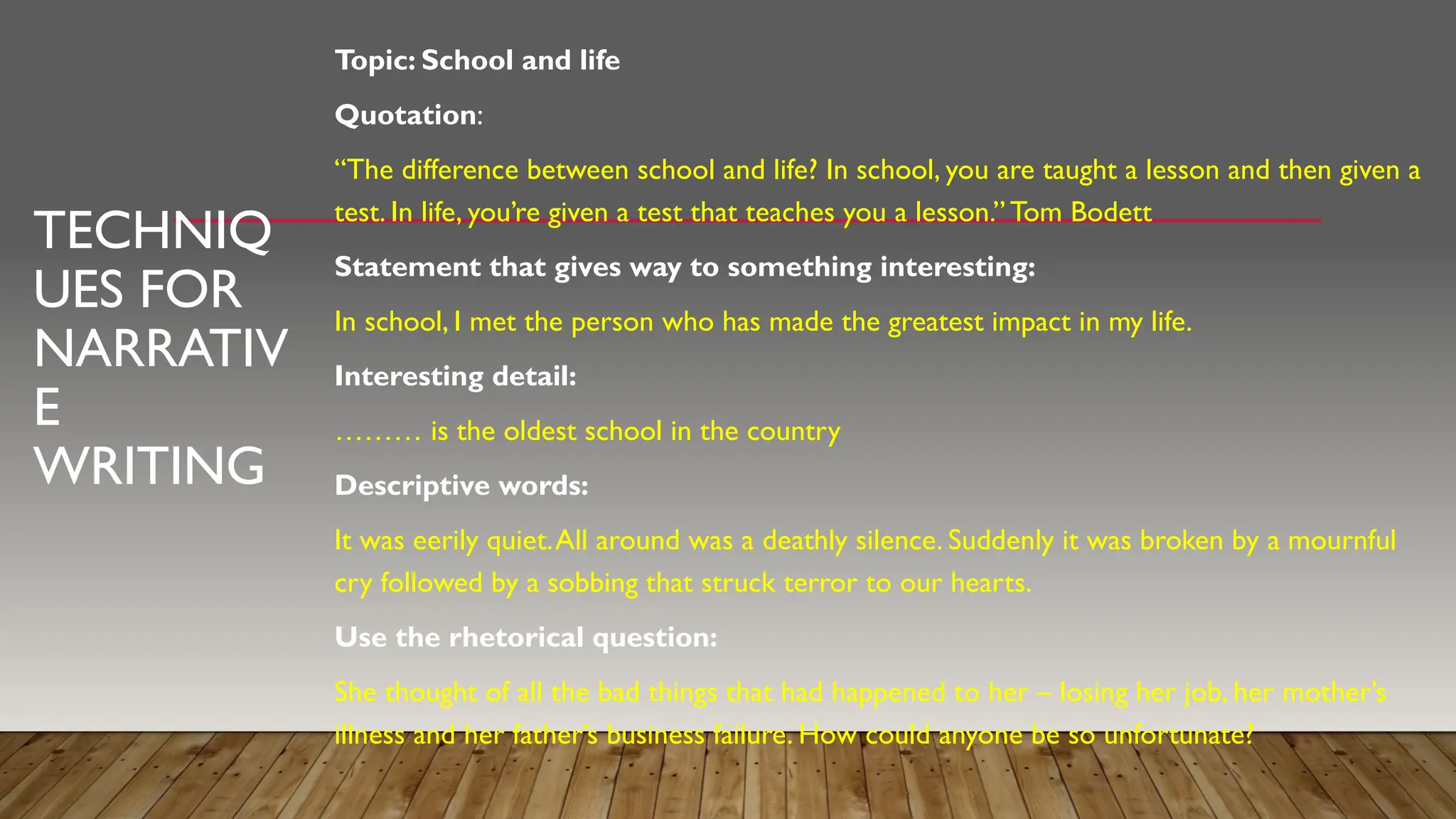
Topic: School and life
Quotation:
“The difference between school and life? In school, you are taught a lesson and then given a
test. In life, you’re given a test that teaches you a lesson.” Tom Bodett
Statement that gives way to something interesting:
In school, I met the person who has made the greatest impact in my life.
Interesting detail:
……… is the oldest school in the country
Descriptive words:
It was eerily quiet.All around was a deathly silence. Suddenly it was broken by a mournful
cry followed by a sobbing that struck terror to our hearts.
Use the rhetorical question:
She thought of all the bad things that had happened to her – losing her job, her mother’s
illness and her father’s business failure. How could anyone be so unfortunate?
TECHNIQUE
S FOR
NARRATIVE
WRITING
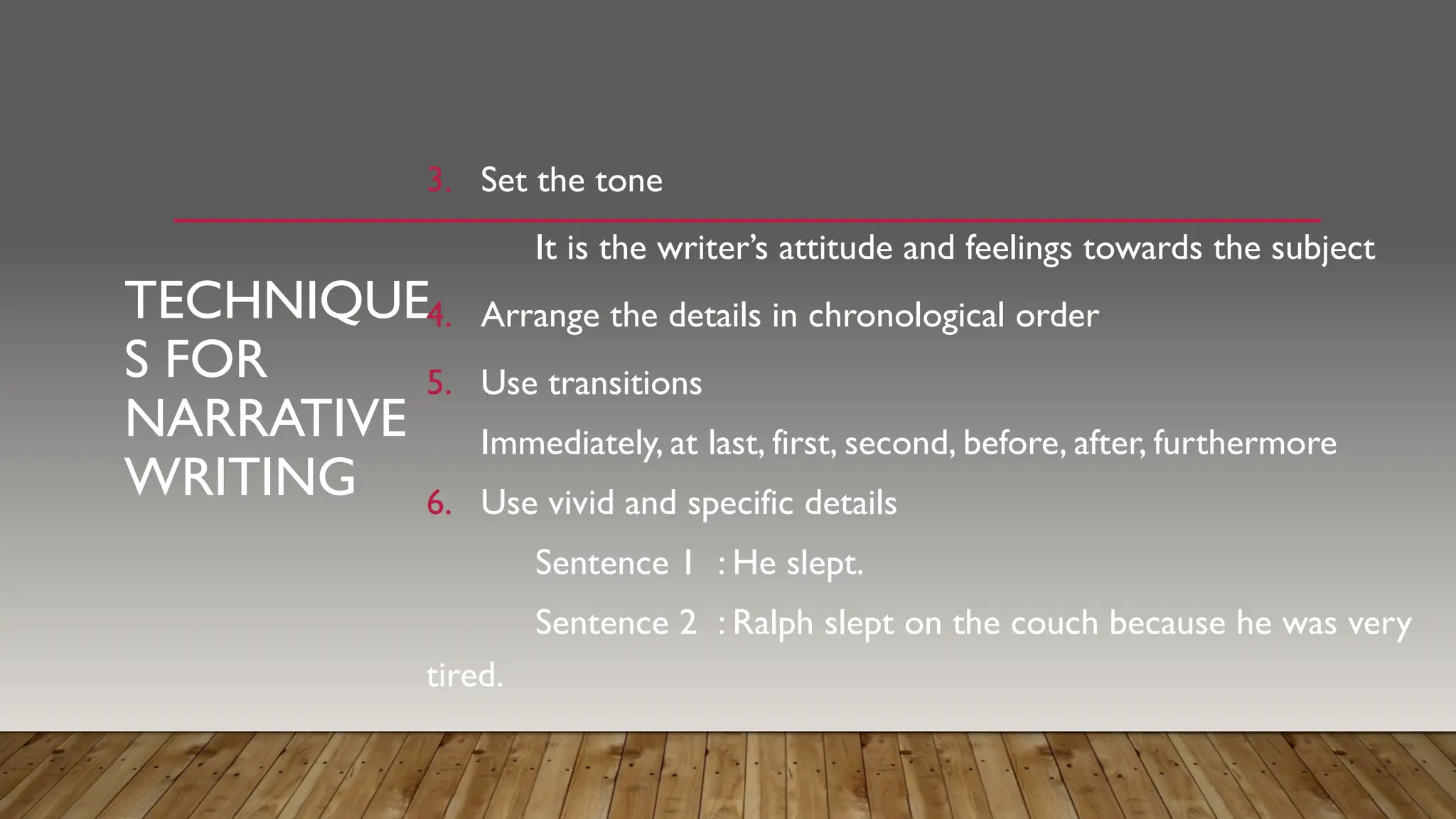
3. Set the tone
It is the writer’s attitude and feelings towards the subject
4. Arrange the details in chronological order
5. Use transitions
Immediately, at last, first, second, before, after, furthermore
6. Use vivid and specific details
Sentence 1 : He slept.
Sentence 2 : Ralph slept on the couch because he was very
tired.
LET’S
PRACTISE
Coming up with catchy introductions
1. Health : Use a question
2. School : Use a quote
3. Children : Statement that gives way to something
interesting
4. Family : Use a question
5. Technology: Use a quote
USINGVIVID
WORDS
AND
DETAILS
Revise the following sentences in order to
make the sentences clearer, concise and more
appealing to the readers.
1. She was tired.
2. They fell.
3. They ran.
4. She loved to cook.
5. He was angry.
WRITING CONCLUSIONS
1. Reiterate your main idea
2. Add a new insight
Conclude your narrative by showing your
readers the significance of your story.
3. Appeal to your reader’s emotions
4. End with a quotation, question or a catch
phrase
LET’S
PRACTISE
Three years ago, my family had to migrate to Spain. My
family had to move because of a job my father took. It
was one of the most interesting times of my life as I
was introduced to a new way of life and culture.The
first few months were hard because I did not know
how to speak their language.Also, I was not used to
their way of living. However, after the adjustment
period, the charm of Spain grew on me and I now
consider it my home.
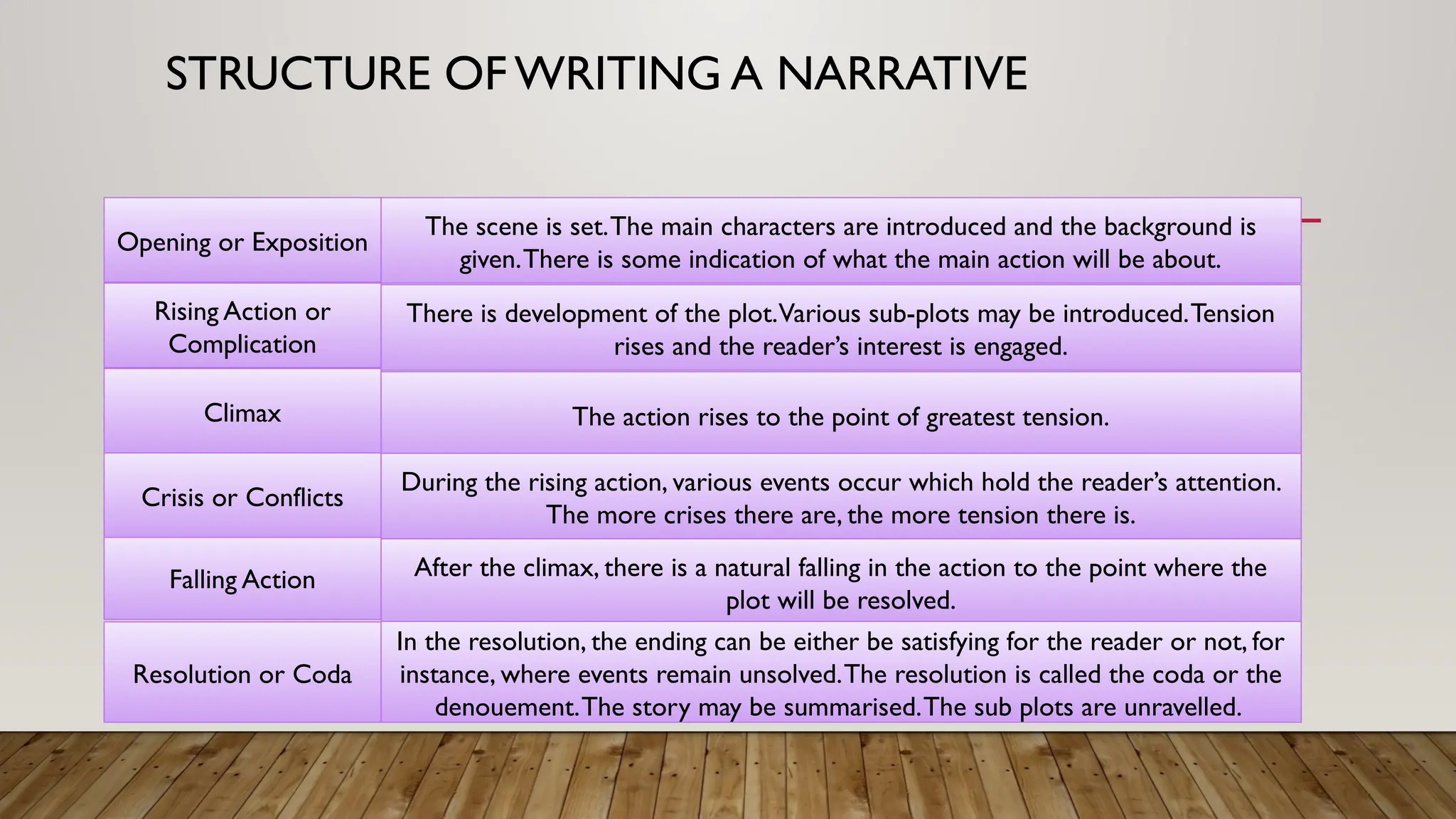
STRUCTURE OF WRITING A NARRATIVE
Opening or Exposition
Rising Action or
Complication
Climax
Falling Action
Crisis or Conflicts
Resolution or Coda
The scene is set.The main characters are introduced and the background is
given.There is some indication of what the main action will be about.
There is development of the plot.Various sub-plots may be introduced.Tension
rises and the reader’s interest is engaged.
The action rises to the point of greatest tension.
During the rising action, various events occur which hold the reader’s attention.
The more crises there are, the more tension there is.
After the climax, there is a natural falling in the action to the point where the
plot will be resolved.
In the resolution, the ending can be either be satisfying for the reader or not, for
instance, where events remain unsolved.The resolution is called the coda or the
denouement.The story may be summarised.The sub plots are unravelled.
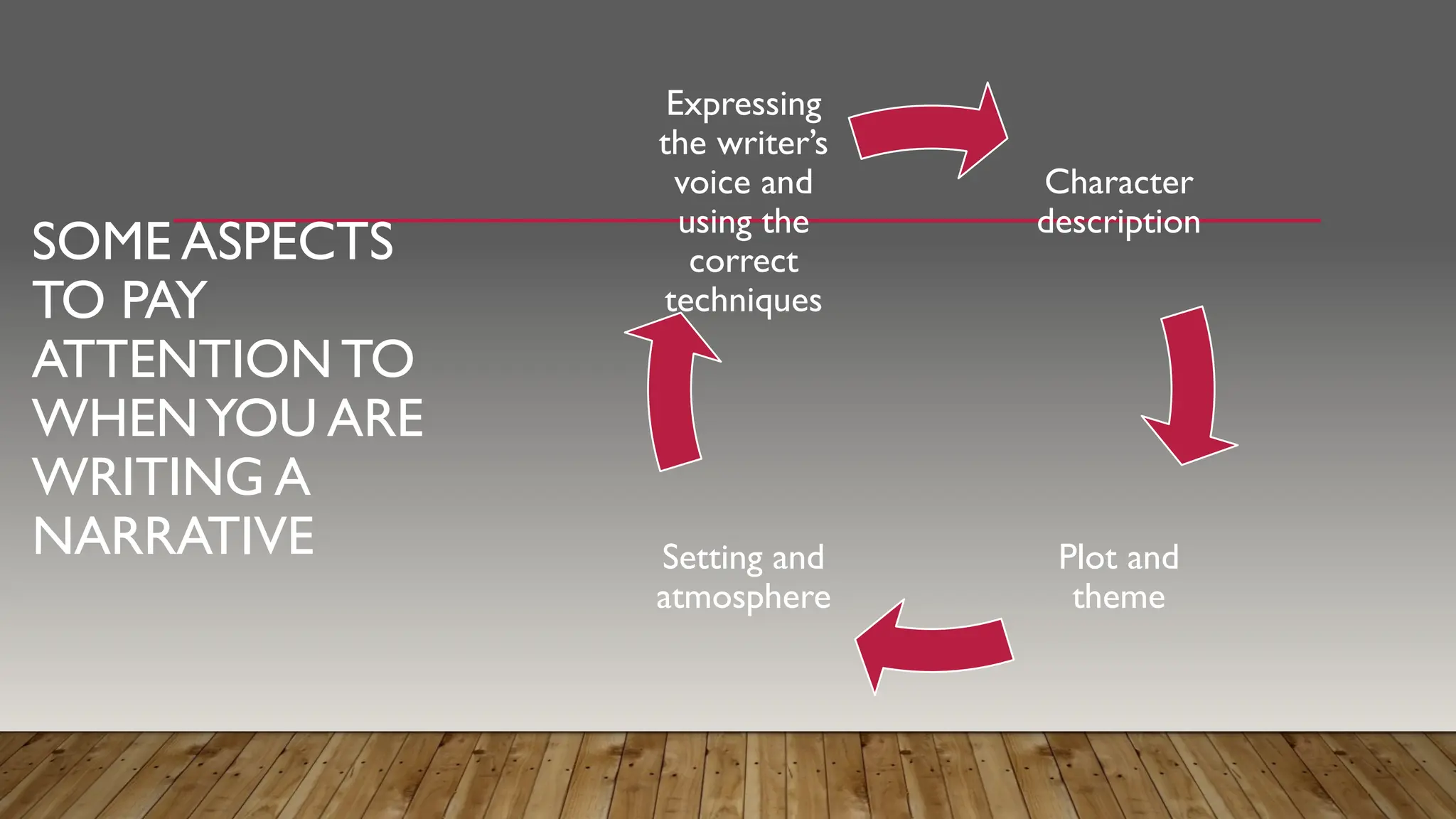
SOME ASPECTS
TO PAY
ATTENTION TO
WHENYOU ARE
WRITING A
NARRATIVE
Character
description
Plot and
theme
Setting and
atmosphere
Expressing
the writer’s
voice and
using the
correct
techniques
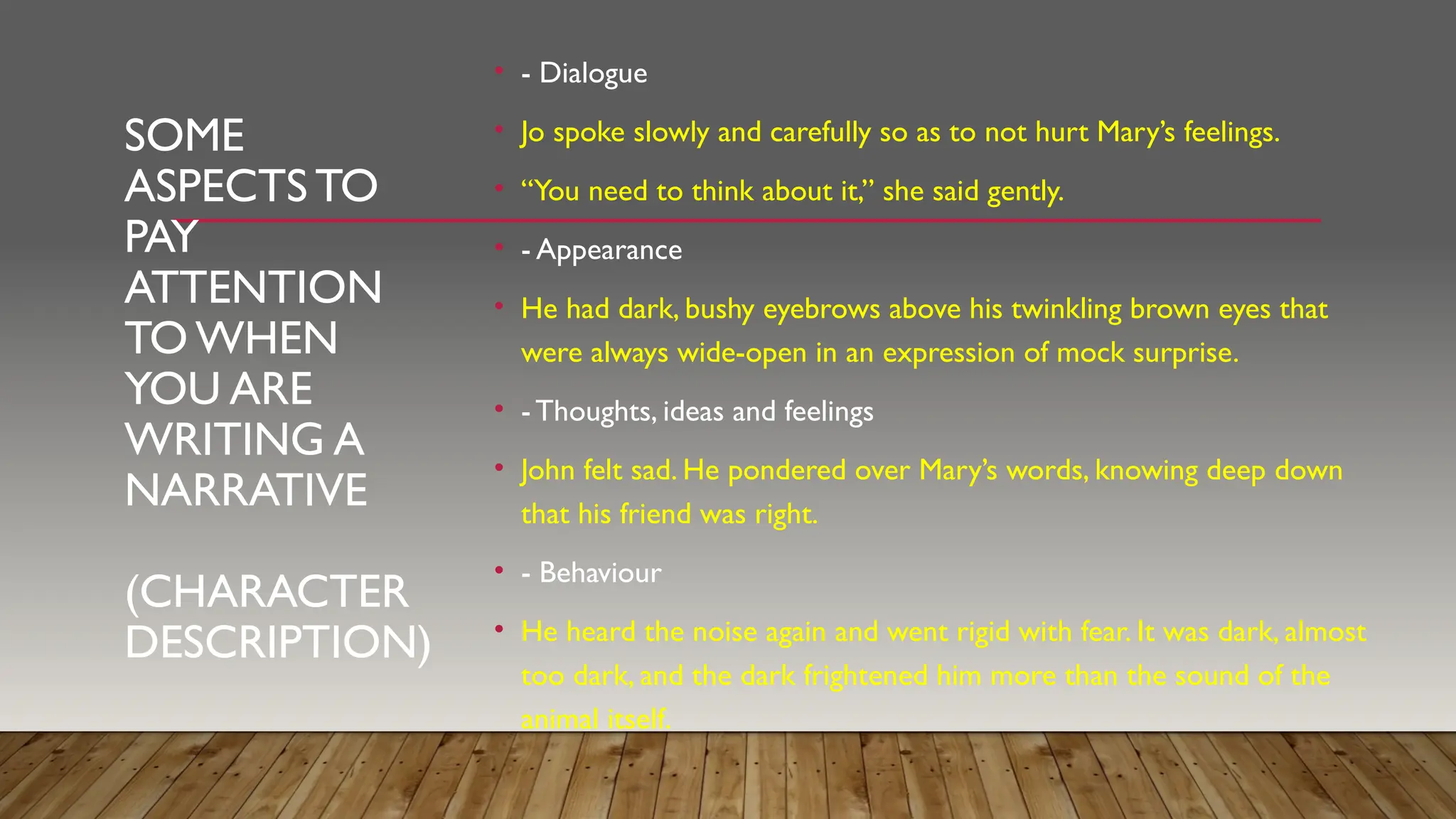
SOME
ASPECTS TO
PAY
ATTENTION
TO WHEN
YOU ARE
WRITING A
NARRATIVE
(CHARACTER
DESCRIPTION)
• - Dialogue
• Jo spoke slowly and carefully so as to not hurt Mary’s feelings.
• “You need to think about it,” she said gently.
• - Appearance
• He had dark, bushy eyebrows above his twinkling brown eyes that
were always wide-open in an expression of mock surprise.
• - Thoughts, ideas and feelings
• John felt sad. He pondered over Mary’s words, knowing deep down
that his friend was right.
• - Behaviour
• He heard the noise again and went rigid with fear. It was dark, almost
too dark, and the dark frightened him more than the sound of the
animal itself.
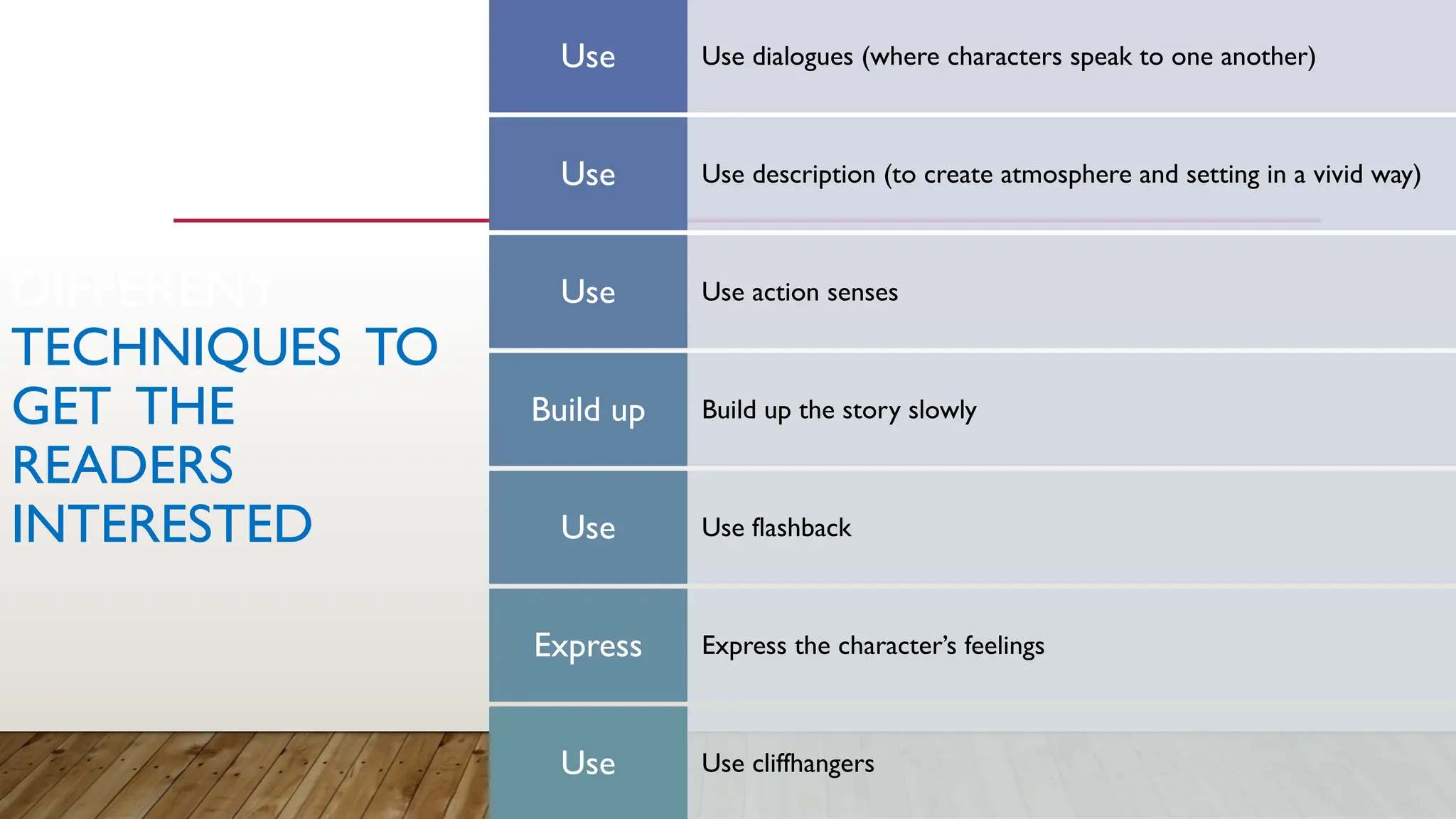
DIFFERENT
TECHNIQUES TO
GET THE
READERS
INTERESTED
Use dialogues (where characters speak to one another)
Use
Use description (to create atmosphere and setting in a vivid way)
Use
Use action senses
Use
Build up the story slowly
Build up
Use flashback
Use
Express the character’s feelings
Express
Use cliffhangers
Use
WHENYOU WRITE
A SHORT
NARRATIVE,YOU
MUST KEEP TO
THESE RULES
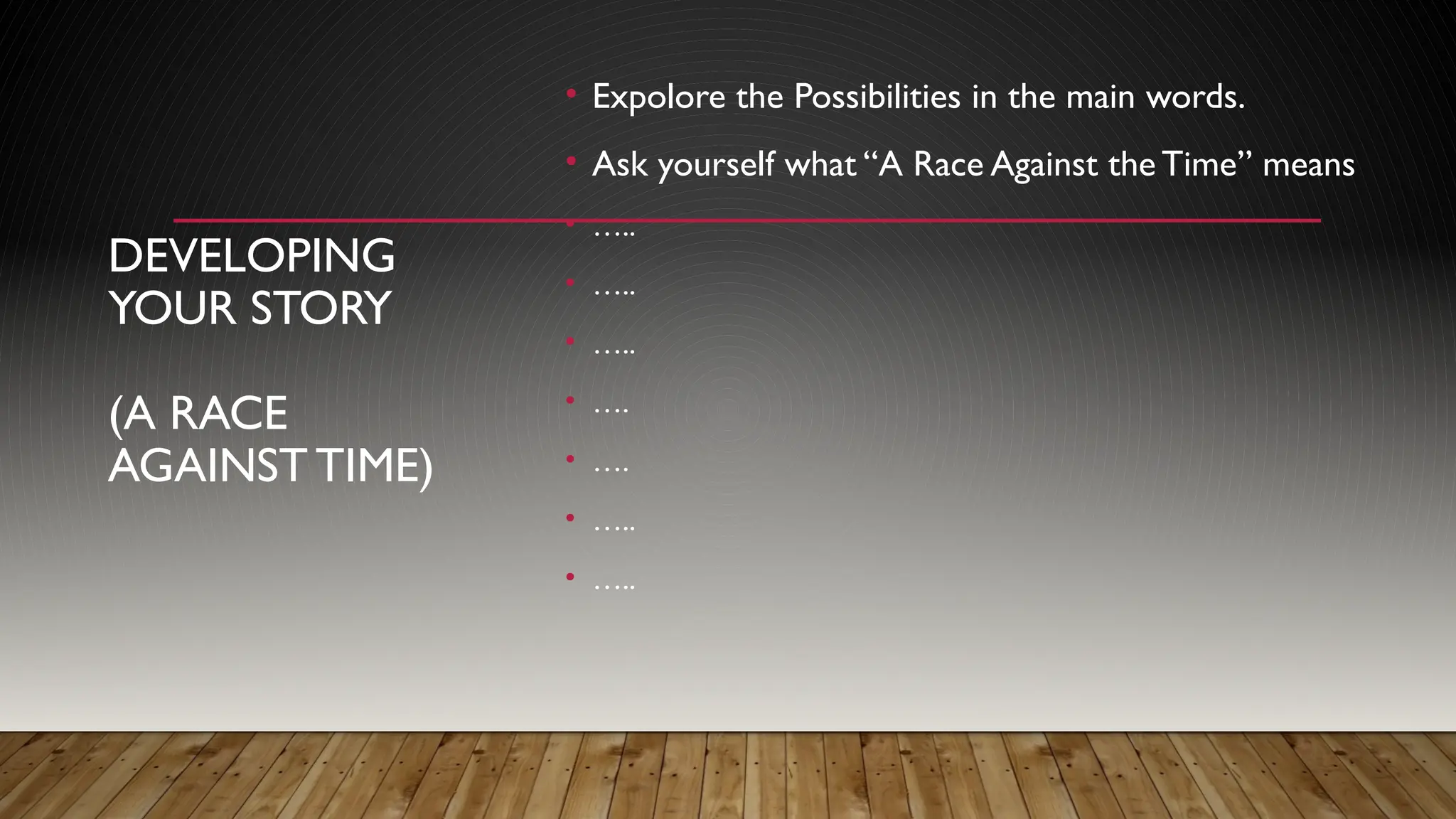
1. Few Characters – no more than three
developed people
2. Limited Setting – one main place
3. Limited Time – only a short time, hours rather
than days
4. Limited Action – one main conflict or event
5. SimpleTheme – one main idea
DEVELOPING
YOUR STORY
(A RACE
AGAINSTTIME)
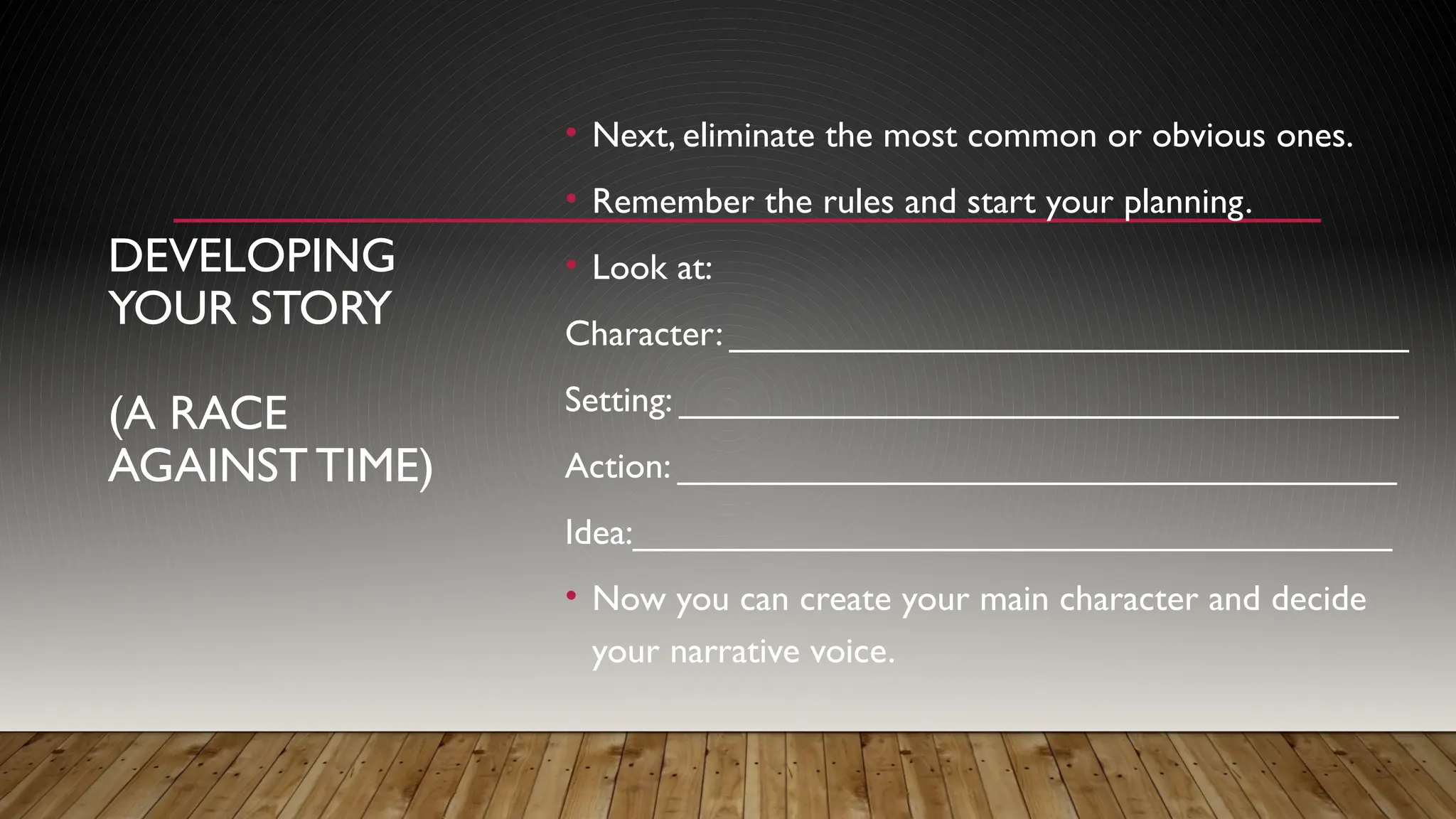
• Expolore the Possibilities in the main words.
• Ask yourself what “A Race Against the Time” means
• …..
• …..
• …..
• ….
• ….
• …..
• …..
DEVELOPING
YOUR STORY
(A RACE
AGAINSTTIME)
• Next, eliminate the most common or obvious ones.
• Remember the rules and start your planning.
• Look at:
Character: __________________________________
Setting: ____________________________________
Action: ____________________________________
Idea:______________________________________
• Now you can create your main character and decide
your narrative voice.
• PARAGRAPH 1
PARAGRAPH 2
PARAGRAPH 3
PARAGRAPH 4
PARAGRAPH 5
______________________________________________________
______________________________________________________
_____________________________________________
______________________________________________________
______________________________________________________
_____________________________________________
______________________________________________________
______________________________________________________
______________________________________________________
__________________________________________
______________________________________________________
______________________________________________________
_____________________________________________
______________________________________________________
______________________________________________________
______________________________________________________
__________________________________________

Narrative Writing - Notes FOR SECONDARY STUDENTS

  • 1.
  • 2.
    WRITING A NARRATIVE Sometips on writing a narrative: • Read and keyword the question carefully. • Some good stories start with a framing device such as a frightening flashback or someone telling the story to listeners. • Keep the storyline simple but try to vary the pace of the narrative; if it is too slow, it will become boring; too fast, and it will become confusing. • Decide on the tense you are going to use. • Decide on the narrative voice.
  • 3.
    WRITING A NARRATIVE •Keep the number of characters to a minimum to avoid confusion • Not all characters need dialogue • Use figurative language • Proofread and edit your composition • In a narrative, the imagination is brought in to play rather than the events being real • There is suspense throughout to make the reader want to read
  • 4.
    TECHNIQUE S FOR NARRATIVE WRITING 1. Providebackground information Assume that your reader does not have any idea of what you are about to discuss. Provide significant details to make your story more comprehensible to your reader. 2. Capture your reader’s attention An effective introduction is one that compels your reader to continue reading. To do this, you can begin your narrative by starting with a/an: Quotation Statement that gives way to something interesting that follows Interesting detail about your topic Use words that are very descriptive, vivid and forceful Use rhetorical question, one that has a strong utterance and doesn’t need a reply
  • 5.
    TECHNIQ UES FOR NARRATIV E WRITING Topic: Schooland life Quotation: “The difference between school and life? In school, you are taught a lesson and then given a test. In life, you’re given a test that teaches you a lesson.” Tom Bodett Statement that gives way to something interesting: In school, I met the person who has made the greatest impact in my life. Interesting detail: ……… is the oldest school in the country Descriptive words: It was eerily quiet.All around was a deathly silence. Suddenly it was broken by a mournful cry followed by a sobbing that struck terror to our hearts. Use the rhetorical question: She thought of all the bad things that had happened to her – losing her job, her mother’s illness and her father’s business failure. How could anyone be so unfortunate?
  • 6.
    TECHNIQUE S FOR NARRATIVE WRITING 3. Setthe tone It is the writer’s attitude and feelings towards the subject 4. Arrange the details in chronological order 5. Use transitions Immediately, at last, first, second, before, after, furthermore 6. Use vivid and specific details Sentence 1 : He slept. Sentence 2 : Ralph slept on the couch because he was very tired.
  • 7.
    LET’S PRACTISE Coming up withcatchy introductions 1. Health : Use a question 2. School : Use a quote 3. Children : Statement that gives way to something interesting 4. Family : Use a question 5. Technology: Use a quote
  • 8.
    USINGVIVID WORDS AND DETAILS Revise the followingsentences in order to make the sentences clearer, concise and more appealing to the readers. 1. She was tired. 2. They fell. 3. They ran. 4. She loved to cook. 5. He was angry.
  • 9.
    WRITING CONCLUSIONS 1. Reiterateyour main idea 2. Add a new insight Conclude your narrative by showing your readers the significance of your story. 3. Appeal to your reader’s emotions 4. End with a quotation, question or a catch phrase
  • 10.
    LET’S PRACTISE Three years ago,my family had to migrate to Spain. My family had to move because of a job my father took. It was one of the most interesting times of my life as I was introduced to a new way of life and culture.The first few months were hard because I did not know how to speak their language.Also, I was not used to their way of living. However, after the adjustment period, the charm of Spain grew on me and I now consider it my home.
  • 11.
    STRUCTURE OF WRITINGA NARRATIVE Opening or Exposition Rising Action or Complication Climax Falling Action Crisis or Conflicts Resolution or Coda The scene is set.The main characters are introduced and the background is given.There is some indication of what the main action will be about. There is development of the plot.Various sub-plots may be introduced.Tension rises and the reader’s interest is engaged. The action rises to the point of greatest tension. During the rising action, various events occur which hold the reader’s attention. The more crises there are, the more tension there is. After the climax, there is a natural falling in the action to the point where the plot will be resolved. In the resolution, the ending can be either be satisfying for the reader or not, for instance, where events remain unsolved.The resolution is called the coda or the denouement.The story may be summarised.The sub plots are unravelled.
  • 12.
    SOME ASPECTS TO PAY ATTENTIONTO WHENYOU ARE WRITING A NARRATIVE Character description Plot and theme Setting and atmosphere Expressing the writer’s voice and using the correct techniques
  • 13.
    SOME ASPECTS TO PAY ATTENTION TO WHEN YOUARE WRITING A NARRATIVE (CHARACTER DESCRIPTION) • - Dialogue • Jo spoke slowly and carefully so as to not hurt Mary’s feelings. • “You need to think about it,” she said gently. • - Appearance • He had dark, bushy eyebrows above his twinkling brown eyes that were always wide-open in an expression of mock surprise. • - Thoughts, ideas and feelings • John felt sad. He pondered over Mary’s words, knowing deep down that his friend was right. • - Behaviour • He heard the noise again and went rigid with fear. It was dark, almost too dark, and the dark frightened him more than the sound of the animal itself.
  • 14.
    DIFFERENT TECHNIQUES TO GET THE READERS INTERESTED Usedialogues (where characters speak to one another) Use Use description (to create atmosphere and setting in a vivid way) Use Use action senses Use Build up the story slowly Build up Use flashback Use Express the character’s feelings Express Use cliffhangers Use
  • 15.
    WHENYOU WRITE A SHORT NARRATIVE,YOU MUSTKEEP TO THESE RULES 1. Few Characters – no more than three developed people 2. Limited Setting – one main place 3. Limited Time – only a short time, hours rather than days 4. Limited Action – one main conflict or event 5. SimpleTheme – one main idea
  • 16.
    DEVELOPING YOUR STORY (A RACE AGAINSTTIME) •Expolore the Possibilities in the main words. • Ask yourself what “A Race Against the Time” means • ….. • ….. • ….. • …. • …. • ….. • …..
  • 17.
    DEVELOPING YOUR STORY (A RACE AGAINSTTIME) •Next, eliminate the most common or obvious ones. • Remember the rules and start your planning. • Look at: Character: __________________________________ Setting: ____________________________________ Action: ____________________________________ Idea:______________________________________ • Now you can create your main character and decide your narrative voice.
  • 18.
    • PARAGRAPH 1 PARAGRAPH2 PARAGRAPH 3 PARAGRAPH 4 PARAGRAPH 5 ______________________________________________________ ______________________________________________________ _____________________________________________ ______________________________________________________ ______________________________________________________ _____________________________________________ ______________________________________________________ ______________________________________________________ ______________________________________________________ __________________________________________ ______________________________________________________ ______________________________________________________ _____________________________________________ ______________________________________________________ ______________________________________________________ ______________________________________________________ __________________________________________