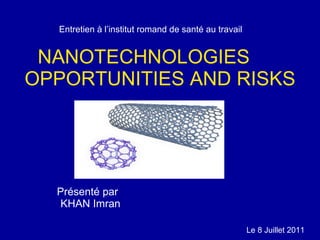
NANOTECHNOLOGIES  OPPORTUNITIES AND RISKS Présenté par  KHAN Imran  Entretien à l’institut romand de santé au travail  Le 8 Juillet 2011
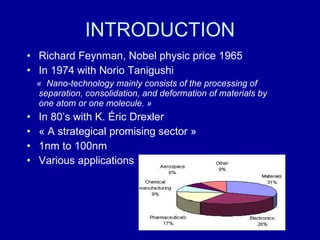
INTRODUCTION Richard Feynman, Nobel physic price 1965  In 1974 with Norio Tanigushi «  Nano-technology mainly consists of the processing of separation, consolidation, and deformation of materials by one atom or one molecule. »  In 80’s with K. Éric Drexler « A strategical promising sector » 1nm to 100nm Various applications
INTRODUCTION Domains and applications FOOD REVOLUTION AGRICULTURE SPACE CONQUEST MILITARY ENERGY CAR INDUSTRIES ELECTRONICS INDUSTRIES CHEMICALS INDUSTRIES PHARMACEUTICAL INDUSTRIES ENVIRONMENTAL SAFETY
INTRODUCTION Domains and applications FOOD REVOLUTION New food systems Taste interactions Healthcare specific delivery Remedy for deficiencies, allergies,… « Intelligent filters »
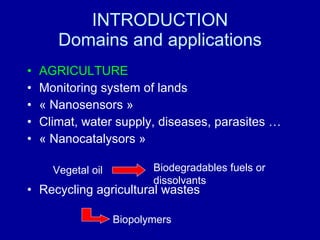
INTRODUCTION Domains and applications AGRICULTURE Monitoring system of lands « Nanosensors » Climat, water supply, diseases, parasites … « Nanocatalysors » Recycling agricultural wastes Vegetal oil Biodegradables fuels or dissolvants Biopolymers
INTRODUCTION Domains and applications SPACE CONQUEST NASA Space ships and orbital stations « Terraforming » planet Mars « Space lift » MILITARY Lighter and more resistant materials Miniaturized systems
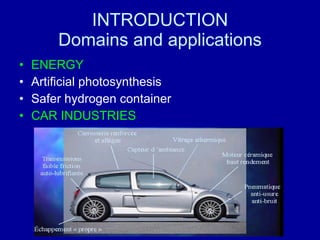
INTRODUCTION Domains and applications ENERGY Artificial photosynthesis Safer hydrogen container CAR INDUSTRIES
INTRODUCTION Domains and applications ELECTRONIC INDUSTRIES Databases capacity Information and communication CHEMICAL INDUSTRIES Specific catalysors « Smart » magnetic fluids Extreme cutting tools Treatment more efficient and speed
INTRODUCTION Domains and applications PHARMACEUTICAL INDUSTRIES Targeting of precise places Biocompatible materials  Autodiagnosis kits Improvement of surgical operations Cancer targeting Nanodrugs « Lab-on-chip »
INTRODUCTION Domains and applications PHARMACEUTICAL INDUSTRIES Cancer targeting « nanohorns » capsules Cisplatine insertion Liberation in the cell environment Possible vectors for anti-tumor  Drug specific delivery system Cytotoxic action
INTRODUCTION Domains and applications PHARMACEUTICAL INDUSTRIES Nanodrugs Spatiotemporal distribution « Drug vectorization » « Specific activation » « Nano-manufacturing » Miniaturization project
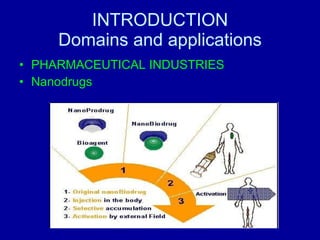
INTRODUCTION Domains and applications PHARMACEUTICAL INDUSTRIES Nanodrugs
INTRODUCTION Domains and applications PHARMACEUTICAL INDUSTRIES « Lab-on-chip » Reduce size of an actual laboratory Evaluate rate of sugar, cholesterol Recognize DNA sequences Just with one blood droplet !!! D ivision into more little droplets Progressing in canals Specific reaction chambers
INTRODUCTION Domains and applications Environmental safety Decontamination potential « nanofiltration » Toxic metals Bacteria Virus Major concern in water treatment
INTRODUCTION Domains and applications To a new industrial era « The 3rd revolution » New functionnal properties Numerous applications 2000 billions of dollars for 2015 BUT Health and environmental impacts not well know
NANOTECHNOLOGY RISKS In human and public health  For the environment For professionals
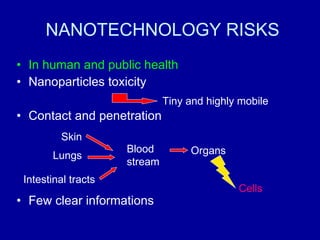
NANOTECHNOLOGY RISKS In human and public health  Nanoparticles toxicity Contact and penetration Few clear informations Tiny and highly mobile Lungs Skin Blood stream Organs Cells Intestinal tracts
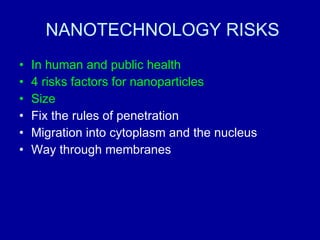
NANOTECHNOLOGY RISKS In human and public health  4 risks factors for nanoparticles Size Fix the rules of penetration Migration into cytoplasm and the nucleus Way through membranes
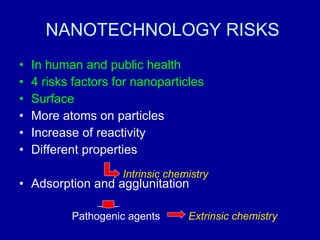
NANOTECHNOLOGY RISKS In human and public health  4 risks factors for nanoparticles Surface More atoms on particles Increase of reactivity Different properties Adsorption and agglunitation  Intrinsic chemistry Extrinsic chemistry Pathogenic agents
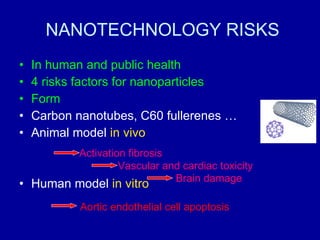
NANOTECHNOLOGY RISKS In human and public health  4 risks factors for nanoparticles Form Carbon nanotubes, C60 fullerenes … Animal model  in vivo Human model  in vitro Activation fibrosis  Aortic endothelial cell apoptosis Vascular and cardiac toxicity Brain damage
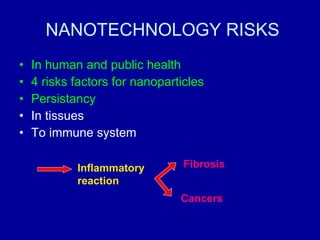
NANOTECHNOLOGY RISKS In human and public health  4 risks factors for nanoparticles Persistancy In tissues To immune system Inflammatory reaction Fibrosis Cancers
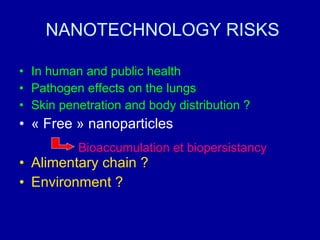
NANOTECHNOLOGY RISKS In human and public health  Pathogen effects on the lungs Skin penetration and body distribution ? « Free » nanoparticles Alimentary chain ? Environment ? Bioaccumulation et biopersistancy
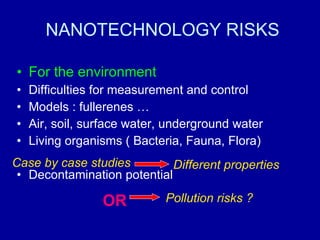
NANOTECHNOLOGY RISKS For the environment Difficulties for measurement and control Models : fullerenes … Air, soil, surface water, underground water Living organisms ( Bacteria, Fauna, Flora) Decontamination potential Pollution risks ? OR Case by case studies Different properties
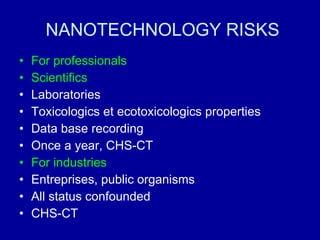
NANOTECHNOLOGY RISKS For professionals Scientifics Laboratories Toxicologics et ecotoxicologics properties Data base recording Once a year, CHS-CT For industries Entreprises, public organisms All status confounded CHS-CT
RISK MANAGEMENT At european level, one example : NANOSAFE 1 Control of productions Safe use of nanomaterials Evidency of lack of informations Then NANOSAFE 2, in 2005 till 2009 6 steps of risk management
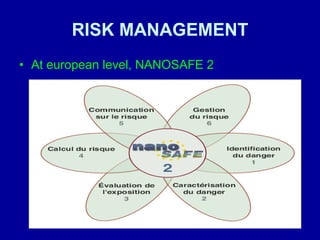
RISK MANAGEMENT At european level, NANOSAFE 2
RISK MANAGEMENT At european level, NANOSAFE 1 Control of productions Safe use of nanomaterials Evidency of lack of informations Then NANOSAFE 2, in 2004 till 2009 6 steps of risk management 4 independant subprojects
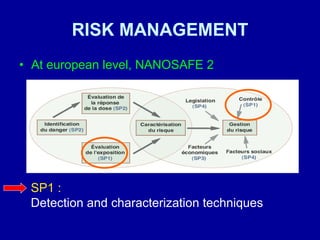
RISK MANAGEMENT At european level, NANOSAFE 2 SP1 :   Detection and characterization techniques
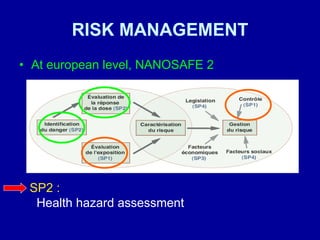
RISK MANAGEMENT At european level, NANOSAFE 2 SP2 :  Health hazard assessment
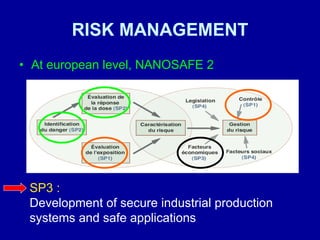
RISK MANAGEMENT At european level, NANOSAFE 2 SP3 : Development of secure industrial production systems and safe applications
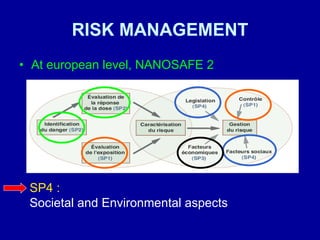
RISK MANAGEMENT At european level, NANOSAFE 2 SP4 :  Societal and Environmental aspects
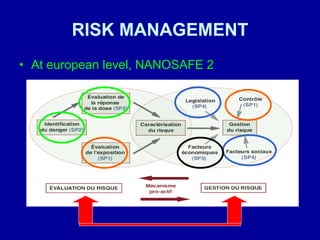
RISK MANAGEMENT At european level, NANOSAFE 2
RISK MANAGEMENT Precautionary Principle List nanoparticles Produce new knowledges Adopt safety measures Protect the population and ecosystems Lead a reglementary reflexion REACH
CONCLUSIONS 1 nanometer = 10 atoms Exponential evolution 1188   « Nanoproducts » on PEN High challenge for sanitary risk management and toxicological research Lack of information Amiante, OGM Approach based on precaution All in really close future !!!
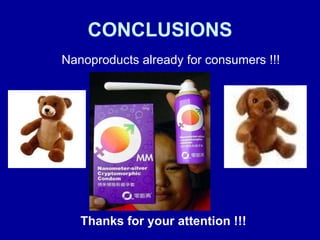
CONCLUSIONS Nanoproducts already for consumers !!! Thanks for your attention !!!

Nanotechnologies, risks and opportunities

  • 1.
    NANOTECHNOLOGIES OPPORTUNITIESAND RISKS Présenté par KHAN Imran Entretien à l’institut romand de santé au travail Le 8 Juillet 2011
  • 2.
    INTRODUCTION Richard Feynman,Nobel physic price 1965 In 1974 with Norio Tanigushi «  Nano-technology mainly consists of the processing of separation, consolidation, and deformation of materials by one atom or one molecule. » In 80’s with K. Éric Drexler « A strategical promising sector » 1nm to 100nm Various applications
  • 3.
    INTRODUCTION Domains andapplications FOOD REVOLUTION AGRICULTURE SPACE CONQUEST MILITARY ENERGY CAR INDUSTRIES ELECTRONICS INDUSTRIES CHEMICALS INDUSTRIES PHARMACEUTICAL INDUSTRIES ENVIRONMENTAL SAFETY
  • 4.
    INTRODUCTION Domains andapplications FOOD REVOLUTION New food systems Taste interactions Healthcare specific delivery Remedy for deficiencies, allergies,… « Intelligent filters »
  • 5.
    INTRODUCTION Domains andapplications AGRICULTURE Monitoring system of lands « Nanosensors » Climat, water supply, diseases, parasites … « Nanocatalysors » Recycling agricultural wastes Vegetal oil Biodegradables fuels or dissolvants Biopolymers
  • 6.
    INTRODUCTION Domains andapplications SPACE CONQUEST NASA Space ships and orbital stations « Terraforming » planet Mars « Space lift » MILITARY Lighter and more resistant materials Miniaturized systems
  • 7.
    INTRODUCTION Domains andapplications ENERGY Artificial photosynthesis Safer hydrogen container CAR INDUSTRIES
  • 8.
    INTRODUCTION Domains andapplications ELECTRONIC INDUSTRIES Databases capacity Information and communication CHEMICAL INDUSTRIES Specific catalysors « Smart » magnetic fluids Extreme cutting tools Treatment more efficient and speed
  • 9.
    INTRODUCTION Domains andapplications PHARMACEUTICAL INDUSTRIES Targeting of precise places Biocompatible materials Autodiagnosis kits Improvement of surgical operations Cancer targeting Nanodrugs « Lab-on-chip »
  • 10.
    INTRODUCTION Domains andapplications PHARMACEUTICAL INDUSTRIES Cancer targeting « nanohorns » capsules Cisplatine insertion Liberation in the cell environment Possible vectors for anti-tumor Drug specific delivery system Cytotoxic action
  • 11.
    INTRODUCTION Domains andapplications PHARMACEUTICAL INDUSTRIES Nanodrugs Spatiotemporal distribution « Drug vectorization » « Specific activation » « Nano-manufacturing » Miniaturization project
  • 12.
    INTRODUCTION Domains andapplications PHARMACEUTICAL INDUSTRIES Nanodrugs
  • 13.
    INTRODUCTION Domains andapplications PHARMACEUTICAL INDUSTRIES « Lab-on-chip » Reduce size of an actual laboratory Evaluate rate of sugar, cholesterol Recognize DNA sequences Just with one blood droplet !!! D ivision into more little droplets Progressing in canals Specific reaction chambers
  • 14.
    INTRODUCTION Domains andapplications Environmental safety Decontamination potential « nanofiltration » Toxic metals Bacteria Virus Major concern in water treatment
  • 15.
    INTRODUCTION Domains andapplications To a new industrial era « The 3rd revolution » New functionnal properties Numerous applications 2000 billions of dollars for 2015 BUT Health and environmental impacts not well know
  • 16.
    NANOTECHNOLOGY RISKS Inhuman and public health  For the environment For professionals
  • 17.
    NANOTECHNOLOGY RISKS Inhuman and public health  Nanoparticles toxicity Contact and penetration Few clear informations Tiny and highly mobile Lungs Skin Blood stream Organs Cells Intestinal tracts
  • 18.
    NANOTECHNOLOGY RISKS Inhuman and public health  4 risks factors for nanoparticles Size Fix the rules of penetration Migration into cytoplasm and the nucleus Way through membranes
  • 19.
    NANOTECHNOLOGY RISKS Inhuman and public health  4 risks factors for nanoparticles Surface More atoms on particles Increase of reactivity Different properties Adsorption and agglunitation Intrinsic chemistry Extrinsic chemistry Pathogenic agents
  • 20.
    NANOTECHNOLOGY RISKS Inhuman and public health  4 risks factors for nanoparticles Form Carbon nanotubes, C60 fullerenes … Animal model in vivo Human model in vitro Activation fibrosis Aortic endothelial cell apoptosis Vascular and cardiac toxicity Brain damage
  • 21.
    NANOTECHNOLOGY RISKS Inhuman and public health  4 risks factors for nanoparticles Persistancy In tissues To immune system Inflammatory reaction Fibrosis Cancers
  • 22.
    NANOTECHNOLOGY RISKS Inhuman and public health  Pathogen effects on the lungs Skin penetration and body distribution ? « Free » nanoparticles Alimentary chain ? Environment ? Bioaccumulation et biopersistancy
  • 23.
    NANOTECHNOLOGY RISKS Forthe environment Difficulties for measurement and control Models : fullerenes … Air, soil, surface water, underground water Living organisms ( Bacteria, Fauna, Flora) Decontamination potential Pollution risks ? OR Case by case studies Different properties
  • 24.
    NANOTECHNOLOGY RISKS Forprofessionals Scientifics Laboratories Toxicologics et ecotoxicologics properties Data base recording Once a year, CHS-CT For industries Entreprises, public organisms All status confounded CHS-CT
  • 25.
    RISK MANAGEMENT Ateuropean level, one example : NANOSAFE 1 Control of productions Safe use of nanomaterials Evidency of lack of informations Then NANOSAFE 2, in 2005 till 2009 6 steps of risk management
  • 26.
    RISK MANAGEMENT Ateuropean level, NANOSAFE 2
  • 27.
    RISK MANAGEMENT Ateuropean level, NANOSAFE 1 Control of productions Safe use of nanomaterials Evidency of lack of informations Then NANOSAFE 2, in 2004 till 2009 6 steps of risk management 4 independant subprojects
  • 28.
    RISK MANAGEMENT Ateuropean level, NANOSAFE 2 SP1 : Detection and characterization techniques
  • 29.
    RISK MANAGEMENT Ateuropean level, NANOSAFE 2 SP2 : Health hazard assessment
  • 30.
    RISK MANAGEMENT Ateuropean level, NANOSAFE 2 SP3 : Development of secure industrial production systems and safe applications
  • 31.
    RISK MANAGEMENT Ateuropean level, NANOSAFE 2 SP4 : Societal and Environmental aspects
  • 32.
    RISK MANAGEMENT Ateuropean level, NANOSAFE 2
  • 33.
    RISK MANAGEMENT PrecautionaryPrinciple List nanoparticles Produce new knowledges Adopt safety measures Protect the population and ecosystems Lead a reglementary reflexion REACH
  • 34.
    CONCLUSIONS 1 nanometer= 10 atoms Exponential evolution 1188 « Nanoproducts » on PEN High challenge for sanitary risk management and toxicological research Lack of information Amiante, OGM Approach based on precaution All in really close future !!!
  • 35.
    CONCLUSIONS Nanoproducts alreadyfor consumers !!! Thanks for your attention !!!