Seminar On
NANO TECHNOLOGY
Submitted by-
Gyan Jyoti Gogoi
CONTENTS
 Introduction
 What is nanotechnology?
 Approaches
 Steps to produce nanomaterials
 Applications
 Advantages
 Conclusion
Introduction
 It’s the development and practical
applications on a nanometric scale
 Engineering of tiny machines
 Greek prefix “Nano” means a billionth
 100 nanometers is the limit to
observe new
 properties of matter
What Is Nanotechnology?
 Nanotechnology is the engineering of tiny
machines—the projected ability to make things from
the bottom up, using techniques and tools being
developed today to place every atom and molecule
in a desired place. Shortly after this envisioned
molecular machinery is created, it will result in a
manufacturing revolution, probably causing severe
disruption. It also has serious economic, social,
environmental, and military implications.
 The principles of physics do not limit
our ability to manipulate things atom
by atom. It is not an attempt to
violate any laws; it is something, in
principle, that can be done; but in
practice, it has not been done
because we are too big.
--Richard
Feynman
Approaches
 In building any nanomaterials; the
available approaches i.e. methods are
 Top-down:-
 The structure varies gradually from large
(top) to small(small)
 By Feynman in 1959
 The problem: repairs which arise in
miniature structures at bottom can’t be
repaired by large ones at top
Bottom-up
 Structure varies gradually from bottom
(small) to top(large)
 Considered the one and only “true”
nanotechnology
 Limits of miniaturization are resolved
 Highly useful in electronics
Steps to produce
NANOMATERIALS:
Three primary steps to produce
nanomaterials
 Ability to manipulate individual
atoms
 Development of nanoscopic
machines(assemblers)
 Replicators are to be programmed
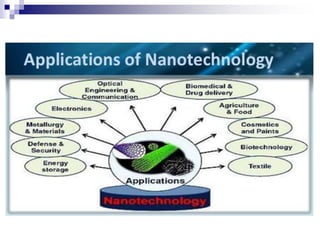
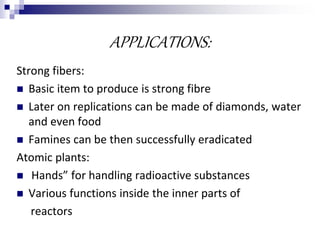
APPLICATIONS:
Strong fibers:
 Basic item to produce is strong fibre
 Later on replications can be made of diamonds, water
and even food
 Famines can be then successfully eradicated
Atomic plants:
 Hands” for handling radioactive substances
 Various functions inside the inner parts of
reactors
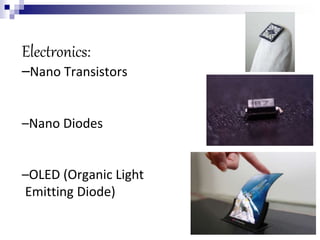
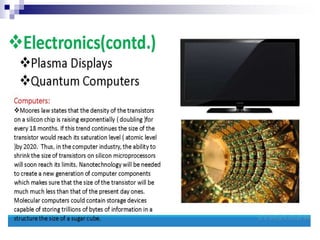
Electronics:
–Nano Transistors
–Nano Diodes
–OLED (Organic Light
Emitting Diode)
Space working
 Machines with very low mass, volume and
power consumption
 Reconfigurable, autonomous and
“thinking” spacecrafts
 Ultra new and ultra small constructions
and probes

Nano technology
Nano technology
Nano technology
Nano technology
Nano technology
Nano technology

Nano technology

  • 1.
  • 2.
    CONTENTS  Introduction  Whatis nanotechnology?  Approaches  Steps to produce nanomaterials  Applications  Advantages  Conclusion
  • 3.
    Introduction  It’s thedevelopment and practical applications on a nanometric scale  Engineering of tiny machines  Greek prefix “Nano” means a billionth  100 nanometers is the limit to observe new  properties of matter
  • 4.
    What Is Nanotechnology? Nanotechnology is the engineering of tiny machines—the projected ability to make things from the bottom up, using techniques and tools being developed today to place every atom and molecule in a desired place. Shortly after this envisioned molecular machinery is created, it will result in a manufacturing revolution, probably causing severe disruption. It also has serious economic, social, environmental, and military implications.
  • 5.
     The principlesof physics do not limit our ability to manipulate things atom by atom. It is not an attempt to violate any laws; it is something, in principle, that can be done; but in practice, it has not been done because we are too big. --Richard Feynman
  • 6.
    Approaches  In buildingany nanomaterials; the available approaches i.e. methods are  Top-down:-  The structure varies gradually from large (top) to small(small)  By Feynman in 1959  The problem: repairs which arise in miniature structures at bottom can’t be repaired by large ones at top
  • 7.
    Bottom-up  Structure variesgradually from bottom (small) to top(large)  Considered the one and only “true” nanotechnology  Limits of miniaturization are resolved  Highly useful in electronics
  • 8.
    Steps to produce NANOMATERIALS: Threeprimary steps to produce nanomaterials  Ability to manipulate individual atoms  Development of nanoscopic machines(assemblers)  Replicators are to be programmed
  • 10.
    APPLICATIONS: Strong fibers:  Basicitem to produce is strong fibre  Later on replications can be made of diamonds, water and even food  Famines can be then successfully eradicated Atomic plants:  Hands” for handling radioactive substances  Various functions inside the inner parts of reactors
  • 11.
  • 16.
    Space working  Machineswith very low mass, volume and power consumption  Reconfigurable, autonomous and “thinking” spacecrafts  Ultra new and ultra small constructions and probes
  • 17.