THE SOCIAL SHOPPER
How Retailers Can Connect With Customers
Marisa Peacock
the Strategic Peacock
North American Home Furnishings Association #NAHFA
Winter Market, Las Vegas
January 21, 2015
WHAT IS SOCIAL SHOPPING?
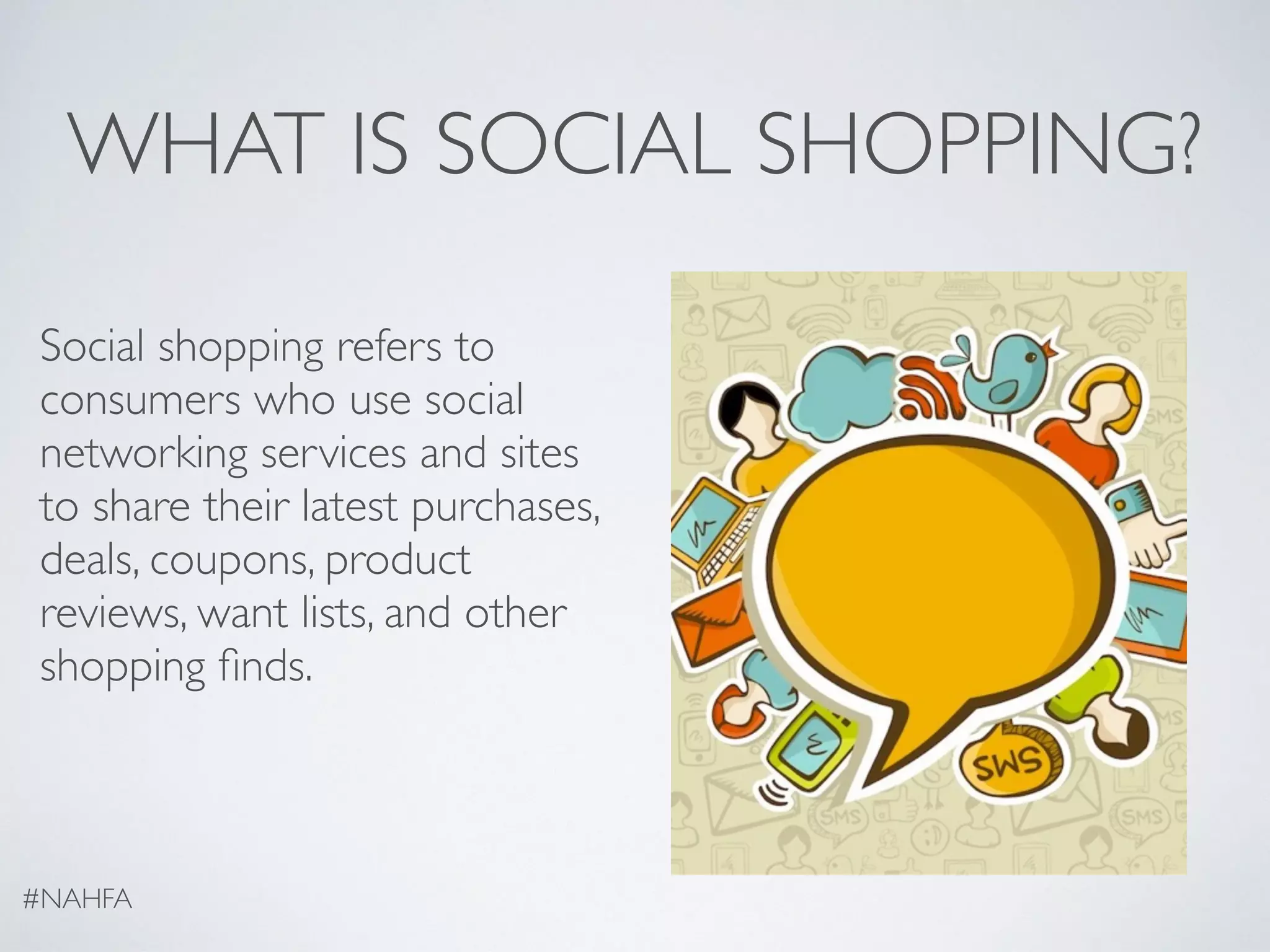
Social shopping refers to
consumers who use social
networking services and sites
to share their latest purchases,
deals, coupons, product
reviews, want lists, and other
shopping finds.
#NAHFA
WHO IS A SOCIAL SHOPPER?
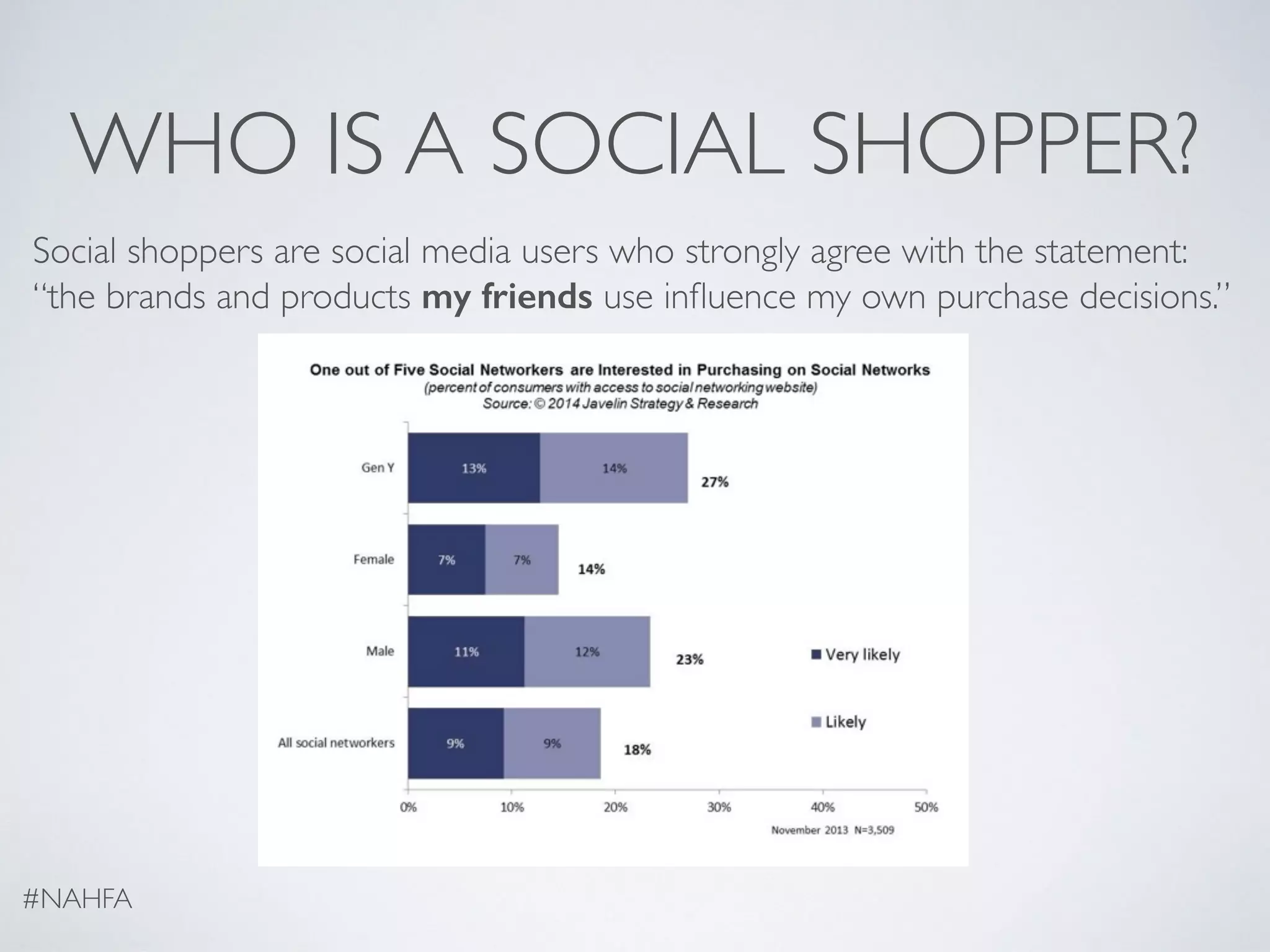
Social shoppers are social media users who strongly agree with the statement:
“the brands and products my friends use influence my own purchase decisions.”
#NAHFA
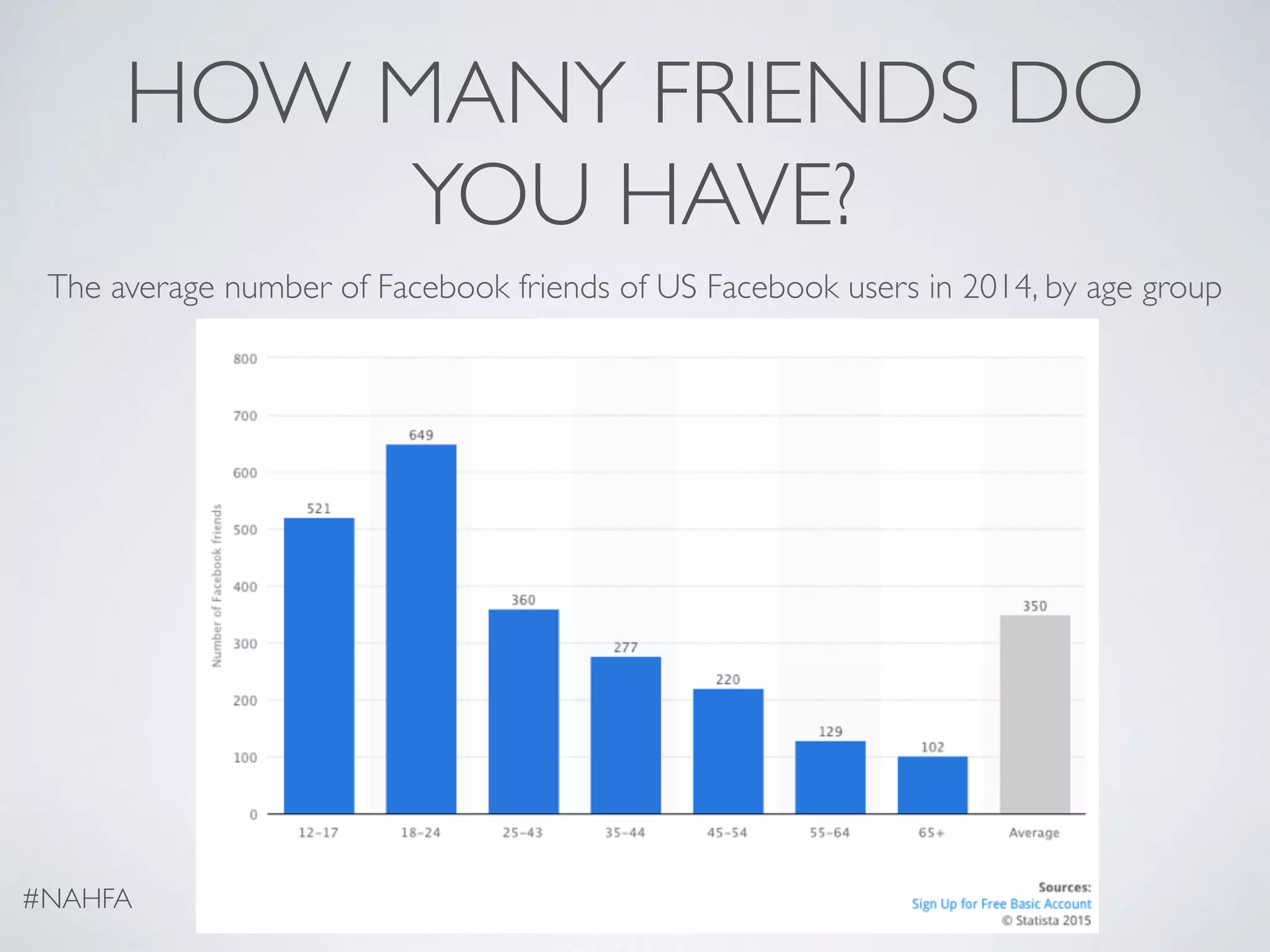
HOW MANY FRIENDS DO
YOU HAVE?
The average number of Facebook friends of US Facebook users in 2014, by age group
#NAHFA
FRIENDSHIPTRUMPS
RESEARCH
Researchers from Oxford, Harvard and the
University of Limerick found that:
Community members randomly copy the choices made
by other members in the recent past so that products
whose popularity levels have recently grown the fastest
are more likely to be selected, whether or not they are
most popular overall.
#NAHFA
TYPES OF SOCIAL SHOPPERS
• Efficiency Sprint Shopper
• The Peer Shopper
• The In-the-Know Shopper
• Impulse Buying Shopper
#NAHFA
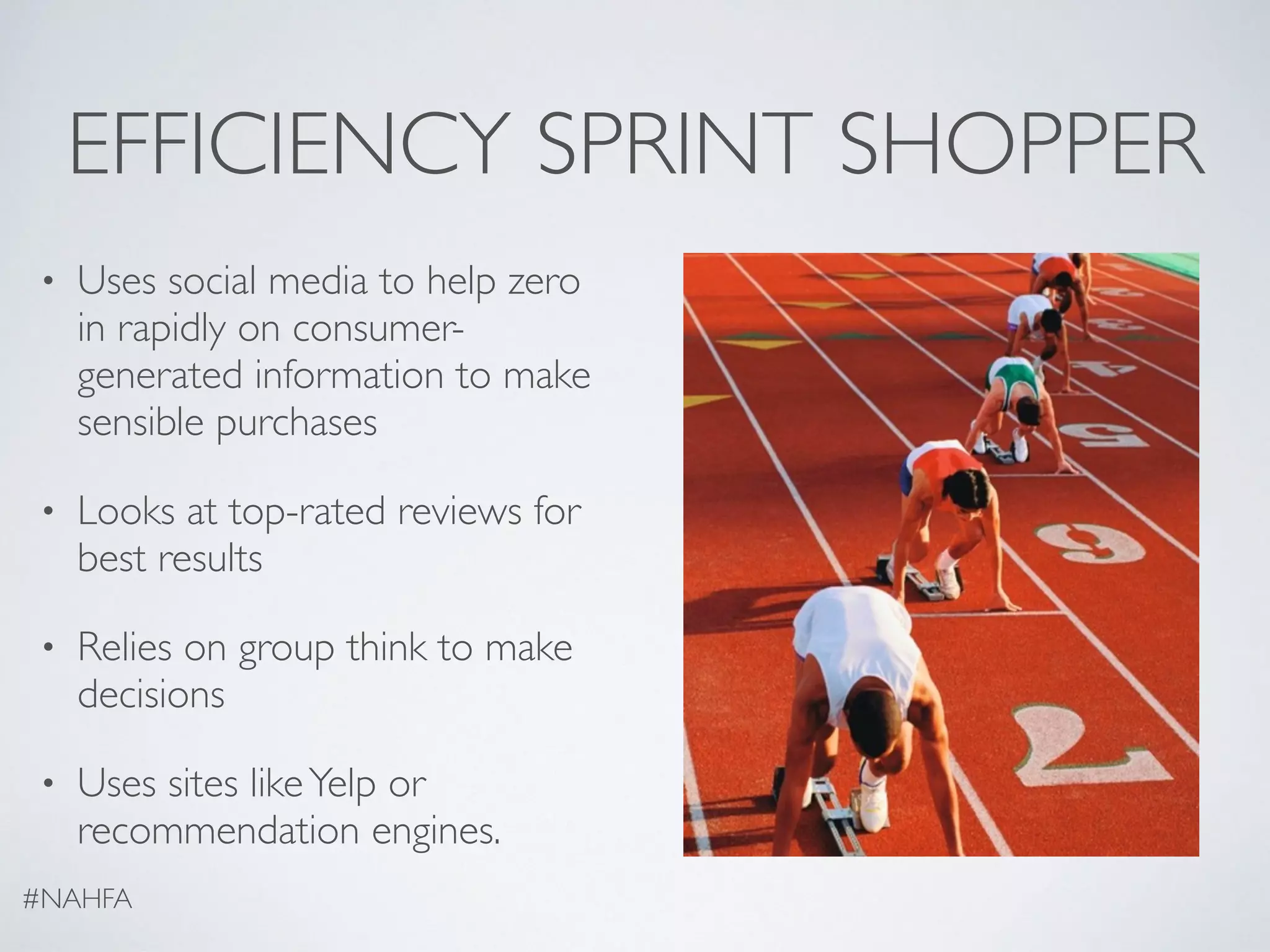
EFFICIENCY SPRINT SHOPPER
• Uses social media to help zero
in rapidly on consumer-
generated information to make
sensible purchases
• Looks at top-rated reviews for
best results
• Relies on group think to make
decisions
• Uses sites likeYelp or
recommendation engines.
#NAHFA
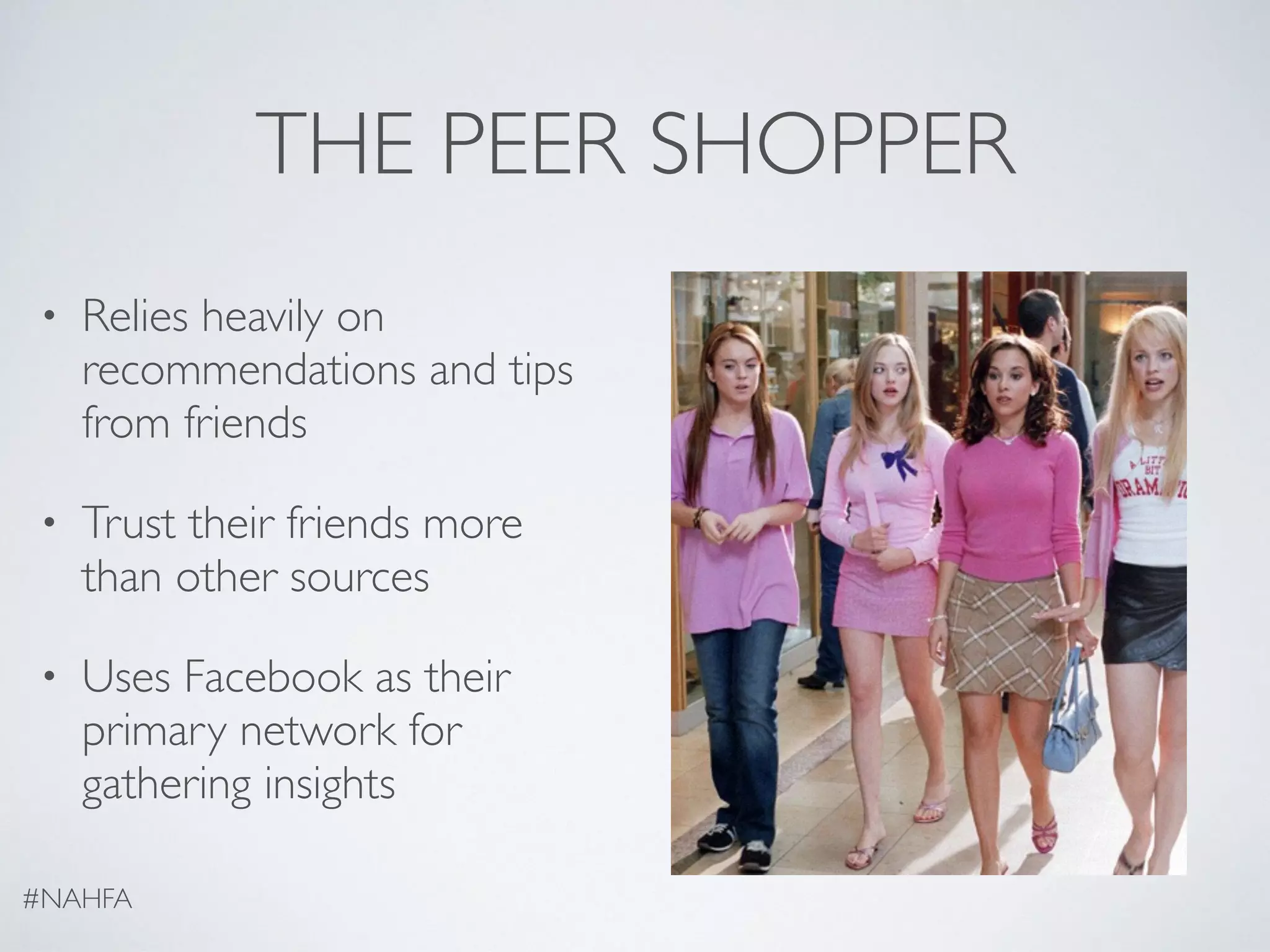
THE PEER SHOPPER
• Relies heavily on
recommendations and tips
from friends
• Trust their friends more
than other sources
• Uses Facebook as their
primary network for
gathering insights
#NAHFA
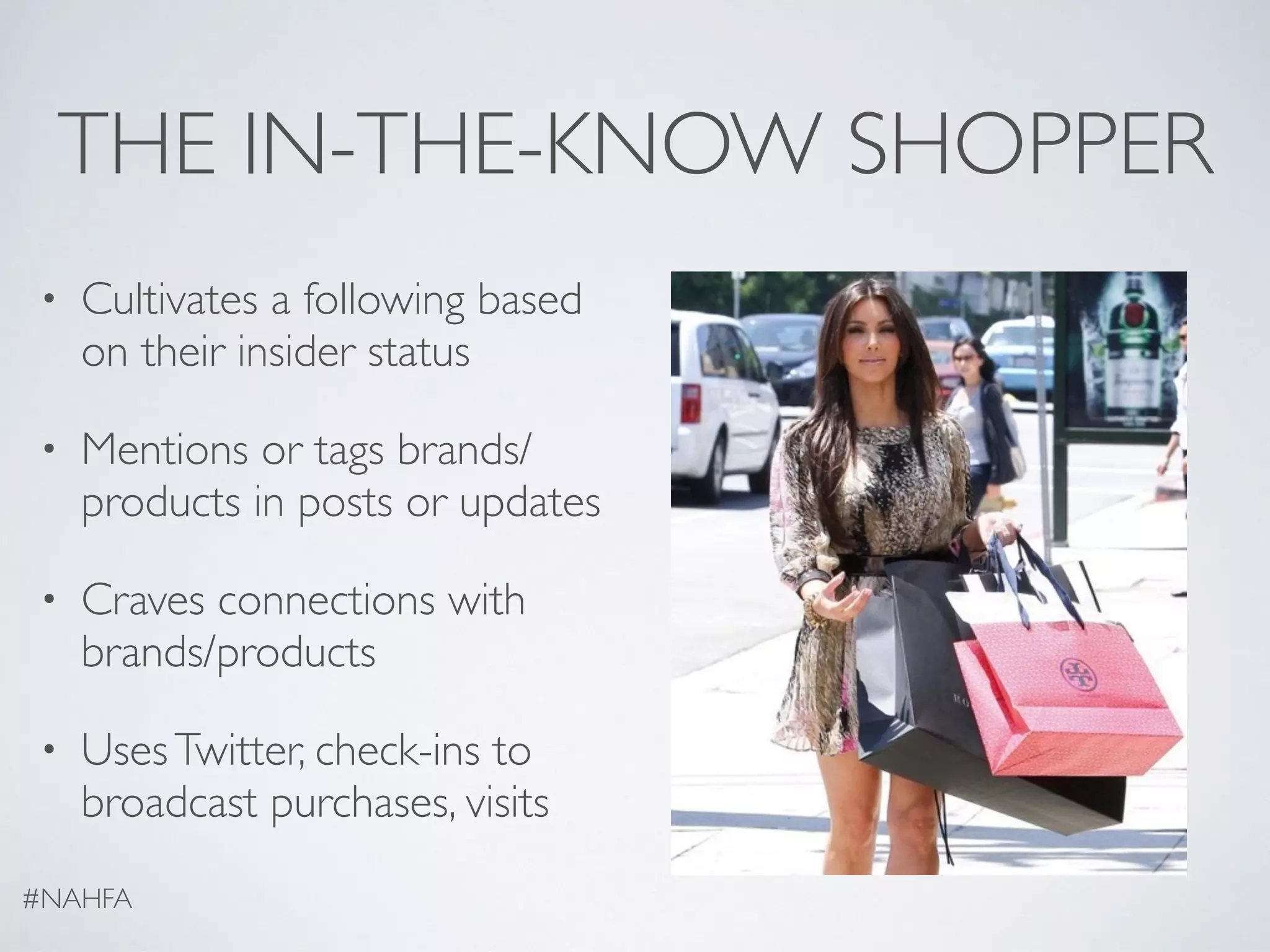
THE IN-THE-KNOW SHOPPER
• Cultivates a following based
on their insider status
• Mentions or tags brands/
products in posts or updates
• Craves connections with
brands/products
• UsesTwitter, check-ins to
broadcast purchases, visits
#NAHFA
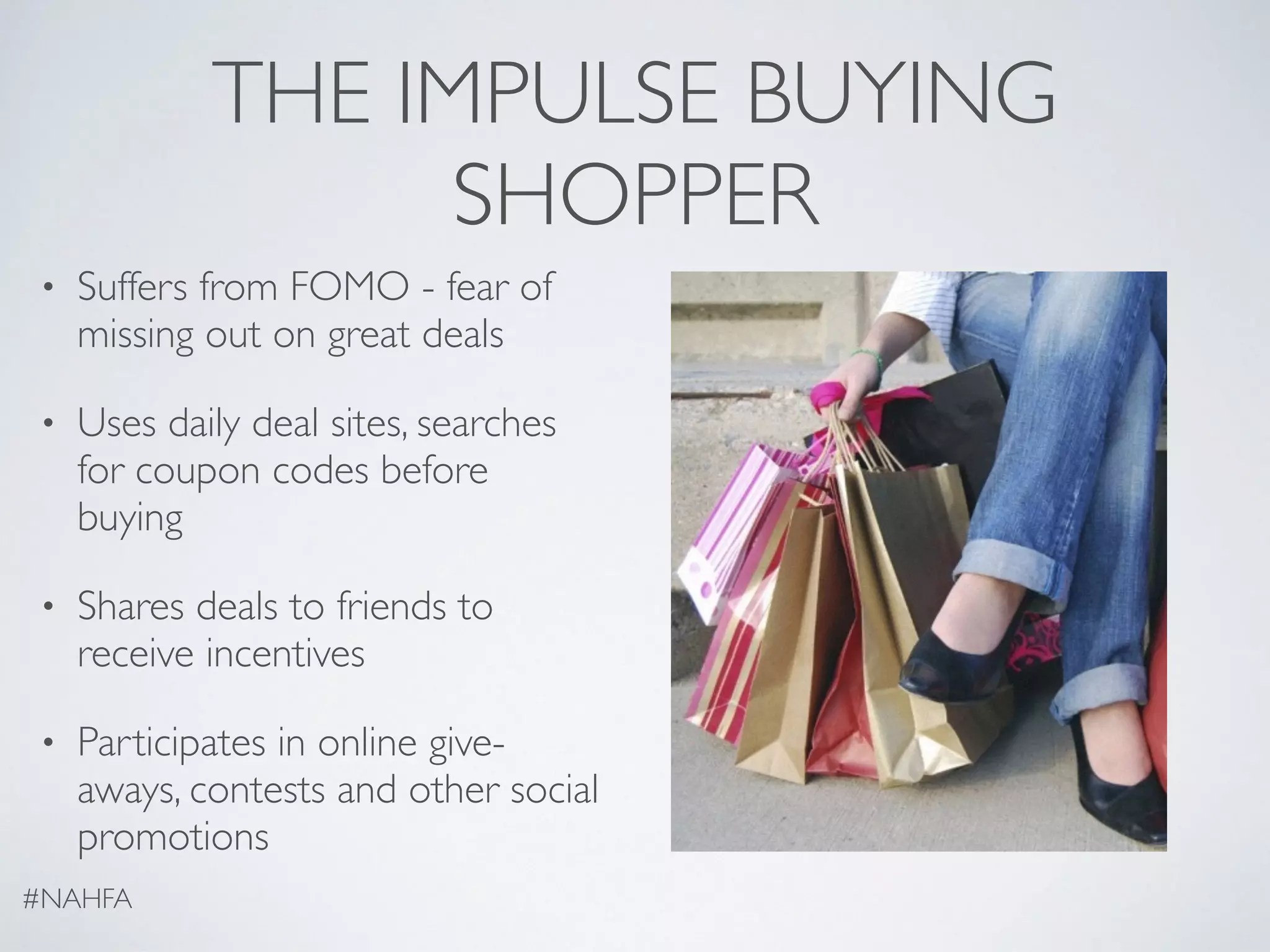
THE IMPULSE BUYING
SHOPPER
• Suffers from FOMO - fear of
missing out on great deals
• Uses daily deal sites, searches
for coupon codes before
buying
• Shares deals to friends to
receive incentives
• Participates in online give-
aways, contests and other social
promotions
#NAHFA
5 CATEGORIES FOR SOCIAL
SHOPPING
Group Shopping Sites
Sites like Groupon or Living Social that encourage
groups of people to buy together at wholesale
prices.
Shopping Communities
Using the wisdom of crowds, users communicate
and aggregate information about products, prices,
and deals. Many sites allow users to create custom
shopping lists and share them with friends.
Recommendation Engines
sites that provide customers opportunities to write
reviews and offer advice to fellow shoppers.
Shopping Marketplaces
Sites like Polyvore or Etsy that bring sellers and
buyers together to connect and transact. The
marketplace affords buyers and sellers methods to
connect and communicate whilst also performing
the role of e-commerce facilitator for sellers and
discovery engine for buyers.
Shared Shopping
Sites that allow shoppers to form ad hoc
collaborative shopping groups in which one person
can drive an online shopping experience for one or
more other people, using real-time communication
among themselves and with the retailer.
#NAHFA
WHAT SOCIAL SHOPPING
LOOKS LIKE
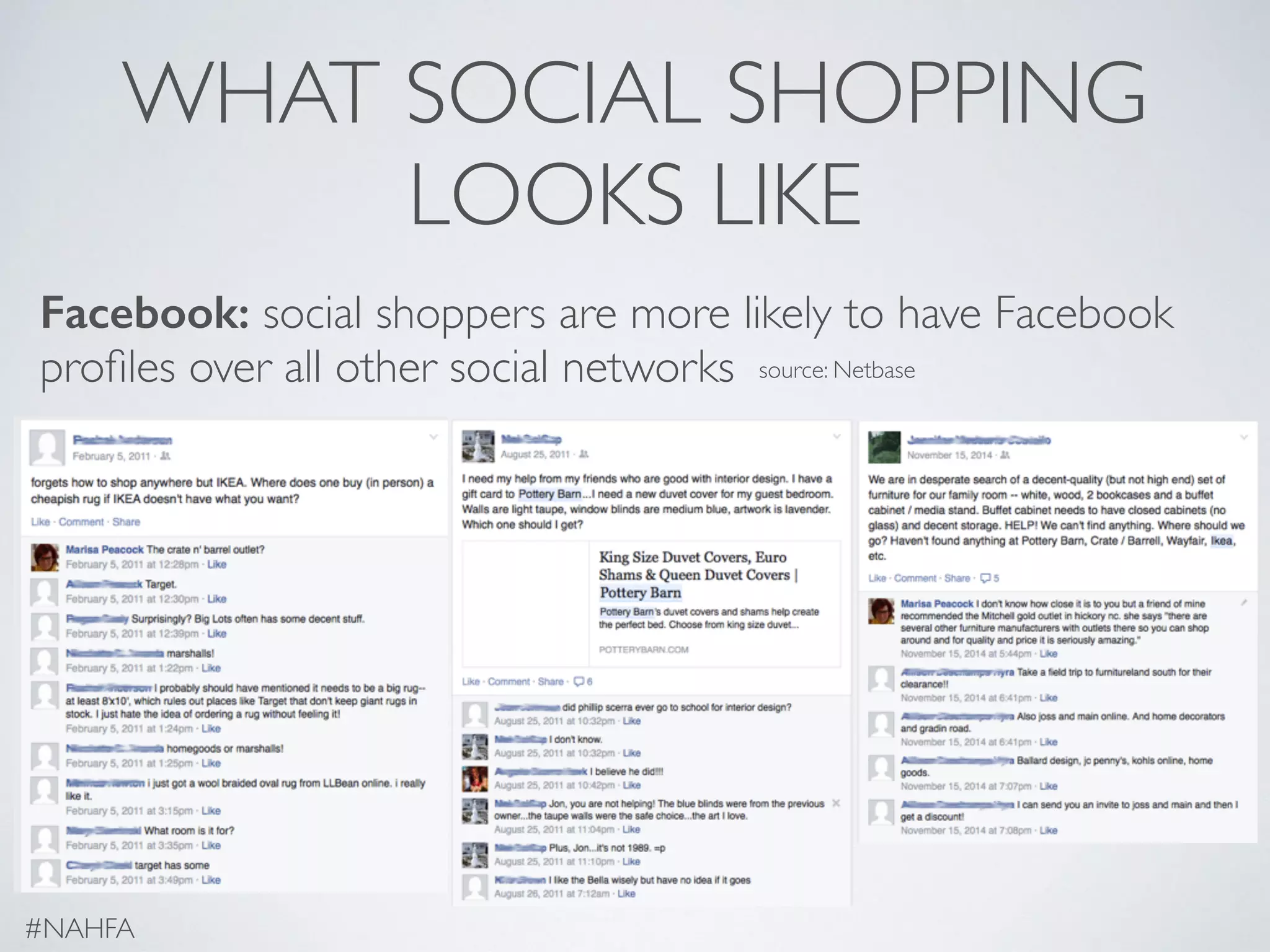
Facebook: social shoppers are more likely to have Facebook
profiles over all other social networks
#NAHFA
source: Netbase
WHAT SOCIAL SHOPPING
LOOKS LIKE
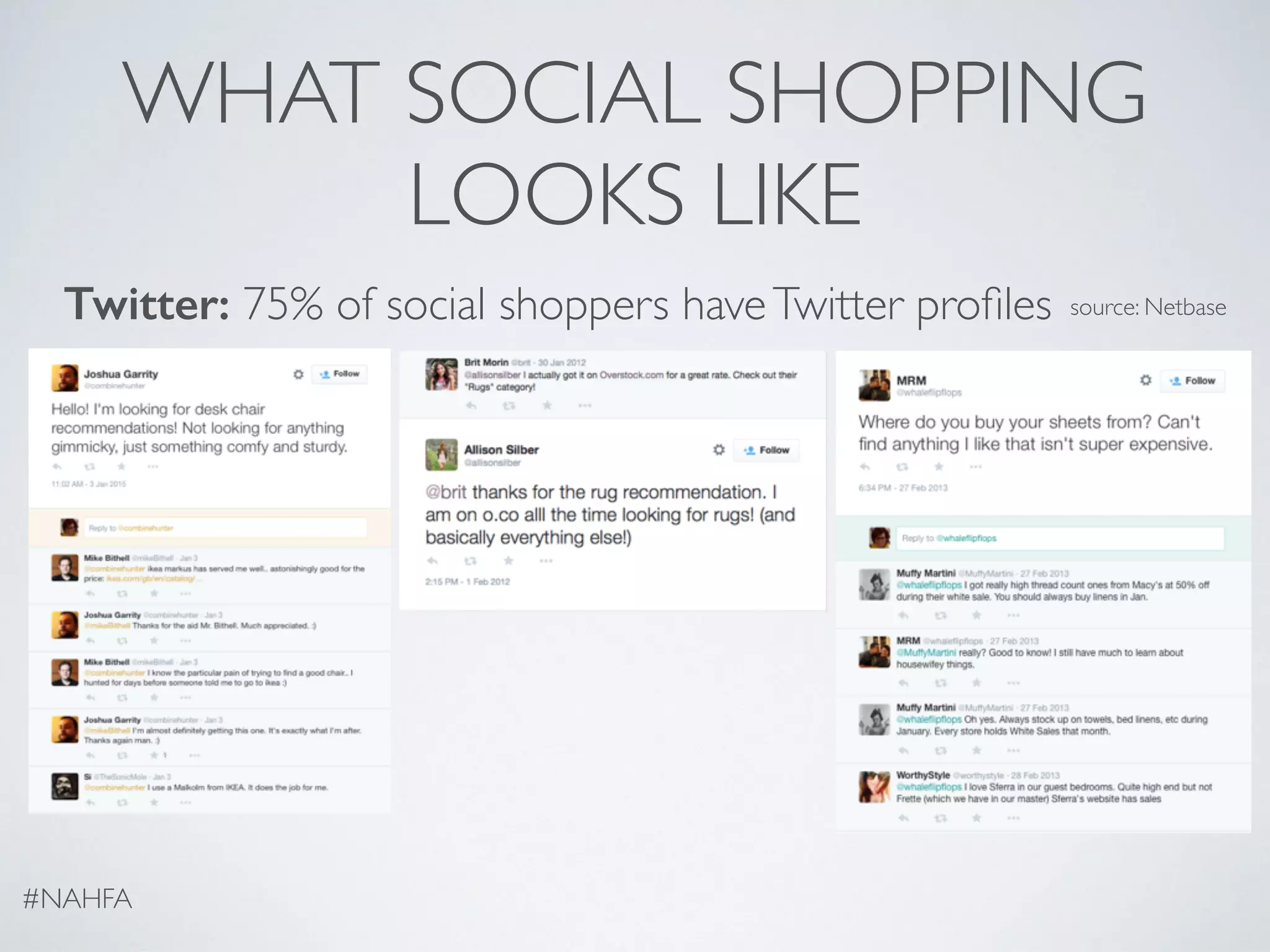
Twitter: 75% of social shoppers haveTwitter profiles
#NAHFA
source: Netbase
WHAT SOCIAL SHOPPING
LOOKS LIKE
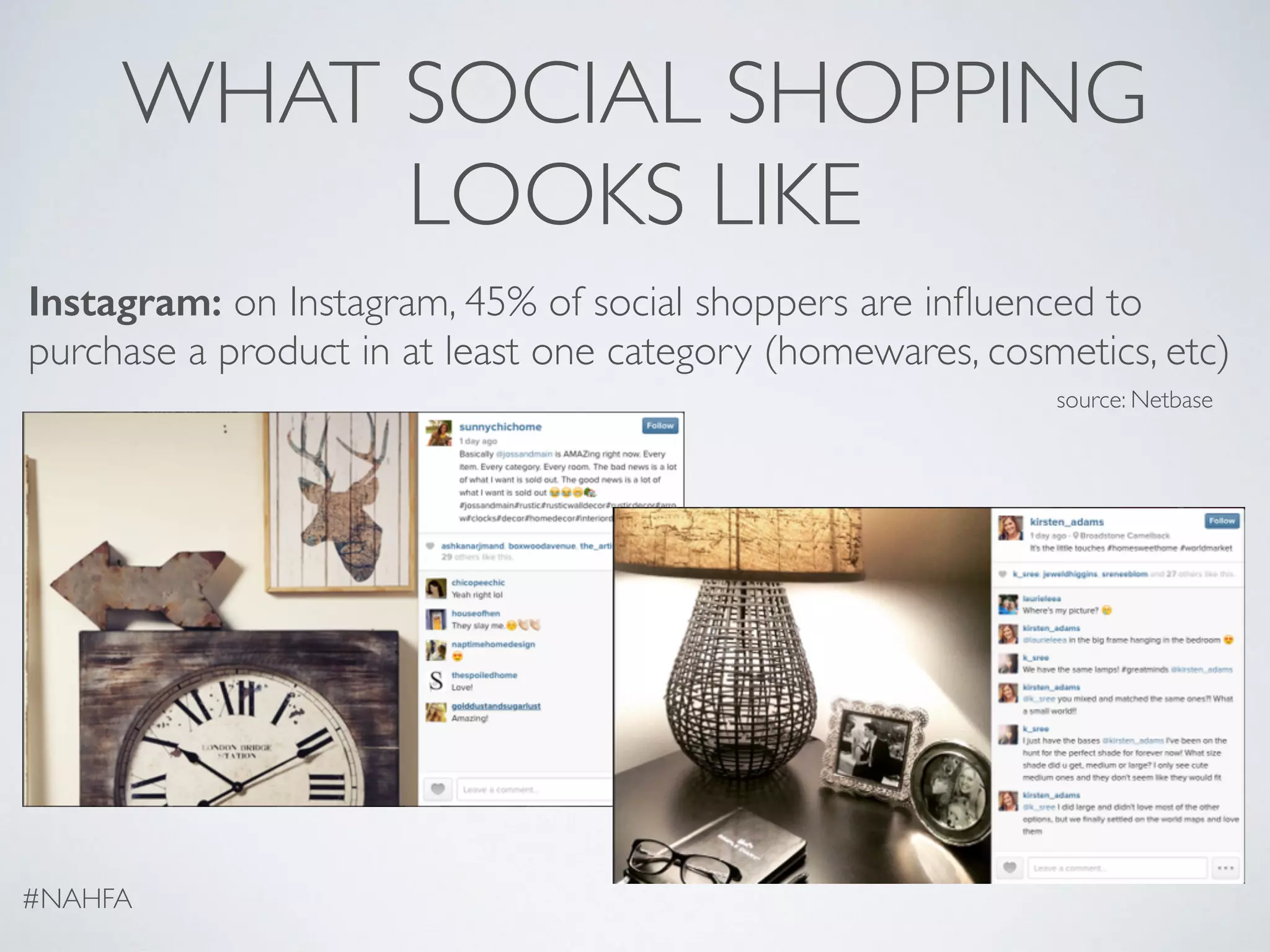
Instagram: on Instagram, 45% of social shoppers are influenced to
purchase a product in at least one category (homewares, cosmetics, etc)
#NAHFA
source: Netbase
WHAT SOCIAL SHOPPING
LOOKS LIKE
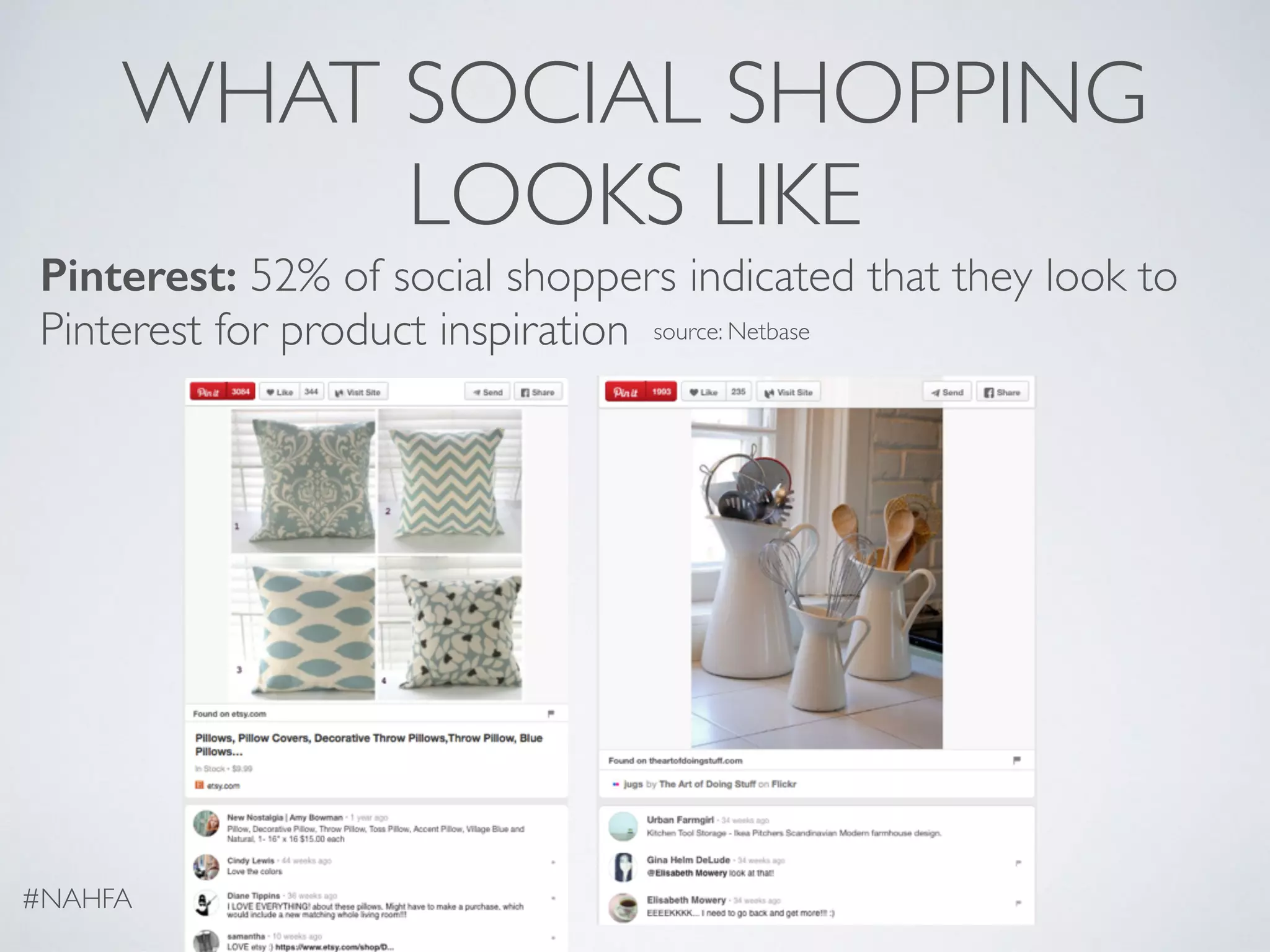
Pinterest: 52% of social shoppers indicated that they look to
Pinterest for product inspiration
#NAHFA
source: Netbase
WHAT SOCIAL SHOPPING
LOOKS LIKE
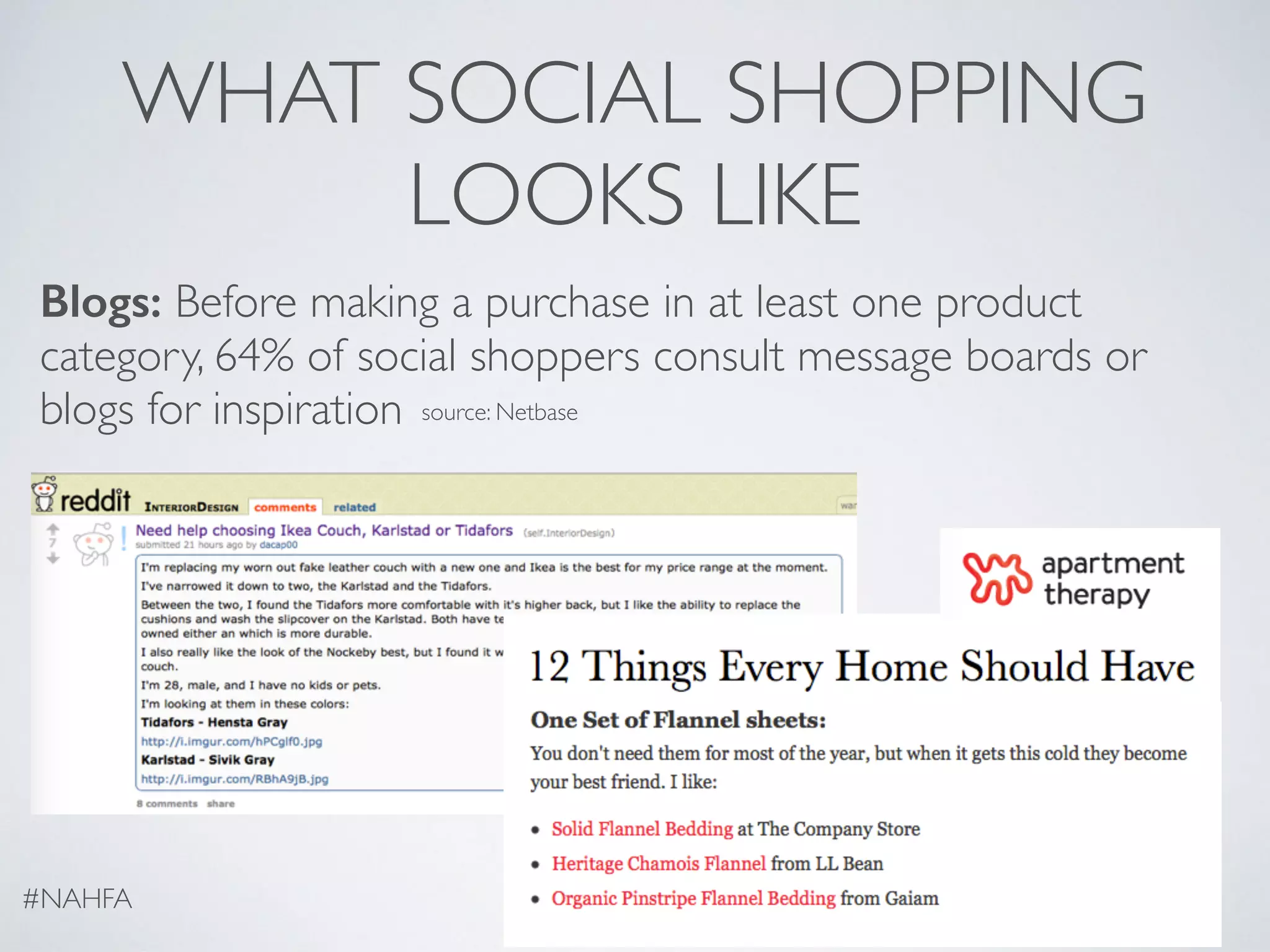
Blogs: Before making a purchase in at least one product
category, 64% of social shoppers consult message boards or
blogs for inspiration
#NAHFA
source: Netbase
WHAT SOCIAL SHOPPING
LOOKS LIKE
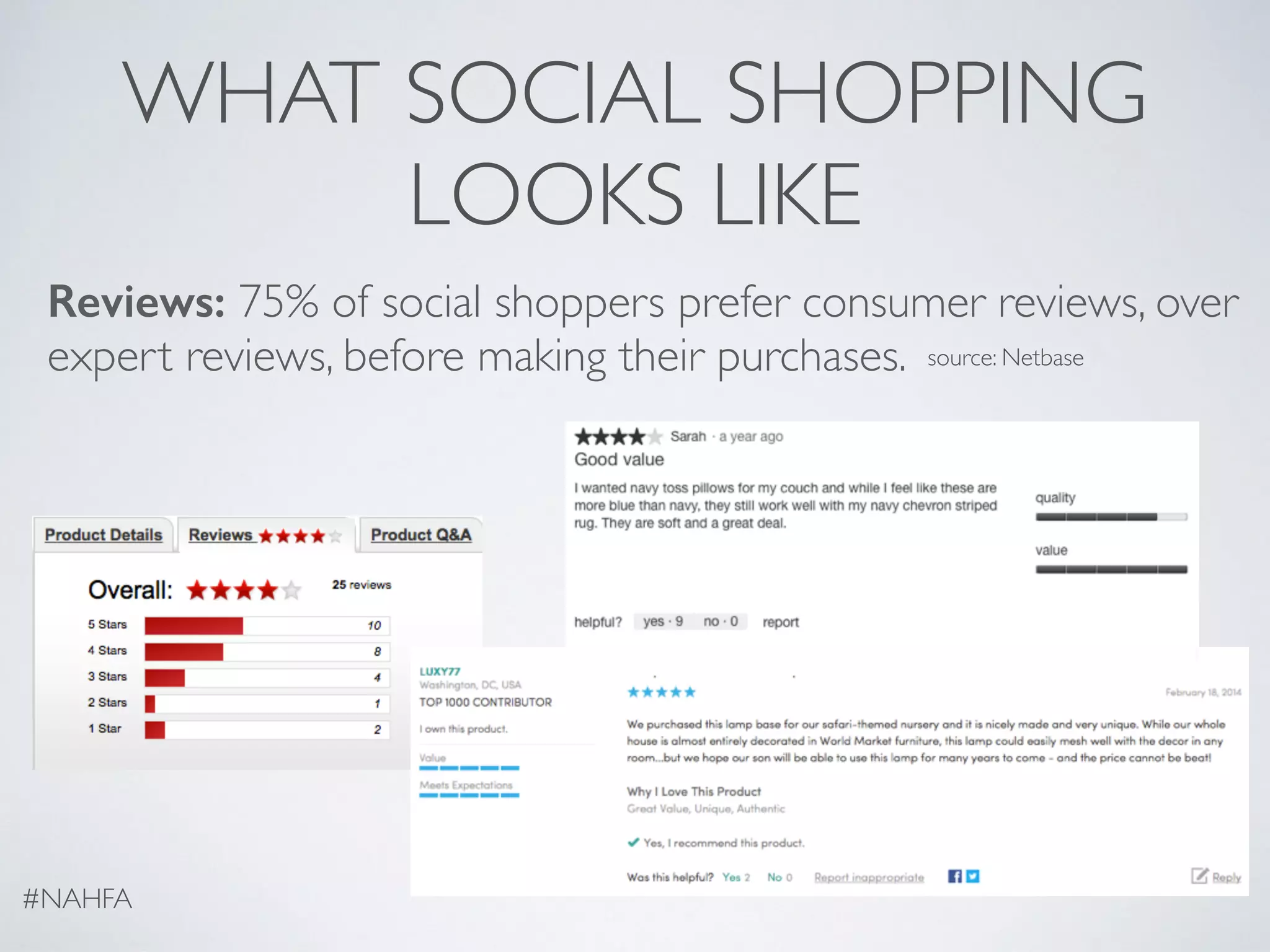
Reviews: 75% of social shoppers prefer consumer reviews, over
expert reviews, before making their purchases.
#NAHFA
source: Netbase
BEST PRACTICES
HOW RETAILERS CAN
CONNECT WITH SHOPPERS
Marketers can leverage social shopping to drive traffic,
sales, and loyalty and become the ultimate influencer.
Let’s learn how to:
• Show Social Proof
• Analyze sharing
behaviors
• Create a new
vocabulary
• Integrate online and
in-store experiences
#NAHFA
SHOW SOCIAL PROOF
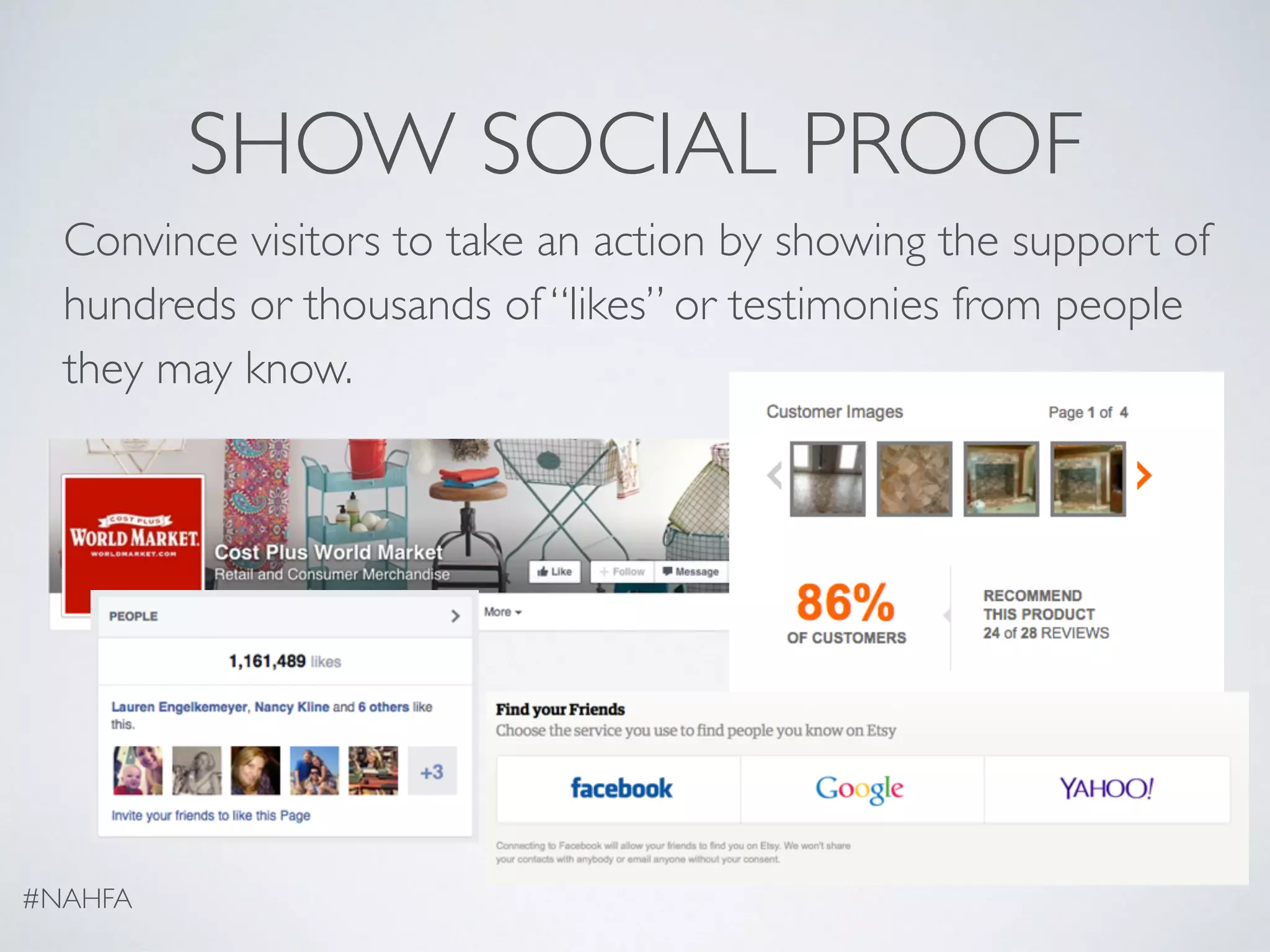
Convince visitors to take an action by showing the support of
hundreds or thousands of “likes” or testimonies from people
they may know.
#NAHFA
MAKE SHARING EASY
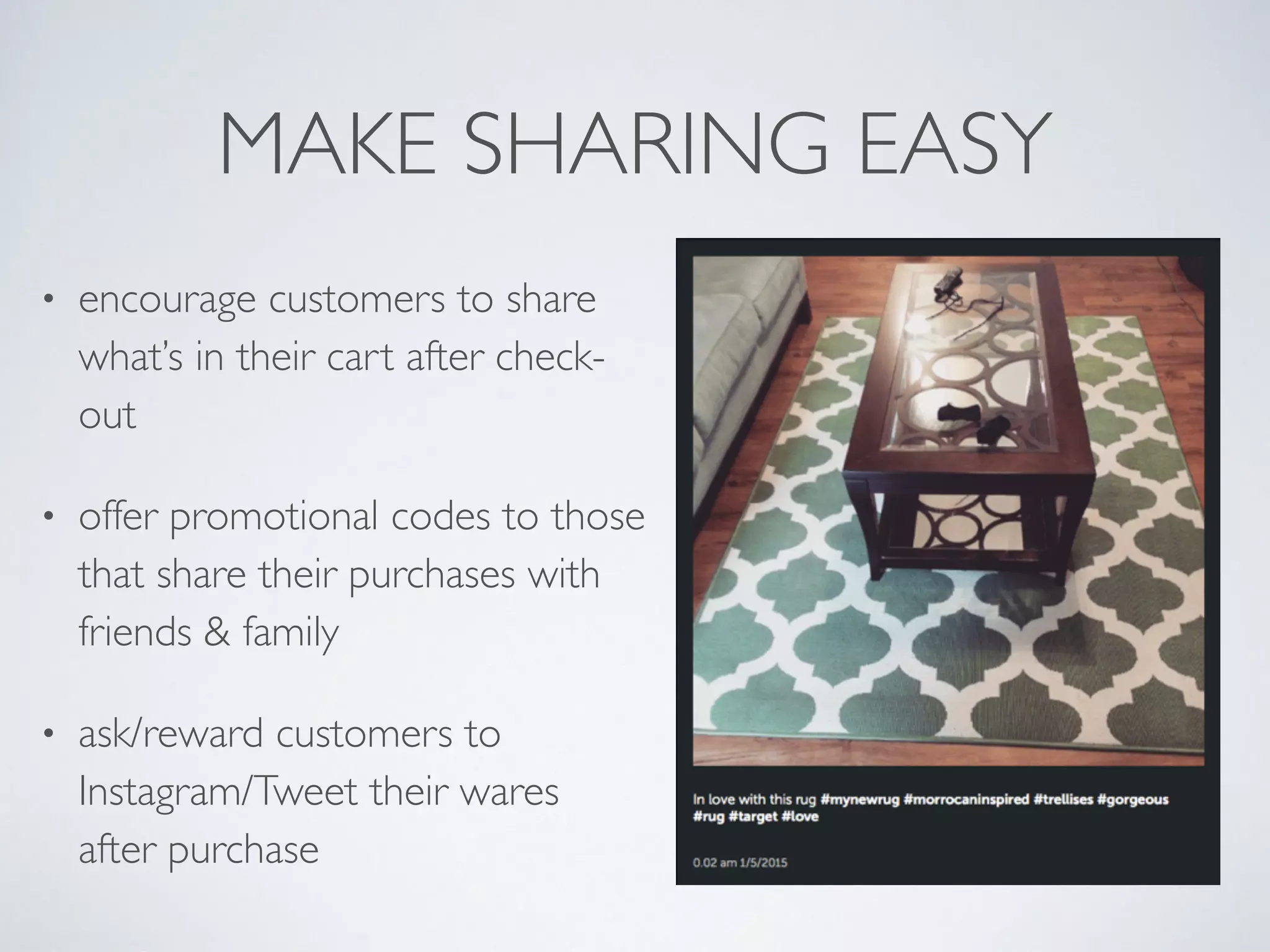
• encourage customers to share
what’s in their cart after check-
out
• offer promotional codes to those
that share their purchases with
friends & family
• ask/reward customers to
Instagram/Tweet their wares
after purchase
ANALYZE SHARING
BEHAVIORS
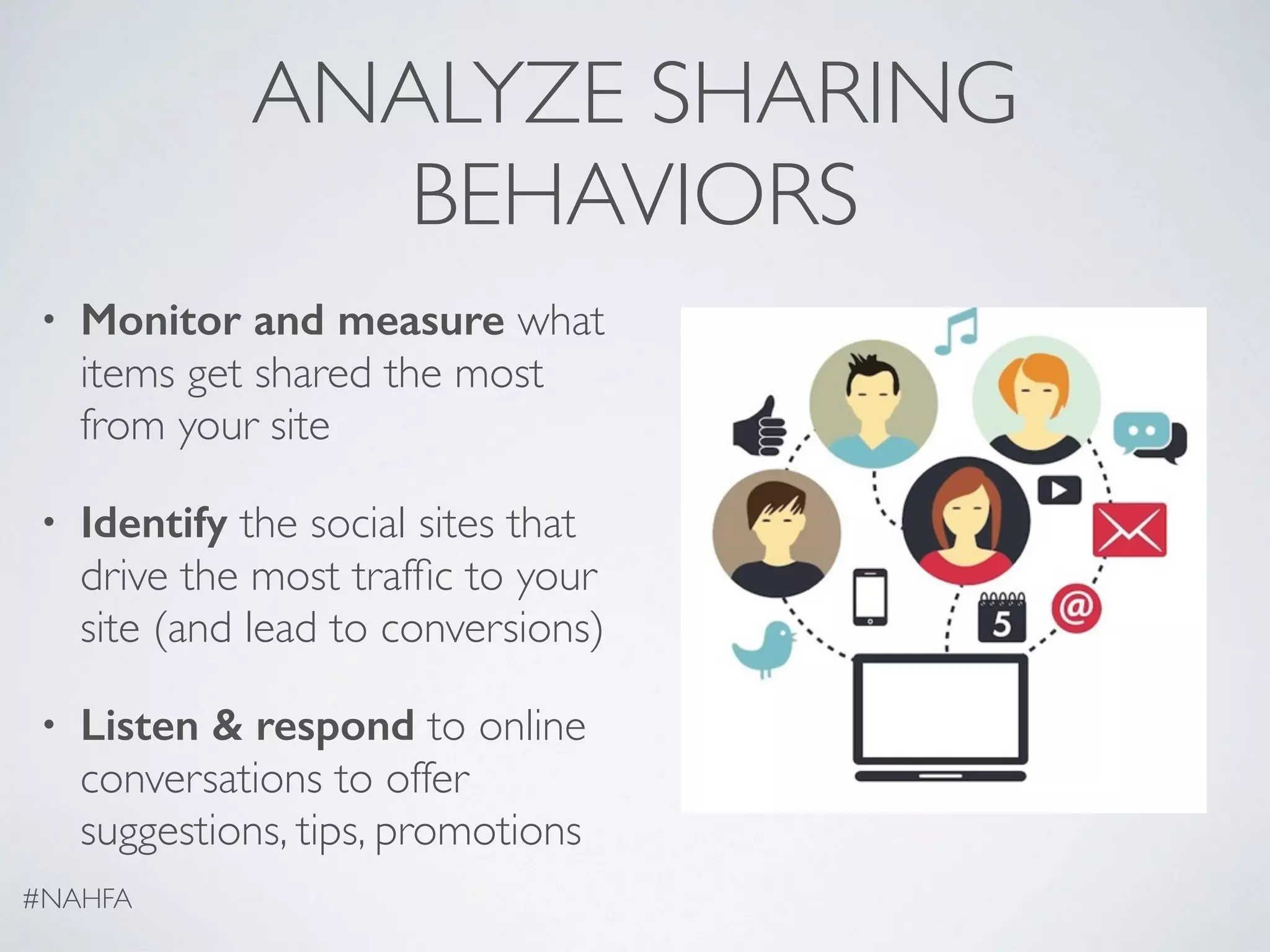
• Monitor and measure what
items get shared the most
from your site
• Identify the social sites that
drive the most traffic to your
site (and lead to conversions)
• Listen & respond to online
conversations to offer
suggestions, tips, promotions
#NAHFA
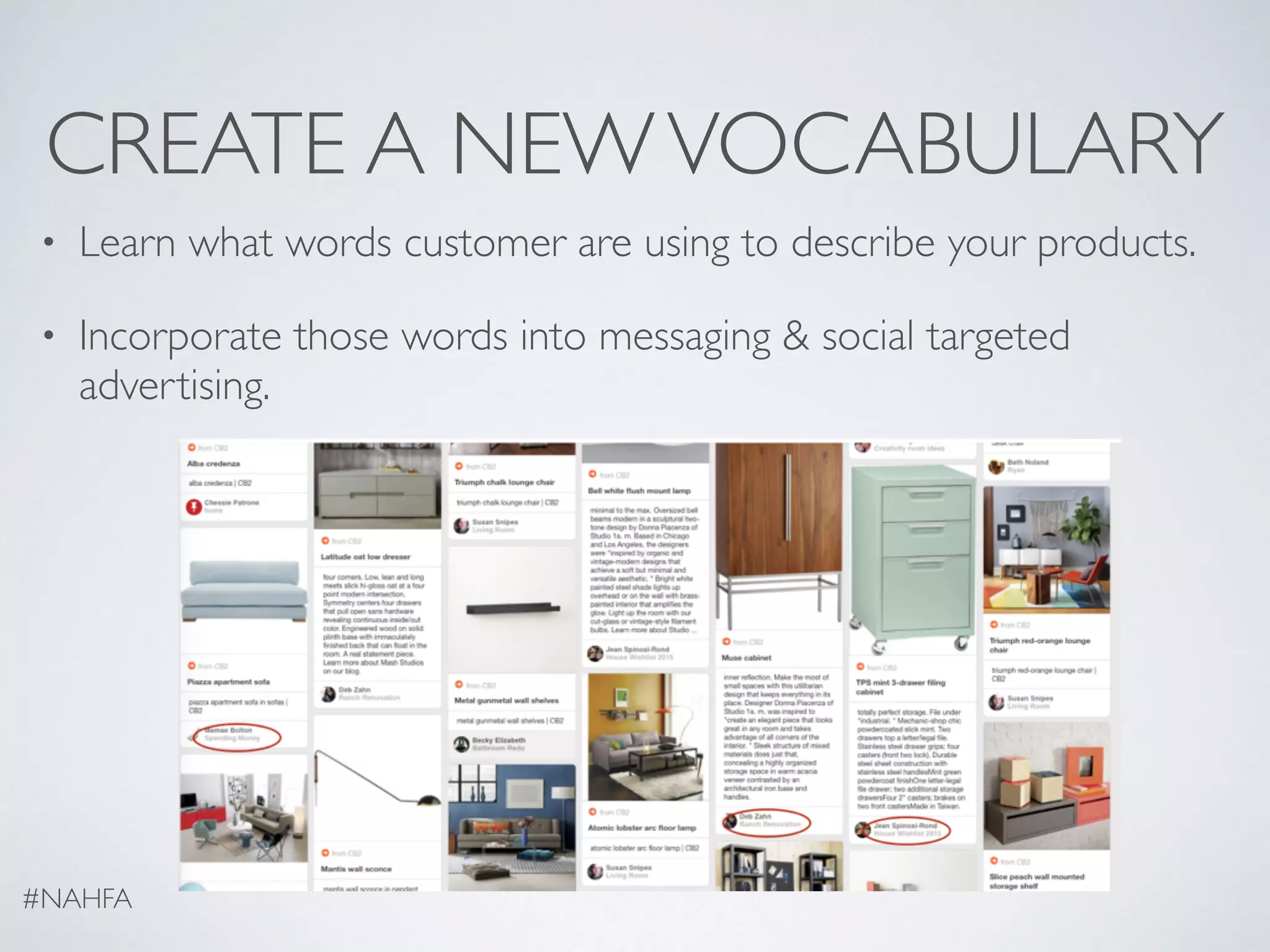
CREATE A NEWVOCABULARY
• Learn what words customer are using to describe your products.
• Incorporate those words into messaging & social targeted
advertising.
#NAHFA
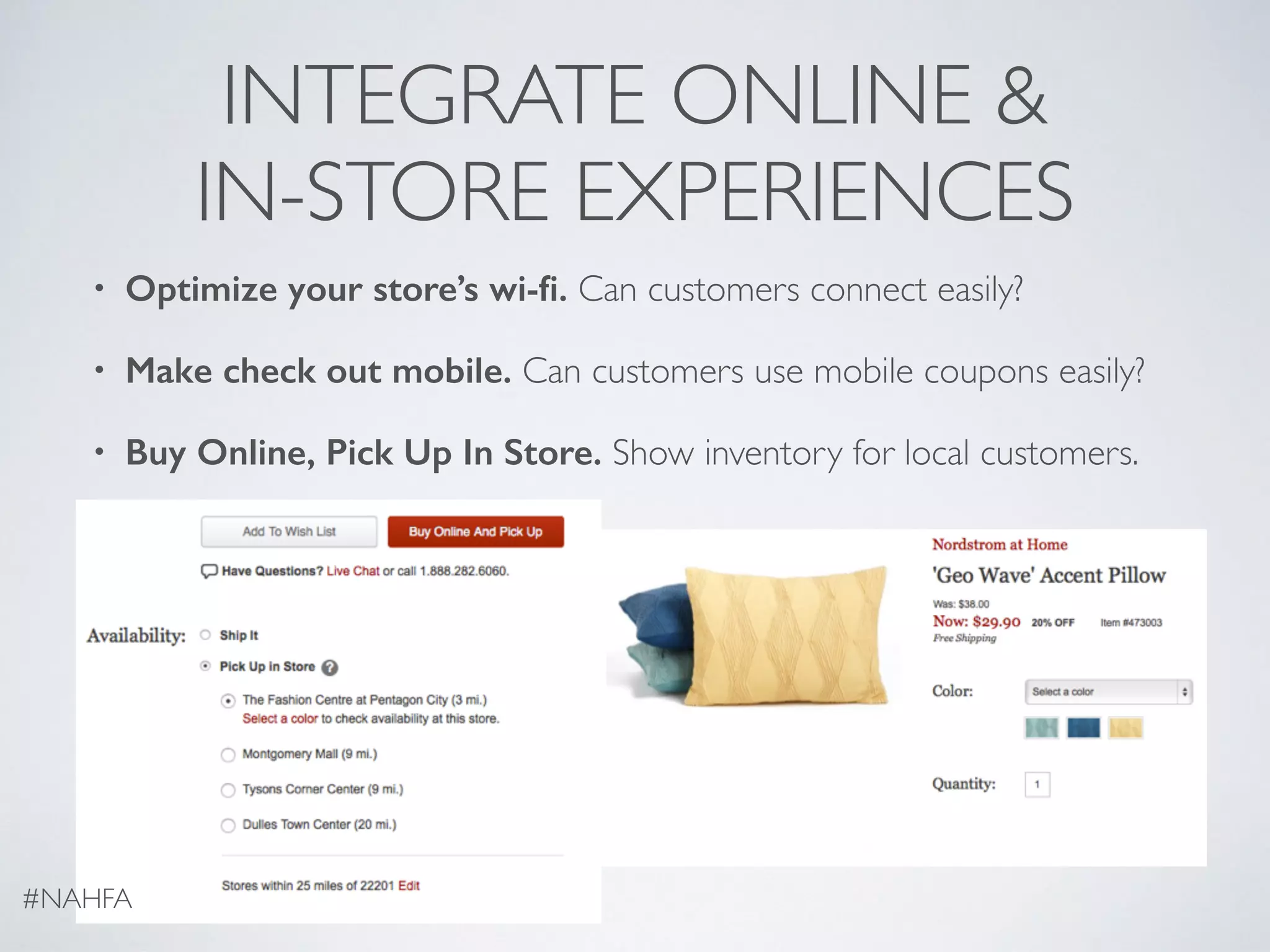
INTEGRATE ONLINE &
IN-STORE EXPERIENCES
• Optimize your store’s wi-fi. Can customers connect easily?
• Make check out mobile. Can customers use mobile coupons easily?
• Buy Online, Pick Up In Store. Show inventory for local customers.
#NAHFA
WHAT IS SHOWROOMING?
Showrooming: when customers
use a mobile device to compare
prices online to in-store prices, and
then leave the showroom to buy
online. (46% of people in the US
showroom)
Reverse Showrooming: when
consumers go online to research
products, but then head to a bricks-
and-mortar store to complete their
purchase. (69% of people in the US
reverse-showroom)
#NAHFA
source: BI Intelligence
WHATYOU NEEDTO KNOW
ABOUT SHOWROOMING
Amazon.com remains the No. 1 place where
showroomers end up making their purchases,
but it's an even more popular destination for
reverse showroomers who ultimately buy
elsewhere.
Location-based technology can engage
customers while they are in-store and provide
them with personalized offers on the item
they are looking at or mobile-only promotions
as they walk by a store. Personalized mobile
notifications can turn browsers into buyers.
42% of consumers using a mobile device
while in-store spend more than $1,000, while
only 21% of shoppers without a phone spend
as much.
#NAHFA
source: Interactive Advertising Bureau
source: BI Intelligence
QUESTIONS?
marisa@strategicpeacock.com
www.strategicpeacock.com
@marisacp51
THANKYOU!

The Social Shopper: How Retailers Can Connect with Shoppers

  • 1.
    THE SOCIAL SHOPPER HowRetailers Can Connect With Customers Marisa Peacock the Strategic Peacock North American Home Furnishings Association #NAHFA Winter Market, Las Vegas January 21, 2015
  • 2.
    WHAT IS SOCIALSHOPPING? Social shopping refers to consumers who use social networking services and sites to share their latest purchases, deals, coupons, product reviews, want lists, and other shopping finds. #NAHFA
  • 3.
    WHO IS ASOCIAL SHOPPER? Social shoppers are social media users who strongly agree with the statement: “the brands and products my friends use influence my own purchase decisions.” #NAHFA
  • 4.
    HOW MANY FRIENDSDO YOU HAVE? The average number of Facebook friends of US Facebook users in 2014, by age group #NAHFA
  • 5.
    FRIENDSHIPTRUMPS RESEARCH Researchers from Oxford,Harvard and the University of Limerick found that: Community members randomly copy the choices made by other members in the recent past so that products whose popularity levels have recently grown the fastest are more likely to be selected, whether or not they are most popular overall. #NAHFA
  • 6.
    TYPES OF SOCIALSHOPPERS • Efficiency Sprint Shopper • The Peer Shopper • The In-the-Know Shopper • Impulse Buying Shopper #NAHFA
  • 7.
    EFFICIENCY SPRINT SHOPPER •Uses social media to help zero in rapidly on consumer- generated information to make sensible purchases • Looks at top-rated reviews for best results • Relies on group think to make decisions • Uses sites likeYelp or recommendation engines. #NAHFA
  • 8.
    THE PEER SHOPPER •Relies heavily on recommendations and tips from friends • Trust their friends more than other sources • Uses Facebook as their primary network for gathering insights #NAHFA
  • 9.
    THE IN-THE-KNOW SHOPPER •Cultivates a following based on their insider status • Mentions or tags brands/ products in posts or updates • Craves connections with brands/products • UsesTwitter, check-ins to broadcast purchases, visits #NAHFA
  • 10.
    THE IMPULSE BUYING SHOPPER •Suffers from FOMO - fear of missing out on great deals • Uses daily deal sites, searches for coupon codes before buying • Shares deals to friends to receive incentives • Participates in online give- aways, contests and other social promotions #NAHFA
  • 11.
    5 CATEGORIES FORSOCIAL SHOPPING Group Shopping Sites Sites like Groupon or Living Social that encourage groups of people to buy together at wholesale prices. Shopping Communities Using the wisdom of crowds, users communicate and aggregate information about products, prices, and deals. Many sites allow users to create custom shopping lists and share them with friends. Recommendation Engines sites that provide customers opportunities to write reviews and offer advice to fellow shoppers. Shopping Marketplaces Sites like Polyvore or Etsy that bring sellers and buyers together to connect and transact. The marketplace affords buyers and sellers methods to connect and communicate whilst also performing the role of e-commerce facilitator for sellers and discovery engine for buyers. Shared Shopping Sites that allow shoppers to form ad hoc collaborative shopping groups in which one person can drive an online shopping experience for one or more other people, using real-time communication among themselves and with the retailer. #NAHFA
  • 12.
    WHAT SOCIAL SHOPPING LOOKSLIKE Facebook: social shoppers are more likely to have Facebook profiles over all other social networks #NAHFA source: Netbase
  • 13.
    WHAT SOCIAL SHOPPING LOOKSLIKE Twitter: 75% of social shoppers haveTwitter profiles #NAHFA source: Netbase
  • 14.
    WHAT SOCIAL SHOPPING LOOKSLIKE Instagram: on Instagram, 45% of social shoppers are influenced to purchase a product in at least one category (homewares, cosmetics, etc) #NAHFA source: Netbase
  • 15.
    WHAT SOCIAL SHOPPING LOOKSLIKE Pinterest: 52% of social shoppers indicated that they look to Pinterest for product inspiration #NAHFA source: Netbase
  • 16.
    WHAT SOCIAL SHOPPING LOOKSLIKE Blogs: Before making a purchase in at least one product category, 64% of social shoppers consult message boards or blogs for inspiration #NAHFA source: Netbase
  • 17.
    WHAT SOCIAL SHOPPING LOOKSLIKE Reviews: 75% of social shoppers prefer consumer reviews, over expert reviews, before making their purchases. #NAHFA source: Netbase
  • 18.
  • 19.
    HOW RETAILERS CAN CONNECTWITH SHOPPERS Marketers can leverage social shopping to drive traffic, sales, and loyalty and become the ultimate influencer. Let’s learn how to: • Show Social Proof • Analyze sharing behaviors • Create a new vocabulary • Integrate online and in-store experiences #NAHFA
  • 20.
    SHOW SOCIAL PROOF Convincevisitors to take an action by showing the support of hundreds or thousands of “likes” or testimonies from people they may know. #NAHFA
  • 21.
    MAKE SHARING EASY •encourage customers to share what’s in their cart after check- out • offer promotional codes to those that share their purchases with friends & family • ask/reward customers to Instagram/Tweet their wares after purchase
  • 22.
    ANALYZE SHARING BEHAVIORS • Monitorand measure what items get shared the most from your site • Identify the social sites that drive the most traffic to your site (and lead to conversions) • Listen & respond to online conversations to offer suggestions, tips, promotions #NAHFA
  • 23.
    CREATE A NEWVOCABULARY •Learn what words customer are using to describe your products. • Incorporate those words into messaging & social targeted advertising. #NAHFA
  • 24.
    INTEGRATE ONLINE & IN-STOREEXPERIENCES • Optimize your store’s wi-fi. Can customers connect easily? • Make check out mobile. Can customers use mobile coupons easily? • Buy Online, Pick Up In Store. Show inventory for local customers. #NAHFA
  • 25.
    WHAT IS SHOWROOMING? Showrooming:when customers use a mobile device to compare prices online to in-store prices, and then leave the showroom to buy online. (46% of people in the US showroom) Reverse Showrooming: when consumers go online to research products, but then head to a bricks- and-mortar store to complete their purchase. (69% of people in the US reverse-showroom) #NAHFA source: BI Intelligence source: BI Intelligence
  • 26.
    WHATYOU NEEDTO KNOW ABOUTSHOWROOMING Amazon.com remains the No. 1 place where showroomers end up making their purchases, but it's an even more popular destination for reverse showroomers who ultimately buy elsewhere. Location-based technology can engage customers while they are in-store and provide them with personalized offers on the item they are looking at or mobile-only promotions as they walk by a store. Personalized mobile notifications can turn browsers into buyers. 42% of consumers using a mobile device while in-store spend more than $1,000, while only 21% of shoppers without a phone spend as much. #NAHFA source: Interactive Advertising Bureau source: BI Intelligence
  • 27.