Samah al shukaili
Liver diseases
Case 1
• 35 yr old gentleman , not Known to have any
medical illness .
• He was called from blood bank that his
hepatitis profile is +ve.
• He came to do further investigation .
• LFT with heptitis profile was sent .
• HBsAgTotal : +ve
• Anti-HBsTotal : -ve
• anti-HBc : +ve
• ALT 80 ,
• AST/ALT : <2
• Hebtitis C : -ve
How to proceed
History
• often asymptomatic, but symptoms may include right
upper quadrant pain, jaundice, and pruritus.
• R/o possible causes for liver dx : alcohol and drug use, risk
factors for viral hepatitis, including intravenous drug use,
blood transfusion, and sexual activities.
- The history should explore diet, physical activity, change in
weight (usually an increase, such as 40 lb [18 kg] over two
to three years),
- Associated conditions (e.g., diabetes, hypertension,
hyperlipidemia, obesity, sleep apnea).
- The patient's family history should be checked for
cardiovascular and metabolic disorders, and chronic liver
disease
Physical examination
• Vital signs :including blood pressure, weight,
BMI, and waist circumference.
• Physical examination often is unremarkable,
but may include elevated blood pressure,
central obesity, and hepatosplenomegaly.
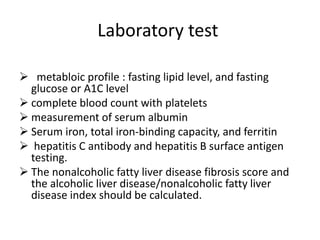
Laboratory test
 metabloic profile : fasting lipid level, and fasting
glucose or A1C level
 complete blood count with platelets
 measurement of serum albumin
 Serum iron, total iron-binding capacity, and ferritin
 hepatitis C antibody and hepatitis B surface antigen
testing.
 The nonalcoholic fatty liver disease fibrosis score and
the alcoholic liver disease/nonalcoholic fatty liver
disease index should be calculated.
• Additional laboratory evaluation should be
considered in patients with chronically
elevated liver enzyme levels or in those with a
family history of cirrhosis.
• These tests include measurement of
antinuclear antibody, smooth muscle
antibody, α1-antitrypsin, ceruloplasmin, and
thyroid-stimulating hormone levels
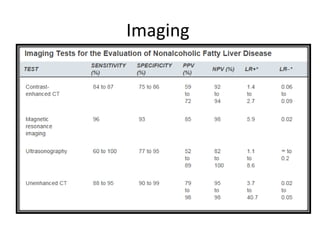
Imaging
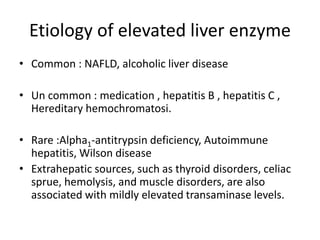
Etiology of elevated liver enzyme
• Common : NAFLD, alcoholic liver disease
• Un common : medication , hepatitis B , hepatitis C ,
Hereditary hemochromatosi.
• Rare :Alpha1-antitrypsin deficiency, Autoimmune
hepatitis, Wilson disease
• Extrahepatic sources, such as thyroid disorders, celiac
sprue, hemolysis, and muscle disorders, are also
associated with mildly elevated transaminase levels.
Case 2
• 38 yr old lady ,
• Give hx that she did US abdomen in private ,
without justified reason, found to have fatty
liver.
NAFLD
• Nonalcoholic fatty liver disease
fatty infiltration of the liver in the absence of other causes of
steatosis, such as alcohol consumption.
It is characterized by excessive fat accumulation in the liver
(hepatic steatosis).
Nonalcoholic steatohepatitis is a subgroup of nonalcoholic
fatty liver disease characterized by steatosis with additional
findings of liver cell injury and inflammation. Hepatic
steatosis and steatohepatitis can be distinguished only by
liver biopsy and histology . It is unclear whether
nonalcoholic fatty liver disease is a surrogate marker for
disease, such as metabolic syndrome.
Hepatic steatosis and steatohepatitis can be
distinguished only by liver biopsy and histology
pathogenesis
• The exact mechanism of nonalcoholic fatty
liver disease is unknown but involves insulin
resistance, steatosis, the release of
inflammatory cytokines, and oxidative stress,
which may lead to fibrosis and cirrhosis
epidemiology
• The prevalence of nonalcoholic fatty liver
disease has increased as more patients
develop a sedentary lifestyle, metabolic
syndrome, and obesity.
• It is the most common liver disease in
Western countries, with a prevalence of 27%
to 38%
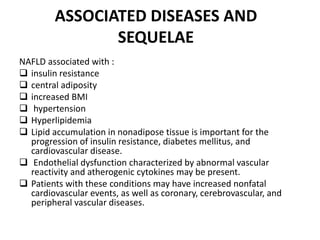
ASSOCIATED DISEASES AND
SEQUELAE
NAFLD associated with :
 insulin resistance
 central adiposity
 increased BMI
 hypertension
 Hyperlipidemia
 Lipid accumulation in nonadipose tissue is important for the
progression of insulin resistance, diabetes mellitus, and
cardiovascular disease.
 Endothelial dysfunction characterized by abnormal vascular
reactivity and atherogenic cytokines may be present.
 Patients with these conditions may have increased nonfatal
cardiovascular events, as well as coronary, cerebrovascular, and
peripheral vascular diseases.
screening
• Screening for nonalcoholic fatty liver disease is
not recommended in the general population.
• It usually is considered after an incidental
discovery of unexplained elevation of liver
enzyme levels or when hepatic steatosis is
noted on imaging (e.g., ultrasonography).
Risk factor
• age older than 45 years,
• an alanine transaminase (ALT) level greater than
the an aspartate transaminase (AST) level
• diabetes, insulin resistance
• low albumin level (less than 3.6 g per dL [36 g per
L])
• low platelet count (less than 100 × 103 per μL
[100 × 109 per L])
• metabolic syndrome, obesity
• portal hypertension on imaging
Liver biopsy
• It is the standard test for diagnosis and
determination of steatosis, as well as the
grade of inflammation and the stage of
fibrosis.
• Routine use is controversial in persons with
nonalcoholic fatty liver disease. Liver biopsy
should be considered in atypical clinical
situations.
NONINVASIVE TESTS FOR LIVER
FIBROSIS
 the aspartate transferase to platelet ratio index
 the alanine transferase ratio
 the BARD score, 5 which comprises the weighted sum of
three variables (body mass index [BMI] of 28 kg per m2 or
more, aspartate transferase to alanine transferase ratio,
and the presence of diabetes mellitus).
 The FIB-4 score has similar variables as the aspartate
transferase to platelet ratio index, with the addition of age.
 the NAFLD fibrosis score includes age, BMI, blood glucose
levels, transferase levels, platelet count, and albumin levels
 magnetic resonance elastography
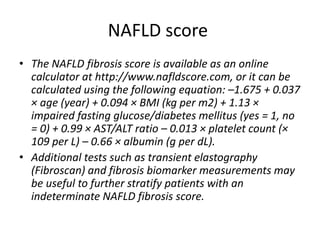
NAFLD score
• The NAFLD fibrosis score is available as an online
calculator at http://www.nafldscore.com, or it can be
calculated using the following equation: –1.675 + 0.037
× age (year) + 0.094 × BMI (kg per m2) + 1.13 ×
impaired fasting glucose/diabetes mellitus (yes = 1, no
= 0) + 0.99 × AST/ALT ratio – 0.013 × platelet count (×
109 per L) – 0.66 × albumin (g per dL).
• Additional tests such as transient elastography
(Fibroscan) and fibrosis biomarker measurements may
be useful to further stratify patients with an
indeterminate NAFLD fibrosis score.
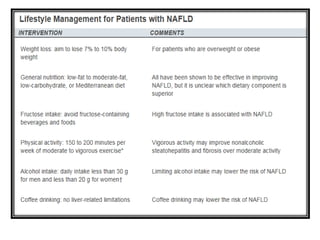
Treatment
• The goals of therapy include the prevention or
reversal of hepatic injury and fibrosis
• Comorbid conditions, such as diabetes,
hyperlipidemia, hypertension, or sleep apnea,
should be addressed and treated appropriately.
• Statins are not contraindicated in patients with
nonalcoholic fatty liver disease, and the risk of
hepatotoxicity in these patients is not increased
compared with the general population
PHARMACOLOGIC THERAPY
• Three Cochrane reviews found insufficient
evidence to support the use of bile acids (e.g.,
ursodeoxycholic acid), antioxidant
supplements, metformin (Glucophage), or
thiazolidinediones in the absence of diabetes
in patients with nonalcoholic fatty liver
disease.
prevention
• Should be Immunized for hepatitis A and B
• encouraged to limit alcohol use to prevent the
development of alcohol-induced liver disease.
prognosis
• not associated with an increased risk of all-
cause mortality, cardiovascular disease,
cancer, or liver disease.
• 15% to 30% of patients with nonalcoholic
steatohepatitis progress to advanced fibrosis
• 12% to 35% with advanced fibrosis progress to
cirrhosis
Applying the Evidence
• A 56-year-old woman with a BMI of 32 kg per m2 has a mild
elevation of transaminase levels on routine screening. Her
aspartate transferase level is 83 U per L (1.39 μkat per L),
normal = 10 to 40 U per L (0.17 to 0.67 μkat per L); and
alanine transferase is 100 U per L (1.67 μkat per L), normal
= 7 to 56 U per L (0.12 to 0.94 μkat per L). Other pertinent
laboratory findings include a serum albumin level of 4.4 g
per dL (44 g per L), normal = 3.5 to 5.5 g per dL (35 to 55 g
per L); and a normal complete blood count, with a platelet
count of 230 × 103 per mm3 (230 × 109 per L).
Ultrasonography shows fatty infiltration of the liver. She
does not have impaired glucose tolerance, and she does
not drink alcohol. How should this patient be managed?
Answer
• Using the online calculator (http://www. nafld
score.com), she has an NAFLD fibrosis score of
–1.667, which is less than the low cutoff of –
1.455. Thus, the probability that she has
significant fibrosis is low, and she can be
treated by her primary care physician.
Reference
• AAFP
• Mildly Elevated Liver Transaminase Levels:
Causes and Evaluation, 2017
• Nonalcoholic Fatty Liver Disease: Diagnosis
and Management , 2013
• Point-of-Care Guides, Nonalcoholic Fatty
Liver Disease: Identifying Patients at Risk of
Inflammation or Fibrosis

Nafld raised lft

  • 1.
  • 2.
    Case 1 • 35yr old gentleman , not Known to have any medical illness . • He was called from blood bank that his hepatitis profile is +ve. • He came to do further investigation . • LFT with heptitis profile was sent .
  • 3.
    • HBsAgTotal :+ve • Anti-HBsTotal : -ve • anti-HBc : +ve • ALT 80 , • AST/ALT : <2 • Hebtitis C : -ve
  • 4.
  • 5.
    History • often asymptomatic,but symptoms may include right upper quadrant pain, jaundice, and pruritus. • R/o possible causes for liver dx : alcohol and drug use, risk factors for viral hepatitis, including intravenous drug use, blood transfusion, and sexual activities. - The history should explore diet, physical activity, change in weight (usually an increase, such as 40 lb [18 kg] over two to three years), - Associated conditions (e.g., diabetes, hypertension, hyperlipidemia, obesity, sleep apnea). - The patient's family history should be checked for cardiovascular and metabolic disorders, and chronic liver disease
  • 6.
    Physical examination • Vitalsigns :including blood pressure, weight, BMI, and waist circumference. • Physical examination often is unremarkable, but may include elevated blood pressure, central obesity, and hepatosplenomegaly.
  • 7.
    Laboratory test  metabloicprofile : fasting lipid level, and fasting glucose or A1C level  complete blood count with platelets  measurement of serum albumin  Serum iron, total iron-binding capacity, and ferritin  hepatitis C antibody and hepatitis B surface antigen testing.  The nonalcoholic fatty liver disease fibrosis score and the alcoholic liver disease/nonalcoholic fatty liver disease index should be calculated.
  • 8.
    • Additional laboratoryevaluation should be considered in patients with chronically elevated liver enzyme levels or in those with a family history of cirrhosis. • These tests include measurement of antinuclear antibody, smooth muscle antibody, α1-antitrypsin, ceruloplasmin, and thyroid-stimulating hormone levels
  • 9.
  • 10.
    Etiology of elevatedliver enzyme • Common : NAFLD, alcoholic liver disease • Un common : medication , hepatitis B , hepatitis C , Hereditary hemochromatosi. • Rare :Alpha1-antitrypsin deficiency, Autoimmune hepatitis, Wilson disease • Extrahepatic sources, such as thyroid disorders, celiac sprue, hemolysis, and muscle disorders, are also associated with mildly elevated transaminase levels.
  • 12.
    Case 2 • 38yr old lady , • Give hx that she did US abdomen in private , without justified reason, found to have fatty liver.
  • 13.
    NAFLD • Nonalcoholic fattyliver disease fatty infiltration of the liver in the absence of other causes of steatosis, such as alcohol consumption. It is characterized by excessive fat accumulation in the liver (hepatic steatosis). Nonalcoholic steatohepatitis is a subgroup of nonalcoholic fatty liver disease characterized by steatosis with additional findings of liver cell injury and inflammation. Hepatic steatosis and steatohepatitis can be distinguished only by liver biopsy and histology . It is unclear whether nonalcoholic fatty liver disease is a surrogate marker for disease, such as metabolic syndrome.
  • 14.
    Hepatic steatosis andsteatohepatitis can be distinguished only by liver biopsy and histology
  • 15.
    pathogenesis • The exactmechanism of nonalcoholic fatty liver disease is unknown but involves insulin resistance, steatosis, the release of inflammatory cytokines, and oxidative stress, which may lead to fibrosis and cirrhosis
  • 16.
    epidemiology • The prevalenceof nonalcoholic fatty liver disease has increased as more patients develop a sedentary lifestyle, metabolic syndrome, and obesity. • It is the most common liver disease in Western countries, with a prevalence of 27% to 38%
  • 17.
    ASSOCIATED DISEASES AND SEQUELAE NAFLDassociated with :  insulin resistance  central adiposity  increased BMI  hypertension  Hyperlipidemia  Lipid accumulation in nonadipose tissue is important for the progression of insulin resistance, diabetes mellitus, and cardiovascular disease.  Endothelial dysfunction characterized by abnormal vascular reactivity and atherogenic cytokines may be present.  Patients with these conditions may have increased nonfatal cardiovascular events, as well as coronary, cerebrovascular, and peripheral vascular diseases.
  • 18.
    screening • Screening fornonalcoholic fatty liver disease is not recommended in the general population. • It usually is considered after an incidental discovery of unexplained elevation of liver enzyme levels or when hepatic steatosis is noted on imaging (e.g., ultrasonography).
  • 19.
    Risk factor • ageolder than 45 years, • an alanine transaminase (ALT) level greater than the an aspartate transaminase (AST) level • diabetes, insulin resistance • low albumin level (less than 3.6 g per dL [36 g per L]) • low platelet count (less than 100 × 103 per μL [100 × 109 per L]) • metabolic syndrome, obesity • portal hypertension on imaging
  • 20.
    Liver biopsy • Itis the standard test for diagnosis and determination of steatosis, as well as the grade of inflammation and the stage of fibrosis. • Routine use is controversial in persons with nonalcoholic fatty liver disease. Liver biopsy should be considered in atypical clinical situations.
  • 21.
    NONINVASIVE TESTS FORLIVER FIBROSIS  the aspartate transferase to platelet ratio index  the alanine transferase ratio  the BARD score, 5 which comprises the weighted sum of three variables (body mass index [BMI] of 28 kg per m2 or more, aspartate transferase to alanine transferase ratio, and the presence of diabetes mellitus).  The FIB-4 score has similar variables as the aspartate transferase to platelet ratio index, with the addition of age.  the NAFLD fibrosis score includes age, BMI, blood glucose levels, transferase levels, platelet count, and albumin levels  magnetic resonance elastography
  • 22.
    NAFLD score • TheNAFLD fibrosis score is available as an online calculator at http://www.nafldscore.com, or it can be calculated using the following equation: –1.675 + 0.037 × age (year) + 0.094 × BMI (kg per m2) + 1.13 × impaired fasting glucose/diabetes mellitus (yes = 1, no = 0) + 0.99 × AST/ALT ratio – 0.013 × platelet count (× 109 per L) – 0.66 × albumin (g per dL). • Additional tests such as transient elastography (Fibroscan) and fibrosis biomarker measurements may be useful to further stratify patients with an indeterminate NAFLD fibrosis score.
  • 24.
    Treatment • The goalsof therapy include the prevention or reversal of hepatic injury and fibrosis • Comorbid conditions, such as diabetes, hyperlipidemia, hypertension, or sleep apnea, should be addressed and treated appropriately. • Statins are not contraindicated in patients with nonalcoholic fatty liver disease, and the risk of hepatotoxicity in these patients is not increased compared with the general population
  • 26.
    PHARMACOLOGIC THERAPY • ThreeCochrane reviews found insufficient evidence to support the use of bile acids (e.g., ursodeoxycholic acid), antioxidant supplements, metformin (Glucophage), or thiazolidinediones in the absence of diabetes in patients with nonalcoholic fatty liver disease.
  • 27.
    prevention • Should beImmunized for hepatitis A and B • encouraged to limit alcohol use to prevent the development of alcohol-induced liver disease.
  • 28.
    prognosis • not associatedwith an increased risk of all- cause mortality, cardiovascular disease, cancer, or liver disease. • 15% to 30% of patients with nonalcoholic steatohepatitis progress to advanced fibrosis • 12% to 35% with advanced fibrosis progress to cirrhosis
  • 29.
    Applying the Evidence •A 56-year-old woman with a BMI of 32 kg per m2 has a mild elevation of transaminase levels on routine screening. Her aspartate transferase level is 83 U per L (1.39 μkat per L), normal = 10 to 40 U per L (0.17 to 0.67 μkat per L); and alanine transferase is 100 U per L (1.67 μkat per L), normal = 7 to 56 U per L (0.12 to 0.94 μkat per L). Other pertinent laboratory findings include a serum albumin level of 4.4 g per dL (44 g per L), normal = 3.5 to 5.5 g per dL (35 to 55 g per L); and a normal complete blood count, with a platelet count of 230 × 103 per mm3 (230 × 109 per L). Ultrasonography shows fatty infiltration of the liver. She does not have impaired glucose tolerance, and she does not drink alcohol. How should this patient be managed?
  • 30.
    Answer • Using theonline calculator (http://www. nafld score.com), she has an NAFLD fibrosis score of –1.667, which is less than the low cutoff of – 1.455. Thus, the probability that she has significant fibrosis is low, and she can be treated by her primary care physician.
  • 31.
    Reference • AAFP • MildlyElevated Liver Transaminase Levels: Causes and Evaluation, 2017 • Nonalcoholic Fatty Liver Disease: Diagnosis and Management , 2013 • Point-of-Care Guides, Nonalcoholic Fatty Liver Disease: Identifying Patients at Risk of Inflammation or Fibrosis