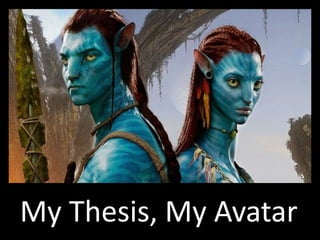
My Thesis, My Avatar
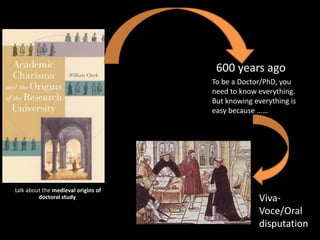
talk about the medieval origins of
doctoral study
600 years ago
To be a Doctor/PhD, you
need to know everything.
But knowing everything is
easy because ……
Viva-
Voce/Oral
disputation
everything is about to change…
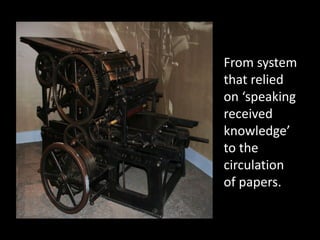
From system
that relied
on ‘speaking
received
knowledge’
to the
circulation
of papers.
The text started to ‘embody the
scholar’ because the
text started to ‘speak knowledge’.
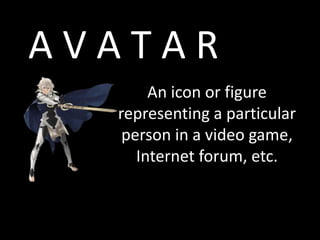
An icon or figure
representing a particular
person in a video game,
Internet forum, etc.
A V A T A R
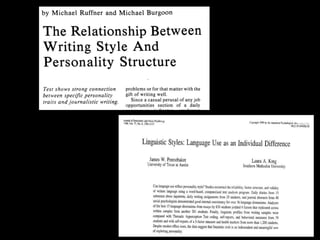
Relationship
between writing
style and
personality?
YES
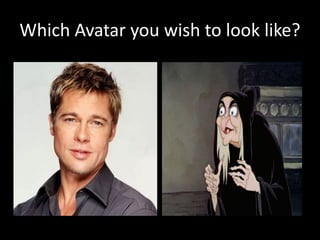
Which Avatar you wish to look like?
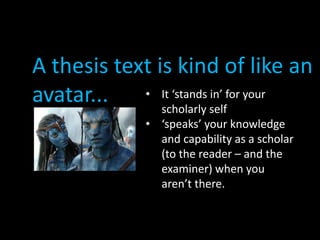
A thesis text is kind of like an
avatar... • It ‘stands in’ for your
scholarly self
• ‘speaks’ your knowledge
and capability as a scholar
(to the reader – and the
examiner) when you
aren’t there.
Therefore, to become a
doctor of philosophy…
your scholarly capabilities must
be translated into the medium of
text.
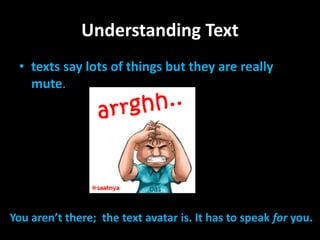
Understanding Text
• texts say lots of things but they are really
mute.
You aren’t there; the text avatar is. It has to speak for you.
This is why it’s important that the thesis
text is very, very good
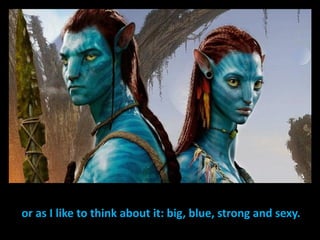
or as I like to think about it: big, blue, strong and sexy.
I wish to be this big, blue, strong and sexy
avatar….
What should I do?
A Clearly Written Thesis
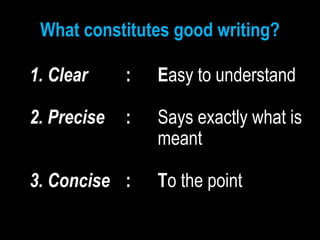
What constitutes good writing?
1. Clear : Easy to understand
2. Precise : Says exactly what is
meant
3. Concise : To the point
How do we achieve good writing?
• Planning
• Draft writing
• Re-writing
• Proof-reading
• Punctuation
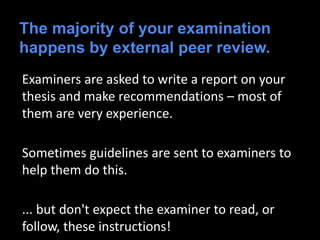
The majority of your examination
happens by external peer review.
Examiners are asked to write a report on your
thesis and make recommendations – most of
them are very experience.
Sometimes guidelines are sent to examiners to
help them do this.
... but don't expect the examiner to read, or
follow, these instructions!
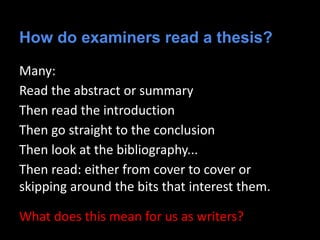
How do examiners read a thesis?
Many:
Read the abstract or summary
Then read the introduction
Then go straight to the conclusion
Then look at the bibliography...
Then read: either from cover to cover or
skipping around the bits that interest them.
What does this mean for us as writers?
Think about this when you are writing - what sort of non
fiction text would you like to read in your spare time?
Where do examiners read your thesis?
Office … after a long busy day
Holiday
In their bed
What is a 'good' thesis?
A report of work which others would want to read
Tells a compelling story articulately whilst pre-empting inevitable
critiques
Carries the reader into complex realms; informs and educates
him/her
Be sufficiently speculative or original to suggest you would be an
interesting future colleague
What is a 'bad' thesis?
Confused or inadequate theoretical framework
'Merely descriptive’ – a data gathering exercise
Researched the wrong problem
Mixed or confused methodological perspectives
Sloppy presentation
Inconsistency between introduction and conclusion
Lacking confidence in the writing
Presenting work that’s not original
Not being able to explain at the end of a thesis what has actually
been argued in the thesis
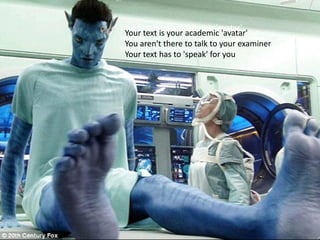
Your text is your academic 'avatar'
You aren't there to talk to your examiner
Your text has to 'speak' for you
Your text is your academic 'avatar'
You aren't there to talk to your examiner
Your text has to 'speak' for you
“The presentation of the thesis falls short….. Substantial
proofreading required”
“The literature review… lack of critical assessment… just a
simple compilation…. Poor argument with many
incomplete sentence”
“The experimental design was not appropriate…. Poorly
explained”
“Many vague statement”
Conclusion
Summary
• Read
• Re-read
• Revise
• Seek comments (appreciate the comments)
• Rewrite
• Proofread
Summary
Good writing is appropriate to context
Good writing is easy to understand
Good writing helps examiners
Good writing brings good news
Caveat: It ties with good research design
I need more help.
Try these books:
Gruba, P & Evans, D (2001) How to write a better thesis, University of Melbourne Press,
Melbourne
Rugg, G and Petre, M (2004) The Unwritten Rules of PhD Research, Open University
Press, Maidenhead.
Booth, W, Gregory, C and Williams, J (1995) The craft of research, University of Chicago
Press, Chicago
Kamler, B & Thomson, P (2006) Helping Doctoral Students to Write, Routledge, New
York
THANKS!

My thesis, my avatar

  • 1.
  • 2.
    talk about themedieval origins of doctoral study 600 years ago To be a Doctor/PhD, you need to know everything. But knowing everything is easy because …… Viva- Voce/Oral disputation
  • 3.
    everything is aboutto change…
  • 4.
    From system that relied on‘speaking received knowledge’ to the circulation of papers.
  • 5.
    The text startedto ‘embody the scholar’ because the text started to ‘speak knowledge’.
  • 6.
    An icon orfigure representing a particular person in a video game, Internet forum, etc. A V A T A R
  • 7.
  • 9.
    Which Avatar youwish to look like?
  • 10.
    A thesis textis kind of like an avatar... • It ‘stands in’ for your scholarly self • ‘speaks’ your knowledge and capability as a scholar (to the reader – and the examiner) when you aren’t there.
  • 11.
    Therefore, to becomea doctor of philosophy… your scholarly capabilities must be translated into the medium of text.
  • 12.
    Understanding Text • textssay lots of things but they are really mute. You aren’t there; the text avatar is. It has to speak for you.
  • 13.
    This is whyit’s important that the thesis text is very, very good
  • 14.
    or as Ilike to think about it: big, blue, strong and sexy.
  • 15.
    I wish tobe this big, blue, strong and sexy avatar…. What should I do? A Clearly Written Thesis
  • 16.
    What constitutes goodwriting? 1. Clear : Easy to understand 2. Precise : Says exactly what is meant 3. Concise : To the point
  • 17.
    How do weachieve good writing? • Planning • Draft writing • Re-writing • Proof-reading • Punctuation
  • 18.
    The majority ofyour examination happens by external peer review. Examiners are asked to write a report on your thesis and make recommendations – most of them are very experience. Sometimes guidelines are sent to examiners to help them do this. ... but don't expect the examiner to read, or follow, these instructions!
  • 19.
    How do examinersread a thesis? Many: Read the abstract or summary Then read the introduction Then go straight to the conclusion Then look at the bibliography... Then read: either from cover to cover or skipping around the bits that interest them. What does this mean for us as writers?
  • 20.
    Think about thiswhen you are writing - what sort of non fiction text would you like to read in your spare time? Where do examiners read your thesis? Office … after a long busy day Holiday In their bed
  • 21.
    What is a'good' thesis? A report of work which others would want to read Tells a compelling story articulately whilst pre-empting inevitable critiques Carries the reader into complex realms; informs and educates him/her Be sufficiently speculative or original to suggest you would be an interesting future colleague
  • 22.
    What is a'bad' thesis? Confused or inadequate theoretical framework 'Merely descriptive’ – a data gathering exercise Researched the wrong problem Mixed or confused methodological perspectives Sloppy presentation Inconsistency between introduction and conclusion Lacking confidence in the writing Presenting work that’s not original Not being able to explain at the end of a thesis what has actually been argued in the thesis
  • 23.
    Your text isyour academic 'avatar' You aren't there to talk to your examiner Your text has to 'speak' for you Your text is your academic 'avatar' You aren't there to talk to your examiner Your text has to 'speak' for you
  • 24.
    “The presentation ofthe thesis falls short….. Substantial proofreading required” “The literature review… lack of critical assessment… just a simple compilation…. Poor argument with many incomplete sentence” “The experimental design was not appropriate…. Poorly explained” “Many vague statement” Conclusion
  • 25.
    Summary • Read • Re-read •Revise • Seek comments (appreciate the comments) • Rewrite • Proofread
  • 26.
    Summary Good writing isappropriate to context Good writing is easy to understand Good writing helps examiners Good writing brings good news Caveat: It ties with good research design
  • 27.
    I need morehelp. Try these books: Gruba, P & Evans, D (2001) How to write a better thesis, University of Melbourne Press, Melbourne Rugg, G and Petre, M (2004) The Unwritten Rules of PhD Research, Open University Press, Maidenhead. Booth, W, Gregory, C and Williams, J (1995) The craft of research, University of Chicago Press, Chicago Kamler, B & Thomson, P (2006) Helping Doctoral Students to Write, Routledge, New York
  • 28.