Tolerate even unreasonable criticism. 
 Convert debate into conversation. 
Conversations have give and take. 
Debates have winners and losers. 
 A conversation can conclude with both sides learning, and 
a promise of more good talk to come. 
 Never defend your work against criticism 
Explain what you were trying to accomplish. 
Debate then likely becomes a conversation. 
WRITING TOOLS CHAPTER 49 
LEARN FROM YOUR CRITICS
In summary: 
 Do not fall into the trap of arguing about matters of taste. 
 Do not, as a reflex, defend your work against negative 
criticism. 
 Explain to your critic what you were trying to do. 
 Transform arguments into conversations. 
If you learn to use criticism in positive ways, you will continue 
to grow as a writer. 
WRITING TOOLS CHAPTER 49 
LEARN FROM YOUR CRITICS
The tools have been organized into four parts. 
1) Nuts and bolts: Power of subject and verb, emphatic 
word order, stronger and weaker elements. 
2) Special effects: Use of language to cue readers, 
overpower cliches with creativity, set a pace, 
overstatement and understatement, showing over telling. 
3) Blueprints: Organizing, difference between reports and 
stories, planting clues, generating suspense. 
4) Reliable habits: Routines for courage and stamina, 
transforming procrastination into rehearsal, reading with a 
purpose, how to help and be helped, how to learn from 
criticism. 
WRITING TOOLS CHAPTER 50 
OWN THE TOOLS OF YOUR CRAFT
Now, how to store all of 
your tools on the shelves 
of a metaphorical 
workbench. 
WRITING TOOLS CHAPTER 50 
OWN THE TOOLS OF YOUR CRAFT
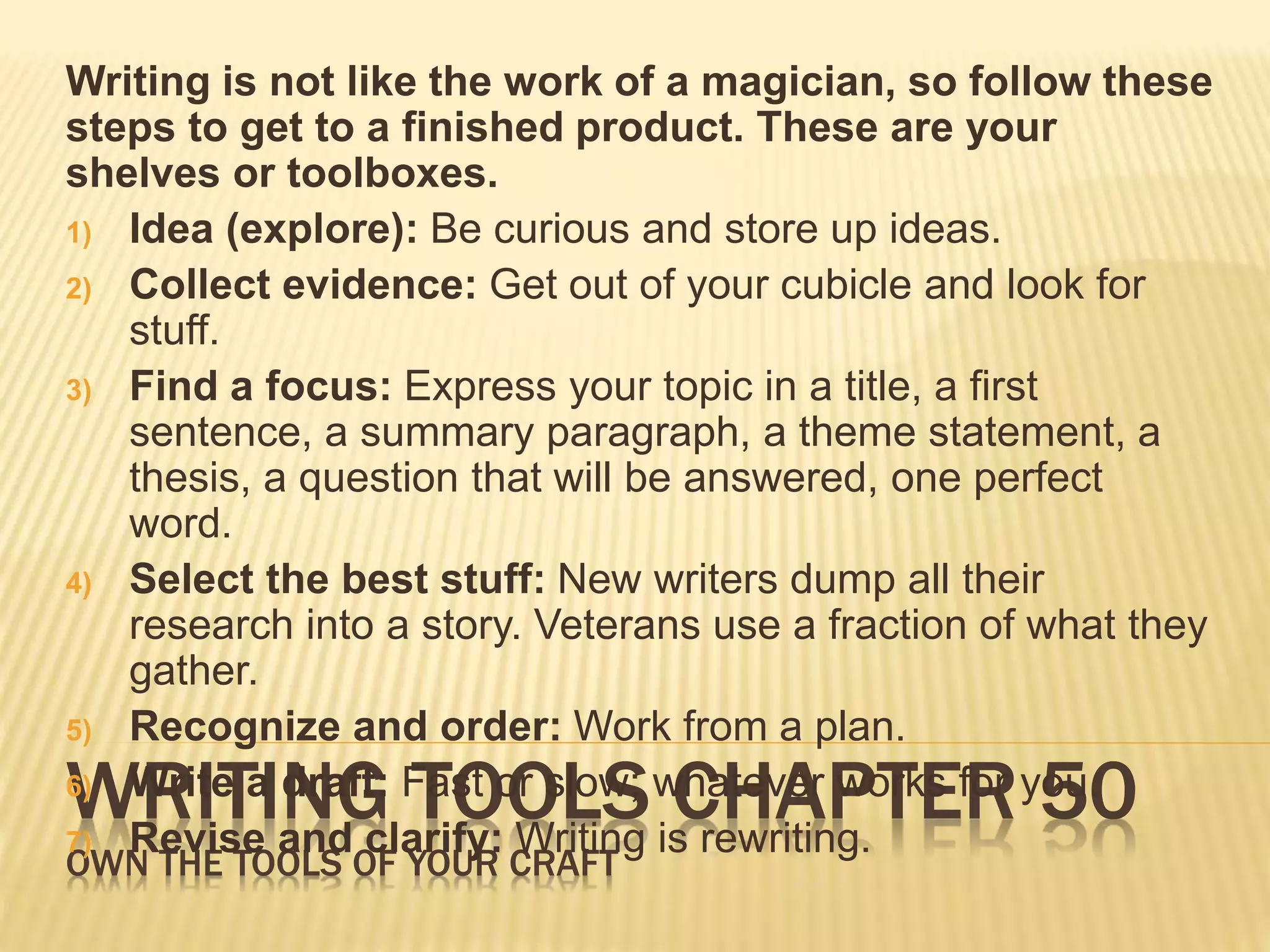
Writing is not like the work of a magician, so follow these 
steps to get to a finished product. These are your 
shelves or toolboxes. 
1) Idea (explore): Be curious and store up ideas. 
2) Collect evidence: Get out of your cubicle and look for 
stuff. 
3) Find a focus: Express your topic in a title, a first 
sentence, a summary paragraph, a theme statement, a 
thesis, a question that will be answered, one perfect 
word. 
4) Select the best stuff: New writers dump all their 
research into a story. Veterans use a fraction of what they 
gather. 
5) Recognize and order: Work from a plan. 
6) Write a draft: Fast or slow; whatever works for you. 
7) Revise and clarify: Writing is rewriting. 
WRITING TOOLS CHAPTER 50 
OWN THE TOOLS OF YOUR CRAFT
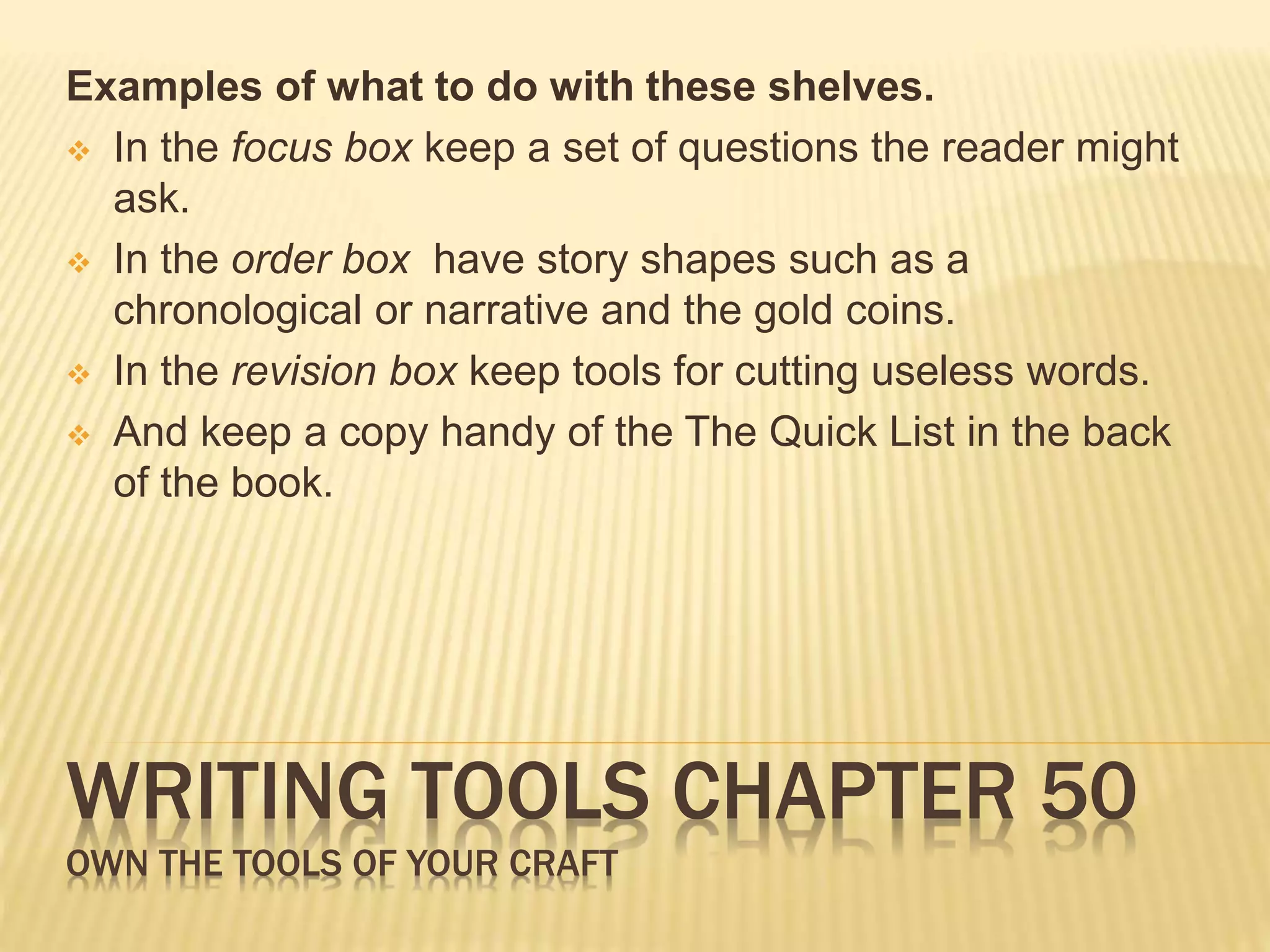
Examples of what to do with these shelves. 
 In the focus box keep a set of questions the reader might 
ask. 
 In the order box have story shapes such as a 
chronological or narrative and the gold coins. 
 In the revision box keep tools for cutting useless words. 
 And keep a copy handy of the The Quick List in the back 
of the book. 
WRITING TOOLS CHAPTER 50 
OWN THE TOOLS OF YOUR CRAFT

Writing tools ch49 50

  • 1.
    Tolerate even unreasonablecriticism.  Convert debate into conversation. Conversations have give and take. Debates have winners and losers.  A conversation can conclude with both sides learning, and a promise of more good talk to come.  Never defend your work against criticism Explain what you were trying to accomplish. Debate then likely becomes a conversation. WRITING TOOLS CHAPTER 49 LEARN FROM YOUR CRITICS
  • 2.
    In summary: Do not fall into the trap of arguing about matters of taste.  Do not, as a reflex, defend your work against negative criticism.  Explain to your critic what you were trying to do.  Transform arguments into conversations. If you learn to use criticism in positive ways, you will continue to grow as a writer. WRITING TOOLS CHAPTER 49 LEARN FROM YOUR CRITICS
  • 3.
    The tools havebeen organized into four parts. 1) Nuts and bolts: Power of subject and verb, emphatic word order, stronger and weaker elements. 2) Special effects: Use of language to cue readers, overpower cliches with creativity, set a pace, overstatement and understatement, showing over telling. 3) Blueprints: Organizing, difference between reports and stories, planting clues, generating suspense. 4) Reliable habits: Routines for courage and stamina, transforming procrastination into rehearsal, reading with a purpose, how to help and be helped, how to learn from criticism. WRITING TOOLS CHAPTER 50 OWN THE TOOLS OF YOUR CRAFT
  • 4.
    Now, how tostore all of your tools on the shelves of a metaphorical workbench. WRITING TOOLS CHAPTER 50 OWN THE TOOLS OF YOUR CRAFT
  • 5.
    Writing is notlike the work of a magician, so follow these steps to get to a finished product. These are your shelves or toolboxes. 1) Idea (explore): Be curious and store up ideas. 2) Collect evidence: Get out of your cubicle and look for stuff. 3) Find a focus: Express your topic in a title, a first sentence, a summary paragraph, a theme statement, a thesis, a question that will be answered, one perfect word. 4) Select the best stuff: New writers dump all their research into a story. Veterans use a fraction of what they gather. 5) Recognize and order: Work from a plan. 6) Write a draft: Fast or slow; whatever works for you. 7) Revise and clarify: Writing is rewriting. WRITING TOOLS CHAPTER 50 OWN THE TOOLS OF YOUR CRAFT
  • 6.
    Examples of whatto do with these shelves.  In the focus box keep a set of questions the reader might ask.  In the order box have story shapes such as a chronological or narrative and the gold coins.  In the revision box keep tools for cutting useless words.  And keep a copy handy of the The Quick List in the back of the book. WRITING TOOLS CHAPTER 50 OWN THE TOOLS OF YOUR CRAFT