Based on the works of
Notice & Note by Kylene
Beers and Robert Probst
Where are the signposts?
Fiction and Nonfiction Close Reading
Fiction Vs. Nonfiction• As we watch the following video, take notes on
a sticky note about the difference(s) between
teaching fiction and nonfiction as well as how
those differences impact our teaching.
• After viewing the video, discuss your notes with
your table group, then whole group.
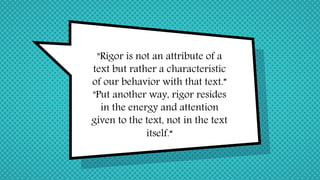
"Rigor is not an attribute of a
text but rather a characteristic
of our behavior with that text.”
"Put another way, rigor resides
in the energy and attention
given to the text, not in the text
itself.“
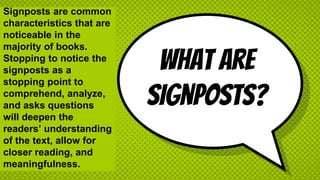
What are
signposts?
Signposts are common
characteristics that are
noticeable in the
majority of books.
Stopping to notice the
signposts as a
stopping point to
comprehend, analyze,
and asks questions
will deepen the
readers’ understanding
of the text, allow for
closer reading, and
meaningfulness.
Characteristics of a close
reading passage
•Short
•Intense focus
•Meaning extends from the passage to create
understanding in other parts of the text
•Great deal of exploratory discussion
•Read, reread, discuss, reread again
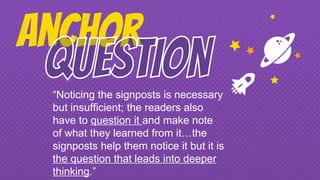
anchor
“Noticing the signposts is necessary
but insufficient; the readers also
have to question it and make note
of what they learned from it…the
signposts help them notice it but it is
the question that leads into deeper
thinking.”
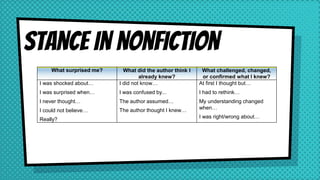
Stance in nonfiction
What surprised me? What did the author think I
already knew?
What challenged, changed,
or confirmed what I knew?
I was shocked about…
I was surprised when…
I never thought…
I could not believe…
Really?
I did not know…
I was confused by...
The author assumed…
The author thought I knew…
At first I thought but…
I had to rethink…
My understanding changed
when…
I was right/wrong about…
Anchor Question:
What is the
difference and
why does it
matter?
(main idea, compare & contrast, understand
author’s purpose, infer, make a generalization, and
cause and effect)
When the author shows you a
difference between what you
know and what is happening in
the text or a difference between
two or more things in the text.
Contrast &
contradictions
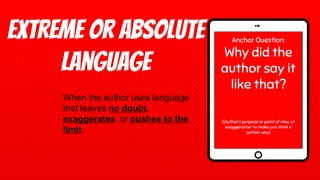
Anchor Question:
Why did the
author say it
like that?
((author’s purpose or point of view, or
exaggeration to make you think a
certain way)
When the author uses language
that leaves no doubt,
exaggerates, or pushes to the
limit.
Extreme or absolute
language
:
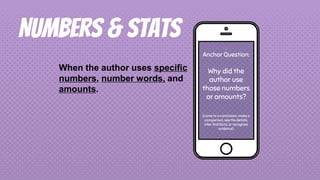
Anchor Question:
Why did the
author use
those numbers
or amounts?
(come to a conclusion, make a
comparison, see the details,
infer, find facts, or recognize
evidence)
When the author uses specific
numbers, number words, and
amounts.
Numbers & stats
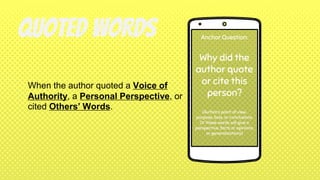
Anchor Question:
Why did the
author quote
or cite this
person?
(Author’s point of view,
purpose, bias, or conclusions.
Or these words will give a
perspective, facts or opinions,
or generalizations)
When the author quoted a Voice of
Authority, a Personal Perspective, or
cited Others’ Words.
Quoted words
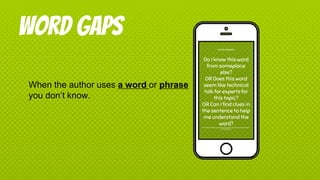
Anchor Question:
Do I know this word
from someplace
else?
OR Does this word
seem like technical
talk for experts for
this topic?
OR Can I find clues in
the sentence to help
me understand the
word?
(the answers willhelp you decide should you look the word up or keep reading for
more information)
When the author uses a word or phrase
you don’t know.
Word gaps

Sign posts modified

  • 1.
    Based on theworks of Notice & Note by Kylene Beers and Robert Probst Where are the signposts? Fiction and Nonfiction Close Reading
  • 2.
    Fiction Vs. Nonfiction•As we watch the following video, take notes on a sticky note about the difference(s) between teaching fiction and nonfiction as well as how those differences impact our teaching. • After viewing the video, discuss your notes with your table group, then whole group.
  • 3.
    "Rigor is notan attribute of a text but rather a characteristic of our behavior with that text.” "Put another way, rigor resides in the energy and attention given to the text, not in the text itself.“
  • 4.
    What are signposts? Signposts arecommon characteristics that are noticeable in the majority of books. Stopping to notice the signposts as a stopping point to comprehend, analyze, and asks questions will deepen the readers’ understanding of the text, allow for closer reading, and meaningfulness.
  • 5.
    Characteristics of aclose reading passage •Short •Intense focus •Meaning extends from the passage to create understanding in other parts of the text •Great deal of exploratory discussion •Read, reread, discuss, reread again
  • 6.
    anchor “Noticing the signpostsis necessary but insufficient; the readers also have to question it and make note of what they learned from it…the signposts help them notice it but it is the question that leads into deeper thinking.”
  • 7.
    Stance in nonfiction Whatsurprised me? What did the author think I already knew? What challenged, changed, or confirmed what I knew? I was shocked about… I was surprised when… I never thought… I could not believe… Really? I did not know… I was confused by... The author assumed… The author thought I knew… At first I thought but… I had to rethink… My understanding changed when… I was right/wrong about…
  • 8.
    Anchor Question: What isthe difference and why does it matter? (main idea, compare & contrast, understand author’s purpose, infer, make a generalization, and cause and effect) When the author shows you a difference between what you know and what is happening in the text or a difference between two or more things in the text. Contrast & contradictions
  • 9.
    Anchor Question: Why didthe author say it like that? ((author’s purpose or point of view, or exaggeration to make you think a certain way) When the author uses language that leaves no doubt, exaggerates, or pushes to the limit. Extreme or absolute language
  • 10.
    : Anchor Question: Why didthe author use those numbers or amounts? (come to a conclusion, make a comparison, see the details, infer, find facts, or recognize evidence) When the author uses specific numbers, number words, and amounts. Numbers & stats
  • 11.
    Anchor Question: Why didthe author quote or cite this person? (Author’s point of view, purpose, bias, or conclusions. Or these words will give a perspective, facts or opinions, or generalizations) When the author quoted a Voice of Authority, a Personal Perspective, or cited Others’ Words. Quoted words
  • 12.
    Anchor Question: Do Iknow this word from someplace else? OR Does this word seem like technical talk for experts for this topic? OR Can I find clues in the sentence to help me understand the word? (the answers willhelp you decide should you look the word up or keep reading for more information) When the author uses a word or phrase you don’t know. Word gaps