Institute of Engineering & Technology
Guided By :
Mr. Amit Mittal
Presented By:
Aman Jain
Priya Chandel
Roshni Dharu
BE - IVth yr IT “A”
Contents
 Introduction
 Problem Domain
 Solution Domain
 Literature Survey
 Objective of the Project
 Advantages
 Analysis Tools
 Requirements
 Conclusion
INTRODUCTION
Why we choose “Traditional Shopping ” rather than
“ Online Shopping” ? ..... Why Youth Focus on
Online Shopping?
Online Shopping is a form of electronic commerce which
allows consumers to directly buy goods, or services from a
seller over the internet using a web browser.
In day to day life, we will need to buy lots of goods or products
from a shop. It may we food items, electronic item, house hold
items etc. Now a days, it is really hard to get same time to go
out and get them by ourselves due to busy life style or lots of
works. In order to solve this, B2C (Business to Consumers)
E-Commerce websites have win started.
INTRODUCTION
PROBLEM DOMAIN
This Existing system of buying goods has several disadvantages. It
requires lots of time to travel to the particular shop to buy the
goods. Since everyone is leading busy life now a days, means a lot
to everyone. Also there are expenses for traveling from house to
shop. More over the shop from where we would like to buy
something may not be open 24*7*365. Hence we have to adjust our
time with the shopkeeper’s time or vendor’s time .
SOLUTION DOMAIN
In order to overcome this we have E-Commerce solution, i.e. one
place where we can get all required goods/products online .The
proposed system helps in building a websites to buy , sell products
or goods online using internet connection purchasing of goods
online using internet connection. Purchasing of goods online ,user
can choose different products based on categories ,online payments ,
delivery services and hence covering the disadvantages of the
existing system and making the buying easier and helping the
vendors to reach wider market.
LITERATURE SURVEY
Shopping Websites:
 ebay : ebay is an American multinational corporation and E-
commerce company, providing consumer-to-consumer and
business-to-consumer sales services via the Internet. It is
headquartered in San Jose, California.
 Amazon : Amazon.com, often referred to as simply Amazon, is an
American electronic commerce and cloud computing company with
headquarters in Seattle,Washington.
 Flipkart : Flipkart is an e-commerce marketplace unicorn
company founded in 2007 by Sachin Bansal and Binny Bansal. The
company is registered in Singapore, but has its headquarters in
bangalore, karnataka, India.
Myntra : Myntra is an Indian Fashion e-commerce marketplace
company headquartered in Bengaluru, Karnataka, India. The
Company was founded in 2007 by Indian Institute of Technology
graduates with a focus on personalisation of gift items.
 Snapdeal : Snapdeal is an B2C marketplace, based in New Delhi,
India. The company was started by Kunal Bahl, A Wharton graduate
as part of the dual degree M&T Engineering and Business program at
Penn, and Rohit Bansal, an alumnus of IIT Delhi in February 2010.
LITERATURE SURVEY
Shopping Websites:
Objective of the Project
 Save time.
 Get a better selection.
 Complete product details.
 Better value/offer.
 Flexible return policy.
ADVANTAGES
 Convenience : One of the biggest benefits of online shopping is
that you can buy almost anything you could imagine without ever
leaving your house.
 Selection : Online stores are able to carry more selection than
traditional brick- and – mortar stores.
 Information : Online shops tend to provide more information
about items for sale than you would get in a physical store (Unless
you asked a sales associate).
 Price : Because online stores don’t have to pay rent for a store
front in a nice part of town and tend to sell much larger quantities
of goods, they can offer to sell products for a much lower price.
 Availability : Online retailers accept orders twenty four hours a
day while consumers who wish to shop at traditional stores have to
be available to visit the store during normal business hours.
ADVANTAGES
Analysis Tools
Analysis is the process of breaking a complex topic or
substance into smaller parts to gain a better understanding
of it.
 Use Case Diagram
 E-R Diagram
 Activity Diagram
 Sequence Diagram
 Class Diagram
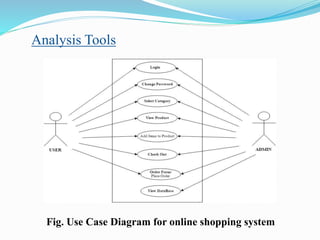
Fig. Use Case Diagram for online shopping system
Analysis Tools
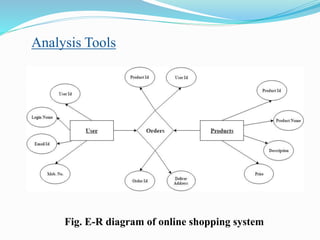
Fig. E-R diagram of online shopping system
Analysis Tools
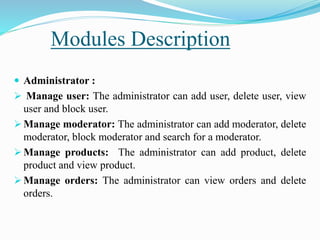
Modules Description
 Administrator :
 Manage user: The administrator can add user, delete user, view
user and block user.
 Manage moderator: The administrator can add moderator, delete
moderator, block moderator and search for a moderator.
 Manage products: The administrator can add product, delete
product and view product.
 Manage orders: The administrator can view orders and delete
orders.
Modules Description
 User : User is the visitor that can perform several task, such as :
a. Can do register himself.
b. Can do login.
c. Can change password.
d. View available products in shop.
e. Add required product to shopping cart.
f. Remove, added items from cart.
g. Can change the quantity of product in cart.
h. Can place order.
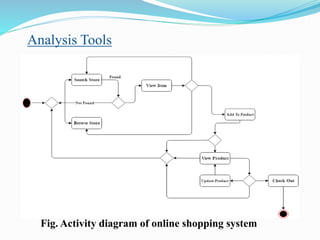
Fig. Activity diagram of online shopping system
Analysis Tools
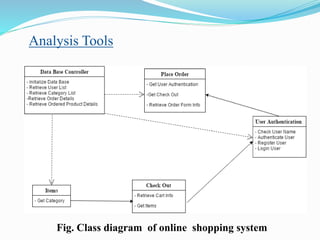
Fig. Class diagram of online shopping system
Analysis Tools
REQUREMENTS
 Interface Required:
 Platform Used: Windows XP Or Higher Version
 Language Used : Java, JSP, HTML, CSS, JAVASCRIPT
 Database Used : Microsoft SQL Server
• Hardware Required:
 Processor : P4(Pentium 4) or Latest Above
 RAM : 1GB or Above
 Hard Disk : 20 GB or Above
CONCLUSION
• Consumer buys goods from the online shopping and provide free
home delivery and cash of delivery payment option..
• It provides a friendly graphical user interface which can easily
operated by customers.
• Our system is provide simplicity to shopkeeper for managing
inventory information.
• System security, data security and reliability are the striking
features.
• The System has adequate scope for modification in future if it is
necessary.
• Being able to buy any time, any place ,anywhere, provides
exciting opportunities to the customers and these benefits are
likely to increase overtime.
• The project could very well enhanced further as per the
requirements.
CONCLUSION
My ppt
My ppt

My ppt

  • 1.
    Institute of Engineering& Technology Guided By : Mr. Amit Mittal Presented By: Aman Jain Priya Chandel Roshni Dharu BE - IVth yr IT “A”
  • 2.
    Contents  Introduction  ProblemDomain  Solution Domain  Literature Survey  Objective of the Project  Advantages  Analysis Tools  Requirements  Conclusion
  • 3.
    INTRODUCTION Why we choose“Traditional Shopping ” rather than “ Online Shopping” ? ..... Why Youth Focus on Online Shopping?
  • 4.
    Online Shopping isa form of electronic commerce which allows consumers to directly buy goods, or services from a seller over the internet using a web browser. In day to day life, we will need to buy lots of goods or products from a shop. It may we food items, electronic item, house hold items etc. Now a days, it is really hard to get same time to go out and get them by ourselves due to busy life style or lots of works. In order to solve this, B2C (Business to Consumers) E-Commerce websites have win started. INTRODUCTION
  • 5.
    PROBLEM DOMAIN This Existingsystem of buying goods has several disadvantages. It requires lots of time to travel to the particular shop to buy the goods. Since everyone is leading busy life now a days, means a lot to everyone. Also there are expenses for traveling from house to shop. More over the shop from where we would like to buy something may not be open 24*7*365. Hence we have to adjust our time with the shopkeeper’s time or vendor’s time .
  • 6.
    SOLUTION DOMAIN In orderto overcome this we have E-Commerce solution, i.e. one place where we can get all required goods/products online .The proposed system helps in building a websites to buy , sell products or goods online using internet connection purchasing of goods online using internet connection. Purchasing of goods online ,user can choose different products based on categories ,online payments , delivery services and hence covering the disadvantages of the existing system and making the buying easier and helping the vendors to reach wider market.
  • 7.
    LITERATURE SURVEY Shopping Websites: ebay : ebay is an American multinational corporation and E- commerce company, providing consumer-to-consumer and business-to-consumer sales services via the Internet. It is headquartered in San Jose, California.  Amazon : Amazon.com, often referred to as simply Amazon, is an American electronic commerce and cloud computing company with headquarters in Seattle,Washington.  Flipkart : Flipkart is an e-commerce marketplace unicorn company founded in 2007 by Sachin Bansal and Binny Bansal. The company is registered in Singapore, but has its headquarters in bangalore, karnataka, India.
  • 8.
    Myntra : Myntrais an Indian Fashion e-commerce marketplace company headquartered in Bengaluru, Karnataka, India. The Company was founded in 2007 by Indian Institute of Technology graduates with a focus on personalisation of gift items.  Snapdeal : Snapdeal is an B2C marketplace, based in New Delhi, India. The company was started by Kunal Bahl, A Wharton graduate as part of the dual degree M&T Engineering and Business program at Penn, and Rohit Bansal, an alumnus of IIT Delhi in February 2010. LITERATURE SURVEY Shopping Websites:
  • 9.
    Objective of theProject  Save time.  Get a better selection.  Complete product details.  Better value/offer.  Flexible return policy.
  • 10.
    ADVANTAGES  Convenience :One of the biggest benefits of online shopping is that you can buy almost anything you could imagine without ever leaving your house.  Selection : Online stores are able to carry more selection than traditional brick- and – mortar stores.  Information : Online shops tend to provide more information about items for sale than you would get in a physical store (Unless you asked a sales associate).
  • 11.
     Price :Because online stores don’t have to pay rent for a store front in a nice part of town and tend to sell much larger quantities of goods, they can offer to sell products for a much lower price.  Availability : Online retailers accept orders twenty four hours a day while consumers who wish to shop at traditional stores have to be available to visit the store during normal business hours. ADVANTAGES
  • 13.
    Analysis Tools Analysis isthe process of breaking a complex topic or substance into smaller parts to gain a better understanding of it.  Use Case Diagram  E-R Diagram  Activity Diagram  Sequence Diagram  Class Diagram
  • 14.
    Fig. Use CaseDiagram for online shopping system Analysis Tools
  • 15.
    Fig. E-R diagramof online shopping system Analysis Tools
  • 16.
    Modules Description  Administrator:  Manage user: The administrator can add user, delete user, view user and block user.  Manage moderator: The administrator can add moderator, delete moderator, block moderator and search for a moderator.  Manage products: The administrator can add product, delete product and view product.  Manage orders: The administrator can view orders and delete orders.
  • 17.
    Modules Description  User: User is the visitor that can perform several task, such as : a. Can do register himself. b. Can do login. c. Can change password. d. View available products in shop. e. Add required product to shopping cart. f. Remove, added items from cart. g. Can change the quantity of product in cart. h. Can place order.
  • 18.
    Fig. Activity diagramof online shopping system Analysis Tools
  • 19.
    Fig. Class diagramof online shopping system Analysis Tools
  • 20.
    REQUREMENTS  Interface Required: Platform Used: Windows XP Or Higher Version  Language Used : Java, JSP, HTML, CSS, JAVASCRIPT  Database Used : Microsoft SQL Server • Hardware Required:  Processor : P4(Pentium 4) or Latest Above  RAM : 1GB or Above  Hard Disk : 20 GB or Above
  • 21.
    CONCLUSION • Consumer buysgoods from the online shopping and provide free home delivery and cash of delivery payment option.. • It provides a friendly graphical user interface which can easily operated by customers. • Our system is provide simplicity to shopkeeper for managing inventory information. • System security, data security and reliability are the striking features. • The System has adequate scope for modification in future if it is necessary.
  • 22.
    • Being ableto buy any time, any place ,anywhere, provides exciting opportunities to the customers and these benefits are likely to increase overtime. • The project could very well enhanced further as per the requirements. CONCLUSION