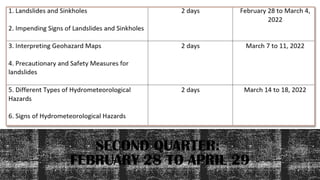
DISASTER READINESS AND
RISK REDUCTION
DISASTER
READINESS AND
RISK REDUCTION
This learning area is designed
to provide knowledge about
disaster readiness and risk
reduction by first
understanding the hazards
that may potentially lead to
disasters. Precautionary
measures and ideal responses
to prevent disasters for each
hazard type will be
comprehensively discuss.
Towards the end of the course,
students will focus on the
applications of what they have
learned to the community and
Philippine society.
FIRST QUARTER:
JANUARY 5 TO FEBRUARY 24
FIRST QUARTER:
JANUARY 5 TO FEBRUARY 24
FIRST QUARTER:
JANUARY 5 TO FEBRUARY 24
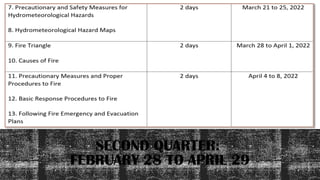
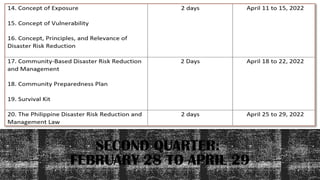
SECOND QUARTER:
FEBRUARY 28 TO APRIL 29
SECOND QUARTER:
FEBRUARY 28 TO APRIL 29
SECOND QUARTER:
FEBRUARY 28 TO APRIL 29
GRADE COMPONENTS/SCHEDULE
WRITTEN WORKS: 40%
PERFORMANCE TASK: 60%
STEM – FAITH
MONDAY
12:30 TO 2:00
SYNCHRONOUS CLASS
WEDNESDAY
12:30 TO 2:00
ASYNCHRONOUS CLASS
STEM – HOPE
TUESDAY
2:00 TO 3:30
SYNCHRONOUS CLASS
THURSDAY
12:30 TO 2:00
ASYNCHRONOUS CLASS
STEM – LOVE
TUESDAY
12:30 TO 2:00
SYNCHRONOUS CLASS
FRIDAY
12:30 TO 2:00
ASYNCHRONOUS CLASS
MODE OF COMMUNICATION
For Announcement And Information Dissemination
Facebook Messenger And Google Classroom
For Submission Of Written Works And Performance Tasks
Google Classroom
GOOGLE CLASSROOM CODE
STEM – LOVE
3nu4yfj
STEM – FAITH
mn7zebr
STEM – HOPE
ubrx2ru
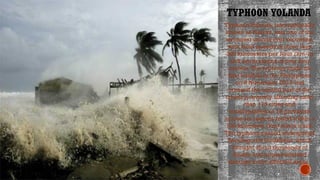
TYPHOON YOLANDA
Click icon to add picture
Typhoon Yolanda, internationally
known as Haiyan, was one of the
strongest storms ever recorded,
with wind speeds of more than
300 kilometers per hour (km/h)
and storm surges of over four
meters.The typhoon made its
first landfall in the Philippines
on 8 November 2013 and
crossed the central part of the
country, severely affecting more
than 170 cities and
municipalities in 14 provinces
across six regions found within a
100-kilometer (km) storm track.
The typhoon caused widespread
flooding and landslides, which
brought about thousands of
deaths and unprecedented
damage to the affected areas.
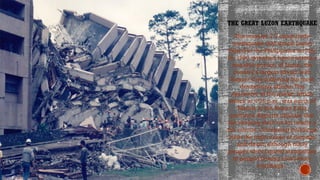
THE GREAT LUZON EARTHQUAKE
Click icon to add picture
The massive 7.7-magnitude
earthquake that struck Luzon
Island in the Philippines on July
16, 1990, wreaked havoc across a
sizeable portion of Luzon, the
country’s largest island, with
Baguio City suffering the most
devastating effects.The
epicenter of the quake, which
struck at 4:26 p.m., was north of
Manila in the Nueva Ecija
province. Reports indicate that
the shaking went on for nearly a
full minute. Collapsing buildings
were the main cause of damage
and death, although many
people were injured stampedes
of people fleeing multi-story
buildings.
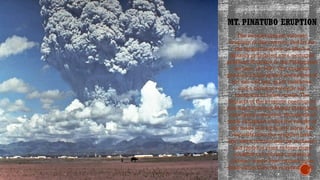
MT. PINATUBO ERUPTION
Click icon to add picture
The second-largest volcanic
eruption of this century, and by far
the largest eruption to affect a
densely populated area, occurred
at Mount Pinatubo in the Philippines
on June 15, 1991.The eruption
produced high-speed avalanches of
hot ash and gas, giant mudflows,
and a cloud of volcanic ash
hundreds of miles across.The
impacts of the eruption continue to
this day. Following Mount Pinatubo's
cataclysmic eruption, thousands of
roofs collapsed under the weight of
ash made wet by heavy rains. Ash
deposits from the eruption have
also been remobilized by monsoon
and typhoon rains to form giant
mudflows of volcanic materials
(lahars), which have caused more
destruction than the eruption itself.
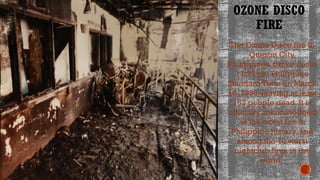
OZONE DISCO
FIRE
Click icon to add picture
The Ozone Disco fire in
Quezon City,
Philippines, broke out at
11:35 pm Philippine
Standard Time on March
18, 1996, leaving at least
162 people dead. It is
officially acknowledged
as the worst fire in
Philippine history, and
among the 10 worst
nightclub fires in the
world.
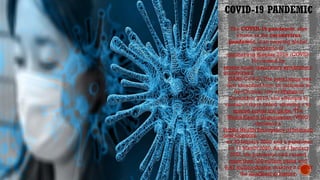
COVID-19 PANDEMIC
Click icon to add picture
The COVID-19 pandemic, also
known as the coronavirus
pandemic, is an ongoing global
pandemic of
coronavirus disease 2019 (COVID-
19) caused by
severe acute respiratory syndrome c
oronavirus 2
(SARS-CoV-2).The novel virus was
first identified from an outbreak in
the Chinese city of Wuhan in
December 2019, and attempts to
contain it there failed, allowing it to
spread across the globe.The
World Health Organization (WHO)
declared a
Public Health Emergency of Internati
onal Concern
on 30 January 2020 and a pandemic
on 11 March 2020. As of 7 January
2022, the pandemic had caused
more than 300 million cases and
5.47 million deaths, making it one of
the deadliest in history.
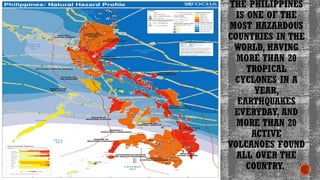
THE PHILIPPINES
IS ONE OF THE
MOST HAZARDOUS
COUNTRIES IN THE
WORLD, HAVING
MORE THAN 20
TROPICAL
CYCLONES IN A
YEAR,
EARTHQUAKES
EVERYDAY, AND
MORE THAN 20
ACTIVE
VOLCANOES FOUND
ALL OVER THE
COUNTRY.
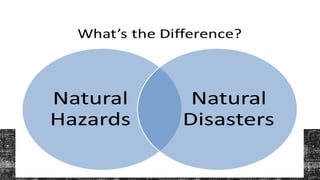
PHENOMENON, SUBSTANCE, HUMAN
ACTIVITY OR CONDITION THAT MAY
CAUSE LOSS OF LIFE, INJURY OR OTHER
HEALTH IMPACTS, PROPERTY DAMAGE,
LOSS OF LIVELIHOODS AND SERVICES,
SOCIAL AND ECONOMIC DISRUPTION,
OR ENVIRONMENTAL DAMAGE.
DISASTER - A SERIOUS DISRUPTION OF
THE FUNCTIONING OF A COMMUNITY
OR A SOCIETY INVOLVING WIDESPREAD
HUMAN, MATERIAL, ECONOMIC, OR
ENVIRONMENTAL LOSSES AND IMPACTS
WHICH EXCEEDS THE ABILITY OF THE
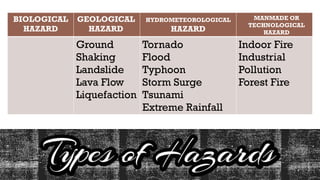
Classify the phenomena in a
table.You may group them in
any way you want but make
sure that you can describe
the basis you used for
classifying.Write your
answer on a piece of paper.
Ground
Shaking
Landslide
Lava Flow
Liquefaction
Tornado
Flood
Typhoon
Storm Surge
Tsunami
Extreme Rainfall
Indoor Fire
Industrial
Pollution
Forest Fire
BIOLOGICAL
HAZARD
GEOLOGICAL
HAZARD
HYDROMETEOROLOGICAL
HAZARD
MANMADE OR
TECHNOLOGICAL
HAZARD
NATURAL HAZARDS
 Naturally-occurring physical phenomena caused
either by rapid or slow onset events which can
be geophysical (earthquakes, landslides,
tsunamis and volcanic activity), hydrological
(avalanches and floods), climatological (extreme
temperatures, drought and wildfires),
meteorological (cyclones and storms/wave
surges) or biological (disease epidemics and
insect/animal plagues).
NATURAL HAZARDS CAN BE…
BIOLOGICAL
• Process or phenomenon of organic origin or conveyed
by biological vectors/ agents, including exposure to
pathogenic microorganisms, toxins and bioactive
substances
• Examples of biological hazards include outbreaks of
epidemic diseases, plant or animal contagion, insect or
other animal plagues and infestations.
NATURAL HAZARDS CAN BE…
GEOLOGICAL
• Geological process or phenomenon
• Geological hazards include internal earth processes,
such as earthquakes, volcanic activity and emissions,
and related geophysical processes such as mass
movements, landslides, rockslides, surface collapses,
and debris or mudflows.
NATURAL HAZARDS CAN BE…
HYDROMETEOROLOGICAL
• Process or phenomenon of atmospheric, hydrological or
oceanographic nature
• Hydrometeorological hazards include tropical cyclones
(also known as typhoons and hurricanes),
thunderstorms, hailstorms, tornados, blizzards, heavy
snowfall, avalanches, coastal storm surges, floods
including flash floods, drought, heatwaves and cold
spells.
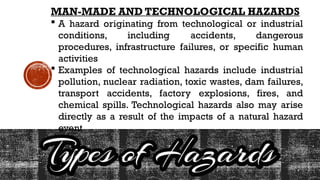
MAN-MADE AND TECHNOLOGICAL HAZARDS
 A hazard originating from technological or industrial
conditions, including accidents, dangerous
procedures, infrastructure failures, or specific human
activities
 Examples of technological hazards include industrial
pollution, nuclear radiation, toxic wastes, dam failures,
transport accidents, factory explosions, fires, and
chemical spills. Technological hazards also may arise
directly as a result of the impacts of a natural hazard
event
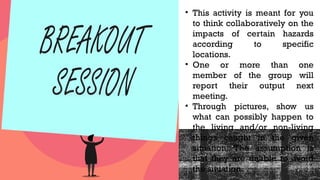
• This activity is meant for you
to think collaboratively on the
impacts of certain hazards
according to specific
locations.
• One or more than one
member of the group will
report their output next
meeting.
• Through pictures, show us
what can possibly happen to
the living and/or non-living
things caught in the given
situation. The assumption is
that they are unable to avoid
the situation.
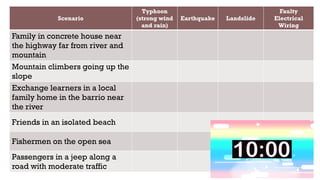
Scenario
Typhoon
(strong wind
and rain)
Earthquake Landslide
Faulty
Electrical
Wiring
Family in concrete house near
the highway far from river and
mountain
Mountain climbers going up the
slope
Exchange learners in a local
family home in the barrio near
the river
Friends in an isolated beach
Fishermen on the open sea
Passengers in a jeep along a
road with moderate traffic
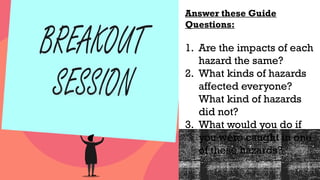
Answer these Guide
Questions:
1. Are the impacts of each
hazard the same?
2. What kinds of hazards
affected everyone?
What kind of hazards
did not?
3. What would you do if
you were caught in one
of these hazards?

DISASTER READINESS AND RISK REDUCTION.pptx

  • 1.
  • 2.
    DISASTER READINESS AND RISK REDUCTION Thislearning area is designed to provide knowledge about disaster readiness and risk reduction by first understanding the hazards that may potentially lead to disasters. Precautionary measures and ideal responses to prevent disasters for each hazard type will be comprehensively discuss. Towards the end of the course, students will focus on the applications of what they have learned to the community and Philippine society.
  • 3.
  • 4.
  • 5.
  • 6.
  • 7.
  • 8.
  • 9.
    GRADE COMPONENTS/SCHEDULE WRITTEN WORKS:40% PERFORMANCE TASK: 60% STEM – FAITH MONDAY 12:30 TO 2:00 SYNCHRONOUS CLASS WEDNESDAY 12:30 TO 2:00 ASYNCHRONOUS CLASS STEM – HOPE TUESDAY 2:00 TO 3:30 SYNCHRONOUS CLASS THURSDAY 12:30 TO 2:00 ASYNCHRONOUS CLASS STEM – LOVE TUESDAY 12:30 TO 2:00 SYNCHRONOUS CLASS FRIDAY 12:30 TO 2:00 ASYNCHRONOUS CLASS
  • 10.
    MODE OF COMMUNICATION ForAnnouncement And Information Dissemination Facebook Messenger And Google Classroom For Submission Of Written Works And Performance Tasks Google Classroom GOOGLE CLASSROOM CODE STEM – LOVE 3nu4yfj STEM – FAITH mn7zebr STEM – HOPE ubrx2ru
  • 11.
    TYPHOON YOLANDA Click iconto add picture Typhoon Yolanda, internationally known as Haiyan, was one of the strongest storms ever recorded, with wind speeds of more than 300 kilometers per hour (km/h) and storm surges of over four meters.The typhoon made its first landfall in the Philippines on 8 November 2013 and crossed the central part of the country, severely affecting more than 170 cities and municipalities in 14 provinces across six regions found within a 100-kilometer (km) storm track. The typhoon caused widespread flooding and landslides, which brought about thousands of deaths and unprecedented damage to the affected areas.
  • 12.
    THE GREAT LUZONEARTHQUAKE Click icon to add picture The massive 7.7-magnitude earthquake that struck Luzon Island in the Philippines on July 16, 1990, wreaked havoc across a sizeable portion of Luzon, the country’s largest island, with Baguio City suffering the most devastating effects.The epicenter of the quake, which struck at 4:26 p.m., was north of Manila in the Nueva Ecija province. Reports indicate that the shaking went on for nearly a full minute. Collapsing buildings were the main cause of damage and death, although many people were injured stampedes of people fleeing multi-story buildings.
  • 13.
    MT. PINATUBO ERUPTION Clickicon to add picture The second-largest volcanic eruption of this century, and by far the largest eruption to affect a densely populated area, occurred at Mount Pinatubo in the Philippines on June 15, 1991.The eruption produced high-speed avalanches of hot ash and gas, giant mudflows, and a cloud of volcanic ash hundreds of miles across.The impacts of the eruption continue to this day. Following Mount Pinatubo's cataclysmic eruption, thousands of roofs collapsed under the weight of ash made wet by heavy rains. Ash deposits from the eruption have also been remobilized by monsoon and typhoon rains to form giant mudflows of volcanic materials (lahars), which have caused more destruction than the eruption itself.
  • 14.
    OZONE DISCO FIRE Click iconto add picture The Ozone Disco fire in Quezon City, Philippines, broke out at 11:35 pm Philippine Standard Time on March 18, 1996, leaving at least 162 people dead. It is officially acknowledged as the worst fire in Philippine history, and among the 10 worst nightclub fires in the world.
  • 15.
    COVID-19 PANDEMIC Click iconto add picture The COVID-19 pandemic, also known as the coronavirus pandemic, is an ongoing global pandemic of coronavirus disease 2019 (COVID- 19) caused by severe acute respiratory syndrome c oronavirus 2 (SARS-CoV-2).The novel virus was first identified from an outbreak in the Chinese city of Wuhan in December 2019, and attempts to contain it there failed, allowing it to spread across the globe.The World Health Organization (WHO) declared a Public Health Emergency of Internati onal Concern on 30 January 2020 and a pandemic on 11 March 2020. As of 7 January 2022, the pandemic had caused more than 300 million cases and 5.47 million deaths, making it one of the deadliest in history.
  • 16.
    THE PHILIPPINES IS ONEOF THE MOST HAZARDOUS COUNTRIES IN THE WORLD, HAVING MORE THAN 20 TROPICAL CYCLONES IN A YEAR, EARTHQUAKES EVERYDAY, AND MORE THAN 20 ACTIVE VOLCANOES FOUND ALL OVER THE COUNTRY.
  • 18.
    PHENOMENON, SUBSTANCE, HUMAN ACTIVITYOR CONDITION THAT MAY CAUSE LOSS OF LIFE, INJURY OR OTHER HEALTH IMPACTS, PROPERTY DAMAGE, LOSS OF LIVELIHOODS AND SERVICES, SOCIAL AND ECONOMIC DISRUPTION, OR ENVIRONMENTAL DAMAGE. DISASTER - A SERIOUS DISRUPTION OF THE FUNCTIONING OF A COMMUNITY OR A SOCIETY INVOLVING WIDESPREAD HUMAN, MATERIAL, ECONOMIC, OR ENVIRONMENTAL LOSSES AND IMPACTS WHICH EXCEEDS THE ABILITY OF THE
  • 19.
    Classify the phenomenain a table.You may group them in any way you want but make sure that you can describe the basis you used for classifying.Write your answer on a piece of paper.
  • 20.
    Ground Shaking Landslide Lava Flow Liquefaction Tornado Flood Typhoon Storm Surge Tsunami ExtremeRainfall Indoor Fire Industrial Pollution Forest Fire BIOLOGICAL HAZARD GEOLOGICAL HAZARD HYDROMETEOROLOGICAL HAZARD MANMADE OR TECHNOLOGICAL HAZARD
  • 21.
    NATURAL HAZARDS  Naturally-occurringphysical phenomena caused either by rapid or slow onset events which can be geophysical (earthquakes, landslides, tsunamis and volcanic activity), hydrological (avalanches and floods), climatological (extreme temperatures, drought and wildfires), meteorological (cyclones and storms/wave surges) or biological (disease epidemics and insect/animal plagues).
  • 22.
    NATURAL HAZARDS CANBE… BIOLOGICAL • Process or phenomenon of organic origin or conveyed by biological vectors/ agents, including exposure to pathogenic microorganisms, toxins and bioactive substances • Examples of biological hazards include outbreaks of epidemic diseases, plant or animal contagion, insect or other animal plagues and infestations.
  • 23.
    NATURAL HAZARDS CANBE… GEOLOGICAL • Geological process or phenomenon • Geological hazards include internal earth processes, such as earthquakes, volcanic activity and emissions, and related geophysical processes such as mass movements, landslides, rockslides, surface collapses, and debris or mudflows.
  • 24.
    NATURAL HAZARDS CANBE… HYDROMETEOROLOGICAL • Process or phenomenon of atmospheric, hydrological or oceanographic nature • Hydrometeorological hazards include tropical cyclones (also known as typhoons and hurricanes), thunderstorms, hailstorms, tornados, blizzards, heavy snowfall, avalanches, coastal storm surges, floods including flash floods, drought, heatwaves and cold spells.
  • 25.
    MAN-MADE AND TECHNOLOGICALHAZARDS  A hazard originating from technological or industrial conditions, including accidents, dangerous procedures, infrastructure failures, or specific human activities  Examples of technological hazards include industrial pollution, nuclear radiation, toxic wastes, dam failures, transport accidents, factory explosions, fires, and chemical spills. Technological hazards also may arise directly as a result of the impacts of a natural hazard event
  • 26.
    • This activityis meant for you to think collaboratively on the impacts of certain hazards according to specific locations. • One or more than one member of the group will report their output next meeting. • Through pictures, show us what can possibly happen to the living and/or non-living things caught in the given situation. The assumption is that they are unable to avoid the situation.
  • 27.
    Scenario Typhoon (strong wind and rain) EarthquakeLandslide Faulty Electrical Wiring Family in concrete house near the highway far from river and mountain Mountain climbers going up the slope Exchange learners in a local family home in the barrio near the river Friends in an isolated beach Fishermen on the open sea Passengers in a jeep along a road with moderate traffic
  • 28.
    Answer these Guide Questions: 1.Are the impacts of each hazard the same? 2. What kinds of hazards affected everyone? What kind of hazards did not? 3. What would you do if you were caught in one of these hazards?