The Mutual Information Metric
By Mike, and Vishal
Agenda
 Assumptions
 Original Images
 Flowchart
 Evaluating this
Metric
 Image Size vs.
Execution
 Sub-Pixel
Resolution
 Histograms
 Self
 Neighbor
 Difference
 Future Directions
 Questions
Assumptions
 Rigid transform
 No x-scale
 No y-scale
 x-translation
 y-translation
 rotation
 Only two pictures
 Traffic 001
 Traffic 024
Original Images
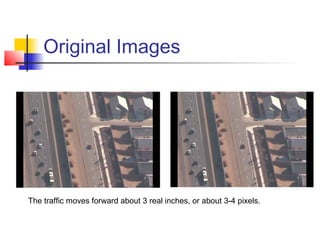
The traffic moves forward about 3 real inches, or about 3-4 pixels.
The Metric is part of a system
Image of
Interest
(1a)
Target
Image
(1b)
Affine
Transform
(2)
Optimization
Algorithm
(4)
Metric
(3)
Output
(5)
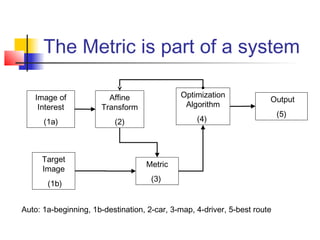
Auto: 1a-beginning, 1b-destination, 2-car, 3-map, 4-driver, 5-best route
Evaluating this Metric
 Price
 Execution time
 Improve Optimization
 Speed
 Quality
 Optimal Point
 Find Direction
 Find Locus
 Optimization Quality
 Sub-Pixel Resolution
 Error Tolerance
Image Size vs. Execution time
Computation Time vs. Image Size
y=2E-11x 2
+4E-06x+0.2765
R2
=0.9425
y=0.3131e 1E-05x
R2
=0.916
0
0.2
0.4
0.6
0.8
1
1.2
0 20000 40000 60000 80000 100000
Numberof Pixels
Computation Time
Series1
Series2
Poly.(Series1)
Expon.(Series2)
Transition from polynomial to exponential time
this happens around (140x140) pixels
In Matlab there is a destabilization around 20,000 pixels (140x140)
Notes: this data has already had about 10 outliers culled, and was done on p4 2.25Ghz w/256Mb Ram
Sub-Pixel Resolution
Given:
step = 0.1 pixel
Question:
How does MI vary
across boundary?
Results:
Near origin the
boundary varies
sharply at pixel
edges
Local Region
Sub-Pixel Resolution
Linear Interp
Pixel Min
Sub-Pixel Min
Sub-Pixel Resolution
 Poor Near Origin
 Ballasting?
 Valid away from origin
 Great between pixels
 Interpolation dependent
 Linear
 Others?
http://citeseer.ist.psu.edu/shekarforoush96subpixel.html
Error Tolerance
 Local extrema
 Many
 global max
 Single
 Large/clear
 Mixed results
Self Histogram
Pure Diagonal
Artifact ?
Neighbor Histogram
Fuzzy Diagonal
Difference in the histograms
• Note the transition in the diagonal.
• The “perfect” translation moves off-diagonal elements to make a strongly
diagonally dominant histogram
Top View
3-d View
Distance between mappings
Red and Green are highest distance, blue is least.
The aspect ratio of the roofs, sidewalks, and shadows is most informative.
Cleaner Dist between maps
Conclusions
 They say about golf:
 Drive for show, putt for dough
 MI is terrible for driving
 Many local maxima/minima
 High computational overhead
 MI is great for putting
 Sub-pixel resolution
Future Directions
 Can we determine the next transform based
on the histogram?
 Jacobi or Gauss-Seidel
 An inverse mapping from the histogram
 Diagonalization
 How well does this apply to point matching
algorithms?
 Inverse Histogram distance as a window?
Any Questions?

Mutual information

  • 1.
    The Mutual InformationMetric By Mike, and Vishal
  • 2.
    Agenda  Assumptions  OriginalImages  Flowchart  Evaluating this Metric  Image Size vs. Execution  Sub-Pixel Resolution  Histograms  Self  Neighbor  Difference  Future Directions  Questions
  • 3.
    Assumptions  Rigid transform No x-scale  No y-scale  x-translation  y-translation  rotation  Only two pictures  Traffic 001  Traffic 024
  • 4.
    Original Images The trafficmoves forward about 3 real inches, or about 3-4 pixels.
  • 5.
    The Metric ispart of a system Image of Interest (1a) Target Image (1b) Affine Transform (2) Optimization Algorithm (4) Metric (3) Output (5) Auto: 1a-beginning, 1b-destination, 2-car, 3-map, 4-driver, 5-best route
  • 6.
    Evaluating this Metric Price  Execution time  Improve Optimization  Speed  Quality  Optimal Point  Find Direction  Find Locus  Optimization Quality  Sub-Pixel Resolution  Error Tolerance
  • 7.
    Image Size vs.Execution time Computation Time vs. Image Size y=2E-11x 2 +4E-06x+0.2765 R2 =0.9425 y=0.3131e 1E-05x R2 =0.916 0 0.2 0.4 0.6 0.8 1 1.2 0 20000 40000 60000 80000 100000 Numberof Pixels Computation Time Series1 Series2 Poly.(Series1) Expon.(Series2) Transition from polynomial to exponential time this happens around (140x140) pixels In Matlab there is a destabilization around 20,000 pixels (140x140) Notes: this data has already had about 10 outliers culled, and was done on p4 2.25Ghz w/256Mb Ram
  • 8.
    Sub-Pixel Resolution Given: step =0.1 pixel Question: How does MI vary across boundary? Results: Near origin the boundary varies sharply at pixel edges
  • 9.
  • 10.
  • 11.
    Sub-Pixel Resolution  PoorNear Origin  Ballasting?  Valid away from origin  Great between pixels  Interpolation dependent  Linear  Others? http://citeseer.ist.psu.edu/shekarforoush96subpixel.html
  • 12.
    Error Tolerance  Localextrema  Many  global max  Single  Large/clear  Mixed results
  • 13.
  • 14.
  • 15.
    Difference in thehistograms • Note the transition in the diagonal. • The “perfect” translation moves off-diagonal elements to make a strongly diagonally dominant histogram Top View 3-d View
  • 16.
    Distance between mappings Redand Green are highest distance, blue is least. The aspect ratio of the roofs, sidewalks, and shadows is most informative.
  • 17.
  • 18.
    Conclusions  They sayabout golf:  Drive for show, putt for dough  MI is terrible for driving  Many local maxima/minima  High computational overhead  MI is great for putting  Sub-pixel resolution
  • 19.
    Future Directions  Canwe determine the next transform based on the histogram?  Jacobi or Gauss-Seidel  An inverse mapping from the histogram  Diagonalization  How well does this apply to point matching algorithms?  Inverse Histogram distance as a window?
  • 20.

Editor's Notes

  • #8 Execution time for a single process with image size of 720*480 pixels is about 7.2 seconds