Maps by Owen Stuckey, April 2015Based on 2010 U.S. Census Data.
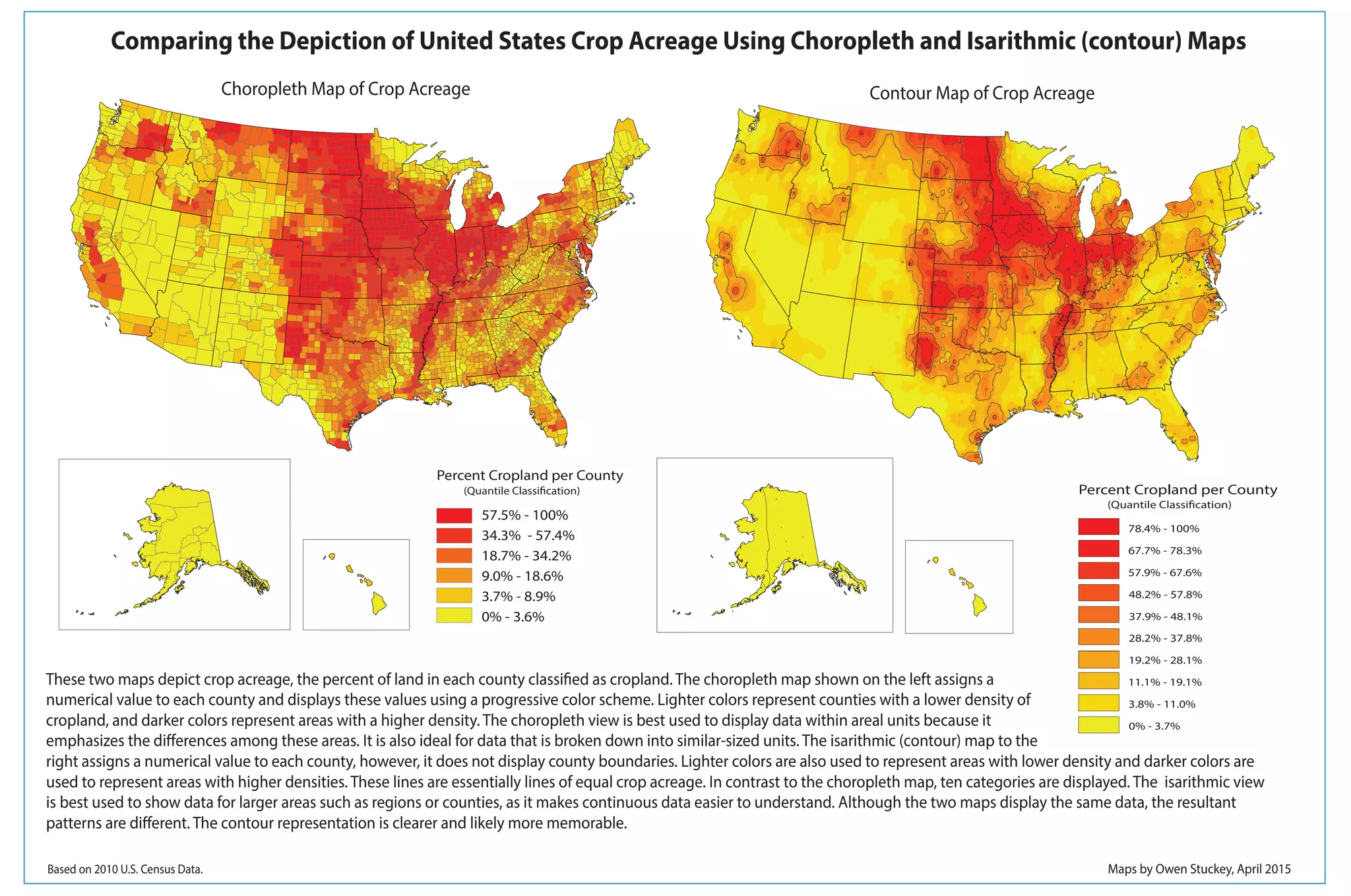
Comparing the Depiction of United States Crop Acreage Using Choropleth and Isarithmic (contour) Maps
Choropleth Map of Crop Acreage
57.5% - 100%
34.3% - 57.4%
Percent Cropland per County
18.7% - 34.2%
9.0% - 18.6%
3.7% - 8.9%
0% - 3.6%
(Quantile Classification)
Contour Map of Crop Acreage
These two maps depict crop acreage, the percent of land in each county classified as cropland. The choropleth map shown on the left assigns a
numerical value to each county and displays these values using a progressive color scheme. Lighter colors represent counties with a lower density of
cropland, and darker colors represent areas with a higher density. The choropleth view is best used to display data within areal units because it
emphasizes the differences among these areas. It is also ideal for data that is broken down into similar-sized units. The isarithmic (contour) map to the
right assigns a numerical value to each county, however, it does not display county boundaries. Lighter colors are also used to represent areas with lower density and darker colors are
used to represent areas with higher densities. These lines are essentially lines of equal crop acreage. In contrast to the choropleth map, ten categories are displayed. The isarithmic view
is best used to show data for larger areas such as regions or counties, as it makes continuous data easier to understand. Although the two maps display the same data, the resultant
patterns are different. The contour representation is clearer and likely more memorable.
Percent Cropland per County
(Quantile Classification)
78.4% - 100%
67.7% - 78.3%
57.9% - 67.6%
48.2% - 57.8%
37.9% - 48.1%
28.2% - 37.8%
19.2% - 28.1%
11.1% - 19.1%
3.8% - 11.0%
0% - 3.7%

Big Two Map

  • 1.
    Maps by OwenStuckey, April 2015Based on 2010 U.S. Census Data. Comparing the Depiction of United States Crop Acreage Using Choropleth and Isarithmic (contour) Maps Choropleth Map of Crop Acreage 57.5% - 100% 34.3% - 57.4% Percent Cropland per County 18.7% - 34.2% 9.0% - 18.6% 3.7% - 8.9% 0% - 3.6% (Quantile Classification) Contour Map of Crop Acreage These two maps depict crop acreage, the percent of land in each county classified as cropland. The choropleth map shown on the left assigns a numerical value to each county and displays these values using a progressive color scheme. Lighter colors represent counties with a lower density of cropland, and darker colors represent areas with a higher density. The choropleth view is best used to display data within areal units because it emphasizes the differences among these areas. It is also ideal for data that is broken down into similar-sized units. The isarithmic (contour) map to the right assigns a numerical value to each county, however, it does not display county boundaries. Lighter colors are also used to represent areas with lower density and darker colors are used to represent areas with higher densities. These lines are essentially lines of equal crop acreage. In contrast to the choropleth map, ten categories are displayed. The isarithmic view is best used to show data for larger areas such as regions or counties, as it makes continuous data easier to understand. Although the two maps display the same data, the resultant patterns are different. The contour representation is clearer and likely more memorable. Percent Cropland per County (Quantile Classification) 78.4% - 100% 67.7% - 78.3% 57.9% - 67.6% 48.2% - 57.8% 37.9% - 48.1% 28.2% - 37.8% 19.2% - 28.1% 11.1% - 19.1% 3.8% - 11.0% 0% - 3.7%