




MUTUAL FUNDS
 Mutual Funds in India are financial instruments
 It is an investment fund that pools money from different
investors to purchase securities to achieve financial goals
 The owner of a mutual fund unit gets a proportional share of
the fund’s gain or loss
 Mutual Fund Scheme’s are managed by a Fund Manager’s
ORGANIZATION STRUCTURE
OF MUTUAL FUNDS
 Mutual fund manager have high responsibility of maximizing
return and to minimize the risk. When fund provided high return
with high risk, investors attract to invest more fund for same
scheme.
 The graph indicates how the process was going on to investors to
earn returns.
TYPES OF FUNDS
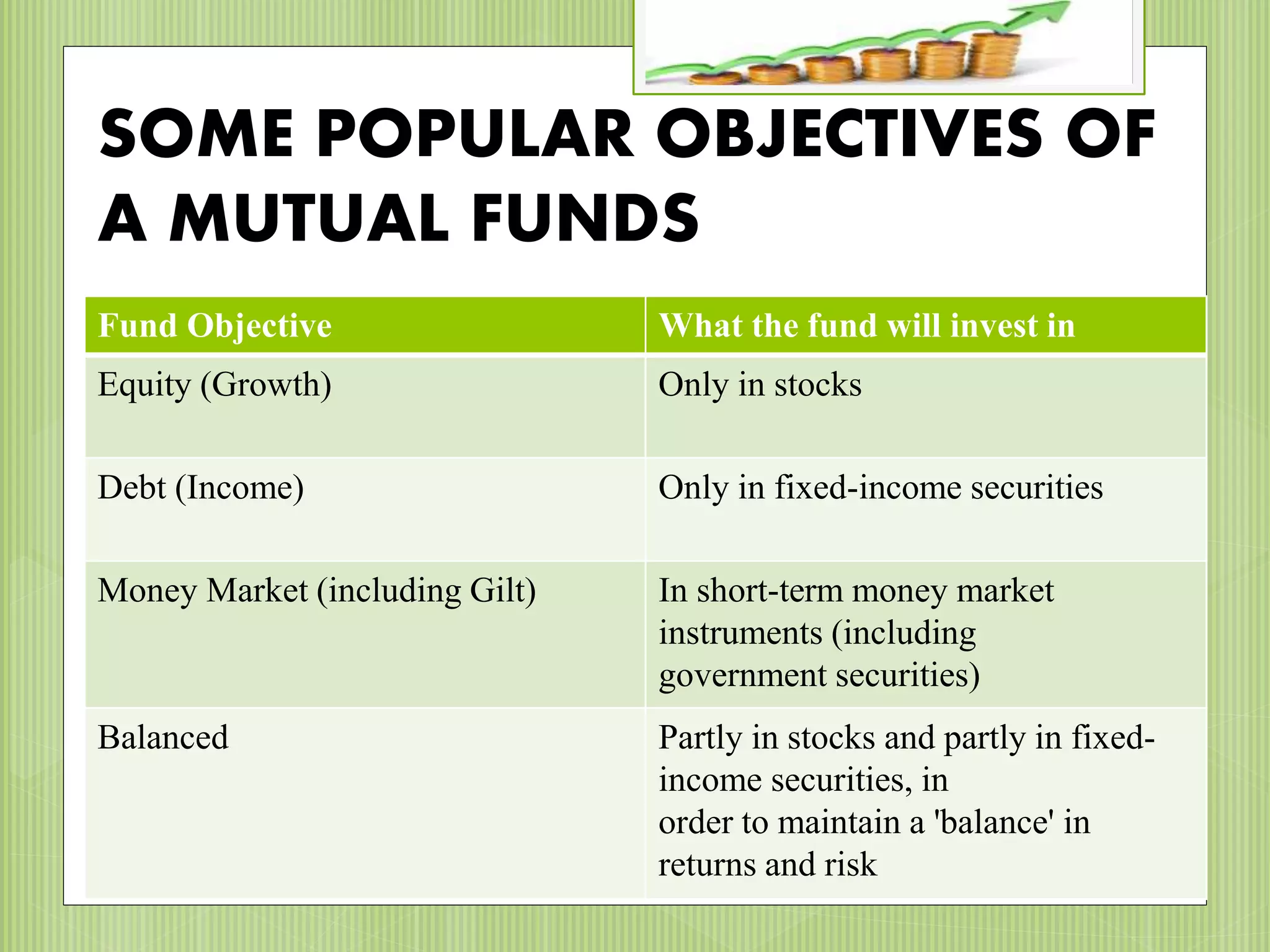
SOME POPULAR OBJECTIVES OF
A MUTUAL FUNDS
Fund Objective What the fund will invest in
Equity (Growth) Only in stocks
Debt (Income) Only in fixed-income securities
Money Market (including Gilt) In short-term money market
instruments (including
government securities)
Balanced Partly in stocks and partly in fixed-
income securities, in
order to maintain a 'balance' in
returns and risk
GROWTH OF MUTUAL FUND
INDUSTRY IN INDIA:
The Indian mutual fund industry is one of the fastest growing sectors in the
Indian capital and financial markets. The mutual fund industry in India has
seen dramatic improvements in quantity as well as quality of product and
service offerings in recent years.
 The concept of mutual funds was introduced in India with the formation
of Unit Trust of India in 1963.
 The first scheme launched by UTI was the now infamous Unit Scheme 64
in 1964.
CONTD…
 UTI continued to be the sole mutual fund until 1987, when
some public sector banks and Life Insurance Corporation of
India and General Insurance Corporation of India set up
mutual funds.
 In 1993, private players entered the market.
 Today, 32 mutual funds collectively manage Rs 6713575.19
cr under hundreds of schemes
FUTURE AND GROWTH OF
MUTUAL FUNDS IN INDIA- KEY
FINDINGS
According to report of Business maps of India, Important aspects
related to the future of mutual funds in India are:
 The growth rate was 100 % in previous years.
 The saving rate in India is 23 %.
 There is a huge scope in the future for the expansion of the mutual
funds industry.
 The Securities Exchange Board of India has allowed the introduction
of commodity mutual funds.
 The emphasis is being given on the effective corporate governance of
Mutual Funds.
 The Mutual funds in India has the scope of penetrating into the rural
and semi urban areas.
 Financial planners are introduced into the market, which would
provide the people with better financial planning.
 A number of foreign based assets management companies are
venturing into Indian markets
ADVANTAGES OF MUTUAL
FUNDS
 Advanced Portfolio Management
You pay a management fee as part of your expense ratio, which is
used to hire a professional portfolio manager who buys and sells
stocks, bonds, etc. This is a relatively small price to pay for help in
the management of an investment portfolio.
 Dividend Reinvestment
As dividends and other interest income is declared for the fund, it
can be used to purchase additional shares in the mutual fund, thus
helping your investment grow.
CONTD…
 Risk Reduction (Safety)
A reduced portfolio risk is achieved through the use of diversification,
as most mutual funds will invest in anywhere from 50 to 200 different
securities - depending on their focus. Several index stock mutual funds
own 1,000 or more individual stock positions.
 Convenience and Fair Pricing
Mutual funds are common and easy to buy. They typically have low
minimum investments (some around $2,500) and they are traded only
once per day at the closing net asset value (NAV). This eliminates
price fluctuation throughout the day and various arbitrage
opportunities that day traders practice.
DISADVANTAGES OF MUTUAL
FUND
 High Expense Ratios and Sales Charges
 If you're not paying attention to mutual fund expense ratios and sales
charges, they can get out of hand.
 Be very cautious when investing in funds with expense ratios higher than
1.20%, as they will be considered on the higher cost end.
 There are several good fund companies out there that have no sales
charges.
 Fees reduce overall investment returns.
 Management Abuses
Churning, turnover and window dressing may happen if your manager is
abusing his or her authority. This includes unnecessary trading, excessive
replacement and selling the losers prior to quarter-end to fix the books.
 Tax Inefficiency
Like it or not, investors do not have a choice when it comes to capital
gain payouts in mutual funds. Due to the turnover, redemptions, gains
and losses in security holdings throughout the year, investors typically
receive distributions from the fund that are an uncontrollable tax event.
 Poor Trade Execution
If you place your mutual fund trade anytime before the cut-off time for
same-day NAV, you'll receive the same closing price NAV for your buy
or sell on the mutual fund. For investors looking for faster execution
times, maybe because of short investment horizons, day trading, or
timing the market, mutual funds provide a weak execution strategy.
LIST OF MUTUAL FUND
COMPANIES IN INDIA
 State Bank of India
 Kotak Mahindra
 ING
 ICICI Prudential
 HSBC
 Canara Bank
 Birla Sun Life
 Bank of Baroda
 AIG
 HDFC
 Reliance Mutual Fund

Mutual funds - Better way of Investment

  • 2.
    MUTUAL FUNDS  MutualFunds in India are financial instruments  It is an investment fund that pools money from different investors to purchase securities to achieve financial goals  The owner of a mutual fund unit gets a proportional share of the fund’s gain or loss  Mutual Fund Scheme’s are managed by a Fund Manager’s
  • 3.
    ORGANIZATION STRUCTURE OF MUTUALFUNDS  Mutual fund manager have high responsibility of maximizing return and to minimize the risk. When fund provided high return with high risk, investors attract to invest more fund for same scheme.  The graph indicates how the process was going on to investors to earn returns.
  • 4.
  • 5.
    SOME POPULAR OBJECTIVESOF A MUTUAL FUNDS Fund Objective What the fund will invest in Equity (Growth) Only in stocks Debt (Income) Only in fixed-income securities Money Market (including Gilt) In short-term money market instruments (including government securities) Balanced Partly in stocks and partly in fixed- income securities, in order to maintain a 'balance' in returns and risk
  • 6.
    GROWTH OF MUTUALFUND INDUSTRY IN INDIA: The Indian mutual fund industry is one of the fastest growing sectors in the Indian capital and financial markets. The mutual fund industry in India has seen dramatic improvements in quantity as well as quality of product and service offerings in recent years.  The concept of mutual funds was introduced in India with the formation of Unit Trust of India in 1963.  The first scheme launched by UTI was the now infamous Unit Scheme 64 in 1964.
  • 7.
    CONTD…  UTI continuedto be the sole mutual fund until 1987, when some public sector banks and Life Insurance Corporation of India and General Insurance Corporation of India set up mutual funds.  In 1993, private players entered the market.  Today, 32 mutual funds collectively manage Rs 6713575.19 cr under hundreds of schemes
  • 8.
    FUTURE AND GROWTHOF MUTUAL FUNDS IN INDIA- KEY FINDINGS According to report of Business maps of India, Important aspects related to the future of mutual funds in India are:  The growth rate was 100 % in previous years.  The saving rate in India is 23 %.  There is a huge scope in the future for the expansion of the mutual funds industry.
  • 9.
     The SecuritiesExchange Board of India has allowed the introduction of commodity mutual funds.  The emphasis is being given on the effective corporate governance of Mutual Funds.  The Mutual funds in India has the scope of penetrating into the rural and semi urban areas.  Financial planners are introduced into the market, which would provide the people with better financial planning.  A number of foreign based assets management companies are venturing into Indian markets
  • 10.
    ADVANTAGES OF MUTUAL FUNDS Advanced Portfolio Management You pay a management fee as part of your expense ratio, which is used to hire a professional portfolio manager who buys and sells stocks, bonds, etc. This is a relatively small price to pay for help in the management of an investment portfolio.  Dividend Reinvestment As dividends and other interest income is declared for the fund, it can be used to purchase additional shares in the mutual fund, thus helping your investment grow.
  • 11.
    CONTD…  Risk Reduction(Safety) A reduced portfolio risk is achieved through the use of diversification, as most mutual funds will invest in anywhere from 50 to 200 different securities - depending on their focus. Several index stock mutual funds own 1,000 or more individual stock positions.  Convenience and Fair Pricing Mutual funds are common and easy to buy. They typically have low minimum investments (some around $2,500) and they are traded only once per day at the closing net asset value (NAV). This eliminates price fluctuation throughout the day and various arbitrage opportunities that day traders practice.
  • 12.
    DISADVANTAGES OF MUTUAL FUND High Expense Ratios and Sales Charges  If you're not paying attention to mutual fund expense ratios and sales charges, they can get out of hand.  Be very cautious when investing in funds with expense ratios higher than 1.20%, as they will be considered on the higher cost end.  There are several good fund companies out there that have no sales charges.  Fees reduce overall investment returns.  Management Abuses Churning, turnover and window dressing may happen if your manager is abusing his or her authority. This includes unnecessary trading, excessive replacement and selling the losers prior to quarter-end to fix the books.
  • 13.
     Tax Inefficiency Likeit or not, investors do not have a choice when it comes to capital gain payouts in mutual funds. Due to the turnover, redemptions, gains and losses in security holdings throughout the year, investors typically receive distributions from the fund that are an uncontrollable tax event.  Poor Trade Execution If you place your mutual fund trade anytime before the cut-off time for same-day NAV, you'll receive the same closing price NAV for your buy or sell on the mutual fund. For investors looking for faster execution times, maybe because of short investment horizons, day trading, or timing the market, mutual funds provide a weak execution strategy.
  • 14.
    LIST OF MUTUALFUND COMPANIES IN INDIA  State Bank of India  Kotak Mahindra  ING  ICICI Prudential  HSBC  Canara Bank  Birla Sun Life  Bank of Baroda  AIG  HDFC  Reliance Mutual Fund