MUTUAL FUNDS
FOR BEGINNERS
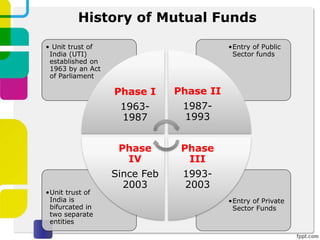
History of Mutual Funds
•Entry of Private
Sector Funds
•Unit trust of
India is
bifurcated in
two separate
entities
•Entry of Public
Sector funds
• Unit trust of
India (UTI)
established on
1963 by an Act
of Parliament
Phase I
1963-
1987
Phase II
1987-
1993
Phase
III
1993-
2003
Phase
IV
Since Feb
2003
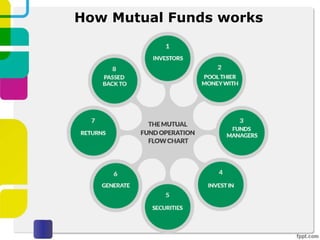
How Mutual Funds works
Advantages of Mutual Funds
Providing greats Affordability & Liquidity
• Affordability: Small investor can afford to invest in
Mutual Funds. They provide an attractive &cost effective
alternative to direct purchase of shares. In the absence
of Mutual Funds. Small investors cannot think of
participated in a number of investment with such a
meagre sum.
• Liquidity: Units can be sold to the fund at any time at the Net
Asset Value (NAV) and thus quick access to liquid cash is
assured. Net Asset Value: The repurchase price is linked to the
Net Asset Value.
(NAV: Market price of each unit of a particular scheme in
relation to all the assets of the scheme. This value is a true
indicator of the performance of the fund.)
How to calculate NET Asset Value
• If NAV is more than the face value of the unit, it clearly
indicated that the money invested on that unit has
appreciated and the fund has performed well.
E.g.: Fortune Mutual Fund introduced a scheme size –
100 crores value of each unit is Rs.10.
the company invested all funds in share and debenture
and for market value of investment comes to Rs.200
crores.
200 crores
NAV =------------- X Value of each unit.
100 crores
= 2 X 10
= 20/-
Hence NAV = Rs. 20/-
High Performing Mutual Funds – Are
they Best Mutual Funds?
• Let us take an example of cricket. I will consider two players to give
you an idea about what I am going to share with you in this post.
• First cricketer is Rahul Dravid and the second one is Shahid Afridi.
Both are the best batsmen. However, on whom we rely most?
• Is it on Dravid or Afridi? Definitely on the WALL (Dravid) because of
his consistency but not on high sixes and fours of Afridi.
• If you we look at the cricketing career of both the batsman
the average is high for Rahul Dravid. However, strike rate is high for
Shahid Afridi.
High Performing Mutual Funds –
How they can kill your wealth?
• Let us say, two friends, Mr.Chinmay and Mr. Loukik decided
to invest in equity mutual funds. They searched and found
two funds are really high rated. Let us say these two funds
as Fund ABC and Fund XYZ.
• However, they again found that both funds average returns
over 5 years are same. Now they really in a confused mind
of which one to choose.
• Both are high performing mutual funds and both are
ranking highly in all rating portals. Also, the average 5
years returns are almost same.
• In such a situation, which one to choose?
• Here come the Dravid and Afridi example. Who performed
consistently with lowest ups and downs? This is also be
called Standard Deviation.
Why we consider High Performing
Mutual Funds?
• It is human tendency to look for BEST while buying
something or investing. So obviously we go in search for
BEST or high performing mutual funds.
• We feel that high performing mutual funds will give us
high returns. It is not true at all with the above
examples of cricket players and the funds.
• Also, we never estimate the risk we can take. We
always feel that HIGH RISK means HIGH RETURN. But
forget the simple logic that HIGH RISK will not
GUARANTEE you HIGH RETURN. Instead, the high risk
may lead to a positive or negative return, which does
not mean HIGH RETURN.
MORAL
• Never chase the high performing funds. Along with
higher returns, how the fund generated that much high
return is also important. Remember one thing, give the
equal importance go goal as well as to the way of
reaching goal.
• Consistency is key rather than high performance

Mutual funds for beginners

  • 1.
  • 2.
    History of MutualFunds •Entry of Private Sector Funds •Unit trust of India is bifurcated in two separate entities •Entry of Public Sector funds • Unit trust of India (UTI) established on 1963 by an Act of Parliament Phase I 1963- 1987 Phase II 1987- 1993 Phase III 1993- 2003 Phase IV Since Feb 2003
  • 3.
  • 4.
    Advantages of MutualFunds Providing greats Affordability & Liquidity • Affordability: Small investor can afford to invest in Mutual Funds. They provide an attractive &cost effective alternative to direct purchase of shares. In the absence of Mutual Funds. Small investors cannot think of participated in a number of investment with such a meagre sum. • Liquidity: Units can be sold to the fund at any time at the Net Asset Value (NAV) and thus quick access to liquid cash is assured. Net Asset Value: The repurchase price is linked to the Net Asset Value. (NAV: Market price of each unit of a particular scheme in relation to all the assets of the scheme. This value is a true indicator of the performance of the fund.)
  • 5.
    How to calculateNET Asset Value • If NAV is more than the face value of the unit, it clearly indicated that the money invested on that unit has appreciated and the fund has performed well. E.g.: Fortune Mutual Fund introduced a scheme size – 100 crores value of each unit is Rs.10. the company invested all funds in share and debenture and for market value of investment comes to Rs.200 crores. 200 crores NAV =------------- X Value of each unit. 100 crores = 2 X 10 = 20/- Hence NAV = Rs. 20/-
  • 6.
    High Performing MutualFunds – Are they Best Mutual Funds? • Let us take an example of cricket. I will consider two players to give you an idea about what I am going to share with you in this post. • First cricketer is Rahul Dravid and the second one is Shahid Afridi. Both are the best batsmen. However, on whom we rely most? • Is it on Dravid or Afridi? Definitely on the WALL (Dravid) because of his consistency but not on high sixes and fours of Afridi. • If you we look at the cricketing career of both the batsman the average is high for Rahul Dravid. However, strike rate is high for Shahid Afridi.
  • 7.
    High Performing MutualFunds – How they can kill your wealth? • Let us say, two friends, Mr.Chinmay and Mr. Loukik decided to invest in equity mutual funds. They searched and found two funds are really high rated. Let us say these two funds as Fund ABC and Fund XYZ. • However, they again found that both funds average returns over 5 years are same. Now they really in a confused mind of which one to choose. • Both are high performing mutual funds and both are ranking highly in all rating portals. Also, the average 5 years returns are almost same. • In such a situation, which one to choose? • Here come the Dravid and Afridi example. Who performed consistently with lowest ups and downs? This is also be called Standard Deviation.
  • 8.
    Why we considerHigh Performing Mutual Funds? • It is human tendency to look for BEST while buying something or investing. So obviously we go in search for BEST or high performing mutual funds. • We feel that high performing mutual funds will give us high returns. It is not true at all with the above examples of cricket players and the funds. • Also, we never estimate the risk we can take. We always feel that HIGH RISK means HIGH RETURN. But forget the simple logic that HIGH RISK will not GUARANTEE you HIGH RETURN. Instead, the high risk may lead to a positive or negative return, which does not mean HIGH RETURN.
  • 9.
    MORAL • Never chasethe high performing funds. Along with higher returns, how the fund generated that much high return is also important. Remember one thing, give the equal importance go goal as well as to the way of reaching goal. • Consistency is key rather than high performance