Musicians and the PreventionMusicians and the Prevention
of Hearing Lossof Hearing Loss
Catherine V. Palmer, PhD
Director of Audiology, UPMC
Associate Professor, Communication Science and
Disorders
WarningWarning
By attending this presentation, you will
have to think differently about the way you
do things.
I would go as far as to say that it would be
extremely uncomfortable to have this
information and not take action…
Understanding the ear andUnderstanding the ear and
hearinghearing
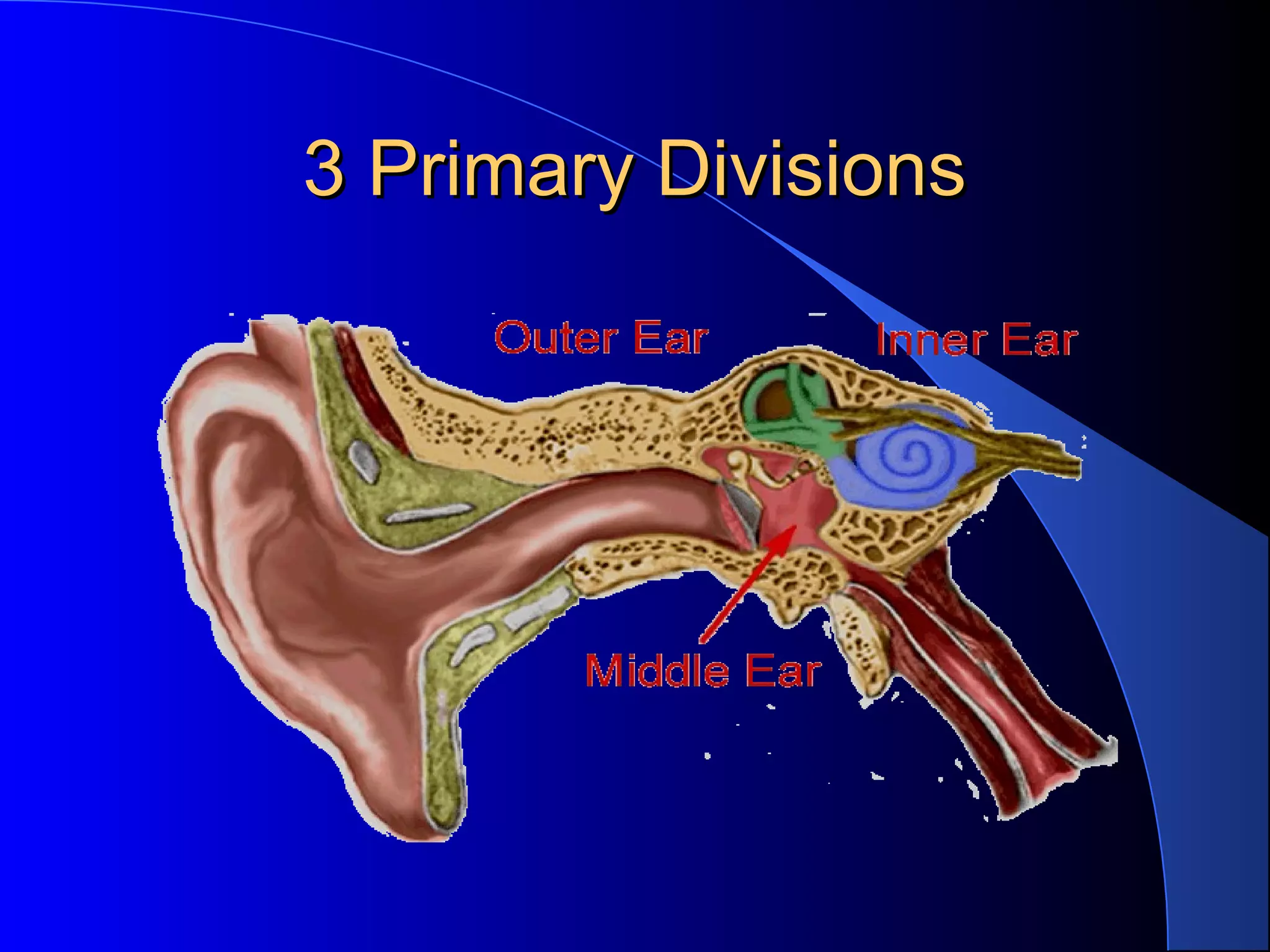
3 Primary Divisions3 Primary Divisions
Tour through the Ear.wmv
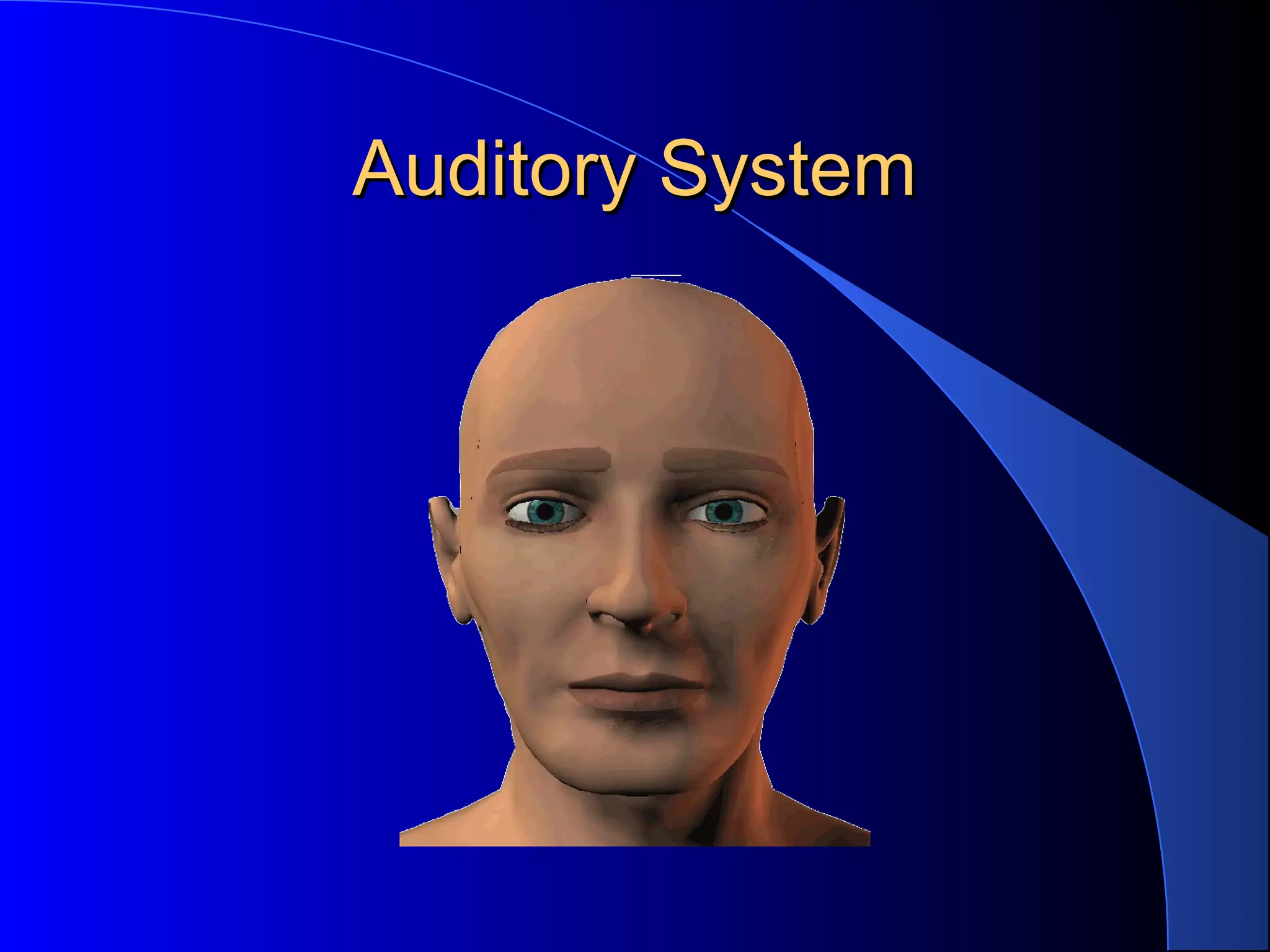
Auditory SystemAuditory System
With musicians, hearing lossWith musicians, hearing loss
is not the only problem …is not the only problem …
Tinnitus
Pitch perception problems
Two Critical Factors AffectingTwo Critical Factors Affecting
Hearing LossHearing Loss
 Intensity
 Duration
Who is in danger?Who is in danger?
Remember, the danger of damage to the
hair cells and subsequent hearing loss has to
do with the individual’s total dose.
You have to think about all the loud sounds
that the individual will be exposed to during
the day.
Functional ImpactFunctional Impact
Decreased sensitivity (you need sounds
louder to hear them)
Diminished clarity (frequency resolution is
poor). This impacts playing music,
enjoying music, and hearing speech.
Tinnitus (ringing sounds, often high
pitched)
After exposure there may be no symptoms,
or the individual may experience ringing in
the ears, a sensation of fullness, or sounds
my seem “dull”
The damage and functional change is
gradual. The individual may not notice a
problem for a decade or more.
The damage continuesThe damage continues
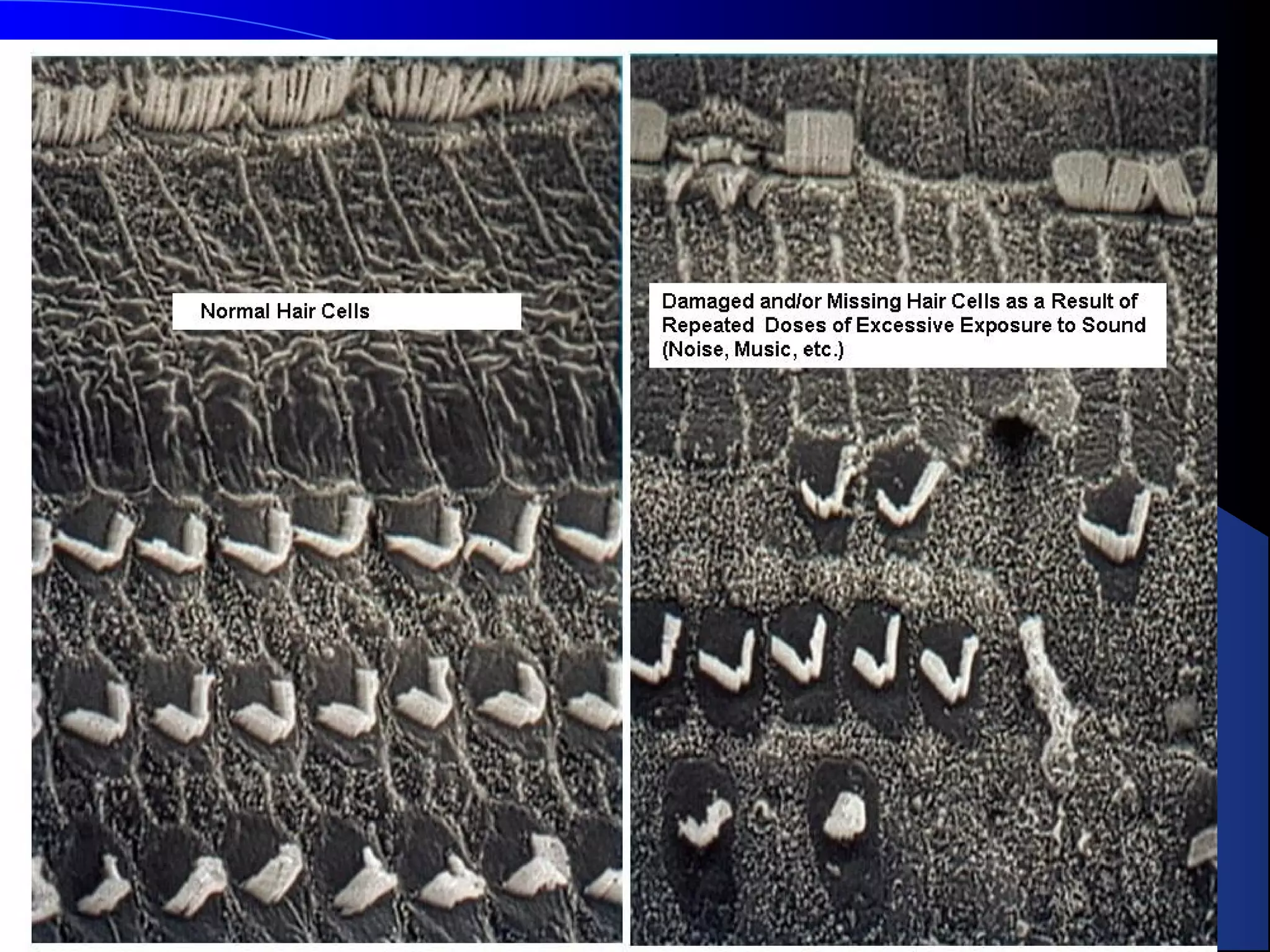
We know that hair cells continue to die well
after the exposure.
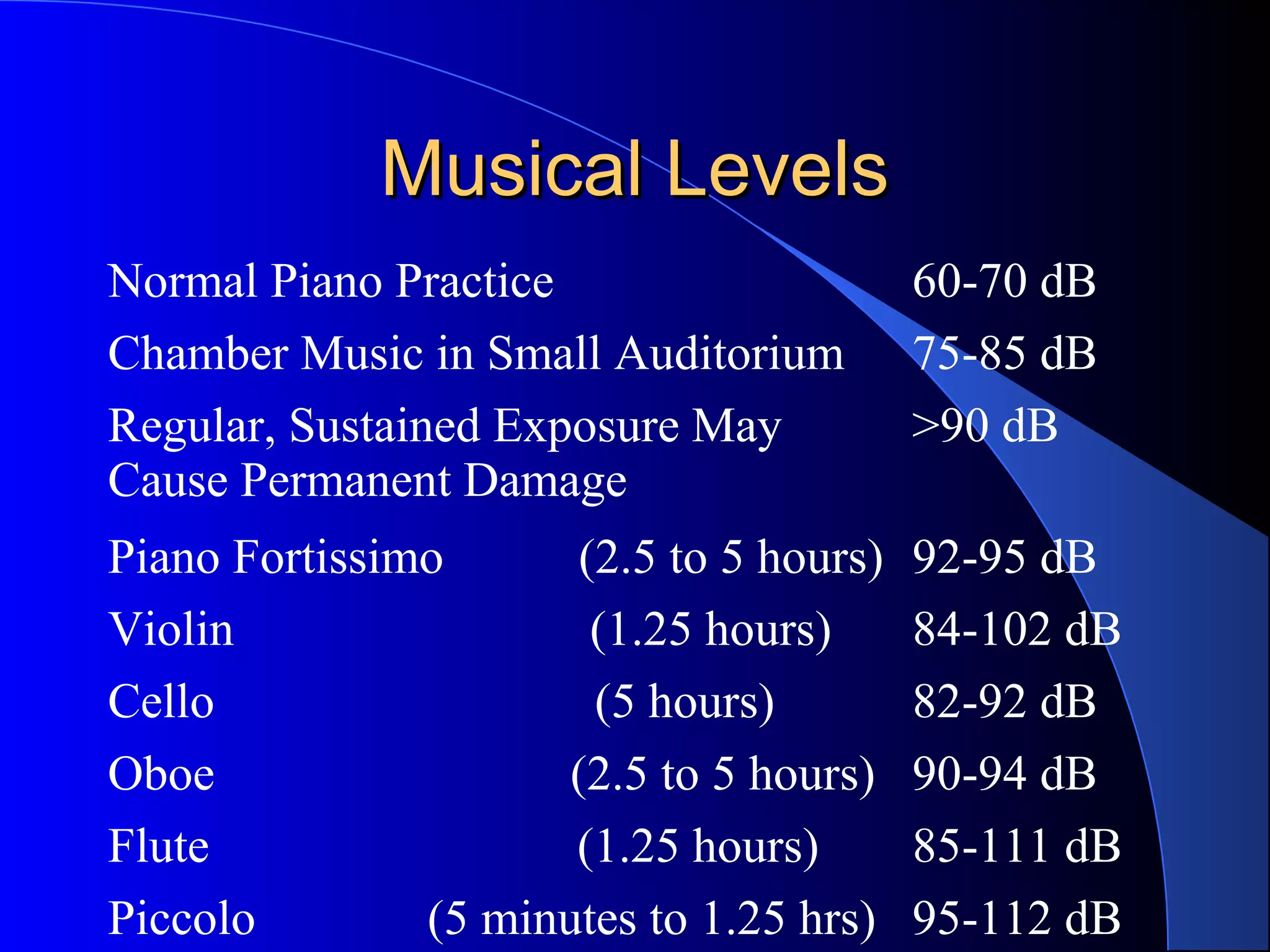
Musical LevelsMusical Levels
Normal Piano Practice 60-70 dB
Chamber Music in Small Auditorium 75-85 dB
Regular, Sustained Exposure May
Cause Permanent Damage
>90 dB
Piano Fortissimo (2.5 to 5 hours) 92-95 dB
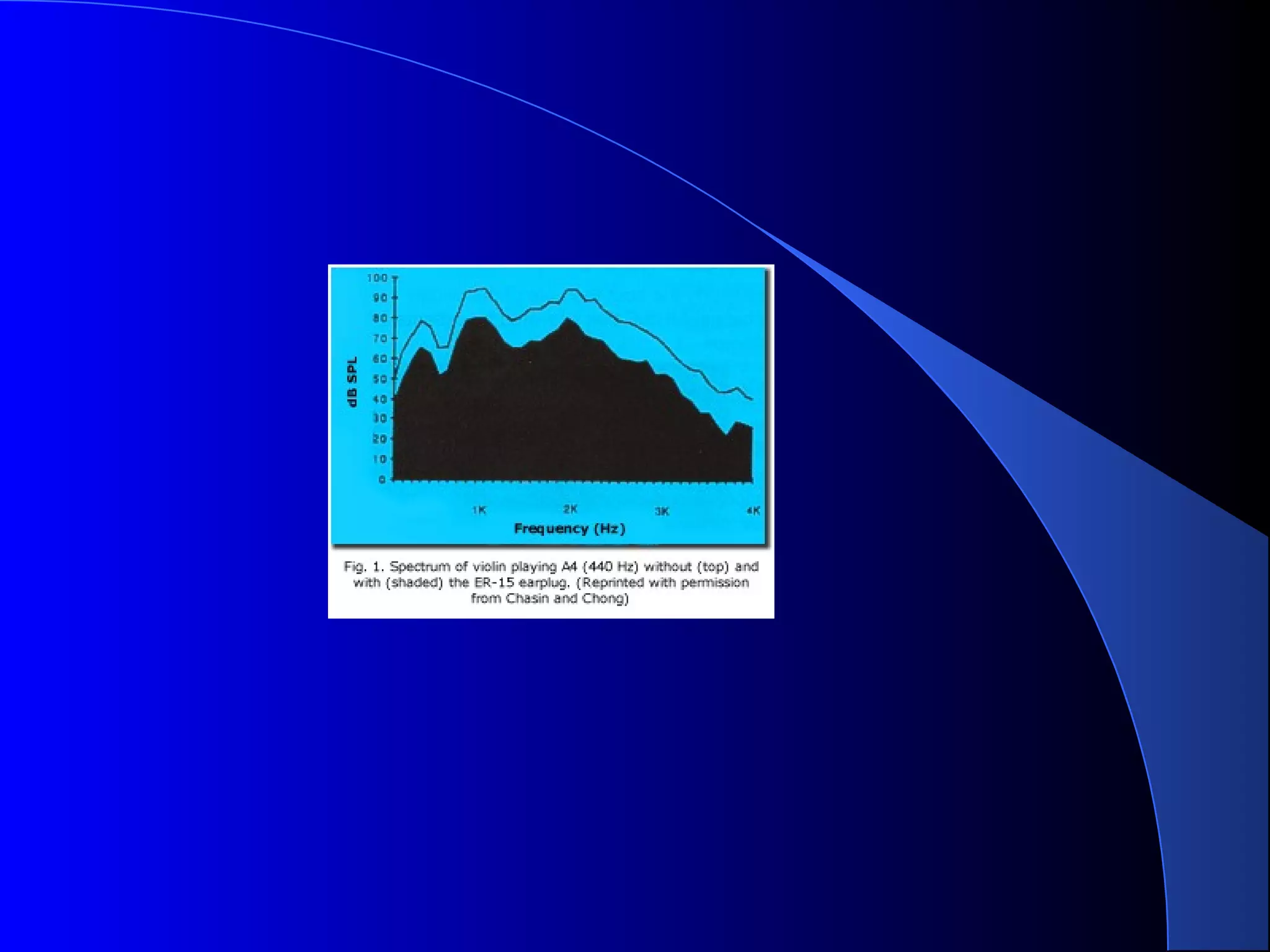
Violin (1.25 hours) 84-102 dB
Cello (5 hours) 82-92 dB
Oboe (2.5 to 5 hours) 90-94 dB
Flute (1.25 hours) 85-111 dB
Piccolo (5 minutes to 1.25 hrs) 95-112 dB
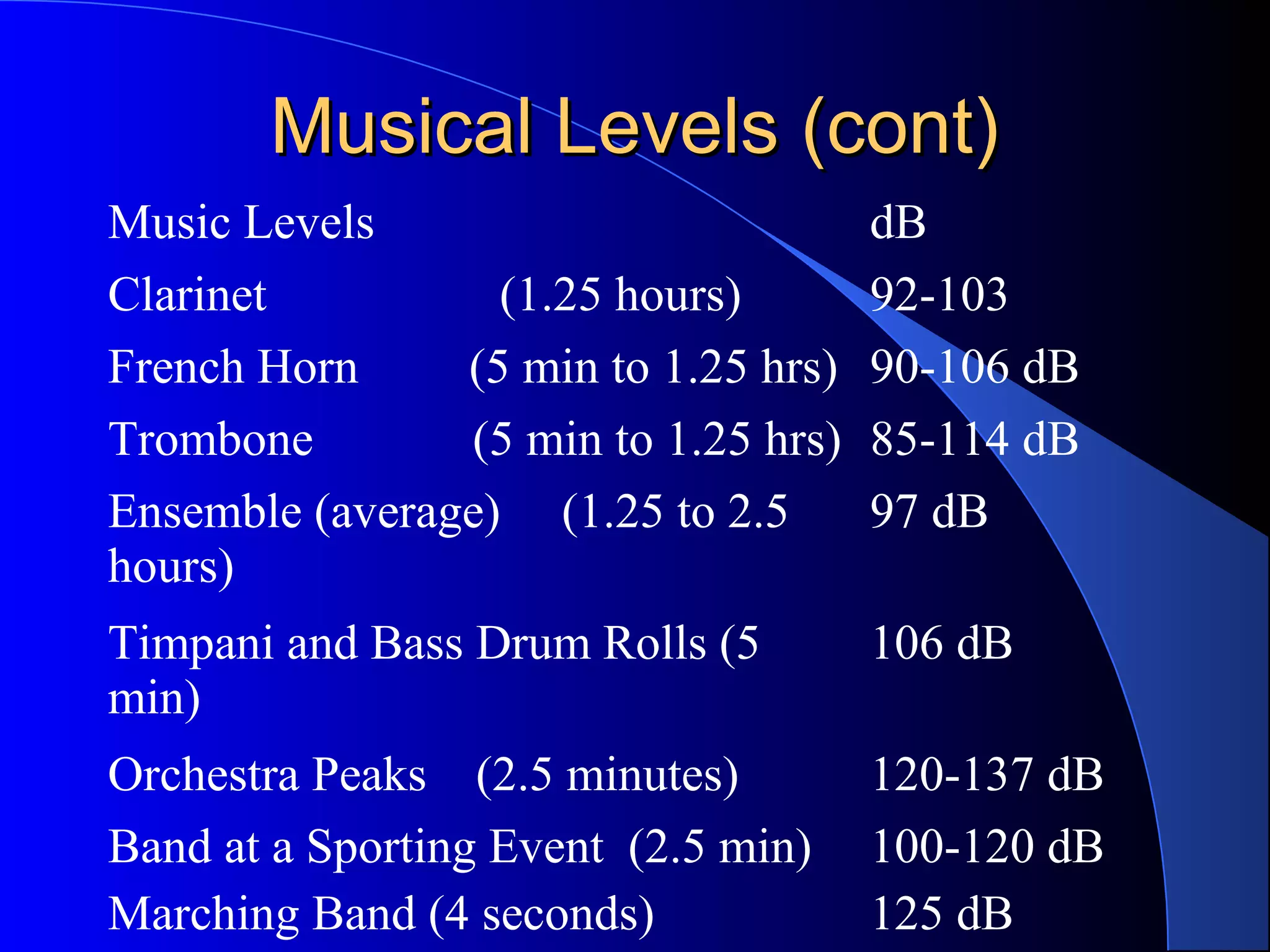
Musical Levels (cont)Musical Levels (cont)
Music Levels dB
Clarinet (1.25 hours) 92-103
French Horn (5 min to 1.25 hrs) 90-106 dB
Trombone (5 min to 1.25 hrs) 85-114 dB
Ensemble (average) (1.25 to 2.5
hours)
97 dB
Timpani and Bass Drum Rolls (5
min)
106 dB
Orchestra Peaks (2.5 minutes) 120-137 dB
Band at a Sporting Event (2.5 min)
Marching Band (4 seconds)
100-120 dB
125 dB
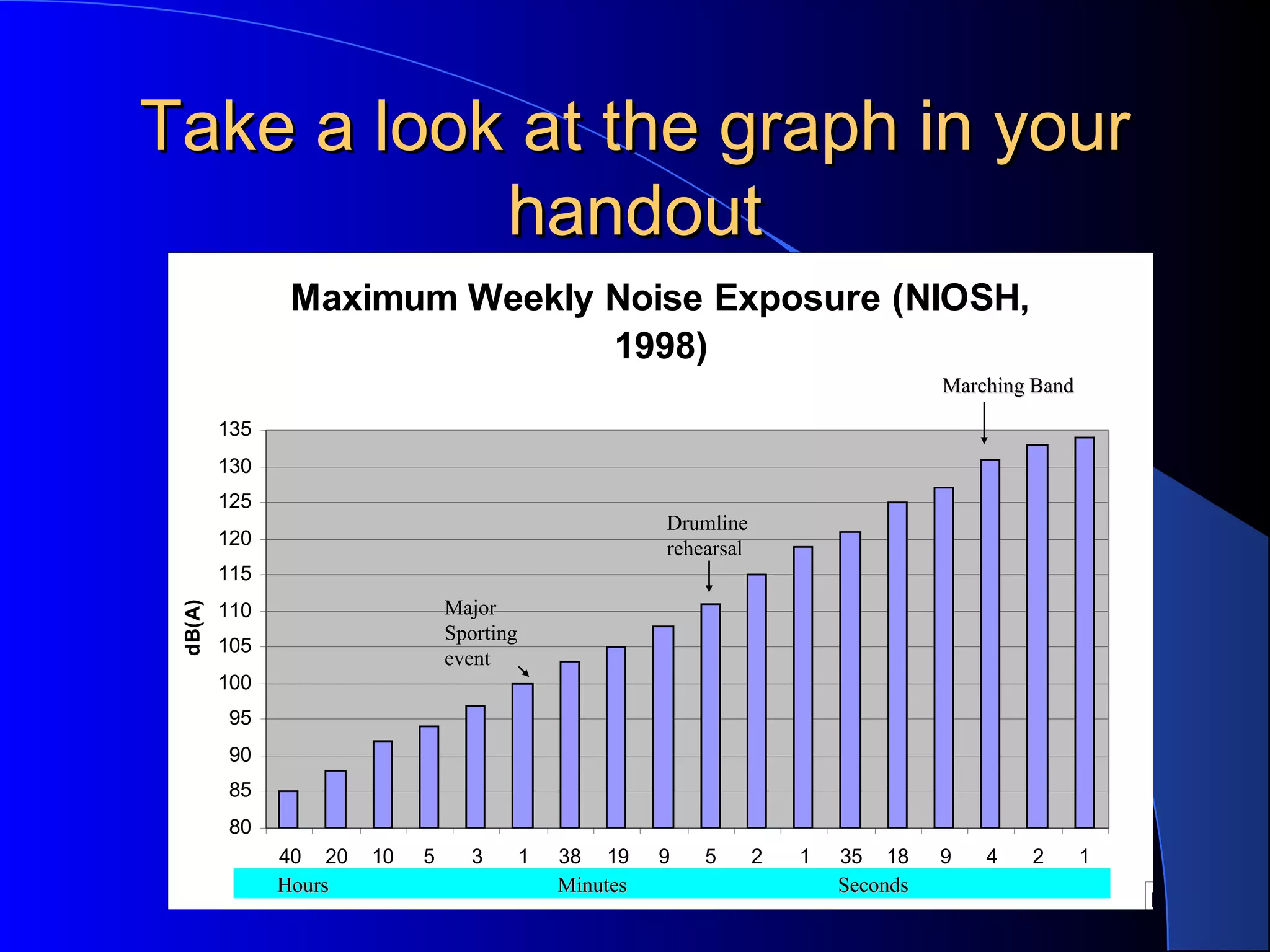
Take a look at the graph in yourTake a look at the graph in your
handouthandout
Maximum Weekly Noise Exposure (NIOSH,
1998)
80
85
90
95
100
105
110
115
120
125
130
135
40 20 10 5 3 1 38 19 9 5 2 1 35 18 9 4 2 1
Hours Minutes Seconds
dB(A)
MajorMajor
SportingSporting
eventevent
DrumlineDrumline
rehearsalrehearsal
Marching BandMarching Band
HoursHours MinutesMinutes SecondsSeconds
Take home messageTake home message
 Once instrumentalists play in a group, they are in
danger of permanent noise induced hearing loss
within minutes
 Drummers are always in danger of hearing loss
(practicing alone or in a group)
 You have to consider the total daily dose
 The impact of hearing loss may not be noticed for
years
 These times are based on adult data and there are
some animal studies that suggest that children are
more susceptible
What can instrumental instructorsWhat can instrumental instructors
(and parents) do?(and parents) do?
Protect yourself
Protect your students (children)
Educate your students (children)
– Hearing health care should be part of every
music program and part of health class
– Let’s talk about hearing protection…
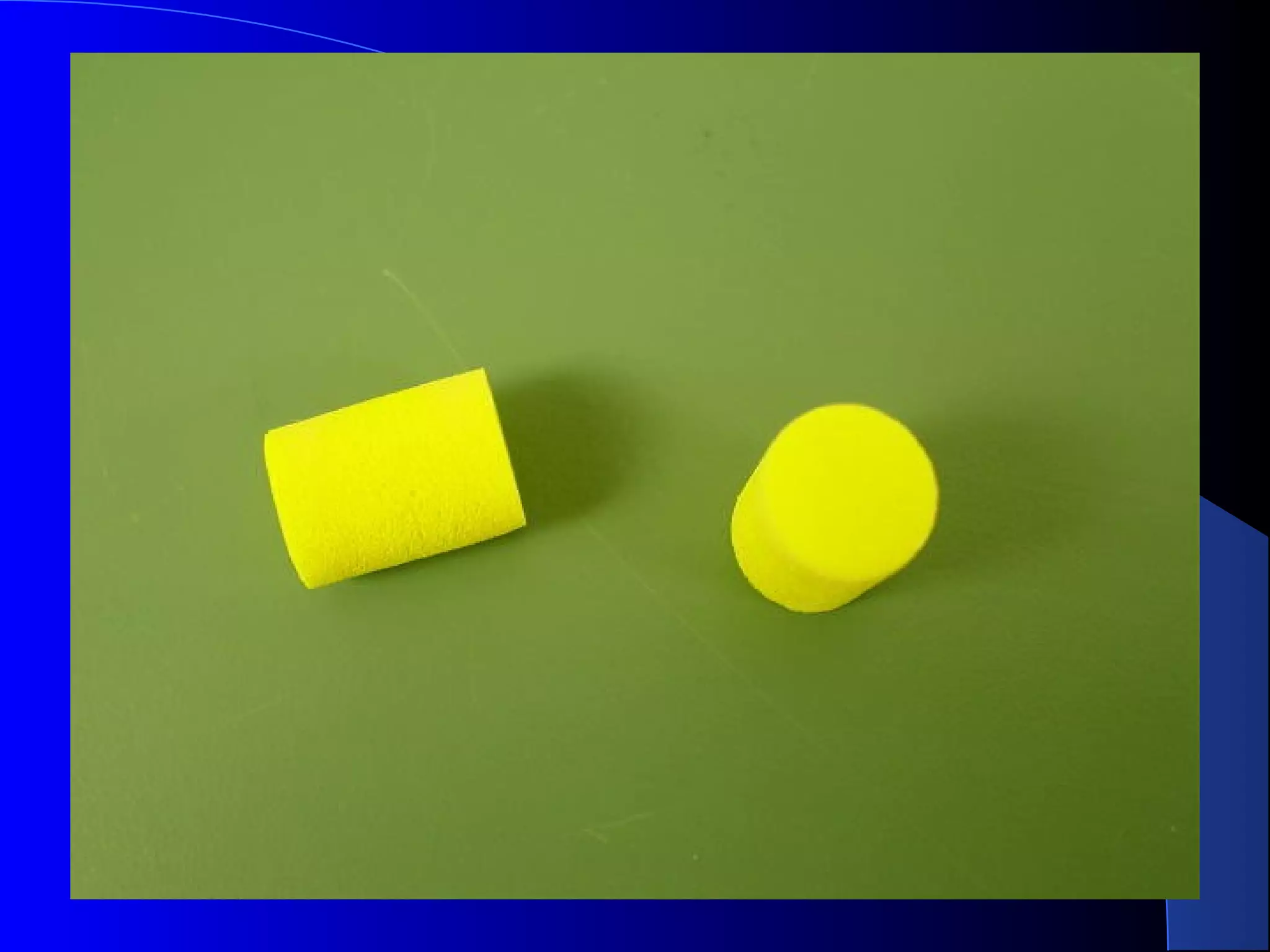
Hearing ProtectionHearing Protection
“Who wants earplugs that won’t let you
hear?”
Mead Killion
Description of School ProgramsDescription of School Programs
A recent national study estimated that
approximately 12% of all children ages 6 to
19 years have noise-induced hearing loss.
Children are the fastest growing population
of individuals with noise-induced hearing
loss.
Goals of the ProgramGoals of the Program
 Provide instrumental music instructors with
education related to hearing loss and hearing
protection and music
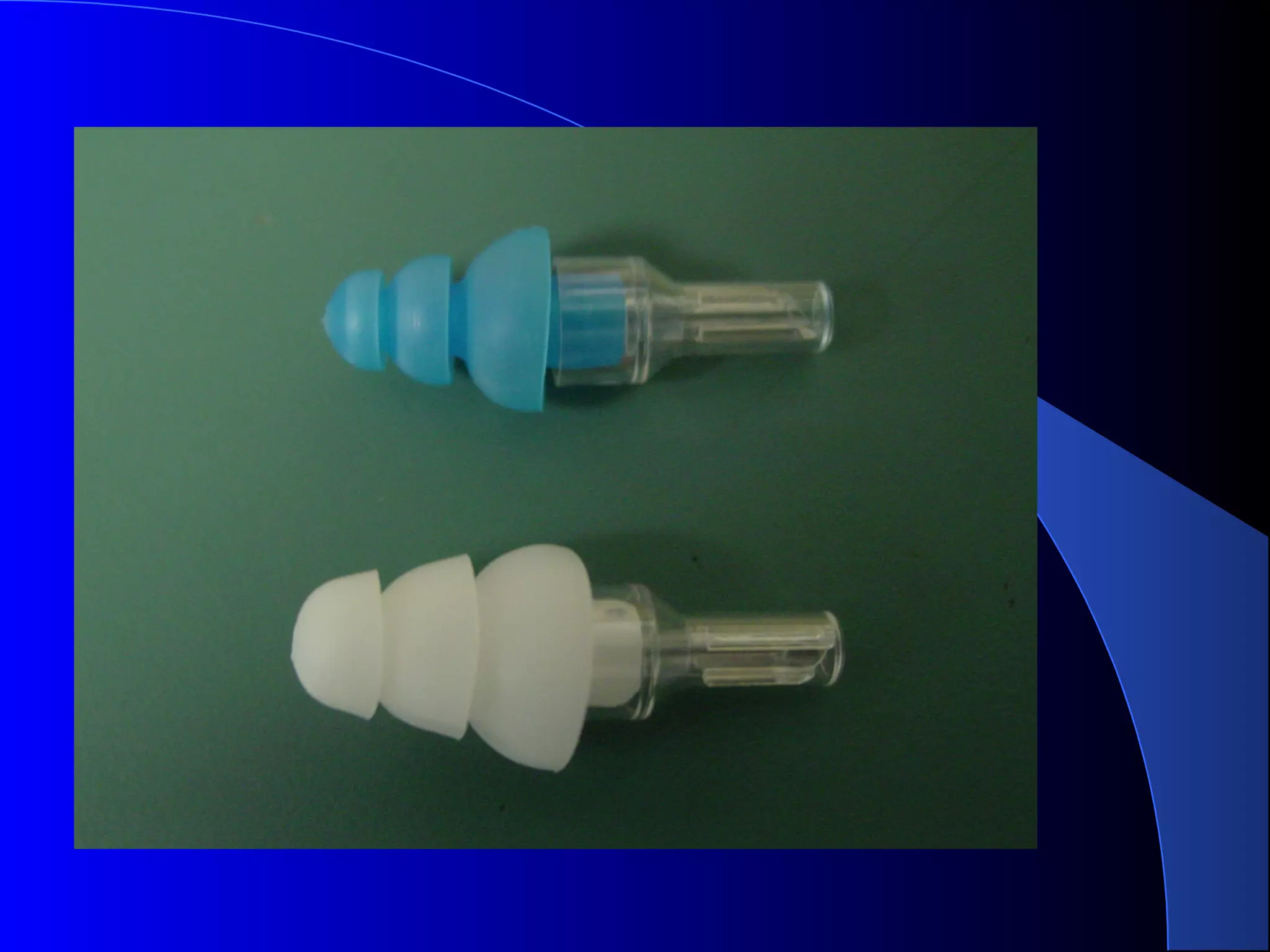
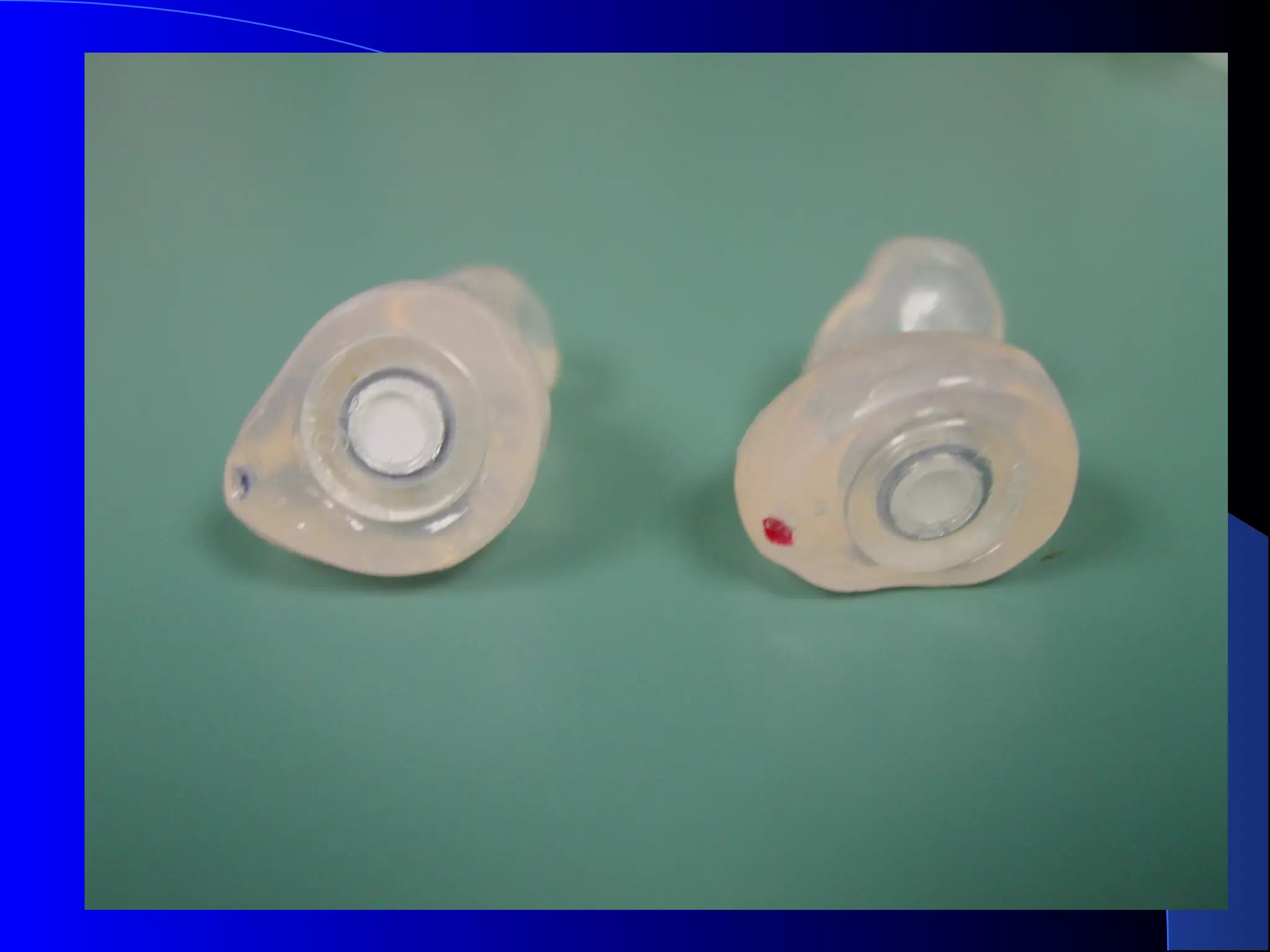
 Provide instrumental music instructors with non-
custom Musicians’ Earplugs or custom Musicians’
Earplugs at a reasonable cost
 Provide non-custom Musicians’ Earplugs to
instrumental music students through the
instructors
 Provide education to instrumental music students
through the instrumental music teachers
Putting Hearing Protection inPutting Hearing Protection in
ContextContext
 We would not consider sending students to chemistry
class or shop class without protective goggles.
 We would not consider allowing students to play
football without a helmet.
 We may know that a football player rides his bike
with no helmet, but that would not make us decide
not to bother with a helmet during football just
because he has increased his chance of having a head
injury anyway.
 Parents have the right to assume that schools make
school activities as safe as possible using current
information and technology.
It actually would be much simpler if noise
induced hearing loss caused pain or
bleeding – then you can be sure hearing
protection would be required.
The damage is invisible…finally there is
functional impact but it can be years after
the damage
Are we saying that music isAre we saying that music is
dangerous?dangerous?
No, but we are saying like many things we
engage in, you need to use the appropriate
equipment to make it safe and to be able to
enjoy it over a long period of time.
Successful Programs So FarSuccessful Programs So Far
 What message is the teacher sending if he/she wears
hearing protection in front of students? Good health
habits
 Mandatory – when you come into the band room, the first
thing you do is get your hearing protection.
 No hearing protection – you don’t participate in class.
(keep lots of extras)
 Help the students adjust. It takes about 2 weeks to get
used to using the hearing protection (horns are the
toughest)
Easy to useEasy to use
 The plugs come with cords so the students can
have them in and out if needed and drape them
over their necks
 The plugs come in a case that can be hooked to a
back pack or instrument case
 Students are welcome to use these earplugs
throughout their days, weekends, etc. or the
teacher may want to keep them in the band room
Who should absolutely be usingWho should absolutely be using
hearing protection?hearing protection?
Instructors
Band students
Orchestra students
Steel Band students
All drumming groups
Most other group-type musical students
Professional Musicians
All ages
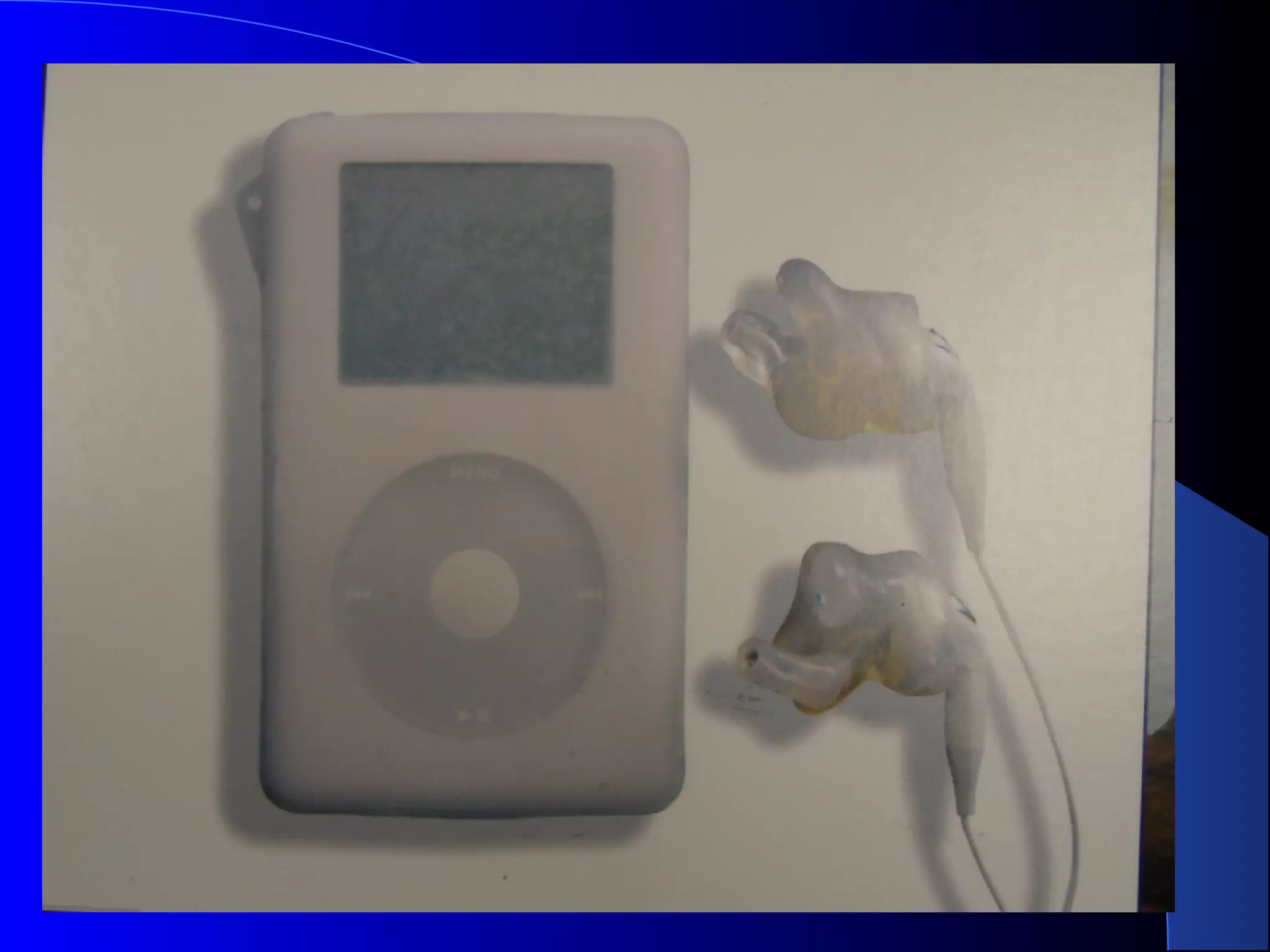
What about IPods?What about IPods?
 They are not inherently dangerous.
 It’s the level and amount of time.
 Custom earplugs can reduce the volume used, but
then you can’t hear the sounds around you.
 I’m only talking about hearing safety, there are
other concerns with being “plugged” in for hours
and not interacting with your environment.
 Remember, it’s all about total dose.
Arms-Length RuleArms-Length Rule
If you have to shout to be heard from 3 feet
away, then the noise (music) is too loud.
Turn down the volume or wear hearing
protection.
E Earplugs/earmuffs
A Avoid loud sounds
R Reduce the volume
S Shorten the time in noise
FactsFacts
 Any type of music can cause
permanent hearing loss and
ringing in the ears.
 It is intensity level and length of
exposure that matters.
 The type of hearing loss people
get from sound exposure is
permanent.
 The loss starts in the high
frequencies and progresses. It
causes difficulty
communicating in noisy
situations and impacts how
music is perceived.
 Sound exposure also may
cause ringing in the ears
(tinnitus).
 Some musicians need to
wear hearing protection
when they are practicing
alone.
 All musicians need to
wear hearing protection
when they are playing in a
group (band, orchestra) if
they want to avoid hearing
loss.

Musician instructor talk

  • 1.
    Musicians and thePreventionMusicians and the Prevention of Hearing Lossof Hearing Loss Catherine V. Palmer, PhD Director of Audiology, UPMC Associate Professor, Communication Science and Disorders
  • 2.
    WarningWarning By attending thispresentation, you will have to think differently about the way you do things. I would go as far as to say that it would be extremely uncomfortable to have this information and not take action…
  • 3.
    Understanding the earandUnderstanding the ear and hearinghearing
  • 4.
    3 Primary Divisions3Primary Divisions
  • 5.
  • 6.
  • 9.
    With musicians, hearinglossWith musicians, hearing loss is not the only problem …is not the only problem … Tinnitus Pitch perception problems
  • 10.
    Two Critical FactorsAffectingTwo Critical Factors Affecting Hearing LossHearing Loss  Intensity  Duration
  • 11.
    Who is indanger?Who is in danger? Remember, the danger of damage to the hair cells and subsequent hearing loss has to do with the individual’s total dose. You have to think about all the loud sounds that the individual will be exposed to during the day.
  • 12.
    Functional ImpactFunctional Impact Decreasedsensitivity (you need sounds louder to hear them) Diminished clarity (frequency resolution is poor). This impacts playing music, enjoying music, and hearing speech. Tinnitus (ringing sounds, often high pitched)
  • 13.
    After exposure theremay be no symptoms, or the individual may experience ringing in the ears, a sensation of fullness, or sounds my seem “dull” The damage and functional change is gradual. The individual may not notice a problem for a decade or more.
  • 14.
    The damage continuesThedamage continues We know that hair cells continue to die well after the exposure.
  • 15.
    Musical LevelsMusical Levels NormalPiano Practice 60-70 dB Chamber Music in Small Auditorium 75-85 dB Regular, Sustained Exposure May Cause Permanent Damage >90 dB Piano Fortissimo (2.5 to 5 hours) 92-95 dB Violin (1.25 hours) 84-102 dB Cello (5 hours) 82-92 dB Oboe (2.5 to 5 hours) 90-94 dB Flute (1.25 hours) 85-111 dB Piccolo (5 minutes to 1.25 hrs) 95-112 dB
  • 16.
    Musical Levels (cont)MusicalLevels (cont) Music Levels dB Clarinet (1.25 hours) 92-103 French Horn (5 min to 1.25 hrs) 90-106 dB Trombone (5 min to 1.25 hrs) 85-114 dB Ensemble (average) (1.25 to 2.5 hours) 97 dB Timpani and Bass Drum Rolls (5 min) 106 dB Orchestra Peaks (2.5 minutes) 120-137 dB Band at a Sporting Event (2.5 min) Marching Band (4 seconds) 100-120 dB 125 dB
  • 17.
    Take a lookat the graph in yourTake a look at the graph in your handouthandout Maximum Weekly Noise Exposure (NIOSH, 1998) 80 85 90 95 100 105 110 115 120 125 130 135 40 20 10 5 3 1 38 19 9 5 2 1 35 18 9 4 2 1 Hours Minutes Seconds dB(A) MajorMajor SportingSporting eventevent DrumlineDrumline rehearsalrehearsal Marching BandMarching Band HoursHours MinutesMinutes SecondsSeconds
  • 18.
    Take home messageTakehome message  Once instrumentalists play in a group, they are in danger of permanent noise induced hearing loss within minutes  Drummers are always in danger of hearing loss (practicing alone or in a group)  You have to consider the total daily dose  The impact of hearing loss may not be noticed for years  These times are based on adult data and there are some animal studies that suggest that children are more susceptible
  • 19.
    What can instrumentalinstructorsWhat can instrumental instructors (and parents) do?(and parents) do? Protect yourself Protect your students (children) Educate your students (children) – Hearing health care should be part of every music program and part of health class – Let’s talk about hearing protection…
  • 20.
    Hearing ProtectionHearing Protection “Whowants earplugs that won’t let you hear?” Mead Killion
  • 25.
    Description of SchoolProgramsDescription of School Programs A recent national study estimated that approximately 12% of all children ages 6 to 19 years have noise-induced hearing loss. Children are the fastest growing population of individuals with noise-induced hearing loss.
  • 26.
    Goals of theProgramGoals of the Program  Provide instrumental music instructors with education related to hearing loss and hearing protection and music  Provide instrumental music instructors with non- custom Musicians’ Earplugs or custom Musicians’ Earplugs at a reasonable cost  Provide non-custom Musicians’ Earplugs to instrumental music students through the instructors  Provide education to instrumental music students through the instrumental music teachers
  • 27.
    Putting Hearing ProtectioninPutting Hearing Protection in ContextContext  We would not consider sending students to chemistry class or shop class without protective goggles.  We would not consider allowing students to play football without a helmet.  We may know that a football player rides his bike with no helmet, but that would not make us decide not to bother with a helmet during football just because he has increased his chance of having a head injury anyway.  Parents have the right to assume that schools make school activities as safe as possible using current information and technology.
  • 28.
    It actually wouldbe much simpler if noise induced hearing loss caused pain or bleeding – then you can be sure hearing protection would be required. The damage is invisible…finally there is functional impact but it can be years after the damage
  • 29.
    Are we sayingthat music isAre we saying that music is dangerous?dangerous? No, but we are saying like many things we engage in, you need to use the appropriate equipment to make it safe and to be able to enjoy it over a long period of time.
  • 30.
    Successful Programs SoFarSuccessful Programs So Far  What message is the teacher sending if he/she wears hearing protection in front of students? Good health habits  Mandatory – when you come into the band room, the first thing you do is get your hearing protection.  No hearing protection – you don’t participate in class. (keep lots of extras)  Help the students adjust. It takes about 2 weeks to get used to using the hearing protection (horns are the toughest)
  • 31.
    Easy to useEasyto use  The plugs come with cords so the students can have them in and out if needed and drape them over their necks  The plugs come in a case that can be hooked to a back pack or instrument case  Students are welcome to use these earplugs throughout their days, weekends, etc. or the teacher may want to keep them in the band room
  • 32.
    Who should absolutelybe usingWho should absolutely be using hearing protection?hearing protection? Instructors Band students Orchestra students Steel Band students All drumming groups Most other group-type musical students Professional Musicians All ages
  • 33.
    What about IPods?Whatabout IPods?  They are not inherently dangerous.  It’s the level and amount of time.  Custom earplugs can reduce the volume used, but then you can’t hear the sounds around you.  I’m only talking about hearing safety, there are other concerns with being “plugged” in for hours and not interacting with your environment.  Remember, it’s all about total dose.
  • 35.
    Arms-Length RuleArms-Length Rule Ifyou have to shout to be heard from 3 feet away, then the noise (music) is too loud. Turn down the volume or wear hearing protection.
  • 36.
    E Earplugs/earmuffs A Avoidloud sounds R Reduce the volume S Shorten the time in noise
  • 37.
    FactsFacts  Any typeof music can cause permanent hearing loss and ringing in the ears.  It is intensity level and length of exposure that matters.  The type of hearing loss people get from sound exposure is permanent.  The loss starts in the high frequencies and progresses. It causes difficulty communicating in noisy situations and impacts how music is perceived.  Sound exposure also may cause ringing in the ears (tinnitus).  Some musicians need to wear hearing protection when they are practicing alone.  All musicians need to wear hearing protection when they are playing in a group (band, orchestra) if they want to avoid hearing loss.

Editor's Notes

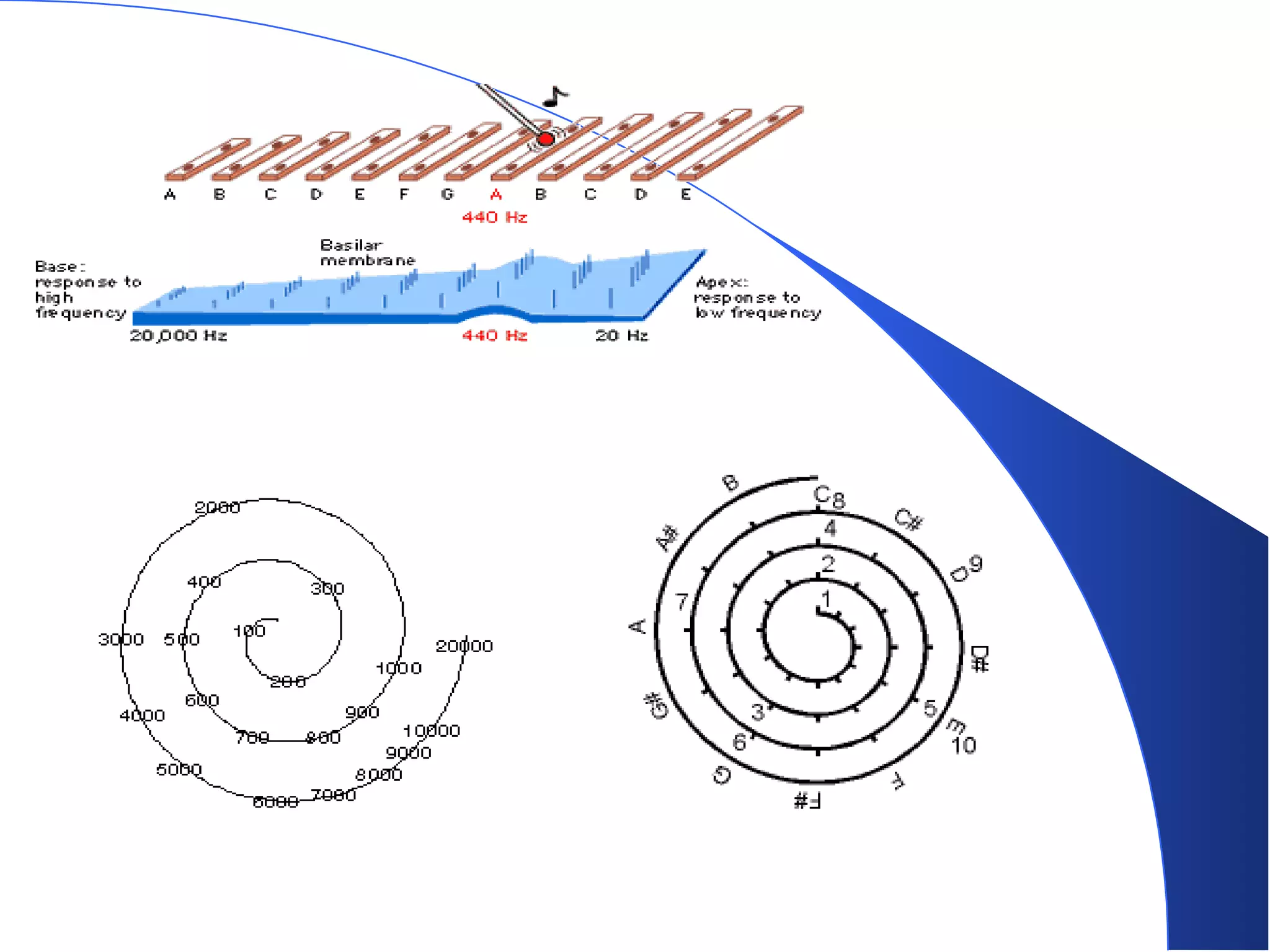
  • #5 The ear is divided into 3 parts, each with its own function. The outer ear collects sounds from the environment and funnels them down the ear canal to the eardrum. The eardrum vibrates and moves three tiny bones, the Hammer, the Anvil and the Stirrup. This movement amplifies the sounds and pass them on to the inner ear. The sound vibrations are converted to nerve impulses by the microscopic hair cells of the cochlea. From there, the impulses travel along the auditory nerve to the brain.
  • #7 The peripheral auditory system is located deep within the temporal bone of the skull. The inner ear structures are located roughly posterior or the eye sockets. This slide provides a very simplified animation of the position of these structures as they would be discovered during a dissection.