By: Debbie Tyson, Shelly Lawyer and  Andrew Schell
 
 
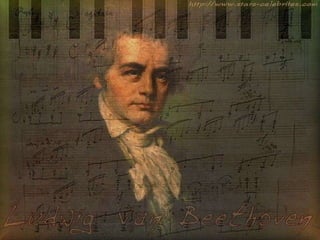
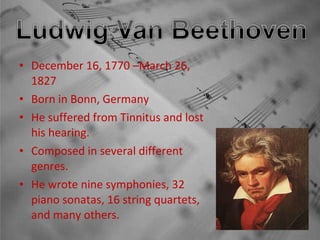
December 16, 1770 –March 26, 1827 Born in Bonn, Germany He suffered from Tinnitus and lost his hearing. Composed in several different genres. He wrote nine symphonies, 32 piano sonatas, 16 string quartets, and many others.
 
January 31, 1797 – November 19, 1828 Born in Vienna Wrote nine symphonies and many other pieces including some smaller piano compositions Produced many different forms of music including, Operas, liturgical music, chamber and solo piano music, and symphonies.  Wrote 21 complete sonatas for the piano including some duet pieces.
 
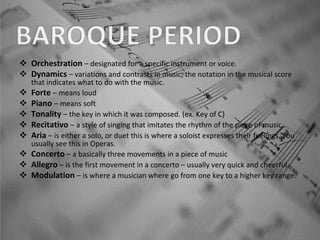
Orchestration  – designated for a specific instrument or voice. Dynamics   – variations and contrasts in music, the notation in the musical score that indicates what to do with the music. Forte   – means loud Piano   – means soft Tonality  – the key in which it was composed. (ex. Key of C) Recitativo  – a style of singing that imitates the rhythm of the piece of music. Aria   – is either a solo, or duet this is where a soloist expresses their feelings. You usually see this in Operas. Concerto   – a basically three movements in a piece of music Allegro  – is the first movement in a concerto – usually very quick and cheerful. Modulation   – is where a musician where go from one key to a higher key range.
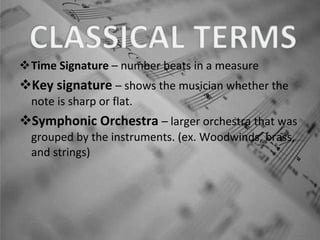
Time Signature  – number beats in a measure Key signature  – shows the musician whether the note is sharp or flat. Symphonic Orchestra  – larger orchestra that was grouped by the instruments. (ex. Woodwinds, brass, and strings)
Acapella  –  Without instruments accompaniment. Chorale   – A hymn sung by everyone. Homophony  – a musical technique with voices that sing the melody in unison. Lieder   – is a written solo for either instrumental or vocalist.

Music%20 project

  • 1.
    By: Debbie Tyson,Shelly Lawyer and Andrew Schell
  • 2.
  • 3.
  • 4.
    December 16, 1770–March 26, 1827 Born in Bonn, Germany He suffered from Tinnitus and lost his hearing. Composed in several different genres. He wrote nine symphonies, 32 piano sonatas, 16 string quartets, and many others.
  • 5.
  • 6.
    January 31, 1797– November 19, 1828 Born in Vienna Wrote nine symphonies and many other pieces including some smaller piano compositions Produced many different forms of music including, Operas, liturgical music, chamber and solo piano music, and symphonies. Wrote 21 complete sonatas for the piano including some duet pieces.
  • 7.
  • 8.
    Orchestration –designated for a specific instrument or voice. Dynamics – variations and contrasts in music, the notation in the musical score that indicates what to do with the music. Forte – means loud Piano – means soft Tonality – the key in which it was composed. (ex. Key of C) Recitativo – a style of singing that imitates the rhythm of the piece of music. Aria – is either a solo, or duet this is where a soloist expresses their feelings. You usually see this in Operas. Concerto – a basically three movements in a piece of music Allegro – is the first movement in a concerto – usually very quick and cheerful. Modulation – is where a musician where go from one key to a higher key range.
  • 9.
    Time Signature – number beats in a measure Key signature – shows the musician whether the note is sharp or flat. Symphonic Orchestra – larger orchestra that was grouped by the instruments. (ex. Woodwinds, brass, and strings)
  • 10.
    Acapella – Without instruments accompaniment. Chorale – A hymn sung by everyone. Homophony – a musical technique with voices that sing the melody in unison. Lieder – is a written solo for either instrumental or vocalist.

Editor's Notes

  • #4 Add key historical facts about Beethoven in the form of a bullet list.
  • #6 Add Key historical fact on Franz in bullet point form.