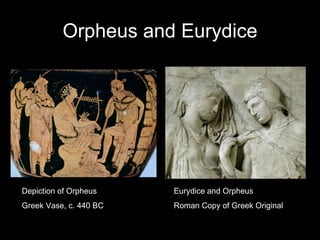
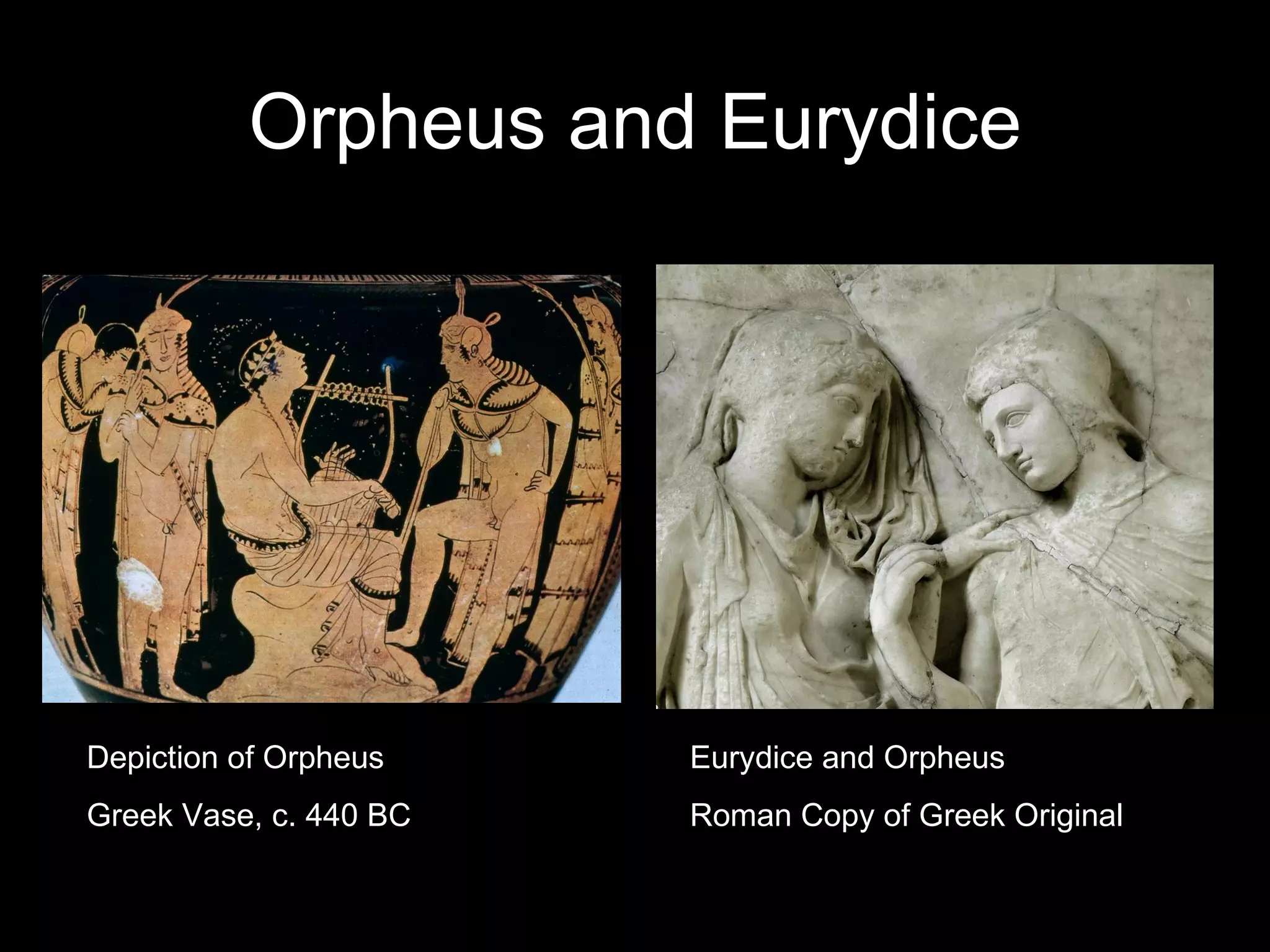
Orpheus and Eurydice Depiction of Orpheus  Greek Vase, c. 440 BC Eurydice and Orpheus  Roman Copy of Greek Original
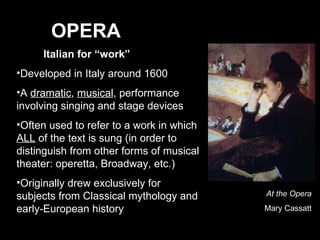
OPERA Italian for “work” Developed in Italy around 1600 A  dramatic ,  musical , performance involving singing and stage devices Often used to refer to a work in which  ALL  of the text is sung (in order to distinguish from other forms of musical theater: operetta, Broadway, etc.) Originally drew exclusively for subjects from Classical mythology and early-European history At the Opera Mary Cassatt
Opera and the “Seconda Pratica” Seconda Pratica vs. Prima Pratica: Prima Pratica  – refers to the old style of composing polyphonic music according to strict principles of balance, control, and harmonic organization “ The music is master of the text” Associated with polyphonic sacred music, and the technique perfected by Palestrina Seconda Pratica  – refers to the new style of setting words in a text-driven manner which prioritizes meaning and expression over rules of harmonic and melodic organization  “ The text is master of the music” Associated with solo vocal writing (monody), and the works of Monteverdi
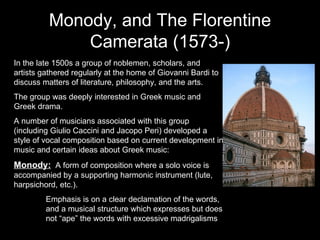
Monody, and The Florentine Camerata (1573-) In the late 1500s a group of noblemen, scholars, and artists gathered regularly at the home of Giovanni Bardi to discuss matters of literature, philosophy, and the arts. The group was deeply interested in Greek music and Greek drama. A number of musicians associated with this group (including Giulio Caccini and Jacopo Peri) developed a style of vocal composition based on current development in music and certain ideas about Greek music: Monody:   A form of composition where a solo voice is accompanied by a supporting harmonic instrument (lute, harpsichord, etc.).  Emphasis is on a clear declamation of the words,  and a musical structure which expresses but does  not “ape” the words with excessive madrigalisms
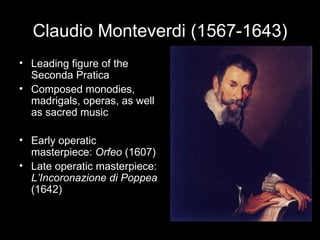
Claudio Monteverdi (1567-1643) Leading figure of the Seconda Pratica Composed monodies, madrigals, operas, as well as sacred music Early operatic masterpiece:  Orfeo  (1607) Late operatic masterpiece:  L’Incoronazione di Poppea  (1642)
Recitative and Aria (The basic organization of opera concerns the alternation of “recitative” and “aria”) Recitative:   A unique form of lightly accompanied vocal composition used for points of dialogue in order to move the music forward.  Employs a natural, “speech-like,” rhythm and melodic contour: though “natural,” the text is still “elevated” by musical treatment An outgrowth of monody, and a natural application of those principles to a dramatic context which echoed ideas about Greek drama.\ Aria:   A moment of intensified vocal expression Generally a closed unit (although it may flow naturally to or from a recitative) Style is more melodic, songful – regular rhythms and “catchy” tunes Arioso:   A middle-ground between recitative and aria A more intense, sustained, and expressive version of recitative
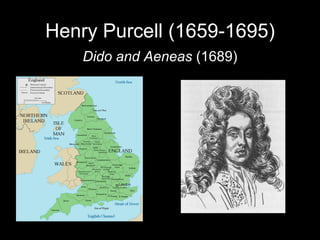
Henry Purcell (1659-1695) Dido and Aeneas  (1689)
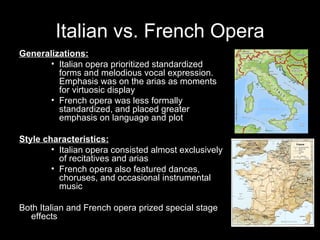
Italian vs. French Opera Generalizations: Italian opera prioritized standardized forms and melodious vocal expression.  Emphasis was on the arias as moments for virtuosic display French opera was less formally standardized, and placed greater emphasis on language and plot Style characteristics: Italian opera consisted almost exclusively of recitatives and arias French opera also featured dances, choruses, and occasional instrumental music Both Italian and French opera prized special stage effects
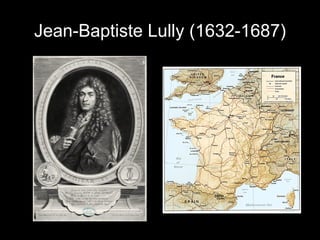
Jean-Baptiste Lully (1632-1687)
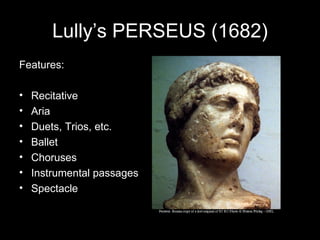
Lully’s PERSEUS (1682) Features: Recitative Aria Duets, Trios, etc. Ballet Choruses Instrumental passages Spectacle
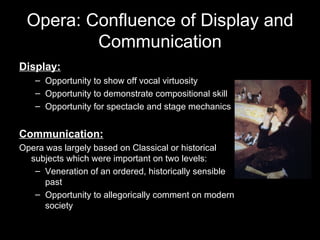
Opera: Confluence of Display and Communication Display: Opportunity to show off vocal virtuosity Opportunity to demonstrate compositional skill Opportunity for spectacle and stage mechanics Communication: Opera was largely based on Classical or historical subjects which were important on two levels: Veneration of an ordered, historically sensible past Opportunity to allegorically comment on modern society

UNIT II - Class 11

  • 1.
    Orpheus and EurydiceDepiction of Orpheus Greek Vase, c. 440 BC Eurydice and Orpheus Roman Copy of Greek Original
  • 2.
    OPERA Italian for“work” Developed in Italy around 1600 A dramatic , musical , performance involving singing and stage devices Often used to refer to a work in which ALL of the text is sung (in order to distinguish from other forms of musical theater: operetta, Broadway, etc.) Originally drew exclusively for subjects from Classical mythology and early-European history At the Opera Mary Cassatt
  • 3.
    Opera and the“Seconda Pratica” Seconda Pratica vs. Prima Pratica: Prima Pratica – refers to the old style of composing polyphonic music according to strict principles of balance, control, and harmonic organization “ The music is master of the text” Associated with polyphonic sacred music, and the technique perfected by Palestrina Seconda Pratica – refers to the new style of setting words in a text-driven manner which prioritizes meaning and expression over rules of harmonic and melodic organization “ The text is master of the music” Associated with solo vocal writing (monody), and the works of Monteverdi
  • 4.
    Monody, and TheFlorentine Camerata (1573-) In the late 1500s a group of noblemen, scholars, and artists gathered regularly at the home of Giovanni Bardi to discuss matters of literature, philosophy, and the arts. The group was deeply interested in Greek music and Greek drama. A number of musicians associated with this group (including Giulio Caccini and Jacopo Peri) developed a style of vocal composition based on current development in music and certain ideas about Greek music: Monody: A form of composition where a solo voice is accompanied by a supporting harmonic instrument (lute, harpsichord, etc.). Emphasis is on a clear declamation of the words, and a musical structure which expresses but does not “ape” the words with excessive madrigalisms
  • 5.
    Claudio Monteverdi (1567-1643)Leading figure of the Seconda Pratica Composed monodies, madrigals, operas, as well as sacred music Early operatic masterpiece: Orfeo (1607) Late operatic masterpiece: L’Incoronazione di Poppea (1642)
  • 6.
    Recitative and Aria(The basic organization of opera concerns the alternation of “recitative” and “aria”) Recitative: A unique form of lightly accompanied vocal composition used for points of dialogue in order to move the music forward. Employs a natural, “speech-like,” rhythm and melodic contour: though “natural,” the text is still “elevated” by musical treatment An outgrowth of monody, and a natural application of those principles to a dramatic context which echoed ideas about Greek drama.\ Aria: A moment of intensified vocal expression Generally a closed unit (although it may flow naturally to or from a recitative) Style is more melodic, songful – regular rhythms and “catchy” tunes Arioso: A middle-ground between recitative and aria A more intense, sustained, and expressive version of recitative
  • 7.
    Henry Purcell (1659-1695)Dido and Aeneas (1689)
  • 8.
    Italian vs. FrenchOpera Generalizations: Italian opera prioritized standardized forms and melodious vocal expression. Emphasis was on the arias as moments for virtuosic display French opera was less formally standardized, and placed greater emphasis on language and plot Style characteristics: Italian opera consisted almost exclusively of recitatives and arias French opera also featured dances, choruses, and occasional instrumental music Both Italian and French opera prized special stage effects
  • 9.
  • 10.
    Lully’s PERSEUS (1682)Features: Recitative Aria Duets, Trios, etc. Ballet Choruses Instrumental passages Spectacle
  • 11.
    Opera: Confluence ofDisplay and Communication Display: Opportunity to show off vocal virtuosity Opportunity to demonstrate compositional skill Opportunity for spectacle and stage mechanics Communication: Opera was largely based on Classical or historical subjects which were important on two levels: Veneration of an ordered, historically sensible past Opportunity to allegorically comment on modern society