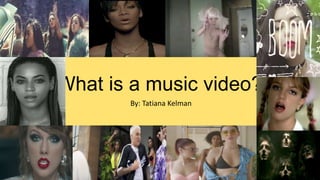
What is a music video?
By: Tatiana Kelman
•A music video is a short film or video that accompanies an
artist’s piece of music. The primary use of music videos is
to market and promote the sales of the music, however
some artists use music videos purely for artistic purposes.
•Although music videos are dated, many artists still use
them to promote and market their songs. Even though
the origin of music videos come from a long time ago,
they came important in the 1980s, when MTV based their
format around them.
Definition
Music videos use a variety of styles of film making
techniques such as animation, documentaries,
action filming and non-narratives performances
such as abstract films. Many music videos that
have been created combine more than one style,
for example, live action and animation. Some
music videos are focused more one just one
technique, being simply a filmed version of the
song’s live performance.
In addition,
Styles of music
videos
•Performance
•Narrative/story
•Mixed performance and narrative
•Cameo
•Animation
Editing and sound
Different types of techniques used:
• The editing fits with the beat of the song
• Straight cuts
• Special effects
• Split-screens
• Jump cuts
• Diegetic sound as well as the song itself
• Changes in the volume
What to look for when analysing a music
video
• Camera movement, angles and shot distance can set a music video’s atmosphere and
depth of meaning, therefore must be analysed. The camera movement may also reflect
the movement of the performers or can be used to set a different feel by moving in an
asynchronous way.
• Editing – Transitions and pace create the mood and feel of the video to convey the
song. Digital effects which enhance the editing offer different kinds of visual pleasure
for a different kind of audience demographic.
• Mise en scene – This looks at costumes, props, setting, lighting, performers and make-
up which makes the visual effects of a music video in order to attract an audience.
• Lyrics – The lyrics of a music video establish the general feeling or mood of the song.
Often, key lines or lyrics may contribute to visuals associated with the song.
• Genre – Every music video is categorized into a specific genre in which follow typical
codes and conventions. It is easy to identify a genre of a music video because of
distinct features used for each genre.
Continuing
• Intertextuality – A music video can be described as ‘post-modern’. This is about
how music videos draw upon existing texts in order to gain such audiences.
• Voyeurism – A concept that is simply when a person gains erotic pleasure by
looking at a sexual object. In terms of music videos, voyeurism can be used to
describe the relationship between what we see and why we watch music videos,
it is because it does possibly have a large impact on who watches and purchases.
• Narrative/performance – Narrative music videos express storylines or offer
complex fragments in a non linear order, leaving the viewer wanting to see more.
• Star image/brand - This is the ’look’ of the music video and the ‘look’ of the
band/artist which allows the audience to decide whether they like what they see
when watching the music video. Artist’s and band’s fans will have expectations of
what they want to see in a music video so record companies have to include
what they think fans will want to see, as well as a wider audience.

music video

  • 1.
    What is amusic video? By: Tatiana Kelman
  • 2.
    •A music videois a short film or video that accompanies an artist’s piece of music. The primary use of music videos is to market and promote the sales of the music, however some artists use music videos purely for artistic purposes. •Although music videos are dated, many artists still use them to promote and market their songs. Even though the origin of music videos come from a long time ago, they came important in the 1980s, when MTV based their format around them. Definition
  • 3.
    Music videos usea variety of styles of film making techniques such as animation, documentaries, action filming and non-narratives performances such as abstract films. Many music videos that have been created combine more than one style, for example, live action and animation. Some music videos are focused more one just one technique, being simply a filmed version of the song’s live performance. In addition,
  • 4.
    Styles of music videos •Performance •Narrative/story •Mixedperformance and narrative •Cameo •Animation
  • 5.
    Editing and sound Differenttypes of techniques used: • The editing fits with the beat of the song • Straight cuts • Special effects • Split-screens • Jump cuts • Diegetic sound as well as the song itself • Changes in the volume
  • 6.
    What to lookfor when analysing a music video • Camera movement, angles and shot distance can set a music video’s atmosphere and depth of meaning, therefore must be analysed. The camera movement may also reflect the movement of the performers or can be used to set a different feel by moving in an asynchronous way. • Editing – Transitions and pace create the mood and feel of the video to convey the song. Digital effects which enhance the editing offer different kinds of visual pleasure for a different kind of audience demographic. • Mise en scene – This looks at costumes, props, setting, lighting, performers and make- up which makes the visual effects of a music video in order to attract an audience. • Lyrics – The lyrics of a music video establish the general feeling or mood of the song. Often, key lines or lyrics may contribute to visuals associated with the song. • Genre – Every music video is categorized into a specific genre in which follow typical codes and conventions. It is easy to identify a genre of a music video because of distinct features used for each genre.
  • 7.
    Continuing • Intertextuality –A music video can be described as ‘post-modern’. This is about how music videos draw upon existing texts in order to gain such audiences. • Voyeurism – A concept that is simply when a person gains erotic pleasure by looking at a sexual object. In terms of music videos, voyeurism can be used to describe the relationship between what we see and why we watch music videos, it is because it does possibly have a large impact on who watches and purchases. • Narrative/performance – Narrative music videos express storylines or offer complex fragments in a non linear order, leaving the viewer wanting to see more. • Star image/brand - This is the ’look’ of the music video and the ‘look’ of the band/artist which allows the audience to decide whether they like what they see when watching the music video. Artist’s and band’s fans will have expectations of what they want to see in a music video so record companies have to include what they think fans will want to see, as well as a wider audience.