MUSIC THEORY
GRADE 2
By Suzan
G
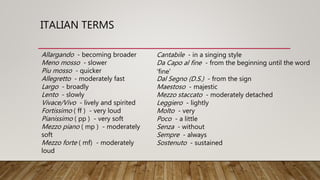
ITALIAN TERMS
Allargando - becoming broader
Meno mosso - slower
Piu mosso - quicker
Allegretto - moderately fast
Largo - broadly
Lento - slowly
Vivace/Vivo - lively and spirited
Fortissimo ( ff ) - very loud
Pianissimo ( pp ) - very soft
Mezzo piano ( mp ) - moderately
soft
Mezzo forte ( mf) - moderately
loud
Cantabile - in a singing style
Da Capo al fine - from the beginning until the word
‘fine‛
Dal Segno (D.S.) - from the sign
Maestoso - majestic
Mezzo staccato - moderately detached
Leggiero - lightly
Molto - very
Poco - a little
Senza - without
Sempre - always
Sostenuto - sustained
SIGNS
Name Meaning
Pause/fermata Hold for longer than what it is
Accent Play strong
Mezzo staccato (1 note) Moderately detached
Mezzo staccato (more than 1 note) Moderately detached
Triplet 3 notes played in time of 2 notes of
equal value.
Repeat Repeat the music between the dots.
Strong accent Play stronger than a normal accent.
Sign
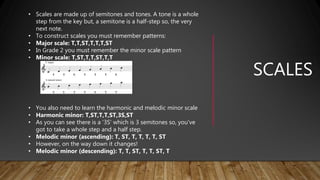
SCALES
• Scales are made up of semitones and tones. A tone is a whole
step from the key but, a semitone is a half-step so, the very
next note.
• To construct scales you must remember patterns:
• Major scale: T,T,ST,T,T,T,ST
• In Grade 2 you must remember the minor scale pattern
• Minor scale: T,ST,T,T,ST,T,T
• You also need to learn the harmonic and melodic minor scale
• Harmonic minor: T,ST,T,T,ST,3S,ST
• As you can see there is a '3S' which is 3 semitones so, you've
got to take a whole step and a half step.
• Melodic minor (ascending): T, ST, T, T, T, T, ST
• However, on the way down it changes!
• Melodic minor (descending): T, T, ST, T, T, ST, T
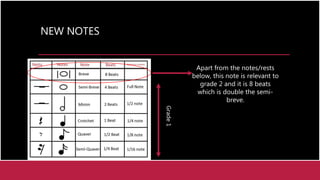
NEW NOTES
Apart from the notes/rests
below, this note is relevant to
grade 2 and it is 8 beats
which is double the semi-
breve.
Grade1
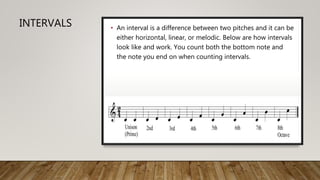
INTERVALS • An interval is a difference between two pitches and it can be
either horizontal, linear, or melodic. Below are how intervals
look like and work. You count both the bottom note and
the note you end on when counting intervals.
TIME
SIGNATURES
(WITH ?/2)
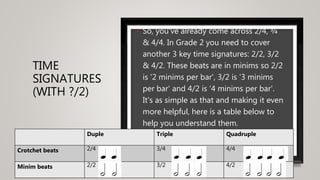
• So, you've already come across 2/4, ¾
& 4/4. In Grade 2 you need to cover
another 3 key time signatures: 2/2, 3/2
& 4/2. These beats are in minims so 2/2
is '2 minims per bar', 3/2 is '3 minims
per bar' and 4/2 is '4 minims per bar'.
It's as simple as that and making it even
more helpful, here is a table below to
help you understand them.
Duple Triple Quadruple
Crotchet beats 2/4 3/4 4/4
Minim beats 2/2 3/2 4/2
TIME
SIGNATURE 3/8
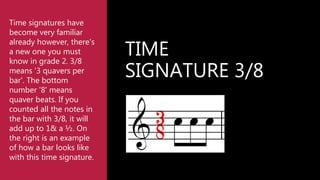
Time signatures have
become very familiar
already however, there's
a new one you must
know in grade 2. 3/8
means '3 quavers per
bar'. The bottom
number '8' means
quaver beats. If you
counted all the notes in
the bar with 3/8, it will
add up to 1& a ½. On
the right is an example
of how a bar looks like
with this time signature.
GROUPING OF RESTS
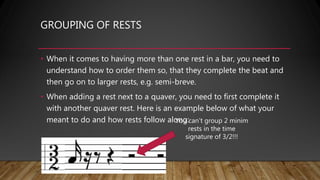
• When it comes to having more than one rest in a bar, you need to
understand how to order them so, that they complete the beat and
then go on to larger rests, e.g. semi-breve.
• When adding a rest next to a quaver, you need to first complete it
with another quaver rest. Here is an example below of what your
meant to do and how rests follow along:You can't group 2 minim
rests in the time
signature of 3/2!!!
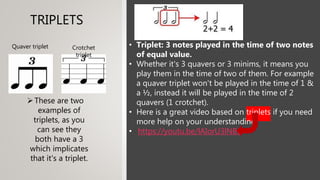
TRIPLETS
• Triplet: 3 notes played in the time of two notes
of equal value.
• Whether it's 3 quavers or 3 minims, it means you
play them in the time of two of them. For example
a quaver triplet won't be played in the time of 1 &
a ½, instead it will be played in the time of 2
quavers (1 crotchet).
• Here is a great video based on triplets if you need
more help on your understanding:
• https://youtu.be/lAIorU3lNBE
These are two
examples of
triplets, as you
can see they
both have a 3
which implicates
that it's a triplet.
Quaver triplet Crotchet
triplet
RELATIVE KEYS
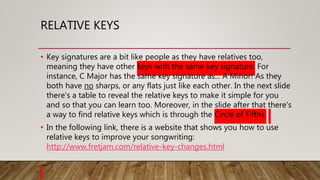
• Key signatures are a bit like people as they have relatives too,
meaning they have other keys with the same key signature. For
instance, C Major has the same key signature as... A Minor! As they
both have no sharps, or any flats just like each other. In the next slide
there's a table to reveal the relative keys to make it simple for you
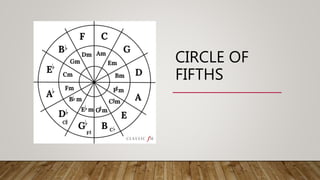
and so that you can learn too. Moreover, in the slide after that there's
a way to find relative keys which is through the Circle of Fifths.
• In the following link, there is a website that shows you how to use
relative keys to improve your songwriting:
http://www.fretjam.com/relative-key-changes.html
Key signature Major key Minor key
B♭, E♭, A♭, D♭, G♭, C♭, F♭ C♭ major A♭ minor
B♭, E♭, A♭, D♭, G♭, C♭ G♭ major E♭ minor
B♭, E♭, A♭, D♭, G♭ D♭ major B♭ minor
B♭, E♭, A♭, D♭ A♭ major F minor
B♭, E♭, A♭ E♭ major C minor
B♭, E♭ B♭ major G minor
B♭ F major D minor
C major A minor
F♯ G major E minor
F♯, C♯ D major B minor
F♯, C♯, G♯ A major F♯ minor
F♯, C♯, G♯, D♯ E major C♯ minor
F♯, C♯, G♯, D♯, A♯ B major G♯ minor
F♯, C♯, G♯, D♯, A♯, E♯ F♯ major D♯ minor
F♯, C♯, G♯, D♯, A♯, E♯, B♯ C♯ major A♯ minor
These are the
majors and the
minors that
share the same
key signatures.
CIRCLE OF
FIFTHS
HALVING/DOUBLING
• There's a bit of math attached to
this but, it's very easy once you
understand what to do. In an exam
they may ask you to re-write the
melody but, either you must double
or half the notes. Look at the
example below:
1.What is half of a semi
breve?
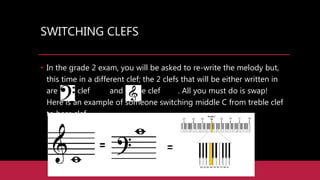
SWITCHING CLEFS
• In the grade 2 exam, you will be asked to re-write the melody but,
this time in a different clef; the 2 clefs that will be either written in
are bass clef and treble clef . All you must do is swap!
Here is an example of someone switching middle C from treble clef
to bass clef.
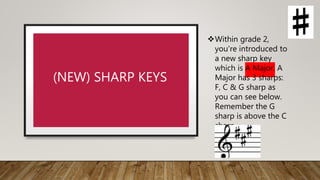
(NEW) SHARP KEYS
Within grade 2,
you're introduced to
a new sharp key
which is A Major. A
Major has 3 sharps:
F, C & G sharp as
you can see below.
Remember the G
sharp is above the C
sharp.
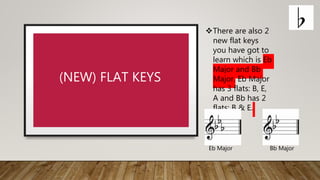
(NEW) FLAT KEYS
There are also 2
new flat keys
you have got to
learn which is Eb
Major and Bb
Major. Eb Major
has 3 flats: B, E,
A and Bb has 2
flats: B & E.
Eb Major Bb Major
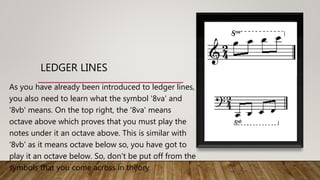
LEDGER LINES
As you have already been introduced to ledger lines,
you also need to learn what the symbol '8va' and
'8vb' means. On the top right, the '8va' means
octave above which proves that you must play the
notes under it an octave above. This is similar with
'8vb' as it means octave below so, you have got to
play it an octave below. So, don't be put off from the
symbols that you come across in theory.

Music Theory: Grade 2

  • 1.
  • 2.
    ITALIAN TERMS Allargando -becoming broader Meno mosso - slower Piu mosso - quicker Allegretto - moderately fast Largo - broadly Lento - slowly Vivace/Vivo - lively and spirited Fortissimo ( ff ) - very loud Pianissimo ( pp ) - very soft Mezzo piano ( mp ) - moderately soft Mezzo forte ( mf) - moderately loud Cantabile - in a singing style Da Capo al fine - from the beginning until the word ‘fine‛ Dal Segno (D.S.) - from the sign Maestoso - majestic Mezzo staccato - moderately detached Leggiero - lightly Molto - very Poco - a little Senza - without Sempre - always Sostenuto - sustained
  • 3.
    SIGNS Name Meaning Pause/fermata Holdfor longer than what it is Accent Play strong Mezzo staccato (1 note) Moderately detached Mezzo staccato (more than 1 note) Moderately detached Triplet 3 notes played in time of 2 notes of equal value. Repeat Repeat the music between the dots. Strong accent Play stronger than a normal accent. Sign
  • 4.
    SCALES • Scales aremade up of semitones and tones. A tone is a whole step from the key but, a semitone is a half-step so, the very next note. • To construct scales you must remember patterns: • Major scale: T,T,ST,T,T,T,ST • In Grade 2 you must remember the minor scale pattern • Minor scale: T,ST,T,T,ST,T,T • You also need to learn the harmonic and melodic minor scale • Harmonic minor: T,ST,T,T,ST,3S,ST • As you can see there is a '3S' which is 3 semitones so, you've got to take a whole step and a half step. • Melodic minor (ascending): T, ST, T, T, T, T, ST • However, on the way down it changes! • Melodic minor (descending): T, T, ST, T, T, ST, T
  • 5.
    NEW NOTES Apart fromthe notes/rests below, this note is relevant to grade 2 and it is 8 beats which is double the semi- breve. Grade1
  • 6.
    INTERVALS • Aninterval is a difference between two pitches and it can be either horizontal, linear, or melodic. Below are how intervals look like and work. You count both the bottom note and the note you end on when counting intervals.
  • 7.
    TIME SIGNATURES (WITH ?/2) • So,you've already come across 2/4, ¾ & 4/4. In Grade 2 you need to cover another 3 key time signatures: 2/2, 3/2 & 4/2. These beats are in minims so 2/2 is '2 minims per bar', 3/2 is '3 minims per bar' and 4/2 is '4 minims per bar'. It's as simple as that and making it even more helpful, here is a table below to help you understand them. Duple Triple Quadruple Crotchet beats 2/4 3/4 4/4 Minim beats 2/2 3/2 4/2
  • 8.
    TIME SIGNATURE 3/8 Time signatureshave become very familiar already however, there's a new one you must know in grade 2. 3/8 means '3 quavers per bar'. The bottom number '8' means quaver beats. If you counted all the notes in the bar with 3/8, it will add up to 1& a ½. On the right is an example of how a bar looks like with this time signature.
  • 9.
    GROUPING OF RESTS •When it comes to having more than one rest in a bar, you need to understand how to order them so, that they complete the beat and then go on to larger rests, e.g. semi-breve. • When adding a rest next to a quaver, you need to first complete it with another quaver rest. Here is an example below of what your meant to do and how rests follow along:You can't group 2 minim rests in the time signature of 3/2!!!
  • 10.
    TRIPLETS • Triplet: 3notes played in the time of two notes of equal value. • Whether it's 3 quavers or 3 minims, it means you play them in the time of two of them. For example a quaver triplet won't be played in the time of 1 & a ½, instead it will be played in the time of 2 quavers (1 crotchet). • Here is a great video based on triplets if you need more help on your understanding: • https://youtu.be/lAIorU3lNBE These are two examples of triplets, as you can see they both have a 3 which implicates that it's a triplet. Quaver triplet Crotchet triplet
  • 11.
    RELATIVE KEYS • Keysignatures are a bit like people as they have relatives too, meaning they have other keys with the same key signature. For instance, C Major has the same key signature as... A Minor! As they both have no sharps, or any flats just like each other. In the next slide there's a table to reveal the relative keys to make it simple for you and so that you can learn too. Moreover, in the slide after that there's a way to find relative keys which is through the Circle of Fifths. • In the following link, there is a website that shows you how to use relative keys to improve your songwriting: http://www.fretjam.com/relative-key-changes.html
  • 12.
    Key signature Majorkey Minor key B♭, E♭, A♭, D♭, G♭, C♭, F♭ C♭ major A♭ minor B♭, E♭, A♭, D♭, G♭, C♭ G♭ major E♭ minor B♭, E♭, A♭, D♭, G♭ D♭ major B♭ minor B♭, E♭, A♭, D♭ A♭ major F minor B♭, E♭, A♭ E♭ major C minor B♭, E♭ B♭ major G minor B♭ F major D minor C major A minor F♯ G major E minor F♯, C♯ D major B minor F♯, C♯, G♯ A major F♯ minor F♯, C♯, G♯, D♯ E major C♯ minor F♯, C♯, G♯, D♯, A♯ B major G♯ minor F♯, C♯, G♯, D♯, A♯, E♯ F♯ major D♯ minor F♯, C♯, G♯, D♯, A♯, E♯, B♯ C♯ major A♯ minor These are the majors and the minors that share the same key signatures.
  • 13.
  • 14.
    HALVING/DOUBLING • There's abit of math attached to this but, it's very easy once you understand what to do. In an exam they may ask you to re-write the melody but, either you must double or half the notes. Look at the example below: 1.What is half of a semi breve?
  • 15.
    SWITCHING CLEFS • Inthe grade 2 exam, you will be asked to re-write the melody but, this time in a different clef; the 2 clefs that will be either written in are bass clef and treble clef . All you must do is swap! Here is an example of someone switching middle C from treble clef to bass clef.
  • 16.
    (NEW) SHARP KEYS Withingrade 2, you're introduced to a new sharp key which is A Major. A Major has 3 sharps: F, C & G sharp as you can see below. Remember the G sharp is above the C sharp.
  • 17.
    (NEW) FLAT KEYS Thereare also 2 new flat keys you have got to learn which is Eb Major and Bb Major. Eb Major has 3 flats: B, E, A and Bb has 2 flats: B & E. Eb Major Bb Major
  • 18.
    LEDGER LINES As youhave already been introduced to ledger lines, you also need to learn what the symbol '8va' and '8vb' means. On the top right, the '8va' means octave above which proves that you must play the notes under it an octave above. This is similar with '8vb' as it means octave below so, you have got to play it an octave below. So, don't be put off from the symbols that you come across in theory.