Music Theory 101Music Theory 101
The BeginningThe Beginning
 AA staffstaff is made up of five horizontal lines and four spacesis made up of five horizontal lines and four spaces
 AA clefclef is a musical symbol placed at the beginning of the staff that determines the letteris a musical symbol placed at the beginning of the staff that determines the letter
names of the lines and spaces.names of the lines and spaces.
 The two main clefs are theThe two main clefs are the trebletreble and theand the bassbass::
 Ledger LinesLedger Lines
Treble Clef
“G” Clef
Bass Clef
“F” Clef
Treble Clef
(TOP)
Bass Clef
(BOTTOM)
=
The BeginningThe Beginning
 The music is often SATB (4 parts: Soprano, Alto, Tenor, Bass), SAB (3 part: Soprano, Alto,The music is often SATB (4 parts: Soprano, Alto, Tenor, Bass), SAB (3 part: Soprano, Alto,
Men) or Two-Part (Soprano/Tenor, Alto/Bass)Men) or Two-Part (Soprano/Tenor, Alto/Bass)
 TYPICALLY, women’s music parts are written on the treble clef and men’s music parts areTYPICALLY, women’s music parts are written on the treble clef and men’s music parts are
written on the bass clefwritten on the bass clef
 SopranoSoprano typically refers to female singers and is a voice type with a vocal range from approximatelytypically refers to female singers and is a voice type with a vocal range from approximately
middle C to "high A. The soprano takes the highest part, which usually encompasses the melody. Themiddle C to "high A. The soprano takes the highest part, which usually encompasses the melody. The
music part is often the top line of the treble clef.music part is often the top line of the treble clef.
 AltoAlto refers to the second highest part and is approximately from the G below middle C to the F in therefers to the second highest part and is approximately from the G below middle C to the F in the
second octave above middle C. The music part is often the bottom line of the treble clef.second octave above middle C. The music part is often the bottom line of the treble clef.
 TenorTenor is a type of singing voice and is the highest male voice within the modal register. The tenor voiceis a type of singing voice and is the highest male voice within the modal register. The tenor voice
lies between the C one octave below middle C, and the A above middle C. The music part is often thelies between the C one octave below middle C, and the A above middle C. The music part is often the
top line of the bass clef.top line of the bass clef.
 BaritoneBaritone is a type of male singing voice that lies between the bass and tenor voices. It is the mostis a type of male singing voice that lies between the bass and tenor voices. It is the most
common male voice. Music for this voice is typically written in the range from the second F belowcommon male voice. Music for this voice is typically written in the range from the second F below
middle C to the F above middle C in choral music, but can be extended at either end.middle C to the F above middle C in choral music, but can be extended at either end.
 BassBass is a type of male singing voice and possesses the lowest vocal range of all voice types. A bass isis a type of male singing voice and possesses the lowest vocal range of all voice types. A bass is
typically classified as having a range extending from around the second E below middle C to the Etypically classified as having a range extending from around the second E below middle C to the E
above middle C. The music part is often the bottom line of the bass clef.above middle C. The music part is often the bottom line of the bass clef.
 Occasionally, the treble clef will split into 3 parts – the sopranos split and theOccasionally, the treble clef will split into 3 parts – the sopranos split and the Second SopranosSecond Sopranos
oror Mezzo-SopranosMezzo-Sopranos will sing that partwill sing that part
The BeginningThe Beginning
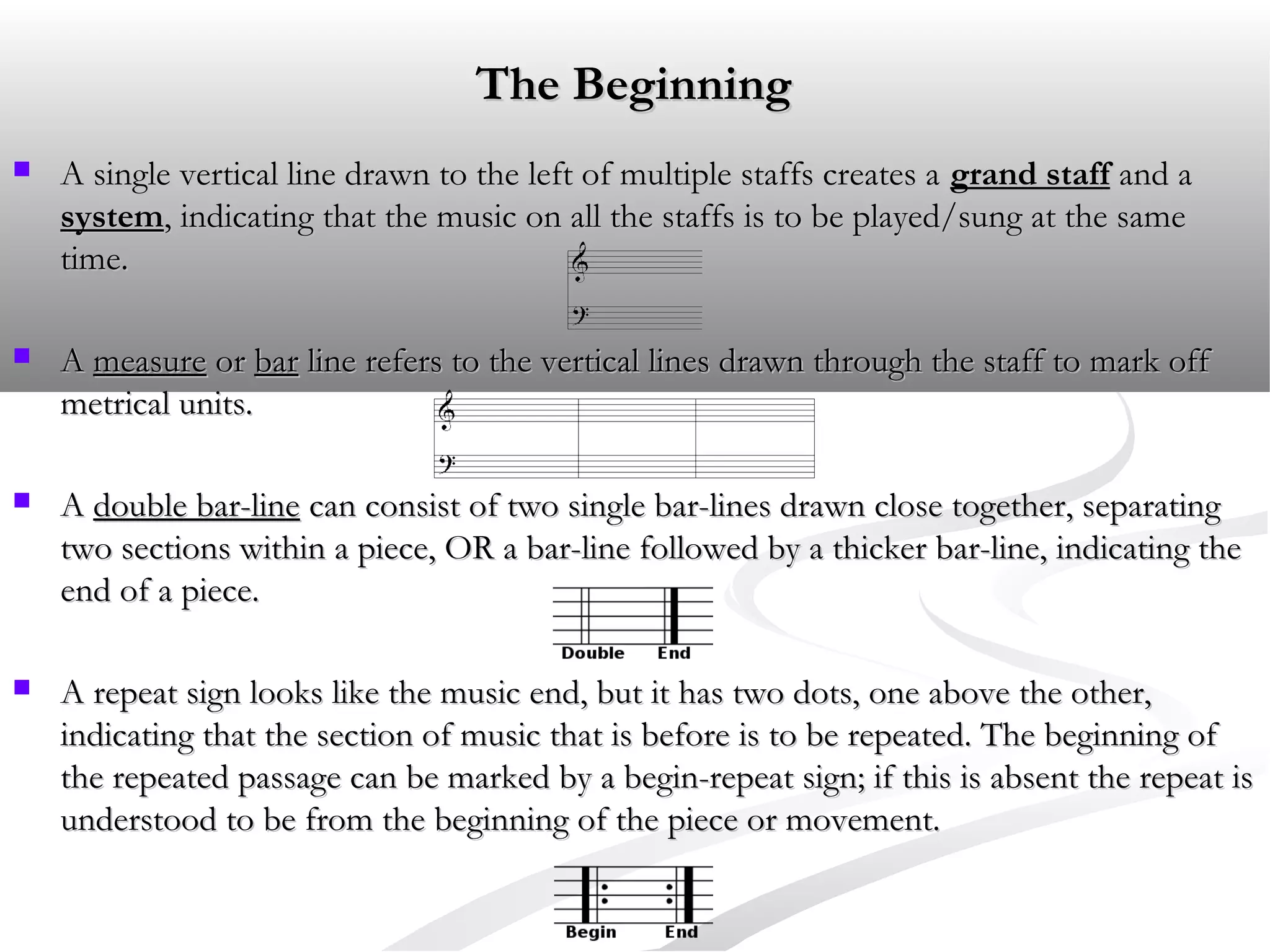
 A single vertical line drawn to the left of multiple staffs creates aA single vertical line drawn to the left of multiple staffs creates a grand staffgrand staff and aand a
systemsystem, indicating that the music on all the staffs is to be played/sung at the same, indicating that the music on all the staffs is to be played/sung at the same
time.time.
 AA measuremeasure oror barbar line refers to the vertical lines drawn through the staff to mark offline refers to the vertical lines drawn through the staff to mark off
metrical units.metrical units.
 AA double bar-linedouble bar-line can consist of two single bar-lines drawn close together, separatingcan consist of two single bar-lines drawn close together, separating
two sections within a piece, OR a bar-line followed by a thicker bar-line, indicating thetwo sections within a piece, OR a bar-line followed by a thicker bar-line, indicating the
end of a piece.end of a piece.
 A repeat sign looks like the music end, but it has two dots, one above the other,A repeat sign looks like the music end, but it has two dots, one above the other,
indicating that the section of music that is before is to be repeated. The beginning ofindicating that the section of music that is before is to be repeated. The beginning of
the repeated passage can be marked by a begin-repeat sign; if this is absent the repeat isthe repeated passage can be marked by a begin-repeat sign; if this is absent the repeat is
understood to be from the beginning of the piece or movement.understood to be from the beginning of the piece or movement.
PitchesPitches

PitchesPitches are named after the first seven letters of the alphabetare named after the first seven letters of the alphabet (A B C D E F G)(A B C D E F G) andand
follow that same order for both treble and bass cleffollow that same order for both treble and bass clef
 Some standard acronyms to help remember the notes on a staff are:Some standard acronyms to help remember the notes on a staff are:
 The smallest interval used in Western music is the half step. A visual representation ofThe smallest interval used in Western music is the half step. A visual representation of
a half step would be the distance between a consecutive white and black note on thea half step would be the distance between a consecutive white and black note on the
piano. There are two exceptions to this rule, as two natural half steps occur betweenpiano. There are two exceptions to this rule, as two natural half steps occur between
the notes E and F, and B and C. A whole step is made up of two half steps.the notes E and F, and B and C. A whole step is made up of two half steps.
 Letter names are modified by theLetter names are modified by the accidentalsaccidentals. A. A sharpsharp raises a note by a half-step, and araises a note by a half-step, and a
flatflat lowers it by the same amount. Alowers it by the same amount. A naturalnatural is an accidental which cancels previousis an accidental which cancels previous
accidentals and represents the unaltered pitch of a noteaccidentals and represents the unaltered pitch of a note
A flat, C sharp, A natural
ACROSTICS TO REMEMBER.
• For the Spaces of the Treble or “G” Clef
• F A C E
• For the Lines of the Treble or “G” Clef
• Every Good Boy Does Fine
• For the Spaces of the Bass or “F” Clef
• All Cows Eat Grass
• For the Lines of the Bass or “F” Clef
• Good Boy’s Do Fine Always
• Movement By 5th
• Father Charles Goes Down And Ends Battle
• Battle Ends And Down Goes Charles Father
Notes ValuesNotes Values
 Each type ofEach type of notenote has a specific look and a specific duration:has a specific look and a specific duration:
 A note value may be augmented by adding aA note value may be augmented by adding a dotdot after it. This dot adds the next lowerafter it. This dot adds the next lower
note value, making itnote value, making it one and a halfone and a half times its original duration.times its original duration.
1 beat + ½ beat = 1.5 beats
2 beats + 2/2 beats = 3 beats
Time SignaturesTime Signatures
 Time signaturesTime signatures indicate the meter the song is in which indicate how many beats areindicate the meter the song is in which indicate how many beats are
in each measure and which note value constitutes one beat. 4/4in each measure and which note value constitutes one beat. 4/4
 In a musical score, the time signature appears at the beginning of the piece, usually asIn a musical score, the time signature appears at the beginning of the piece, usually as
stacked numerals immediately following the key signature (or immediately followingstacked numerals immediately following the key signature (or immediately following
the clef if the key signature is empty).the clef if the key signature is empty).
 A mid-score time signature, usually immediately following a barline, indicates a changeA mid-score time signature, usually immediately following a barline, indicates a change
of meter.of meter.
 There are various types of time signatures, depending on whether the music followsThere are various types of time signatures, depending on whether the music follows
simple rhythms or involves unusual shifting tempos, including: simple and compoundsimple rhythms or involves unusual shifting tempos, including: simple and compound
Pulse – 2 Concepts to ConsiderPulse – 2 Concepts to Consider
 Concept #1Concept #1 –– “Feeling” the Pulse“Feeling” the Pulse
 Nature and pulse-lie concepts/activities (heartbeat, clock,Nature and pulse-lie concepts/activities (heartbeat, clock,
walking)walking)
 Concept #2Concept #2 –– Internalizing the PulseInternalizing the Pulse
 Impact of playing & reading music on student ability toImpact of playing & reading music on student ability to
maintain pulse (Multiple Mental Processes).maintain pulse (Multiple Mental Processes).
Exercises for Pulse DevelopmentExercises for Pulse Development
 Feeling the PulseFeeling the Pulse
 Tapping/Clapping to Recorded MusicTapping/Clapping to Recorded Music
 Vary tempo, meter, styles of musicVary tempo, meter, styles of music
 Counting ExercisesCounting Exercises
 Aloud & silentlyAloud & silently
 Hand signals (palm up/down)Hand signals (palm up/down)
 Macro Pulse versus Sub-Divided PulseMacro Pulse versus Sub-Divided Pulse
Note ValuesNote Values
Dotted Values & CompoundDotted Values & Compound
MeterMeter
 Power of the DotPower of the Dot
 Counting tripletsCounting triplets
 Counting sextupletsCounting sextuplets
 Using 12/8 to teach compound meter – no 6/8Using 12/8 to teach compound meter – no 6/8
 Family of Notes & compound meter (12/8)Family of Notes & compound meter (12/8)
 
Eastman Counting SystemEastman Counting System
Time SignaturesTime Signatures
 Simple time signatures consist of two numerals, one stacked above the other:Simple time signatures consist of two numerals, one stacked above the other:
 the lower numeral indicates the note value which represents one beatthe lower numeral indicates the note value which represents one beat
(4 = quarter, 8 = eighth, 1 = whole, etc)(4 = quarter, 8 = eighth, 1 = whole, etc)
 the upper numeral indicates how many such beats there are in a barthe upper numeral indicates how many such beats there are in a bar
For instance,For instance,
2 / 4 means two quarter-note beats per measure2 / 4 means two quarter-note beats per measure
6 / 8 means six eighth-note beats per measure, but is felt in “2” (1,2,3) + (1,2,3)6 / 8 means six eighth-note beats per measure, but is felt in “2” (1,2,3) + (1,2,3)
 A is sometimes used to refer to 4 / 4 timeA is sometimes used to refer to 4 / 4 time
 Compound time signatures split the “feel” into 3 instead of 2.Compound time signatures split the “feel” into 3 instead of 2.
 The most common time signatures that we will deal with areThe most common time signatures that we will deal with are

Music theory 101 b

  • 1.
  • 2.
    The BeginningThe Beginning AA staffstaff is made up of five horizontal lines and four spacesis made up of five horizontal lines and four spaces  AA clefclef is a musical symbol placed at the beginning of the staff that determines the letteris a musical symbol placed at the beginning of the staff that determines the letter names of the lines and spaces.names of the lines and spaces.  The two main clefs are theThe two main clefs are the trebletreble and theand the bassbass::  Ledger LinesLedger Lines Treble Clef “G” Clef Bass Clef “F” Clef Treble Clef (TOP) Bass Clef (BOTTOM) =
  • 3.
    The BeginningThe Beginning The music is often SATB (4 parts: Soprano, Alto, Tenor, Bass), SAB (3 part: Soprano, Alto,The music is often SATB (4 parts: Soprano, Alto, Tenor, Bass), SAB (3 part: Soprano, Alto, Men) or Two-Part (Soprano/Tenor, Alto/Bass)Men) or Two-Part (Soprano/Tenor, Alto/Bass)  TYPICALLY, women’s music parts are written on the treble clef and men’s music parts areTYPICALLY, women’s music parts are written on the treble clef and men’s music parts are written on the bass clefwritten on the bass clef  SopranoSoprano typically refers to female singers and is a voice type with a vocal range from approximatelytypically refers to female singers and is a voice type with a vocal range from approximately middle C to "high A. The soprano takes the highest part, which usually encompasses the melody. Themiddle C to "high A. The soprano takes the highest part, which usually encompasses the melody. The music part is often the top line of the treble clef.music part is often the top line of the treble clef.  AltoAlto refers to the second highest part and is approximately from the G below middle C to the F in therefers to the second highest part and is approximately from the G below middle C to the F in the second octave above middle C. The music part is often the bottom line of the treble clef.second octave above middle C. The music part is often the bottom line of the treble clef.  TenorTenor is a type of singing voice and is the highest male voice within the modal register. The tenor voiceis a type of singing voice and is the highest male voice within the modal register. The tenor voice lies between the C one octave below middle C, and the A above middle C. The music part is often thelies between the C one octave below middle C, and the A above middle C. The music part is often the top line of the bass clef.top line of the bass clef.  BaritoneBaritone is a type of male singing voice that lies between the bass and tenor voices. It is the mostis a type of male singing voice that lies between the bass and tenor voices. It is the most common male voice. Music for this voice is typically written in the range from the second F belowcommon male voice. Music for this voice is typically written in the range from the second F below middle C to the F above middle C in choral music, but can be extended at either end.middle C to the F above middle C in choral music, but can be extended at either end.  BassBass is a type of male singing voice and possesses the lowest vocal range of all voice types. A bass isis a type of male singing voice and possesses the lowest vocal range of all voice types. A bass is typically classified as having a range extending from around the second E below middle C to the Etypically classified as having a range extending from around the second E below middle C to the E above middle C. The music part is often the bottom line of the bass clef.above middle C. The music part is often the bottom line of the bass clef.  Occasionally, the treble clef will split into 3 parts – the sopranos split and theOccasionally, the treble clef will split into 3 parts – the sopranos split and the Second SopranosSecond Sopranos oror Mezzo-SopranosMezzo-Sopranos will sing that partwill sing that part
  • 4.
    The BeginningThe Beginning A single vertical line drawn to the left of multiple staffs creates aA single vertical line drawn to the left of multiple staffs creates a grand staffgrand staff and aand a systemsystem, indicating that the music on all the staffs is to be played/sung at the same, indicating that the music on all the staffs is to be played/sung at the same time.time.  AA measuremeasure oror barbar line refers to the vertical lines drawn through the staff to mark offline refers to the vertical lines drawn through the staff to mark off metrical units.metrical units.  AA double bar-linedouble bar-line can consist of two single bar-lines drawn close together, separatingcan consist of two single bar-lines drawn close together, separating two sections within a piece, OR a bar-line followed by a thicker bar-line, indicating thetwo sections within a piece, OR a bar-line followed by a thicker bar-line, indicating the end of a piece.end of a piece.  A repeat sign looks like the music end, but it has two dots, one above the other,A repeat sign looks like the music end, but it has two dots, one above the other, indicating that the section of music that is before is to be repeated. The beginning ofindicating that the section of music that is before is to be repeated. The beginning of the repeated passage can be marked by a begin-repeat sign; if this is absent the repeat isthe repeated passage can be marked by a begin-repeat sign; if this is absent the repeat is understood to be from the beginning of the piece or movement.understood to be from the beginning of the piece or movement.
  • 5.
    PitchesPitches  PitchesPitches are namedafter the first seven letters of the alphabetare named after the first seven letters of the alphabet (A B C D E F G)(A B C D E F G) andand follow that same order for both treble and bass cleffollow that same order for both treble and bass clef  Some standard acronyms to help remember the notes on a staff are:Some standard acronyms to help remember the notes on a staff are:  The smallest interval used in Western music is the half step. A visual representation ofThe smallest interval used in Western music is the half step. A visual representation of a half step would be the distance between a consecutive white and black note on thea half step would be the distance between a consecutive white and black note on the piano. There are two exceptions to this rule, as two natural half steps occur betweenpiano. There are two exceptions to this rule, as two natural half steps occur between the notes E and F, and B and C. A whole step is made up of two half steps.the notes E and F, and B and C. A whole step is made up of two half steps.  Letter names are modified by theLetter names are modified by the accidentalsaccidentals. A. A sharpsharp raises a note by a half-step, and araises a note by a half-step, and a flatflat lowers it by the same amount. Alowers it by the same amount. A naturalnatural is an accidental which cancels previousis an accidental which cancels previous accidentals and represents the unaltered pitch of a noteaccidentals and represents the unaltered pitch of a note A flat, C sharp, A natural
  • 6.
    ACROSTICS TO REMEMBER. •For the Spaces of the Treble or “G” Clef • F A C E • For the Lines of the Treble or “G” Clef • Every Good Boy Does Fine • For the Spaces of the Bass or “F” Clef • All Cows Eat Grass • For the Lines of the Bass or “F” Clef • Good Boy’s Do Fine Always • Movement By 5th • Father Charles Goes Down And Ends Battle • Battle Ends And Down Goes Charles Father
  • 7.
    Notes ValuesNotes Values Each type ofEach type of notenote has a specific look and a specific duration:has a specific look and a specific duration:  A note value may be augmented by adding aA note value may be augmented by adding a dotdot after it. This dot adds the next lowerafter it. This dot adds the next lower note value, making itnote value, making it one and a halfone and a half times its original duration.times its original duration. 1 beat + ½ beat = 1.5 beats 2 beats + 2/2 beats = 3 beats
  • 8.
    Time SignaturesTime Signatures Time signaturesTime signatures indicate the meter the song is in which indicate how many beats areindicate the meter the song is in which indicate how many beats are in each measure and which note value constitutes one beat. 4/4in each measure and which note value constitutes one beat. 4/4  In a musical score, the time signature appears at the beginning of the piece, usually asIn a musical score, the time signature appears at the beginning of the piece, usually as stacked numerals immediately following the key signature (or immediately followingstacked numerals immediately following the key signature (or immediately following the clef if the key signature is empty).the clef if the key signature is empty).  A mid-score time signature, usually immediately following a barline, indicates a changeA mid-score time signature, usually immediately following a barline, indicates a change of meter.of meter.  There are various types of time signatures, depending on whether the music followsThere are various types of time signatures, depending on whether the music follows simple rhythms or involves unusual shifting tempos, including: simple and compoundsimple rhythms or involves unusual shifting tempos, including: simple and compound
  • 9.
    Pulse – 2Concepts to ConsiderPulse – 2 Concepts to Consider  Concept #1Concept #1 –– “Feeling” the Pulse“Feeling” the Pulse  Nature and pulse-lie concepts/activities (heartbeat, clock,Nature and pulse-lie concepts/activities (heartbeat, clock, walking)walking)  Concept #2Concept #2 –– Internalizing the PulseInternalizing the Pulse  Impact of playing & reading music on student ability toImpact of playing & reading music on student ability to maintain pulse (Multiple Mental Processes).maintain pulse (Multiple Mental Processes).
  • 10.
    Exercises for PulseDevelopmentExercises for Pulse Development  Feeling the PulseFeeling the Pulse  Tapping/Clapping to Recorded MusicTapping/Clapping to Recorded Music  Vary tempo, meter, styles of musicVary tempo, meter, styles of music  Counting ExercisesCounting Exercises  Aloud & silentlyAloud & silently  Hand signals (palm up/down)Hand signals (palm up/down)  Macro Pulse versus Sub-Divided PulseMacro Pulse versus Sub-Divided Pulse
  • 11.
  • 13.
    Dotted Values &CompoundDotted Values & Compound MeterMeter  Power of the DotPower of the Dot  Counting tripletsCounting triplets  Counting sextupletsCounting sextuplets  Using 12/8 to teach compound meter – no 6/8Using 12/8 to teach compound meter – no 6/8  Family of Notes & compound meter (12/8)Family of Notes & compound meter (12/8)  
  • 15.
  • 17.
    Time SignaturesTime Signatures Simple time signatures consist of two numerals, one stacked above the other:Simple time signatures consist of two numerals, one stacked above the other:  the lower numeral indicates the note value which represents one beatthe lower numeral indicates the note value which represents one beat (4 = quarter, 8 = eighth, 1 = whole, etc)(4 = quarter, 8 = eighth, 1 = whole, etc)  the upper numeral indicates how many such beats there are in a barthe upper numeral indicates how many such beats there are in a bar For instance,For instance, 2 / 4 means two quarter-note beats per measure2 / 4 means two quarter-note beats per measure 6 / 8 means six eighth-note beats per measure, but is felt in “2” (1,2,3) + (1,2,3)6 / 8 means six eighth-note beats per measure, but is felt in “2” (1,2,3) + (1,2,3)  A is sometimes used to refer to 4 / 4 timeA is sometimes used to refer to 4 / 4 time  Compound time signatures split the “feel” into 3 instead of 2.Compound time signatures split the “feel” into 3 instead of 2.  The most common time signatures that we will deal with areThe most common time signatures that we will deal with are