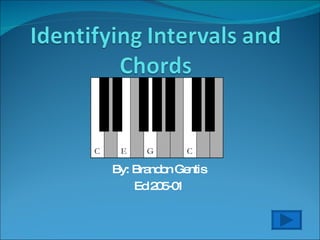
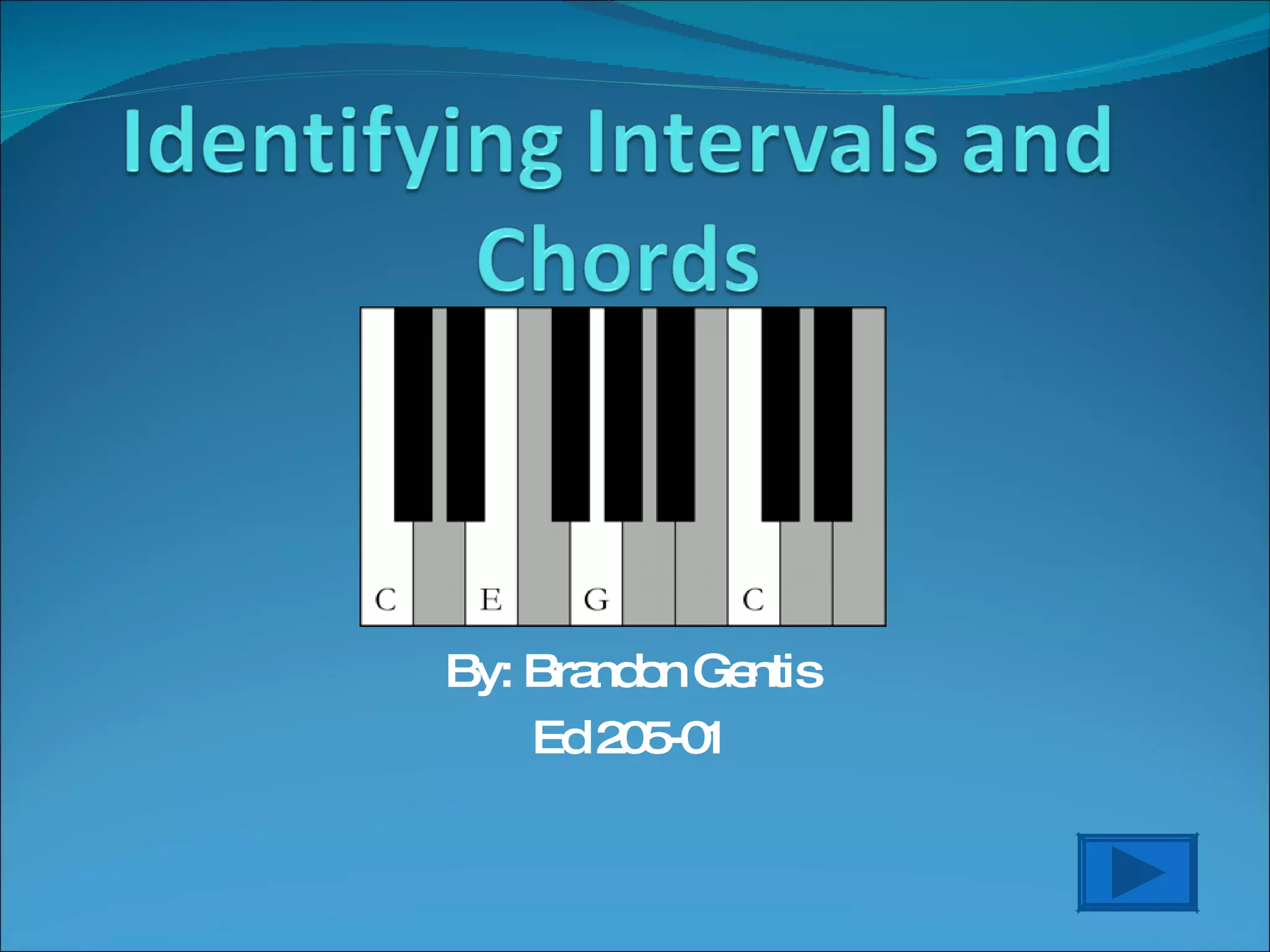
By: Brandon Gentis Ed 205-01
The Root of the Presentation Interval  Major Minor Augmented Diminished Perfect Chart Showing All 5 Chords Major Minor Augmented Diminished Chord Practice About Creator Resources Video Demonstrating Chords QUIT
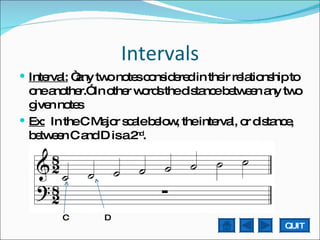
Intervals Interval:  “any two notes considered in their relationship to one another.” In other words the distance between any two given notes Ex:   In the C Major scale below, the interval, or distance, between C and D is a 2 nd .  C  D QUIT
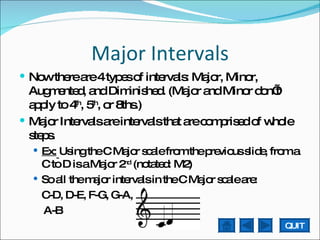
Major Intervals Now there are 4 types of intervals: Major, Minor, Augmented, and Diminished. (Major and Minor don’t apply to 4 th , 5 th , or 8ths.) Major Intervals are intervals that are comprised of whole steps. Ex:   Using the C Major scale from the previous slide, from a C to D is a Major 2 nd  (notated: M2)  So all the major intervals in the C Major scale are: C-D, D-E, F-G, G-A,  A-B QUIT
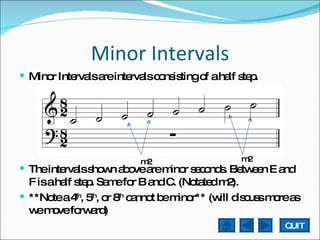
Minor Intervals Minor Intervals are intervals consisting of a half step. The intervals shown above are minor seconds. Between E and F is a half step. Same for B and C. (Notated m2). **Note a 4 th , 5 th , or 8 th  cannot be minor** (will discuss more as we move forward) m2 m2 QUIT
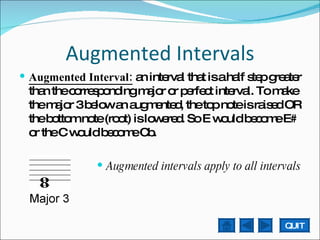
Augmented Intervals Augmented Interval:  an interval that is a half step greater than the corresponding major or perfect interval. To make the major 3 below an augmented, the top note is raised OR the bottom note (root) is lowered. So E would become E# or the C would become Cb.  Augmented intervals apply to all intervals QUIT
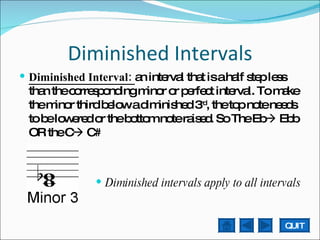
Diminished Intervals Diminished Interval:  an interval that is a half step less than the corresponding minor or perfect interval. To make the minor third below a diminished 3 rd , the top note needs to be lowered or the bottom note raised. So The Eb   Ebb OR the C   C#  Diminished intervals apply to all intervals QUIT
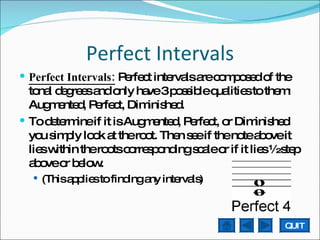
Perfect Intervals Perfect Intervals:  Perfect intervals are composed of the tonal degrees and only have 3 possible qualities to them: Augmented, Perfect, Diminished.  To determine if it is Augmented, Perfect, or Diminished you simply look at the root. Then see if the note above it lies within the roots corresponding scale or if it lies ½ step above or below. (This applies to finding any intervals) QUIT
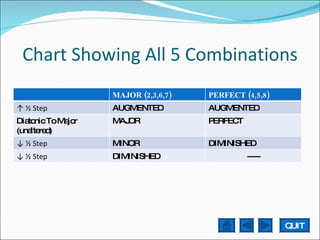
Chart Showing All 5 Combinations QUIT MAJOR (2,3,6,7) PERFECT (4,5,8) ↑  ½ Step AUGMENTED AUGMENTED Diatonic To Major (unaltered) MAJOR PERFECT ↓  ½ Step MINOR DIMINISHED ↓  ½ Step DIMINISHED -----
Chords Chords are built on intervals. Just like intervals there are 4 main types of chords Major Chords Minor Chords Augmented Chords Diminished Chords QUIT
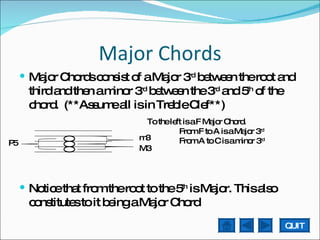
Major Chords Major Chords consist of a Major 3 rd  between the root and third and then a minor 3 rd  between the 3 rd  and 5 th  of the chord.  (**Assume all is in Treble Clef**) Notice that from the root to the 5 th  is Major. This also constitutes to it being a Major Chord To the left is a F Major Chord. From F to A is a Major 3 rd From A to C is a minor 3 rd   M3 m3 P5 QUIT
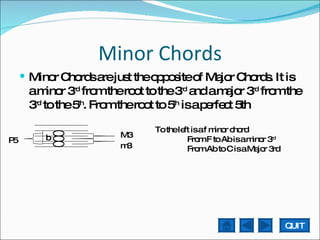
Minor Chords Minor Chords are just the opposite of Major Chords. It is a minor 3 rd  from the root to the 3 rd  and a major 3 rd  from the 3 rd  to the 5 th . From the root to 5 th  is a perfect 5th b  To the left is a f minor chord From F to Ab is a minor 3 rd From Ab to C is a Major 3rd QUIT m3 M3 P5
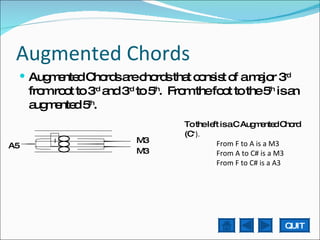
Augmented Chords Augmented Chords are chords that consist of a major 3 rd  from root to 3 rd  and 3 rd  to 5 th .  From the foot to the 5 th  is an augmented 5 th .  # M3 M3 A5 To the left is a C Augmented Chord (C ⁺).  From F to A is a M3 From A to C# is a M3 From F to C# is a A3 QUIT
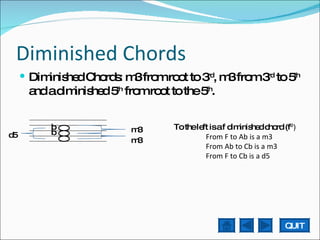
Diminished Chords Diminished Chords: m3 from root to 3 rd , m3 from 3 rd  to 5 th  and a diminished 5 th  from root to the 5 th .  b b m3 m3 d5 To the left is a f diminished chord (f ⁰) From F to Ab is a m3 From Ab to Cb is a m3 From F to Cb is a d5 QUIT
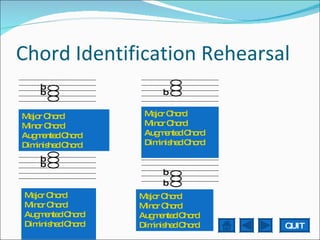
Chord Identification Rehearsal  b b Major Chord Minor Chord Augmented Chord Diminished Chord b Major Chord Minor Chord Augmented Chord Diminished Chord b b b b Major Chord Minor Chord Augmented Chord Diminished Chord Major Chord Minor Chord Augmented Chord Diminished Chord QUIT
Correctly Identified! QUIT Return To Practice Page
Error In Selection Check your selection and try identifying the distance between the root and 3 rd  and 3 rd  and 5 th .  If needed, go back and review what makes a chord major, minor, augmented or diminished. QUIT Return To Practice Page
Show Time Chords are the very basic for any song out there. Chords make songs what they are, they fill in the gaps between melodic lines. Below is an example of a piano cover of David Cook’s “Time of my Life” Click The Image For The Demonstration Video QUIT
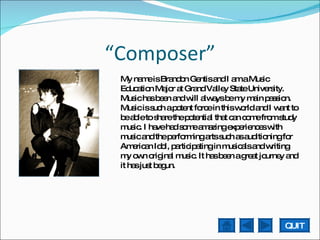
“ Composer” My name is Brandon Gentis and I am a Music Education Major at Grand Valley State University. Music has been and will always be my main passion. Music is such a potent force in this world and I want to be able to share the potential that can come from study music. I have had some amazing experiences with music and the performing arts such as auditioning for American Idol, participating in musicals and writing my own original music. It has been a great journey and it has just begun.  QUIT
Resources www.google.com  (for images) Nelson, Robert.  Fundamentals of Music . 6 th  edition. http://www.youtube.com/watch?v=wHOY5MA1Arw   QUIT

Chords and Intervals

  • 1.
  • 2.
    The Root ofthe Presentation Interval Major Minor Augmented Diminished Perfect Chart Showing All 5 Chords Major Minor Augmented Diminished Chord Practice About Creator Resources Video Demonstrating Chords QUIT
  • 3.
    Intervals Interval: “any two notes considered in their relationship to one another.” In other words the distance between any two given notes Ex: In the C Major scale below, the interval, or distance, between C and D is a 2 nd . C D QUIT
  • 4.
    Major Intervals Nowthere are 4 types of intervals: Major, Minor, Augmented, and Diminished. (Major and Minor don’t apply to 4 th , 5 th , or 8ths.) Major Intervals are intervals that are comprised of whole steps. Ex: Using the C Major scale from the previous slide, from a C to D is a Major 2 nd (notated: M2) So all the major intervals in the C Major scale are: C-D, D-E, F-G, G-A, A-B QUIT
  • 5.
    Minor Intervals MinorIntervals are intervals consisting of a half step. The intervals shown above are minor seconds. Between E and F is a half step. Same for B and C. (Notated m2). **Note a 4 th , 5 th , or 8 th cannot be minor** (will discuss more as we move forward) m2 m2 QUIT
  • 6.
    Augmented Intervals AugmentedInterval: an interval that is a half step greater than the corresponding major or perfect interval. To make the major 3 below an augmented, the top note is raised OR the bottom note (root) is lowered. So E would become E# or the C would become Cb. Augmented intervals apply to all intervals QUIT
  • 7.
    Diminished Intervals DiminishedInterval: an interval that is a half step less than the corresponding minor or perfect interval. To make the minor third below a diminished 3 rd , the top note needs to be lowered or the bottom note raised. So The Eb  Ebb OR the C  C# Diminished intervals apply to all intervals QUIT
  • 8.
    Perfect Intervals PerfectIntervals: Perfect intervals are composed of the tonal degrees and only have 3 possible qualities to them: Augmented, Perfect, Diminished. To determine if it is Augmented, Perfect, or Diminished you simply look at the root. Then see if the note above it lies within the roots corresponding scale or if it lies ½ step above or below. (This applies to finding any intervals) QUIT
  • 9.
    Chart Showing All5 Combinations QUIT MAJOR (2,3,6,7) PERFECT (4,5,8) ↑ ½ Step AUGMENTED AUGMENTED Diatonic To Major (unaltered) MAJOR PERFECT ↓ ½ Step MINOR DIMINISHED ↓ ½ Step DIMINISHED -----
  • 10.
    Chords Chords arebuilt on intervals. Just like intervals there are 4 main types of chords Major Chords Minor Chords Augmented Chords Diminished Chords QUIT
  • 11.
    Major Chords MajorChords consist of a Major 3 rd between the root and third and then a minor 3 rd between the 3 rd and 5 th of the chord. (**Assume all is in Treble Clef**) Notice that from the root to the 5 th is Major. This also constitutes to it being a Major Chord To the left is a F Major Chord. From F to A is a Major 3 rd From A to C is a minor 3 rd M3 m3 P5 QUIT
  • 12.
    Minor Chords MinorChords are just the opposite of Major Chords. It is a minor 3 rd from the root to the 3 rd and a major 3 rd from the 3 rd to the 5 th . From the root to 5 th is a perfect 5th b To the left is a f minor chord From F to Ab is a minor 3 rd From Ab to C is a Major 3rd QUIT m3 M3 P5
  • 13.
    Augmented Chords AugmentedChords are chords that consist of a major 3 rd from root to 3 rd and 3 rd to 5 th . From the foot to the 5 th is an augmented 5 th . # M3 M3 A5 To the left is a C Augmented Chord (C ⁺). From F to A is a M3 From A to C# is a M3 From F to C# is a A3 QUIT
  • 14.
    Diminished Chords DiminishedChords: m3 from root to 3 rd , m3 from 3 rd to 5 th and a diminished 5 th from root to the 5 th . b b m3 m3 d5 To the left is a f diminished chord (f ⁰) From F to Ab is a m3 From Ab to Cb is a m3 From F to Cb is a d5 QUIT
  • 15.
    Chord Identification Rehearsal b b Major Chord Minor Chord Augmented Chord Diminished Chord b Major Chord Minor Chord Augmented Chord Diminished Chord b b b b Major Chord Minor Chord Augmented Chord Diminished Chord Major Chord Minor Chord Augmented Chord Diminished Chord QUIT
  • 16.
    Correctly Identified! QUITReturn To Practice Page
  • 17.
    Error In SelectionCheck your selection and try identifying the distance between the root and 3 rd and 3 rd and 5 th . If needed, go back and review what makes a chord major, minor, augmented or diminished. QUIT Return To Practice Page
  • 18.
    Show Time Chordsare the very basic for any song out there. Chords make songs what they are, they fill in the gaps between melodic lines. Below is an example of a piano cover of David Cook’s “Time of my Life” Click The Image For The Demonstration Video QUIT
  • 19.
    “ Composer” Myname is Brandon Gentis and I am a Music Education Major at Grand Valley State University. Music has been and will always be my main passion. Music is such a potent force in this world and I want to be able to share the potential that can come from study music. I have had some amazing experiences with music and the performing arts such as auditioning for American Idol, participating in musicals and writing my own original music. It has been a great journey and it has just begun. QUIT
  • 20.
    Resources www.google.com (for images) Nelson, Robert. Fundamentals of Music . 6 th edition. http://www.youtube.com/watch?v=wHOY5MA1Arw QUIT