GRADE 1 & INTRODUCTION
MUSIC THEORY
ITALIAN TERMS
Adagio – slowly.
Andante - at an easy walking pace.
Moderato - at a moderate speed.
Allegro - lively and fast.
Presto - very fast.
Accelerando (accel.) - gradually becoming faster.
Rallentando (rall.) - gradually becoming slower.
Ritardando (rit. / ritard.) - gradually becoming
slower.
Ritenuto (riten.) - immediately slower.
A tempo - return to former speed.
Crescendo - gradually becoming louder.
Decrescendo - gradually becoming softer.
Diminuendo (dim.) - gradually becoming
softer.
Forte ( f ) - loud.
Piano ( p ) - soft.
Legato - smooth, well connected.
Staccato - short and detached.
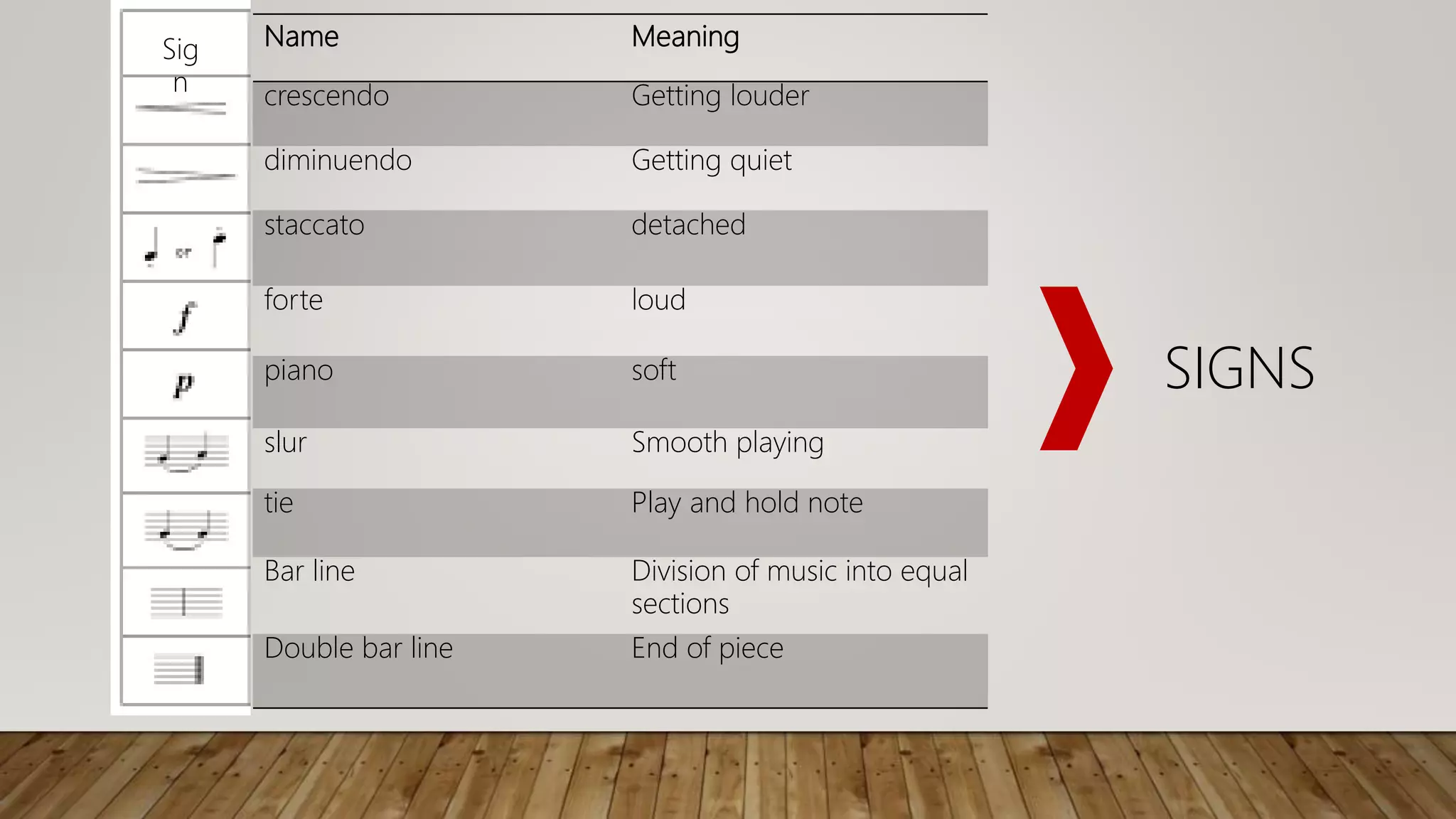
Name Meaning
crescendo Getting louder
diminuendo Getting quiet
staccato detached
forte loud
piano soft
slur Smooth playing
tie Play and hold note
Bar line Division of music into equal
sections
Double bar line End of piece
Sig
n
SIGNS
TONIC TRIADS
• Chords are 2 or more notes played together.
• Triads are chords made up of 3 notes but, a tonic
triad is 3 notes built on the tonic which is scale
degree 1 depending on the scale.
• The second and third note is scale degree 3 then
5. so, to make one you must skip out a note and
start with whatever key it is in. Remember to
include key signature or accidental, it all depends
on the question given.
FLATS AND SHARPS
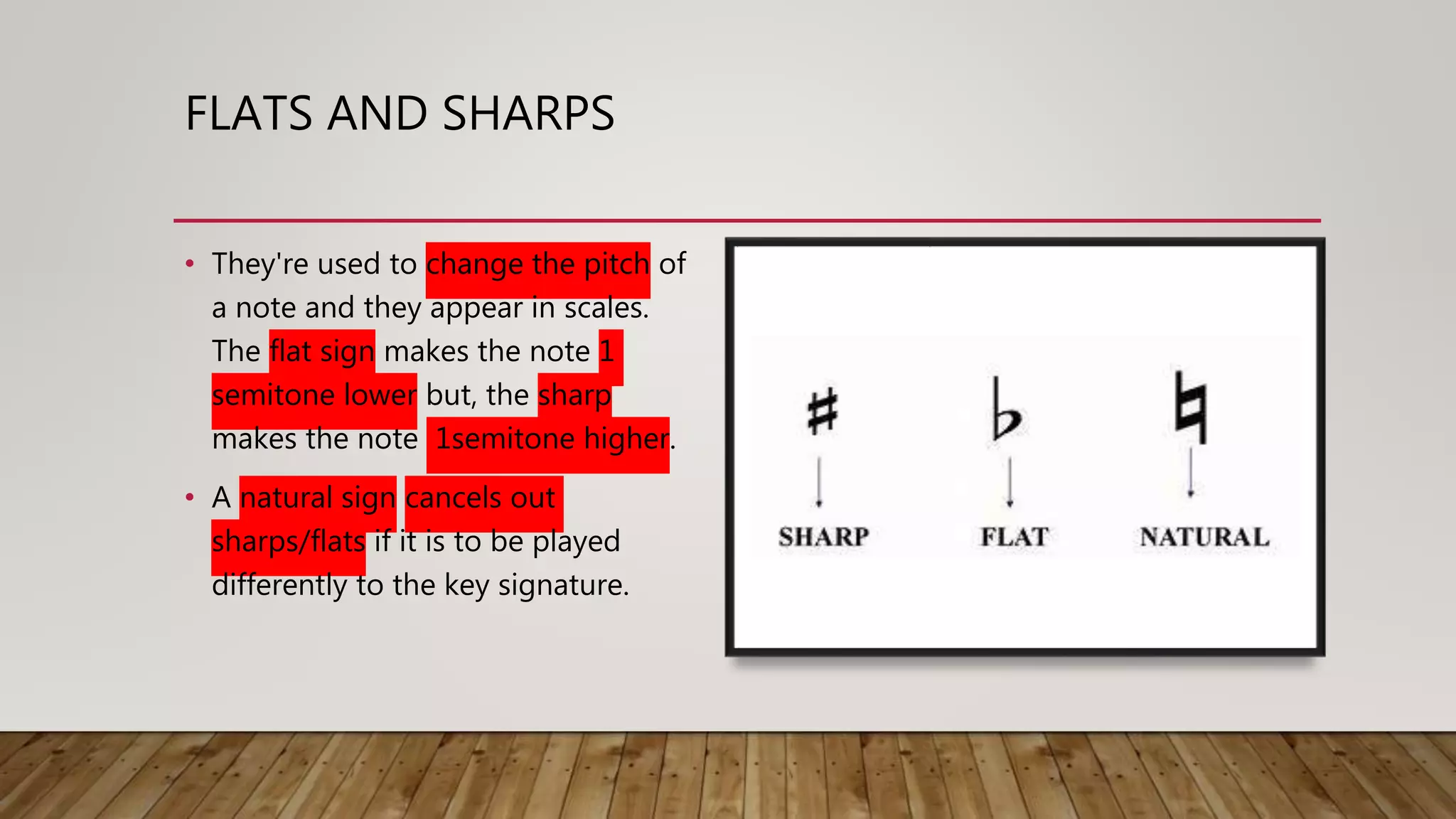
• They're used to change the pitch of
a note and they appear in scales.
The flat sign makes the note 1
semitone lower but, the sharp
makes the note 1semitone higher.
• A natural sign cancels out
sharps/flats if it is to be played
differently to the key signature.
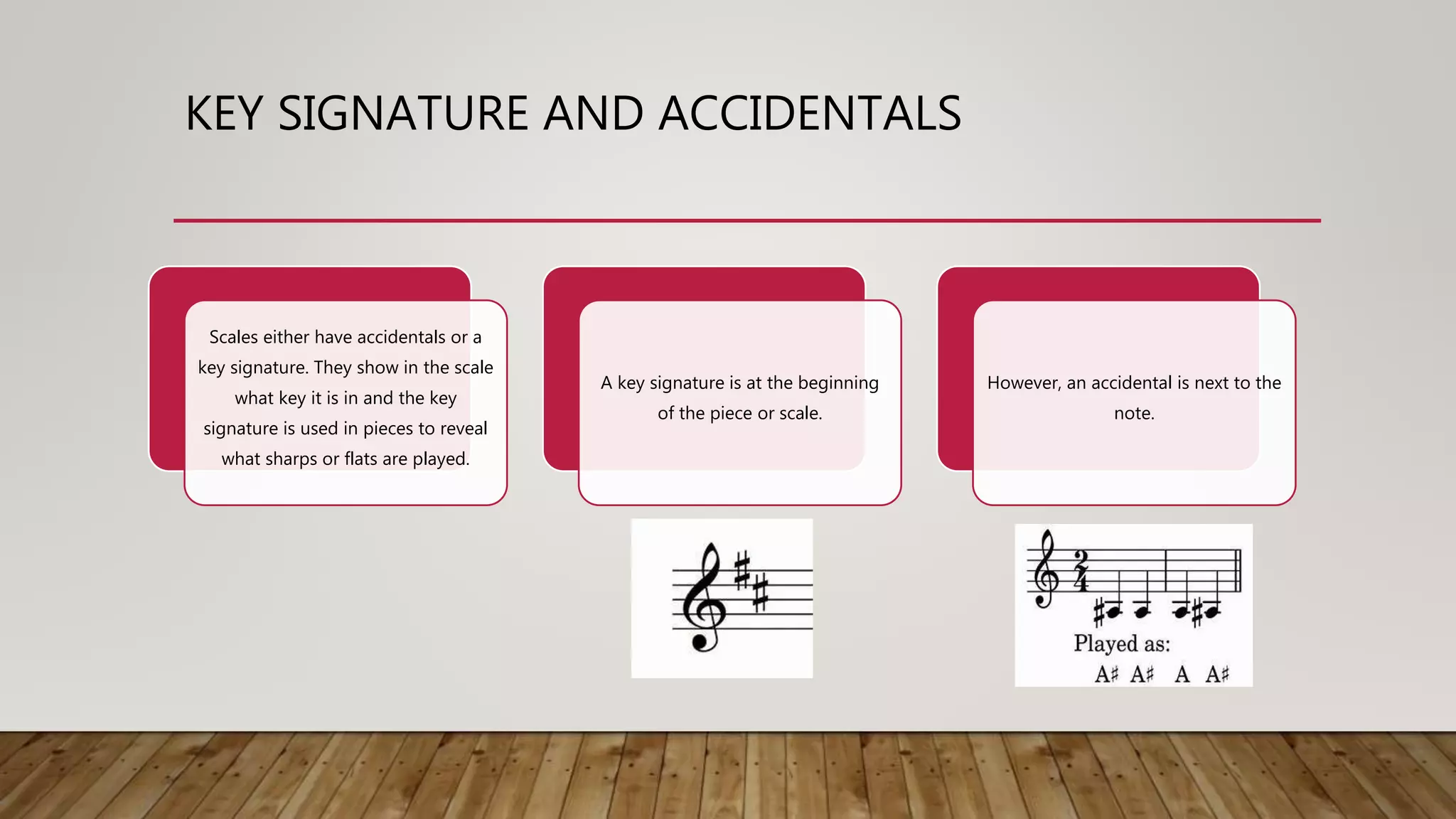
KEY SIGNATURE AND ACCIDENTALS
Scales either have accidentals or a
key signature. They show in the scale
what key it is in and the key
signature is used in pieces to reveal
what sharps or flats are played.
A key signature is at the beginning
of the piece or scale.
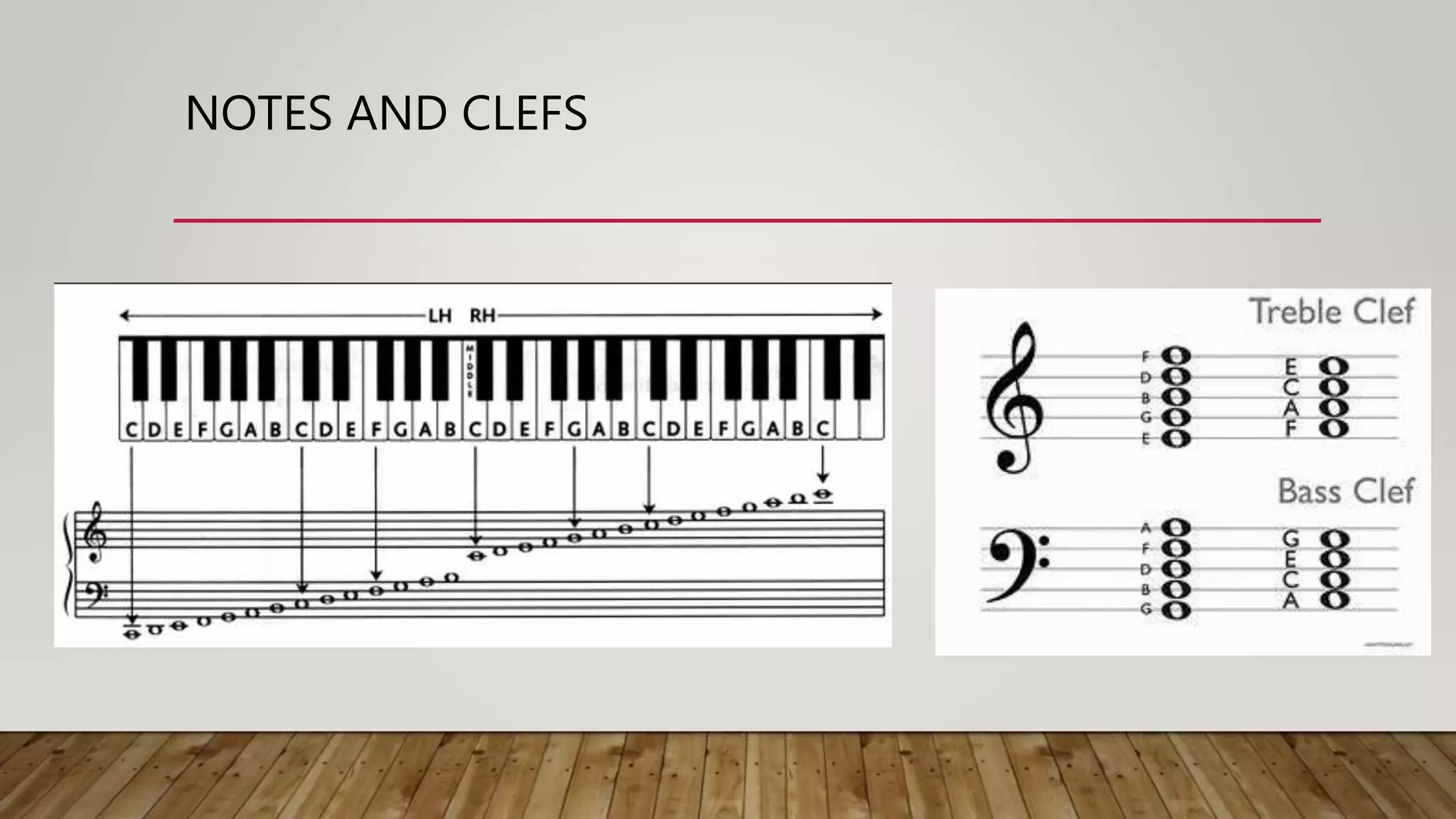
However, an accidental is next to the
note.
NOTES AND CLEFS
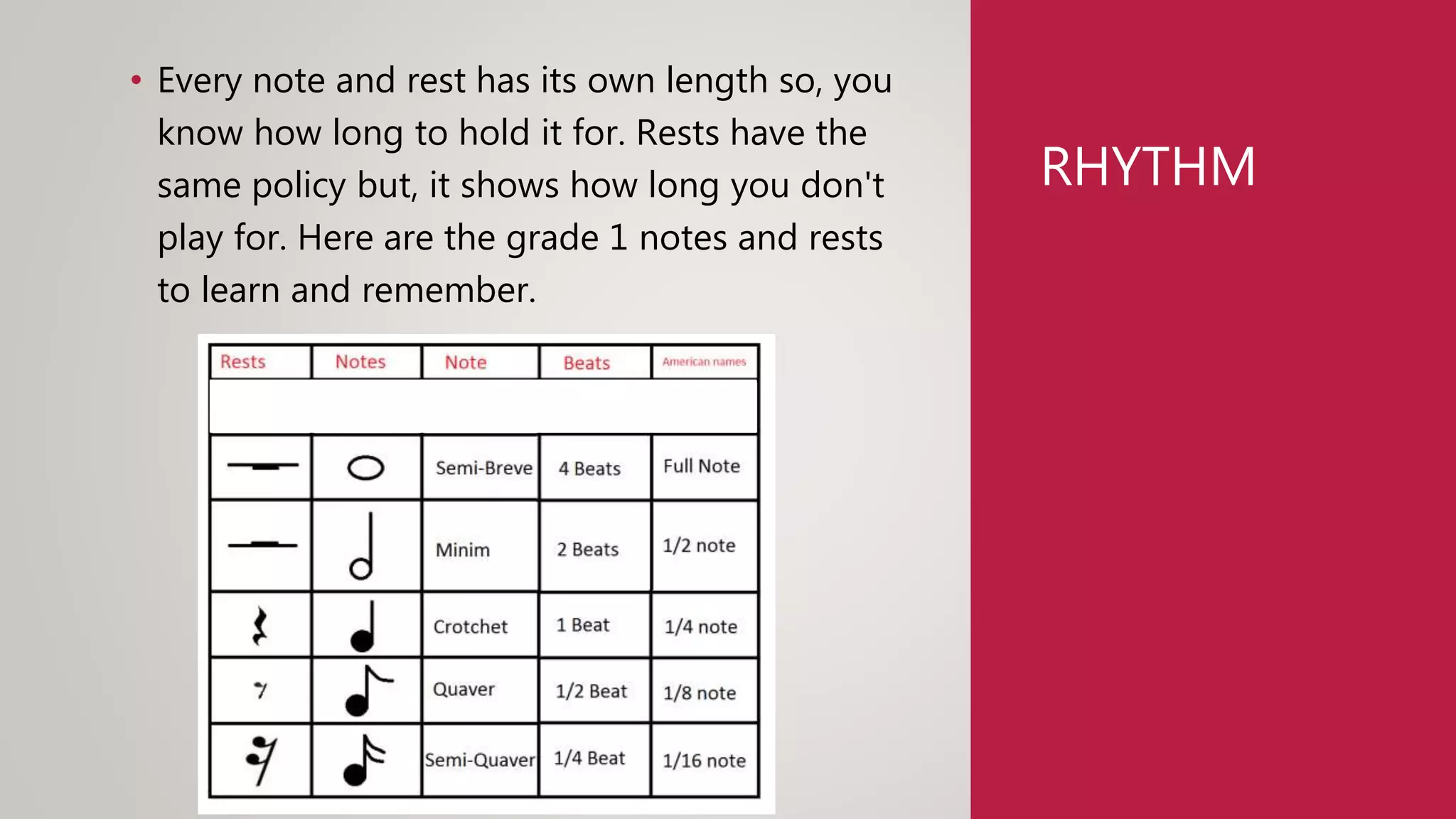
NAMING THE NOTES
• Often, you're asked to name notes given in a
melody or piece and it seem easy but, don't
forget to add the accidentals (#). They will be
marked with this sign *, and remember the
bottom line is G for bass clef and it is E for the
treble clef. Always check the key signature and
clef! The notes depend whether it is bass clef
(left hand) or treble clef (right hand).
* * * Here's an example of
how you name the
notes._ _ _
LEGER LINES
• Leger lines are extra lines for the notes that
are below or above the stave. So, it's when
notes run out of lines/space. There is no rule
about how many is needed and it shows
clearly what note it is.
• Remember, the note dangles from the line
below the stave but, it sits on the line above
the stave. Sometimes it goes through the line
like, middle C.
RHYTHM
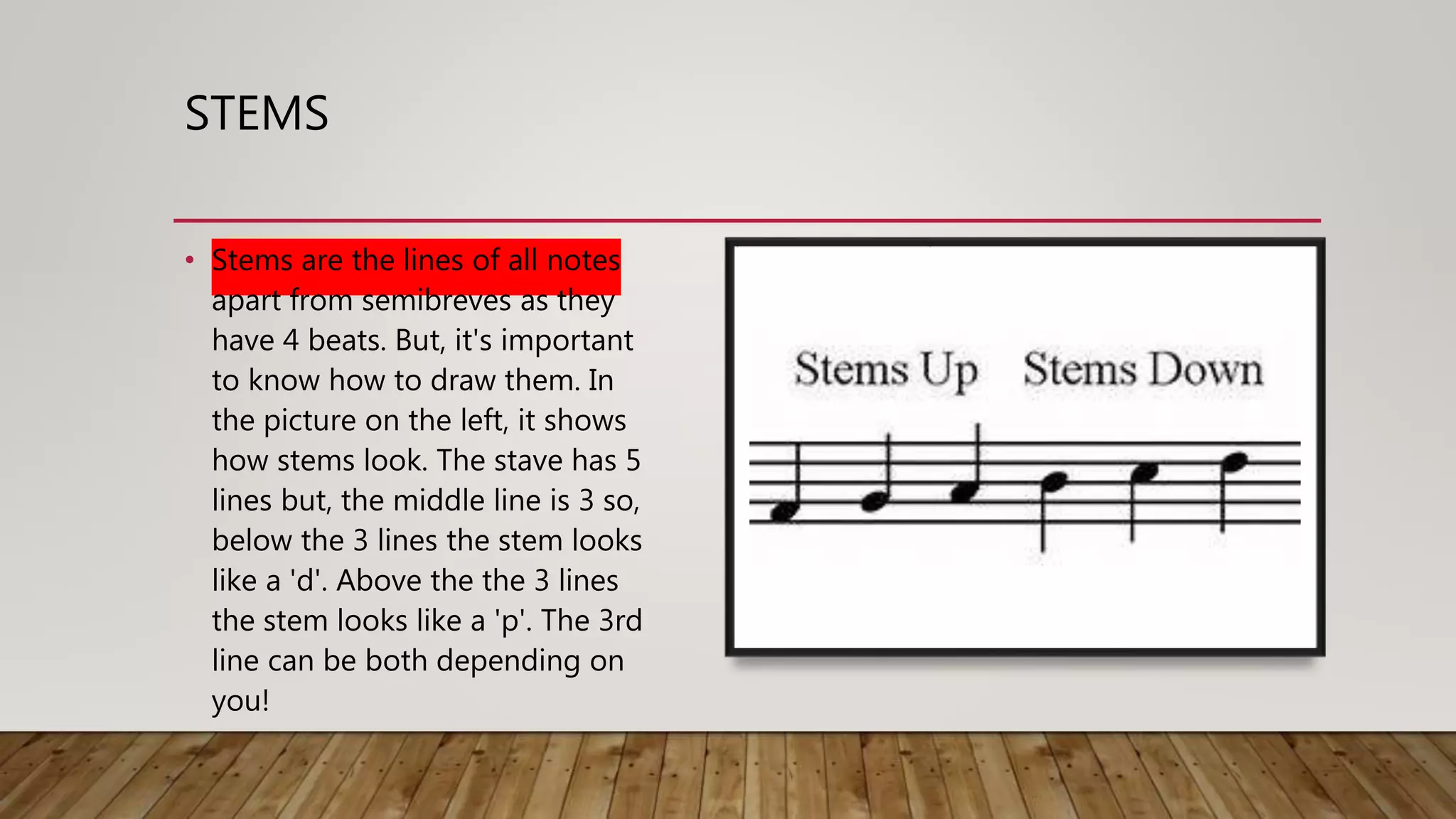
• Every note and rest has its own length so, you
know how long to hold it for. Rests have the
same policy but, it shows how long you don't
play for. Here are the grade 1 notes and rests
to learn and remember.
STEMS
• Stems are the lines of all notes
apart from semibreves as they
have 4 beats. But, it's important
to know how to draw them. In
the picture on the left, it shows
how stems look. The stave has 5
lines but, the middle line is 3 so,
below the 3 lines the stem looks
like a 'd'. Above the the 3 lines
the stem looks like a 'p'. The 3rd
line can be both depending on
you!
QUAVERS
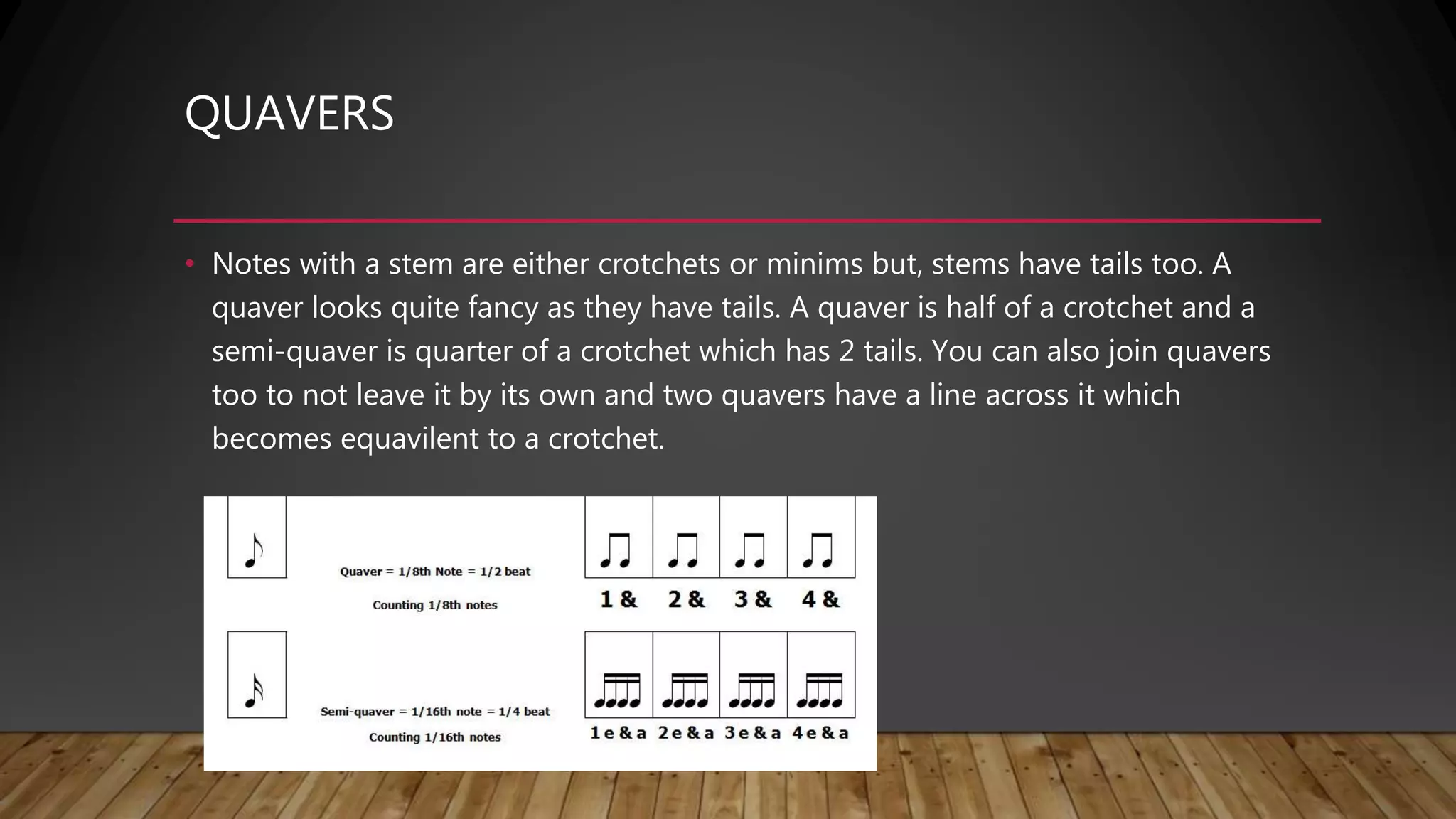
• Notes with a stem are either crotchets or minims but, stems have tails too. A
quaver looks quite fancy as they have tails. A quaver is half of a crotchet and a
semi-quaver is quarter of a crotchet which has 2 tails. You can also join quavers
too to not leave it by its own and two quavers have a line across it which
becomes equavilent to a crotchet.
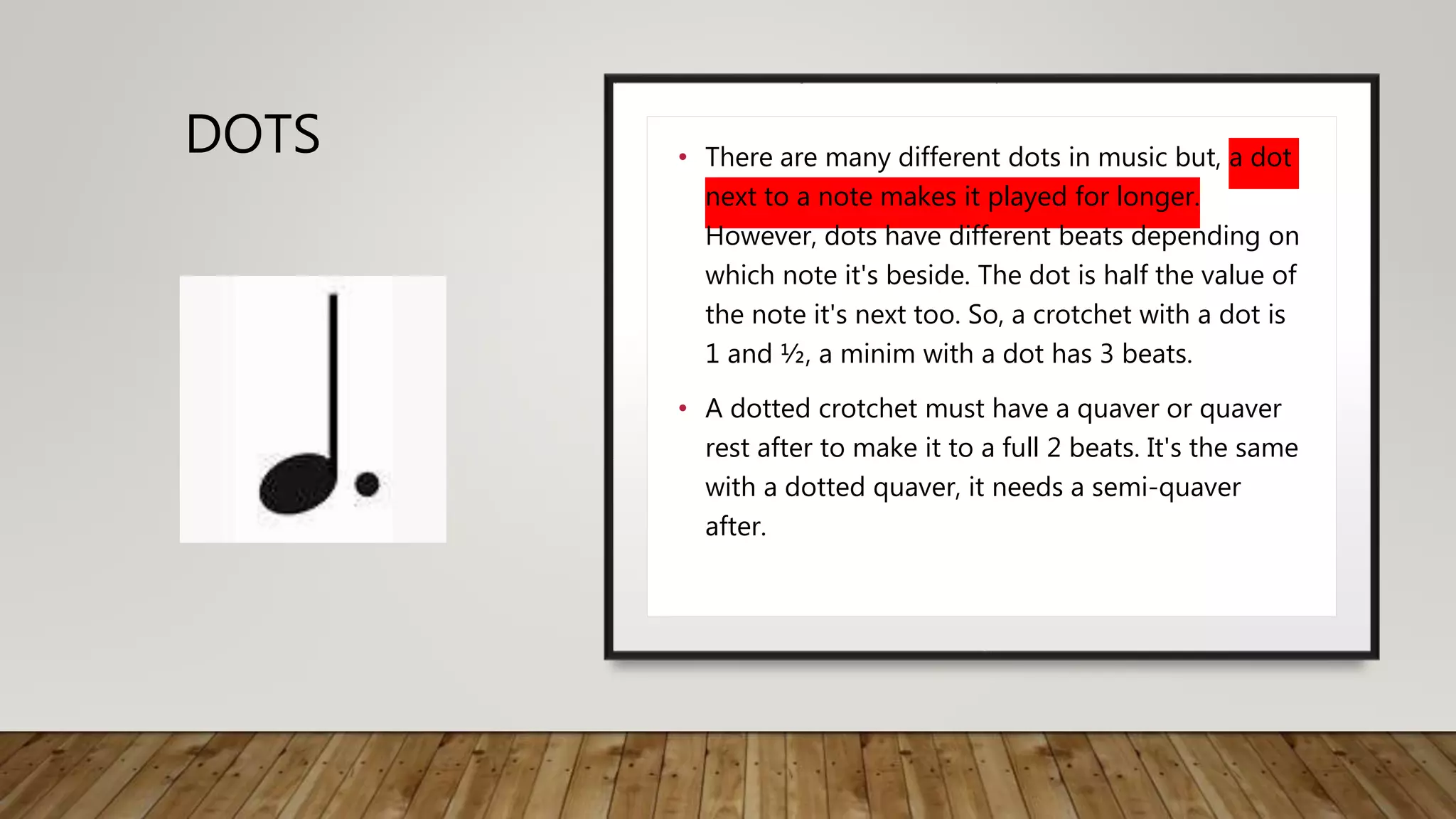
DOTS • There are many different dots in music but, a dot
next to a note makes it played for longer.
However, dots have different beats depending on
which note it's beside. The dot is half the value of
the note it's next too. So, a crotchet with a dot is
1 and ½, a minim with a dot has 3 beats.
• A dotted crotchet must have a quaver or quaver
rest after to make it to a full 2 beats. It's the same
with a dotted quaver, it needs a semi-quaver
after.
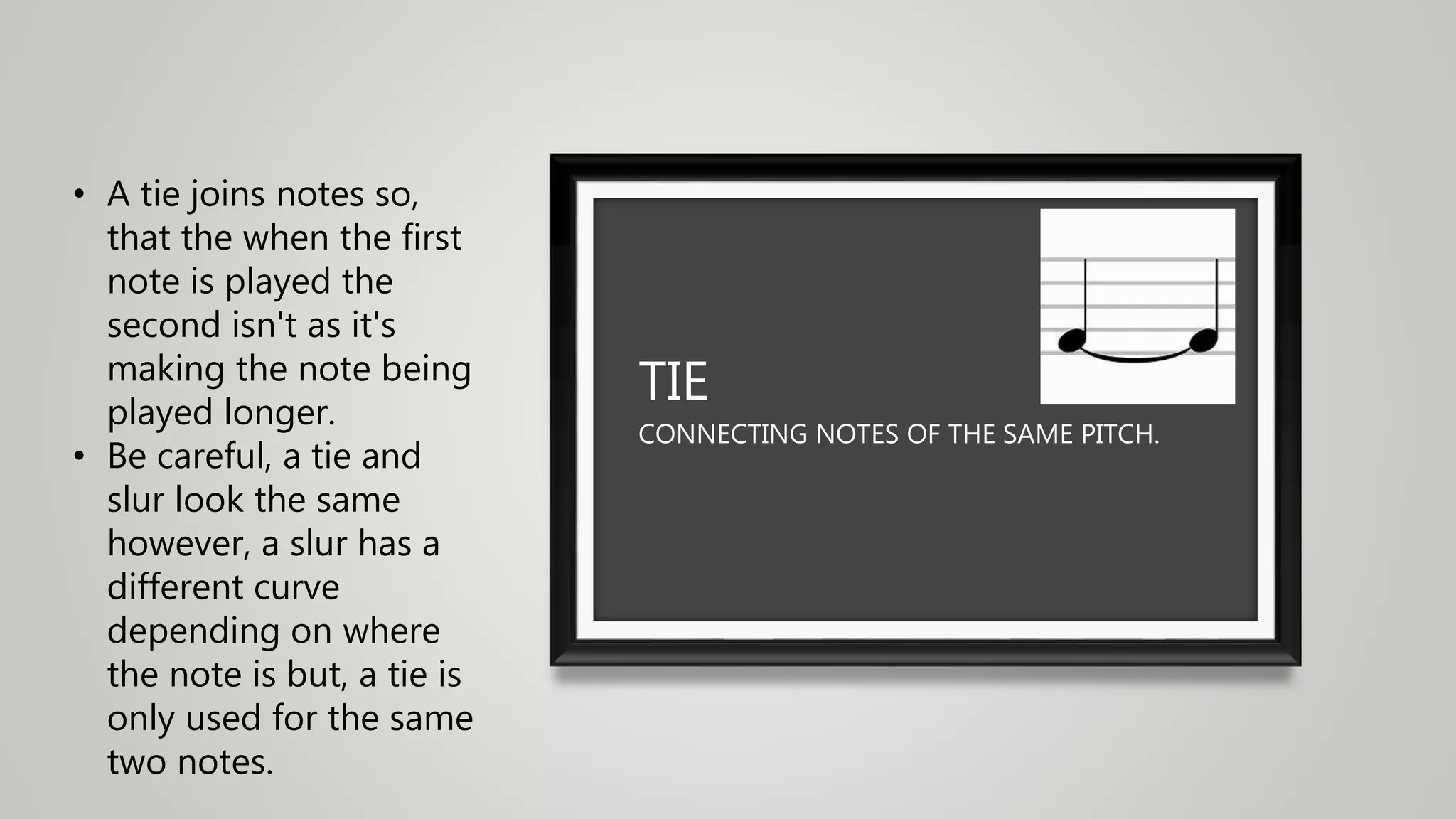
TIE
CONNECTING NOTES OF THE SAME PITCH.
• A tie joins notes so,
that the when the first
note is played the
second isn't as it's
making the note being
played longer.
• Be careful, a tie and
slur look the same
however, a slur has a
different curve
depending on where
the note is but, a tie is
only used for the same
two notes.
TIME
SIGNATURES
& BARS
• Time signatures make music all mathematical as
pieces have specific beats to play along to and
when writing it's even more confusing with the
bar lines. Time signature say how many and what
beats per bar. The bar lines are to fit the beats in
bars according to the time signature. They're
very important and they get harder as you go
deeper in theory.
• There are 2 numbers, the top tells you the
number of beats and the bottom says what kind
of beats. Bottom numbers: 2 means minims and
4 means crotchet beats.
• 2/4 means 2 crotchet beats per bar and 4/4
means 4 crotchet beats per bar. ¾ means 3
crotchet beats per bar. This doesn't mean you
only use crotchet notes, it means each bar must
add up to (top number) in crotchets which add
up to 1 each.
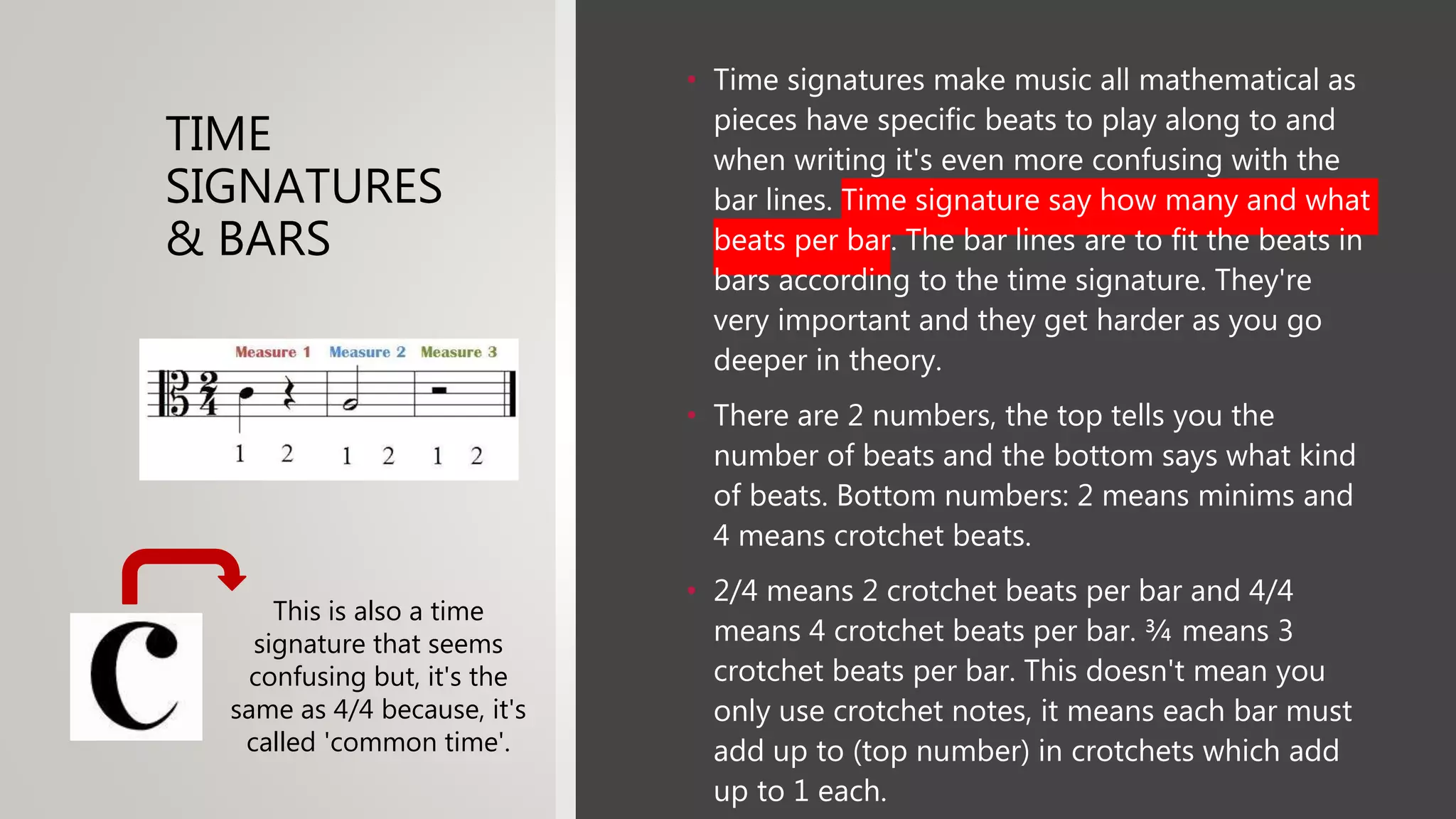
This is also a time
signature that seems
confusing but, it's the
same as 4/4 because, it's
called 'common time'.

Music Theory: Grade 1

  • 1.
    GRADE 1 &INTRODUCTION MUSIC THEORY
  • 2.
    ITALIAN TERMS Adagio –slowly. Andante - at an easy walking pace. Moderato - at a moderate speed. Allegro - lively and fast. Presto - very fast. Accelerando (accel.) - gradually becoming faster. Rallentando (rall.) - gradually becoming slower. Ritardando (rit. / ritard.) - gradually becoming slower. Ritenuto (riten.) - immediately slower. A tempo - return to former speed. Crescendo - gradually becoming louder. Decrescendo - gradually becoming softer. Diminuendo (dim.) - gradually becoming softer. Forte ( f ) - loud. Piano ( p ) - soft. Legato - smooth, well connected. Staccato - short and detached.
  • 3.
    Name Meaning crescendo Gettinglouder diminuendo Getting quiet staccato detached forte loud piano soft slur Smooth playing tie Play and hold note Bar line Division of music into equal sections Double bar line End of piece Sig n SIGNS
  • 4.
    TONIC TRIADS • Chordsare 2 or more notes played together. • Triads are chords made up of 3 notes but, a tonic triad is 3 notes built on the tonic which is scale degree 1 depending on the scale. • The second and third note is scale degree 3 then 5. so, to make one you must skip out a note and start with whatever key it is in. Remember to include key signature or accidental, it all depends on the question given.
  • 5.
    FLATS AND SHARPS •They're used to change the pitch of a note and they appear in scales. The flat sign makes the note 1 semitone lower but, the sharp makes the note 1semitone higher. • A natural sign cancels out sharps/flats if it is to be played differently to the key signature.
  • 6.
    KEY SIGNATURE ANDACCIDENTALS Scales either have accidentals or a key signature. They show in the scale what key it is in and the key signature is used in pieces to reveal what sharps or flats are played. A key signature is at the beginning of the piece or scale. However, an accidental is next to the note.
  • 7.
  • 8.
    NAMING THE NOTES •Often, you're asked to name notes given in a melody or piece and it seem easy but, don't forget to add the accidentals (#). They will be marked with this sign *, and remember the bottom line is G for bass clef and it is E for the treble clef. Always check the key signature and clef! The notes depend whether it is bass clef (left hand) or treble clef (right hand). * * * Here's an example of how you name the notes._ _ _
  • 9.
    LEGER LINES • Legerlines are extra lines for the notes that are below or above the stave. So, it's when notes run out of lines/space. There is no rule about how many is needed and it shows clearly what note it is. • Remember, the note dangles from the line below the stave but, it sits on the line above the stave. Sometimes it goes through the line like, middle C.
  • 10.
    RHYTHM • Every noteand rest has its own length so, you know how long to hold it for. Rests have the same policy but, it shows how long you don't play for. Here are the grade 1 notes and rests to learn and remember.
  • 11.
    STEMS • Stems arethe lines of all notes apart from semibreves as they have 4 beats. But, it's important to know how to draw them. In the picture on the left, it shows how stems look. The stave has 5 lines but, the middle line is 3 so, below the 3 lines the stem looks like a 'd'. Above the the 3 lines the stem looks like a 'p'. The 3rd line can be both depending on you!
  • 12.
    QUAVERS • Notes witha stem are either crotchets or minims but, stems have tails too. A quaver looks quite fancy as they have tails. A quaver is half of a crotchet and a semi-quaver is quarter of a crotchet which has 2 tails. You can also join quavers too to not leave it by its own and two quavers have a line across it which becomes equavilent to a crotchet.
  • 13.
    DOTS • Thereare many different dots in music but, a dot next to a note makes it played for longer. However, dots have different beats depending on which note it's beside. The dot is half the value of the note it's next too. So, a crotchet with a dot is 1 and ½, a minim with a dot has 3 beats. • A dotted crotchet must have a quaver or quaver rest after to make it to a full 2 beats. It's the same with a dotted quaver, it needs a semi-quaver after.
  • 14.
    TIE CONNECTING NOTES OFTHE SAME PITCH. • A tie joins notes so, that the when the first note is played the second isn't as it's making the note being played longer. • Be careful, a tie and slur look the same however, a slur has a different curve depending on where the note is but, a tie is only used for the same two notes.
  • 15.
    TIME SIGNATURES & BARS • Timesignatures make music all mathematical as pieces have specific beats to play along to and when writing it's even more confusing with the bar lines. Time signature say how many and what beats per bar. The bar lines are to fit the beats in bars according to the time signature. They're very important and they get harder as you go deeper in theory. • There are 2 numbers, the top tells you the number of beats and the bottom says what kind of beats. Bottom numbers: 2 means minims and 4 means crotchet beats. • 2/4 means 2 crotchet beats per bar and 4/4 means 4 crotchet beats per bar. ¾ means 3 crotchet beats per bar. This doesn't mean you only use crotchet notes, it means each bar must add up to (top number) in crotchets which add up to 1 each. This is also a time signature that seems confusing but, it's the same as 4/4 because, it's called 'common time'.