MUSIC LEARNING MODULES 1-2:

                   Composed Vocal Music 1: Nationalistic Songs and Love Songs

I         TARGET GRADE LEVEL: Grade 7

II        MODULES 1-2: Vocal Music 1: Nationalistic Songs and Love Songs

III       TIME ALLOTMENT: 2 Hours

IV        OVERVIEW OF THE MODULE

          The lesson is an introduction to two classifications of Vocal Music composed by Filipinos –
the . Nationalistic Songs and Love Songs. The compositions Marangal na Dalit ng Katagalugan by
Julio Nakpil and Lupang Hinirang by Julian Felipe ( Nationalistic) , the Kundiman Nasaan Ka Irog ? by
Nicanor Abelardo and the ballad           Gaano Ko Ikaw Kamahal by Ernani Cuenco ( Love Songs) will
complete the musical journey in this module. Throughout the lesson, one will discover how these
songs express the beliefs of a nation about patriotism and love and how a nation places a value on
artists’ creations. . A group song and dance performance on these four songs culminates the
educational experience.

V         PERFORMANCE STANDARDS

         Analyzes musical elements and processes of Philippine music.
         Correlates Philippine music to Philippine culture.
         Performs examples of Philippine music, alone and with others, in appropriate tone, pitch,
          rhythm, expression and style.


VI        COMPETENCIES/OBJECTIVES
         Analyzes a representative example of a work by a Filipino composer, and describes how the
          musical elements are used.
         Explains the distinguishing characteristics of representative works by Filipino composers, in
          relation to history and culture of the area.
         Analyzes the relationship of functions of the representative works of Filipino composers to
          the lives of the people.
         Sings accurately representative works of Filipino composers, alone and / or with others.
   Performs on available instruments works of representative Filipino composers, alone and / or
          with others.
         Improvises simple rhythmic / harmonic accompaniments to selected works of representative
          Filipino composers.
         Explores ways of producing sounds on a variety of sources that would simulate the sound of
          instruments being studied.
         Evaluates music and music performances applying knowledge of musical elements and style.


VII       CONTENT/TOPIC

          Nationalistic Songs and Love Songs
         Vocal Music – Nationalistic Songs (Julio Nakpil and Julian Felipe), Love Songs ( Nicanor
          Abelardo,Kundiman and Ernani Cuenco, Ballad)
         Cultural Context (History and Traditions) – Filipino conflict during the Spanish Period
          (Aguinaldo and . Bonifacio), How a National Artist is proclaimed
         Compositions –Himno Nacional Filipino, Lupang Hinirang, Marangal na Dalit ng Katagalugan;
          Nasaan Ka Irog?, Gaano Ko Ikaw Kamahal
         Social Functions – Patriotism, Artistry in the Society


VIII      RESOURCES


Readings:

Epistola, Ernesto V. (1996) Nicanor Abelardo, the Man, the Artist: A Biography (1st ed., pp. 50-52).
Manila: Rex Book Store.

Himig: The Filipino Music Collection of FHL. (2012) Ernani Joson Cuenco. Retrieved 7 June 2012.
http://www.himig.com.ph/people/14-ernani-joson-cuenco?composer=true.

Lubang, Danalyn T. Tamang Pagkanta ng Pambansang Awit. The Varsitarian. (Vol LXXXi, No. 13).
http://www.varsitarian.net/filipino/20100507/tamang_pagkanta_ng_pambansang_awit. retrieved
on 06/13/2012 - 11:46.

Santos-Viola, Carlos N. Julio Nakpil: A Patriot and a Musician. http://julionakpil.blogspot.com/.

THE NATIONAL ARTISTS OF THE PHILIPPINES. http://www.ncca.gov.ph/about-ncca/org-
awards/org-awards-national-artist-list.php.
THE NATIONAL ARTISTS OF THE PHILIPPINES GUIDELINES.
http://www.ncca.gov.ph/about-ncca/org-awards/org-awards-national-artist-guidelines.php.

Supreme Court E-Library. Executive Orders. [Executive Order No. 236, September 19, 2003]
http://elibrary.judiciary.gov.ph/index10.php?doctype=Executive%20Orders&docid=a45475a11ec72
b843d74959b60fd7bd645fae1093b5c5.

Supreme Court E-Library. Executive Orders. [Executive Order No. 435, June 8, 2005]
http://elibrary.judiciary.gov.ph/index10.php?doctype=Executive%20Orders&docid=f50a99f950ea0
dd2453e89f5c9d6a397455a4894e8228.

Tiongson, Nicanor (Ed.). (1994). CCP Encyclopedia of Philippine Art (Vol. 6: Philippine Music). Manila:
Cultural Center of the Philippines.

Recordings:

Kundiman Art Song – Nasaan Ka Irog? – Sylvia La Torre. http://www.youtube.com/watch?v=W8-
NqGJJYkeE.

Lupang Hinirang Ang Pambansang Awit ng Pilipinas. ( ) [CD-ROM]. Philippines: .


IX     ACTIVITIES

Philippine __________ Anthem: Musical Charades

Form two teams for the musical charades. Your teacher will give to each team strips of paper
containing phrases from Lupang Hinirang. To get a point, the team must sing the phrase, with correct
lyrics and correct melody. The first team to get 5 correct performances wins incentive points.
(SUBJECT for APPROVAL)

K-W-L Chart: Write what you currently know about Nationalistic Songs and Love Songs under
column 1 and what you want to know about Nationalistic Songs and Love Songs under column 2.

                                Nationalistic Song and Love Songs


                                       What I want to                        What I've
        What I Know
                                          Know                               learned
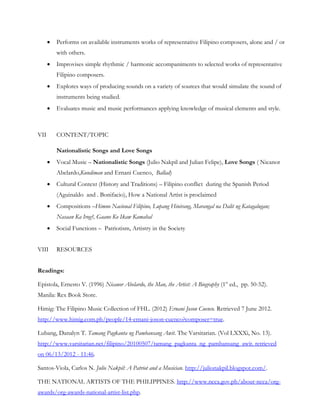
Concept Map: With the help of the readings and links given above, complete the concept map by
writing details regarding Nationalistic Songs and Love Songs..


                                        Socio-
                                                             Musical
                                      historical
                                                             Forms
                                       Context
                                     Nationalistic Songs and Love Songs


                                                             Musical
                                         Issues
                                                             Context


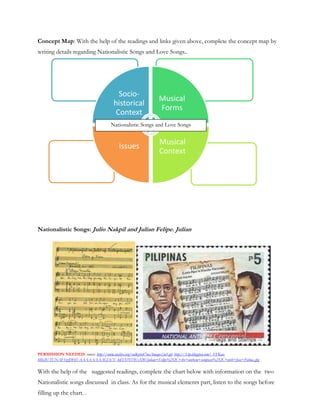
Nationalistic Songs: Julio Nakpil and Julian Felipe. Julian


PERMISSION NEEDED: source: http://www.oocities.org/valkyrie47no/Images/jn1.gif, http://3.bp.blogspot.com/_FFKau-
MIe2I/TUNAF1zzDHI/AAAAAAAACfA/Y_k6YS3Ti78/s320/Julian+Felipe%252C+the+anthem+composer%252C+with+Jose+Palma..jpg

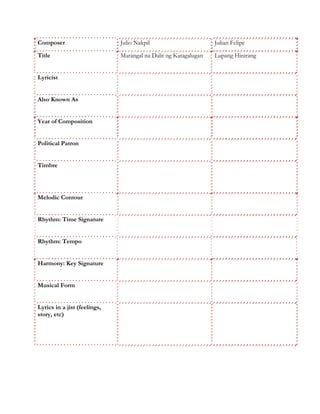
With the help of the suggested readings, complete the chart below with information on the two
Nationalistic songs discussed in class. As for the musical elements part, listen to the songs before
filling up the chart. .
Composer                      Julio Nakpil                       Julian Felipe

Title                         Marangal na Dalit ng Katagalugan   Lupang Hinirang


Lyricist


Also Known As


Year of Composition


Political Patron


Timbre


Melodic Contour


Rhythm: Time Signature


Rhythm: Tempo


Harmony: Key Signature


Musical Form


Lyrics in a jist (feelings,
story, etc)
Love Songs

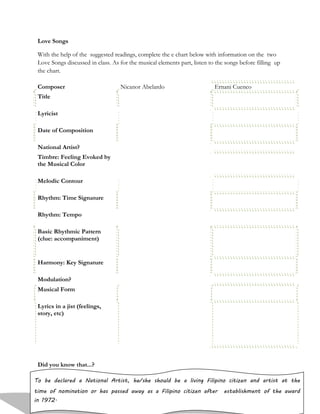
 With the help of the suggested readings, complete the e chart below with information on the two
 Love Songs discussed in class. As for the musical elements part, listen to the songs before filling up
 the chart.

 Composer                          Nicanor Abelardo                        Ernani Cuenco
 Title

 Lyricist

 Date of Composition

 National Artist?
 Timbre: Feeling Evoked by
 the Musical Color

 Melodic Contour

 Rhythm: Time Signature

 Rhythm: Tempo

 Basic Rhythmic Pattern
 (clue: accompaniment)


 Harmony: Key Signature

 Modulation?
 Musical Form

 Lyrics in a jist (feelings,
 story, etc)


 Did you know that...?

To be declared a National Artist, he/she should be a living Filipino citizen and artist at the
time of nomination or has passed away as a Filipino citizen after              establishment of the award
in 1972.
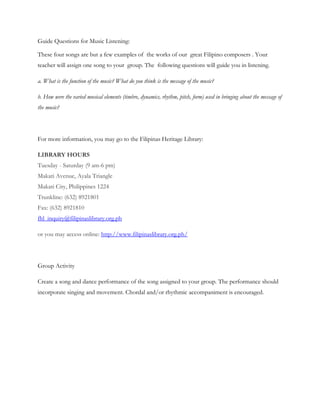
Guide Questions for Music Listening:

These four songs are but a few examples of the works of our great Filipino composers . Your
teacher will assign one song to your group. The following questions will guide you in listening.

a. What is the function of the music? What do you think is the message of the music?

b. How were the varied musical elements (timbre, dynamics, rhythm, pitch, form) used in bringing about the message of
the music?


For more information, you may go to the Filipinas Heritage Library:

LIBRARY HOURS
Tuesday - Saturday (9 am-6 pm)
Makati Avenue, Ayala Triangle
Makati City, Philippines 1224
Trunkline: (632) 8921801
Fax: (632) 8921810
fhl_inquiry@filipinaslibrary.org.ph

or you may access online: http://www.filipinaslibrary.org.ph/


Group Activity

Create a song and dance performance of the song assigned to your group. The performance should
incorporate singing and movement. Chordal and/or rhythmic accompaniment is encouraged.
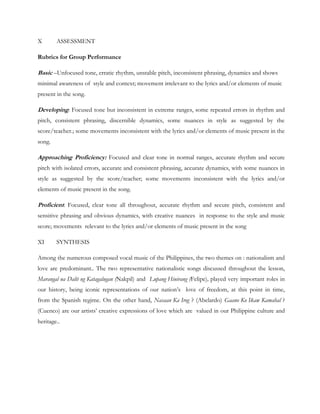
X       ASSESSMENT

Rubrics for Group Performance

Basic –Unfocused tone, erratic rhythm, unstable pitch, inconsistent phrasing, dynamics and shows
minimal awareness of style and context; movement irrelevant to the lyrics and/or elements of music
present in the song.

Developing: Focused tone but inconsistent in extreme ranges, some repeated errors in rhythm and
pitch, consistent phrasing, discernible dynamics, some nuances in style as suggested by the
score/teacher.; some movements inconsistent with the lyrics and/or elements of music present in the
song.

Approaching Proficiency: Focused and clear tone in normal ranges, accurate rhythm and secure
pitch with isolated errors, accurate and consistent phrasing, accurate dynamics, with some nuances in
style as suggested by the score/teacher; some movements inconsistent with the lyrics and/or
elements of music present in the song.

Proficient: Focused, clear tone all throughout, accurate rhythm and secure pitch, consistent and
sensitive phrasing and obvious dynamics, with creative nuances in response to the style and music
score; movements relevant to the lyrics and/or elements of music present in the song

XI      SYNTHESIS

Among the numerous composed vocal music of the Philippines, the two themes on : nationalism and
love are predominant.. The two representative nationalistic songs discussed throughout the lesson,
Marangal na Dalit ng Katagalugan (Nakpil) and Lupang Hinirang (Felipe), played very important roles in
our history, being iconic representations of our nation’s love of freedom, at this point in time,
from the Spanish regime. On the other hand, Nasaan Ka Irog ? (Abelardo) Gaano Ko Ikaw Kamahal ?
(Cuenco) are our artists’ creative expressions of love which are valued in our Philippine culture and
heritage..
MUSIC TEACHING GUIDES 1-2:

                   Composed Vocal Music 1: Nationalistic Songs and Love Songs

I         TARGET GRADE LEVEL: Grade 7

II        MODULES 1-2: Nationalistic Songs and Love Songs

III       TIME ALLOTMENT: 2 Hours

IV        OVERVIEW OF THE MODULE

The module is an introduction to two classifications of Vocal Music composed by Filipinos – the .
Nationalistic Songs and Love Songs. The compositions Marangal na Dalit ng Katagalugan by Julio
Nakpil and Lupang Hinirang by Julian Felipe ( Nationalistic) , the Kundiman Nasaan Ka Irog ? by
Nicanor Abelardo and the ballad Gaano Ko Ikaw Kamahal by Ernani Cuenco ( Love Songs) will
complete the musical journey in this module. Throughout the lesson, one will discover how these
songs express the beliefs of a nation about patriotism and love and how a nation places a value on
artists’ creations. . A group song and dance performance on these four songs culminates the
educational experience.


V         PERFORMANCE STANDARDS

         Analyzes musical elements and processes of Philippine music.
         Correlates Philippine music to Philippine culture.
         Performs examples of Philippine music, alone and with others, in appropriate tone, pitch,
          rhythm, expression and style.


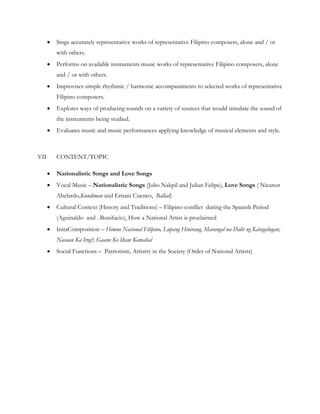
VI        COMPETENCIES/OBJECTIVES
         Analyzes an example of a representative work of Filipino composers, and describes how the
          musical elements are used.
         Explains the distinguishing characteristics of representative a works of Filipino composers,
          in relation to history and culture of the area.
         Analyzes the relationship of functions of representative works of Filipino composers, to the
          lives of the people.
   Sings accurately representative works of representative Filipino composers, alone and / or
          with others.
         Performs on available instruments music works of representative Filipino composers, alone
          and / or with others.
         Improvises simple rhythmic / harmonic accompaniments to selected works of representative
          Filipino composers.
         Explores ways of producing sounds on a variety of sources that would simulate the sound of
          the instruments being studied.
         Evaluates music and music performances applying knowledge of musical elements and style.


VII       CONTENT/TOPIC

         Nationalistic Songs and Love Songs
         Vocal Music – Nationalistic Songs (Julio Nakpil and Julian Felipe), Love Songs ( Nicanor
          Abelardo,Kundiman and Ernani Cuenco, Ballad)
         Cultural Context (History and Traditions) – Filipino conflict during the Spanish Period
          (Aguinaldo and . Bonifacio), How a National Artist is proclaimed
         InitaComposition – Himno Nacional Filipino, Lupang Hinirang, Marangal na Dalit ng Katagalugan;
          Nasaan Ka Irog?, Gaano Ko Ikaw Kamahal
         Social Functions – Patriotism, Artistry in the Society (Order of National Artists)
VIII      PRIOR SKILLS & ASSESSMENT
          Short recitation on Quarter 3’s topics (Music of Mindanao)


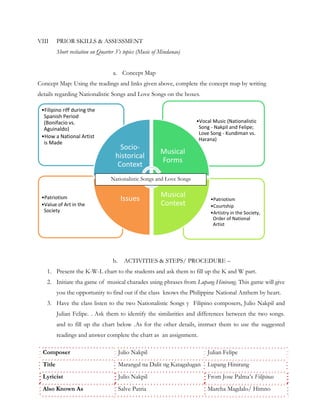
                                    a. Concept Map
Concept Map: Using the readings and links given above, complete the concept map by writing
details regarding Nationalistic Songs and Love Songs on the boxes.

 •Filipino riff during the
  Spanish Period
  (Bonifacio vs.                                                        •Vocal Music (Nationalistic
  Aguinaldo)                                                             Song - Nakpil and Felipe;
                                                                         Love Song - Kundiman vs.
 •How a National Artist                                                  Harana)
  is Made
                                       Socio-
                                                          Musical
                                     historical
                                                          Forms
                                      Context
                                   Nationalistic Songs and Love Songs


 •Patriotism                             Issues           Musical
                                                                              •Patriotism
 •Value of Art in the                                     Context             •Courtship
  Society                                                                     •Artistry in the Society,
                                                                               Order of National
                                                                               Artist


                                    b.     ACTIVITIES & STEPS/ PROCEDURE –
   1. Present the K-W-L chart to the students and ask them to fill up the K and W part.
   2. Initiate tha game of musical charades using phrases from Lupang Hinirang. This game will give
          you the opportunity to find out if the class knows the Philippine National Anthem by heart.
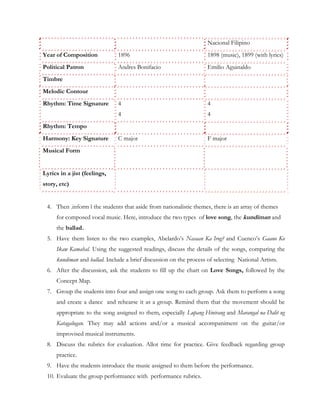
   3. Have the class listen to the two Nationalistic Songs y Filipino composers, Julio Nakpil and
          Julian Felipe. . Ask them to identify the similarities and differences between the two songs.
          and to fill up the chart below .As for the other details, instruct them to use the suggested
          readings and answer complete the chart as an assignment.

  Composer                               Julio Nakpil                        Julian Felipe
  Title                                  Marangal na Dalit ng Katagalugan    Lupang Hinirang
  Lyricist                               Julio Nakpil                        From Jose Palma’s Filipinas
  Also Known As                          Salve Patria                        Marcha Magdalo/ Himno
Nacional Filipino
Year of Composition           1896                                  1898 (music), 1899 (with lyrics)
Political Patron              Andres Bonifacio                      Emilio Aguinaldo
Timbre
Melodic Contour
Rhythm: Time Signature        4                                     4
                              4                                     4
Rhythm: Tempo
Harmony: Key Signature        C major                               F major
Musical Form


Lyrics in a jist (feelings,
story, etc)


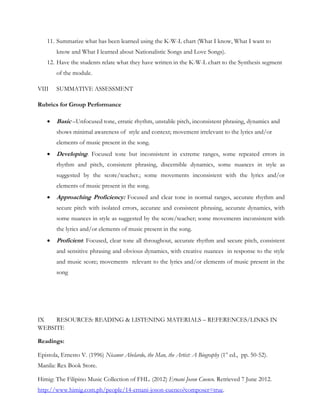
 4. Then .inform l the students that aside from nationalistic themes, there is an array of themes
     for composed vocal music. Here, introduce the two types of love song, the kundiman and
     the ballad.
 5. Have them listen to the two examples, Abelardo’s Nasaan Ka Irog? and Cuenco’s Gaano Ko
     Ikaw Kamahal. Using the suggested readings, discuss the details of the songs, comparing the
     kundiman and ballad. Include a brief discussion on the process of selecting National Artists.
 6. After the discussion, ask the students to fill up the chart on Love Songs, followed by the
     Concept Map.
 7. Group the students into four and assign one song to each group. Ask them to perform a song
     and create a dance and rehearse it as a group. Remind them that the movement should be
     appropriate to the song assigned to them, especially Lupang Hinirang and Marangal na Dalit ng
     Katagalugan. They may add actions and/or a musical accompaniment on the guitar/or
     improvised musical instruments.
 8. Discuss the rubrics for evaluation. Allot time for practice. Give feedback regarding group
     practice.
 9. Have the students introduce the music assigned to them before the performance.
 10. Evaluate the group performance with performance rubrics.
11. Summarize what has been learned using the K-W-L chart (What I know, What I want to
        know and What I learned about Nationalistic Songs and Love Songs).
    12. Have the students relate what they have written in the K-W-L chart to the Synthesis segment
        of the module.

VIII    SUMMATIVE ASSESSMENT

Rubrics for Group Performance

       Basic –Unfocused tone, erratic rhythm, unstable pitch, inconsistent phrasing, dynamics and
        shows minimal awareness of style and context; movement irrelevant to the lyrics and/or
        elements of music present in the song.
       Developing: Focused tone but inconsistent in extreme ranges, some repeated errors in
        rhythm and pitch, consistent phrasing, discernible dynamics, some nuances in style as
        suggested by the score/teacher.; some movements inconsistent with the lyrics and/or
        elements of music present in the song.
       Approaching Proficiency: Focused and clear tone in normal ranges, accurate rhythm and
        secure pitch with isolated errors, accurate and consistent phrasing, accurate dynamics, with
        some nuances in style as suggested by the score/teacher; some movements inconsistent with
        the lyrics and/or elements of music present in the song.
       Proficient: Focused, clear tone all throughout, accurate rhythm and secure pitch, consistent
        and sensitive phrasing and obvious dynamics, with creative nuances in response to the style
        and music score; movements relevant to the lyrics and/or elements of music present in the
        song


IX   RESOURCES: READING & LISTENING MATERIALS – REFERENCES/LINKS IN
WEBSITE

Readings:

Epistola, Ernesto V. (1996) Nicanor Abelardo, the Man, the Artist: A Biography (1st ed., pp. 50-52).
Manila: Rex Book Store.

Himig: The Filipino Music Collection of FHL. (2012) Ernani Joson Cuenco. Retrieved 7 June 2012.
http://www.himig.com.ph/people/14-ernani-joson-cuenco?composer=true.
Lubang, Danalyn T. Tamang Pagkanta ng Pambansang Awit. The Varsitarian. (Vol LXXXi, No. 13).
http://www.varsitarian.net/filipino/20100507/tamang_pagkanta_ng_pambansang_awit. retrieved
on 06/13/2012 - 11:46.

Santos-Viola, Carlos N. Julio Nakpil: A Patriot and a Musician. http://julionakpil.blogspot.com/.

THE NATIONAL ARTISTS OF THE PHILIPPINES. http://www.ncca.gov.ph/about-ncca/org-
awards/org-awards-national-artist-list.php.

THE NATIONAL ARTISTS OF THE PHILIPPINES GUIDELINES.
http://www.ncca.gov.ph/about-ncca/org-awards/org-awards-national-artist-guidelines.php.

Supreme Court E-Library. Executive Orders. [Executive Order No. 236, September 19, 2003]
http://elibrary.judiciary.gov.ph/index10.php?doctype=Executive%20Orders&docid=a45475a11ec72
b843d74959b60fd7bd645fae1093b5c5.

Supreme Court E-Library. Executive Orders. [Executive Order No. 435, June 8, 2005]
http://elibrary.judiciary.gov.ph/index10.php?doctype=Executive%20Orders&docid=f50a99f950ea0
dd2453e89f5c9d6a397455a4894e8228.

Tiongson, Nicanor (Ed.). (1994). CCP Encyclopedia of Philippine Art (Vol. 6: Philippine music). Manila:
Cultural Center of the Philippines.

Recordings:

Kundiman Art Song – Nasaan Ka Irog? – Sylvia La Torre. http://www.youtube.com/watch?v=W8-
NqGJJYkeE.

Lupang Hinirang Ang Pambansang Awit ng Pilipinas. ( ) [CD-ROM]. Philippines: .


X      GLOSSARY OF MUSIC TERMS & SYMBOLS

    1. Himno Nacional Filipino –known presently as Lupang Hinirang, the National Anthem of the
       Philippines, with music by Julian Felipe, originally an instrumental march, known as either
       Marcha Filipina Nacional or Marcha Filipino Magdalo, and lyrics from Jose Palma’s Filipinas, Letra
       Para La Marcha Nacional. This work was commissioned by Emilio Aguinaldo and was played
       during the declaration of Philippine Independence on June 12, 1898.

    2. Marangal na Dalit ng Katagalugan – with music and lyrics written by Julio Nakpil in 1896.
       Nakpil later changed      the title to Salve Patria. This work was commissioned by Andres
Bonifacio, but Emilio Aguinaldo preferred the work of Julian Felipe. It was fist played to
   commemorate the eighth anniversary of Rizal’s execution on December 30, 1904.

3. Kundiman – known as The Philippines’ signature love song; It is an art song in triple time.
   According to Raymundo Bañas, there are three theories on the origin of the kundiman: a
   shortened version of the phrase “kung hindi man”, derived from the verse “Hele hele nang
   kandungan/ Hele hele ng kundiman”, and kundiman, referring to a red cloth worn by male dancers
   or men in the Philippines. Aside from messages of love, it also expressed sentiments of
   nationalism.

4. Nasaan Ka Irog? – a kundiman in slow triple time composed by Nicanor Abelardo in 1923,
   which was inspired by his childhood friend Dr. Francisco Tecson’s personal experience on
   love. The original Spanish was written by Narciso Asistio; the Tagalog lyrics were written by
   Jose Corazon de Jesus. This song has inspired the filming of a 1936 movie, retaining the
   title of the song.

5. Nicanor Santa Ana Abelardo (1893-1934) – He is one of our great composers, pianist, and a
   teacher of composition at the University of the Philippines then Conservatory of Music. His
   140 compositions include kundimans, sarswelas, instrumental works, and UP Beloved, a
   university l hymn which won first prize in an open musical composition contest.

6. Ballad- a narrative song, ranging from indigenous forms to Hispanic-influenced themes. The
   romantic themes of the contemporary ballad or urban popular love songs are closely related
   to the kundiman.

7. Gaano Ko Ikaw Kamahal? – a ballad composed by Ernani Cuenco in 1979, with lyrics by
   Levi Celerio, both National Artists for Music. It was used as a movie theme for a 1980s
   movie with the same title, starring Lito Lapid.

8. Ernani Joson Cuenco (1936-1988) – proclaimed National Artist for Music in 1999; He was an
   award-winning film scorer in the early 1960s, working in collaboration with National Artist
   for Music Levi Celerio. He was also a teacher and a seasoned orchestra player.

9. Order of National Artists – The highest national recognition bestowed upon to Filipino
   artists who have made significant contributions to the development of Philippine arts;
   namely, Music, Dance, Theater, Visual Arts, Literature, Film, Broadcast Arts, and
Architecture and Allied Arts. The order is jointly administered by the National Commission
for Culture and the Arts (NCCA) and the Cultural Center of the Philippines (CCP) and
conferred by the President of the Philippines upon recommendation by both institutions.
(from NCCA Website)

Music grade 7 learner's module (module 1 2) - (q4)

  • 1.
    MUSIC LEARNING MODULES1-2: Composed Vocal Music 1: Nationalistic Songs and Love Songs I TARGET GRADE LEVEL: Grade 7 II MODULES 1-2: Vocal Music 1: Nationalistic Songs and Love Songs III TIME ALLOTMENT: 2 Hours IV OVERVIEW OF THE MODULE The lesson is an introduction to two classifications of Vocal Music composed by Filipinos – the . Nationalistic Songs and Love Songs. The compositions Marangal na Dalit ng Katagalugan by Julio Nakpil and Lupang Hinirang by Julian Felipe ( Nationalistic) , the Kundiman Nasaan Ka Irog ? by Nicanor Abelardo and the ballad Gaano Ko Ikaw Kamahal by Ernani Cuenco ( Love Songs) will complete the musical journey in this module. Throughout the lesson, one will discover how these songs express the beliefs of a nation about patriotism and love and how a nation places a value on artists’ creations. . A group song and dance performance on these four songs culminates the educational experience. V PERFORMANCE STANDARDS  Analyzes musical elements and processes of Philippine music.  Correlates Philippine music to Philippine culture.  Performs examples of Philippine music, alone and with others, in appropriate tone, pitch, rhythm, expression and style. VI COMPETENCIES/OBJECTIVES  Analyzes a representative example of a work by a Filipino composer, and describes how the musical elements are used.  Explains the distinguishing characteristics of representative works by Filipino composers, in relation to history and culture of the area.  Analyzes the relationship of functions of the representative works of Filipino composers to the lives of the people.  Sings accurately representative works of Filipino composers, alone and / or with others.
  • 2.
    Performs on available instruments works of representative Filipino composers, alone and / or with others.  Improvises simple rhythmic / harmonic accompaniments to selected works of representative Filipino composers.  Explores ways of producing sounds on a variety of sources that would simulate the sound of instruments being studied.  Evaluates music and music performances applying knowledge of musical elements and style. VII CONTENT/TOPIC Nationalistic Songs and Love Songs  Vocal Music – Nationalistic Songs (Julio Nakpil and Julian Felipe), Love Songs ( Nicanor Abelardo,Kundiman and Ernani Cuenco, Ballad)  Cultural Context (History and Traditions) – Filipino conflict during the Spanish Period (Aguinaldo and . Bonifacio), How a National Artist is proclaimed  Compositions –Himno Nacional Filipino, Lupang Hinirang, Marangal na Dalit ng Katagalugan; Nasaan Ka Irog?, Gaano Ko Ikaw Kamahal  Social Functions – Patriotism, Artistry in the Society VIII RESOURCES Readings: Epistola, Ernesto V. (1996) Nicanor Abelardo, the Man, the Artist: A Biography (1st ed., pp. 50-52). Manila: Rex Book Store. Himig: The Filipino Music Collection of FHL. (2012) Ernani Joson Cuenco. Retrieved 7 June 2012. http://www.himig.com.ph/people/14-ernani-joson-cuenco?composer=true. Lubang, Danalyn T. Tamang Pagkanta ng Pambansang Awit. The Varsitarian. (Vol LXXXi, No. 13). http://www.varsitarian.net/filipino/20100507/tamang_pagkanta_ng_pambansang_awit. retrieved on 06/13/2012 - 11:46. Santos-Viola, Carlos N. Julio Nakpil: A Patriot and a Musician. http://julionakpil.blogspot.com/. THE NATIONAL ARTISTS OF THE PHILIPPINES. http://www.ncca.gov.ph/about-ncca/org- awards/org-awards-national-artist-list.php.
  • 3.
    THE NATIONAL ARTISTSOF THE PHILIPPINES GUIDELINES. http://www.ncca.gov.ph/about-ncca/org-awards/org-awards-national-artist-guidelines.php. Supreme Court E-Library. Executive Orders. [Executive Order No. 236, September 19, 2003] http://elibrary.judiciary.gov.ph/index10.php?doctype=Executive%20Orders&docid=a45475a11ec72 b843d74959b60fd7bd645fae1093b5c5. Supreme Court E-Library. Executive Orders. [Executive Order No. 435, June 8, 2005] http://elibrary.judiciary.gov.ph/index10.php?doctype=Executive%20Orders&docid=f50a99f950ea0 dd2453e89f5c9d6a397455a4894e8228. Tiongson, Nicanor (Ed.). (1994). CCP Encyclopedia of Philippine Art (Vol. 6: Philippine Music). Manila: Cultural Center of the Philippines. Recordings: Kundiman Art Song – Nasaan Ka Irog? – Sylvia La Torre. http://www.youtube.com/watch?v=W8- NqGJJYkeE. Lupang Hinirang Ang Pambansang Awit ng Pilipinas. ( ) [CD-ROM]. Philippines: . IX ACTIVITIES Philippine __________ Anthem: Musical Charades Form two teams for the musical charades. Your teacher will give to each team strips of paper containing phrases from Lupang Hinirang. To get a point, the team must sing the phrase, with correct lyrics and correct melody. The first team to get 5 correct performances wins incentive points. (SUBJECT for APPROVAL) K-W-L Chart: Write what you currently know about Nationalistic Songs and Love Songs under column 1 and what you want to know about Nationalistic Songs and Love Songs under column 2. Nationalistic Song and Love Songs What I want to What I've What I Know Know learned
  • 4.
    Concept Map: Withthe help of the readings and links given above, complete the concept map by writing details regarding Nationalistic Songs and Love Songs.. Socio- Musical historical Forms Context Nationalistic Songs and Love Songs Musical Issues Context Nationalistic Songs: Julio Nakpil and Julian Felipe. Julian PERMISSION NEEDED: source: http://www.oocities.org/valkyrie47no/Images/jn1.gif, http://3.bp.blogspot.com/_FFKau- MIe2I/TUNAF1zzDHI/AAAAAAAACfA/Y_k6YS3Ti78/s320/Julian+Felipe%252C+the+anthem+composer%252C+with+Jose+Palma..jpg With the help of the suggested readings, complete the chart below with information on the two Nationalistic songs discussed in class. As for the musical elements part, listen to the songs before filling up the chart. .
  • 5.
    Composer Julio Nakpil Julian Felipe Title Marangal na Dalit ng Katagalugan Lupang Hinirang Lyricist Also Known As Year of Composition Political Patron Timbre Melodic Contour Rhythm: Time Signature Rhythm: Tempo Harmony: Key Signature Musical Form Lyrics in a jist (feelings, story, etc)
  • 6.
    Love Songs Withthe help of the suggested readings, complete the e chart below with information on the two Love Songs discussed in class. As for the musical elements part, listen to the songs before filling up the chart. Composer Nicanor Abelardo Ernani Cuenco Title Lyricist Date of Composition National Artist? Timbre: Feeling Evoked by the Musical Color Melodic Contour Rhythm: Time Signature Rhythm: Tempo Basic Rhythmic Pattern (clue: accompaniment) Harmony: Key Signature Modulation? Musical Form Lyrics in a jist (feelings, story, etc) Did you know that...? To be declared a National Artist, he/she should be a living Filipino citizen and artist at the time of nomination or has passed away as a Filipino citizen after establishment of the award in 1972.
  • 7.
    Guide Questions forMusic Listening: These four songs are but a few examples of the works of our great Filipino composers . Your teacher will assign one song to your group. The following questions will guide you in listening. a. What is the function of the music? What do you think is the message of the music? b. How were the varied musical elements (timbre, dynamics, rhythm, pitch, form) used in bringing about the message of the music? For more information, you may go to the Filipinas Heritage Library: LIBRARY HOURS Tuesday - Saturday (9 am-6 pm) Makati Avenue, Ayala Triangle Makati City, Philippines 1224 Trunkline: (632) 8921801 Fax: (632) 8921810 fhl_inquiry@filipinaslibrary.org.ph or you may access online: http://www.filipinaslibrary.org.ph/ Group Activity Create a song and dance performance of the song assigned to your group. The performance should incorporate singing and movement. Chordal and/or rhythmic accompaniment is encouraged.
  • 8.
    X ASSESSMENT Rubrics for Group Performance Basic –Unfocused tone, erratic rhythm, unstable pitch, inconsistent phrasing, dynamics and shows minimal awareness of style and context; movement irrelevant to the lyrics and/or elements of music present in the song. Developing: Focused tone but inconsistent in extreme ranges, some repeated errors in rhythm and pitch, consistent phrasing, discernible dynamics, some nuances in style as suggested by the score/teacher.; some movements inconsistent with the lyrics and/or elements of music present in the song. Approaching Proficiency: Focused and clear tone in normal ranges, accurate rhythm and secure pitch with isolated errors, accurate and consistent phrasing, accurate dynamics, with some nuances in style as suggested by the score/teacher; some movements inconsistent with the lyrics and/or elements of music present in the song. Proficient: Focused, clear tone all throughout, accurate rhythm and secure pitch, consistent and sensitive phrasing and obvious dynamics, with creative nuances in response to the style and music score; movements relevant to the lyrics and/or elements of music present in the song XI SYNTHESIS Among the numerous composed vocal music of the Philippines, the two themes on : nationalism and love are predominant.. The two representative nationalistic songs discussed throughout the lesson, Marangal na Dalit ng Katagalugan (Nakpil) and Lupang Hinirang (Felipe), played very important roles in our history, being iconic representations of our nation’s love of freedom, at this point in time, from the Spanish regime. On the other hand, Nasaan Ka Irog ? (Abelardo) Gaano Ko Ikaw Kamahal ? (Cuenco) are our artists’ creative expressions of love which are valued in our Philippine culture and heritage..
  • 9.
    MUSIC TEACHING GUIDES1-2: Composed Vocal Music 1: Nationalistic Songs and Love Songs I TARGET GRADE LEVEL: Grade 7 II MODULES 1-2: Nationalistic Songs and Love Songs III TIME ALLOTMENT: 2 Hours IV OVERVIEW OF THE MODULE The module is an introduction to two classifications of Vocal Music composed by Filipinos – the . Nationalistic Songs and Love Songs. The compositions Marangal na Dalit ng Katagalugan by Julio Nakpil and Lupang Hinirang by Julian Felipe ( Nationalistic) , the Kundiman Nasaan Ka Irog ? by Nicanor Abelardo and the ballad Gaano Ko Ikaw Kamahal by Ernani Cuenco ( Love Songs) will complete the musical journey in this module. Throughout the lesson, one will discover how these songs express the beliefs of a nation about patriotism and love and how a nation places a value on artists’ creations. . A group song and dance performance on these four songs culminates the educational experience. V PERFORMANCE STANDARDS  Analyzes musical elements and processes of Philippine music.  Correlates Philippine music to Philippine culture.  Performs examples of Philippine music, alone and with others, in appropriate tone, pitch, rhythm, expression and style. VI COMPETENCIES/OBJECTIVES  Analyzes an example of a representative work of Filipino composers, and describes how the musical elements are used.  Explains the distinguishing characteristics of representative a works of Filipino composers, in relation to history and culture of the area.  Analyzes the relationship of functions of representative works of Filipino composers, to the lives of the people.
  • 10.
    Sings accurately representative works of representative Filipino composers, alone and / or with others.  Performs on available instruments music works of representative Filipino composers, alone and / or with others.  Improvises simple rhythmic / harmonic accompaniments to selected works of representative Filipino composers.  Explores ways of producing sounds on a variety of sources that would simulate the sound of the instruments being studied.  Evaluates music and music performances applying knowledge of musical elements and style. VII CONTENT/TOPIC  Nationalistic Songs and Love Songs  Vocal Music – Nationalistic Songs (Julio Nakpil and Julian Felipe), Love Songs ( Nicanor Abelardo,Kundiman and Ernani Cuenco, Ballad)  Cultural Context (History and Traditions) – Filipino conflict during the Spanish Period (Aguinaldo and . Bonifacio), How a National Artist is proclaimed  InitaComposition – Himno Nacional Filipino, Lupang Hinirang, Marangal na Dalit ng Katagalugan; Nasaan Ka Irog?, Gaano Ko Ikaw Kamahal  Social Functions – Patriotism, Artistry in the Society (Order of National Artists)
  • 11.
    VIII PRIOR SKILLS & ASSESSMENT Short recitation on Quarter 3’s topics (Music of Mindanao) a. Concept Map Concept Map: Using the readings and links given above, complete the concept map by writing details regarding Nationalistic Songs and Love Songs on the boxes. •Filipino riff during the Spanish Period (Bonifacio vs. •Vocal Music (Nationalistic Aguinaldo) Song - Nakpil and Felipe; Love Song - Kundiman vs. •How a National Artist Harana) is Made Socio- Musical historical Forms Context Nationalistic Songs and Love Songs •Patriotism Issues Musical •Patriotism •Value of Art in the Context •Courtship Society •Artistry in the Society, Order of National Artist b. ACTIVITIES & STEPS/ PROCEDURE – 1. Present the K-W-L chart to the students and ask them to fill up the K and W part. 2. Initiate tha game of musical charades using phrases from Lupang Hinirang. This game will give you the opportunity to find out if the class knows the Philippine National Anthem by heart. 3. Have the class listen to the two Nationalistic Songs y Filipino composers, Julio Nakpil and Julian Felipe. . Ask them to identify the similarities and differences between the two songs. and to fill up the chart below .As for the other details, instruct them to use the suggested readings and answer complete the chart as an assignment. Composer Julio Nakpil Julian Felipe Title Marangal na Dalit ng Katagalugan Lupang Hinirang Lyricist Julio Nakpil From Jose Palma’s Filipinas Also Known As Salve Patria Marcha Magdalo/ Himno
  • 12.
    Nacional Filipino Year ofComposition 1896 1898 (music), 1899 (with lyrics) Political Patron Andres Bonifacio Emilio Aguinaldo Timbre Melodic Contour Rhythm: Time Signature 4 4 4 4 Rhythm: Tempo Harmony: Key Signature C major F major Musical Form Lyrics in a jist (feelings, story, etc) 4. Then .inform l the students that aside from nationalistic themes, there is an array of themes for composed vocal music. Here, introduce the two types of love song, the kundiman and the ballad. 5. Have them listen to the two examples, Abelardo’s Nasaan Ka Irog? and Cuenco’s Gaano Ko Ikaw Kamahal. Using the suggested readings, discuss the details of the songs, comparing the kundiman and ballad. Include a brief discussion on the process of selecting National Artists. 6. After the discussion, ask the students to fill up the chart on Love Songs, followed by the Concept Map. 7. Group the students into four and assign one song to each group. Ask them to perform a song and create a dance and rehearse it as a group. Remind them that the movement should be appropriate to the song assigned to them, especially Lupang Hinirang and Marangal na Dalit ng Katagalugan. They may add actions and/or a musical accompaniment on the guitar/or improvised musical instruments. 8. Discuss the rubrics for evaluation. Allot time for practice. Give feedback regarding group practice. 9. Have the students introduce the music assigned to them before the performance. 10. Evaluate the group performance with performance rubrics.
  • 13.
    11. Summarize whathas been learned using the K-W-L chart (What I know, What I want to know and What I learned about Nationalistic Songs and Love Songs). 12. Have the students relate what they have written in the K-W-L chart to the Synthesis segment of the module. VIII SUMMATIVE ASSESSMENT Rubrics for Group Performance  Basic –Unfocused tone, erratic rhythm, unstable pitch, inconsistent phrasing, dynamics and shows minimal awareness of style and context; movement irrelevant to the lyrics and/or elements of music present in the song.  Developing: Focused tone but inconsistent in extreme ranges, some repeated errors in rhythm and pitch, consistent phrasing, discernible dynamics, some nuances in style as suggested by the score/teacher.; some movements inconsistent with the lyrics and/or elements of music present in the song.  Approaching Proficiency: Focused and clear tone in normal ranges, accurate rhythm and secure pitch with isolated errors, accurate and consistent phrasing, accurate dynamics, with some nuances in style as suggested by the score/teacher; some movements inconsistent with the lyrics and/or elements of music present in the song.  Proficient: Focused, clear tone all throughout, accurate rhythm and secure pitch, consistent and sensitive phrasing and obvious dynamics, with creative nuances in response to the style and music score; movements relevant to the lyrics and/or elements of music present in the song IX RESOURCES: READING & LISTENING MATERIALS – REFERENCES/LINKS IN WEBSITE Readings: Epistola, Ernesto V. (1996) Nicanor Abelardo, the Man, the Artist: A Biography (1st ed., pp. 50-52). Manila: Rex Book Store. Himig: The Filipino Music Collection of FHL. (2012) Ernani Joson Cuenco. Retrieved 7 June 2012. http://www.himig.com.ph/people/14-ernani-joson-cuenco?composer=true.
  • 14.
    Lubang, Danalyn T.Tamang Pagkanta ng Pambansang Awit. The Varsitarian. (Vol LXXXi, No. 13). http://www.varsitarian.net/filipino/20100507/tamang_pagkanta_ng_pambansang_awit. retrieved on 06/13/2012 - 11:46. Santos-Viola, Carlos N. Julio Nakpil: A Patriot and a Musician. http://julionakpil.blogspot.com/. THE NATIONAL ARTISTS OF THE PHILIPPINES. http://www.ncca.gov.ph/about-ncca/org- awards/org-awards-national-artist-list.php. THE NATIONAL ARTISTS OF THE PHILIPPINES GUIDELINES. http://www.ncca.gov.ph/about-ncca/org-awards/org-awards-national-artist-guidelines.php. Supreme Court E-Library. Executive Orders. [Executive Order No. 236, September 19, 2003] http://elibrary.judiciary.gov.ph/index10.php?doctype=Executive%20Orders&docid=a45475a11ec72 b843d74959b60fd7bd645fae1093b5c5. Supreme Court E-Library. Executive Orders. [Executive Order No. 435, June 8, 2005] http://elibrary.judiciary.gov.ph/index10.php?doctype=Executive%20Orders&docid=f50a99f950ea0 dd2453e89f5c9d6a397455a4894e8228. Tiongson, Nicanor (Ed.). (1994). CCP Encyclopedia of Philippine Art (Vol. 6: Philippine music). Manila: Cultural Center of the Philippines. Recordings: Kundiman Art Song – Nasaan Ka Irog? – Sylvia La Torre. http://www.youtube.com/watch?v=W8- NqGJJYkeE. Lupang Hinirang Ang Pambansang Awit ng Pilipinas. ( ) [CD-ROM]. Philippines: . X GLOSSARY OF MUSIC TERMS & SYMBOLS 1. Himno Nacional Filipino –known presently as Lupang Hinirang, the National Anthem of the Philippines, with music by Julian Felipe, originally an instrumental march, known as either Marcha Filipina Nacional or Marcha Filipino Magdalo, and lyrics from Jose Palma’s Filipinas, Letra Para La Marcha Nacional. This work was commissioned by Emilio Aguinaldo and was played during the declaration of Philippine Independence on June 12, 1898. 2. Marangal na Dalit ng Katagalugan – with music and lyrics written by Julio Nakpil in 1896. Nakpil later changed the title to Salve Patria. This work was commissioned by Andres
  • 15.
    Bonifacio, but EmilioAguinaldo preferred the work of Julian Felipe. It was fist played to commemorate the eighth anniversary of Rizal’s execution on December 30, 1904. 3. Kundiman – known as The Philippines’ signature love song; It is an art song in triple time. According to Raymundo Bañas, there are three theories on the origin of the kundiman: a shortened version of the phrase “kung hindi man”, derived from the verse “Hele hele nang kandungan/ Hele hele ng kundiman”, and kundiman, referring to a red cloth worn by male dancers or men in the Philippines. Aside from messages of love, it also expressed sentiments of nationalism. 4. Nasaan Ka Irog? – a kundiman in slow triple time composed by Nicanor Abelardo in 1923, which was inspired by his childhood friend Dr. Francisco Tecson’s personal experience on love. The original Spanish was written by Narciso Asistio; the Tagalog lyrics were written by Jose Corazon de Jesus. This song has inspired the filming of a 1936 movie, retaining the title of the song. 5. Nicanor Santa Ana Abelardo (1893-1934) – He is one of our great composers, pianist, and a teacher of composition at the University of the Philippines then Conservatory of Music. His 140 compositions include kundimans, sarswelas, instrumental works, and UP Beloved, a university l hymn which won first prize in an open musical composition contest. 6. Ballad- a narrative song, ranging from indigenous forms to Hispanic-influenced themes. The romantic themes of the contemporary ballad or urban popular love songs are closely related to the kundiman. 7. Gaano Ko Ikaw Kamahal? – a ballad composed by Ernani Cuenco in 1979, with lyrics by Levi Celerio, both National Artists for Music. It was used as a movie theme for a 1980s movie with the same title, starring Lito Lapid. 8. Ernani Joson Cuenco (1936-1988) – proclaimed National Artist for Music in 1999; He was an award-winning film scorer in the early 1960s, working in collaboration with National Artist for Music Levi Celerio. He was also a teacher and a seasoned orchestra player. 9. Order of National Artists – The highest national recognition bestowed upon to Filipino artists who have made significant contributions to the development of Philippine arts; namely, Music, Dance, Theater, Visual Arts, Literature, Film, Broadcast Arts, and
  • 16.
    Architecture and AlliedArts. The order is jointly administered by the National Commission for Culture and the Arts (NCCA) and the Cultural Center of the Philippines (CCP) and conferred by the President of the Philippines upon recommendation by both institutions. (from NCCA Website)