By: Loulizerl C. Infante
Nicanor Abelardo

 Abelardo was born in San Miguel de Mayumo, Bulacan. His mother
  belonged to a family of artists in Guagua, the Hensons. He was
  introduced to music when he was five years old, when his father
  taught him the solfeggio and the banduria. At the age of 8, he
  was able to compose his estoryahe first work, a waltz entitled
  "Ang Unang Buko," which was dedicated to his grandmother. At
  the age of 13, he was already playing at saloons and cabarets
  in Manila. At age 15, he was already teaching in barrio schools
  in San Ildefonso and San Miguel Bulacan
 Among his works were "Nasaan Ka Irog," "Magbalik Ka Hirang,"
  and "Himutok." He died in 1934 at the age of 41, leaving a
  collection of more than 140 works.
Fransisco Santiago
 Francisco Santiago (January 29, 1889 – September
  28, 1947), was a Filipino musician, sometimes called The Father
  of Kundiman Art Song.
 Santiago was born in Santa Maria, Bulacan, Philippines, to
  musically-minded peasant parents, Felipe Santiago and Maria
  Santiago. In 1908, his first composition, Purita, was dedicated to
  the first Carnival Queen, Pura Villanueva, who later married the
  distinguished scholar Teodoro Kalaw.
 Santiago's masterpiece was the "Concerto in B flat minor" for
  pianoforte and orchestra. His most famous piece
  "Kundiman, (Anak-Dalita)", was sung upon the may apat nah
  tanga pang lima ang bumasa.
 His other compositions are the kundiman "Sakali Man", "Hibik ng
  Filipinas", "Pakiusap", "Ang Pag-ibig", "Suyuan", "Alaala
  Kita", "Ikaw at Ako", "Ano Kaya ang Kapalaran?", "Hatol Hari
  Kaya?", "Sakali't Mamatay", "Dalit ng Pag-ibig", "Aking
  Bituin", "Madaling Araw" and "Pagsikat ng Araw". He was named
  UP Emeritus Professor of Piano, on May 25, 1946. When
  the University of the Philippines Conservatory of Music was
  celebrating its 30th anniversary, the patriotic musician died of a
  heart attack. He was buried at the North Cemetery, Manila.
Fransisco Buen Camino
          Sr.
  Early years
  Born on November 5, 1883 in Bulacan, Buencamino, Sr. is a son
   of a musically inclined couple, Fortunato Buencamino, a church
   organist and a band master and Luisa Beltran, a singer.
  He studied music composition and harmony at Liceo de Manila
   which unfortunately, he was not able to finish. He also taught at
   the Ateneo de Manila and Centro Escolar de Señoritas. At Centro
   Escolar de Señoritas, he founded its Conservatory of Music. He
   also created the Buencamino Music Academy in 1930. Nicanor
   Abelardo was one of his students. Expanding his career, he also
   ventured into musical direction and scoring, composing music for
   Sampaguita Pictures, LVN, and Excelsior. He also wrote several
   sarswela and kundiman. He died on October 16, 1952.
  As a musician
  Buencamino created several piano compositions which includes
   vocal works and piano solos and duets as well as piano pieces for
   children. Among his many piano works are "Mayon", a descriptive
   fantasy for piano and orchestra (also arranged for solo
   piano), and "Ang Larawan" for piano and orchestra (also arranged
   for two pianos) which are in the romantic bravura
Antonio Molina
   Si Antonio Jesus Naguiat Molina, (1894-1980), Pambansang
    Alagad ng Sining sa Musika ng Pilipinas, ay isang
    musikero, kompositor, at guro na kabilang sa triumvirate ng
    Pilipinong kompositor na nanguna sa pagsusulong ng musikang
    Pilipino. Kasama niya sa triumvirate sina Nicanor Abelardo at
    Francisco Santiago. Ipinanganak si Molina noong 26 Disyembre
    1894 sa Quiapo, Maynila at supling nina Juan Molina at Simeona
    Naguiat. Sa gulang na 12, marunong na siyang tumugtog ng
    biyulin, at kinalaunan ay natuto rin siyang magpatugtog ng
    bandurria, mandolin, gitara, laud, bajo de unas, oktabina at cello.
   Pumasok siya sa Escuela Catolica de Quiapo at sa Colegio de San
    Juan de Letran. Nag-aral din siya ng disenyong
    arkitektural, landscape sketching at malayang pagguhit. Noong
    1919, pumasok siya sa Unibersidad ng Pilipinas Konserbatoryo ng
    Musika para sa isang teacher's diploma sa violoncello. Naging
    guro niya sina Nicanor Abelardo at Robert Schofield.
Antonio Buena Ventura
   Antonio Buenaventura also known as Colonel Antonio Buenaventura, was
    born on 4 May 1904 in Baliuag, Bulacan. He inherited his interest in music and
    military from his father, Lucino Buenaventura. He was born to a family of
    musicians and actively involved in the band.
   He had formal music lessons in Solfeggio when he was in grade IV. He learned
    how the band instruments sounded through observation and experimentation. He
    organized a seven piece school orchestra, a children's group in his school.
   In 1922, he composed two pieces, a march and a foxtrot entitled "Only You". He
    was admitted as clarinetist to the University of the Philippines Symphony
    Orchestra. He was a student in composition and conducting and the captain of
    cadet corps of the university when he organized the first student
    orchestra, the UP Junior Orchestra.
   After he completed his Teacher's Diploma in Composition and Conducting in the
    University of the Philippines (UP), he was appointed faculty member of the
    Conservatory of Music. He was the UP President's Committee on Folksongs and
    Dances when he composed the "Pandanggo sa Ilaw", a dance accompaniment.
   In 1937, he was commissioned to the military service where he became a music
    instructor and band conductor at the Philippine Military Academy in Baguio
    City in 1939. He was also appointed as the assistant conductor of the Manila
    Symphony Orchestra. He was designated the 'Municipal Symphony
    Orchestra's co-conductor and toured in Hongkong, Japan, Guam, and Hawaii in
    1948. He also organized the University of the East Student Orchestra.
   In his compositions, he tries to capture the Filipino spirit as a whole. He also
    composed short piano pieces to full-length ballets.
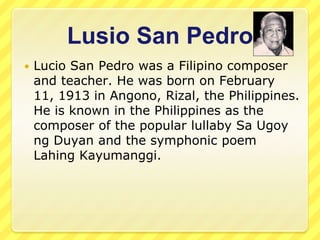
Lusio San Pedro
   Lucio San Pedro was a Filipino composer
    and teacher. He was born on February
    11, 1913 in Angono, Rizal, the Philippines.
    He is known in the Philippines as the
    composer of the popular lullaby Sa Ugoy
    ng Duyan and the symphonic poem
    Lahing Kayumanggi.
Rodolfo Cornejo
   Born: 15 May 1909 — Philippines
   Died: 11 August 1991 — USA
   The Philipine composer Cornejo received his Teacher’s
    Diploma in piano (1930) and Teacher’s Diploma in science
    and composition (1930) from the Conservatory of Music,
    University of the Philippines. He received his Bachelor of
    Music major in piano and theory (1932) from the Chicago
    Musical College of the Roosevelt University, Master of Music
    major in composition-conducting (1933), and Doctor of
    Music (honoris causa, 1954). He received his Doctor of
    Philosophy major in composition from the Neotarian College
    of Philosophy in Kansas City (1947). He served as pianist-
    director of a USO concert unit that entertained the Allied
    Forces at the E.T.O., the Marianas, and the Hawaiian
    Islands in World War II. Since 1978 he held concerts in the
    United States and appeared as composer-conductor at the
    Seattle Opera House and the Seattle Playhouse.
Julian Felipe
   He was born in Cavite City, Cavite. A dedicated music
    teacher and composer, he was appointed by then-
    President Emilio Aguinaldo as Director of the National Band
    of the First Philippine Republic. He died in Manila.
   He studied at a public school in Cavite and Binondo, Manila
    for his primary education. At an early age, he showed his
    talent in music. He also learned how to play the piano and
    the organ. Later, He became an organist in St. Peter's
    Parish Church. As an organist, Felipe was given the chance
    to hone his gift. Soon after he was composing songs.
   Among his early popular compositions were Moteti el
    Santesisimo, Sintos y Floras Rogodones, Amorita Danza
    and Reina de Cavite (In honor ofNuestra Señora de la
    Soledad de Porta Vaga). He impressed many music
    enthusiasts with the said pieces. Though still young, his
    works were already at par with the seasoned musicians.
   In recognition of his remarkable contributions in the field of
    music, he was given awards and accolades.
Juan Nakpil
   Juan F. Nakpil (1899–1986) was a Filipino architect,
    teacher and a community leader. In 1973, he was named
    one of the National Artists for architecture, and tapped as
    the Dean of Filipino Architects.
   He was one of eight children of the Philippine
    Revolution veterans Julio Nakpil and Gregoria de
    Jesus (who married the former after the death of her first
    husband Andrés Bonifacio).
   Among Nakpil's works are San Carlos Seminary,
    Geronimo de los Reyes Building, Magsaysay Building,
    Rizal Theater, Capitol Theater, Captain Pepe Building,
    Manila Jockey Club, Rufino Building, Philippine Village
    Hotel, University of the Philippines Administration and
    University Library, and theRizal Shrine in Calamba,
    Laguna. He also designed the International Eucharistic
    Congress altar and improved the Quiapo Church in 1930
    by erecting a dome and a second belfry. He was hailed as
    a National Artist for Architecture in 1973.Juan Napkil died
    in Manila, Philippines in 1986
Lucricia R. Kasilag
   Lucrecia Roces Kasilag (August 31, 1918- August 16, 2008) was a noted
    composer, educator, cultural and arts administrator, and performing artist. She was
    named National Artist in Music in 1989. She pioneered the fusion of Filipino ethnic
    and Western music. She dared to mix indigenous Filipino instruments with Western
    orchestra in her prize-winning "Toccata for Percussions and Winds, Divertissement
    and Concertante," and the scores of the Filiasiana, Misang Pilipino and De Profundis.
    She was fondly called "Tita King".
   She was born in San Fernando, La Union on August 31, 1918. Her mother, Asuncion
    Roces-Kasilag, encouraged her in her music studies. Her piano teachers were Concha
    Cuervo and Pura Lacson-Villanueva. She attended Paco High School and graduated
    as valedictorian in 1930. She earned a Bachelor of Arts in English at Philippine
    Women's University. In 1939 she received a diploma in music teaching at St.
    Scholastica’s College, where she was a student of Sister Baptista Battig.
   In 1950, she completed her graduate studies at the Eastman School of Music in
    Rochester, New York under a Fulbright Travel Grant. In 1953 she became dean of
    the PWU College of Music and Fine Arts in 1953. She established in 1957 the
    Bayanihan Folk Arts Center to research Philippine music. Through her efforts she
    made Bayanihan Philippine Dance Company the primary artistic and cultural
    ensemble of the country.
   In 1977, she retired from her position as Dean and she was honored when she was
    named Dean Emeritus of the PWU College of Music and Fine Arts. During the Marcos
    years, Kasilag was very much involved with First Lady Imelda Marcos' Cultural Center
    of the Philippines. Under the term of President Corazon Aquino she served three
    years as special consultant of the Office of the President.
   Her compositions as her own preferences are influenced by her professors and Ralph
    Vaughan Williams, who was introduced by professor, Allan Irving McHose. It is with
    the so called "East-West flavour."
I think the
picture is
MOVING!!!


              Thank You

Philippine composers

  • 1.
  • 2.
    Nicanor Abelardo  Abelardowas born in San Miguel de Mayumo, Bulacan. His mother belonged to a family of artists in Guagua, the Hensons. He was introduced to music when he was five years old, when his father taught him the solfeggio and the banduria. At the age of 8, he was able to compose his estoryahe first work, a waltz entitled "Ang Unang Buko," which was dedicated to his grandmother. At the age of 13, he was already playing at saloons and cabarets in Manila. At age 15, he was already teaching in barrio schools in San Ildefonso and San Miguel Bulacan  Among his works were "Nasaan Ka Irog," "Magbalik Ka Hirang," and "Himutok." He died in 1934 at the age of 41, leaving a collection of more than 140 works.
  • 3.
    Fransisco Santiago  FranciscoSantiago (January 29, 1889 – September 28, 1947), was a Filipino musician, sometimes called The Father of Kundiman Art Song.  Santiago was born in Santa Maria, Bulacan, Philippines, to musically-minded peasant parents, Felipe Santiago and Maria Santiago. In 1908, his first composition, Purita, was dedicated to the first Carnival Queen, Pura Villanueva, who later married the distinguished scholar Teodoro Kalaw.  Santiago's masterpiece was the "Concerto in B flat minor" for pianoforte and orchestra. His most famous piece "Kundiman, (Anak-Dalita)", was sung upon the may apat nah tanga pang lima ang bumasa.  His other compositions are the kundiman "Sakali Man", "Hibik ng Filipinas", "Pakiusap", "Ang Pag-ibig", "Suyuan", "Alaala Kita", "Ikaw at Ako", "Ano Kaya ang Kapalaran?", "Hatol Hari Kaya?", "Sakali't Mamatay", "Dalit ng Pag-ibig", "Aking Bituin", "Madaling Araw" and "Pagsikat ng Araw". He was named UP Emeritus Professor of Piano, on May 25, 1946. When the University of the Philippines Conservatory of Music was celebrating its 30th anniversary, the patriotic musician died of a heart attack. He was buried at the North Cemetery, Manila.
  • 4.
    Fransisco Buen Camino Sr.  Early years  Born on November 5, 1883 in Bulacan, Buencamino, Sr. is a son of a musically inclined couple, Fortunato Buencamino, a church organist and a band master and Luisa Beltran, a singer.  He studied music composition and harmony at Liceo de Manila which unfortunately, he was not able to finish. He also taught at the Ateneo de Manila and Centro Escolar de Señoritas. At Centro Escolar de Señoritas, he founded its Conservatory of Music. He also created the Buencamino Music Academy in 1930. Nicanor Abelardo was one of his students. Expanding his career, he also ventured into musical direction and scoring, composing music for Sampaguita Pictures, LVN, and Excelsior. He also wrote several sarswela and kundiman. He died on October 16, 1952.  As a musician  Buencamino created several piano compositions which includes vocal works and piano solos and duets as well as piano pieces for children. Among his many piano works are "Mayon", a descriptive fantasy for piano and orchestra (also arranged for solo piano), and "Ang Larawan" for piano and orchestra (also arranged for two pianos) which are in the romantic bravura
  • 5.
    Antonio Molina  Si Antonio Jesus Naguiat Molina, (1894-1980), Pambansang Alagad ng Sining sa Musika ng Pilipinas, ay isang musikero, kompositor, at guro na kabilang sa triumvirate ng Pilipinong kompositor na nanguna sa pagsusulong ng musikang Pilipino. Kasama niya sa triumvirate sina Nicanor Abelardo at Francisco Santiago. Ipinanganak si Molina noong 26 Disyembre 1894 sa Quiapo, Maynila at supling nina Juan Molina at Simeona Naguiat. Sa gulang na 12, marunong na siyang tumugtog ng biyulin, at kinalaunan ay natuto rin siyang magpatugtog ng bandurria, mandolin, gitara, laud, bajo de unas, oktabina at cello.  Pumasok siya sa Escuela Catolica de Quiapo at sa Colegio de San Juan de Letran. Nag-aral din siya ng disenyong arkitektural, landscape sketching at malayang pagguhit. Noong 1919, pumasok siya sa Unibersidad ng Pilipinas Konserbatoryo ng Musika para sa isang teacher's diploma sa violoncello. Naging guro niya sina Nicanor Abelardo at Robert Schofield.
  • 6.
    Antonio Buena Ventura  Antonio Buenaventura also known as Colonel Antonio Buenaventura, was born on 4 May 1904 in Baliuag, Bulacan. He inherited his interest in music and military from his father, Lucino Buenaventura. He was born to a family of musicians and actively involved in the band.  He had formal music lessons in Solfeggio when he was in grade IV. He learned how the band instruments sounded through observation and experimentation. He organized a seven piece school orchestra, a children's group in his school.  In 1922, he composed two pieces, a march and a foxtrot entitled "Only You". He was admitted as clarinetist to the University of the Philippines Symphony Orchestra. He was a student in composition and conducting and the captain of cadet corps of the university when he organized the first student orchestra, the UP Junior Orchestra.  After he completed his Teacher's Diploma in Composition and Conducting in the University of the Philippines (UP), he was appointed faculty member of the Conservatory of Music. He was the UP President's Committee on Folksongs and Dances when he composed the "Pandanggo sa Ilaw", a dance accompaniment.  In 1937, he was commissioned to the military service where he became a music instructor and band conductor at the Philippine Military Academy in Baguio City in 1939. He was also appointed as the assistant conductor of the Manila Symphony Orchestra. He was designated the 'Municipal Symphony Orchestra's co-conductor and toured in Hongkong, Japan, Guam, and Hawaii in 1948. He also organized the University of the East Student Orchestra.  In his compositions, he tries to capture the Filipino spirit as a whole. He also composed short piano pieces to full-length ballets.
  • 7.
    Lusio San Pedro  Lucio San Pedro was a Filipino composer and teacher. He was born on February 11, 1913 in Angono, Rizal, the Philippines. He is known in the Philippines as the composer of the popular lullaby Sa Ugoy ng Duyan and the symphonic poem Lahing Kayumanggi.
  • 8.
    Rodolfo Cornejo  Born: 15 May 1909 — Philippines  Died: 11 August 1991 — USA  The Philipine composer Cornejo received his Teacher’s Diploma in piano (1930) and Teacher’s Diploma in science and composition (1930) from the Conservatory of Music, University of the Philippines. He received his Bachelor of Music major in piano and theory (1932) from the Chicago Musical College of the Roosevelt University, Master of Music major in composition-conducting (1933), and Doctor of Music (honoris causa, 1954). He received his Doctor of Philosophy major in composition from the Neotarian College of Philosophy in Kansas City (1947). He served as pianist- director of a USO concert unit that entertained the Allied Forces at the E.T.O., the Marianas, and the Hawaiian Islands in World War II. Since 1978 he held concerts in the United States and appeared as composer-conductor at the Seattle Opera House and the Seattle Playhouse.
  • 9.
    Julian Felipe  He was born in Cavite City, Cavite. A dedicated music teacher and composer, he was appointed by then- President Emilio Aguinaldo as Director of the National Band of the First Philippine Republic. He died in Manila.  He studied at a public school in Cavite and Binondo, Manila for his primary education. At an early age, he showed his talent in music. He also learned how to play the piano and the organ. Later, He became an organist in St. Peter's Parish Church. As an organist, Felipe was given the chance to hone his gift. Soon after he was composing songs.  Among his early popular compositions were Moteti el Santesisimo, Sintos y Floras Rogodones, Amorita Danza and Reina de Cavite (In honor ofNuestra Señora de la Soledad de Porta Vaga). He impressed many music enthusiasts with the said pieces. Though still young, his works were already at par with the seasoned musicians.  In recognition of his remarkable contributions in the field of music, he was given awards and accolades.
  • 10.
    Juan Nakpil  Juan F. Nakpil (1899–1986) was a Filipino architect, teacher and a community leader. In 1973, he was named one of the National Artists for architecture, and tapped as the Dean of Filipino Architects.  He was one of eight children of the Philippine Revolution veterans Julio Nakpil and Gregoria de Jesus (who married the former after the death of her first husband Andrés Bonifacio).  Among Nakpil's works are San Carlos Seminary, Geronimo de los Reyes Building, Magsaysay Building, Rizal Theater, Capitol Theater, Captain Pepe Building, Manila Jockey Club, Rufino Building, Philippine Village Hotel, University of the Philippines Administration and University Library, and theRizal Shrine in Calamba, Laguna. He also designed the International Eucharistic Congress altar and improved the Quiapo Church in 1930 by erecting a dome and a second belfry. He was hailed as a National Artist for Architecture in 1973.Juan Napkil died in Manila, Philippines in 1986
  • 11.
    Lucricia R. Kasilag  Lucrecia Roces Kasilag (August 31, 1918- August 16, 2008) was a noted composer, educator, cultural and arts administrator, and performing artist. She was named National Artist in Music in 1989. She pioneered the fusion of Filipino ethnic and Western music. She dared to mix indigenous Filipino instruments with Western orchestra in her prize-winning "Toccata for Percussions and Winds, Divertissement and Concertante," and the scores of the Filiasiana, Misang Pilipino and De Profundis. She was fondly called "Tita King".  She was born in San Fernando, La Union on August 31, 1918. Her mother, Asuncion Roces-Kasilag, encouraged her in her music studies. Her piano teachers were Concha Cuervo and Pura Lacson-Villanueva. She attended Paco High School and graduated as valedictorian in 1930. She earned a Bachelor of Arts in English at Philippine Women's University. In 1939 she received a diploma in music teaching at St. Scholastica’s College, where she was a student of Sister Baptista Battig.  In 1950, she completed her graduate studies at the Eastman School of Music in Rochester, New York under a Fulbright Travel Grant. In 1953 she became dean of the PWU College of Music and Fine Arts in 1953. She established in 1957 the Bayanihan Folk Arts Center to research Philippine music. Through her efforts she made Bayanihan Philippine Dance Company the primary artistic and cultural ensemble of the country.  In 1977, she retired from her position as Dean and she was honored when she was named Dean Emeritus of the PWU College of Music and Fine Arts. During the Marcos years, Kasilag was very much involved with First Lady Imelda Marcos' Cultural Center of the Philippines. Under the term of President Corazon Aquino she served three years as special consultant of the Office of the President.  Her compositions as her own preferences are influenced by her professors and Ralph Vaughan Williams, who was introduced by professor, Allan Irving McHose. It is with the so called "East-West flavour."
  • 12.
    I think the pictureis MOVING!!! Thank You