MAPEH GRADE 7 
THIRD QUARTER
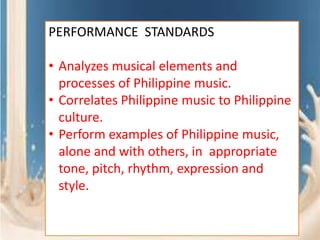
PERFOFRiMlipANinCoE ScToAmNDpAoRDsSers, 
• Analyzes musical elements and 
processes of Philippine music. 
• Correlates Philippine music to Philippine 
culture. 
• Perform examples of Philippine music, 
alone and with others, in appropriate 
tone, pitch, rhythm, expression and 
style.
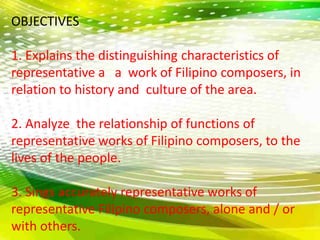
OBJECTIVES 
1. Explains the distinguishing characteristics of 
representative a a work of Filipino composers, in 
relation to history and culture of the area. 
2. Analyze the relationship of functions of 
representative works of Filipino composers, to the 
lives of the people. 
3. Sings accurately representative works of 
representative Filipino composers, alone and / or 
with others.
CONTENT/ TOPIC 
• Nationalistic Songs and Love Songs 
• Vocal Music-Nationalistic Songs (Julio Nakpil 
and Julian Felipe), Love Songs (Nicanor 
Abelardo, Kundiman and Ernani cuenco, 
Ballad) 
• Cultural Context (History and Traditions)- 
Filipino conflict during the Spanish Period 
(Aguinaldo and Bonifacio), How a National 
Artist is proclaimed
CONTENT/TOPIC 
• InitaComposition-Himno National 
Filipino, Lupang Hinirang,Marangal 
na Dalit ng Katagalugan; Nasaan Ka 
Irog?, Gaano Ko Ikaw Kamahal 
• Social Functions-Patriotism, Artistry 
in the Society (Order of National 
artists)
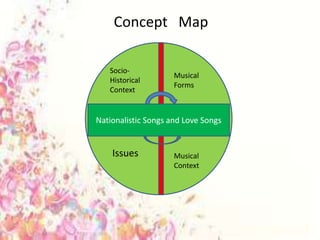
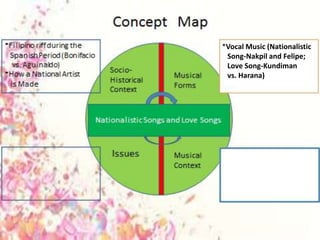
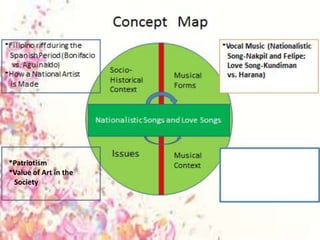
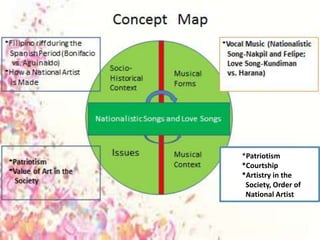
Concept Map 
Socio- 
Historical 
Context 
Musical 
Forms 
Nationalistic Songs and Love Songs 
Issues Musical 
Context
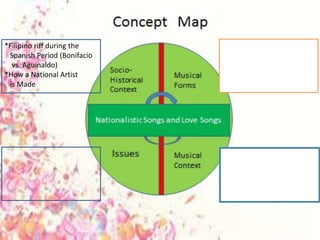
*Filipino riff during the 
Spanish Period (Bonifacio 
vs. Aguinaldo) 
*How a National Artist 
is Made
*Vocal Music (Nationalistic 
Song-Nakpil and Felipe; 
Love Song-Kundiman 
vs. Harana)
*Patriotism 
*Value of Art in the 
Society
*Patriotism 
*Courtship 
*Artistry in the 
Society, Order of 
National Artist
Nationalistic Song and Love Songs 
What I Know What I Want 
to Know 
What I’ve 
learned
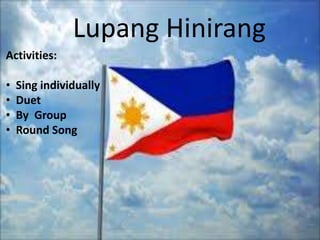
Lupang Hinirang 
Activities: 
• Sing individually 
• Duet 
• By Group 
• Round Song
Nicanor Abelardo was born in San Miguel de Mayumo, Bulacan. His mother belonged 
to a family of artists in Guagua, the Hensons. He was introduced to music when he 
was five years old, when his father taught him the solfeggio and the banduria. At the 
age of 8, he was able to compose his estoryahe first work, a waltz entitled "Ang 
Unang Buko," which was dedicated to his grandmother. At the age of 13, he was 
already playing at saloons and cabarets in Manila. At age 15, he was already teaching 
in barrio schools in San Ildefonso and San Miguel Bulacan. All of these happened 
even before young Abelardo finally took up courses under Guy F. Harrison and Robert 
Schofield at the UP Conservatory of Music in 1916. By 1924, following a teacher’s 
certificate in science and composition received in 1921, he was appointed head of the 
composition department at the Conservatory. Years later, he ran a boarding school for 
young musicians, and among his students were National Artist Antonino 
Buenaventura, Alfredo Lozano and Lucino Sacramento. In the field of composition he 
is known for his redefinition of the kundiman, bringing the genre to art-song status. 
Among his works were "Nasaan Ka Irog," "Magbalik Ka Hirang," and "Himutok." He 
died in 1934 at the age of 41, leaving a collection of more than 140 works.[1] 
As a composition major at the University of the Philippines, he also composed the 
melody for the university's official anthem, U.P. Naming Mahal.
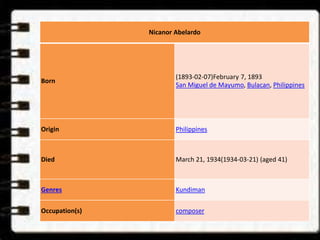
Nicanor Abelardo 
Born 
(1893-02-07)February 7, 1893 
San Miguel de Mayumo, Bulacan, Philippines 
Origin Philippines 
Died March 21, 1934(1934-03-21) (aged 41) 
Genres Kundiman 
Occupation(s) composer
• 1937 - Nasaan ka, Irog (music) 
• 1937 - Bituing Marikit 
(Sampaguita) (music) 
• 2013 - The Songs of Nicanor 
Abelardo,[3] featuring baritone Joseph 
Legaspi, tenor William Lim, soprano 
Katrina Saporsantos, and pianist 
Benjamin Dia.
ERNANI CUENCO’S AUTHOBIOGRAPHY 
Ernani Joson Cuenco (May 10, 1936 – 1988) was a Filipino 
composer,[1] film scorer, musical director and music teacher. He 
wrote an outstanding and memorable body of works that resonate 
with the Filipino sense of musicality and which embody an 
ingenious voice that raises the aesthetic dimensions of 
contemporary Filipino music. Cuenco played with the Filipino Youth 
Symphony Orchestra and the Manila Symphony Orchestra from 
1960 to 1968, and the Manila Chamber Soloists from 1966 to 1970. 
He completed a music degree in piano and cello from the 
University of Santo Tomas where he also taught for decades until 
his death in 1988. 
His songwriting credits include "Nahan, Kahit na Magtiis," and 
"Diligin Mo ng Hamog ang Uhaw na Lupa," "Pilipinas," "Inang 
Bayan," "Isang Dalangin," "Kalesa," "Bato sa Buhangin" and "Gaano 
Kita Kamahal." The latter song shows how Cuenco enriched the 
Filipino love ballad by adding the elements of kundiman to it.
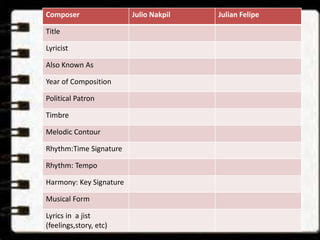
Composer Julio Nakpil Julian Felipe 
Title 
Lyricist 
Also Known As 
Year of Composition 
Political Patron 
Timbre 
Melodic Contour 
Rhythm:Time Signature 
Rhythm: Tempo 
Harmony: Key Signature 
Musical Form 
Lyrics in a jist 
(feelings,story, etc)
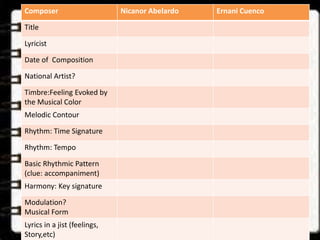
Composer Nicanor Abelardo Ernani Cuenco 
Title 
Lyricist 
Date of Composition 
National Artist? 
Timbre:Feeling Evoked by 
the Musical Color 
Melodic Contour 
Rhythm: Time Signature 
Rhythm: Tempo 
Basic Rhythmic Pattern 
(clue: accompaniment) 
Harmony: Key signature 
Modulation? 
Musical Form 
Lyrics in a jist (feelings, 
Story,etc)
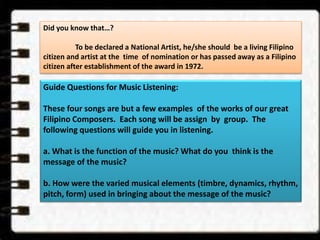
Did you know that…? 
To be declared a National Artist, he/she should be a living Filipino 
citizen and artist at the time of nomination or has passed away as a Filipino 
citizen after establishment of the award in 1972. 
Guide Questions for Music Listening: 
These four songs are but a few examples of the works of our great 
Filipino Composers. Each song will be assign by group. The 
following questions will guide you in listening. 
a. What is the function of the music? What do you think is the 
message of the music? 
b. How were the varied musical elements (timbre, dynamics, rhythm, 
pitch, form) used in bringing about the message of the music?
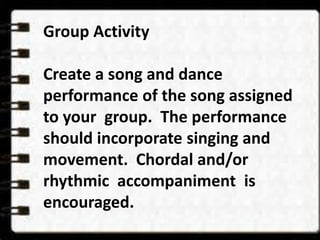
Group Activity 
Create a song and dance 
performance of the song assigned 
to your group. The performance 
should incorporate singing and 
movement. Chordal and/or 
rhythmic accompaniment is 
encouraged.
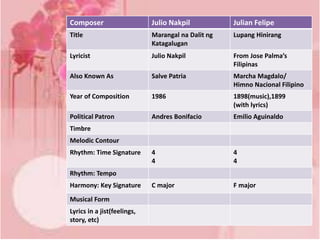
Composer Julio Nakpil Julian Felipe 
Title Marangal na Dalit ng 
Katagalugan 
Lupang Hinirang 
Lyricist Julio Nakpil From Jose Palma’s 
Filipinas 
Also Known As Salve Patria Marcha Magdalo/ 
Himno Nacional Filipino 
Year of Composition 1986 1898(music),1899 
(with lyrics) 
Political Patron Andres Bonifacio Emilio Aguinaldo 
Timbre 
Melodic Contour 
Rhythm: Time Signature 4 
4 
4 
4 
Rhythm: Tempo 
Harmony: Key Signature C major F major 
Musical Form 
Lyrics in a jist(feelings, 
story, etc)
GLOSSARY OF MUSIC TERMS & SYMBOLS 
instrumenal march, known as either 
1.Himno Nacional Filipino-known presently as Lupang Hinirang, the 
National Marcha Anthem of the Filipina 
Philippines, with music by Julian Felipe, 
originally an instrumental march, known as either Marcha Filipina 
nacional or Marcha Filipino Magdalo, and lyrics from Jose Palma’s 
Filipinas, Letra Para La Marcha Nacional. His work was 
commisioned by Emilio Aguinaldo and was played during the 
declaration of Philippine Independence on June 12, 1898. 
2. Marangal na Dalit ng Katagalugan-with music and lyrics written 
by Julio Nakpil in 1896. Nakpil later changed the title to Salve 
Patria. This work was commissioned by Andres Bonifacio, but 
Emilio Aguinaldo preferred the work of Julian Felipe. It was first 
played to commemorate the eight anniversary of Rizal’s execution 
on December 30, 1904. 
3. Kundiman-Known as The Philippines’ signature love song; It is an 
art song in triple time. According to Raymundo Banas, there are 3 
theories on the origin of the Kundiman: a shorten version of the 
phrase “Kung hindi man”, derived from the verse “Hele hele nang 
kandungan/ Hele hele ng kundiman”, and kundiman, referrin to a 
red cloth worn by male dancers or men in the Philippines. Aside 
from messages of love, it also expressed sentiments of nationalism.
4. Nasaan Ka Irog?-a kundiman in slow triple time composed by Nicanor Abelardo in 
1923, which was inspired by his childhood friend Dr. Francisco Tecson’s personal 
experience on love. The original Spanish was written by Narciso Asistio; the tagalog lyrics 
were written by Jose Corazon de Jesus. This song has inspired the filming of a 1936 m0vie, 
retaining the title of the song. 
5. Nicanor Sta. Ana Abelardo (1893-1934)-He is one of our great composers, pianist, and a 
teacher of compositions at the University of the Philippines then Conservatory of Music. 
His 140 compositions include kundimans, sarswelas, instrumental, and UP Beloved, a 
university I hymn which won first prize in an open musical composition contest. 
6.Ballad-a narrative song, ranging from indigenous forms to Hispanic-influenced themes. 
The romantic themes of the contemporary ballad or urban popular love songs are closely 
related to kundiman. 
7. Gaano ko Ikaw Kamahal?-a ballad composed by Ernani Cuenco in 1979, with lyrics by 
Levi Celerio, both National Artists for Music. It was used as a movie theme for a 1980s 
movie with the same title, starring Lito Lapid. 
8. Ernani Joson Cuenco (1936-1988)-proclaimed National Artist for Music in 1999; He was 
an award-winning film scorer in the early 1960s, working in collaboration with National 
Artist for Music Levi Celerio. He was also a teacher and a seasoned orchestra player.
9. Order of National Arttishtse- The highest national 
recognition bestowed upon to Filipino artists who 
have made significant contributions to the 
development o Philippine arts; namely, Music, 
Dance, Theater, Visual Arts, Literature, Film, 
Broadcast Arts, and Architecture and Allied Arts. 
The order is jointly administered by the National 
Commission for Culture and the Arts (NCCA) and 
thr Cultural Center of the Philippines (CCP) and 
conferred by the President of the Philippines upon 
recommendation by both institutions. (from NCCA 
Website)
Third quarter music

Third quarter music

  • 1.
    MAPEH GRADE 7 THIRD QUARTER
  • 3.
    PERFOFRiMlipANinCoE ScToAmNDpAoRDsSers, •Analyzes musical elements and processes of Philippine music. • Correlates Philippine music to Philippine culture. • Perform examples of Philippine music, alone and with others, in appropriate tone, pitch, rhythm, expression and style.
  • 4.
    OBJECTIVES 1. Explainsthe distinguishing characteristics of representative a a work of Filipino composers, in relation to history and culture of the area. 2. Analyze the relationship of functions of representative works of Filipino composers, to the lives of the people. 3. Sings accurately representative works of representative Filipino composers, alone and / or with others.
  • 5.
    CONTENT/ TOPIC •Nationalistic Songs and Love Songs • Vocal Music-Nationalistic Songs (Julio Nakpil and Julian Felipe), Love Songs (Nicanor Abelardo, Kundiman and Ernani cuenco, Ballad) • Cultural Context (History and Traditions)- Filipino conflict during the Spanish Period (Aguinaldo and Bonifacio), How a National Artist is proclaimed
  • 6.
    CONTENT/TOPIC • InitaComposition-HimnoNational Filipino, Lupang Hinirang,Marangal na Dalit ng Katagalugan; Nasaan Ka Irog?, Gaano Ko Ikaw Kamahal • Social Functions-Patriotism, Artistry in the Society (Order of National artists)
  • 7.
    Concept Map Socio- Historical Context Musical Forms Nationalistic Songs and Love Songs Issues Musical Context
  • 8.
    *Filipino riff duringthe Spanish Period (Bonifacio vs. Aguinaldo) *How a National Artist is Made
  • 9.
    *Vocal Music (Nationalistic Song-Nakpil and Felipe; Love Song-Kundiman vs. Harana)
  • 10.
    *Patriotism *Value ofArt in the Society
  • 11.
    *Patriotism *Courtship *Artistryin the Society, Order of National Artist
  • 12.
    Nationalistic Song andLove Songs What I Know What I Want to Know What I’ve learned
  • 13.
    Lupang Hinirang Activities: • Sing individually • Duet • By Group • Round Song
  • 15.
    Nicanor Abelardo wasborn in San Miguel de Mayumo, Bulacan. His mother belonged to a family of artists in Guagua, the Hensons. He was introduced to music when he was five years old, when his father taught him the solfeggio and the banduria. At the age of 8, he was able to compose his estoryahe first work, a waltz entitled "Ang Unang Buko," which was dedicated to his grandmother. At the age of 13, he was already playing at saloons and cabarets in Manila. At age 15, he was already teaching in barrio schools in San Ildefonso and San Miguel Bulacan. All of these happened even before young Abelardo finally took up courses under Guy F. Harrison and Robert Schofield at the UP Conservatory of Music in 1916. By 1924, following a teacher’s certificate in science and composition received in 1921, he was appointed head of the composition department at the Conservatory. Years later, he ran a boarding school for young musicians, and among his students were National Artist Antonino Buenaventura, Alfredo Lozano and Lucino Sacramento. In the field of composition he is known for his redefinition of the kundiman, bringing the genre to art-song status. Among his works were "Nasaan Ka Irog," "Magbalik Ka Hirang," and "Himutok." He died in 1934 at the age of 41, leaving a collection of more than 140 works.[1] As a composition major at the University of the Philippines, he also composed the melody for the university's official anthem, U.P. Naming Mahal.
  • 16.
    Nicanor Abelardo Born (1893-02-07)February 7, 1893 San Miguel de Mayumo, Bulacan, Philippines Origin Philippines Died March 21, 1934(1934-03-21) (aged 41) Genres Kundiman Occupation(s) composer
  • 17.
    • 1937 -Nasaan ka, Irog (music) • 1937 - Bituing Marikit (Sampaguita) (music) • 2013 - The Songs of Nicanor Abelardo,[3] featuring baritone Joseph Legaspi, tenor William Lim, soprano Katrina Saporsantos, and pianist Benjamin Dia.
  • 18.
    ERNANI CUENCO’S AUTHOBIOGRAPHY Ernani Joson Cuenco (May 10, 1936 – 1988) was a Filipino composer,[1] film scorer, musical director and music teacher. He wrote an outstanding and memorable body of works that resonate with the Filipino sense of musicality and which embody an ingenious voice that raises the aesthetic dimensions of contemporary Filipino music. Cuenco played with the Filipino Youth Symphony Orchestra and the Manila Symphony Orchestra from 1960 to 1968, and the Manila Chamber Soloists from 1966 to 1970. He completed a music degree in piano and cello from the University of Santo Tomas where he also taught for decades until his death in 1988. His songwriting credits include "Nahan, Kahit na Magtiis," and "Diligin Mo ng Hamog ang Uhaw na Lupa," "Pilipinas," "Inang Bayan," "Isang Dalangin," "Kalesa," "Bato sa Buhangin" and "Gaano Kita Kamahal." The latter song shows how Cuenco enriched the Filipino love ballad by adding the elements of kundiman to it.
  • 19.
    Composer Julio NakpilJulian Felipe Title Lyricist Also Known As Year of Composition Political Patron Timbre Melodic Contour Rhythm:Time Signature Rhythm: Tempo Harmony: Key Signature Musical Form Lyrics in a jist (feelings,story, etc)
  • 20.
    Composer Nicanor AbelardoErnani Cuenco Title Lyricist Date of Composition National Artist? Timbre:Feeling Evoked by the Musical Color Melodic Contour Rhythm: Time Signature Rhythm: Tempo Basic Rhythmic Pattern (clue: accompaniment) Harmony: Key signature Modulation? Musical Form Lyrics in a jist (feelings, Story,etc)
  • 21.
    Did you knowthat…? To be declared a National Artist, he/she should be a living Filipino citizen and artist at the time of nomination or has passed away as a Filipino citizen after establishment of the award in 1972. Guide Questions for Music Listening: These four songs are but a few examples of the works of our great Filipino Composers. Each song will be assign by group. The following questions will guide you in listening. a. What is the function of the music? What do you think is the message of the music? b. How were the varied musical elements (timbre, dynamics, rhythm, pitch, form) used in bringing about the message of the music?
  • 22.
    Group Activity Createa song and dance performance of the song assigned to your group. The performance should incorporate singing and movement. Chordal and/or rhythmic accompaniment is encouraged.
  • 23.
    Composer Julio NakpilJulian Felipe Title Marangal na Dalit ng Katagalugan Lupang Hinirang Lyricist Julio Nakpil From Jose Palma’s Filipinas Also Known As Salve Patria Marcha Magdalo/ Himno Nacional Filipino Year of Composition 1986 1898(music),1899 (with lyrics) Political Patron Andres Bonifacio Emilio Aguinaldo Timbre Melodic Contour Rhythm: Time Signature 4 4 4 4 Rhythm: Tempo Harmony: Key Signature C major F major Musical Form Lyrics in a jist(feelings, story, etc)
  • 24.
    GLOSSARY OF MUSICTERMS & SYMBOLS instrumenal march, known as either 1.Himno Nacional Filipino-known presently as Lupang Hinirang, the National Marcha Anthem of the Filipina Philippines, with music by Julian Felipe, originally an instrumental march, known as either Marcha Filipina nacional or Marcha Filipino Magdalo, and lyrics from Jose Palma’s Filipinas, Letra Para La Marcha Nacional. His work was commisioned by Emilio Aguinaldo and was played during the declaration of Philippine Independence on June 12, 1898. 2. Marangal na Dalit ng Katagalugan-with music and lyrics written by Julio Nakpil in 1896. Nakpil later changed the title to Salve Patria. This work was commissioned by Andres Bonifacio, but Emilio Aguinaldo preferred the work of Julian Felipe. It was first played to commemorate the eight anniversary of Rizal’s execution on December 30, 1904. 3. Kundiman-Known as The Philippines’ signature love song; It is an art song in triple time. According to Raymundo Banas, there are 3 theories on the origin of the Kundiman: a shorten version of the phrase “Kung hindi man”, derived from the verse “Hele hele nang kandungan/ Hele hele ng kundiman”, and kundiman, referrin to a red cloth worn by male dancers or men in the Philippines. Aside from messages of love, it also expressed sentiments of nationalism.
  • 25.
    4. Nasaan KaIrog?-a kundiman in slow triple time composed by Nicanor Abelardo in 1923, which was inspired by his childhood friend Dr. Francisco Tecson’s personal experience on love. The original Spanish was written by Narciso Asistio; the tagalog lyrics were written by Jose Corazon de Jesus. This song has inspired the filming of a 1936 m0vie, retaining the title of the song. 5. Nicanor Sta. Ana Abelardo (1893-1934)-He is one of our great composers, pianist, and a teacher of compositions at the University of the Philippines then Conservatory of Music. His 140 compositions include kundimans, sarswelas, instrumental, and UP Beloved, a university I hymn which won first prize in an open musical composition contest. 6.Ballad-a narrative song, ranging from indigenous forms to Hispanic-influenced themes. The romantic themes of the contemporary ballad or urban popular love songs are closely related to kundiman. 7. Gaano ko Ikaw Kamahal?-a ballad composed by Ernani Cuenco in 1979, with lyrics by Levi Celerio, both National Artists for Music. It was used as a movie theme for a 1980s movie with the same title, starring Lito Lapid. 8. Ernani Joson Cuenco (1936-1988)-proclaimed National Artist for Music in 1999; He was an award-winning film scorer in the early 1960s, working in collaboration with National Artist for Music Levi Celerio. He was also a teacher and a seasoned orchestra player.
  • 26.
    9. Order ofNational Arttishtse- The highest national recognition bestowed upon to Filipino artists who have made significant contributions to the development o Philippine arts; namely, Music, Dance, Theater, Visual Arts, Literature, Film, Broadcast Arts, and Architecture and Allied Arts. The order is jointly administered by the National Commission for Culture and the Arts (NCCA) and thr Cultural Center of the Philippines (CCP) and conferred by the President of the Philippines upon recommendation by both institutions. (from NCCA Website)