Credit(s) earned on completion of this course will be
reported to AIA CES for AIA members. Certificates of
Completion for both AIA members and non-AIA
members are available upon request.
This course is registered with AIA CES for
continuing professional education. As such, it does
not include content that may be deemed or
construed to be an approval or endorsement by the
AIA of any material of construction or any method or
manner of
handling, using, distributing, or dealing in any
material or product.
___________________________________________
Questions related to specific materials, methods, and services will
be addressed at the conclusion of this presentation.
Michael Shulman
Principal Engineer
UL LLC
The Standard for Low Voltage Lighting Systems, UL 2108, was revised in
2015 to explicitly accommodate PoE Lighting Systems. These systems
include a network switch serving as the LED driver, communications cable
(Cat5 / Cat6, et al), and low voltage luminaires equipped with an RJ45
input port and the ability to communicate with the network switch. They
offer far-reaching versatility for facility lighting control. Compliance with
the NEC, however, requires detailed knowledge about several different
but inter-related articles to establish a clear fit between the equipment and
the requirements. Special applications, such as emergency lighting, pose
additional challenges. This presentation will explore the standard and
code issues that equipment producers, specifiers, installers, and
authorities having jurisdiction should consider when developing,
recommending, deploying, or approving such equipment.
1. How Codes and Standards try to keep pace with
technology
2. Safety does not establish Compliance
3. Standards-level (UL 2108) compliance of PoE
Lighting
4. Code-level (NEC 411, 725) compliance of PoE
Lighting
5. Questions for PoE emergency lighting (NEC 700)
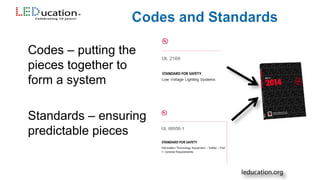
Codes – putting the
pieces together to
form a system
Standards – ensuring
predictable pieces
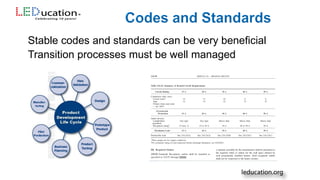
Stable codes and standards can be very beneficial
Transition processes must be well managed
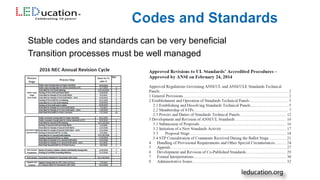
Stable codes and standards can be very beneficial
Transition processes must be well managed
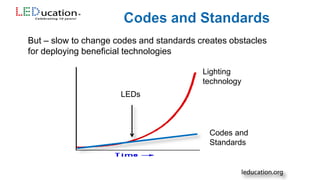
But – slow to change codes and standards creates obstacles
for deploying beneficial technologies
Codes and
Standards
Lighting
technology
LEDs
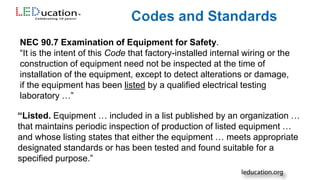
“Listed. Equipment … included in a list published by an organization …
that maintains periodic inspection of production of listed equipment …
and whose listing states that either the equipment … meets appropriate
designated standards or has been tested and found suitable for a
specified purpose.”
NEC 90.7 Examination of Equipment for Safety.
“It is the intent of this Code that factory-installed internal wiring or the
construction of equipment need not be inspected at the time of
installation of the equipment, except to detect alterations or damage,
if the equipment has been listed by a qualified electrical testing
laboratory …”
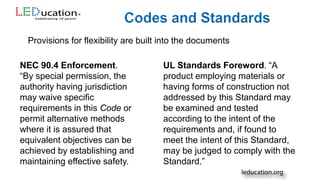
Provisions for flexibility are built into the documents
NEC 90.4 Enforcement.
“By special permission, the
authority having jurisdiction
may waive specific
requirements in this Code or
permit alternative methods
where it is assured that
equivalent objectives can be
achieved by establishing and
maintaining effective safety.
UL Standards Foreword. “A
product employing materials or
having forms of construction not
addressed by this Standard may
be examined and tested
according to the intent of the
requirements and, if found to
meet the intent of this Standard,
may be judged to comply with the
Standard.”
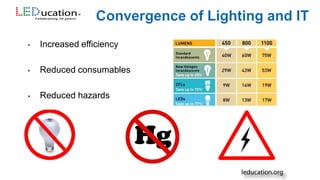
• Increased efficiency
• Reduced consumables
• Reduced hazards
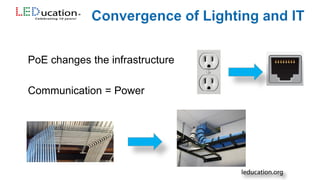
PoE changes the infrastructure
Communication = Power
UL 60950-1 / UL 62368: Standards for A/V, Information and
Communications Equipment
Limited safety risks due to restricted voltage and power
levels
Safety ≠ Compliance
Uncertainty about compliance 
2015 Revisions:
• PoE luminaires added to “SCOPE”
• PoE definition, citing conformance to IEEE
802.3
• PoE power units permitted to be cord/plug
connected
• Cat5 (and equivalent) cables permitted
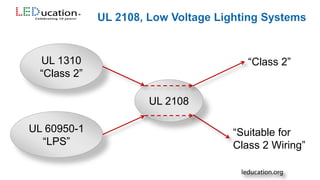
UL 1310
“Class 2”
UL 60950-1
“LPS”
UL 2108
“Class 2”
“Suitable for
Class 2 Wiring”
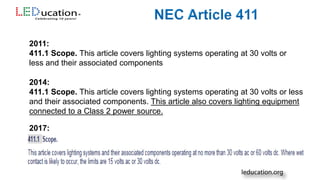
2014:
411.1 Scope. This article covers lighting systems operating at 30 volts or less
and their associated components. This article also covers lighting equipment
connected to a Class 2 power source.
2017:
2011:
411.1 Scope. This article covers lighting systems operating at 30 volts or
less and their associated components
Covers installation of power-limited circuits. Permits alternative wiring
methods – smaller, less insulated, and more limited electrical /
mechanical protection for conductors
Chapter 3 wiring
Chapter 7 wiring
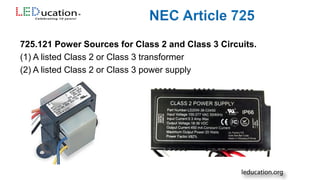
725.121 Power Sources for Class 2 and Class 3 Circuits.
(1) A listed Class 2 or Class 3 transformer
(2) A listed Class 2 or Class 3 power supply
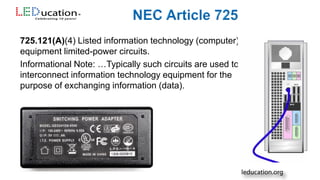
725.121(A)(4) Listed information technology (computer)
equipment limited-power circuits.
Informational Note: …Typically such circuits are used to
interconnect information technology equipment for the
purpose of exchanging information (data).
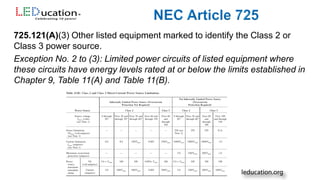
725.121(A)(3) Other listed equipment marked to identify the Class 2 or
Class 3 power source.
Exception No. 2 to (3): Limited power circuits of listed equipment where
these circuits have energy levels rated at or below the limits established in
Chapter 9, Table 11(A) and Table 11(B).
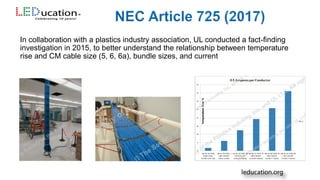
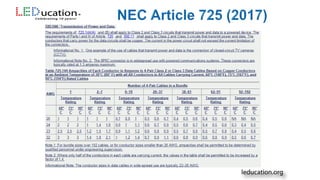
In collaboration with a plastics industry association, UL conducted a fact-finding
investigation in 2015, to better understand the relationship between temperature
rise and CM cable size (5, 6, 6a), bundle sizes, and current
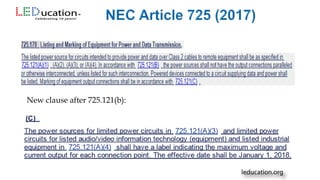
New clause after 725.121(b):
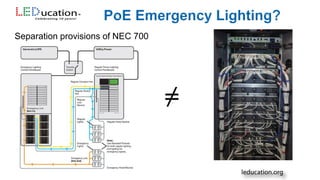
Separation provisions of NEC 700
≠
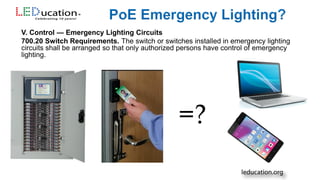
V. Control — Emergency Lighting Circuits
700.20 Switch Requirements. The switch or switches installed in emergency lighting
circuits shall be arranged so that only authorized persons have control of emergency
lighting.
=?
• Safety is comparable to that of class 2 lighting
• Listing is available under UL 2108
• Approval under the NEC faces some uncertainty,
depending in part on what NEC edition is used
• Interesting questions remain regarding separation,
control, and activation of emergency lighting
“Power over Ethernet Lighting – Evolution or Revolution?”
Available at http://library.ul.com/ (white paper)
This concludes The American Institute of Architects
Continuing Education Systems Course
Michael.shulman@ul.com

Safety and Code Compliance Considerations for POE Lighting

  • 2.
    Credit(s) earned oncompletion of this course will be reported to AIA CES for AIA members. Certificates of Completion for both AIA members and non-AIA members are available upon request. This course is registered with AIA CES for continuing professional education. As such, it does not include content that may be deemed or construed to be an approval or endorsement by the AIA of any material of construction or any method or manner of handling, using, distributing, or dealing in any material or product. ___________________________________________ Questions related to specific materials, methods, and services will be addressed at the conclusion of this presentation.
  • 3.
  • 4.
    The Standard forLow Voltage Lighting Systems, UL 2108, was revised in 2015 to explicitly accommodate PoE Lighting Systems. These systems include a network switch serving as the LED driver, communications cable (Cat5 / Cat6, et al), and low voltage luminaires equipped with an RJ45 input port and the ability to communicate with the network switch. They offer far-reaching versatility for facility lighting control. Compliance with the NEC, however, requires detailed knowledge about several different but inter-related articles to establish a clear fit between the equipment and the requirements. Special applications, such as emergency lighting, pose additional challenges. This presentation will explore the standard and code issues that equipment producers, specifiers, installers, and authorities having jurisdiction should consider when developing, recommending, deploying, or approving such equipment.
  • 5.
    1. How Codesand Standards try to keep pace with technology 2. Safety does not establish Compliance 3. Standards-level (UL 2108) compliance of PoE Lighting 4. Code-level (NEC 411, 725) compliance of PoE Lighting 5. Questions for PoE emergency lighting (NEC 700)
  • 6.
    Codes – puttingthe pieces together to form a system Standards – ensuring predictable pieces
  • 7.
    Stable codes andstandards can be very beneficial Transition processes must be well managed
  • 8.
    Stable codes andstandards can be very beneficial Transition processes must be well managed
  • 9.
    But – slowto change codes and standards creates obstacles for deploying beneficial technologies Codes and Standards Lighting technology LEDs
  • 10.
    “Listed. Equipment …included in a list published by an organization … that maintains periodic inspection of production of listed equipment … and whose listing states that either the equipment … meets appropriate designated standards or has been tested and found suitable for a specified purpose.” NEC 90.7 Examination of Equipment for Safety. “It is the intent of this Code that factory-installed internal wiring or the construction of equipment need not be inspected at the time of installation of the equipment, except to detect alterations or damage, if the equipment has been listed by a qualified electrical testing laboratory …”
  • 11.
    Provisions for flexibilityare built into the documents NEC 90.4 Enforcement. “By special permission, the authority having jurisdiction may waive specific requirements in this Code or permit alternative methods where it is assured that equivalent objectives can be achieved by establishing and maintaining effective safety. UL Standards Foreword. “A product employing materials or having forms of construction not addressed by this Standard may be examined and tested according to the intent of the requirements and, if found to meet the intent of this Standard, may be judged to comply with the Standard.”
  • 12.
    • Increased efficiency •Reduced consumables • Reduced hazards
  • 13.
    PoE changes theinfrastructure Communication = Power
  • 14.
    UL 60950-1 /UL 62368: Standards for A/V, Information and Communications Equipment Limited safety risks due to restricted voltage and power levels Safety ≠ Compliance Uncertainty about compliance 
  • 15.
    2015 Revisions: • PoEluminaires added to “SCOPE” • PoE definition, citing conformance to IEEE 802.3 • PoE power units permitted to be cord/plug connected • Cat5 (and equivalent) cables permitted
  • 16.
    UL 1310 “Class 2” UL60950-1 “LPS” UL 2108 “Class 2” “Suitable for Class 2 Wiring”
  • 17.
    2014: 411.1 Scope. Thisarticle covers lighting systems operating at 30 volts or less and their associated components. This article also covers lighting equipment connected to a Class 2 power source. 2017: 2011: 411.1 Scope. This article covers lighting systems operating at 30 volts or less and their associated components
  • 18.
    Covers installation ofpower-limited circuits. Permits alternative wiring methods – smaller, less insulated, and more limited electrical / mechanical protection for conductors Chapter 3 wiring Chapter 7 wiring
  • 19.
    725.121 Power Sourcesfor Class 2 and Class 3 Circuits. (1) A listed Class 2 or Class 3 transformer (2) A listed Class 2 or Class 3 power supply
  • 20.
    725.121(A)(4) Listed informationtechnology (computer) equipment limited-power circuits. Informational Note: …Typically such circuits are used to interconnect information technology equipment for the purpose of exchanging information (data).
  • 21.
    725.121(A)(3) Other listedequipment marked to identify the Class 2 or Class 3 power source. Exception No. 2 to (3): Limited power circuits of listed equipment where these circuits have energy levels rated at or below the limits established in Chapter 9, Table 11(A) and Table 11(B).
  • 22.
    In collaboration witha plastics industry association, UL conducted a fact-finding investigation in 2015, to better understand the relationship between temperature rise and CM cable size (5, 6, 6a), bundle sizes, and current
  • 24.
    New clause after725.121(b):
  • 25.
  • 26.
    V. Control —Emergency Lighting Circuits 700.20 Switch Requirements. The switch or switches installed in emergency lighting circuits shall be arranged so that only authorized persons have control of emergency lighting. =?
  • 27.
    • Safety iscomparable to that of class 2 lighting • Listing is available under UL 2108 • Approval under the NEC faces some uncertainty, depending in part on what NEC edition is used • Interesting questions remain regarding separation, control, and activation of emergency lighting “Power over Ethernet Lighting – Evolution or Revolution?” Available at http://library.ul.com/ (white paper)
  • 28.
    This concludes TheAmerican Institute of Architects Continuing Education Systems Course
  • 29.