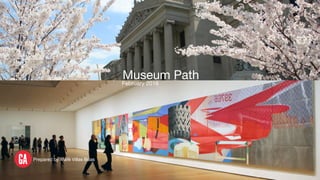
Museum Path
February 2016
Prepared by Mafê Villas Boas
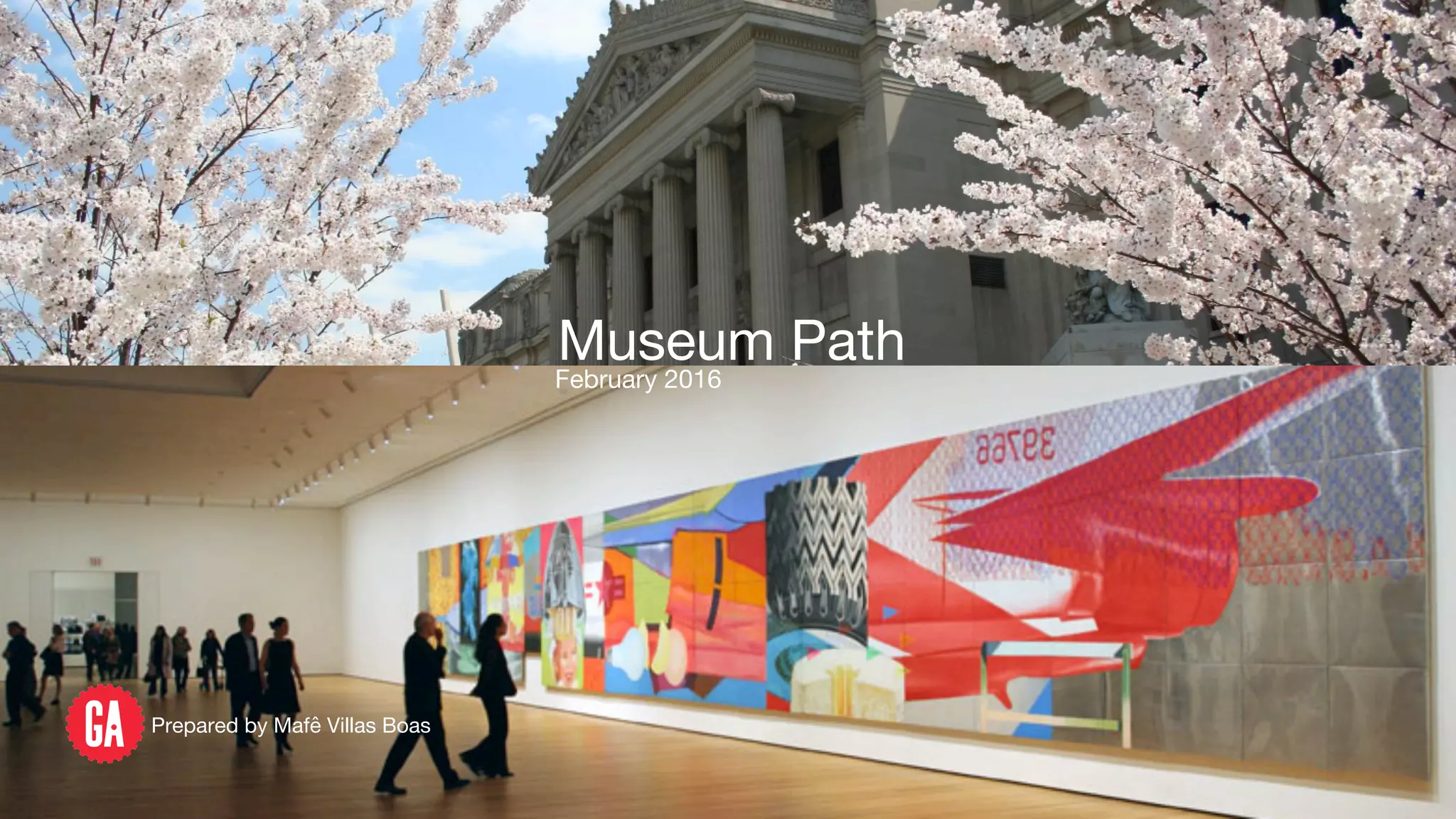
Young Woman with a Water Pitcher!
Johannes Vermeer
More than 2,000,000 square feet
Source: Wikipedia, free encyclopedia.
It would take 83,333 “Young
Woman with a Water Pitcher”
to tile the floor at the Met
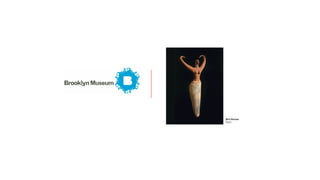
Bird Woman!
Egypt
Over 8694 Egyptian objects 
Source: Brooklyn Museum official website.
If you spent twenty minutes
with each object it would
take you four months to see
the whole collection
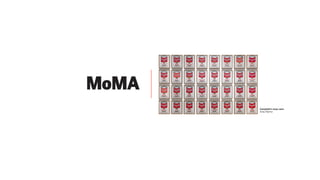
Campbell's soup cans !
Andy Warhol
Over 10,000 artists
in MoMA’s collection
Source: Moma’s official website
Enough artists to fill
almost 4 Carnegie Hall
Source: Population of Brooklyn in 2010 = 2.49 million
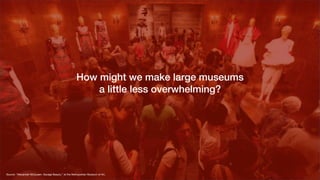
Source: “Alexander McQueen: Savage Beauty,” at the Metropolitan Museum of Art,

How might we make large museums
a little less overwhelming?
“To get people in the doors (and ultimately deliver a better experience
with the art), let’s stop telling them why they should come and start
asking them why they do.”
- JEHRA PATRICK, Program Director for Mn Artists
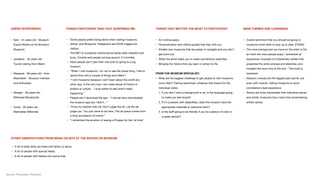
THINGS PARTICIPANT SAID THAT SURPRISED ME:
 THINGS THAT MATTER THE MOST TO PARTICIPANT:
 MAIN THEMES AND LEARNINGS
USERS INTERVIEWED 
OTHER OBSERVATIONS FROM BEING ON SITE AT THE BROOKLYN MUSEUM:
•  Sam - 31 years old - Museum
Expert (Works at the Brooklyn
Museum)

•  Jonathan - 40 years old -
Tourist visiting from Miami

•  Margaret - 59 years old - from
Manhattan - Museum member
and enthusiast

•  Morgan - 28 years old -
Millennial Brooklynite

•  Cindy - 26 years old -
Manhattan Millennial
•  Some people prefer being alone when visiting museums.
•  Artists’ and Museums’ Instagrams are HUGE triggers for
visitors.
•  The MET is constantly mentioned as being really stressful and
busy. Crowds and people running around. It’s horrible.
•  Most people don’t plan their visit prior to going to a big
museum.
•  “When I visit museums, I try not to see the whole thing. I like to
spend time with a couple of things and reflect.”
•  “I visit museums because I can’t learn about the world any
other way. Is the only way I can make sense of history or
politics or culture… I trust artists to see what’s really
happening.”
•  People don’t download the app - “I should have downloaded
the museum app but I didn’t…”
•  “Once my teacher told me: Don’t judge the art. Let the art
judge you. You just came to be here. This art piece comes from
a long succession of events.”
•  “I remember the emotion of seeing a Picasso for the 1st time”
•  Overall sentiment that you should be going to
museums more often to stay up to date. (FOMO)
•  The more background you have on the artist or the
art work the more people enjoy / remember an
experience. Example of a Kandinsky exhibit that
presented the artist process and sketches, and
revealed the work only at the end - This build is
important.
•  Museum crowds are the biggest pain points, but
even with crowds, visiting museums is never
considered a bad experience.
•  Shows are more memorable than individual pieces
and artists. Everyone has a hard time remembering
artists names.
•  An inviting space.
•  Personalization and visiting guides that stay with you.
•  Smaller size museums that are easier to navigate and you don’t
get burnt out.
•  When the show helps you to make connections seamless.
•  Bringing the history that you learn in school to life.

FROM THE MUSEUM SPECIALIST:
•  What are the biggest challenge to get people to visit museums
more often? Feeling welcomed, whatever that means for the
individual visitor.
1.  If you don’t have a background in art, is the language going
to make you feel stupid?
2.  If it’s a person with disabilities, does the museum have the
appropriate materials to welcome them?
3.  Is the staff going to be friendly if you’re a person of color or
a queer person?
•  A lot of older folks are there with family or alone.
•  A lot of people with special needs. 
•  A lot of people with babies and young kids.
Source: Proprietary Research
“I visit museums because I can’t learn about the world any other way.
It is the only way I can make sense of history or politics or culture… 
I trust artists to see what’s really happening.”
- SAM, Museum Professional
Source: Proprietary Research
Motivational identities and visitor characterization!
Explorers
Explorers come because attending
museums interests them and appeals to
their curiosity. If you asked them if they like
art they would say ‘yes;’ if you asked them
if they came for something in particular,
they would probably say ‘no,’ they ‘just like
art and know what they like when they see
it.’ They do not have concrete learning
goals, like ‘I’m going to go to the MIA to
learn everything I can about
Expressionism,’ but they like to know new
things. [This is the type to read didactics
and labels, but might not know names and
contextual references.] This type could
really be anyone. Explorers’ goal is to
satisfy a curiosity. They may or may not
know how to use the space.
Facilitator
Facilitators come because of someone
else. They are perhaps bringing a friend or
a group of people—possibly youth or
students—because they think that the visit
would benefit the other party or parties, not
because of a personal need. Their personal
need is to make a good experience for
others.
Experience Seeker
An experience seeker is a person who
is checking off a list of things to do,
whether personal or as a tourist. They
want to see the thing that is iconic of
that place, they want to do ‘what you’re
supposed to do in that city or area.’
They may need to see the museum’s
highlights to feel satisfied.
Professional/Hobbiest 
This category includes teachers,
educators, museum professionals, artists,
and people in related fields. Their goals
may range by their particular role as a
professional or hobbiest; a photographer
may attend with the goal in mind to take
pictures or to learn about photography
through exhibits. An art educator may be
interested in the art as in their field of
interest, or they may be planning a
lesson, etc.
Rechargers 
Rechargers find the museum a
place to ‘get away from it all,’ to
decompress, and their visit is
almost a spiritual one. They tend
to avoid crowds or sensations and
are fairly self-sufficient. A
successful visit for them will leave
them with the feeling that they
have gotten away.
our focus for this project
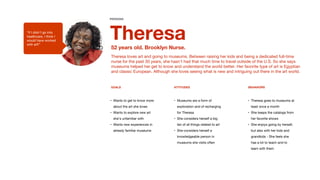
Persona
52 years old. Brooklyn Nurse.
Theresa loves art and going to museums. Between raising her kids and being a dedicated full-time
nurse for the past 30 years, she hasn’t had that much time to travel outside of the U.S. So she says
museums helped her get to know and understand the world better. Her favorite type of art is Egyptian
and classic European. Although she loves seeing what is new and intriguing out there in the art world. 
Theresa 
GOALS
 BEHAVIORS
ATTITUDES
•  Wants to get to know more
about the art she loves
•  Wants to explore new art
she’s unfamiliar with
•  Wants new experiences in
already familiar museums
•  Museums are a form of
exploration and of recharging
for Theresa
•  She considers herself a big
fan of all things related to art
•  She considers herself a
knowledgeable person in
museums she visits often
•  Theresa goes to museums at
least once a month
•  She keeps the catalogs from
her favorite shows
•  She enjoys going by herself,
but also with her kids and
grandkids - She feels she
has a lot to teach and to
learn with them
PERSONA
“If I didn’t go into
healthcare, I think I
would have worked 
with art!”
Theresa needs a way to navigate museums she already knows in a different way because the
more she contemplates new things and gets to know about the art she loves, the more she
feels good about herself.
We believe that by helping Theresa gain a fresh perspective we will achieve
a better quality time for her at museums.
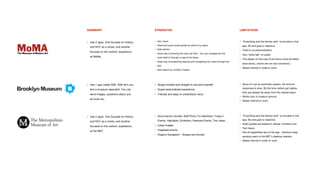
Competitive Research
SUMMARY
 LIMITATIONS
•  Has 2 apps. One focused on History
and NYC as a whole, and another
focused on the visitors’ experience
at MoMa.
•  Has 1 app called ASK. ASK let’s you
text a museum specialist. You can
send images, questions about any
art work etc.
•  Since it’s not an automatic system, the time for
responses is slow. By the time visitors get replies,
they are already far away from the original piece.
•  Works only in museum ground.
•  Needs internet to work.
•  “Everything and the kitchen sink” is included in this
app. No end goal or objective.
•  There is no personalization. 
•  Very “artist talk” on audio.
•  The design on the map of the floors could be better.
(load slowly, zooms are not very functional.) 
•  Needs internet in order to work.
•  Has 2 apps. One focused on History
and NYC as a whole, and another
focused on the visitors’ experience
at the MET.
•  “Everything and the kitchen sink” is included in this
app. No end goal or objective.
•  Audio guides are based on pieces’ numbers only.
•  Text heavy.
•  Not all capabilities are on the app - Sections keep
sending users to the MET’s desktop website.
•  Needs internet in order to work.
STRENGTHS 
•  Very visual. 
•  Great and quick audio guides by artist or by piece.
•  Kids section.
•  Good way of showing the work per floor. You can navigate per the
work itself or through a map of the floors.
•  Great way of presenting features and navigating new users through the
app.
•  Nice search by number of piece.
•  Single minded and straight to the point benefit. 
•  Super personalized experience.
•  Friendly and easy to understand voice.
•  Good section divides: Staff Picks, For Members, Today’s
Events, Highlights, Exhibition, Featured Events, The Latest…
•  Large images. 
•  Integrates events.
•  Organic Navigation - Swipes and Scrolls.
User Flows
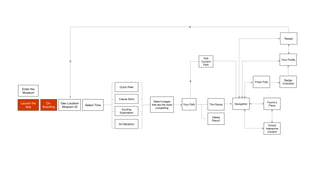
Enter the
Museum
Launch the
App
Select Time
Casual Stroll
Quick Peek
Exciting
Exploration
Select images
that are the most
compelling 
Your Path
 Navigation
The Pieces
Delete
Piece?
Art Marathon
Found a
Piece
Unlock
Interactive
Content
Finish Path
Badge
Unlocked
Geo Location
Museum ID
Your Profile
On-
Boarding
Restart
Edit
Current
Path
Prototypes
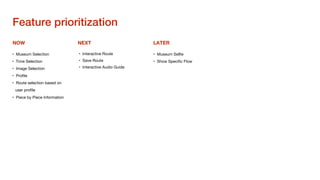
NEXT
 LATER
NOW
•  Museum Selection
•  Time Selection
•  Image Selection
•  Profile
•  Route selection based on
user profile
•  Piece by Piece Information
•  Interactive Route
•  Save Route
•  Interactive Audio Guide
•  Museum Selfie
•  Show Specific Flow
Feature prioritization!
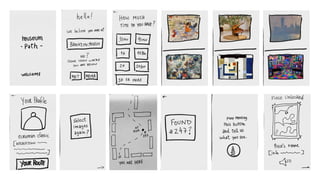
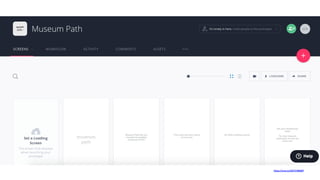
https://invis.io/3Z5YON6MP

Museum Path: Navigating Art Through UXD

  • 1.
  • 2.
    Young Woman witha Water Pitcher! Johannes Vermeer
  • 3.
    More than 2,000,000square feet Source: Wikipedia, free encyclopedia.
  • 4.
    It would take83,333 “Young Woman with a Water Pitcher” to tile the floor at the Met
  • 5.
  • 6.
    Over 8694 Egyptianobjects Source: Brooklyn Museum official website.
  • 7.
    If you spenttwenty minutes with each object it would take you four months to see the whole collection
  • 8.
    Campbell's soup cans! Andy Warhol
  • 9.
    Over 10,000 artists inMoMA’s collection Source: Moma’s official website
  • 10.
    Enough artists tofill almost 4 Carnegie Hall Source: Population of Brooklyn in 2010 = 2.49 million
  • 11.
    Source: “Alexander McQueen:Savage Beauty,” at the Metropolitan Museum of Art, How might we make large museums a little less overwhelming?
  • 12.
    “To get peoplein the doors (and ultimately deliver a better experience with the art), let’s stop telling them why they should come and start asking them why they do.” - JEHRA PATRICK, Program Director for Mn Artists
  • 13.
    THINGS PARTICIPANT SAIDTHAT SURPRISED ME: THINGS THAT MATTER THE MOST TO PARTICIPANT: MAIN THEMES AND LEARNINGS USERS INTERVIEWED OTHER OBSERVATIONS FROM BEING ON SITE AT THE BROOKLYN MUSEUM: •  Sam - 31 years old - Museum Expert (Works at the Brooklyn Museum) •  Jonathan - 40 years old - Tourist visiting from Miami •  Margaret - 59 years old - from Manhattan - Museum member and enthusiast •  Morgan - 28 years old - Millennial Brooklynite •  Cindy - 26 years old - Manhattan Millennial •  Some people prefer being alone when visiting museums. •  Artists’ and Museums’ Instagrams are HUGE triggers for visitors. •  The MET is constantly mentioned as being really stressful and busy. Crowds and people running around. It’s horrible. •  Most people don’t plan their visit prior to going to a big museum. •  “When I visit museums, I try not to see the whole thing. I like to spend time with a couple of things and reflect.” •  “I visit museums because I can’t learn about the world any other way. Is the only way I can make sense of history or politics or culture… I trust artists to see what’s really happening.” •  People don’t download the app - “I should have downloaded the museum app but I didn’t…” •  “Once my teacher told me: Don’t judge the art. Let the art judge you. You just came to be here. This art piece comes from a long succession of events.” •  “I remember the emotion of seeing a Picasso for the 1st time” •  Overall sentiment that you should be going to museums more often to stay up to date. (FOMO) •  The more background you have on the artist or the art work the more people enjoy / remember an experience. Example of a Kandinsky exhibit that presented the artist process and sketches, and revealed the work only at the end - This build is important. •  Museum crowds are the biggest pain points, but even with crowds, visiting museums is never considered a bad experience. •  Shows are more memorable than individual pieces and artists. Everyone has a hard time remembering artists names. •  An inviting space. •  Personalization and visiting guides that stay with you. •  Smaller size museums that are easier to navigate and you don’t get burnt out. •  When the show helps you to make connections seamless. •  Bringing the history that you learn in school to life. FROM THE MUSEUM SPECIALIST: •  What are the biggest challenge to get people to visit museums more often? Feeling welcomed, whatever that means for the individual visitor. 1.  If you don’t have a background in art, is the language going to make you feel stupid? 2.  If it’s a person with disabilities, does the museum have the appropriate materials to welcome them? 3.  Is the staff going to be friendly if you’re a person of color or a queer person? •  A lot of older folks are there with family or alone. •  A lot of people with special needs. •  A lot of people with babies and young kids. Source: Proprietary Research
  • 14.
    “I visit museumsbecause I can’t learn about the world any other way. It is the only way I can make sense of history or politics or culture… I trust artists to see what’s really happening.” - SAM, Museum Professional Source: Proprietary Research
  • 15.
    Motivational identities andvisitor characterization! Explorers Explorers come because attending museums interests them and appeals to their curiosity. If you asked them if they like art they would say ‘yes;’ if you asked them if they came for something in particular, they would probably say ‘no,’ they ‘just like art and know what they like when they see it.’ They do not have concrete learning goals, like ‘I’m going to go to the MIA to learn everything I can about Expressionism,’ but they like to know new things. [This is the type to read didactics and labels, but might not know names and contextual references.] This type could really be anyone. Explorers’ goal is to satisfy a curiosity. They may or may not know how to use the space. Facilitator Facilitators come because of someone else. They are perhaps bringing a friend or a group of people—possibly youth or students—because they think that the visit would benefit the other party or parties, not because of a personal need. Their personal need is to make a good experience for others. Experience Seeker An experience seeker is a person who is checking off a list of things to do, whether personal or as a tourist. They want to see the thing that is iconic of that place, they want to do ‘what you’re supposed to do in that city or area.’ They may need to see the museum’s highlights to feel satisfied. Professional/Hobbiest This category includes teachers, educators, museum professionals, artists, and people in related fields. Their goals may range by their particular role as a professional or hobbiest; a photographer may attend with the goal in mind to take pictures or to learn about photography through exhibits. An art educator may be interested in the art as in their field of interest, or they may be planning a lesson, etc. Rechargers Rechargers find the museum a place to ‘get away from it all,’ to decompress, and their visit is almost a spiritual one. They tend to avoid crowds or sensations and are fairly self-sufficient. A successful visit for them will leave them with the feeling that they have gotten away. our focus for this project
  • 16.
  • 17.
    52 years old.Brooklyn Nurse. Theresa loves art and going to museums. Between raising her kids and being a dedicated full-time nurse for the past 30 years, she hasn’t had that much time to travel outside of the U.S. So she says museums helped her get to know and understand the world better. Her favorite type of art is Egyptian and classic European. Although she loves seeing what is new and intriguing out there in the art world. Theresa GOALS BEHAVIORS ATTITUDES •  Wants to get to know more about the art she loves •  Wants to explore new art she’s unfamiliar with •  Wants new experiences in already familiar museums •  Museums are a form of exploration and of recharging for Theresa •  She considers herself a big fan of all things related to art •  She considers herself a knowledgeable person in museums she visits often •  Theresa goes to museums at least once a month •  She keeps the catalogs from her favorite shows •  She enjoys going by herself, but also with her kids and grandkids - She feels she has a lot to teach and to learn with them PERSONA “If I didn’t go into healthcare, I think I would have worked with art!”
  • 18.
    Theresa needs away to navigate museums she already knows in a different way because the more she contemplates new things and gets to know about the art she loves, the more she feels good about herself.
  • 19.
    We believe thatby helping Theresa gain a fresh perspective we will achieve a better quality time for her at museums.
  • 20.
  • 21.
    SUMMARY LIMITATIONS •  Has2 apps. One focused on History and NYC as a whole, and another focused on the visitors’ experience at MoMa. •  Has 1 app called ASK. ASK let’s you text a museum specialist. You can send images, questions about any art work etc. •  Since it’s not an automatic system, the time for responses is slow. By the time visitors get replies, they are already far away from the original piece. •  Works only in museum ground. •  Needs internet to work. •  “Everything and the kitchen sink” is included in this app. No end goal or objective. •  There is no personalization. •  Very “artist talk” on audio. •  The design on the map of the floors could be better. (load slowly, zooms are not very functional.) •  Needs internet in order to work. •  Has 2 apps. One focused on History and NYC as a whole, and another focused on the visitors’ experience at the MET. •  “Everything and the kitchen sink” is included in this app. No end goal or objective. •  Audio guides are based on pieces’ numbers only. •  Text heavy. •  Not all capabilities are on the app - Sections keep sending users to the MET’s desktop website. •  Needs internet in order to work. STRENGTHS •  Very visual. •  Great and quick audio guides by artist or by piece. •  Kids section. •  Good way of showing the work per floor. You can navigate per the work itself or through a map of the floors. •  Great way of presenting features and navigating new users through the app. •  Nice search by number of piece. •  Single minded and straight to the point benefit. •  Super personalized experience. •  Friendly and easy to understand voice. •  Good section divides: Staff Picks, For Members, Today’s Events, Highlights, Exhibition, Featured Events, The Latest… •  Large images. •  Integrates events. •  Organic Navigation - Swipes and Scrolls.
  • 22.
  • 23.
    Enter the Museum Launch the App SelectTime Casual Stroll Quick Peek Exciting Exploration Select images that are the most compelling Your Path Navigation The Pieces Delete Piece? Art Marathon Found a Piece Unlock Interactive Content Finish Path Badge Unlocked Geo Location Museum ID Your Profile On- Boarding Restart Edit Current Path
  • 24.
  • 26.
    NEXT LATER NOW •  MuseumSelection •  Time Selection •  Image Selection •  Profile •  Route selection based on user profile •  Piece by Piece Information •  Interactive Route •  Save Route •  Interactive Audio Guide •  Museum Selfie •  Show Specific Flow Feature prioritization!
  • 27.