Are there common backgrounds that
all of humanity draws reference
from?
● Sums: EMOTION. We all experience emotion in similar ways. We can all connect to things
emotionally.
● Imani: Common knowledge, common things...like the majority of humanity hates Hitler.
(Common historical biases).
● Moh: Pain and Oppression that we feel from history, we remember it and try to avoid it.
● Elianny: Certain stuff that everyone is exposed to. We all know it, but everybody knows it.
● Rosandris: Pain and struggle, we need empathy to help us relate to each other more.
○ Kozak: What keeps us from relating to each other?
■ Sums: Race, background, profession (class), humans have created the barriers
from relating to each other.
■ Elianny: segregation, religions, cultures.
■ Imani: Difference of opinions about anything
● Presidential elections (45th at the moment)
● Race, borders, religion.
P2
Psst! Write DIANA AL-
HADID in big letters at the
top of a new page!
Are there common backgrounds that
all of humanity draws reference
from?
● Eric: Once a story has been broken down enough, there’s one story that all
other stories follow (shakespeare, biblical stories).
● Miles: Thinkin “What if?” because other animals don’t think that way.
(potential for hypotheticals)
● What is the common “human culture?”
○ The emotions we all share?
■ Pain?
■ Happiness?
○ The seven deadly sins? The need for something bigger than us.
○ Interaction with one another. Creating things for the sake of creating
things.
P3
Psst! Write DIANA AL-
HADID in big letters at the
top of a new page!
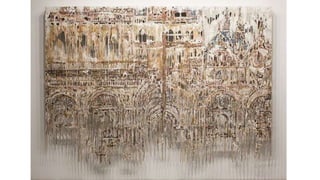
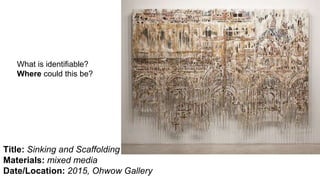
Title: Sinking and Scaffolding
Materials: mixed media
Date/Location: 2015, Ohwow Gallery
What is identifiable?
Where could this be?
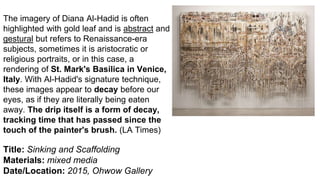
Title: Sinking and Scaffolding
Materials: mixed media
Date/Location: 2015, Ohwow Gallery
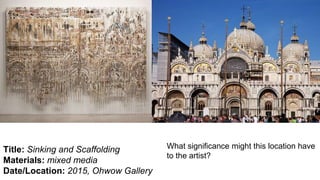
The imagery of Diana Al-Hadid is often
highlighted with gold leaf and is abstract and
gestural but refers to Renaissance-era
subjects, sometimes it is aristocratic or
religious portraits, or in this case, a
rendering of St. Mark's Basilica in Venice,
Italy. With Al-Hadid's signature technique,
these images appear to decay before our
eyes, as if they are literally being eaten
away. The drip itself is a form of decay,
tracking time that has passed since the
touch of the painter's brush. (LA Times)
Title: Sinking and Scaffolding
Materials: mixed media
Date/Location: 2015, Ohwow Gallery
What significance might this location have
to the artist?
HW for MONDAY Take a photo of something in a
state of decay and email it to
kozakartclass@mhshs.org along with a short
description of what it is, where you found it, and
why it caught your attention.
All emails must be received by 11:59 on Sunday
9/16
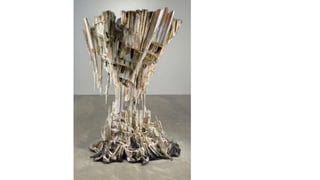
Title: Self Melt
Materials:polymer gypsum, steel, polystyrene, fiberglass, cardboard, wax, pigment
Date/Location: Created in 2008, has been touring.
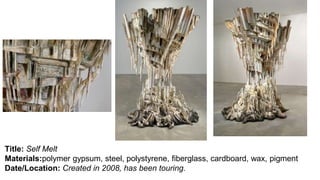
Title: Self Melt
Materials:polymer gypsum, steel, polystyrene, fiberglass, cardboard, wax, pigment
Date/Location: Created in 2008, has been touring.
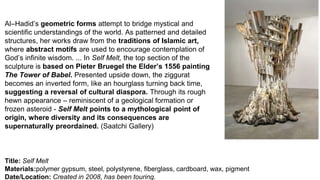
Al–Hadid’s geometric forms attempt to bridge mystical and
scientific understandings of the world. As patterned and detailed
structures, her works draw from the traditions of Islamic art,
where abstract motifs are used to encourage contemplation of
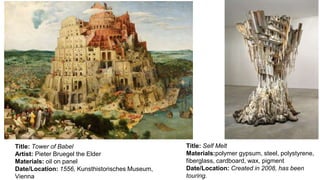
God’s infinite wisdom. ... In Self Melt, the top section of the
sculpture is based on Pieter Bruegel the Elder’s 1556 painting
The Tower of Babel. Presented upside down, the ziggurat
becomes an inverted form, like an hourglass turning back time,
suggesting a reversal of cultural diaspora. Through its rough
hewn appearance – reminiscent of a geological formation or
frozen asteroid - Self Melt points to a mythological point of
origin, where diversity and its consequences are
supernaturally preordained. (Saatchi Gallery)
Title: Self Melt
Materials:polymer gypsum, steel, polystyrene,
fiberglass, cardboard, wax, pigment
Date/Location: Created in 2008, has been
touring.
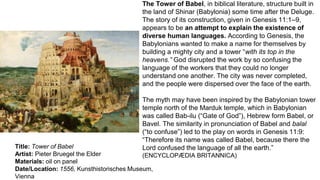
Title: Tower of Babel
Artist: Pieter Bruegel the Elder
Materials: oil on panel
Date/Location: 1556, Kunsthistorisches Museum,
Vienna
Title: Tower of Babel
Artist: Pieter Bruegel the Elder
Materials: oil on panel
Date/Location: 1556, Kunsthistorisches Museum,
Vienna
The Tower of Babel, in biblical literature, structure built in
the land of Shinar (Babylonia) some time after the Deluge.
The story of its construction, given in Genesis 11:1–9,
appears to be an attempt to explain the existence of
diverse human languages. According to Genesis, the
Babylonians wanted to make a name for themselves by
building a mighty city and a tower “with its top in the
heavens.” God disrupted the work by so confusing the
language of the workers that they could no longer
understand one another. The city was never completed,
and the people were dispersed over the face of the earth.
The myth may have been inspired by the Babylonian tower
temple north of the Marduk temple, which in Babylonian
was called Bab-ilu (“Gate of God”), Hebrew form Babel, or
Bavel. The similarity in pronunciation of Babel and balal
(“to confuse”) led to the play on words in Genesis 11:9:
“Therefore its name was called Babel, because there the
Lord confused the language of all the earth.”
(ENCYCLOPÆDIA BRITANNICA)
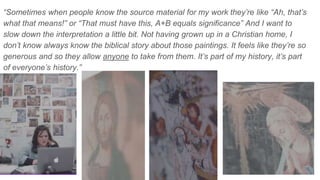
“Sometimes when people know the source material for my work they’re like “Ah, that’s
what that means!” or “That must have this, A+B equals significance” And I want to
slow down the interpretation a little bit. Not having grown up in a Christian home, I
don’t know always know the biblical story about those paintings. It feels like they’re so
generous and so they allow anyone to take from them. It’s part of my history, it’s part
of everyone’s history.”
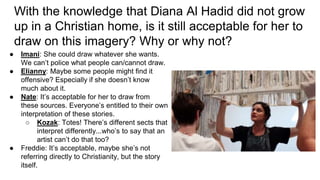
With the knowledge that Diana Al Hadid did not grow
up in a Christian home, is it still acceptable for her to
draw on this imagery? Why or why not?
● Imani: She could draw whatever she wants.
We can’t police what people can/cannot draw.
● Elianny: Maybe some people might find it
offensive? Especially if she doesn’t know
much about it.
● Nate: It’s acceptable for her to draw from
these sources. Everyone’s entitled to their own
interpretation of these stories.
○ Kozak: Totes! There’s different sects that
interpret differently...who’s to say that an
artist can’t do that too?
● Freddie: It’s acceptable, maybe she’s not
referring directly to Christianity, but the story
itself.
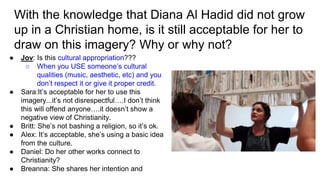
With the knowledge that Diana Al Hadid did not grow
up in a Christian home, is it still acceptable for her to
draw on this imagery? Why or why not?
● Jov: Is this cultural appropriation???
○ When you USE someone’s cultural
qualities (music, aesthetic, etc) and you
don’t respect it or give it proper credit.
● Sara:It’s acceptable for her to use this
imagery...it’s not disrespectful….I don’t think
this will offend anyone….it doesn’t show a
negative view of Christianity.
● Britt: She’s not bashing a religion, so it’s ok.
● Alex: It’s acceptable, she’s using a basic idea
from the culture.
● Daniel: Do her other works connect to
Christianity?
● Breanna: She shares her intention and
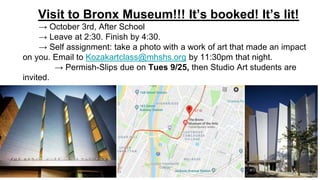
Visit to Bronx Museum!!! It’s booked! It’s lit!
→ October 3rd, After School
→ Leave at 2:30. Finish by 4:30.
→ Self assignment: take a photo with a work of art that made an impact
on you. Email to Kozakartclass@mhshs.org by 11:30pm that night.
→ Permish-Slips due on Tues 9/25, then Studio Art students are
invited.
What does this
artist seem like as
a person??
● Lauren: She seems restless, she doesn’t wannt do the
same technique or piece twice.
● Brianna: She’s a risk taker, and creative. Figuring out
what she can do with the drips, she took the chance.
● Sara: She seems FREE in a way...not constricted.
● Eric: She seems ambiguous, and she doesn’t want her
work to be immediately understood.
● Miles: She might daydream or doze off in her own world
thinking of stuff she may have read or heard.
● Jov: She thinks differently from everyone, she takes
expectations to a while new level.
○ ARTISTIC PROCESS???
● Britt: She turns her disadvantages into advantages, like
with limited space and learning to work within it.
● Alex: Go big or go HOME.
● Araceli: IT’s TIME consuming!
What does this
artist seem like as
a person??
● Eli: She seems more creative than other artists, the way she uses
the drips as building.
● Sums: She looks really passionate about her work, the way she
talks about art, she has a wide range with everything.
● Freddie: She thinks out of the box, she doesn’t just follow the
ordinary traditional methods for making art.
● Nate: She’s seems calm. She’s okay with the work being messy.
● Imani: She’s mysterious. She doesn’t want to put out her
intention, she wants it to be totally up to the audience.
● Ros: Her work isn’t “conventional” and she’s very physical with
her art. “It’s not just an image, it becomes an object.”
● Elianny: She’s very laid back, messy, and she just like, goes for
it.
● ARTIST PROCESS
● Dom: (doesn’t want to play videogames with her) She makes
things with a lot of support from people around her (art assistants)
● Elianny: She seems to have a lot of fun doing it. I usually think of
artists as so serious.
● Sam: She doesn't let the assistants control what’s happening with
the art, but she lets them work independently.
● Nate: It takes time, it’s detailed.
Articles to check out
https://news.artnet.com/exhibitions/art21-watch-diana-al-hadid-1310702
https://www.interviewmagazine.com/art/diana-al-hadid-marianne-boesky

Diana Al Hadid - past work

  • 1.
    Are there commonbackgrounds that all of humanity draws reference from? ● Sums: EMOTION. We all experience emotion in similar ways. We can all connect to things emotionally. ● Imani: Common knowledge, common things...like the majority of humanity hates Hitler. (Common historical biases). ● Moh: Pain and Oppression that we feel from history, we remember it and try to avoid it. ● Elianny: Certain stuff that everyone is exposed to. We all know it, but everybody knows it. ● Rosandris: Pain and struggle, we need empathy to help us relate to each other more. ○ Kozak: What keeps us from relating to each other? ■ Sums: Race, background, profession (class), humans have created the barriers from relating to each other. ■ Elianny: segregation, religions, cultures. ■ Imani: Difference of opinions about anything ● Presidential elections (45th at the moment) ● Race, borders, religion. P2 Psst! Write DIANA AL- HADID in big letters at the top of a new page!
  • 2.
    Are there commonbackgrounds that all of humanity draws reference from? ● Eric: Once a story has been broken down enough, there’s one story that all other stories follow (shakespeare, biblical stories). ● Miles: Thinkin “What if?” because other animals don’t think that way. (potential for hypotheticals) ● What is the common “human culture?” ○ The emotions we all share? ■ Pain? ■ Happiness? ○ The seven deadly sins? The need for something bigger than us. ○ Interaction with one another. Creating things for the sake of creating things. P3 Psst! Write DIANA AL- HADID in big letters at the top of a new page!
  • 4.
    Title: Sinking andScaffolding Materials: mixed media Date/Location: 2015, Ohwow Gallery What is identifiable? Where could this be?
  • 5.
    Title: Sinking andScaffolding Materials: mixed media Date/Location: 2015, Ohwow Gallery The imagery of Diana Al-Hadid is often highlighted with gold leaf and is abstract and gestural but refers to Renaissance-era subjects, sometimes it is aristocratic or religious portraits, or in this case, a rendering of St. Mark's Basilica in Venice, Italy. With Al-Hadid's signature technique, these images appear to decay before our eyes, as if they are literally being eaten away. The drip itself is a form of decay, tracking time that has passed since the touch of the painter's brush. (LA Times)
  • 6.
    Title: Sinking andScaffolding Materials: mixed media Date/Location: 2015, Ohwow Gallery What significance might this location have to the artist?
  • 7.
    HW for MONDAYTake a photo of something in a state of decay and email it to kozakartclass@mhshs.org along with a short description of what it is, where you found it, and why it caught your attention. All emails must be received by 11:59 on Sunday 9/16
  • 9.
    Title: Self Melt Materials:polymergypsum, steel, polystyrene, fiberglass, cardboard, wax, pigment Date/Location: Created in 2008, has been touring.
  • 10.
    Title: Self Melt Materials:polymergypsum, steel, polystyrene, fiberglass, cardboard, wax, pigment Date/Location: Created in 2008, has been touring. Al–Hadid’s geometric forms attempt to bridge mystical and scientific understandings of the world. As patterned and detailed structures, her works draw from the traditions of Islamic art, where abstract motifs are used to encourage contemplation of God’s infinite wisdom. ... In Self Melt, the top section of the sculpture is based on Pieter Bruegel the Elder’s 1556 painting The Tower of Babel. Presented upside down, the ziggurat becomes an inverted form, like an hourglass turning back time, suggesting a reversal of cultural diaspora. Through its rough hewn appearance – reminiscent of a geological formation or frozen asteroid - Self Melt points to a mythological point of origin, where diversity and its consequences are supernaturally preordained. (Saatchi Gallery)
  • 11.
    Title: Self Melt Materials:polymergypsum, steel, polystyrene, fiberglass, cardboard, wax, pigment Date/Location: Created in 2008, has been touring. Title: Tower of Babel Artist: Pieter Bruegel the Elder Materials: oil on panel Date/Location: 1556, Kunsthistorisches Museum, Vienna
  • 12.
    Title: Tower ofBabel Artist: Pieter Bruegel the Elder Materials: oil on panel Date/Location: 1556, Kunsthistorisches Museum, Vienna The Tower of Babel, in biblical literature, structure built in the land of Shinar (Babylonia) some time after the Deluge. The story of its construction, given in Genesis 11:1–9, appears to be an attempt to explain the existence of diverse human languages. According to Genesis, the Babylonians wanted to make a name for themselves by building a mighty city and a tower “with its top in the heavens.” God disrupted the work by so confusing the language of the workers that they could no longer understand one another. The city was never completed, and the people were dispersed over the face of the earth. The myth may have been inspired by the Babylonian tower temple north of the Marduk temple, which in Babylonian was called Bab-ilu (“Gate of God”), Hebrew form Babel, or Bavel. The similarity in pronunciation of Babel and balal (“to confuse”) led to the play on words in Genesis 11:9: “Therefore its name was called Babel, because there the Lord confused the language of all the earth.” (ENCYCLOPÆDIA BRITANNICA)
  • 13.
    “Sometimes when peopleknow the source material for my work they’re like “Ah, that’s what that means!” or “That must have this, A+B equals significance” And I want to slow down the interpretation a little bit. Not having grown up in a Christian home, I don’t know always know the biblical story about those paintings. It feels like they’re so generous and so they allow anyone to take from them. It’s part of my history, it’s part of everyone’s history.”
  • 14.
    With the knowledgethat Diana Al Hadid did not grow up in a Christian home, is it still acceptable for her to draw on this imagery? Why or why not? ● Imani: She could draw whatever she wants. We can’t police what people can/cannot draw. ● Elianny: Maybe some people might find it offensive? Especially if she doesn’t know much about it. ● Nate: It’s acceptable for her to draw from these sources. Everyone’s entitled to their own interpretation of these stories. ○ Kozak: Totes! There’s different sects that interpret differently...who’s to say that an artist can’t do that too? ● Freddie: It’s acceptable, maybe she’s not referring directly to Christianity, but the story itself.
  • 15.
    With the knowledgethat Diana Al Hadid did not grow up in a Christian home, is it still acceptable for her to draw on this imagery? Why or why not? ● Jov: Is this cultural appropriation??? ○ When you USE someone’s cultural qualities (music, aesthetic, etc) and you don’t respect it or give it proper credit. ● Sara:It’s acceptable for her to use this imagery...it’s not disrespectful….I don’t think this will offend anyone….it doesn’t show a negative view of Christianity. ● Britt: She’s not bashing a religion, so it’s ok. ● Alex: It’s acceptable, she’s using a basic idea from the culture. ● Daniel: Do her other works connect to Christianity? ● Breanna: She shares her intention and
  • 16.
    Visit to BronxMuseum!!! It’s booked! It’s lit! → October 3rd, After School → Leave at 2:30. Finish by 4:30. → Self assignment: take a photo with a work of art that made an impact on you. Email to Kozakartclass@mhshs.org by 11:30pm that night. → Permish-Slips due on Tues 9/25, then Studio Art students are invited.
  • 17.
    What does this artistseem like as a person?? ● Lauren: She seems restless, she doesn’t wannt do the same technique or piece twice. ● Brianna: She’s a risk taker, and creative. Figuring out what she can do with the drips, she took the chance. ● Sara: She seems FREE in a way...not constricted. ● Eric: She seems ambiguous, and she doesn’t want her work to be immediately understood. ● Miles: She might daydream or doze off in her own world thinking of stuff she may have read or heard. ● Jov: She thinks differently from everyone, she takes expectations to a while new level. ○ ARTISTIC PROCESS??? ● Britt: She turns her disadvantages into advantages, like with limited space and learning to work within it. ● Alex: Go big or go HOME. ● Araceli: IT’s TIME consuming!
  • 18.
    What does this artistseem like as a person?? ● Eli: She seems more creative than other artists, the way she uses the drips as building. ● Sums: She looks really passionate about her work, the way she talks about art, she has a wide range with everything. ● Freddie: She thinks out of the box, she doesn’t just follow the ordinary traditional methods for making art. ● Nate: She’s seems calm. She’s okay with the work being messy. ● Imani: She’s mysterious. She doesn’t want to put out her intention, she wants it to be totally up to the audience. ● Ros: Her work isn’t “conventional” and she’s very physical with her art. “It’s not just an image, it becomes an object.” ● Elianny: She’s very laid back, messy, and she just like, goes for it. ● ARTIST PROCESS ● Dom: (doesn’t want to play videogames with her) She makes things with a lot of support from people around her (art assistants) ● Elianny: She seems to have a lot of fun doing it. I usually think of artists as so serious. ● Sam: She doesn't let the assistants control what’s happening with the art, but she lets them work independently. ● Nate: It takes time, it’s detailed.
  • 19.
    Articles to checkout https://news.artnet.com/exhibitions/art21-watch-diana-al-hadid-1310702 https://www.interviewmagazine.com/art/diana-al-hadid-marianne-boesky

Editor's Notes

  • #4 http://www.latimes.com/entertainment/arts/la-et-cm-diana-al-hadid-at-ohwow-gallery-20150427-story.html#
  • #5 http://www.latimes.com/entertainment/arts/la-et-cm-diana-al-hadid-at-ohwow-gallery-20150427-story.html#
  • #6 http://www.latimes.com/entertainment/arts/la-et-cm-diana-al-hadid-at-ohwow-gallery-20150427-story.html#
  • #7 http://www.latimes.com/entertainment/arts/la-et-cm-diana-al-hadid-at-ohwow-gallery-20150427-story.html#
  • #9 www.dianaalhadid.com/work/self-melt
  • #10 www.dianaalhadid.com/work/self-melt
  • #11 www.dianaalhadid.com/work/self-melt https://www.saatchigallery.com/artists/artpages/diana_hadid_self_melt_2.htm
  • #12 www.dianaalhadid.com/work/self-melt https://www.saatchigallery.com/artists/artpages/diana_hadid_self_melt_2.htm
  • #13 www.dianaalhadid.com/work/self-melt https://www.saatchigallery.com/artists/artpages/diana_hadid_self_melt_2.htm
  • #14 https://art21.org/watch/new-york-close-up/diana-al-hadid-plays-the-classics/
  • #18 https://art21.org/watch/new-york-close-up/diana-al-hadid-plays-the-classics/ https://www.youtube.com/watch?v=SDIAn5KoJzg
  • #19 https://art21.org/watch/new-york-close-up/diana-al-hadid-plays-the-classics/ https://www.youtube.com/watch?v=SDIAn5KoJzg