Page | 1
Page | 2
1. Introduction
A dabbawala is a person in Mumbai, India, whose job is carrying and delivering freshly-made food
fromhome in lunchboxestooffice workers.Theyare formally known as MTBSA (Mumbai Tiffin Box
SuppliersAssociation),butmostpeople refertothemas the dabbawalas.The dabbawalasoriginated
whenIndiawasunderBritishrule.Since manyBritishpeople whocame toIndiadid not like the local
food, a service was set up to bring lunch to their offices straight from their home. The 100-odd
dabbas (or lunch boxes) of those days were carried around in horse-drawn trams and delivered in
the Fort area, which housed important offices. Today, businessmen in modern Mumbai use this
service andhave become the maincustomersof the dabbawalas.Infact, the 5,000-strong workforce
(there are a handful of women) is so well-known that Prince Charles paid them a visit during his
recenttripto India.Several academicinstitutionsregularlyinvitethe dabbawalas’representativesfor
discussion, and to complement and enhance their academic content. At times, businesses find it
useful to illustrate the application of how such a system uses Six Sigma principles to improve its
operations.
The main reasonpeople use the service of the dabbawalas is to eat a proper, home-prepared meal
during lunch. Office-goers in Mumbai usually leave at 7 am and do not get back until after 7 pm.
Most of them commute from suburbs of Mumbai and travel south to the main commercial area of
Mumbai.The railwaynetworkduringthe peakhoursis jam-packed with commuters hanging on the
trainswithone hand.Thus bringingone’slunchatthat time is not feasible. Commuters need to use
one hand to hangon fromthe trainsand holdon to their briefcases with their other hands. Most of
the commuters cannot afford to eat outside every day. Offices often do not provide a canteen or
cafeteriaservice fortheiremployees.Eating on the roadside is unhealthy and unhygienic. Plus, the
Indiandiversityof foodhabitsmakesitverydifficulttoanswerthe specificneedof eachemployee at
the office canteen.Bydeliveringtoeachemployeehis Tiffinorlunchfilledwith food prepared at his
home,the dabbawalassolve the problemforanestimated200,000 people.Theycharge between Rs.
150 to Rs. 300 per dabba per month, depending on the location and collection time.
2. Supply chain
During a dabba’s journey from kitchen to consumer, it is handled by between three and twelve
differentdeliverymen.Foradabbawala,the daybeginsat9 am, withan hour spent collecting all the
20-25 dabbasinhisarea. He will have apre-assignedsetof homesunderhisarea.He will either walk
or travel on a bicycle tocollectthe lunchboxes.The households are expected to have the lunch box
Page | 3
readywhenhe goesfor collection.Afterthe collection,he will go to the local train station where he
gathers with the other dabbawalas of his area. At the departure station, the dabbas will be shared
out according to their next destinations. Next, the dabbas are sorted according to the next train
station and are handed off to the dabbawala who is responsible for that particular station for
delivery to the final destination.
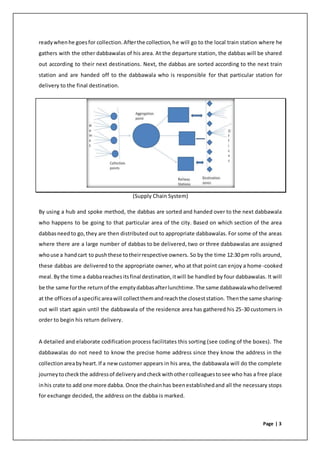
(Supply Chain System)
By using a hub and spoke method, the dabbas are sorted and handed over to the next dabbawala
who happens to be going to that particular area of the city. Based on which section of the area
dabbasneedto go,they are then distributed out to appropriate dabbawalas. For some of the areas
where there are a large number of dabbas to be delivered, two or three dabbawalas are assigned
whouse a handcart to pushthese totheirrespective owners. So by the time 12:30 pm rolls around,
these dabbas are delivered to the appropriate owner, who at that point can enjoy a home-cooked
meal.Bythe time a dabbareachesitsfinal destination,itwill be handled by four dabbawalas. It will
be the same forthe returnof the emptydabbasafterlunchtime.The same dabbawalawhodelivered
at the officesof aspecificareawill collectthemandreachthe closeststation. Thenthe same sharing-
out will start again until the dabbawala of the residence area has gathered his 25-30 customers in
order to begin his return delivery.
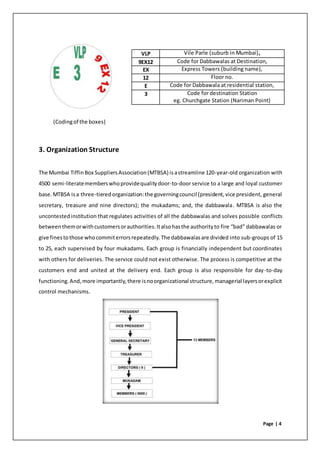
A detailed and elaborate codification process facilitates this sorting (see coding of the boxes). The
dabbawalas do not need to know the precise home address since they know the address in the
collectionareabyheart.If a newcustomer appears in his area, the dabbawala will do the complete
journeytocheckthe addressof deliveryandcheckwithothercolleaguestosee who has a free place
inhis crate to add one more dabba. Once the chainhas beenestablishedand all the necessary stops
for exchange decided, the address on the dabba is marked.
Page | 4
(Codingof the boxes)
3. Organization Structure
The Mumbai TiffinBox SuppliersAssociation(MTBSA) isastreamline 120-year-old organization with
4500 semi-literatememberswhoprovidequalitydoor-to-door service to a large and loyal customer
base.MTBSA isa three-tieredorganization:the governingcouncil (president,vice president, general
secretary, treasure and nine directors); the mukadams; and, the dabbawala. MTBSA is also the
uncontestedinstitution that regulates activities of all the dabbawalas and solves possible conflicts
betweenthemorwithcustomersorauthorities.Italsohasthe authorityto fire “bad” dabbawalas or
give finestothose whocommiterrorsrepeatedly. The dabbawalasare divided into sub-groups of 15
to 25, each supervised by four mukadams. Each group is financially independent but coordinates
with others for deliveries. The service could not exist otherwise. The process is competitive at the
customers end and united at the delivery end. Each group is also responsible for day-to-day
functioning.And,more importantly,there isnoorganizational structure,managerial layersorexplicit
control mechanisms.
VLP Vile Parle (suburb in Mumbai),
9EX12 Code for Dabbawalas at Destination,
EX Express Towers (building name),
12 Floor no.
E Code for Dabbawala at residential station,
3 Code for destination Station
eg. Churchgate Station (Nariman Point)
Page | 5
Apart fromcommitmentand dedication, each dabbawala, like any other businessman, has to bring
some capital withhim.The minimuminvestmentis twobicycles(approximatelyRs.4,000),a wooden
crate for the tiffins (Rs. 500), at least one white, cotton kurta-pyjama (Rs. 600), and Rs. 20 for the
trademarkGandhi topi (hat). Onaverage,one dabbawalacanearn anywhere betweenRs.5000 to Rs.
6000 each month.Outof this,he contributes Rs. 15 per month to the association, which spends the
money on community work, loans and providing venues for marriages at a discount. Meetings are
held every month to discuss customer service, investigate complaints from customers and solve
otherdisputeswithinthe organization. If a customer complains of poor service, the association can
shift the customer’s account to another dabbawala and no one is allowed to undercut each other.
Dabbawala Community
The dabbawalas come from the rural area of Maharashtra, about 200 kilometers east of Mumbai.
They are the descendants of soldiers of the legendary Maharashtrian warrior-king, Shivaji. They
belong to the Malva caste and arrive in Mumbai from places like Rajgurunagar, Akola, Ambegaon,
Junnar,and Maashi.Theybelieve inemployingpeoplefromtheirowncommunitiesandvillageelders
recommendarelative fromtheirvillage.Theybelongtofamiliesof small farmersandstill workinthe
fields from time to time. Most of the dabbawalas leave Mumbai at harvest time, stopping the
deliveryservice foraweek.The trainees,comingfromthe villages,alwaysbelong to the family of an
older dabbawala who will take care of the training. The dabbawalas see themselves as migrants.
Their wives, children, and older parents actually live in the villages where the men go visit about
every three months since the journey is long and expensive for them. In Mumbai, they are a
community of males only, living disseminated in the city slums or chawls.
4. Sustainable Enterprise
A sustainable enterprise is one that is aligned and coexists with society, the environment, and
financial opportunities in the marketplace through models and systems of strategy, leadership,
innovation, and technology. Keeping this definition in mind, the dabbawalas of Mumbai operate a
businessenterprisethatprovidesfinancialopportunityfor migrant workers, and coexists socially by
providing a service to large number of customers in Mumbai and is environment-friendly. This
enterprise isprobablythe most environment-friendly, with zero percent fuel usage, using existing
publictransportation,bicyclesandhandcartstoget the jobdone. Theyare providingemployment to
low-income members of the community and using the cheap labour to deliver lunches.
Page | 6
5. Critical Success Factors
What is the secret to the dabbawalas success?
 Six Sigma:
5,000 dabbawalas make about 400,000 transactions per day for a cost of Rs. 150 to Rs. 300 per
month, per dabba. The defect rate is as low as 1 in 6 million! The success of the operation, in six
sigma terms, lies in the extreme certainty and predictability of the operation, coupled with an
equallysimple design.Repetitive/predictable transactions with high visual content get mastered by
humanmindsrathereasily.Practicallynothingchangesformonthsinthe entire course of operation,
except an odd addition/deletion of containers and maybe a few persons. The number of variables
(effective defect opportunities) is kept to a minimum. The only processes involved are sorting,
loading, and unloading and they don’t need any technology or qualified personnel to operate.
Although the number of transactions per day is large, each person handles a limited number of
transactionsat a time.Inaddition,the dabbawalastypically do not deliver to the exact office of the
client. Instead, they deliver it to the floor or the wing of the building and the client identifies his
dabba fromthe lotbasedon hispersonal markings on the container, and puts it back in the lot after
lunch. This shortens the address and error opportunities. The external container that houses the
lunch box inside is of standard shape & size. The containers are placed in a single file in a wooden
crate withthe lidsof the entire lot visible. Also, the dabbawalas never lose custody of the wooden
crate throughout the delivery process, although they use two to three modes of transportation. In
addition,the contentsof thisconsignmentare unique inthattheyare low-cost,perishable goodsand
hold no value to thieves.
 Effective Use of Rail Network:
Mumbai is an archipelagoof several small islands,off the westcoastof the state of Maharashtra, and
isthe mostpopulouscityinIndiawithanestimatedpopulationof 13 million.Inaway, the cityis very
similartoNewYork.The geographyof the cityis predominantlynorth-south,withpeople working in
the central part and commuting outward to return home using the suburban rail network. The
dabbawalas’ elegant logistics system involves 25 km of public transport and 10 km of footwork
involving multiple transfer points. Since the majority of the journey involves public transport, the
meticulous timing of the dabbawalas is dependent on Mumbai’s extensive suburban rail network.
The dabbawalas use the rail network very effectively by employing simple, straight routes, mostly
Page | 7
north-south, and limit sorting to a few central points. This is key to the dabbawalas’ efficiency and
success.
 Mutual bonding:
Another aspect critical to the dabbawalas success is the bonding between the dabbawalas. The
dabbawalashave aremarkablyflatorganizationwithjustthree tiers.Here nobody is an employer or
an employee. Each dabbawala considers himself a shareholder and entrepreneur. The dabbawalas
are supervised by mukadams, experienced old-timers who are familiar with the logistics process.
They play a key role in resolving disputes, training juniors and creating a bond between the
dabbawalas.Mostof the dabbawalashail fromthe same region, hence, there is a brotherhood built
on similarity and trust that cannot be found in the corporate world.
 Uninterrupted Services:
The service isalmostalwaysuninterrupted,even on the days of severe weather such as monsoons.
The local dabbawalas and population know each other well and often form bonds of trust.
Dabbawalas are generally well accustomed to the local areas they cater to, and use shortcuts and
otherlow profile routes to deliver their goods on time. Since 1890, when the dabbawalas formally
came intoexistence,none of themhadevergone onstrike until 2011 whenthe membersdecidedto
head towards Azad Maidan to support Anna Hazare in his campaign against corruption.
 Sustainable Development:
Successof a sustainable developmentprojectsuchasthiscan be measuredinthree aspects,namely:
Environmental, Social, Governance. Environmentally speaking, the process focuses on: reducing
energyuse and toxic emissions by using public transport; enhancing recycling of materials through
using the same dabba over and over as opposed to fast food containers and wrappers, which are
typically use-and-throw; maximizing the use of renewable resources; and basically being an eco-
efficient process.Froma social standpoint,the systemenhancesworkplace conditionsbyproviding a
good place for employee development through mentorship and trust. In addition, the dabbawala
business model is philanthropic in nature. Governance is achieved by instilling ethics, values and
principlesin employees and by holding employees accountable at all times. For example, by firing
irresponsible employees immediately, the dabbawalas set strong examples of ethical decisions.
Page | 8
6. Challenges
In an emergingeconomylike thatof India, asustainable enterprise like the dabbawalasfaces several
challenges. From a managerial standpoint, it is critical to maximize employee engagement and
performance, and to get the most out of a varied workforce so they work as a team. It is important
to realize thatwhile financial benefits certainly play a role in influencing employee performance, a
keyfactor isintrinsicmotivation,i.e.doingatasksimplyforthe challenge involved. However, this is
easier said than done. In a country where the economy is booming at ten percent per year, and
inflation risingatfive percent,itistoughtoretaina workforce andkeepworkersfromjob-hopping.It
is human nature to want more and to “keep up with the Jones.” The dabbawalas are no different.
That said,the dabbawalamanagementhasthusfardone an amazing jobof creating a “great place to
work”atmosphere,where employees trust the people they work with, take pride in what they do,
and enjoy the company of each other. The dabbawalas find their jobs challenging and meaningful.
Although this seems very basic, corporate America, and the world, for that matter, has missed the
essence of “work.”
In developingeconomies,pollution, poverty, and depletion of natural resources affect businesses,
and present challenges, especially to sustainable enterprises. The dabbawalas depend heavily on
publictransportinfrastructure.AsIndia’spopulation continues to increase, it will bring about more
pollution from motor vehicle emissions, and create stress on existing road networks. This could
affect the delivery times. In addition, Mumbai has inclement weather during the monsoon season
whichusuallyisaharbingerof disease.Thiscreatesdifficultiesforthe dabbawalasinmakingsure the
food is transported in a safe manner from a sanitation standpoint. Over time, as the dabbawala
clienteleincreases,theirchallenge liesin developing strategies to cope with increasing population,
disease, saturated infrastructure, and greater expectations.
The times have changed as well. Ever since Prince Charles’ visit to India, the dabbawalas have
become celebrities, often appearing on primetime TV shows like Deal or No Deal. In the past, they
were justanotherlower-classbusiness.Now,their representatives give talks at top Indian business
schools. It is easy to let success go to your head and get enamored with money. Currently, the
dabbawalascharge a verymeageramountinreturn fortheirservices.However,withincreasinglabor
costs,transportationcosts,andsalary expectations,the dabbawalamanagementhasa tough road to
traverse aheadof them. They need to ensure that there are no rifts between management and the
workforce, no labor strikes and to keep that bond between them very strong.
Page | 9
Times have changed, but the dabbawalas have kept up with the changes. Today’s lunch boxes are
sleekerthanthe huge,unwieldy aluminum boxes of the past. During the 1980s, it used to be Rs. 50,
but today the rates are Rs. 250 per dabba. But certain things have not changed — the dress, the
dedication and the punctuality. However, India’s burgeoning middle class is on the fast track to
Westernization. It is considered fashionable to eat lunch at McDonald’s or Pizza Hut. It is a fad to
spend a few hundred Rupees at a coffee pub in the afternoons and, yes, it is old fashioned to eat
lunch from a box (be it plastic or aluminum) at your desk. After all, even an ordinary call center
representative atDell forexample,earnsaboutRs.15000, and some of these employees are college
studentslookingforextramoneytospendonfood,alcohol,movies,and the like.Will the dabbawala
service lose itsimportance andcharmas people starttoeat out andpreferfastfoodto home-cooked
food? The dabbawalas disagree. According to an interview with the daily The Hindu, veteran
dabbawala Jayasingh Ghorpade says: "Let the youngsters eat junk food. Our targets are the office
and factory workers. Occasionally, they may stop our services and opt to eat at the
canteen/restaurant. But in three months or less, they are back."
7. AWARDS AND FELICITATION
 CASE STUDY – ICFAI Press Hyderabad & Richard Ivey School of Business –Ontarion, Harvard
Business School.
 Documentaries made by BBC ,UTV, MTV, ZEE TV, AAJ TAK, TV TODAY, STAR TV, CNBC
 TV 18, CNN, SONY TV, TV TOKYO, NDTV.
 Included in a subject in Graduate School of Journalism University of California, Berkeley.
 Invited for the Terra Madre World meeting of food communities in Italy between October
20-23, 2004.
 Invited to marriage of Hon. Price Charles of England on 9, April 2005.
 Invitation from CII for conference held in Bangalore, IIML, IIMA, CII Cochin, CII Delhi, Dr.
Reddy’s Lab.,
 Foundation Hyderabad, SCMHRD Pune, SCMHRD Nasik, Sadahana –Poone.
 Name in “GUINESS BOOK of World Records”.
 Part of the “Community of Cooked Food distributors from Mumbai”.
 Radio – German Radio Network, Radio Mirchi, Radio Mid-day, FM –Gold, BBC Radio.
 Registered with Ripley's “believe it or not”.
 Shri.Varkari Prabhodhan Mahasmati Dindi (palkhi) sohala–4th march –2001.
 World record in best time management.
Page | 10
8. Conclusions
The dabbawalas are an incredible team. They have survived for over one hundred years, through
wars,throughpolitical crisis,the technologicalcraze andthe Blackberryrevolution. But they are still
intact. They have a record of no strikes against management in a socialistic country such as India,
and they are always on-time, even through the rainiest days on the planet. Their creativity and
ingenuity have kept them alive. When telephone services were at a premium in India, the
dabbawalas encouraged housewives to use their system to communicate with their spouses by
placinglittle chitsinside theirboxes.The husbandsenjoyed the chits as much as the food. Thus, the
dabbawalaswere able to “think outside the box” and broaden their capabilities given very limited
infrastructure.
More recently,onDecember1,2005, whenMumbai office workers opened their lunch boxes, they
were infor a surprise.Theyfoundavarietyof HIV/AIDS-prevention messages because it was World
AIDSDay. The HealthCommunicationPartnershipimplementedthis innovative program by working
with the dabbawalas to reach several thousand workers a day. In addition, 5,000 dabbawalas wore
redribbonson theirshirtstoshowtheirsupportfor AIDSpreventionandcure.The commitmentthat
the dabbawalashave shown towards advanced diseases like AIDS is exemplary, given that most of
these workersare supposedlyilliterate. The media was also mobilized to support and promote the
dabbawalaprogram.RadioCityFM 91 encouragedpeopleto wear the red ribbons and to SMS CARE
signifying their commitment to the fight against HIV/AIDS. Radio City FMalso broadcast programs
addressing myths and misconceptions around HIV/AIDS, interviews with a medical doctor on
frequently asked questions about HIV/AIDS, interviews with the dabbawalas, and interviews with
people living with HIV/AIDS.
The Dabbawalas have also embraced technology. On March 25, 2006, the dabbawalas went online
with www.mydabbawala.com. The event was covered by every major TV channel in India. The
website will not only enable potential customers to know more about the system and become
members, but give existing customers an opportunity to get closer to their dabbawalas by giving
suggestionsandimprovingthe process.Speakingonthe occasion, Mr. Raghunath Medge, president
of the dabbawalassaid“We wantto take full advantage of ITto improve processesandprovide new
services like getting pizza or ice-cream delivered to your desktop.” One can even buy dabbawala
memorabilia on the website.
Page | 11
The dabbawalas have also inspired entrepreneurs to follow in their footsteps. In 2004, a San
Francisco native, Kavitha Srivathsan, began as a hobby a homespun operation of delivering home-
cooked,vegetarianmealsduring lunch for $6 per meal. Her husband and a few close friends would
performthe jobof delivering the hot lunches. In no time, her business became so popular that she
decidedthatshe couldnolongerrun it from home. She had to make it a legitimate business, rent a
kitchenandhire cooks.Since Indiaisa large country andIndianstendtofavor cuisine fromtheirown
region, she hired cooks from different parts of India. Customers click on her website
(www.annadaata.com) andcanchoose fromseveral differentIndian cuisines, pay for the meal with
their credit card, and home-cooked, healthy food in recyclable containers is delivered to their
desktops.
The dabbawalas have become icons of hard work and dedication. They are here for the long haul
and over time will only get better. It is no doubt that Prince Charles had words of praise for them
during his visit to India. He must have wondered if they could deliver home-cooked food for him
from the Buckingham Palace. Well, given proper transport arrangements, the dabbawalas might
have done that too.
Page | 12
9. References and Bibliography
Dabbawalas, Tiffin carriers of Mumbai, Marie Percot, 1991
Mumbai’s Amazing Dabbawalas, www.rediff.com
Mumbai Tiffin (dabba) Express, Natarajan Balakrishnan and Chung-Piaw Teo, April 2004
World Class Logistics Operations: The case of Bombay Dabbawalas, N Raichandran, 2005
http://en.wikipedia.org/wiki/
www.mydabbawala.com
Amberish K Diwanji, "Dabbawallahs: Mumbai's best managed business", Rediff.com,
November 4, 2003
Bombay Dabbawalas go high-tech". Physorg.com. Retrieved 2011-09-15.

Mumbai dabbawala

  • 1.
  • 2.
    Page | 2 1.Introduction A dabbawala is a person in Mumbai, India, whose job is carrying and delivering freshly-made food fromhome in lunchboxestooffice workers.Theyare formally known as MTBSA (Mumbai Tiffin Box SuppliersAssociation),butmostpeople refertothemas the dabbawalas.The dabbawalasoriginated whenIndiawasunderBritishrule.Since manyBritishpeople whocame toIndiadid not like the local food, a service was set up to bring lunch to their offices straight from their home. The 100-odd dabbas (or lunch boxes) of those days were carried around in horse-drawn trams and delivered in the Fort area, which housed important offices. Today, businessmen in modern Mumbai use this service andhave become the maincustomersof the dabbawalas.Infact, the 5,000-strong workforce (there are a handful of women) is so well-known that Prince Charles paid them a visit during his recenttripto India.Several academicinstitutionsregularlyinvitethe dabbawalas’representativesfor discussion, and to complement and enhance their academic content. At times, businesses find it useful to illustrate the application of how such a system uses Six Sigma principles to improve its operations. The main reasonpeople use the service of the dabbawalas is to eat a proper, home-prepared meal during lunch. Office-goers in Mumbai usually leave at 7 am and do not get back until after 7 pm. Most of them commute from suburbs of Mumbai and travel south to the main commercial area of Mumbai.The railwaynetworkduringthe peakhoursis jam-packed with commuters hanging on the trainswithone hand.Thus bringingone’slunchatthat time is not feasible. Commuters need to use one hand to hangon fromthe trainsand holdon to their briefcases with their other hands. Most of the commuters cannot afford to eat outside every day. Offices often do not provide a canteen or cafeteriaservice fortheiremployees.Eating on the roadside is unhealthy and unhygienic. Plus, the Indiandiversityof foodhabitsmakesitverydifficulttoanswerthe specificneedof eachemployee at the office canteen.Bydeliveringtoeachemployeehis Tiffinorlunchfilledwith food prepared at his home,the dabbawalassolve the problemforanestimated200,000 people.Theycharge between Rs. 150 to Rs. 300 per dabba per month, depending on the location and collection time. 2. Supply chain During a dabba’s journey from kitchen to consumer, it is handled by between three and twelve differentdeliverymen.Foradabbawala,the daybeginsat9 am, withan hour spent collecting all the 20-25 dabbasinhisarea. He will have apre-assignedsetof homesunderhisarea.He will either walk or travel on a bicycle tocollectthe lunchboxes.The households are expected to have the lunch box
  • 3.
    Page | 3 readywhenhegoesfor collection.Afterthe collection,he will go to the local train station where he gathers with the other dabbawalas of his area. At the departure station, the dabbas will be shared out according to their next destinations. Next, the dabbas are sorted according to the next train station and are handed off to the dabbawala who is responsible for that particular station for delivery to the final destination. (Supply Chain System) By using a hub and spoke method, the dabbas are sorted and handed over to the next dabbawala who happens to be going to that particular area of the city. Based on which section of the area dabbasneedto go,they are then distributed out to appropriate dabbawalas. For some of the areas where there are a large number of dabbas to be delivered, two or three dabbawalas are assigned whouse a handcart to pushthese totheirrespective owners. So by the time 12:30 pm rolls around, these dabbas are delivered to the appropriate owner, who at that point can enjoy a home-cooked meal.Bythe time a dabbareachesitsfinal destination,itwill be handled by four dabbawalas. It will be the same forthe returnof the emptydabbasafterlunchtime.The same dabbawalawhodelivered at the officesof aspecificareawill collectthemandreachthe closeststation. Thenthe same sharing- out will start again until the dabbawala of the residence area has gathered his 25-30 customers in order to begin his return delivery. A detailed and elaborate codification process facilitates this sorting (see coding of the boxes). The dabbawalas do not need to know the precise home address since they know the address in the collectionareabyheart.If a newcustomer appears in his area, the dabbawala will do the complete journeytocheckthe addressof deliveryandcheckwithothercolleaguestosee who has a free place inhis crate to add one more dabba. Once the chainhas beenestablishedand all the necessary stops for exchange decided, the address on the dabba is marked.
  • 4.
    Page | 4 (Codingofthe boxes) 3. Organization Structure The Mumbai TiffinBox SuppliersAssociation(MTBSA) isastreamline 120-year-old organization with 4500 semi-literatememberswhoprovidequalitydoor-to-door service to a large and loyal customer base.MTBSA isa three-tieredorganization:the governingcouncil (president,vice president, general secretary, treasure and nine directors); the mukadams; and, the dabbawala. MTBSA is also the uncontestedinstitution that regulates activities of all the dabbawalas and solves possible conflicts betweenthemorwithcustomersorauthorities.Italsohasthe authorityto fire “bad” dabbawalas or give finestothose whocommiterrorsrepeatedly. The dabbawalasare divided into sub-groups of 15 to 25, each supervised by four mukadams. Each group is financially independent but coordinates with others for deliveries. The service could not exist otherwise. The process is competitive at the customers end and united at the delivery end. Each group is also responsible for day-to-day functioning.And,more importantly,there isnoorganizational structure,managerial layersorexplicit control mechanisms. VLP Vile Parle (suburb in Mumbai), 9EX12 Code for Dabbawalas at Destination, EX Express Towers (building name), 12 Floor no. E Code for Dabbawala at residential station, 3 Code for destination Station eg. Churchgate Station (Nariman Point)
  • 5.
    Page | 5 Apartfromcommitmentand dedication, each dabbawala, like any other businessman, has to bring some capital withhim.The minimuminvestmentis twobicycles(approximatelyRs.4,000),a wooden crate for the tiffins (Rs. 500), at least one white, cotton kurta-pyjama (Rs. 600), and Rs. 20 for the trademarkGandhi topi (hat). Onaverage,one dabbawalacanearn anywhere betweenRs.5000 to Rs. 6000 each month.Outof this,he contributes Rs. 15 per month to the association, which spends the money on community work, loans and providing venues for marriages at a discount. Meetings are held every month to discuss customer service, investigate complaints from customers and solve otherdisputeswithinthe organization. If a customer complains of poor service, the association can shift the customer’s account to another dabbawala and no one is allowed to undercut each other. Dabbawala Community The dabbawalas come from the rural area of Maharashtra, about 200 kilometers east of Mumbai. They are the descendants of soldiers of the legendary Maharashtrian warrior-king, Shivaji. They belong to the Malva caste and arrive in Mumbai from places like Rajgurunagar, Akola, Ambegaon, Junnar,and Maashi.Theybelieve inemployingpeoplefromtheirowncommunitiesandvillageelders recommendarelative fromtheirvillage.Theybelongtofamiliesof small farmersandstill workinthe fields from time to time. Most of the dabbawalas leave Mumbai at harvest time, stopping the deliveryservice foraweek.The trainees,comingfromthe villages,alwaysbelong to the family of an older dabbawala who will take care of the training. The dabbawalas see themselves as migrants. Their wives, children, and older parents actually live in the villages where the men go visit about every three months since the journey is long and expensive for them. In Mumbai, they are a community of males only, living disseminated in the city slums or chawls. 4. Sustainable Enterprise A sustainable enterprise is one that is aligned and coexists with society, the environment, and financial opportunities in the marketplace through models and systems of strategy, leadership, innovation, and technology. Keeping this definition in mind, the dabbawalas of Mumbai operate a businessenterprisethatprovidesfinancialopportunityfor migrant workers, and coexists socially by providing a service to large number of customers in Mumbai and is environment-friendly. This enterprise isprobablythe most environment-friendly, with zero percent fuel usage, using existing publictransportation,bicyclesandhandcartstoget the jobdone. Theyare providingemployment to low-income members of the community and using the cheap labour to deliver lunches.
  • 6.
    Page | 6 5.Critical Success Factors What is the secret to the dabbawalas success?  Six Sigma: 5,000 dabbawalas make about 400,000 transactions per day for a cost of Rs. 150 to Rs. 300 per month, per dabba. The defect rate is as low as 1 in 6 million! The success of the operation, in six sigma terms, lies in the extreme certainty and predictability of the operation, coupled with an equallysimple design.Repetitive/predictable transactions with high visual content get mastered by humanmindsrathereasily.Practicallynothingchangesformonthsinthe entire course of operation, except an odd addition/deletion of containers and maybe a few persons. The number of variables (effective defect opportunities) is kept to a minimum. The only processes involved are sorting, loading, and unloading and they don’t need any technology or qualified personnel to operate. Although the number of transactions per day is large, each person handles a limited number of transactionsat a time.Inaddition,the dabbawalastypically do not deliver to the exact office of the client. Instead, they deliver it to the floor or the wing of the building and the client identifies his dabba fromthe lotbasedon hispersonal markings on the container, and puts it back in the lot after lunch. This shortens the address and error opportunities. The external container that houses the lunch box inside is of standard shape & size. The containers are placed in a single file in a wooden crate withthe lidsof the entire lot visible. Also, the dabbawalas never lose custody of the wooden crate throughout the delivery process, although they use two to three modes of transportation. In addition,the contentsof thisconsignmentare unique inthattheyare low-cost,perishable goodsand hold no value to thieves.  Effective Use of Rail Network: Mumbai is an archipelagoof several small islands,off the westcoastof the state of Maharashtra, and isthe mostpopulouscityinIndiawithanestimatedpopulationof 13 million.Inaway, the cityis very similartoNewYork.The geographyof the cityis predominantlynorth-south,withpeople working in the central part and commuting outward to return home using the suburban rail network. The dabbawalas’ elegant logistics system involves 25 km of public transport and 10 km of footwork involving multiple transfer points. Since the majority of the journey involves public transport, the meticulous timing of the dabbawalas is dependent on Mumbai’s extensive suburban rail network. The dabbawalas use the rail network very effectively by employing simple, straight routes, mostly
  • 7.
    Page | 7 north-south,and limit sorting to a few central points. This is key to the dabbawalas’ efficiency and success.  Mutual bonding: Another aspect critical to the dabbawalas success is the bonding between the dabbawalas. The dabbawalashave aremarkablyflatorganizationwithjustthree tiers.Here nobody is an employer or an employee. Each dabbawala considers himself a shareholder and entrepreneur. The dabbawalas are supervised by mukadams, experienced old-timers who are familiar with the logistics process. They play a key role in resolving disputes, training juniors and creating a bond between the dabbawalas.Mostof the dabbawalashail fromthe same region, hence, there is a brotherhood built on similarity and trust that cannot be found in the corporate world.  Uninterrupted Services: The service isalmostalwaysuninterrupted,even on the days of severe weather such as monsoons. The local dabbawalas and population know each other well and often form bonds of trust. Dabbawalas are generally well accustomed to the local areas they cater to, and use shortcuts and otherlow profile routes to deliver their goods on time. Since 1890, when the dabbawalas formally came intoexistence,none of themhadevergone onstrike until 2011 whenthe membersdecidedto head towards Azad Maidan to support Anna Hazare in his campaign against corruption.  Sustainable Development: Successof a sustainable developmentprojectsuchasthiscan be measuredinthree aspects,namely: Environmental, Social, Governance. Environmentally speaking, the process focuses on: reducing energyuse and toxic emissions by using public transport; enhancing recycling of materials through using the same dabba over and over as opposed to fast food containers and wrappers, which are typically use-and-throw; maximizing the use of renewable resources; and basically being an eco- efficient process.Froma social standpoint,the systemenhancesworkplace conditionsbyproviding a good place for employee development through mentorship and trust. In addition, the dabbawala business model is philanthropic in nature. Governance is achieved by instilling ethics, values and principlesin employees and by holding employees accountable at all times. For example, by firing irresponsible employees immediately, the dabbawalas set strong examples of ethical decisions.
  • 8.
    Page | 8 6.Challenges In an emergingeconomylike thatof India, asustainable enterprise like the dabbawalasfaces several challenges. From a managerial standpoint, it is critical to maximize employee engagement and performance, and to get the most out of a varied workforce so they work as a team. It is important to realize thatwhile financial benefits certainly play a role in influencing employee performance, a keyfactor isintrinsicmotivation,i.e.doingatasksimplyforthe challenge involved. However, this is easier said than done. In a country where the economy is booming at ten percent per year, and inflation risingatfive percent,itistoughtoretaina workforce andkeepworkersfromjob-hopping.It is human nature to want more and to “keep up with the Jones.” The dabbawalas are no different. That said,the dabbawalamanagementhasthusfardone an amazing jobof creating a “great place to work”atmosphere,where employees trust the people they work with, take pride in what they do, and enjoy the company of each other. The dabbawalas find their jobs challenging and meaningful. Although this seems very basic, corporate America, and the world, for that matter, has missed the essence of “work.” In developingeconomies,pollution, poverty, and depletion of natural resources affect businesses, and present challenges, especially to sustainable enterprises. The dabbawalas depend heavily on publictransportinfrastructure.AsIndia’spopulation continues to increase, it will bring about more pollution from motor vehicle emissions, and create stress on existing road networks. This could affect the delivery times. In addition, Mumbai has inclement weather during the monsoon season whichusuallyisaharbingerof disease.Thiscreatesdifficultiesforthe dabbawalasinmakingsure the food is transported in a safe manner from a sanitation standpoint. Over time, as the dabbawala clienteleincreases,theirchallenge liesin developing strategies to cope with increasing population, disease, saturated infrastructure, and greater expectations. The times have changed as well. Ever since Prince Charles’ visit to India, the dabbawalas have become celebrities, often appearing on primetime TV shows like Deal or No Deal. In the past, they were justanotherlower-classbusiness.Now,their representatives give talks at top Indian business schools. It is easy to let success go to your head and get enamored with money. Currently, the dabbawalascharge a verymeageramountinreturn fortheirservices.However,withincreasinglabor costs,transportationcosts,andsalary expectations,the dabbawalamanagementhasa tough road to traverse aheadof them. They need to ensure that there are no rifts between management and the workforce, no labor strikes and to keep that bond between them very strong.
  • 9.
    Page | 9 Timeshave changed, but the dabbawalas have kept up with the changes. Today’s lunch boxes are sleekerthanthe huge,unwieldy aluminum boxes of the past. During the 1980s, it used to be Rs. 50, but today the rates are Rs. 250 per dabba. But certain things have not changed — the dress, the dedication and the punctuality. However, India’s burgeoning middle class is on the fast track to Westernization. It is considered fashionable to eat lunch at McDonald’s or Pizza Hut. It is a fad to spend a few hundred Rupees at a coffee pub in the afternoons and, yes, it is old fashioned to eat lunch from a box (be it plastic or aluminum) at your desk. After all, even an ordinary call center representative atDell forexample,earnsaboutRs.15000, and some of these employees are college studentslookingforextramoneytospendonfood,alcohol,movies,and the like.Will the dabbawala service lose itsimportance andcharmas people starttoeat out andpreferfastfoodto home-cooked food? The dabbawalas disagree. According to an interview with the daily The Hindu, veteran dabbawala Jayasingh Ghorpade says: "Let the youngsters eat junk food. Our targets are the office and factory workers. Occasionally, they may stop our services and opt to eat at the canteen/restaurant. But in three months or less, they are back." 7. AWARDS AND FELICITATION  CASE STUDY – ICFAI Press Hyderabad & Richard Ivey School of Business –Ontarion, Harvard Business School.  Documentaries made by BBC ,UTV, MTV, ZEE TV, AAJ TAK, TV TODAY, STAR TV, CNBC  TV 18, CNN, SONY TV, TV TOKYO, NDTV.  Included in a subject in Graduate School of Journalism University of California, Berkeley.  Invited for the Terra Madre World meeting of food communities in Italy between October 20-23, 2004.  Invited to marriage of Hon. Price Charles of England on 9, April 2005.  Invitation from CII for conference held in Bangalore, IIML, IIMA, CII Cochin, CII Delhi, Dr. Reddy’s Lab.,  Foundation Hyderabad, SCMHRD Pune, SCMHRD Nasik, Sadahana –Poone.  Name in “GUINESS BOOK of World Records”.  Part of the “Community of Cooked Food distributors from Mumbai”.  Radio – German Radio Network, Radio Mirchi, Radio Mid-day, FM –Gold, BBC Radio.  Registered with Ripley's “believe it or not”.  Shri.Varkari Prabhodhan Mahasmati Dindi (palkhi) sohala–4th march –2001.  World record in best time management.
  • 10.
    Page | 10 8.Conclusions The dabbawalas are an incredible team. They have survived for over one hundred years, through wars,throughpolitical crisis,the technologicalcraze andthe Blackberryrevolution. But they are still intact. They have a record of no strikes against management in a socialistic country such as India, and they are always on-time, even through the rainiest days on the planet. Their creativity and ingenuity have kept them alive. When telephone services were at a premium in India, the dabbawalas encouraged housewives to use their system to communicate with their spouses by placinglittle chitsinside theirboxes.The husbandsenjoyed the chits as much as the food. Thus, the dabbawalaswere able to “think outside the box” and broaden their capabilities given very limited infrastructure. More recently,onDecember1,2005, whenMumbai office workers opened their lunch boxes, they were infor a surprise.Theyfoundavarietyof HIV/AIDS-prevention messages because it was World AIDSDay. The HealthCommunicationPartnershipimplementedthis innovative program by working with the dabbawalas to reach several thousand workers a day. In addition, 5,000 dabbawalas wore redribbonson theirshirtstoshowtheirsupportfor AIDSpreventionandcure.The commitmentthat the dabbawalashave shown towards advanced diseases like AIDS is exemplary, given that most of these workersare supposedlyilliterate. The media was also mobilized to support and promote the dabbawalaprogram.RadioCityFM 91 encouragedpeopleto wear the red ribbons and to SMS CARE signifying their commitment to the fight against HIV/AIDS. Radio City FMalso broadcast programs addressing myths and misconceptions around HIV/AIDS, interviews with a medical doctor on frequently asked questions about HIV/AIDS, interviews with the dabbawalas, and interviews with people living with HIV/AIDS. The Dabbawalas have also embraced technology. On March 25, 2006, the dabbawalas went online with www.mydabbawala.com. The event was covered by every major TV channel in India. The website will not only enable potential customers to know more about the system and become members, but give existing customers an opportunity to get closer to their dabbawalas by giving suggestionsandimprovingthe process.Speakingonthe occasion, Mr. Raghunath Medge, president of the dabbawalassaid“We wantto take full advantage of ITto improve processesandprovide new services like getting pizza or ice-cream delivered to your desktop.” One can even buy dabbawala memorabilia on the website.
  • 11.
    Page | 11 Thedabbawalas have also inspired entrepreneurs to follow in their footsteps. In 2004, a San Francisco native, Kavitha Srivathsan, began as a hobby a homespun operation of delivering home- cooked,vegetarianmealsduring lunch for $6 per meal. Her husband and a few close friends would performthe jobof delivering the hot lunches. In no time, her business became so popular that she decidedthatshe couldnolongerrun it from home. She had to make it a legitimate business, rent a kitchenandhire cooks.Since Indiaisa large country andIndianstendtofavor cuisine fromtheirown region, she hired cooks from different parts of India. Customers click on her website (www.annadaata.com) andcanchoose fromseveral differentIndian cuisines, pay for the meal with their credit card, and home-cooked, healthy food in recyclable containers is delivered to their desktops. The dabbawalas have become icons of hard work and dedication. They are here for the long haul and over time will only get better. It is no doubt that Prince Charles had words of praise for them during his visit to India. He must have wondered if they could deliver home-cooked food for him from the Buckingham Palace. Well, given proper transport arrangements, the dabbawalas might have done that too.
  • 12.
    Page | 12 9.References and Bibliography Dabbawalas, Tiffin carriers of Mumbai, Marie Percot, 1991 Mumbai’s Amazing Dabbawalas, www.rediff.com Mumbai Tiffin (dabba) Express, Natarajan Balakrishnan and Chung-Piaw Teo, April 2004 World Class Logistics Operations: The case of Bombay Dabbawalas, N Raichandran, 2005 http://en.wikipedia.org/wiki/ www.mydabbawala.com Amberish K Diwanji, "Dabbawallahs: Mumbai's best managed business", Rediff.com, November 4, 2003 Bombay Dabbawalas go high-tech". Physorg.com. Retrieved 2011-09-15.