


Principles of ManagementMumbai DabbawalasA case studyBy VinayakGarkoti     2009A4PS355HAnkitSinha     2009A5PS905HJatin Chuglani     2009A7PS003HDarshanKishore      2009A7PS011H05-03-20111
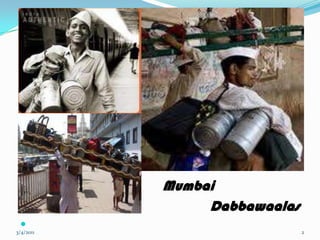
MumbaiDabbawaalas05-03-20112
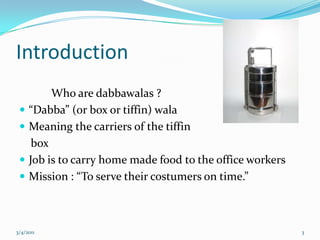
Introduction	Who are dabbawalas ?“Dabba” (or box or tiffin) walaMeaning the carriers of the tiffin    boxJob is to carry home made food to the office workersMission : “To serve their costumers on time.”05-03-20113
Introduction    Why dabbawalas ?In  most metros, the only food choices for an office worker are the restaurants or fast food joints.In India , We love home food and love our home cook lunch.Dabbawalas come to rescue in the situation !05-03-20114
ORGANISATION :  The Nutan Mumbai Tiffin Box Suppliers Trust(NMTBST)  PAST :Started in 1880.Mahadeo Havaji Bachche started with about 100 men.Unified the Dabbawalas.Started for the British people.05-03-20115
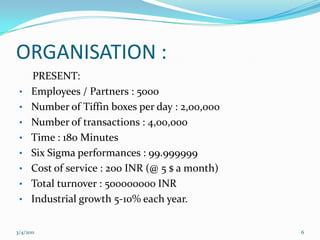
ORGANISATION :     PRESENT:Employees / Partners : 5000
Number of Tiffin boxes per day : 2,00,000
Number of transactions : 4,00,000
Time : 180 Minutes
Six Sigma performances : 99.999999
Cost of service : 200 INR (@ 5 $ a month)
Total turnover : 500000000 INR
Industrial growth 5-10% each year.05-03-20116
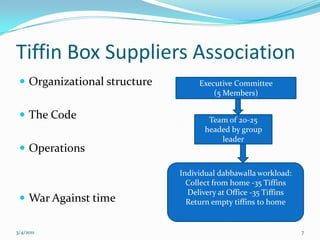
Tiffin Box Suppliers AssociationOrganizational structureThe CodeOperationsWar Against time  05-03-20117Executive Committee(5 Members)Team of 20-25 headed by group leaderIndividual dabbawalla workload:Collect from home -35 Tiffins Delivery at Office -35 TiffinsReturn empty tiffins to home
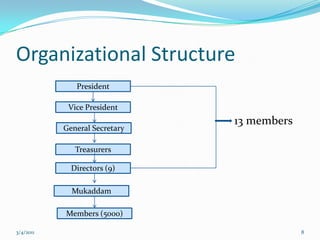
Organizational Structure                                                                          13 members05-03-20118PresidentVice PresidentGeneral SecretaryTreasurersDirectors (9)MukaddamMembers (5000)
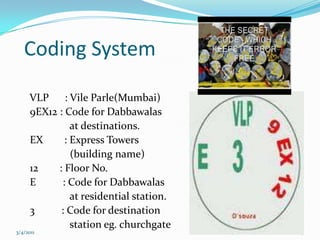
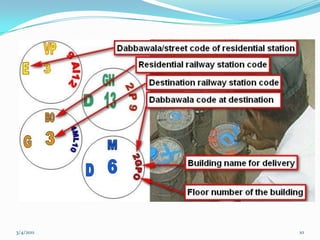
Coding System    VLP      : Vile Parle(Mumbai)    9EX12 : Code for Dabbawalas                  at destinations.   EX        : Express Towers                   (building name)   12        : Floor No.   E          : Code for Dabbawalas                  at residential station.   3          : Code for destination                   station eg. churchgate05-03-20119
05-03-201110
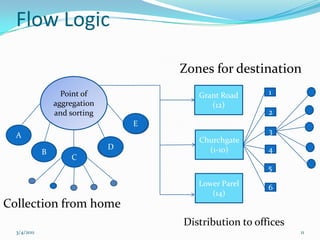
Flow Logic                                                     Zones for destinationCollection from home                          Distribution to offices05-03-201111Point of aggregation and sortingGrant Road(12)12EA3Churchgate(1-10)DB4C5Lower Parel(14)6
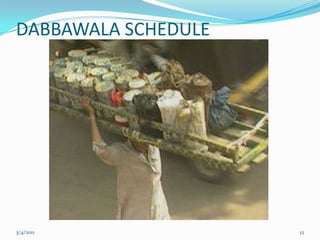
DABBAWALA SCHEDULE05-03-201112
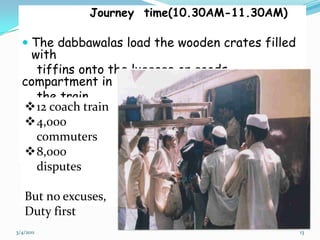
Journey  time(10.30AM-11.30AM)The dabbawalas load the wooden crates filled withtiffinsonto the luggage or goods compartment in   the train. 05-03-20111312 coach train
4,000 commuters
8,000 disputesBut no excuses, Duty first
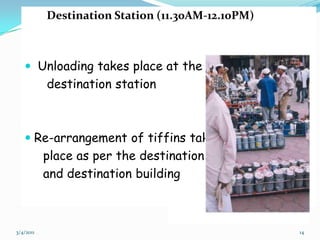
Destination Station (11.30AM-12.10PM) Unloading takes place at the      destination stationRe-arrangement of tiffins takes     place as per the destination areaand destination building 05-03-201114
RETURN JOURNEY:1:15 – 2:00 pm ( At All Destination Stations)Begins the collection process where the dabbawalas   pick up the tiffins from the offices.2:00 – 2:30 pm  (At Destination Station)     The dabbawallas meet for the segregation at    the destination suburb.05-03-201115
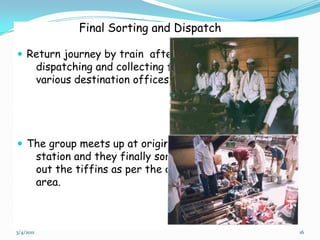
                  Final Sorting and DispatchReturn journey by train  after       dispatching and collecting from      various destination offices. The group meets up at origin     station and they finally sort      out the tiffins as per the origin     area.05-03-201116
Management lessons from the Dabbawalas       Keep operational costs to a minimum:Use cycles, hand carts, local trains – all low cost.
No big office to maintain.
No I-T budget and no miscellaneous costs.
No ad budget – word of mouth publicity!
Very nominal monthly service cost – Rs.200/-05-03-201117
         Keep capital investment bare minimum :Hard work, honesty, promptness and time management are the only investments.
Low cost offices.
Cheap hand carts.
Cycles – easy to maintain.
Use of public space for sorting.05-03-201118
          Just serve your customer – nothing else!!Always deliver food on time – even during heavy rains.
Always on time – even without using a watch!!
Don’t try to impress or bother customers with unsolicited offers.
Bothering customers with offers  may force them to discontinue even existing services.05-03-201119

Mumbai dabbawala management

  • 1.
    Principles of ManagementMumbaiDabbawalasA case studyBy VinayakGarkoti 2009A4PS355HAnkitSinha 2009A5PS905HJatin Chuglani 2009A7PS003HDarshanKishore 2009A7PS011H05-03-20111
  • 2.
  • 3.
    Introduction Who are dabbawalas?“Dabba” (or box or tiffin) walaMeaning the carriers of the tiffin boxJob is to carry home made food to the office workersMission : “To serve their costumers on time.”05-03-20113
  • 4.
    Introduction Why dabbawalas ?In most metros, the only food choices for an office worker are the restaurants or fast food joints.In India , We love home food and love our home cook lunch.Dabbawalas come to rescue in the situation !05-03-20114
  • 5.
    ORGANISATION : The Nutan Mumbai Tiffin Box Suppliers Trust(NMTBST) PAST :Started in 1880.Mahadeo Havaji Bachche started with about 100 men.Unified the Dabbawalas.Started for the British people.05-03-20115
  • 6.
    ORGANISATION : PRESENT:Employees / Partners : 5000
  • 7.
    Number of Tiffinboxes per day : 2,00,000
  • 8.
  • 9.
    Time : 180Minutes
  • 10.
  • 11.
    Cost of service: 200 INR (@ 5 $ a month)
  • 12.
    Total turnover :500000000 INR
  • 13.
    Industrial growth 5-10%each year.05-03-20116
  • 14.
    Tiffin Box SuppliersAssociationOrganizational structureThe CodeOperationsWar Against time 05-03-20117Executive Committee(5 Members)Team of 20-25 headed by group leaderIndividual dabbawalla workload:Collect from home -35 Tiffins Delivery at Office -35 TiffinsReturn empty tiffins to home
  • 15.
    Organizational Structure 13 members05-03-20118PresidentVice PresidentGeneral SecretaryTreasurersDirectors (9)MukaddamMembers (5000)
  • 16.
    Coding System VLP : Vile Parle(Mumbai) 9EX12 : Code for Dabbawalas at destinations. EX : Express Towers (building name) 12 : Floor No. E : Code for Dabbawalas at residential station. 3 : Code for destination station eg. churchgate05-03-20119
  • 17.
  • 18.
    Flow Logic Zones for destinationCollection from home Distribution to offices05-03-201111Point of aggregation and sortingGrant Road(12)12EA3Churchgate(1-10)DB4C5Lower Parel(14)6
  • 19.
  • 20.
    Journey time(10.30AM-11.30AM)Thedabbawalas load the wooden crates filled withtiffinsonto the luggage or goods compartment in the train. 05-03-20111312 coach train
  • 21.
  • 22.
    8,000 disputesBut noexcuses, Duty first
  • 23.
    Destination Station (11.30AM-12.10PM)Unloading takes place at the destination stationRe-arrangement of tiffins takes place as per the destination areaand destination building 05-03-201114
  • 24.
    RETURN JOURNEY:1:15 –2:00 pm ( At All Destination Stations)Begins the collection process where the dabbawalas pick up the tiffins from the offices.2:00 – 2:30 pm (At Destination Station) The dabbawallas meet for the segregation at the destination suburb.05-03-201115
  • 25.
    Final Sorting and DispatchReturn journey by train after dispatching and collecting from various destination offices. The group meets up at origin station and they finally sort out the tiffins as per the origin area.05-03-201116
  • 26.
    Management lessons fromthe Dabbawalas Keep operational costs to a minimum:Use cycles, hand carts, local trains – all low cost.
  • 27.
    No big officeto maintain.
  • 28.
    No I-T budgetand no miscellaneous costs.
  • 29.
    No ad budget– word of mouth publicity!
  • 30.
    Very nominal monthlyservice cost – Rs.200/-05-03-201117
  • 31.
    Keep capital investment bare minimum :Hard work, honesty, promptness and time management are the only investments.
  • 32.
  • 33.
  • 34.
    Cycles – easyto maintain.
  • 35.
    Use of publicspace for sorting.05-03-201118
  • 36.
    Just serve your customer – nothing else!!Always deliver food on time – even during heavy rains.
  • 37.
    Always on time– even without using a watch!!
  • 38.
    Don’t try toimpress or bother customers with unsolicited offers.
  • 39.
    Bothering customers withoffers may force them to discontinue even existing services.05-03-201119