Multistakeholder
                       Co-operation

                   Vermont Co-op Summit
          14th Oct. 2010 // Burlington, VT

      Don Jamison // VT Employee Ownership Center
Erbin Crowell // Neighboring Food Co-op Association
Agenda

 Development of Co-op Forms
 Multistakeholder Models
 Some Examples
 Opportunities & Challenges
 Discussion
New & Renewed Approaches

“Changing times make it critical to find new
  and renewed ways of understanding and
   expressing co-operative approaches to
    business and society. Such new and
  renewed approaches are best developed
  on the basis of a deep comprehension of
 past and present experience. At the same
        time, imagination is critical.”
   Brett Fairbairn, Three Strategic Concepts for Co-operatives
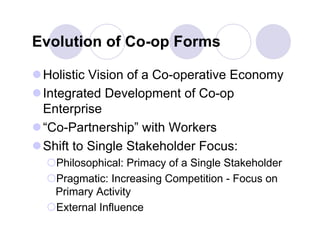
Evolution of Co-op Forms

 Holistic Vision of a Co-operative Economy
 Integrated Development of Co-op
  Enterprise
 “Co-Partnership” with Workers
 Shift to Single Stakeholder Focus:
  Philosophical: Primacy of a Single Stakeholder
  Pragmatic: Increasing Competition - Focus on
   Primary Activity
  External Influence
Development of Forms

 Food Co-ops            Credit Unions
 Agricultural Co-ops    Artisan Co-ops
 Co-op Financial        Housing Co-ops
  Organizations          Utility Co-ops
 Worker Co-ops          Health & Insurance
 Fishery Co-ops          Co-ops, etc.
Stakeholder & “User”

 Co-op as based on “User”: A user-
  owned, user-controlled enterprise
  organized for the benefit of the user:
  The Producer or Supplier
  The Consumer
  The Worker
  The Community Member
 A Stakeholder: A person, organization or
  community that is affected by or has an
  interest in an organization.
Single Stakeholder Co-ops

Advantages                 Disadvantages
 Focus                     Isolation
 Articulate Stakeholder    Divided Movement
  Interest                  Limited Ability to
 Appropriate Systems        Influence Systems
 Simple Structures         Marginalization of
 _________ ?                other Stakeholders
                             (Users)
                            Diminished Difference
                            _________ ?
Why (Re)Consider Structure?

 Opportunity of the Moment
 Articulate Advantages of Co-op Model
 Address Question of Marginalized
  Stakeholders
 Engage Stakeholder Loyalty as
  Competitive Advantage for Co-ops
 Innovate!
 __________ ?
Multistakeholder Approach

Some Combination of…
 The Consumer
 The Producer or Supplier
 The Worker
 The Community Member
 Other Co-ops or Organizations
Multistakeholder Models
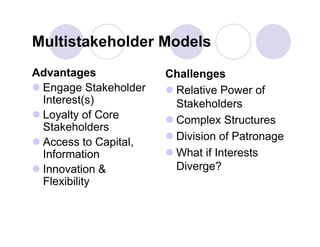
Advantages             Challenges
 Engage Stakeholder    Relative Power of
  Interest(s)            Stakeholders
 Loyalty of Core       Complex Structures
  Stakeholders
                        Division of Patronage
 Access to Capital,
  Information           What if Interests
 Innovation &           Diverge?
  Flexibility
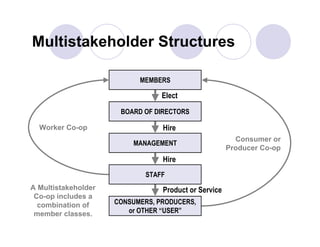
Multistakeholder Structures

                           MEMBERS

                                 Elect
                      BOARD OF DIRECTORS

  Worker Co-op                   Hire
                                                        Consumer or
                         MANAGEMENT
                                                      Producer Co-op
                                 Hire
                             STAFF
A Multistakeholder               Product or Service
 Co-op includes a
  combination of     CONSUMERS, PRODUCERS,
 member classes.        or OTHER “USER”
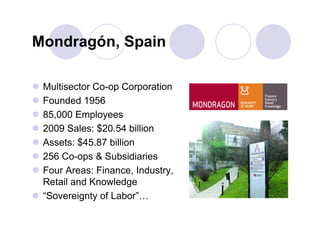
Mondragón, Spain

 Multisector Co-op Corporation          QuickTime™ and a
                                           decompressor

 Founded 1956                     are needed to see this picture.


 85,000 Employees
 2009 Sales: $20.54 billion
 Assets: $45.87 billion
 256 Co-ops & Subsidiaries
 Four Areas: Finance, Industry,
  Retail and Knowledge
 “Sovereignty of Labor”…
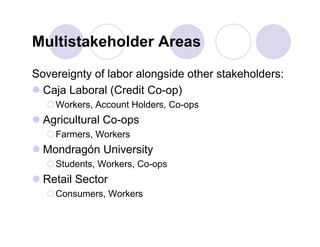
Multistakeholder Areas

Sovereignty of labor alongside other stakeholders:
 Caja Laboral (Credit Co-op)
  Workers, Account Holders, Co-ops
 Agricultural Co-ops
  Farmers, Workers
 Mondragón University
  Students, Workers, Co-ops
 Retail Sector
  Consumers, Workers
Eroski
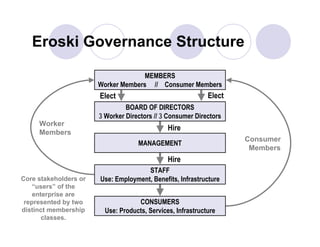
                                   2009 Sales: $11.68 billion
                                   Largest Domestic Grocery
      QuickTime™ and a              Chain in Spain
        decompressor
are needed to see this picture.    2,400 Outlets
                                   2004: 30,000+ Staff
                                   Consumer/Worker Co-op
                                   Board: 3 Consumers, 3
                                    Workers
      QuickTime™ and a
        decompressor
are needed to see this picture.
                                   President is a Consumer
                                   Extending model to
                                    subsidiaries
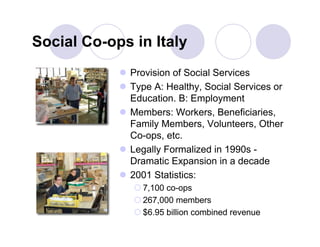
Eroski Governance Structure

                                     MEMBERS
                       Worker Members // Consumer Members
                       Elect                                 Elect
                                BOARD OF DIRECTORS
                       3 Worker Directors // 3 Consumer Directors
     Worker
                                               Hire
     Members
                                                                     Consumer
                                    MANAGEMENT
                                                                      Members
                                               Hire
                                      STAFF
Core stakeholders or   Use: Employment, Benefits, Infrastructure
    “users” of the
    enterprise are
 represented by two                 CONSUMERS
distinct membership      Use: Products, Services, Infrastructure
       classes.
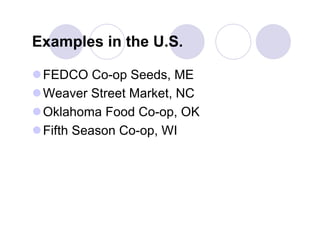
Social Co-ops in Italy
             Provision of Social Services
             Type A: Healthy, Social Services or
              Education. B: Employment
             Members: Workers, Beneficiaries,
              Family Members, Volunteers, Other
              Co-ops, etc.
             Legally Formalized in 1990s -
              Dramatic Expansion in a decade
             2001 Statistics:
                7,100 co-ops
                267,000 members
                $6.95 billion combined revenue
Examples in the U.S.

 FEDCO Co-op Seeds, ME
 Weaver Street Market, NC
 Oklahoma Food Co-op, OK
 Fifth Season Co-op, WI
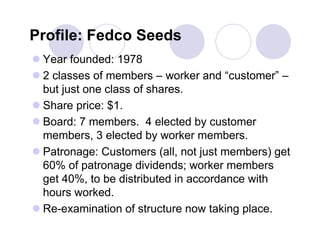
Profile: Fedco Seeds
 Year founded: 1978
 2 classes of members – worker and “customer” –
  but just one class of shares.
 Share price: $1.
 Board: 7 members. 4 elected by customer
  members, 3 elected by worker members.
 Patronage: Customers (all, not just members) get
  60% of patronage dividends; worker members
  get 40%, to be distributed in accordance with
  hours worked.
 Re-examination of structure now taking place.
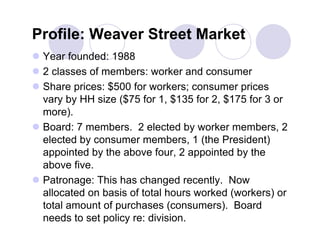
Profile: Weaver Street Market
 Year founded: 1988
 2 classes of members: worker and consumer
 Share prices: $500 for workers; consumer prices
  vary by HH size ($75 for 1, $135 for 2, $175 for 3 or
  more).
 Board: 7 members. 2 elected by worker members, 2
  elected by consumer members, 1 (the President)
  appointed by the above four, 2 appointed by the
  above five.
 Patronage: This has changed recently. Now
  allocated on basis of total hours worked (workers) or
  total amount of purchases (consumers). Board
  needs to set policy re: division.
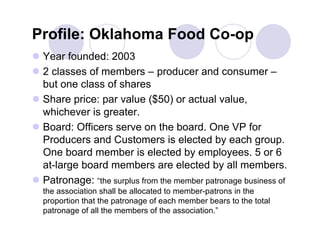
Profile: Oklahoma Food Co-op
 Year founded: 2003
 2 classes of members – producer and consumer –
  but one class of shares
 Share price: par value ($50) or actual value,
  whichever is greater.
 Board: Officers serve on the board. One VP for
  Producers and Customers is elected by each group.
  One board member is elected by employees. 5 or 6
  at-large board members are elected by all members.
 Patronage: “the surplus from the member patronage business of
  the association shall be allocated to member-patrons in the
  proportion that the patronage of each member bears to the total
  patronage of all the members of the association.”
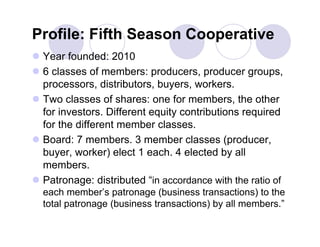
Profile: Fifth Season Cooperative
 Year founded: 2010
 6 classes of members: producers, producer groups,
  processors, distributors, buyers, workers.
 Two classes of shares: one for members, the other
  for investors. Different equity contributions required
  for the different member classes.
 Board: 7 members. 3 member classes (producer,
  buyer, worker) elect 1 each. 4 elected by all
  members.
 Patronage: distributed “in accordance with the ratio of
  each member’s patronage (business transactions) to the
  total patronage (business transactions) by all members.”
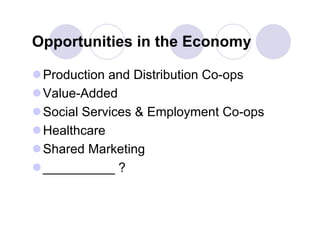
Opportunities in the Economy

 Production and Distribution Co-ops
 Value-Added
 Social Services & Employment Co-ops
 Healthcare
 Shared Marketing
 __________ ?
Discussion

 Is the multistakeholder approach relevant
  to our opportunities and challenges?
 What are your concerns about such a
  model? What is most interesting?
 What are some opportunities you see for
  exploring the model?
Contact

   Erbin Crowell       Don Jamison

 Neighboring Food    Vermont Employee
 Co-op Association    Ownership Center

 erbin@nfca.coop      don@veoc.org
  www.nfca.coop       www.veoc.org

Multistakeholder Cooperation

  • 1.
    Multistakeholder Co-operation Vermont Co-op Summit 14th Oct. 2010 // Burlington, VT Don Jamison // VT Employee Ownership Center Erbin Crowell // Neighboring Food Co-op Association
  • 2.
    Agenda  Development ofCo-op Forms  Multistakeholder Models  Some Examples  Opportunities & Challenges  Discussion
  • 3.
    New & RenewedApproaches “Changing times make it critical to find new and renewed ways of understanding and expressing co-operative approaches to business and society. Such new and renewed approaches are best developed on the basis of a deep comprehension of past and present experience. At the same time, imagination is critical.” Brett Fairbairn, Three Strategic Concepts for Co-operatives
  • 4.
    Evolution of Co-opForms  Holistic Vision of a Co-operative Economy  Integrated Development of Co-op Enterprise  “Co-Partnership” with Workers  Shift to Single Stakeholder Focus: Philosophical: Primacy of a Single Stakeholder Pragmatic: Increasing Competition - Focus on Primary Activity External Influence
  • 5.
    Development of Forms Food Co-ops  Credit Unions  Agricultural Co-ops  Artisan Co-ops  Co-op Financial  Housing Co-ops Organizations  Utility Co-ops  Worker Co-ops  Health & Insurance  Fishery Co-ops Co-ops, etc.
  • 6.
    Stakeholder & “User” Co-op as based on “User”: A user- owned, user-controlled enterprise organized for the benefit of the user: The Producer or Supplier The Consumer The Worker The Community Member  A Stakeholder: A person, organization or community that is affected by or has an interest in an organization.
  • 7.
    Single Stakeholder Co-ops Advantages Disadvantages  Focus  Isolation  Articulate Stakeholder  Divided Movement Interest  Limited Ability to  Appropriate Systems Influence Systems  Simple Structures  Marginalization of  _________ ? other Stakeholders (Users)  Diminished Difference  _________ ?
  • 8.
    Why (Re)Consider Structure? Opportunity of the Moment  Articulate Advantages of Co-op Model  Address Question of Marginalized Stakeholders  Engage Stakeholder Loyalty as Competitive Advantage for Co-ops  Innovate!  __________ ?
  • 9.
    Multistakeholder Approach Some Combinationof…  The Consumer  The Producer or Supplier  The Worker  The Community Member  Other Co-ops or Organizations
  • 10.
    Multistakeholder Models Advantages Challenges  Engage Stakeholder  Relative Power of Interest(s) Stakeholders  Loyalty of Core  Complex Structures Stakeholders  Division of Patronage  Access to Capital, Information  What if Interests  Innovation & Diverge? Flexibility
  • 11.
    Multistakeholder Structures MEMBERS Elect BOARD OF DIRECTORS Worker Co-op Hire Consumer or MANAGEMENT Producer Co-op Hire STAFF A Multistakeholder Product or Service Co-op includes a combination of CONSUMERS, PRODUCERS, member classes. or OTHER “USER”
  • 12.
    Mondragón, Spain  MultisectorCo-op Corporation QuickTime™ and a decompressor  Founded 1956 are needed to see this picture.  85,000 Employees  2009 Sales: $20.54 billion  Assets: $45.87 billion  256 Co-ops & Subsidiaries  Four Areas: Finance, Industry, Retail and Knowledge  “Sovereignty of Labor”…
  • 13.
    Multistakeholder Areas Sovereignty oflabor alongside other stakeholders:  Caja Laboral (Credit Co-op) Workers, Account Holders, Co-ops  Agricultural Co-ops Farmers, Workers  Mondragón University Students, Workers, Co-ops  Retail Sector Consumers, Workers
  • 14.
    Eroski  2009 Sales: $11.68 billion  Largest Domestic Grocery QuickTime™ and a Chain in Spain decompressor are needed to see this picture.  2,400 Outlets  2004: 30,000+ Staff  Consumer/Worker Co-op  Board: 3 Consumers, 3 Workers QuickTime™ and a decompressor are needed to see this picture.  President is a Consumer  Extending model to subsidiaries
  • 15.
    Eroski Governance Structure MEMBERS Worker Members // Consumer Members Elect Elect BOARD OF DIRECTORS 3 Worker Directors // 3 Consumer Directors Worker Hire Members Consumer MANAGEMENT Members Hire STAFF Core stakeholders or Use: Employment, Benefits, Infrastructure “users” of the enterprise are represented by two CONSUMERS distinct membership Use: Products, Services, Infrastructure classes.
  • 16.
    Social Co-ops inItaly  Provision of Social Services  Type A: Healthy, Social Services or Education. B: Employment  Members: Workers, Beneficiaries, Family Members, Volunteers, Other Co-ops, etc.  Legally Formalized in 1990s - Dramatic Expansion in a decade  2001 Statistics:  7,100 co-ops  267,000 members  $6.95 billion combined revenue
  • 17.
    Examples in theU.S.  FEDCO Co-op Seeds, ME  Weaver Street Market, NC  Oklahoma Food Co-op, OK  Fifth Season Co-op, WI
  • 18.
    Profile: Fedco Seeds Year founded: 1978  2 classes of members – worker and “customer” – but just one class of shares.  Share price: $1.  Board: 7 members. 4 elected by customer members, 3 elected by worker members.  Patronage: Customers (all, not just members) get 60% of patronage dividends; worker members get 40%, to be distributed in accordance with hours worked.  Re-examination of structure now taking place.
  • 19.
    Profile: Weaver StreetMarket  Year founded: 1988  2 classes of members: worker and consumer  Share prices: $500 for workers; consumer prices vary by HH size ($75 for 1, $135 for 2, $175 for 3 or more).  Board: 7 members. 2 elected by worker members, 2 elected by consumer members, 1 (the President) appointed by the above four, 2 appointed by the above five.  Patronage: This has changed recently. Now allocated on basis of total hours worked (workers) or total amount of purchases (consumers). Board needs to set policy re: division.
  • 20.
    Profile: Oklahoma FoodCo-op  Year founded: 2003  2 classes of members – producer and consumer – but one class of shares  Share price: par value ($50) or actual value, whichever is greater.  Board: Officers serve on the board. One VP for Producers and Customers is elected by each group. One board member is elected by employees. 5 or 6 at-large board members are elected by all members.  Patronage: “the surplus from the member patronage business of the association shall be allocated to member-patrons in the proportion that the patronage of each member bears to the total patronage of all the members of the association.”
  • 21.
    Profile: Fifth SeasonCooperative  Year founded: 2010  6 classes of members: producers, producer groups, processors, distributors, buyers, workers.  Two classes of shares: one for members, the other for investors. Different equity contributions required for the different member classes.  Board: 7 members. 3 member classes (producer, buyer, worker) elect 1 each. 4 elected by all members.  Patronage: distributed “in accordance with the ratio of each member’s patronage (business transactions) to the total patronage (business transactions) by all members.”
  • 22.
    Opportunities in theEconomy  Production and Distribution Co-ops  Value-Added  Social Services & Employment Co-ops  Healthcare  Shared Marketing  __________ ?
  • 23.
    Discussion  Is themultistakeholder approach relevant to our opportunities and challenges?  What are your concerns about such a model? What is most interesting?  What are some opportunities you see for exploring the model?
  • 24.
    Contact Erbin Crowell Don Jamison Neighboring Food Vermont Employee Co-op Association Ownership Center erbin@nfca.coop don@veoc.org www.nfca.coop www.veoc.org