ONLINE ASSIGNMENT
SUBMITTED BY
DEVIKA LAL
FIRST SEMESTER
PHYSICAL SCIENCE
FMTC, MYLAPORE
TOPIC
GARDNER’S MULTIPLE
INTELLIGENCE
THEORY
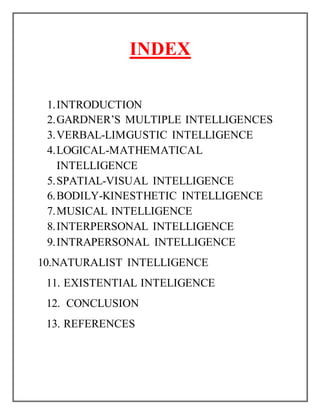
INDEX
1.INTRODUCTION
2.GARDNER’S MULTIPLE INTELLIGENCES
3.VERBAL-LIMGUSTIC INTELLIGENCE
4.LOGICAL-MATHEMATICAL
INTELLIGENCE
5.SPATIAL-VISUAL INTELLIGENCE
6.BODILY-KINESTHETIC INTELLIGENCE
7.MUSICAL INTELLIGENCE
8.INTERPERSONAL INTELLIGENCE
9.INTRAPERSONAL INTELLIGENCE
10.NATURALIST INTELLIGENCE
11. EXISTENTIAL INTELIGENCE
12. CONCLUSION
13. REFERENCES
GARDNER’S MULTIPLE
INTELLIGENCE THEORY
INTRODUCTION
There are a number of different conceptions of intelligence and different
definitions of the term. Definitions tend to emphasize the global capacity
of a person to act purposefully to think analytically, to deal effectively
with his or her environment and to learn from experience in order to
one’s environment.
Gardner in his multiple intelligence theory he emphasized that
intelligence entails several different sets of skills for problem solving
that enable the individual to solve genuine problems. He also placed
emphasis on intelligence as the ability to acquire new knowledge and to
excel and create new intellectual products across a broad range of
different spheres of activities.
Gardner’s early work in psychology and later in human cognition and
human potential led to the nine intelligences and the possibility of
others may eventually expand the list. These intelligences (or
competencies) relate to a person’s unique aptitude set of capabilities and
ways they might prefer to demonstrate intellectual abilities.
GARDNER’S MULTIPLE INTELLIGENCES
1. Verbal-linguistic intelligence (well-developed verbal skills and
sensitivity to the sounds, meanings and rhythms of words)
2. Logical-mathematical intelligence (ability to think conceptually
andabstractly, and capacity to discern logical and numerical patterns)
3. Spatial-visual intelligence (capacity to think in images and pictures,
to visualize accurately and abstractly)
4. Bodily-kinesthetic intelligence (ability to control one’s body
movements and to handle objects skillfully)
5. Musical intelligences (ability to produce and appreciate rhythm, pitch
and timber)
6. Interpersonal intelligence (capacity to detect and respond
appropriately to the moods, motivations and desires of others)
7. Intrapersonalintelligence (capacity to be self-aware and in tune with
inner feelings, values, beliefs and thinking processes)
8. Naturalist intelligence (ability to recognize and categorize plants,
animals and other objects in nature)
9. Existential intelligence(sensitivity and capacity to tackle deep
questions about human existence such as, what is the meaning of life?
Why do we die? How did we get here?)
VERBAL - LINGUISTIC INTELLIGENCE
This intelligence involves the knowing which comes through language;
through reading, writing, and speaking. It involves understanding the
order and meaning of words in both speech and writing and how to
properly use the language. It involves understanding the sociocultural
nuances of a language, including idioms, plays on words, and
linguistically-based humor.
If this is a strong intelligence for you, you have highly developed skills
for reading, speaking, and writing and you tend to think in words. You
probably like various kinds of literature, playing word games, making up
poetry and stories, engaging in involved discussions with other people,
debating, formal speaking, creative writing, and telling jokes. You are
likely precise in expressing yourself and irritated when others are not!
You love learning new words, you do well with written assignments, and
your comprehension of anything you read is high.
LOGICAL – MATHEMATICAL INTELLIGENCE
This intelligence uses numbers, math, and logic to find and understand
the various patterns that occur in our lives: thought patterns, number
patterns, visual patterns, color patters, and so on. It begins with concrete
patterns in the real world but gets increasingly abstract as we try to
understand relationships of the patterns we have seen.
If you happen to be a logical-mathematically inclined person you tend to
think more conceptually and abstractly and are often able to see patterns
and relationships that others miss. You probably like to conduct
experiments, to solve puzzles and other problems, to ask cosmic
questions, andanalyze circumstances and people’s behavior. You most
likely enjoy working with numbers and mathematical formulas and
operations, and you love the challenge of a complex problem to solve.
You are probably systematic and organized, and you likely always have
a logical rationale or argument for what you are doing or thinking at any
given time.
VISUAL OR SPACIAL INTELLIGENCE
We often say “A picture is worth a thousand words!” or “Seeing is
believing!” This intelligence represents the knowing that occurs through
the shapes, images, patterns, designs, and textures we see with our
external eyes, but also includes all of the images we are able to conjure
inside our heads.
If you are strong in this intelligence you tend to think in images and
pictures. You are likely very aware of object, shapes, colors, textures,
and patterns in the environment around you. You probably like to draw,
paint, and make interesting designs and patterns, and work with clay, 2
colored markers, construction paper, and fabric. Many, who are strong in
visual-spatial intelligence love to work jigsaw puzzles, read maps and
find their way around new places. You probably have definite opinions
about colors that go together well, textures that are appropriate and
pleasing, and how a room should be decorated. And, you are likely
excellent at performing tasks that require “seeing with the mind’s eyes,”
such as visualizing, pretending, imagining, and forming mental images.
BODILY – KINAESTHETIC INTELLIGENCE
We often talk about “learning by doing.” This way of knowing happens
through physical movement and through the knowing of our physical
body. The body “knows” many things that are not necessarily known by
the conscious, logical mind, such as how to ride a bike, how to parallel
park a car, dance the waltz, catch a thrown object, maintain balance
while walking, and where the keys are on a computer keyboard.
If you have strength in this intelligence area you tend to have a keen
sense of body awareness. You like physical movement, dancing, making
and inventing things with your hands, and roleplaying. You probably
communicate well through body language and other physical gestures.
You can often perform a task much better after seeing someone elsedo it
first and then mimicking their actions. You probably like physical games
of all kinds and you like to demonstrate how to do something for
someone else. You may find it difficult to sit still for long periods of
time and are easily bored or distracted if you are not actively involved in
what is going on around you.
MUSICAL INTELLIGENCE
This is the knowing that happens through sound and vibration. In the
original research on the theory of multiple intelligences this intelligence
was called musical-rhythmic intelligence.
However, it is not limited to music and rhythm so I’m calling it
auditory-vibrational, for it deals with the whole realm of sound, tones,
beats, and vibrational patterns as well as music. If you are strong in this
intelligence area you likely have a love of music and rhythmic patterns.
You are probably very sensitive to sounds in the environment; the chirp
of cricket, rain on the roof, varying traffic patterns. You may study and
work better with music in the background. You can often reproduce a
melody or rhythmic pattern after hearing it only once. Various sounds,
tones, and rhythms may have a visible effect on you--others can often
see a change in facial expressions, body movement, or emotional
responses. You probably like to create music and you enjoy listening to
a wide variety of music. You may be skilled at mimicking sounds,
languageaccents, and others’ speech patterns, and you can probably
readily recognize different musicalinstruments in a composition.
INTERPERSONAL INTELLIGENCE
This is the person-to-person way of knowing. It is the knowing that
happens when we work with and relate to other people, often as part of a
team. This way of knowing also asks use to develop a whole range of
social skills that are needed for effective person-to-person
communication and relating.
If this person-to-person way of knowing is more developed in you, you
learn through personal interactions. You probably have lots of friends,
show a great deal of empathy for other people and exhibit a deep
understanding of other points of view. You probably love team activities
of all kinds and are a good team member--you “pull your own weight”
and often much more. You are sensitive to other people’s feelings and
ideas, and are good at piggybacking your ideas on others’ thoughts. And
you are likely skilled at drawing others out in a discussion. You are also
probably skilled in conflict resolution, mediation, and finding
compromise when people are in radical opposition to each other.
INTRAPERSONAL INTELLIGENCE
At the heart of this intelligence are our human selfreflectiveabilities by
which we can step outside of ourselves and think about our own lives.
This is the introspective intelligence. It involves our uniquely human
propensity to want to know the meaning, purpose, and significance of
things. It involves our awareness of the inner world of the self, emotions,
values, beliefs, and our various quests for genuine spirituality.
If this intelligence is one of your strong points you may like to work
alone and sometimes you may shy away from others. You are probably
self-reflective and self-aware and thus you tend to bein tune with your
inner feelings, values, beliefs, and thinking processes. You are
frequentlybearers of creative wisdom and insight, are highly intuitive,
and you are inwardly motivated rather than needing external rewards to
keep you going. You are often strong willed, self-confident, and have
definite, well-thought out opinions on almost any issue. Other people
will often come to you for advice and counsel.
NATURALIST INTELLIGENCE
The naturalist intelligence involves the full range of knowing that occurs
in and through our encounters with the natural world including our
recognition, appreciation, and understanding of the natural environment.
It involves such capacities as species discernment, communion with the
natural world and its phenomena, and the ability to recognize and
classify various flora and fauna.
If the naturalist intelligence is one of your strengths you have a profound
love for the outdoors, animals, plants, and almost any natural object.
You are probably fascinated by and noticeably affected by such things as
the weather, changing leaves in the fall, the sound of the wind, the warm
sun or lack thereof, or an insect in the room. At a young age you were
likely nature collectors, adding such things as bugs, rocks leaves,
seashells, sticks, and so on to your collections. You probably brought
home all manner and kinds of stray animals and today you may have
several pets and want more. You tend to have an affinity with and
respect for all living beings.
EXISTENTIAL INTELLIGENCE
Sensitivity and capacity to tackle deep questions about human existence,
such as the meaning of life, why do we die, and how did we get here.
CONCLUSION
Gardner’s work on multiple intelligences has a profound impact in
schools and classrooms, where there is now an attempt to address the
learning strengths of students with varying intelligences. Across the
nation, attention has been given to increase the variety of instructional
procedures and classroom activities.
REFERENCES
1. Howard Gardner (1983) Basic Books, Frames Of Minds : the
Theory of Multiple Intelligence .
2. Dr. T.K.Mathew& Dr. T.M.Mollikutty (2016) Science
Education, Rainbow book publishers.
3. www.wikipedia.com
Corrected By
SMITHA I G
Assistant Professor in Physical Science,
F M T C Mylapore.

Gardners multiple intelligence theory

  • 1.
    ONLINE ASSIGNMENT SUBMITTED BY DEVIKALAL FIRST SEMESTER PHYSICAL SCIENCE FMTC, MYLAPORE
  • 2.
  • 3.
    INDEX 1.INTRODUCTION 2.GARDNER’S MULTIPLE INTELLIGENCES 3.VERBAL-LIMGUSTICINTELLIGENCE 4.LOGICAL-MATHEMATICAL INTELLIGENCE 5.SPATIAL-VISUAL INTELLIGENCE 6.BODILY-KINESTHETIC INTELLIGENCE 7.MUSICAL INTELLIGENCE 8.INTERPERSONAL INTELLIGENCE 9.INTRAPERSONAL INTELLIGENCE 10.NATURALIST INTELLIGENCE 11. EXISTENTIAL INTELIGENCE 12. CONCLUSION 13. REFERENCES
  • 4.
    GARDNER’S MULTIPLE INTELLIGENCE THEORY INTRODUCTION Thereare a number of different conceptions of intelligence and different definitions of the term. Definitions tend to emphasize the global capacity of a person to act purposefully to think analytically, to deal effectively with his or her environment and to learn from experience in order to one’s environment. Gardner in his multiple intelligence theory he emphasized that intelligence entails several different sets of skills for problem solving that enable the individual to solve genuine problems. He also placed emphasis on intelligence as the ability to acquire new knowledge and to excel and create new intellectual products across a broad range of different spheres of activities. Gardner’s early work in psychology and later in human cognition and human potential led to the nine intelligences and the possibility of others may eventually expand the list. These intelligences (or competencies) relate to a person’s unique aptitude set of capabilities and ways they might prefer to demonstrate intellectual abilities.
  • 5.
    GARDNER’S MULTIPLE INTELLIGENCES 1.Verbal-linguistic intelligence (well-developed verbal skills and sensitivity to the sounds, meanings and rhythms of words) 2. Logical-mathematical intelligence (ability to think conceptually andabstractly, and capacity to discern logical and numerical patterns) 3. Spatial-visual intelligence (capacity to think in images and pictures, to visualize accurately and abstractly) 4. Bodily-kinesthetic intelligence (ability to control one’s body movements and to handle objects skillfully) 5. Musical intelligences (ability to produce and appreciate rhythm, pitch and timber) 6. Interpersonal intelligence (capacity to detect and respond appropriately to the moods, motivations and desires of others) 7. Intrapersonalintelligence (capacity to be self-aware and in tune with inner feelings, values, beliefs and thinking processes) 8. Naturalist intelligence (ability to recognize and categorize plants, animals and other objects in nature) 9. Existential intelligence(sensitivity and capacity to tackle deep questions about human existence such as, what is the meaning of life? Why do we die? How did we get here?)
  • 6.
    VERBAL - LINGUISTICINTELLIGENCE This intelligence involves the knowing which comes through language; through reading, writing, and speaking. It involves understanding the order and meaning of words in both speech and writing and how to properly use the language. It involves understanding the sociocultural nuances of a language, including idioms, plays on words, and linguistically-based humor. If this is a strong intelligence for you, you have highly developed skills for reading, speaking, and writing and you tend to think in words. You probably like various kinds of literature, playing word games, making up poetry and stories, engaging in involved discussions with other people, debating, formal speaking, creative writing, and telling jokes. You are likely precise in expressing yourself and irritated when others are not! You love learning new words, you do well with written assignments, and your comprehension of anything you read is high. LOGICAL – MATHEMATICAL INTELLIGENCE This intelligence uses numbers, math, and logic to find and understand the various patterns that occur in our lives: thought patterns, number patterns, visual patterns, color patters, and so on. It begins with concrete patterns in the real world but gets increasingly abstract as we try to understand relationships of the patterns we have seen. If you happen to be a logical-mathematically inclined person you tend to think more conceptually and abstractly and are often able to see patterns and relationships that others miss. You probably like to conduct experiments, to solve puzzles and other problems, to ask cosmic questions, andanalyze circumstances and people’s behavior. You most likely enjoy working with numbers and mathematical formulas and operations, and you love the challenge of a complex problem to solve.
  • 7.
    You are probablysystematic and organized, and you likely always have a logical rationale or argument for what you are doing or thinking at any given time. VISUAL OR SPACIAL INTELLIGENCE We often say “A picture is worth a thousand words!” or “Seeing is believing!” This intelligence represents the knowing that occurs through the shapes, images, patterns, designs, and textures we see with our external eyes, but also includes all of the images we are able to conjure inside our heads. If you are strong in this intelligence you tend to think in images and pictures. You are likely very aware of object, shapes, colors, textures, and patterns in the environment around you. You probably like to draw, paint, and make interesting designs and patterns, and work with clay, 2 colored markers, construction paper, and fabric. Many, who are strong in visual-spatial intelligence love to work jigsaw puzzles, read maps and find their way around new places. You probably have definite opinions about colors that go together well, textures that are appropriate and pleasing, and how a room should be decorated. And, you are likely excellent at performing tasks that require “seeing with the mind’s eyes,” such as visualizing, pretending, imagining, and forming mental images. BODILY – KINAESTHETIC INTELLIGENCE We often talk about “learning by doing.” This way of knowing happens through physical movement and through the knowing of our physical body. The body “knows” many things that are not necessarily known by the conscious, logical mind, such as how to ride a bike, how to parallel park a car, dance the waltz, catch a thrown object, maintain balance while walking, and where the keys are on a computer keyboard.
  • 8.
    If you havestrength in this intelligence area you tend to have a keen sense of body awareness. You like physical movement, dancing, making and inventing things with your hands, and roleplaying. You probably communicate well through body language and other physical gestures. You can often perform a task much better after seeing someone elsedo it first and then mimicking their actions. You probably like physical games of all kinds and you like to demonstrate how to do something for someone else. You may find it difficult to sit still for long periods of time and are easily bored or distracted if you are not actively involved in what is going on around you. MUSICAL INTELLIGENCE This is the knowing that happens through sound and vibration. In the original research on the theory of multiple intelligences this intelligence was called musical-rhythmic intelligence. However, it is not limited to music and rhythm so I’m calling it auditory-vibrational, for it deals with the whole realm of sound, tones, beats, and vibrational patterns as well as music. If you are strong in this intelligence area you likely have a love of music and rhythmic patterns. You are probably very sensitive to sounds in the environment; the chirp of cricket, rain on the roof, varying traffic patterns. You may study and work better with music in the background. You can often reproduce a melody or rhythmic pattern after hearing it only once. Various sounds, tones, and rhythms may have a visible effect on you--others can often see a change in facial expressions, body movement, or emotional responses. You probably like to create music and you enjoy listening to a wide variety of music. You may be skilled at mimicking sounds, languageaccents, and others’ speech patterns, and you can probably readily recognize different musicalinstruments in a composition.
  • 9.
    INTERPERSONAL INTELLIGENCE This isthe person-to-person way of knowing. It is the knowing that happens when we work with and relate to other people, often as part of a team. This way of knowing also asks use to develop a whole range of social skills that are needed for effective person-to-person communication and relating. If this person-to-person way of knowing is more developed in you, you learn through personal interactions. You probably have lots of friends, show a great deal of empathy for other people and exhibit a deep understanding of other points of view. You probably love team activities of all kinds and are a good team member--you “pull your own weight” and often much more. You are sensitive to other people’s feelings and ideas, and are good at piggybacking your ideas on others’ thoughts. And you are likely skilled at drawing others out in a discussion. You are also probably skilled in conflict resolution, mediation, and finding compromise when people are in radical opposition to each other. INTRAPERSONAL INTELLIGENCE At the heart of this intelligence are our human selfreflectiveabilities by which we can step outside of ourselves and think about our own lives. This is the introspective intelligence. It involves our uniquely human propensity to want to know the meaning, purpose, and significance of things. It involves our awareness of the inner world of the self, emotions, values, beliefs, and our various quests for genuine spirituality. If this intelligence is one of your strong points you may like to work alone and sometimes you may shy away from others. You are probably self-reflective and self-aware and thus you tend to bein tune with your inner feelings, values, beliefs, and thinking processes. You are frequentlybearers of creative wisdom and insight, are highly intuitive,
  • 10.
    and you areinwardly motivated rather than needing external rewards to keep you going. You are often strong willed, self-confident, and have definite, well-thought out opinions on almost any issue. Other people will often come to you for advice and counsel. NATURALIST INTELLIGENCE The naturalist intelligence involves the full range of knowing that occurs in and through our encounters with the natural world including our recognition, appreciation, and understanding of the natural environment. It involves such capacities as species discernment, communion with the natural world and its phenomena, and the ability to recognize and classify various flora and fauna. If the naturalist intelligence is one of your strengths you have a profound love for the outdoors, animals, plants, and almost any natural object. You are probably fascinated by and noticeably affected by such things as the weather, changing leaves in the fall, the sound of the wind, the warm sun or lack thereof, or an insect in the room. At a young age you were likely nature collectors, adding such things as bugs, rocks leaves, seashells, sticks, and so on to your collections. You probably brought home all manner and kinds of stray animals and today you may have several pets and want more. You tend to have an affinity with and respect for all living beings. EXISTENTIAL INTELLIGENCE Sensitivity and capacity to tackle deep questions about human existence, such as the meaning of life, why do we die, and how did we get here.
  • 11.
    CONCLUSION Gardner’s work onmultiple intelligences has a profound impact in schools and classrooms, where there is now an attempt to address the learning strengths of students with varying intelligences. Across the nation, attention has been given to increase the variety of instructional procedures and classroom activities.
  • 12.
    REFERENCES 1. Howard Gardner(1983) Basic Books, Frames Of Minds : the Theory of Multiple Intelligence . 2. Dr. T.K.Mathew& Dr. T.M.Mollikutty (2016) Science Education, Rainbow book publishers. 3. www.wikipedia.com Corrected By SMITHA I G Assistant Professor in Physical Science, F M T C Mylapore.