ATTIQ AFTAB
STREAM- INTEGRATED BOTANY
PRESENTATION ON-MULTIPLE ALLELES
MULTIPLE ALLELES
• More than two alternative forms (alleles) of a gene occupying the same
locus on a chromosome or its homologue are known as multiple alleles.
MODE OF ORIGIN
➢ Multiple alleles are produced due to repeated mutation of the same gene.
➢ Multiple alleles show meristic type of germinal variations.
➢ Meristic variation involves the number or arrangement of the parts
CHARACTERISTICS
• ➢ All of them are mutants of the same wild allele.
• ➢ All the multiple alleles of the gene occur on the same gene locus of the same
• chromosome or its homologue.
• ➢ Multiple alleles express different alternatives of a single trait.
• ➢ Different alleles may show codominance, dominance-recessiveness or
• incomplete dominance among themselves.
• ➢ There are more than two alleles of the same gene, for example:
• Alleles for eye colour in Drosophila
• 3 alleles for blood groups in humans
• 4 alleles for coat colour in rabbit.
ABO BLOOD GROUPS
• ➢ ABO blood group in human beings comprises four blood groups.
• ➢ Blood group:
• A
• B
• AB
• O
ABO BLOOD GROUPS
• ➢ Three blood groups A, B and O were discovered by Landsteiner while one
blood group AB was discovered by de Castello and Sturli.
• ➢ ABO grouping is based on the presence or absence of two surface antigens
on the RBCs namely A and B.
• ➢ Similarly, the plasma of different individuals contain two natural antibodies.
Antigen on RBCs
Antigen A Blood Group A
Antigen B Blood Group B
Antigen A and B Blood Group AB
Neither A nor B Blood Group O
The antibodies in your plasma do not react with the antigens on your blood cells
ALLELES FOR ABO BLOOD GROUPS
• ➢ The synthesis of surface antigens is controlled by following alleles,
designated:
IA
lB
I
➢ The i allele is recessive to both IA and IB.
➢ A person who is homozygous ii will have type O blood.
➢ A homozygous IAIA or heterozygous lAi individual will have type A blood
➢ The red blood cells of this individual will contain the surface antigen known as A.
• ➢ A homozygous IBIB or heterozygous IBi individual will produce surface antigen
B.
• ➢ A person who is IAIB will have the blood type AB and express both surface
• antigens A and B.
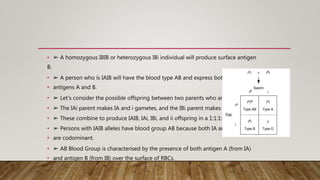
• ➢ Let’s consider the possible offspring between two parents who are IAi and IBi.
• ➢ The IAi parent makes IA and i gametes, and the IBi parent makes IB and i gametes.
• ➢ These combine to produce IAIB, IAi, IBi, and ii offspring in a 1:1:1:1 ratio.
• ➢ Persons with IAIB alleles have blood group AB because both IA and IB alleles
• are codominant.
• ➢ AB Blood Group is characterised by the presence of both antigen A (from IA)
• and antigen B (from IB) over the surface of RBCs.
EYE COLOUR IN FRUIT FLY-DROSOPHILA
• Eye colour in Drosophila is controlled by nearly
15 multiple alleles.
• ➢ The normal or wild type eye colour is red
represented by allele W.
• ➢ There is an allele w for white eye colour which
is recessive to all other alleles.
• ➢ Alleles of other eye colour traits are intermediate between the two.
• ➢ They show various types of codominance and incomplete dominance.
• ➢ These important alleles are
• ➢ wch (cherry),
• ➢ wi (ivory white),
• ➢ wco (coral),
• ➢ wbf (buff),
• ➢ wh (honey),
• ➢ wbl (blood),
• ➢ weo (eosine),
• ➢ ww (wine),
• ➢ wp (pearl)
• ➢ wsat (deep ruby)
• ➢ wa(orange)
COAT COLOUR IN RABBITS
• Agouti Type Coat
• Chinchilla Type Coat
• Himalayan Type Coat
• Albino Type Coat
• In rabbits coat colour is represented by 4 alleles— C, Ch, Cch and c.
• ➢ The coat of rabbit may have following different colours.
AGOUTI TYPE COAT
• Agouti is a brown large long legged wild type
burrowing rodent related to the guinea pig.
• ➢ It is a native of Central and South America.
• ➢ It has dark brown and uniform colour.
• ➢ The gene for full colour is represented by
capital letter C.
CHINCHILLA TYPE COAT
• ➢ The coat is silvery-gray and uniform in colour.
• ➢ The gene for chinchilla is represented as Cch.
• ➢ Chinchilla is a small South American rodent.
Himalayan Type Coat
➢ This type of coat is white except extremities
(nose, ears, feet and tail).
The gene for Himalayan coat is represented by Ch.
ALBINO TYPE COAT
• ➢ The albino coat totally lacks in pigmentation.
• ➢ The eyes of an albino also remain pink due to lack of
pigment in iris of eye.
• The gene for albino is represented by c.
• MULTIPLE ALLELES
The gene C for full colour is dominant over all other
alternatives.
➢ Chinchilla (Cch) is recessive to full colour but dominant to
others
(Himalayan and albino).
➢ Himalayan (Ch) is recessive to full colour and chinchilla but is
dominant over albino.
• ➢ The gene encodes an enzyme called tyrosinase, which is the first
enzyme in a metabolic pathway that leads to the synthesis of
melanin from the amino acid tyrosine.
• ➢ This pathway results in the formation of two forms of melanin.
• ➢ Eumelanin, a black pigment, is made first, and then
phaeomelanin, an
• orange/yellow pigment, is made from eumelanin.
• ➢ Alleles of other genes can also influence the relative amounts of
eumelanin and phaeomelanin.
• ➢ Differences in the various alleles are related to the function of tyrosinase.
• ➢ The C allele encodes a fully functional tyrosinase that allows the synthesis of
• both eumelanin and phaeomelanin resulting in a full brown coat color.
• ➢ The C allele is dominant to the other three alleles.
• ➢ The chinchilla allele (cch) is a partial defect in tyrosinase that leads to a
• slight reduction in black pigment and a greatly diminished amount of
• orange/yellow pigment, which makes the animal look gray.
• ➢ The albino allele, designated c, is a complete loss of tyrosinase, resulting in
• white color.
• ➢ The himalayan pattern of coat color, determined
by the ch allele, is an example of a temperature-
sensitive allele.
• ➢ The mutation in this gene has caused a change in
the structure of tyrosinase,
• so it works enzymatically only at low temperature.
• ➢ Because of this property, the enzyme functions
only in cooler regions of the body,primarily the
tail,the paws
and the tips of the nose and ears.
THANK YOU

Multiple alleles.pptx

  • 1.
    ATTIQ AFTAB STREAM- INTEGRATEDBOTANY PRESENTATION ON-MULTIPLE ALLELES
  • 2.
    MULTIPLE ALLELES • Morethan two alternative forms (alleles) of a gene occupying the same locus on a chromosome or its homologue are known as multiple alleles. MODE OF ORIGIN ➢ Multiple alleles are produced due to repeated mutation of the same gene. ➢ Multiple alleles show meristic type of germinal variations. ➢ Meristic variation involves the number or arrangement of the parts
  • 3.
    CHARACTERISTICS • ➢ Allof them are mutants of the same wild allele. • ➢ All the multiple alleles of the gene occur on the same gene locus of the same • chromosome or its homologue. • ➢ Multiple alleles express different alternatives of a single trait. • ➢ Different alleles may show codominance, dominance-recessiveness or • incomplete dominance among themselves.
  • 4.
    • ➢ Thereare more than two alleles of the same gene, for example: • Alleles for eye colour in Drosophila • 3 alleles for blood groups in humans • 4 alleles for coat colour in rabbit.
  • 5.
    ABO BLOOD GROUPS •➢ ABO blood group in human beings comprises four blood groups. • ➢ Blood group: • A • B • AB • O
  • 6.
    ABO BLOOD GROUPS •➢ Three blood groups A, B and O were discovered by Landsteiner while one blood group AB was discovered by de Castello and Sturli. • ➢ ABO grouping is based on the presence or absence of two surface antigens on the RBCs namely A and B. • ➢ Similarly, the plasma of different individuals contain two natural antibodies.
  • 7.
    Antigen on RBCs AntigenA Blood Group A Antigen B Blood Group B Antigen A and B Blood Group AB Neither A nor B Blood Group O
  • 8.
    The antibodies inyour plasma do not react with the antigens on your blood cells
  • 9.
    ALLELES FOR ABOBLOOD GROUPS • ➢ The synthesis of surface antigens is controlled by following alleles, designated: IA lB I ➢ The i allele is recessive to both IA and IB. ➢ A person who is homozygous ii will have type O blood. ➢ A homozygous IAIA or heterozygous lAi individual will have type A blood ➢ The red blood cells of this individual will contain the surface antigen known as A.
  • 10.
    • ➢ Ahomozygous IBIB or heterozygous IBi individual will produce surface antigen B. • ➢ A person who is IAIB will have the blood type AB and express both surface • antigens A and B. • ➢ Let’s consider the possible offspring between two parents who are IAi and IBi. • ➢ The IAi parent makes IA and i gametes, and the IBi parent makes IB and i gametes. • ➢ These combine to produce IAIB, IAi, IBi, and ii offspring in a 1:1:1:1 ratio. • ➢ Persons with IAIB alleles have blood group AB because both IA and IB alleles • are codominant. • ➢ AB Blood Group is characterised by the presence of both antigen A (from IA) • and antigen B (from IB) over the surface of RBCs.
  • 11.
    EYE COLOUR INFRUIT FLY-DROSOPHILA • Eye colour in Drosophila is controlled by nearly 15 multiple alleles. • ➢ The normal or wild type eye colour is red represented by allele W. • ➢ There is an allele w for white eye colour which is recessive to all other alleles.
  • 12.
    • ➢ Allelesof other eye colour traits are intermediate between the two. • ➢ They show various types of codominance and incomplete dominance. • ➢ These important alleles are • ➢ wch (cherry), • ➢ wi (ivory white), • ➢ wco (coral), • ➢ wbf (buff), • ➢ wh (honey), • ➢ wbl (blood), • ➢ weo (eosine), • ➢ ww (wine), • ➢ wp (pearl) • ➢ wsat (deep ruby) • ➢ wa(orange)
  • 14.
    COAT COLOUR INRABBITS • Agouti Type Coat • Chinchilla Type Coat • Himalayan Type Coat • Albino Type Coat • In rabbits coat colour is represented by 4 alleles— C, Ch, Cch and c. • ➢ The coat of rabbit may have following different colours.
  • 15.
    AGOUTI TYPE COAT •Agouti is a brown large long legged wild type burrowing rodent related to the guinea pig. • ➢ It is a native of Central and South America. • ➢ It has dark brown and uniform colour. • ➢ The gene for full colour is represented by capital letter C.
  • 16.
    CHINCHILLA TYPE COAT •➢ The coat is silvery-gray and uniform in colour. • ➢ The gene for chinchilla is represented as Cch. • ➢ Chinchilla is a small South American rodent. Himalayan Type Coat ➢ This type of coat is white except extremities (nose, ears, feet and tail). The gene for Himalayan coat is represented by Ch.
  • 17.
    ALBINO TYPE COAT •➢ The albino coat totally lacks in pigmentation. • ➢ The eyes of an albino also remain pink due to lack of pigment in iris of eye. • The gene for albino is represented by c. • MULTIPLE ALLELES The gene C for full colour is dominant over all other alternatives. ➢ Chinchilla (Cch) is recessive to full colour but dominant to others (Himalayan and albino). ➢ Himalayan (Ch) is recessive to full colour and chinchilla but is dominant over albino.
  • 18.
    • ➢ Thegene encodes an enzyme called tyrosinase, which is the first enzyme in a metabolic pathway that leads to the synthesis of melanin from the amino acid tyrosine. • ➢ This pathway results in the formation of two forms of melanin. • ➢ Eumelanin, a black pigment, is made first, and then phaeomelanin, an • orange/yellow pigment, is made from eumelanin. • ➢ Alleles of other genes can also influence the relative amounts of eumelanin and phaeomelanin.
  • 19.
    • ➢ Differencesin the various alleles are related to the function of tyrosinase. • ➢ The C allele encodes a fully functional tyrosinase that allows the synthesis of • both eumelanin and phaeomelanin resulting in a full brown coat color. • ➢ The C allele is dominant to the other three alleles. • ➢ The chinchilla allele (cch) is a partial defect in tyrosinase that leads to a • slight reduction in black pigment and a greatly diminished amount of • orange/yellow pigment, which makes the animal look gray. • ➢ The albino allele, designated c, is a complete loss of tyrosinase, resulting in • white color.
  • 20.
    • ➢ Thehimalayan pattern of coat color, determined by the ch allele, is an example of a temperature- sensitive allele. • ➢ The mutation in this gene has caused a change in the structure of tyrosinase, • so it works enzymatically only at low temperature. • ➢ Because of this property, the enzyme functions only in cooler regions of the body,primarily the tail,the paws and the tips of the nose and ears.
  • 21.