Multimodal Literacy Narratives: Leveraging Image, Audio, and VideoJD Klub1:1 Leading Innovation InstituteFriday Institute for Educational InnovationThursday, July 9, 2009Carl  A. YoungNC State Universitycarl_young@ncsu.edu
Focus on Digital Video (DV)Considering DV from 3 different lenses…English EducationTPACKNew Literacies and New Learning Ecology
Lens 1: English Education"Educators must be prepared to work with how messages are sent, received,  and interpreted, as well as how media and technology position us as viewers and users of multimedia texts in the world.“  - Albers, P., & Harste, J., 2007"English educators have the responsibility to influence the development, modification, and adoption of the newer technologies they will integrate into their teaching and their students' learning.“ - Swenson, J., et al., 2006
Lens 2: TPACK – A Framework for Teacher Knowledge and Practice in the 21st Century & BeyondTechnological Pedagogical Content Knowledge[note: graphic is missing context ring around it]  - (Mishra & Koehler, 2006)Efforts to Operationalize TPACK for all Content Area Teachers, including ELA: http://activitytypes.wmwikis.net/(Harris, Hofer, Blanchard, Grandgenet, Schmidt, van Olphen, & Young, 2009)
New Literacies:  Another Lens forConsidering DV in the ELA ClassroomEmerging technologies and the new literacies they make possible provide new modes and media for communication and, likewise, create new opportunities and challenges for what it means to teach the English language arts today.
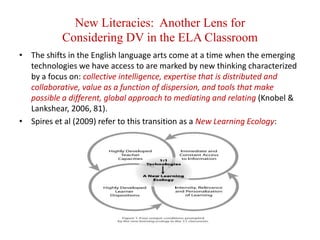
New Literacies:  Another Lens forConsidering DV in the ELA ClassroomThe shifts in the English language arts come at a time when the emerging technologies we have access to are marked by new thinking characterized by a focus on: collective intelligence, expertise that is distributed and collaborative, value as a function of dispersion, and tools that make possible a different, global approach to mediating and relating (Knobel & Lankshear, 2006, 81).Spires et al (2009) refer to this transition as a New Learning Ecology:
Considering DV in the ELA ClassroomEmerging technologies, like DV, provide students and educators with an opportunity to use media to create, produce, manipulate, and share evolving conceptions of text and multimedia products.  As such, DV is a particularly dynamic technology with compelling implications for the English language arts classroom. While older forms of video have been used to varying degrees in education, digital video enters into the English language arts classroom as a new media form and a new tool for multimodal composition.
Considering DV in the ELA ClassroomIn addition, integrating visual images with written text, as done in most digital stories and multimodal compositions, enhances and accelerates comprehension.
Meaning here is not necessarily additive, but more layered, interactive, and complex.  As such, text and pictures, when paired together, often convey more meaning when juxtaposed (Lemke, 2004).
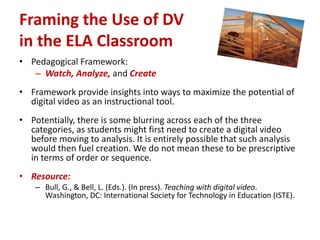
This effect is further intensified with digital video, where motion, design, and interactivity can easily be manipulated by the user and added to the mix.Compelling narratives?
ELA Content Connection: Narrative“I believe that inquiry is universal, a part of what it is to be human.  Over the past decade a similar suggestion has been proposed for narrative.  The presence of narrative across cultures suggests that to be human is to create and respond to story.  Barbara Hardy (1977) calls narrative ‘a primary act of mind’ (p. 12), a fundamental way we understand and construct our experience in the world.  However, within this universal presence of narrative, there is wonderful cultural variation in the sorts of stories told and in the manner and contexts of their telling.  And within these cultural norms, the individual creates and tells and responds to story.  And so the suggestion is that narrative is at once a universal and cultural and an individual phenomenon.”   Judith Wells Lindfors (1999)
DV and Narrative“…variation in the manner and contexts of their telling…” multigenre reading and writing (Romano), multiliteracies (New London Group, 2000; Knobel, 2003), new literacies (Coiro, Knobel, Lankshear, & Leu, 2008 ), multimodal literaciesQ: How then are students and teachers thinking about and conceptualizing new literacies (for themselves and others), especially in terms of the degree to which they  see DV as a viable medium for narrative?Specifically, as a dynamic and compelling way to convey complex concepts and ideas to others?
Framing the Use of DVin the ELA ClassroomPedagogical Framework: Watch, Analyze,and CreateFramework provide insights into ways to maximize the potential of digital video as an instructional tool. Potentially, there is some blurring across each of the three categories, as students might first need to create a digital video before moving to analysis. It is entirely possible that such analysis would then fuel creation. We do not mean these to be prescriptive in terms of order or sequence.Resource: Bull, G., & Bell, L. (Eds.). (In press). Teaching with digital video.  Washington, DC: International Society for Technology in Education (ISTE).
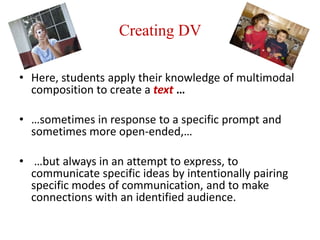
Creating DV     Here, students apply their knowledge of multimodal composition to create a text……sometimes in response to a specific prompt and sometimes more open-ended,……but always in an attempt to express, to communicate specific ideas by intentionally pairing specific modes of communication, and to make connections with an identified audience.
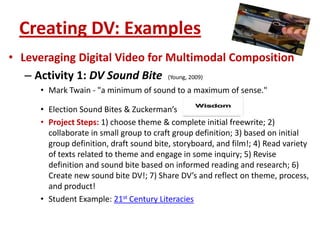
Creating DV: Examples  Leveraging Digital Video for Multimodal Composition Activity 1: DV Sound Bite  (Young, 2009)Mark Twain - "a minimum of sound to a maximum of sense." Election Sound Bites & Zuckerman’s Project Steps: 1) choose theme & complete initial freewrite; 2) collaborate in small group to craft group definition; 3) based on initial group definition, draft sound bite, storyboard, and film!; 4) Read variety of texts related to theme and engage in some inquiry; 5) Revise definition and sound bite based on informed reading and research; 6) Create new sound bite DV!; 7) Share DV’s and reflect on theme, process, and product!Student Example: 21st Century Literacies
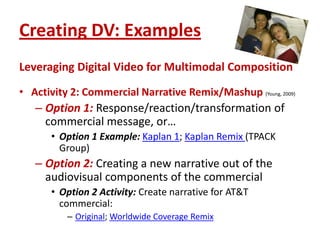
Creating DV: ExamplesLeveraging Digital Video for Multimodal Composition Activity 2: Commercial Narrative Remix/Mashup(Young, 2009)Option 1: Response/reaction/transformation of commercial message, or…Option 1 Example: Kaplan 1; Kaplan Remix (TPACK Group)Option 2: Creating a new narrative out of the audiovisual components of the commercialOption 2 Activity: Create narrative for AT&T commercial: Original; Worldwide Coverage Remix
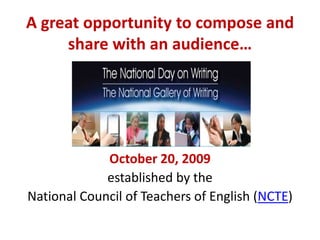
A great opportunity to compose and share with an audience…October 20, 2009established by the National Council of Teachers of English (NCTE)

Multimodal Literacy Narratives

  • 1.
    Multimodal Literacy Narratives:Leveraging Image, Audio, and VideoJD Klub1:1 Leading Innovation InstituteFriday Institute for Educational InnovationThursday, July 9, 2009Carl A. YoungNC State Universitycarl_young@ncsu.edu
  • 2.
    Focus on DigitalVideo (DV)Considering DV from 3 different lenses…English EducationTPACKNew Literacies and New Learning Ecology
  • 3.
    Lens 1: EnglishEducation"Educators must be prepared to work with how messages are sent, received, and interpreted, as well as how media and technology position us as viewers and users of multimedia texts in the world.“ - Albers, P., & Harste, J., 2007"English educators have the responsibility to influence the development, modification, and adoption of the newer technologies they will integrate into their teaching and their students' learning.“ - Swenson, J., et al., 2006
  • 4.
    Lens 2: TPACK– A Framework for Teacher Knowledge and Practice in the 21st Century & BeyondTechnological Pedagogical Content Knowledge[note: graphic is missing context ring around it] - (Mishra & Koehler, 2006)Efforts to Operationalize TPACK for all Content Area Teachers, including ELA: http://activitytypes.wmwikis.net/(Harris, Hofer, Blanchard, Grandgenet, Schmidt, van Olphen, & Young, 2009)
  • 5.
    New Literacies: Another Lens forConsidering DV in the ELA ClassroomEmerging technologies and the new literacies they make possible provide new modes and media for communication and, likewise, create new opportunities and challenges for what it means to teach the English language arts today.
  • 6.
    New Literacies: Another Lens forConsidering DV in the ELA ClassroomThe shifts in the English language arts come at a time when the emerging technologies we have access to are marked by new thinking characterized by a focus on: collective intelligence, expertise that is distributed and collaborative, value as a function of dispersion, and tools that make possible a different, global approach to mediating and relating (Knobel & Lankshear, 2006, 81).Spires et al (2009) refer to this transition as a New Learning Ecology:
  • 7.
    Considering DV inthe ELA ClassroomEmerging technologies, like DV, provide students and educators with an opportunity to use media to create, produce, manipulate, and share evolving conceptions of text and multimedia products. As such, DV is a particularly dynamic technology with compelling implications for the English language arts classroom. While older forms of video have been used to varying degrees in education, digital video enters into the English language arts classroom as a new media form and a new tool for multimodal composition.
  • 8.
    Considering DV inthe ELA ClassroomIn addition, integrating visual images with written text, as done in most digital stories and multimodal compositions, enhances and accelerates comprehension.
  • 9.
    Meaning here isnot necessarily additive, but more layered, interactive, and complex. As such, text and pictures, when paired together, often convey more meaning when juxtaposed (Lemke, 2004).
  • 10.
    This effect isfurther intensified with digital video, where motion, design, and interactivity can easily be manipulated by the user and added to the mix.Compelling narratives?
  • 11.
    ELA Content Connection:Narrative“I believe that inquiry is universal, a part of what it is to be human. Over the past decade a similar suggestion has been proposed for narrative. The presence of narrative across cultures suggests that to be human is to create and respond to story. Barbara Hardy (1977) calls narrative ‘a primary act of mind’ (p. 12), a fundamental way we understand and construct our experience in the world. However, within this universal presence of narrative, there is wonderful cultural variation in the sorts of stories told and in the manner and contexts of their telling. And within these cultural norms, the individual creates and tells and responds to story. And so the suggestion is that narrative is at once a universal and cultural and an individual phenomenon.” Judith Wells Lindfors (1999)
  • 12.
    DV and Narrative“…variationin the manner and contexts of their telling…” multigenre reading and writing (Romano), multiliteracies (New London Group, 2000; Knobel, 2003), new literacies (Coiro, Knobel, Lankshear, & Leu, 2008 ), multimodal literaciesQ: How then are students and teachers thinking about and conceptualizing new literacies (for themselves and others), especially in terms of the degree to which they see DV as a viable medium for narrative?Specifically, as a dynamic and compelling way to convey complex concepts and ideas to others?
  • 13.
    Framing the Useof DVin the ELA ClassroomPedagogical Framework: Watch, Analyze,and CreateFramework provide insights into ways to maximize the potential of digital video as an instructional tool. Potentially, there is some blurring across each of the three categories, as students might first need to create a digital video before moving to analysis. It is entirely possible that such analysis would then fuel creation. We do not mean these to be prescriptive in terms of order or sequence.Resource: Bull, G., & Bell, L. (Eds.). (In press). Teaching with digital video. Washington, DC: International Society for Technology in Education (ISTE).
  • 14.
    Creating DV Here, students apply their knowledge of multimodal composition to create a text……sometimes in response to a specific prompt and sometimes more open-ended,……but always in an attempt to express, to communicate specific ideas by intentionally pairing specific modes of communication, and to make connections with an identified audience.
  • 15.
    Creating DV: Examples Leveraging Digital Video for Multimodal Composition Activity 1: DV Sound Bite (Young, 2009)Mark Twain - "a minimum of sound to a maximum of sense." Election Sound Bites & Zuckerman’s Project Steps: 1) choose theme & complete initial freewrite; 2) collaborate in small group to craft group definition; 3) based on initial group definition, draft sound bite, storyboard, and film!; 4) Read variety of texts related to theme and engage in some inquiry; 5) Revise definition and sound bite based on informed reading and research; 6) Create new sound bite DV!; 7) Share DV’s and reflect on theme, process, and product!Student Example: 21st Century Literacies
  • 16.
    Creating DV: ExamplesLeveragingDigital Video for Multimodal Composition Activity 2: Commercial Narrative Remix/Mashup(Young, 2009)Option 1: Response/reaction/transformation of commercial message, or…Option 1 Example: Kaplan 1; Kaplan Remix (TPACK Group)Option 2: Creating a new narrative out of the audiovisual components of the commercialOption 2 Activity: Create narrative for AT&T commercial: Original; Worldwide Coverage Remix
  • 17.
    A great opportunityto compose and share with an audience…October 20, 2009established by the National Council of Teachers of English (NCTE)