The InternationalEngineeringConsortium(IEC) describes Internet
Telephonyasfollows:
Internet telephony referstocommunications services–voice,facsimile,and/or
voice-messaging applications –that are transportedviathe Internet, rather
than the public switched telephone network (PSTN).The basic steps involved
in originating anInternet telephone call are conversion of the analog voice
signal to digital format and compression/translationof the signal into
Internet protocol (IP) packets for transmission over the Internet ;the process
is reversed at the receiving end.
More technically, Internet telephony is the real-time delivery of of voice and
possibly other multimedia datatypes betweentwoor more parties, across
networks using the Internet protocols,andthe exchange of information
required tocontrol this delivery. The terms Internet telephony,IPtelephony
and voice-over-IP(VoIP)are often used interchangeably.
As shown inFig. 16.6, the transport of real-time audio(andvideo) in Internet
telephony is supportedby RTP (whose control protocol is RTCP).
ADVANTAGES andDISADVANTAGES:net se
Quality of service is commonly definedas the service users’ degreeof
satisfactionduring agivencommunications session.
quality of service describes the collectiveeffects of service performances
which determine the degree of satisfactionof a user of the service.
“QoS is a quantitative andqualitative specificationof an application’s
requirement whichamultimediasystemshould satisfy inorder toachieve
desiredapplicationquality”
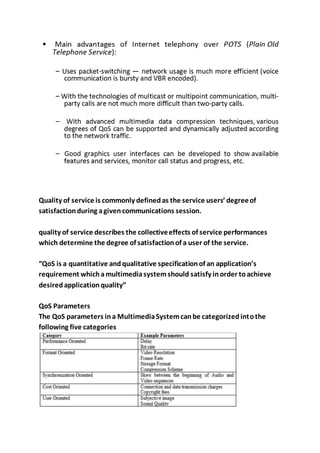
QoS Parameters
The QoS parameters ina MultimediaSystemcanbe categorizedintothe
following five categories
Some of the parameters mentionedabove are discussedbelow
Delay : maximum time needed from transmission to reception.
In somereal time applications, data with acceptable level of error is acceptable
than delayed data.
Bit Rate : This parameter would be used for resourcereservation. A measureof
transmission speed. This is measured in number of kilobits per second
Packet loss or error: a measure(in percentage) of error rate of the packetized
data transmission.
Sync skew: a measure of multimedia data synchronization.
Data quality: The data transmitted in a Multimedia System can be Video or
Acoustics. Subjectiveimage and sound quality needs to be taken care of. The
sampling rate in case acoustic data and the resolution in case of video data
needs to be given due importance depending on the kind of application.
Jitter: a measure of smoothness of the audio/video playback, related to the
varianceof frame/packet delays.
Commitment:Best effort or guaranteedcanbe specified. There are two
types guarantees that canbe provided:statistical, or deterministic.
Frame Losses:The number of frames lost during the transmissionof frames
from sender tothe receiver. Frame losses while transmissionis acceptableto
a limit set for a particular application. The user sets this criterion. Insome
sensitiveapplicationlike inthe fieldof medicine, these losses of frames
during cannot be tolerated.
Quality of service parameter values describedinspecific QOS guidelines
map directly intofour different quality of service classes, reflecting different
levels of user requirements.
End-to-endperformance guarantee is requiredfor multimedia
communications. This performance can be formally specifiedby QoS
parameters. Different applicationshave different parameters. Different
applications have different QoS requirements. The basic ideaof the QoS
concept is that the user specifieswhat he/she wants andthe system
guarantees the user’s requirements if the request is accepted.
RTP Packet Header.
Videoon Demand(VoD) is an interactive multimedia system that works like
cable Television, the difference being that the customer can select a movie
froma large video database. Individualcustomers in an area are able to watch
different programmes when they wish to, making the system a realisation of
the video rental shop broughtinto the home.
VoD-related applications are,
Providing Video Films on Demand
Local News and Weather Forecasting
Games, Music and Leisure
Education and Remote Learning Facilities
Home Shopping and Other Consumer Services
Banking
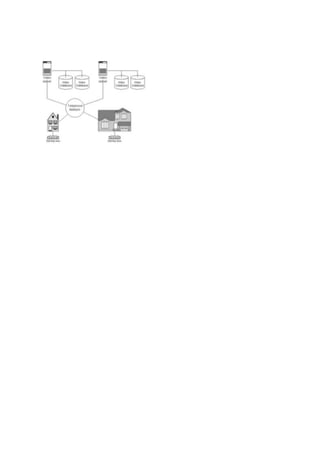
The main components of a video on demand serviceare shown in figure:
: Video Server
The video server to store and provide access to programmes.
Implementing a cost-effectiveand efficient video server should have the
following characteristics:
 Capacity to hold hundreds of Mbytes (or perhaps order of Terabytes) of
digital information
 Providesimultaneous access to several hundreds (or thousands) of
subscribers
 Make economical use of resources by dynamically allocating
programmes into different media such as Magnetic tape, optical W/R
disks, hard disks
The data delivery network
to interconnect the subscriber and the user-end set-top box to interface home
TV equipment with the VoD services. Video-on-Demand currently runs over
cabled networks, Thedifficulty in this, though, is the relatively low
transmission speed.The types of network suitable for Video-on-Demand are
ADSL and ATM.
: Set-Top Box
The Set-top box, interfaces the home TV into the video subscriber network,
decompresses video and converts into a standard TV transmission format. A
VoD set-top box will provideVCR-like functionality, allowing the user to
rewind, fastforward, pause, slow-motion play etc.,
Prerecorded videos be digitally stored in a video server. These videos are then
transmitted in a coded, compressed format. After the videos are ordered
(either via interactive voice responseor two-way remotecontrol), they are
decoded and decompressed by set-top converters in individual homes
Digital video/audio can be compressed and stored on hard disk and advertised
for users on the network
Multimedia

Multimedia

  • 1.
    The InternationalEngineeringConsortium(IEC) describesInternet Telephonyasfollows: Internet telephony referstocommunications services–voice,facsimile,and/or voice-messaging applications –that are transportedviathe Internet, rather than the public switched telephone network (PSTN).The basic steps involved in originating anInternet telephone call are conversion of the analog voice signal to digital format and compression/translationof the signal into Internet protocol (IP) packets for transmission over the Internet ;the process is reversed at the receiving end. More technically, Internet telephony is the real-time delivery of of voice and possibly other multimedia datatypes betweentwoor more parties, across networks using the Internet protocols,andthe exchange of information required tocontrol this delivery. The terms Internet telephony,IPtelephony and voice-over-IP(VoIP)are often used interchangeably. As shown inFig. 16.6, the transport of real-time audio(andvideo) in Internet telephony is supportedby RTP (whose control protocol is RTCP). ADVANTAGES andDISADVANTAGES:net se
  • 2.
    Quality of serviceis commonly definedas the service users’ degreeof satisfactionduring agivencommunications session. quality of service describes the collectiveeffects of service performances which determine the degree of satisfactionof a user of the service. “QoS is a quantitative andqualitative specificationof an application’s requirement whichamultimediasystemshould satisfy inorder toachieve desiredapplicationquality” QoS Parameters The QoS parameters ina MultimediaSystemcanbe categorizedintothe following five categories
  • 3.
    Some of theparameters mentionedabove are discussedbelow Delay : maximum time needed from transmission to reception. In somereal time applications, data with acceptable level of error is acceptable than delayed data. Bit Rate : This parameter would be used for resourcereservation. A measureof transmission speed. This is measured in number of kilobits per second Packet loss or error: a measure(in percentage) of error rate of the packetized data transmission. Sync skew: a measure of multimedia data synchronization. Data quality: The data transmitted in a Multimedia System can be Video or Acoustics. Subjectiveimage and sound quality needs to be taken care of. The sampling rate in case acoustic data and the resolution in case of video data needs to be given due importance depending on the kind of application. Jitter: a measure of smoothness of the audio/video playback, related to the varianceof frame/packet delays. Commitment:Best effort or guaranteedcanbe specified. There are two types guarantees that canbe provided:statistical, or deterministic. Frame Losses:The number of frames lost during the transmissionof frames from sender tothe receiver. Frame losses while transmissionis acceptableto a limit set for a particular application. The user sets this criterion. Insome sensitiveapplicationlike inthe fieldof medicine, these losses of frames during cannot be tolerated. Quality of service parameter values describedinspecific QOS guidelines map directly intofour different quality of service classes, reflecting different levels of user requirements.
  • 4.
    End-to-endperformance guarantee isrequiredfor multimedia communications. This performance can be formally specifiedby QoS parameters. Different applicationshave different parameters. Different applications have different QoS requirements. The basic ideaof the QoS concept is that the user specifieswhat he/she wants andthe system guarantees the user’s requirements if the request is accepted.
  • 7.
    RTP Packet Header. VideoonDemand(VoD) is an interactive multimedia system that works like cable Television, the difference being that the customer can select a movie froma large video database. Individualcustomers in an area are able to watch different programmes when they wish to, making the system a realisation of the video rental shop broughtinto the home. VoD-related applications are, Providing Video Films on Demand Local News and Weather Forecasting
  • 8.
    Games, Music andLeisure Education and Remote Learning Facilities Home Shopping and Other Consumer Services Banking The main components of a video on demand serviceare shown in figure: : Video Server The video server to store and provide access to programmes. Implementing a cost-effectiveand efficient video server should have the following characteristics:  Capacity to hold hundreds of Mbytes (or perhaps order of Terabytes) of digital information  Providesimultaneous access to several hundreds (or thousands) of subscribers  Make economical use of resources by dynamically allocating programmes into different media such as Magnetic tape, optical W/R disks, hard disks The data delivery network to interconnect the subscriber and the user-end set-top box to interface home TV equipment with the VoD services. Video-on-Demand currently runs over cabled networks, Thedifficulty in this, though, is the relatively low transmission speed.The types of network suitable for Video-on-Demand are ADSL and ATM. : Set-Top Box The Set-top box, interfaces the home TV into the video subscriber network, decompresses video and converts into a standard TV transmission format. A VoD set-top box will provideVCR-like functionality, allowing the user to rewind, fastforward, pause, slow-motion play etc., Prerecorded videos be digitally stored in a video server. These videos are then transmitted in a coded, compressed format. After the videos are ordered (either via interactive voice responseor two-way remotecontrol), they are decoded and decompressed by set-top converters in individual homes Digital video/audio can be compressed and stored on hard disk and advertised for users on the network