News-oriented multimedia search over
multiple social networks
Katerina Iliakopoulou, Symeon Papadopoulos and Yiannis Kompatsiaris
1Centre for Research and Technology Hellas (CERTH) – Information Technologies Institute (ITI)
CBMI 2015, June 11, 2015, Prague, Czech Republic
Presented by Katerina Andreadou
The rise of Online Social Networks (OSNs)
#2
• Increasingly popular  Massive amounts of data
– Both text and multimedia
• Content peaks when
– A planned event takes place (e.g., Olympic games)
– An unexpected news story breaks (e.g., earthquake)
Journalistic practices now involve the use of user-
generated content from OSNs for reporting on news
stories and events
The Problem
#3
• News stories are covered in multiple OSNs
– Twitter, Facebook, Google+, Instagram, Tumblr, Flickr
• No effective means of searching over multiple OSNs
– Necessary to build appropriate queries
– Find relevant hashtags and query keywords
• Effective querying is not straightforward
– Long complicated queries retrieve no results
– Vague queries bring back irrelevant content
The Problem is also OSN-specific
#4
• Flickr search is more flexible
– It returns results that contain all requested keywords or a
portion of them with the appropriate ranking
• Instagram is more restrictive
– It can only handle hashtags
– It returns very few or no results to multi-keyword queries
• The order of keywords is also crucial for some OSNs
Query formulation has to be OSN-specific
Content requirements
#5
• High relevance to the topic of interest
• High quality of multimedia
• Diversity of retrieved content
• Usefulness with respect to reporting and publication
Related work
• Optimization of query formulation methods utilizing
terms, proximities and phrases with respect to their
frequency and text position
– Markov random field models (Metzler et al., 2005)
– Positional language models (Lv et al., 2009)
– Query operations (Mishne et al., 2005)
• Improve query formulation by modelling query
concepts
– Learning concept importance (Bendersky et al., 2010)
– Latent content expansion using markov random fields
(Metzler et al., 2007)
#6
Goals and Contributions
• A novel graph-based query formulation method
– Catered for the special characteristics of each OSN
– Captures the primary entities and their associations
– Builds numerous queries by greedy graph traversal
• A relevance classification method
– 12 features based on content (text, visual) and context
(popularity, publication time)
• Evaluation of the framework in real-world events
and stories
#7
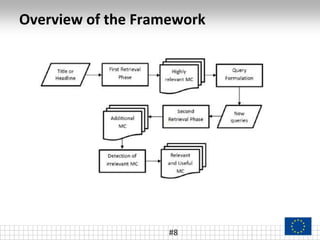
Overview of the Framework
#8
Step I: Collection of highly relevant content
• Query six OSNs with a high precision query q0 to
build an initial collection M0
– news story headline
– official name of the event
• Lower the possibility of noisy content by
– discarding all material retrieved before the story broke
• Only some OSNs were found to contribute to the
collection: Twitter, Flickr, Google+
#9
Step II: Keyword and hashtag extraction
• Extract the Named Entities from the M0 metadata
• Discard all stop-words and filter out HTML tags, web
links and social network account names
• Perform stemming for keywords that are not listed
as Named Entities to group keywords with similar
meaning
Create a list of keywords and a list of hashtags, each
associated with a frequency count
#10
Step III: Graph construction
• Vertices  set of selected keywords
• Edges  their pairwise adjacency relations
– adjacency is computed with respect to the text metadata
• Each edge  frequency of appearance of the phrase
composed of the edge keywords
• Only significant keywords are considered 
keywords with greater frequency than the average
– elimination of noisy keywords
– cost-effectiveness
#11
Step IV: Query building
• Query  path from a starting
node to an end node given a
maximum number of L hops
• Starting node high out-degree
or connected to heavy weighted
edges
• Total score for a node
• Penalize queries with high text
similarity  Jaccard coefficient
#12
Example: 86th Academy Awards
#13
Step V: Relevance classification
Textual relevance is computed wrt the high precision query q0
• title & description
• tags
#14
Popularity
Textual relevance
Visual similarity
Temporal proximity to the story
Image dimensions
Evaluation
#15
• Choose 20 events and news stories which took place
up to five months before data collection
– the older the event, the more content disappears from the
OSNs
• Choose events with considerable size and variety
• Set the maximum number of keyword-base queries
Mmax=20 and the maximum number of hashtag-
based queries to Mmax=10
Data statistics
#16
• More than 88K images for all
20 events
• ~4.4K images per event/new
story on average
• Events are associated on
average with more images
(5.5K) than news stories (3.3K)
Number of images
collected during the
first querying step
Number of images
collected during the
second querying step
Media volume per OSN
#17
• Flickr contributes the most (66.9%) with Twitter
following (19%)
• Instagram and Google+ less but considerable
• Tumblr and Facebook the least content
– Tumblr has significantly lower usage
– Facebook has very poor search API behaviour
• Increase between the two retrieval steps
– Facebook, Flickr, Tumblr: 5x
– Google+, Instagram: even higher (8.1x and 6.8x)
– Twitter: 3x
Quality of formulated queries
#18
• Evaluate the relevance and quality of the retrieved
content in the second step (Mext)
– A large majority (90%) of the images retrieved in the first
step (M0) were relevant
– Four human annotators
• Relevance is high (>50%) for 3 events
• Relevance is decent (>40%) for 3 news stories
• Half of the events and news stories are characterized
by low-to-medium relevance (10% - 40%)
• Relevance is very low (<10%) for two events and two
news stories
Why is irrelevant content collected?
#19
• Vague keyword-based queries or hashtags
– Example: British Academy Film Awards  most popular
hashtag  british
– Example: Sundance Film Festival  vague query  film
festival
• False keyword-based queries
– They contain keywords irrelevant to the subject
– They are left-overs from the graph pruning, they should
have been eliminated
Relevance classification
#20
DT  Decision Tree RF  Random Forest
SVM  Support Vector Machine MP  Multilayer Perceptor
Relevance classification
#21
• RF outperforms the
rest in all cases
• DT is also very good
• SVM has the worst
performance
– Input features are
not normalized
– A few of them are
quantized to a small
set of possible
values
Conclusion - Contributions
• Searching for multimedia content around events and
news stories over multiple OSNs is challenging!
– Collect high quality relevant content in spite of the
different behaviors and requirements of the OSNs
• We proposed a multi-step process including
– a graph-based query building method
– a relevance classification step
• We evaluated the framework on a set of 20 large-
scale events and news stories of global interest
#22
Future Work
• Improve the performance of the query building
method when the number of collected items in the
first step is small
• Extract statistically grounded relevance features
– Take into account distribution differences in different OSNs
• Apply the method while the event evolves
• Add support for the collection of video content
#23
Thank you!
• Slides:
http://www.slideshare.net/sympapadopoulos/newsoriented-
multimedia-search-over-multiple-social-networks
• Get in touch:
@matzika00 / katerina.iliakopoulou@gmail.com
@sympapadopoulos / papadop@iti.gr
#24

News-oriented multimedia search over multiple social networks

  • 1.
    News-oriented multimedia searchover multiple social networks Katerina Iliakopoulou, Symeon Papadopoulos and Yiannis Kompatsiaris 1Centre for Research and Technology Hellas (CERTH) – Information Technologies Institute (ITI) CBMI 2015, June 11, 2015, Prague, Czech Republic Presented by Katerina Andreadou
  • 2.
    The rise ofOnline Social Networks (OSNs) #2 • Increasingly popular  Massive amounts of data – Both text and multimedia • Content peaks when – A planned event takes place (e.g., Olympic games) – An unexpected news story breaks (e.g., earthquake) Journalistic practices now involve the use of user- generated content from OSNs for reporting on news stories and events
  • 3.
    The Problem #3 • Newsstories are covered in multiple OSNs – Twitter, Facebook, Google+, Instagram, Tumblr, Flickr • No effective means of searching over multiple OSNs – Necessary to build appropriate queries – Find relevant hashtags and query keywords • Effective querying is not straightforward – Long complicated queries retrieve no results – Vague queries bring back irrelevant content
  • 4.
    The Problem isalso OSN-specific #4 • Flickr search is more flexible – It returns results that contain all requested keywords or a portion of them with the appropriate ranking • Instagram is more restrictive – It can only handle hashtags – It returns very few or no results to multi-keyword queries • The order of keywords is also crucial for some OSNs Query formulation has to be OSN-specific
  • 5.
    Content requirements #5 • Highrelevance to the topic of interest • High quality of multimedia • Diversity of retrieved content • Usefulness with respect to reporting and publication
  • 6.
    Related work • Optimizationof query formulation methods utilizing terms, proximities and phrases with respect to their frequency and text position – Markov random field models (Metzler et al., 2005) – Positional language models (Lv et al., 2009) – Query operations (Mishne et al., 2005) • Improve query formulation by modelling query concepts – Learning concept importance (Bendersky et al., 2010) – Latent content expansion using markov random fields (Metzler et al., 2007) #6
  • 7.
    Goals and Contributions •A novel graph-based query formulation method – Catered for the special characteristics of each OSN – Captures the primary entities and their associations – Builds numerous queries by greedy graph traversal • A relevance classification method – 12 features based on content (text, visual) and context (popularity, publication time) • Evaluation of the framework in real-world events and stories #7
  • 8.
    Overview of theFramework #8
  • 9.
    Step I: Collectionof highly relevant content • Query six OSNs with a high precision query q0 to build an initial collection M0 – news story headline – official name of the event • Lower the possibility of noisy content by – discarding all material retrieved before the story broke • Only some OSNs were found to contribute to the collection: Twitter, Flickr, Google+ #9
  • 10.
    Step II: Keywordand hashtag extraction • Extract the Named Entities from the M0 metadata • Discard all stop-words and filter out HTML tags, web links and social network account names • Perform stemming for keywords that are not listed as Named Entities to group keywords with similar meaning Create a list of keywords and a list of hashtags, each associated with a frequency count #10
  • 11.
    Step III: Graphconstruction • Vertices  set of selected keywords • Edges  their pairwise adjacency relations – adjacency is computed with respect to the text metadata • Each edge  frequency of appearance of the phrase composed of the edge keywords • Only significant keywords are considered  keywords with greater frequency than the average – elimination of noisy keywords – cost-effectiveness #11
  • 12.
    Step IV: Querybuilding • Query  path from a starting node to an end node given a maximum number of L hops • Starting node high out-degree or connected to heavy weighted edges • Total score for a node • Penalize queries with high text similarity  Jaccard coefficient #12
  • 13.
  • 14.
    Step V: Relevanceclassification Textual relevance is computed wrt the high precision query q0 • title & description • tags #14 Popularity Textual relevance Visual similarity Temporal proximity to the story Image dimensions
  • 15.
    Evaluation #15 • Choose 20events and news stories which took place up to five months before data collection – the older the event, the more content disappears from the OSNs • Choose events with considerable size and variety • Set the maximum number of keyword-base queries Mmax=20 and the maximum number of hashtag- based queries to Mmax=10
  • 16.
    Data statistics #16 • Morethan 88K images for all 20 events • ~4.4K images per event/new story on average • Events are associated on average with more images (5.5K) than news stories (3.3K) Number of images collected during the first querying step Number of images collected during the second querying step
  • 17.
    Media volume perOSN #17 • Flickr contributes the most (66.9%) with Twitter following (19%) • Instagram and Google+ less but considerable • Tumblr and Facebook the least content – Tumblr has significantly lower usage – Facebook has very poor search API behaviour • Increase between the two retrieval steps – Facebook, Flickr, Tumblr: 5x – Google+, Instagram: even higher (8.1x and 6.8x) – Twitter: 3x
  • 18.
    Quality of formulatedqueries #18 • Evaluate the relevance and quality of the retrieved content in the second step (Mext) – A large majority (90%) of the images retrieved in the first step (M0) were relevant – Four human annotators • Relevance is high (>50%) for 3 events • Relevance is decent (>40%) for 3 news stories • Half of the events and news stories are characterized by low-to-medium relevance (10% - 40%) • Relevance is very low (<10%) for two events and two news stories
  • 19.
    Why is irrelevantcontent collected? #19 • Vague keyword-based queries or hashtags – Example: British Academy Film Awards  most popular hashtag  british – Example: Sundance Film Festival  vague query  film festival • False keyword-based queries – They contain keywords irrelevant to the subject – They are left-overs from the graph pruning, they should have been eliminated
  • 20.
    Relevance classification #20 DT Decision Tree RF  Random Forest SVM  Support Vector Machine MP  Multilayer Perceptor
  • 21.
    Relevance classification #21 • RFoutperforms the rest in all cases • DT is also very good • SVM has the worst performance – Input features are not normalized – A few of them are quantized to a small set of possible values
  • 22.
    Conclusion - Contributions •Searching for multimedia content around events and news stories over multiple OSNs is challenging! – Collect high quality relevant content in spite of the different behaviors and requirements of the OSNs • We proposed a multi-step process including – a graph-based query building method – a relevance classification step • We evaluated the framework on a set of 20 large- scale events and news stories of global interest #22
  • 23.
    Future Work • Improvethe performance of the query building method when the number of collected items in the first step is small • Extract statistically grounded relevance features – Take into account distribution differences in different OSNs • Apply the method while the event evolves • Add support for the collection of video content #23
  • 24.
    Thank you! • Slides: http://www.slideshare.net/sympapadopoulos/newsoriented- multimedia-search-over-multiple-social-networks •Get in touch: @matzika00 / katerina.iliakopoulou@gmail.com @sympapadopoulos / papadop@iti.gr #24

Editor's Notes

  • #23 http://irevolution.net/2014/04/03/using-aidr-to-collect-and-analyze-tweets-from-chile-earthquake/
  • #24 http://irevolution.net/2014/04/03/using-aidr-to-collect-and-analyze-tweets-from-chile-earthquake/