GLOBALSOFT TECHNOLOGIES 
IEEE PROJECTS & SOFTWARE DEVELOPMENTS 
IEEE FINAL YEAR PROJECTS|IEEE ENGINEERING PROJECTS|IEEE STUDENTS PROJECTS|IEEE 
BULK PROJECTS|BE/BTECH/ME/MTECH/MS/MCA PROJECTS|CSE/IT/ECE/EEE PROJECTS 
CELL: +91 98495 39085, +91 99662 35788, +91 98495 57908, +91 97014 40401 
Visit: www.finalyearprojects.org Mail to:ieeefinalsemprojects@gmail.com 
Multi-Illuminant Estimation With Conditional 
Random Fields 
Abstract—Most existing color constancy algorithms assume uniform illumination. However, in 
real-world scenes, this is not often the case. Thus, we propose a novel framework for estimating 
the colors of multiple illuminants and their spatial distribution in the scene. We formulate this 
problem as an energy minimization task within a conditional random field over a set of local 
illuminant estimates. In order to quantitatively evaluate the proposed method, we created a novel 
data set of two-dominant illuminant images comprised of laboratory, indoor, and outdoor scenes. 
Unlike prior work, our database includes accurate pixel wise ground truth illuminant 
information. The performance of our method is evaluated on multiple data sets. Experimental 
results show that our framework clearly outperforms single illuminant estimators as well as a 
recently proposed multiilluminant estimation approach.
Existing method: 
Extending existing color constancy methods to successfully compute multi-illuminant estimates is a challenging 
problem. Consider two of the most popular branches of existing color constancy approaches: statistics -based 
methods and physicsbased ones. The success of statistics -based techniques depends on the size of the statistical 
sample. Applying these methods to small image regions introduces inaccuracies and is unlikely to yield stable 
results. Physics-based methods either assume purely diffuse scenes 
Proposed method: 
In this section we compare the performance of the proposed MIRF method to several other approaches. Our error 
metric per image is the mean pixelwise angular distance between the estimated illuminant color and the 
corresponding ground truth. Very dark pixels (i.e., for our 12-bit images, pixels with intensities below 50) were 
excluded from the evaluation due to their relatively low signal-to-noise ratio. We used the per-image errors, to 
compute the median and mean errors per dataset. The evaluation was conducted on three datasets: our laboratory 
dataset, our real-world dataset, and the outdoor dataset that has been used
Merits: 
1. Better PSNR values 
2. Output image more enhancement. 
3. Low BER rate 
Demerits: 
1.noise level is very high 
2. restoration process time is very high.
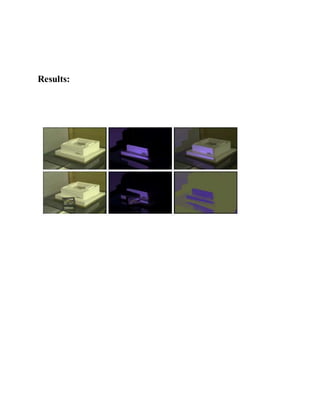
Results:

IEEE 2014 MATLAB IMAGE PROCESSING PROJECTS Multi illuminant estimation with conditional random fields

  • 1.
    GLOBALSOFT TECHNOLOGIES IEEEPROJECTS & SOFTWARE DEVELOPMENTS IEEE FINAL YEAR PROJECTS|IEEE ENGINEERING PROJECTS|IEEE STUDENTS PROJECTS|IEEE BULK PROJECTS|BE/BTECH/ME/MTECH/MS/MCA PROJECTS|CSE/IT/ECE/EEE PROJECTS CELL: +91 98495 39085, +91 99662 35788, +91 98495 57908, +91 97014 40401 Visit: www.finalyearprojects.org Mail to:ieeefinalsemprojects@gmail.com Multi-Illuminant Estimation With Conditional Random Fields Abstract—Most existing color constancy algorithms assume uniform illumination. However, in real-world scenes, this is not often the case. Thus, we propose a novel framework for estimating the colors of multiple illuminants and their spatial distribution in the scene. We formulate this problem as an energy minimization task within a conditional random field over a set of local illuminant estimates. In order to quantitatively evaluate the proposed method, we created a novel data set of two-dominant illuminant images comprised of laboratory, indoor, and outdoor scenes. Unlike prior work, our database includes accurate pixel wise ground truth illuminant information. The performance of our method is evaluated on multiple data sets. Experimental results show that our framework clearly outperforms single illuminant estimators as well as a recently proposed multiilluminant estimation approach.
  • 3.
    Existing method: Extendingexisting color constancy methods to successfully compute multi-illuminant estimates is a challenging problem. Consider two of the most popular branches of existing color constancy approaches: statistics -based methods and physicsbased ones. The success of statistics -based techniques depends on the size of the statistical sample. Applying these methods to small image regions introduces inaccuracies and is unlikely to yield stable results. Physics-based methods either assume purely diffuse scenes Proposed method: In this section we compare the performance of the proposed MIRF method to several other approaches. Our error metric per image is the mean pixelwise angular distance between the estimated illuminant color and the corresponding ground truth. Very dark pixels (i.e., for our 12-bit images, pixels with intensities below 50) were excluded from the evaluation due to their relatively low signal-to-noise ratio. We used the per-image errors, to compute the median and mean errors per dataset. The evaluation was conducted on three datasets: our laboratory dataset, our real-world dataset, and the outdoor dataset that has been used
  • 4.
    Merits: 1. BetterPSNR values 2. Output image more enhancement. 3. Low BER rate Demerits: 1.noise level is very high 2. restoration process time is very high.
  • 5.