Download to read offline
![International Research Journal of Engineering and Technology (IRJET) e-ISSN: 2395-0056
© 2017, IRJET | Impact Factor value: 5.181 | ISO 9001:2008 Certified Journal | Page 3512
MULTI DOCUMENT TEXT SUMMARIZATION USING BACKPROPAGATION
NETWORK
Ashlesha Giradkar1, S.D. Sawarkar2, Archana Gulati3
1 PG student, Datta Meghe College of Engineering
2 Professor, Dept. of computer Engineering, DMCE , India
3 Principal and Professor, Dept. of computer Engineering, DMCE , India
---------------------------------------------------------------------***---------------------------------------------------------------------
Abstract - For English language lots of research work has
been carried out in the field of text summarization but not for
Hindi language. In the proposed system idea is to summarize
multiple Hindi documents. This summarization is based on
features extracted from documents such as sentence length,
sentence position, sentence similarity, subject similarity etc.
Thus, the proposed system can be used for Hindi text
summarization of multiple documents based on
backpropagation network.
Key Words: Text summarization, Stemming, Hindi text
summarization, Backpropagation Network, Sentence
feature etc.
1. INTRODUCTION
When we are talking about Text summarization, first we
must be aware of what is a summary. Summary is a text that
is produced from one or more texts documents that covers
important information in the original text and it is shorter
than original text document. The main aim of automatic text
summarization is transform the source text into a shorter
version which will further reduce reading time of user.
Basically text Summarization methods can be classified into
extractive and abstractive summarization. An extractive
summarization method consists of selecting important
sentences from the original document. An Abstractive
summarization is an understanding the most ideas and
concepts in a document and then rewriting it in own words.
With the exponential growth in the quantity and complexity
of information sources on the internet, it has become
increasingly important to provide improved mechanisms to
user to find exact informationfromavailabledocuments.The
total system is work into three phases: pre-processing the
text document, sentence scoring and summarization
generation. This summarization is based on features
extracted from documents such as sentencelength,sentence
position, sentence similarity etc. Thus, this system partially
implemented for Hindi text summarization of multiple
documents based on Backpropagation network.
2. EXPERIMENT
We use Hindi news articles, URLs as an input to
summarization system. The text portion of Hindi news
article fetched from URL is savedina textdocumentthatacts
as input documents to the summarizer. We used more than
one news documents on same topic. Hindi news documents
are collected from different news channels like Aajtak,
dainikbhaskar etc.
3. APPROACH OF SUMMARIZATION
The proposed methods find out most relevant sentences
from multiple Hindi documents by using statistical and
linguistic approach. This summarization process has three
major steps pre-processing, extraction of feature and
implementation of backpropagation network.
3.1. Preprocessing
Preprocessing is nothing but preparingsourcedocumentfor
analysis [8]. This preparationisbasicallygoingtoperformin
four steps sentence segmentation, sentence tokenization,
stop word removal and stemming.
3.1.1. Segmentation
Given document is divided into sentences in segmentation
step.
Ex. 1. इ
औ
2. इ 6 2016 इ
3.1.2.Tokenization
In tokenization splitting of sentences into wordstakesplace.
Ex. , , , , , , , , इ , , ,
, , , , औ , , , , , , ,
, ,
Volume: 04 Issue: 07 | July -2017 www.irjet.net p-ISSN: 2395-0072](https://image.slidesharecdn.com/irjet-v4i7693-170915105103/85/Multi-Document-Text-Summarization-using-Backpropagation-Network-1-320.jpg)
![International Research Journal of Engineering and Technology (IRJET) e-ISSN: 2395-0056
© 2017, IRJET | Impact Factor value: 5.181 | ISO 9001:2008 Certified Journal | Page 3512
MULTI DOCUMENT TEXT SUMMARIZATION USING BACKPROPAGATION
NETWORK
Ashlesha Giradkar1, S.D. Sawarkar2, Archana Gulati3
1 PG student, Datta Meghe College of Engineering
2 Professor, Dept. of computer Engineering, DMCE , India
3 Principal and Professor, Dept. of computer Engineering, DMCE , India
---------------------------------------------------------------------***---------------------------------------------------------------------
Abstract - For English language lots of research work has
been carried out in the field of text summarization but not for
Hindi language. In the proposed system idea is to summarize
multiple Hindi documents. This summarization is based on
features extracted from documents such as sentence length,
sentence position, sentence similarity, subject similarity etc.
Thus, the proposed system can be used for Hindi text
summarization of multiple documents based on
backpropagation network.
Key Words: Text summarization, Stemming, Hindi text
summarization, Backpropagation Network, Sentence
feature etc.
1. INTRODUCTION
When we are talking about Text summarization, first we
must be aware of what is a summary. Summary is a text that
is produced from one or more texts documents that covers
important information in the original text and it is shorter
than original text document. The main aim of automatic text
summarization is transform the source text into a shorter
version which will further reduce reading time of user.
Basically text Summarization methods can be classified into
extractive and abstractive summarization. An extractive
summarization method consists of selecting important
sentences from the original document. An Abstractive
summarization is an understanding the most ideas and
concepts in a document and then rewriting it in own words.
With the exponential growth in the quantity and complexity
of information sources on the internet, it has become
increasingly important to provide improved mechanisms to
user to find exact informationfromavailabledocuments.The
total system is work into three phases: pre-processing the
text document, sentence scoring and summarization
generation. This summarization is based on features
extracted from documents such as sentencelength,sentence
position, sentence similarity etc. Thus, this system partially
implemented for Hindi text summarization of multiple
documents based on Backpropagation network.
2. EXPERIMENT
We use Hindi news articles, URLs as an input to
summarization system. The text portion of Hindi news
article fetched from URL is savedina textdocumentthatacts
as input documents to the summarizer. We used more than
one news documents on same topic. Hindi news documents
are collected from different news channels like Aajtak,
dainikbhaskar etc.
3. APPROACH OF SUMMARIZATION
The proposed methods find out most relevant sentences
from multiple Hindi documents by using statistical and
linguistic approach. This summarization process has three
major steps pre-processing, extraction of feature and
implementation of backpropagation network.
3.1. Preprocessing
Preprocessing is nothing but preparingsourcedocumentfor
analysis [8]. This preparationisbasicallygoingtoperformin
four steps sentence segmentation, sentence tokenization,
stop word removal and stemming.
3.1.1. Segmentation
Given document is divided into sentences in segmentation
step.
Ex. 1. इ
औ
2. इ 6 2016 इ
3.1.2.Tokenization
In tokenization splitting of sentences into wordstakesplace.
Ex. , , , , , , , , इ , , ,
, , , , औ , , , , , , ,
, ,
Volume: 04 Issue: 07 | July -2017 www.irjet.net p-ISSN: 2395-0072](https://image.slidesharecdn.com/irjet-v4i7693-170915105103/75/Multi-Document-Text-Summarization-using-Backpropagation-Network-1-2048.jpg)
![International Research Journal of Engineering and Technology (IRJET) e-ISSN: 2395-0056
© 2017, IRJET | Impact Factor value: 5.181 | ISO 9001:2008 Certified Journal | Page 3513
Fig-1: Proposed System
3.1.1. Segmentation
Given document is divided into sentences in segmentation
step.
Ex. 1. इ
औ
2. इ 6 2016 इ
3.1.2.Tokenization
In tokenization splitting of sentences into wordstakesplace.
Ex. , , , , , , , , इ , , ,
, , , , औ , , , , , , ,
, ,
3.1.3. Stop word removal
Sentence contains some word which do not aggregate
relevant information for task are eliminated in this step.
Ex. , , , , इ , , , औ , , , ,
3.1.4. Stemming
Stemming process find out root of word by removing prefix
and suffix.
Ex. is root word of
3.2. Feature extraction
In feature extraction [11] stepeverysentenceis represented
by a vector of feature terms. Eachsentencehasa scorebased
on the weight of feature terms which in turn is used for
sentence ranking. Feature term values ranges between 0 to
1. Following section describes the features used in this
study.
3.2.1.AverageTF-ISF(TermFrequencyInverseSentence
Frequency)
TF means to evaluate distribution of each word over the
document. "Inverse sentence frequency means that the
terms that occurs in precisely some sentences that are
additional necessary than others that occur
in several sentences of the document." In other words, it is
important to know in how many sentences a certain word
exists. Since a word which is common in a sentence, but also
it is common in the most of the sentences that is less useful
when it comes to differentiating that sentence from other
sentences.
This feature is calculated as “(1)”
TF = Word occurrence in sentence (Si)
Total number of words in (Si)
SF= Sentence frequency is count of sentence in which word
occurred in a document of N sentences. So
IF = log [Total Sentences / SF]
tf*if = TF * IF
Average tf*if is calculated for each sentence that is nothing
but weight of the sentence.
3.2.2. Sentence length
This feature is useful to filter out short or long sentences.
Too short or long sentence is not good for summary. This
feature computation uses minimum and maximum length
threshold values. The feature weight is computed as “(2)”.
SL = 0 if L <MinL or L >MaxL
Otherwise
SL = Sin ((L-MinL) * ((Max Θ- Min Θ)/ (MaxL - MinL)))
Where, L = Length of Sentence
MinL = Minimum Length of Sentence
MaxL = Maximum Length of Sentence
Min Θ = Minimum Angle (Minimum Angle=0)
Max Θ = Maximum Angle (Maximum Angle=180)
Fig-2: Sentence Length
FEATURE EXTRACTION
GENERATING SUMMARY BY
BACKPROPAGATION NETWORK
HINDI DOC1 HINDI DOC2 HINDI DOC3
PREPROCESSING
SUMMARY
Volume: 04 Issue: 07 | July -2017 www.irjet.net p-ISSN: 2395-0072](https://image.slidesharecdn.com/irjet-v4i7693-170915105103/85/Multi-Document-Text-Summarization-using-Backpropagation-Network-2-320.jpg)
![International Research Journal of Engineering and Technology (IRJET) e-ISSN: 2395-0056
© 2017, IRJET | Impact Factor value: 5.181 | ISO 9001:2008 Certified Journal | Page 3515
H1
Hn
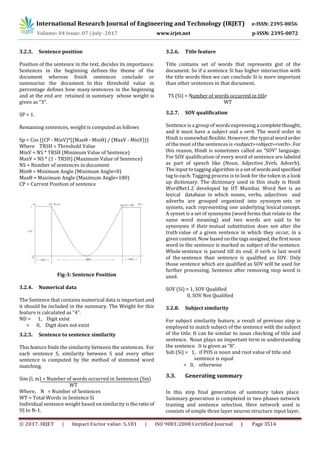
hidden layer and output layer. Input layer consist of 8
neurons. These neurons take input from 8 features as
described above. Hidden layer consist of 300 neurons.
Output layer consist of single neuron to indicate sentence
should be in summary or not.
Backpropagation of error (O1-D1)
Fig-4: Network testing
3.3.1. Network training
The first phase of the process involves training the
backpropagation network [9] to learnthetypesofsentences
that should include in summary. This is done by training
network with sentences from several text documents. With
the help of input neurons, calculated value of features for
sentences is fed to network. Further calculation of hidden
layer and output layer are performed and this calculated
output is compared with actual output of sentences. This
procedure is repeated till this difference is below 0.01.
During every cycle updation of weights takes place.
3.3.2. Sentence selection
Once the network has been trained, it can be used to filter
sentences in paragraph and confirm whether or not
sentence should be enclosed in the summary or not. As
number of training data increases network performs better
while selecting sentence that result in generation of more
meaningful sentences in summary which give better idea
about fed article.
4. EXPERIMENTS AND RESULTS
In this paper, the system is partially implemented & tested
using Java. We used 70 Hindi newsdocumentsfromdifferent
news based URLs as an input to the system. Here the human
generated summaries are used as base summaries for
evaluation of our results and on basis of base summary
further calculation of backpropagation takes place. Since
different user may be have different aspects for base
summary, so there is flexibility in determining accuracy. Out
of 70 document 50 document are used for training network
and remaining 20 are used as testing document. It was
observed that as number of training data increases system
efficiency also increases.
5. CONCLUSIONS AND FUTURE SCOPE
In this work discussion is on Hinditextsummarizationusing
extractive method. An extractive summary is selection of
important sentences from Hindi text documents. The
importance of sentences is decided based on statistical and
linguistic feature of sentences. This summarization
procedure is based on back propagation network
This multiple Hindi text documentsummarizer will beuseful
for the summarization of various documents related to the
same topic and come to a conclusion.Thiswill bealsohelpful
to get the summary of an important document in accurate
and faster way. This project can be further enhanced to
generate summary of multiple documents in various other
Indian languages.
REFERENCES
1] Massih-Reza Amini, Patrick “Self-SupervisedLearningfor
Automatic Text Summarization by Text-span Extraction”
23rd BCS European Annual Colloquium on Information
Retrieval, 2001.
2] Khosrow Kaikhah” Automatic Text Summarization with
Neural Networks “second IEEE international conference on
intelligent systems, June 2004.
3] F. Kyoomarsi, h. Khosravi, e. Eslami and m. Davoudi
“Extraction-based text summarizationusingFuzzyanalysis”
Iranian Journal of Fuzzy Systems Vol. 7, No.3,(2010)pp. 15-
321.
4] Saeedeh Gholamrezazadeh, Mohsen Amini Salehi,
Bahareh Gholamzadeh “A Comprehensive Survey on Text
Summarization Systems” IEEE 2009.
5] Chetana Thaokar, Dr.Latesh Malik “Test Model for
Summarizing Hindi Text using Extraction Method”
Proceedings of 2013 IEEE Conference on Information and
Communication Technologies (ICT 2013).
6] Nabil ALAMI, Mohammed Meknassi, Noureddine Rais
“Automatic texts summarization: current state of the art”
Journal of Asian Scientific Research, 2015.
7] Vishal Gupta “Hindi Rule Based Stemmer for Nouns
“International Journal of Advanced Research in Computer
Science and SoftwareEngineeringVolume4,Issue1,January
2014.
O
1
F1
F2
F3
F4
F5
F6
F7
F8
Volume: 04 Issue: 07 | July -2017 www.irjet.net p-ISSN: 2395-0072](https://image.slidesharecdn.com/irjet-v4i7693-170915105103/85/Multi-Document-Text-Summarization-using-Backpropagation-Network-4-320.jpg)
![International Research Journal of Engineering and Technology (IRJET) e-ISSN: 2395-0056
© 2017, IRJET | Impact Factor value: 5.181 | ISO 9001:2008 Certified Journal | Page 3516
8] Mayuri Rastogi, Pooja Khana “Development of
Morphological Analyzer for Hindi”
International Journal of Computer Applications (0975 –
8887) Volume 95– No.17, June 2014.
9] Dr. S. N. Sivanandam, Dr. S. N. Deepa “Principles of S.oft
Computing”
10] Mr. Sarda A.T., Mrs. Kulkarni A.R. “Text Summarization
using Neural Networks and Rhetorical Structure Theory”
International Journal of Advanced Research in Computer
and Communication Engineering Vol. 4, Issue 6, June 2015
11] Arti S. Bhoir, Archana Gulati“Multi-documentHindiText
Summarization using Fuzzy Logic Method” International
Journal of Advance Foundation And Research In Science &
Engineering (IJAFRSE) Volume 2, Special Issue , Vivruti
2016.
12] Nitika Jhatta, Ashok Kumar Bathla “A Review paper on
Text Summarization of Hindi Documents” IJRCAR VOL.3
ISSUE.5 may 2015
Volume: 04 Issue: 07 | July -2017 www.irjet.net p-ISSN: 2395-0072](https://image.slidesharecdn.com/irjet-v4i7693-170915105103/85/Multi-Document-Text-Summarization-using-Backpropagation-Network-5-320.jpg)

The document describes a system for summarizing multiple Hindi language documents using a backpropagation neural network. It extracts features from the documents like sentence length, position, similarity, and subjects. These features are used to train a neural network to learn which sentences should be included in a summary. The system segments, tokenizes, removes stop words and stems sentences before extracting the features. It then generates a summary by selecting important sentences based on the trained network. The system was tested on 70 Hindi news documents and showed improved performance as more documents were used for training.


